AR
TICLE
1 Universidade de Franca. Av. Doutor Armando Salles Oliveira 201, Parque Universitário. 14404-600 Franca SP Brasil. maira. [email protected] 2 Universidad de la Habana. Habana La Habana Cuba.
Photovoice as a listening mode:
subsidies for the promotion of equity
Abstract Health Promotion observations of pa-tients from a Rehabilitation Center in rural São Paulo evidenced that these people faced difficulties in dealing with their physical limitations when these prevented them from working. This study aimed to broaden listening methods to facilitate dialogue with people in situations of physical frailty and removal from their work activities, using Photovoice, a participatory research-action method, as a tool and Health Promotion’s theo-retical framework. Images captured and reports that accompanied them consisted of the material of this study. Two thematic categories stood out: the expert decision; and physical condition: vanity, power and hope. Labor activity is perceived as a determinant of individuals’ introduction in their environment and defines their role in the family and in the social field. Faced with disability, they feel deprived of their identity, vulnerable and without future prospects of social reintegration, an individual and familiar misfit process, but without social visibility and with negative consequences for global health is observed. Photovoice proved to be effective in apprehending perceptions and stimu-lating debate, providing essential inputs to
pro-mote equity in socially disadvantaged groups.
Key words Equity promotion, Health promotion, Work
Maíra Ferro de Sousa Touso 1
Amado Batista Mainegra 2
Carlos Henrique Gomes Martins 1
Touso MFS Introduction
Throughout the history of humanity, labor has been playing an important role in shaping the identity and list of daily activities performed by individuals in their existence1. Work can be
diffi-cult to define and contextualize, since its mean-ings are imbued with historical, cultural and so-cial notions.
In a broader sense, Alves and Antunes2 point
out some aspects that are involved in the hu-man act of working: gestures, know-how, body engagement, mobilization of intelligence, ability to reflect, interpret and react to situations, and power to feel, think and invent. In other words, authors say that work is not, in the first instance, the wage relationship or job, but rather labor ac-tivity, that is, a way of engaging the personality to address a task delimited by material or social pressures.
Formal or informal work-related activities can be enjoyable or unpleasant; they can be as-sociated or not with economic exchanges (sala-ry) and executed or not within a job3. The salary
they provide allows for basic needs and provides a sense of security, autonomy and independence.
In Brazil, from the mid-twentieth century onwards, mechanized agriculture and the pro-gressive rural exodus created a new contingency for the cities, receiving the migrant population through wage labor and allowing them to inte-grate into the new environment. However, the weak process has exposed fractures of the urban environment and vulnerabilities of its popula-tion.
In collective health, persistent inequality con-ditions are called inequities. To address them, the Ministry of Health (MoH) and other spheres of management of the Unified Health System (SUS) recommend the Promotion of Equity through the progressive reduction of these vulnerabilities. It is necessary to understand the social determi-nants of health of exposed population groups for the organization of health actions and services to ensure resolving access4.
Illness or physical frailty that impairs indi-viduals’ ability to work can adversely affect their overall health. Although they receive state sick-ness benefits during their leave, the provision of resources is undermined, exposing them to so-cially produced inequities, and placing them in a situation of social disadvantage.
The National Institute of Social Security (INSS), an agency linked to the Ministry of So-cial Security and Welfare was established in 1990
as a public organization providing social security services, which, among other responsibilities, is in charge of standardizing, guiding and level-ing-off procedures and payment to beneficiaries of Social Security and Social Welfare with labor disability5.
Souza et al.6 state that illness leading to the
professional incapacitation of young adults has a very painful aspect, which is the destruction of life projects, a significant loss of one’s personal and professional identity. It is necessary to search for new parameters so that the disabled can rec-ognize themselves, reorganize their previous his-tory and construct a new project for the future, taking charge of this process.
Health Promotion advocacy revives the ex-ercise of citizenship and aims to achieve equity in health and ensure physical, mental and social well-being of the people. Therefore, it is outlined as a tool of social participation aimed at protect-ing the universal right to health in Brazil7.
This paper aimed to increase the use of Pho-tovoice as a Health Promotion tool, in order to expand the dialogue with individuals in situa-tions of physical weakness and removed from their work activities.
Methodological theoretical approach: expanding the listening modes
The theoretical conception underpinning this paper was social psychology in a perspective privileging the understanding of social phenom-ena, taking into account that meanings and in-tentionality separate them from the natural phe-nomena. In this context, a more comprehensive than causal aspect is favored vis-à-vis possible in-terpretations given to psychosocial phenomena8.
Photography is shown as a strategy closely linked to qualitative research9. It helps in the
de-scriptive aspect of an event, in the understanding of subjective aspects and can be analyzed induc-tively. Images captured in photos facilitate the study of aspects of life that cannot be grasped with words alone.
e C
ole
tiv
a,
22(12):3883-3892,
2017
Its theoretical body built on three fundamen-tal ideas. The first is based on Paulo Freire’s crit-ical education approach (1970 apud10). This
ap-proach holds that every human being, no matter how ignorant or submerged in the culture of si-lence is capable of a critical and dialectical look at the world around him and his own relationships.
Photovoice is classified as a type of partici-patory research-action in which people produce and discuss photographs that they themselves have taken about their experiences as members of a particular community or group. Through photographs and accompanying reports, it is possible to expand dialogue with the responsible authorities11-13.
The strength of the visual image shows po-tential for the empowerment of socially mar-ginalized population groups, allowing a creative process that facilitates the representation of the diversity of their experiences as members of a group or community14.
This research was developed and idealized from the experience with a Support Group of the Physical Rehabilitation Center of the Santa Casa de Misericórdia Foundation of the municipality of Franca, a hospital complex linked to the SUS. Established in July 2002, it provides services to the population requiring physical rehabilitation referred by the municipal health network. The treatment provided includes an interdisciplinary view of health care and is performed by a mul-tidisciplinary team: social worker, physiothera-pists, speech theraphysiothera-pists, physicians (physiatrists), nutritionist, psychologist, nursing technicians and occupational therapist.
The Support Group aimed to accept and work with the emotional aspects of patients in the process of physical rehabilitation, promoting understanding and adaptation to the physical and social limitations resulting from the illness process. The Group was open and received week-ly an average of ten (10) users. The sample con-sisted of five people who agreed to participate in the research approved by the institution’s ethics committee (019/2007). All were assigned ficti-tious syllables to protect their identities.
After signing the Informed Consent Form (ICF), participants had two meetings for techni-cal preparation. With cameras in hand, they were instructed to take pictures, seeking to portray their daily life from the moment they became incapacitated for work, focusing on the changes that occurred in their daily life routines.
Chart 1 shows a brief characterization of the participants including age, marital status, num-ber of children, profession, time and cause of re-moval from work.
Photographies: pictures and narratives
“To photograph is to align head, eye and heart.” (Henri Cartier-Bresson)
The group produced 56 photos. Two more group meetings took place between researcher and participants to discuss photos. Accounts that accompanied the display of ideas and meanings assigned to photos were recorded and rewritten in their entirety. A dialogue was established with the researched literature, using the Health Pro-motion’s theoretical framework.
We used the thematic content analysis tech-nique8 to analyze the material produced. We first
sought to read the transcripts of interviews in search of categories, themes, words and expres-sions that could organize the results in order to interpret them. They were organized in two the-matic categories: expert decision; and physical condition: vanity, power and hope. The material was then organized in relation to these prevalent themes and classified within the pre-established categories; finally, we made interpretations, broadening the understanding from the empiri-cal data articulated with the theoretiempiri-cal reference. The breadth of the Photovoice method has challenged researchers who have used creativity as a research resource during the artisanal work of this qualitative research; without losing sight that pictures had a symbolic potential and an ability to capture emotions that could not be re-duced to the words captured in the interviews.
Expert decision
In the municipality were participants live, all of them clicked the INSS. Reports resulting from this setting were accompanied by feelings of sad-ness and nonconformity, since removal was not a choice but a need due to illness, its sequelae and work limitations. In the statements, the need for another, the medical expert, for example, to en-dorse the illness, generated distress.
Touso MFS
– [...] So, you get there in an somewhat aver-age condition; when you get in, your already frail psychological condition gets worse, since you know
what you’re about to expect in there [...](Ce.).
– Well, talking about the INSS...This is the line that we face every 2-3 months, depending on the expert. It is a hassle, mentally and psychologically speaking, because they remove you for a short term. You know you are truly unable to work, anyone
could see that just by looking at you. [...](Te.).
Another aspect emphasized was dehuman-ized care and the certainty that a humandehuman-ized care would provide a sensitive reception and view from the professional, who could perceive that people who need this place are usually going through critical moments.
– [...] Yesterday, I heard something absurd on the radio: a doctor discharged a patient with ter-minal cancer. This is what I want to talk about re-garding INSS. Things got worse for those who are
sick. (Ce.).
– This is a sick situation! All this tension around people, without them knowing if the expert will ap-prove them, and there are many people who are not even supposed to be there. Others, I feel so sorry for them, are being discharged, my God! Some people should die and be borne again to go back to work
again. There are so many absurd things! [...] (Te.).
Accounts evidence a gap in the understanding of the professional practice of medical experts, which also includes the difficulty of apprehend-ing the criteria used by them for the preparation of the opinion.
The main reason that leads the participants of this study to make use of the social security sickness benefit, which is the benefit granted by
the INSS to all insured persons who are tempo-rarily incapacitated to perform their usual work activities15.
The social security expert decision appeared as a reason for dissatisfaction and even as an ag-gravation for already precarious health condi-tions. Several criticisms and complaints, such as disrespect to the insured for explicitly addressing political interests by denying the relationship of claims to work are aimed at the results of the acts of Social Security experts16,17. We observe that
this medical decision is subject to variability, de-pending on the interpretative model adopted by the expert, which shows us the subjective charac-ter of this professional exercise.
The expert may also be influenced by his po-litical tendency. Melo and Assunção17 marks two
extremes in these trends; he may be inclined to identify the worker as a victim of work, a sick person, and thus deserving of benefit or the phy-sician will tend to regard the insured as an op-portunist, as if sickness were a secondary gain. In contrast, some individuals who persist in work-ing, despite their symptomatology, and are only removed when they evidence a high level of chro-nicity, recurrence and incapacity. However, none of these positions are adequate for overshadow-ing and impose their personal values over the at-tributes of the medical profession18,19.
Physical condition: vanity, power and hope
The physical condition for work activities arose, albeit between the lines, in most of the photographs and in several moments of the pa-tients’ accounts. We note that the capacity for
Chart 1. Participants’ profiles by gender, age, marital status, number of children, profession, reason and time of removal from work.
Participant Gender Age Marital status Children Profession Reason of
removal
Time of removal
Ce. M 44 Married 02 Shoemaker Work accident 04 months
Di. M 35 Married 04 Shoemaker Degenerative
disease
04 months
Cl. F 34 Married 02 Shoemaker Road traffic
accident
02 months
Te. F 47 Common-law
marriage
00 Telemarketing attendant
WMSD- cervicalgia
1 year and 02 months
Ma. F 42 Common-law
marriage
00 Telemarketing attendant
WMSD and fibromyalgia
1 year and 06 months
e C
ole
tiv
a,
22(12):3883-3892,
2017
work promotes achievements, but removal gen-erates tension.
The profession locates the individuals in their environment; it defines their role in the intimate, family and social context. The person is what he or she does and the loss of doing so entails an identity crisis. When the work activity is con-ceived as synonymous with production, produc-ing and feelproduc-ing useful are pondered. As societal individuals, the ability to establish exchanges with their peers provides a sense of approval that seems to be part of the participants’ need for es-teem.
In its multidisciplinary context, Health Pro-motion covers socioeconomic and psychosocial aspects, as well as the development of new strat-egies that allow people to improve health and quality of life, actively participating to reduce the risks of illness. We understand that risks go beyond chemical, physical and biological agents, reaching the way the company organizes itself and relates to its workers. All these variables have their importance and the management of each one of them can contribute systematically to an improved environment20.
It is interesting to note that statements re-vealed segmented activities in two areas: heavy and intellectual. The first one restricts the pos-sibilities of introduction into the market since they suffer from irreversible physical weaknesses, since their tool of work would be the body itself, in a deterministic sense of the expression. They would still have a room for intellectual improve-ment, but resistance is high. The shaken emo-tional aspect limits their attention and memory capacities and adulthood creates the feeling that one no longer has the time to start over.
The physical condition was portrayed in pho-to-1 (Te), for example. In the picture, the author appears sweeping the balcony of his house with difficulties, an apparently simple activity that ev-idences losses.
– It bothers me a lot. Because, as I said, I was always a nimble person, someone who talked and played. I like to work. I have always worked a lot; I have always been working twelve to sixteen hours a day. Therefore, it bothers me that I am away. I am young, I think I still have a lot to do, I have the will,
but I do not have the conditions. (Te.).
The negative realm of the work activity is pointed out in the verbalizations referring to the fact that when actions are carried out under in-adequate conditions (environment, workload, safety, among others), they cause physical and emotional illness and deprive them of family
contact. The low pay for heavy work and the need to maintain basic subsistence issues led individ-uals to abuse their health to accept overtime on weekends and this seems to have excluded from the participants’ lives the possibilities of self-care21.
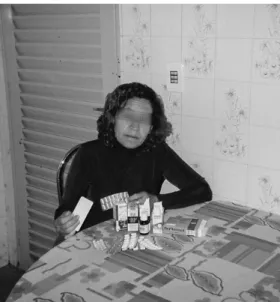
Photo-2 (Te) shows several medicines set on the table that Te. started to make use due to phys-ical illness. Ma. photographed his trusted psychi-atrist, a bond established because of an anxiety disorder arising from her physical condition and its repercussions on overall health.
– No, I have never used any medicine. I have always had good health, willingness, I have always worked with two things, and even when my com-pany made us work twelve hours, I tried to sell something on the side, I always earned some extra cash. I have always been against drugs. Now it is the other way around. I am somewhat groggy to-day because I went through a drug change. I am somewhat sleepy; I really did not want to get out of
bed. [...](Ma.).
We observe a psychic suffering-work dyad; studies reveal that it is the content of tasks, the quality of relationships with co-workers and the organizational hierarchy that can trigger psychic
Figure 1. Te. Performing domestic chores.
Touso MFS suffering or be a source of pleasure and balance,
depending on the margin of freedom provided in the environment and labor relations21,22.
In photo-3, (Ce.3), the participant depicted his wife working in the backyard garage on an outsourced service, illustrating her perception on the changing family provider status.
– I started working early, at the age of eight. There was a candy factory here in Vila Nova, my mother bought candies and we sold them. We had childhood, but a childhood on weekends because we worked on weekdays. Then, suddenly, after more than thirty years of work, my productivity has abruptly interrupted, and that makes anyone annoyed. Then, you depend on other people, and you were contributing before. This bothers me a lot.
[...] (Ce.).
These countless factors add up to another observation: to participants, falling ill corrobo-rates with statements by Mendes and Dias23 when
building on the cultural, political and economic significance that society attributes to their bodies. Culturally, in order to be valued by society, a per-son should be useful, since not working equates to uselessness and ill will, stirring in adults indi-vidual feelings of worthlessness, to the point of not feeling worthy to enjoy moments of leisure.
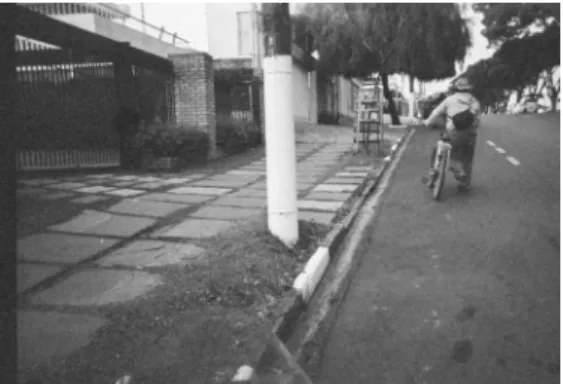
In photo-4 (Di.), the lenses captured a young boy going to work by bicycle early in the morn-ing; his old course when he was employed,
valu-ing the physical condition of the body that is ca-pable of producing.
– There are chemical and tannery products. Even before I was removed, I went to get a sack of baking soda that weighed fifty pounds. Today, the difficulty of rubbing my feet is absurd... Then, just imagine reloading the fifty pounds: I am out! Even the doctor told me to forget it. Regarding nimble-ness, because everything, even sitting, requires a nimble body. To get up, to sit down, to move. I had to discard the possibility of working as I used to do
(Di.).
– I was early up at the firm, because my mother put us early to work. At the age of twelve I already had a formal working relationship; I was already
at the firm and I became a formal employee [...] It
is another life, another availability. It is very differ-ent. You do not get tired. When you come in from work, you do one thing or another. Just lying idle
tires you more than working (Di.).
Attributes such as dedication, responsibili-ty, satisfaction and professional recognition are common elements found in self-description of the participants, who kept rhythm and produc-tivity in their jobs, facilitated by the physical and emotional condition that they no longer have.
The difficulty of maintaining the same pro-ductivity, coupled with hardships caused by the disease itself ensued changes in their ways of acting and reacting. Significant changes that af-fected the several aspects of life, combined with anxieties and concerns, mainly due to the delay in improving the clinical condition.
The physical limitation hinders the perfor-mance of routine personal and domestic care
Figure 2. Te. and the several medicines she has to take.
Author: Te.
Figure 3. Wife of Ce. working in the garage of their own home.
e C
ole
tiv
a,
22(12):3883-3892,
2017
Figure 4. Boy heading for work – remembering Di: his old itinerary.
Author: Di.
activities and leads to require help from other people. These restrictions interfere with auton-omous development of leisure activities, of the profession and those required by the treatment, besides raising distrust of coworkers and bosses, and even of relatives, due to the incomprehen-sion about the difficulties caused by the disease24.
Next to the arm physically weakened by a traffic accident, the photo evidences pins used to fix Cl. bones; symbolizing change and loss.
– That’s it! When I was working, I did not have many things to think about, I did not have much reason to cry or to be sad. There I talked to every-one; I had many friends. After I suffered this acci-dent, it seems as if a lot has changed, even friend-ships. I was more alone, though I was staying with my kids at home. They have their own lives; they like to play and do other things. There is no way we
can spend the whole day together (Cl.).
Work is the arena of suffering and the stage of pleasure. It carries an ambivalent meaning, as we can see in the photographs inserted in this theme. This dubious character of work seems to be syn-thesized in a sentence by French writer Anatole France in his novel The Amethyst Ring25, which
says:
[...] work is good for man. It distracts him from his own life, keeps him away from the frightening sight of himself; it prevents him from looking at this other that is him and that makes his solitude horrible. It is a holy remedy for ethics and aesthetics. Work has one more excellence: it distracts our vanity, deceives our lack of power and makes us feel hope of a good event.
French psychoanalyst Dejours26 affirms that
the dynamic quality of the articulation of the
de-sire to recognize the subject with what he dede-sires and requires work organization (the other’s will) should indicate the way of suffering, subjective mobilization and level of commitment both to health and illness, therefore, both pleasure and suffering.
This reveals the ambivalence of this theme, a source of psychic alienation and health and an emancipating tool27. However, to be a source
of health requires recognition of the one who works, since possibility of giving meaning to the suffering experienced by workers lies in this rec-ognition. In other words, we can say that recogni-tion is an indispensable condirecogni-tion to the process of subjective mobilization of intelligence and personality and plays a crucial role in the possible transformation of suffering into pleasure. This aspect of recognition seems to give meaning to suffering, that is, the individual, through recog-nition, meets his potentialities and singularities and becomes what Dejours and Abdoucheli21 call
creative suffering.
Photographs and reports expanded the un-derstanding about their physical conditions, and disease was the cross-sectional element. The very relationship with work of these studied subjects was ambivalent. On the one hand, it was remem-bered as a source of pleasure because it produced the ballast for recognition and identity. On the other, it was a source of suffering, because these people, in addition to addressing daily work pres-sures and demands, had the disease as their share of engaging in work, a condition that now brings them physical pain and a series of emotional and social consequences that have radically trans-formed their lives.
– Fifteen years ago, I had a bike to ride and to-day, thank God I have a house, I have a motorcycle, which I can no longer ride, and I have a car too. That was proof of what it is to be working, to be producing. If I had a plan to refurbish my house, I figured it would take four months in a row working on it late, and I could do it. You had a plan and you
could do it (Di.).
– Sometimes, when I have some things to read, because I do not know much, I studied little. How-ever, more often, my wife helps me out [...] I think that staying at home does not pay much either. The good thing is you feeling like coming home. Staying
at home makes you sick (Di.).
Touso MFS Boys are oriented to be providers and
pro-tectors. From the very start, they are trained to endure without weeping their physical and emo-tional pains. Thus, a masculine identity image is linked to being strong, capable and protective, vi-olent, determined and courageous. Manly behav-iors, which, if on the one hand, strengthen men’s ideal of being, on the other, consider and prevent self-preservation. These values instill in men an ambition for ascension and settle in their subjec-tivity as a manly perspective that does not feed caring or care, thus confusing personal identity and gender identity28,29.
The concrete and symbolic organization of social life and power connections in the relation-ships between sexes are reflexes of the gender that is concerned with the consolidation of a dis-course that, when constructing a female and male identity, shackles men and women to their limits. The story of the incapacity for work and its re-flections in the participants’ daily lives seems, in part, to liberate them from this stigma30.
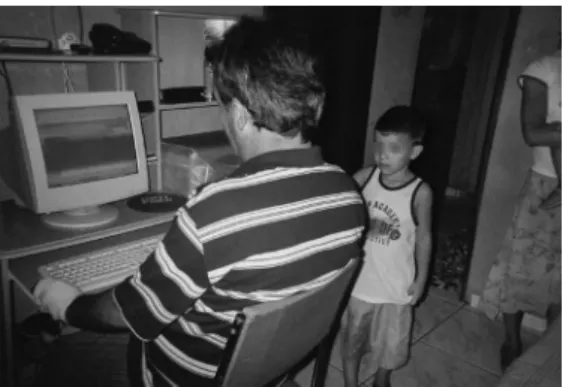
In photo-5 (Ce), among others, the dialogue regarding male roles in the relationship with their children emerged, showing paternal and domestic chores assumed from the physical inca-pacity and resulting changes.
– My current helps me take care of my little ones. It’s a way to get closer. If I were in that life, as I have always been, I would never be able to see them all four dressed in their school uniforms and
carrying their backpack (Di.).
Torrao Filho30 observes that some women
directly associate symbols of social and profes-sional upward mobility and status ascent, such as prestige and power, to the expression of their male side. Much in the same way, men identify their affective needs by referring to their sup-posed female side.
The discourse on gender creates an essence of what it is to be a man and a woman, an identity to which women and men are not invited to in-terfere and preserve diverse prejudices. Thus, the current status of individuals of this study has de-manded and facilitated the experience of aspects identified as of the opposite sexes. Women have felt the need to be more active and competitive in search of their rights, thus experiencing as-pects culturally associated with masculinity. On the other hand, men have been able to be more affectionate with their offspring, to provide care for their homes, to dialogue more with the fam-ily, which are essentially female attributes. We observed in the accounts that emancipation and
equitable access are beneficial to them and enable a satisfactory life experience.
– But I, in particular, still intend to return to the labor market. Not the way I am, because I’m in-capable at the moment, but not forever. Even if it is not to work as an employee, but to have something
of my own, definitely (Ma.).
Final considerations
Objective and numerical data were not sought. This paper aimed to expand listening methods in Health Promotion to facilitate dialogue with the group in a situation of social disadvantage due to the physical weakness and removed from their work activities, in order to identify elements that can support the development of equity-pro-moting policies. The number of participants was obtained based on their availability, the intended period and not saturation because in this case, stories are unique and relate to the existence of these workers.
This paper may be an invitation to overcome the limits of invisibility imposed by a social alien-ation that rarely sees individuals incapacitated with nuances of their pains and, thus, ends up sidelining them. The images captured portrayed how these people are excluded not only from the world of work, but also abandoned by public in-stitutions that should protect them.
From images captured by them, the dialogue in the group space flowed deeper. It had the ca-pacity to be a place of sharing experiences and promoting actions of social engagement. It was not restricted to the search for solutions of
in-Figure 5. Ce. by his computer at his own home, and his youngest son standing by.
e C
ole
tiv
a,
22(12):3883-3892,
2017
dividual problems, since it privileged proposed collective actions with potential social transfor-mation. The need to seize the liberty of gaining other spaces and ensure the full use of institu-tional policies was evidenced.
We consider that strategies, such as those pro-moted by this research, in which the dialogical relationship and subjectivity are valued, generate possibilities for the reflection and construction of new meanings by disadvantaged groups, in this case those that are removed from their work activities, about their rights, their role and partic-ipation as agents of social change, a stimulus to the exercise of citizenship. Strengthening citizen-ship is one of the main objectives of groups sup-ported by the theoretical support of Health Pro-motion. Although it seems a challenge, especially for the weakest groups, effective actions among the different sectors could increase the possible recovery of individuals incapacitated for work.
Thus, the Photovoice methodological option enabled knowledge and assessment of needs that exceeded health diagnosis, by encouraging reflec-tion, sensitization of the participants and conse-quent planning of action. It is an effective toolkit to apprehend perceptions and stimulate debate, providing essential inputs for building policies that promote socially disadvantaged groups.
The Photovoice method expanded the setting and the possible interventions of participants and researchers. Once recorded, images cannot be silenced with words, and when shared with others with similar experiences, they acquire the power to resuscitate subjectivities alienated by the social system. We hope that studies such as these may inspire Equity Promotion policies for populations with similar characteristics, since we perceive that critical awareness has the potential to mobilize action and to break with the resign-ing attitude.
Collaborators
MFS Touso, AB Mainegra, CHG Martins and GLA Figueiredo were responsible for designing and outlining the study, writing and critically reviewing the paper and approving the final ver-sion to be published. MFS Touso was responsible for extracting data. MFS Touso and AB Mainegra participated in the design of the study, data re-view and interpretation and approval of the final version to be published.
Acknowledgements
Touso MFS References
1. Dubar C. La crise des identités: l’interprétation d’une mutation. Paris: Presses universitaires de France; 2010. 2. Alves A, Antunes R. As mutações no mundo do traba-lho na era da mundialização do capital. Rev Educação &
Sociedade 2004; 25 (87):335-351.
3. Morin EM. Os sentidos do trabalho. Rev Admin de Em-presas 2001; 41(3):8-19.
4. Brasil. Ministério da Saúde (MS). Secretaria de Gestão Estratégica e Participativa. Departamento de Apoio à Gestão Participativa. Políticas de promoção da equidade em saúde. Brasília: MS; 2013.
5. Brasil. Lei nº 8.213, de 24 de julho de 1991. Dispõe so-bre os planos de benefícios da Previdência Social e dá outras providências. Diário Oficial da União 1998; 14 ago.
6. Souza NCC, Garcia de Freitas E, Souza Mendonça LC, Rubio Alem ME, Cote Gil Coury, HJ. Capacidade para o trabalho e qualidade de vida de trabalhadores indus-triais. Cien Saude Colet 2012; 17(6):1635-1641. 7. Gonçalves Germani ACC, Fenando AITH. Advocacia
em promoção da saúde: conceitos, fundamentos e es-tratégias para a defesa da equidade em saúde. Rev Di-reito Sanitário 2013; 14(1):34-59.
8. Minayo MCS. O desafio do conhecimento: pesquisa qua-litativa em saúde. 14ª ed. São Paulo, Rio de Janeiro: Hu-citec, Abrasco; 2014.
9. Bogdan CR, Biklen KS. Investigação qualitativa em
educação: uma introdução à teoria e aos métodos. Porto:
Porto Editora; 1994. (Coleção Ciências da Educação). 10. Wang CC, Burris MA, Xiang YP. Chinese village
wom-en as visual anthropologists: a participatory approach to reaching policymakers. Social Science and Medicine
1996; (42):1391-1400.
11. Wang CC, Burris MA. Photovoice: concept, method-ology, and use for participartory needs assesssment.
Health Educ. Behavior 1997; 24(3):369-387.
12. Wang CC, Red-Wood Jones A. Photovoice ethics: per-spectives from flint Photovoice. Health Educ Behav
2001; 28(5):560-572.
13. Wang CC, Cash J, Powers LS. Who knows the streets as well as the homeless? Promoting per-sonal and com-munity action through Photovoice. Health Promotion Practice 2000; 1(1):81-89.
14. Latz AO. Photovoice Research in Education and Beyond:
A practical guide from theory to exhibition. New York:
Taylor & Francis; 2017.
15. Boff BM, Leite DF, Azambuja MIR. Morbidade sub-jacente à concessão de benefício por incapacidade temporária para o trabalho. Rev Saude Publica 2002; 36(3):337-342.
16. Ávila AA, Silva Abreu MN. Fatores associados a dis-túrbios osteomusculares relacionados ao trabalho autorreferidos em adultos brasileiros. Rev Saude Publi-ca 2017; 51(Supl. 1):1-12.
17. Melo MPP, Assunção AA. A decisão pericial no âmbito da previdência social. Physis 2003; 13(2):343-365. 18. Assunção AA, Lima FPA. A nocividade do trabalho:
contribuição da ergonomia para a identificação, redu-ção e eliminaredu-ção da nocividade do trabalho. In: Men-des R, organizador. Patologia do trabalho. 2a ed. São Paulo: Atheneu; 2003. p.1767-1789.
19. Hoefel MG, Jacques MG, Amazarray MR, Mendes JMR, Netz MA. Uma proposta em saúde do trabalhador com portadores de LER/DORT: grupos de ação solidária.
Cad psicol soc trab 2004; 7:31-39.
20. Santos RA, Cintra PP, Chibás LC, Gonçalves NS, Co-telez LA. Promoção de saúde e risco ocupacional. In: Figueiredo GLA, Gomes CH , organizador. Políticas
tecnologias e práticas em promoção da saúde. São Paulo:
Hucitec; 2016. p. 406-440.
21. Dejours C, Abdoucheli E. Itinerário teórico em psico-patologia do trabalho. In: Betiol MIS, coordenador. Psi-codinâmica do trabalho: contribuições da Escola Dejou-riana à análise da relação prazer, sofrimento e trabalho. São Paulo: Atlas; 1994. p. 45-65.
22. Dejours C. O fator humano. Rio de Janeiro: FGV; 1997. 23. Mendes R, Dias EC. Saúde do trabalhador. In: Ro-quayrol M Z. Epidemiologia e saúde. 4º ed. Rio de Janei-ro: Medsi; 1994. p. 383-402.
24. Murofuse NT, Marziale MHP. Mudanças no trabalho e na vida de bancários portadores de lesões por esfor-ços repetitivos: LER. Rev Latino-Am Enfermagem 2001; 9(4):19-25.
25. France A. L’Anneau d’améthyste. Paris: Calmann-Lévy; 1898.
26. Dejours C. A banalização da injustiça social. 2a ed. Rio de Janeiro: FGV; 1999.
27. Dejours C. Psicodinâmica do trabalho: casos clínicos. São Paulo: Ed. Dublinense; 2017.
28. Braz MA. A construção da subjetividade masculina e seu impacto sobre a saúde do homem: reflexão bioé-tica sobre justiça distributiva. Cien Saude Colet 2005; 10(1):97-104.
29. Inda N. Género masculino, número singular. In: Burin M, Bleichmar ED, organizadores. Género, psicoanálisis,
subjetividad. Buenos Aires: Paidós; 1996. p. 212-240
30. Torrao Filho A. Uma questão de gênero: onde o mascu-lino e o feminino se cruzam. Cad. Pagu 2005; 24:127-152.
Article submitted on 30/08/2017 Approved on 04/09/2017