FREE THEMES
1 Centro de Ciências da Saúde e do Desporto, Universidade Federal do Acre. Rodovia BR 364/ Km 04, Distrito Industrial. 69915-900 Rio Branco AC Brasil. [email protected] 2 Departamento de Nutrição, Faculdade de Saúde Pública, Universidade de São Paulo. São Paulo SP Brasil. 3 Coordenação Geral de Alimentação e Nutrição, Ministério da Saúde do Brasil. Brasília DF Brasil.
Anemia and micronutrient deficiencies in infants
attending at Primary Health Care in Rio Branco, Acre, Brazil
Abstract The present study investigated the factors associated with anemia and micronutri-ent deficiencies in a cross-sectional analysis con-ducted with 150 children aged 11 to 14 months attending at basic health centers in Rio Branco, Acre. Venous blood samples were obtained to as-sess the occurrence of anemia and deficiencies of iron (ID), vitamin A (VAD), and B12 (VB12D). Multiple Poisson regression models were used to identify factors associated with anemia. Anemia, ID, VAD and B12D were observed in 23%, 76%, 18% and 20% of children, respectively. The factors associated with anemia were: do not be only child, living in households without access to cable TV or internet, stunting, late introduction of the com-plementary feeding (more than 240 days), VAD, VB12D, and current evidence of infection (plasma CRP > 5 mg/L). There was a lower prevalence of anemia among children with birth weight > 3,500 g. Overall, 82% of the study children had at least one of the micronutrient deficiencies (ID, VAD and VB12D). Actions with emphasis on timely and healthy feeding practices, better management of morbidities and supplementation with other micronutrients should be focused on the improve-ment of child care services at primary health care in this county.
Key words Anemia, Iron deficiency, Micronutri-ents, Nutritional status, Infants
Cristieli Sérgio de Menezes Oliveira 1
Rosângela Aparecida Augusto 2
Pascoal Torres Muniz 1
Sara Araújo da Silva 3
O
li
v
e
ir
a CSM
Introduction
Anemia in infancy remains a public health prob-lem, not only because of its prevalence, but also its severity. Estimates show that worldwide, some 273 million pre-school children suffer from this nutri-tional problem, or about 43% of the population
in that age group1. Half of these cases have been
attributed to iron deficiency (ID), which is why anemia is used as an important indicator to
esti-mate the magnitude of this deficiency in children2.
Anemia is related to increased infant and neonatal morbimortality. The combined effects of multiple vitamin and mineral deficiencies from conception to the age of two contribute increased perinatal mortality, and reduce the individual’s physical ability to work and his/her productivity, which in turn has a negative impact
on the country’s economic growth3,4.
Other factors considered in the etiology of anemia are genetic hemoglobinopathies, malaria, infections, other micronutrient deficiencies (Vi-tamin A, Vi(Vi-tamin B12 and Folate), and exposure to adverse environmental and socioeconomic
conditions4
.
Iron deficiency is the main cause of anemia in Brazilian children under the age of two, the result of inadequate nutritional practices (result-ing in decreased iron consumption and
bioavail-ability)5,6, fast growth and recurring infections,
especially in children in the poorer regions of
the country4. However, recent studies in
sever-al regions of the country7,8 have also taken into
account the contribution of other micronutrient deficiencies, confirming international evidence
found among children in Mexico9, and
school-children in Colombia10.
Data from the National Demographics and
Health Survey11 shows that Brazilian children
have an inadequate nutritional standard, with the introduction of semi-solid foods of low nu-tritional value at a very early age (47.1% of chil-dren under five months use a bottle), and delayed introduction of important food groups: 37% of the children between the ages of 6 and 11 months did not eat fruits and vegetables daily, 47% did not eat beans and 83% did not eat meat.
Different strategies have been used to prevent and control anemia and ID, however few have
been successful in reducing their incidence12.
Global data shows a very slow downward trend in prevalence - around 4% a year over the past
two decades (1995-2011)1.
While Brazil’s development indicators have improved significantly, with better income dis-tribution, easier access to goods and public
ser-vices, and declining gaps between regions, some inequalities remain. and the North of the coun-try has one of the highest social vulnerabilities, which reflects in infant health and nutrition. 80.1% of the households in the North do not have access to sanitation services, and the area has the highest rate of hospitalizations for oral fecal transmissible diseases (693.8 per 100
thou-sand inhabitants, or 80.1% in 2010)13.
In spite of strategies to prevent and control anemia, with compulsory fortifying of wheat and corn flours, and prophylactic supplementation for high-risk groups, the incidence of anemia in children remains a public health problem in all
regions of the country14-16. Studies indicate the
prevalence of anemia in children under the age of two in the Brazilian Amazon ranges from 40
to 70%17-21. The literature has few studies that
analyze the factors associated with anemia in children in developing nations that also consid-er their nutritional status in tconsid-erms of micronu-trients. For this reason, this study looked at the nutritional status of children under the age of two seen in basic healthcare units of the Unified Healthcare System (SUS) in Rio Branco, Acre.
We hope to contribute with information on the magnitude and factors associated with ane-mia and micronutrient deficiency in these chil-dren, thus fostering improved infant care ser-vices, within those already provided in primary child healthcare.
Methodology
Study design, area and population
This is a cross-sectional study that is part of ENFAC (Estudo Nacional de Fortificação Caseira da Alimentação Complementar), aimed at home supplementation of complementary feeding. This is a pragmatic, multi-center clinical trial performed in four Brazilian cities (Rio Branco, Olinda, Goiânia and Porto Alegre). ENFAC is comprised of two study groups, a control with children 12 to 14 months routinely seen by the childcare services of basic healthcare units (UBS) participating in the trial, and the intervention group, made up of children receiving fortified nutrition at home with a variety of powdered micronutrients from the age of 6 - 8 months.
aúd
e C
ole
tiv
a,
21(2):517-529,
2016
the mother or guardian; b) not being treated for anemia when the trial started. Exclusion criteria were premature birth (children born at under 37 weeks gestation), twins, children with HIV, ma-laria, tuberculosis, hemoglobinopathies or fever (> 39°) on the day blood was drawn.
In Rio Branco the trial included six basic care units (UBS) between June 2012 and February 2013. Rio Branco is the capital of the Brazilian state of Acre, located in the north of the coun-try. Based on the 2010 Demographic Census, the city’s Human Development Index (HDI-M) is 0.727, which is considered high. The city has a total population of 336,038, with children un-der the age of four making up 9% of the total. The infant mortality rate (IMR) in Rio Branco in 2010 was 20 per thousand live births, higher
than the country average of 16.7 per TLB22,23.
Over the course of the past decade, coverage of the Family Health Program in Rio Branco has varied quite widely (25.9% in 2004, jumping to
50.1% in 2009)24. By 2012, the year this study was
conducted, it had dropped again to 38.7%25.
The sample anticipated for Rio Branco was 105 children per group (control and interven-tion), plus 30% to cover withdrawals and re-fusals, thus a total sample of 135 children [per group]. We were able to recruit 155 children who met the inclusion criteria for the control group. Of these, five refused to participate in the study. The final sample was made up of 150 children. This sample size resulted in a testing power of 80% and a two-tail significance level of 0.05 for detecting 6 g/L differences in mean hemoglobin assays, estimating a standard deviation of 12 g/L for the main study (ENFAC). Children included in the study were no different from those who were not in terms of gender, age, socioeconomic, maternal and early childhood conditions.
Field teams were comprised of nurses and undergraduate students in nutrition at Universi-dade Federal do Acre. Teams were trained and al-located to the UBSs participating in the study. A Free and Informed Consent Form was signed by the mothers or guardians once we had explained the goals and advantages of the study. The Con-sent Form stated they were voluntarily partici-pating in the study, and were assured that all of the information provided would be kept as confi-dential. The study was approved by the Research Ethics Committee of the Public Health School at the University of São Paulo. Data collection was preceded by consent from the Rio Branco, Acre City Health Department.
Data collection
Interviewers applied a structured questionnaire to mothers or guardians going to the health-care service, or actively sought out mothers and guardians living in the area served by the partic-ipating UBSs. The following data was collected: a) demographics (gender, age of child, race/col-or), b) socioeconomic data (per capita house-hold income, parent (mother and father) years of schooling, registration in the Programa Bolsa Família (cash transfer trogramme), cable TV and Internet in the home, number of children under the age of 5 in the household, number of children of same mother); c) environmental (treated water); d) maternal characteristics (age, type of delivery, number of pre-natal visits); e) characteristics and morbidities at birth (weight at birth, hospitalizations in the past 12 months, diarrhea, fever and cough in the past 15 days); f) nutritional status and infant nutrition hab-its (malnutrition, nursed in the first hour after birth, how long child nursed exclusively, age at which complementary feeding is introduced); g) use of nutritional supplements by the child (iron and vitamins A and D).
Trained researchers measured the length and weight of the children using standard procedures
and calibrated equipment26. Each measurement
was repeated and the mean calculated. To mea-sure weight
We used an electronic Tanita UM-061 scale with capacity of 150 kg and sensitive to 100 g. Length was measured using a Sanny ES-2000 por-table infantometer with 1 meter extension and 1 mm precision. Children were measured lying on their backs on a flat service. Length was measured in centimeters. To analyze their nutritional status we used the Length/Age Z-score obtained using WHO Anthro version 3.2.2 software, using as a
reference the WHO growth standards27.
Malnu-trition was defined as a Z score of less than -2. Blood sample collections were scheduled for the week following the interview, based on the availability of the caretakers. Blood was drawn by a nurse technician experienced in infant veni-puncture. Blood samples were drawn after a fast of at least three hours.
O
li
v
e
ir
a CSM
kept frozen at -20°C until being shipped to the Human Nutrition lab at the Nutrition Depart-ment (FSP/USP), where they were kept at -70°C until biochemical analyses were performed.
Serum folate and Vitamin B12 concentrations
were measured using fluoroimmunoassay (Per-kin Elmer, WallacOy, Turku, Finland). The
cut-off for determining folate deficiency (FOLD) was
10 nmol. For Vitamin B12 deficiency (VB12D)
we used a cut-off of 150 pmol/L. Serum retinol and Vitamin E were analyzed using reverse-phase High Performance Liquid Chromatography (HPLC-1100, Hewlett-Packard, United States). Children with serum retinol concentrations below 1.05 µmol/L and below 0.7 µmol/L were used for Vitamin A insufficiency and
deficien-cy respectively (VAD)28. Vitamin E insufficiency
was considered for concentrations below 11.6
µmol/L. For anemia, we used the WHO4 cut-off
point of Hb < 110 g/L in children six months to five years of age. Blood hemoglobin (Hb) was measured using a portable Hemocue (Hb301; HemoCue®, Angelholm, Sweden) hemoglo-bin-meter at the time of blood collection. Iron deficiency (ID) was determined when plasma ferritin (PF) was below 12 g/L and/or the solu-ble transferrin receptor (sTfR) concentration was less than 8.3 g/mL. IDA was determined when anemic children presented iron defficien-cy20,29. These analyzes were performed by enzyme
immunoassay (Ramco, Houston, Texas, USA). Knowing that PF concentration increases with inflammation and infection, and can lead to
un-der-estimating ID30, plasma C-Reactive Protein
(CFP) was determined to check for infection in the study children. We used an immunochemical system - IMMAGE (Beckman Coulter, Brea, CA, USA). PCR values under 5 mg/L and/or Alfa-1 acid glycoprotein (AGP) greater than 1 g/L were considered to be associated with existing or chronic inflammation and/or infection, as
de-scribed in the meta-analysis30. Samples were
ana-lyzed within 6 months of being collected. The lab ran blind analyses for internal and external qual-ity control. Children diagnosed with anemia, ID or VAD were sent to the UBS healthcare system for treatment, as per the guidelines of the Minis-try of Health. The frequency of each micronutri-ent deficiency was calculated. However, we know that the cut-off points for these deficiencies are not considered definitive as micronutrients, es-pecially in children, have imperfect sensitivities
and specificities31,32.
Data analysis
The main outcome of interest was anemia. The frequency of micronutrient deficiencies (ID,
VAD, VB12D and FOLD) were used to describe
the study population.
Data was doubly inputted using Epiinfo 6.04 (Center for Disease Control and Prevention, At-lanta, Georgia) software, and exported to Stata v. 10.0 (StataCorp., College Station, Texas) for analysis. The distribution of the continuous vari-ables was identified using the Shapiro Wilk test. To characterize the samples, absolute and rela-tive frequencies were calculated for the categor-ical variables, the mean and standard deviation for continuous variables with normal distribu-tion, and the median and interquartile intervals for variables without a normal distribution. Pearson’s Chi-squared was used to compare the amounts of anemia, ID and IDA using the di-chotomous variables, with a level of significance p < 0.05.
In the first step, gross analysis using a Poisson regression looked at the effect of each of the ex-planatory variables on anemia individually. The following independent variables were investigat-ed: demographic and socioeconomic characteris-tics, access to public services, maternal and birth characteristics, morbidities, infant nutrition practices, the use of nutritional supplements by the infant and biochemical markers. The cut-off point to select variables for inclusion in multi-ple models was p < 0.20. Adjusted prevalence rations and 95% confidence intervals controlled by gender were obtained using multiple Pois-son regressions with robust variance, as per the existing conceptual model adapted from earlier
studies7,21. Considering the characteristics of our
study population, late inclusion of complemen-tary nutrition was categorized as before or after 240 days, and weight at birth as less than or more than 3,500 grams.
aúd
e C
ole
tiv
a,
21(2):517-529,
2016
Results
The median age was 13.3 months, 55% of the children were male, and most of them mulatto (89.9%). Median per capita household income was a bit above the minimum wage in 2012 (R$ 622,00) Regarding their environments, about 30% of the children lived in homes with inadequately treated water, and 43% in homes with no connection to public sewage. Regarding data on the mothers, the median age and years of schooling were 25 and 10 years respectively. The median number of pre-natal visits was 7.
One-half of the children had fever and 27% had diarrhea in the 15 days before the study. More than 24% had been hospitalized in the preceding 12 months. The share of children who had used iron or Vitamin A and D supplements sometime in their lives was relatively low - 13.5% and 2.7% respectively (Table 1).
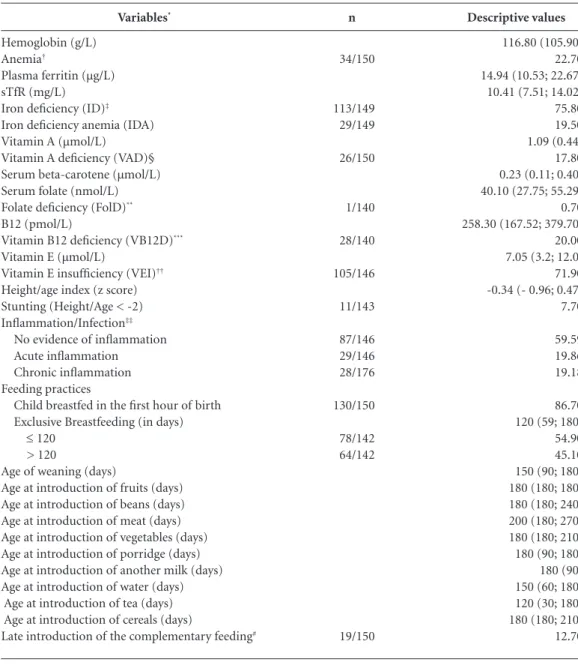
Descriptive values of the indicators of nutri-tional status regarding iron, frequency of anemia and other conditions are shown in Table 2. The frequencies for anemia, iron deficiency and iron deficiency anemia were 22.7%, 75.8% and 19.5% respectively. We found no case of severe anemia (Hb < 70 g/L). 27.5% of the anemic children had iron deficiency. 85.3% of the children with ID were anemic. The frequencies of Vitamin A
(VAD), Vitamin B12 (VB12D), folate (FOLD)
de-ficiency and malnutrition were 17.8%, 20.0%, 0.7% and 7.7% respectively. Of the 150 children evaluated, 82% had multiple deficiencies (ID,
VAD, VB12D. Acute (CRP > 5 mg/L) or chronic
(AGP > 1 g/L) inflammation or infection were found in 21.2% and 38% of the children respec-tively.
Regarding infant nutrition practices, only 86.7% of the children nursed in the first hour after birth. The median period during which babies nursed exclusively was 120 days, and the average age at weaning was 150 days. Comple-mentary feeding was added late (after 8 months) to 13% of the nursing infants.
Figure 1 shows the frequency of ID and VAD using acute (PCR) and chronic (AGP) inflamma-tion markers. The prevalence of ID was higher where there was chronic inflammation than in the presence of any other conditions, although the difference was not statistically significant. For VAD the difference between the two groups was limitrophe.
The frequency of anemia according to the independent variables, and the relative contri-bution of each risk factor to this condition, were
estimated using χ2. The adjusted prevalence
ra-tios (APR) are shown in Table 3. Anemia was uniformly distributed between the two genders, with no statistically significant difference. High-er prevalence of anemia and increased risk of this outcome were related to the following vari-ables: not being an only child [30.1%; APR: 2,11 (CI95%:1.06; 4.19), no cable TV or Internet in the home [APR: 4.57 (1.13; 18.47), malnutrition, late introduction of iron-rich foods or those that promote iron absorption, Vitamin A and B12 de-ficiency and CRP > 5 mg/L. Children weighing more than 3,500 grams at birth were at lower risk for anemia.
ID was 17% lower among children of moth-ers who had 9 or more years of schooling than among the children of mothers with fewer years of schooling. Late introduction of iron-rich foods or those that promote iron absorption increased the risk of ID by 26% compared to those children introduced to these foods at the right time. VAD was associated with ID [1.37 (1.17; 1.61)]. The only factors associated with IDA were late intro-duction of iron-rich foods or those that promote iron absorption [2.16 (1.14;4.09)], malnutrition [2.28 (1.12; 4.61)] and Vitamin A [1.96 (1.04;
3.70)] and B12 [2.82 (1.48; 5.37)] deficiencies.
Discussion
In this study, socioeconomic factors and infant feeding practices were associated with the pres-ence of anemia. Other factors strongly associated with anemia were weight at birth, malnutrition, presence of infection and deficiency of other
mi-cronutrients (Vitamins A and B12).
The largest proportion of anemia was found in children where iron rich foods such as meat and other iron absorption promoters were in-troduced late. The strong association between this variable and the outcome reinforces the importance of nutritional education measures that stress the timely and suitable introduc-tion of complementary nutriintroduc-tion, showing the nutritional damages caused by maintaining a
dairy-based diet, as shown in other studies5,14,33,34.
Surveys by Garcia et al.17 and Castro et al.18 in a
O
li
v
e
ir
a CSM
Descriptive values
13.27 (12.39-14.09)a
44.70b
55.30b
8.70b
89.86b
1.45b
700.00 (622.00; 1,200.00)a
10 (6; 11)a
9 (5; 11)a
32.90b
23.30b
76.70b
68.70b
31.30b
44.70b
53.30b
70.0b
42.76b
57.24b
25 (21; 31)a
7 (6; 8)a
3,230 (0,453)c
77.10b
22.90b
24.70b
26.8b
50.7b
69.80b
13.5b
2.7b Variables*
Demographic and socioeconomic Age (months)
Gender Female Male Race/ethnicity
White Mulatto Black
Per capita income (reais)
Maternal schooling (years of study) Paternal education (years of study)
Registration in cash transfer programme (Programa Bolsa Família) Presence of cable TV and Internet at home
At least one None
Number of children aged <5 y in the household 1
> 1
Number of siblings 1
> 1 Environmental
Adequate treatment of drinking water Sanitary sewer
Without public network With public network Maternal
Maternal age (years)
Number of prenatal appointments Characteristics at birth and morbidity
Birth weight (g)
≤ 3500 > 3500
Hospitalization in the last 12 months Diarrhea in the last 15 d
Fever in the last 15 d Cough in the last 15 d
Use of mineral and vitamin supplements Supplements of iron
Supplements of vitamin A
Table 1. Demographic, socioeconomic, environmental, maternal characteristics and morbidities of infants attending at Basic Health Units in Rio Branco, Acre, 2012. (n = 150)
n/total
67/150 83/150
12/138 124/138 2/138
49/149
35/150 115/150
103/150 47/150
67/150 83/150
105/150
62/145 83/145
114/148 34/148 27/140 40/149 76/150 104/149
20/148 4/149
* Differences in absolute frequencies corresponding missing values. a Median; interquartile ranges (p25-p75) in parenthesis. b Frequency (%). c Mean ± standard-deviation in parenthesis.
iron heme and low mineral utilization. It also can lead to microgastrointestinal bleeding due to the early introduction of cow’s milk. Studies reinforce the importance of eating meats during the weaning period, which should start as soon as complementary feeding is introduced, and
al-ways before the 27th week35.
aúd
e C
ole
tiv
a,
21(2):517-529,
2016
Descriptive values
116.80 (105.90)a
22.70b
14.94 (10.53; 22.67)c
10.41 (7.51; 14.02)c
75.80b
19.50b
1.09 (0.44)a
17.80b
0.23 (0.11; 0.40)c
40.10 (27.75; 55.29)c
0.70b
258.30 (167.52; 379.70)c
20.00b
7.05 (3.2; 12.0)c
71.90b
-0.34 (- 0.96; 0.47)a
7.70b
59.59b
19.86b
19.18b
86.70b
120 (59; 180)c
54.90b
45.10b
150 (90; 180)c
180 (180; 180)c
180 (180; 240)c
200 (180; 270)c
180 (180; 210)c
180 (90; 180)c
180 (90)a
150 (60; 180)c
120 (30; 180)c
180 (180; 210)c
12.70b Variables*
Hemoglobin (g/L) Anemia†
Plasma ferritin (µg/L) sTfR (mg/L) Iron deficiency (ID)‡
Iron deficiency anemia (IDA) Vitamin A (µmol/L) Vitamin A deficiency (VAD)§ Serum beta-carotene (µmol/L) Serum folate (nmol/L) Folate deficiency (FolD)**
B12 (pmol/L)
Vitamin B12 deficiency (VB12D)***
Vitamin E (µmol/L)
Vitamin E insufficiency (VEI)††
Height/age index (z score) Stunting (Height/Age < -2) Inflammation/Infection‡‡
No evidence of inflammation Acute inflammation Chronic inflammation Feeding practices
Child breastfed in the first hour of birth Exclusive Breastfeeding (in days)
≤ 120 > 120
Age of weaning (days)
Age at introduction of fruits (days) Age at introduction of beans (days) Age at introduction of meat (days) Age at introduction of vegetables (days) Age at introduction of porridge (days) Age at introduction of another milk (days) Age at introduction of water (days) Age at introduction of tea (days) Age at introduction of cereals (days)
Late introduction of the complementary feeding#
Table 2. Nutritional status and feeding practices of infants attending at basic health units in Rio Branco, Acre, 2012. (n = 150)
n
34/150
113/149 29/149
26/150
1/140
28/140
105/146
11/143
87/146 29/146 28/176
130/150
78/142 64/142
19/150
* Differences in absolute frequencies correspond to missing values. † Cut-off for anemia: < 110 g/L. ‡ ID defined with plasma ferritin < 12µg/mL or soluble transferrin receptor > 8.3mg/L. IDA was defined when ID occurred in anaemic children. § VAD defined if retinol <0,70 µmol/L. ** FolD if <10 nmol/L. *** VB12D if ≤ 150pmol/L. †† VEI if <11,6 µmol/L. ‡‡ No evidence of inflammation: CRP ≤ 5 and AGP ≤ 1; Acute inflammation: CRP > 5 and AGP > 1; Chronic inflammation: CRP ≤ 5 and AGP > 1. AGP: α-1-acid glicoprotein (g/L); CRP: C-reactive protein (mg/L). # Introduction of foods rich in iron or which promote its absorption (fruits, beans, meat and vegetables above 240 days). a Mean ± standard-deviation in parenthesis. b Frequency (%). c Median; interquartile ranges (p25-p75) in parenthesis.
information about this variable. The importance of breast feeding for reducing the risk of anemia and infant survival is known, and is considered the single highest-impact intervention for reduc-ing preventable deaths of children under the age
of five (90% of infant deaths in the world)36.
O
li
v
e
ir
a CSM
The North has the smallest Internet penetration in Brazil (20.2% of the population has Inter-net access, compared to the national average of
36.5%)37. In this context, this variable is a good
indicator of socioeconomic level. In a study of
nursing infants in Pernambuco, Lima et al.38
found that the absence of a TV in the home was significantly associated with a lower mean blood hemoglobin level.
It is believed that the role of the mother’s years of schooling is related to an increase in the ability to understand the instructions received and with making healthier food choices, provid-ing their children with a better diet. They tend to be more aware of healthcare in general, which
results in more efficient care practices39.
Howev-er, unlike some studies33 but agreeing with
oth-ers5,40, this study found no association between
maternal education and anemia. A possible ex-planation may be the homogeneous distribution
of education in the study population, without enough contrast for proper comparisons.
The low prevalence of the use of supplements as prophylaxis for the main micronutrient defi-ciencies in young children (Vitamins A, D and iron) shows limited adherence of this population to this type of public health measure. This re-duced rate of adherence is common in a number of countries other than Brazil, and is a topic of much discussion in the literature. In the case of iron supplementation, this is generally attribut-ed to gastrointestinal effects, sensory aspects, the long period of administration, limited prescrip-tion by healthcare professionals and lack of
in-formaiton41.
Vitamin B12 deficiency is associated with
Ane-mia and IDA, [this study found] higher numbers (20%) than the numbers found in children 6-24
months old in Acre (12%)20, and lower than
those found in children under the age of 2 in
Colombia (50%)42. Inadequate levels of Vitamin
B12 have been found in numerous developing
na-tions. The few studies available on the prevalence
of Vitamin B12 deficiency used small samples and
non-standard methods of nutritional assess-ment, making comparisons difficult. In global terms, this association has been considered un-common, possibly due to diagnostic limitations, as ID tends to reduce mean corpuscular volume
(MCV) more easily than Vitamin B12 deficiency32.
It is likely that this finding is due to late introduc-tion of meats to infant nutriintroduc-tion, found in this study.
Half of the children studied had inadequate levels of Vitamin A, and about one in five had Vitamin A deficiency, shown to be associated with anemia, thus corroborating the findings
of Pedraza et al.43 in a study conducted in the
Brazilian Northeast. In Rio Branco, 40% of the anemic children also presented VAD, but ID was not found, reinforcing the involvement of other micronutrients in anemia.
The prevalence of VAD was higher among children with acute inflammation, corroborating
the findings of Rohner et al.44. The magnitude of
the Vitamin A deficiency found was larger than
the national estimate (16.3%)11, and higher than
the numbers found in a study of children in the
Amazon (14.2%)20 and the Philippines (3%)44.
This situation probably reflects insufficient con-sumption of foods rich in pro-vitamin A (e.g. yellow fruits and vegetables), as well as the high morbidity among the study population. Numer-ous studies have demonstrated the influence of
Vitamin A on the iron status34,45 and
hemoglo-Figure 1. Relative frequency (%) of iron (ID) and vitamin A deficiencies (VAD) according to the presence of inflammation in infants in Rio Branco (n= 150).
No infection, CRP ≤ 5mg/L and AGP ≤ 1g/L, n=69/87 (ID) and n = 10/87 (VAD); Acute inflammation, CRP > 5mg/L and AGP > 1g/L, n = 17/29 (ID) e n = 9/29 (VAD); Chronic inflammation, CRP ≤ 5mg/L and AGP > 1g/L, n = 22/28 (ID) e n = 6/28 (VAD). Only 2 children showed CRP > 5 mg/L and AGP ≤ 1g/L; Differences in absolute frequencies correspond to missing values to biochemical indicators. AGP: α-1-acid glicoprotein; CRP: C-reactive protein. * p value of the categories of inflammation in relation to each outcome.
p = 0,095* p = 0,056*
Acute inflammation
Chronic inflammation No evidence of
inflammation
ID VAD 0
aúd e C ole tiv a, 21(2):517-529, 2016
bin levels46. Because of this, some studies have
suggested that combined supplementation with Vitamin A and iron would have a greater impact on reducing anemia than the administration of
either one of these in isolation9,10, as more often
than not, micronutrient deficiencies are
associ-ated47.
Weight at birth has been associated with the prevalence of anemia, with higher birth weight considered protection from this outcome. The literature shows that children who weigh less at birth have lower iron reserves, and many are
weaned early, accentuating iron depletion38.
How-ever, as this is a variable obtained from the child’s file, care must be taken in its interpretation.
Regarding morbidity, it is known that chil-dren living in unsuitable environments are more
prone to infectious diseases34. In this study,
~27% of the children between 11 and 14 months had diarrhea, and 70% had a cough in the two weeks preceding the study. The variable indicat-ing recent inflammation or infection (CRP) was strongly associated with anemia and showed a borderline association with VAD. The prevalence of anemia in children with inflammation was al-most three times higher than among those with no inflammation. The literature has ample ref-erences to a predisposition for anemia following acute infection, as in general this is accompanied by a worsening appetite, and greater loss or
uti-Variables
Gender Male Female
Children aged < 5 y in the household 1 child
> 1 child
Presence of cable TV and Internet at home At least one
None Birth weight (g)
≤ 3.500 > 3.500
Stunting (Height/Age < -2) Não
Sim
Late introduction of the complementary feeding (> 240 days)#
No Yes
Vitamin A deficiency No
Yes
Vitamin B12 deficiency No
Yes Iron deficiency
No Yes
Inflammation/Acute Infection (CRP in mg/L)
≤ 5 > 5
Table 3. Crude and adjusted prevalence ratios (RP) for factors associated to anemia in infants attending at Basic Health Units in Rio Branco, Acre, 2012. (n = 150)
* Pearson’s χ2 test. ** Variables were adjusted for others in the same or higher levels following the hierarchical conceptual framework. # Introduction of foods rich in iron or which promote its absorption (fruits, beans, meat and vegetables above 240 days).
Crude PR (95% CI)
1 0.97 (0.53; 1.77)
1 2.24 (1.12; 4.48)
1 4.86 (1.22; 19.39)
1 0.32 (0.10; 0.99)
1 2.66 (1.40; 5.04)
1 2.12 (1.12; 3.99)
1 1.92 (1.04; 3.52)
1 2.40 (1.33; 4.31)
1 1.84 (0.77; 4.43)
1 2.92 (1.68; 5.07)
Anemia* % 22.9 22.4 13.4 30.1 5.7 27.8 27.2 8.8 20.4 54.5 19.8 42.1 20.0 38.5 17.9 42.9 13.9 25.7 16.5 48.4 p 0.942 0.022 0.025 0.05 0.003 0.020 0.034 0.003 0.169 <0.001
Adjusted ** PR (95% CI)
1 0.94 (0.53; 1.68)
1 2.11 (1.06; 4.19)
1 4.57 (1.13; 18.47)
1 0.31 (0.10; 0.90)
1 2.28 (1.28; 4.09)
1 1.92 (1.10; 3.37)
1 1.85(1.05; 3.28)
1 1.90 (1.05; 3.46)
1 1.60 (0.83; 3.09)
1 2.21 (1.38; 3.54)
O
li
v
e
ir
a CSM
lization of micronutrients, which varies
depend-ing on the duration and severity of disease30,34,38.
The frequency of anemia found in children in this part of the Amazon was similar to the
find-ings of the 2006 PNDS11, and of a study in New
Zealand40. However, they were lower than the
frequency found in other Brazilian studies con-ducted with children of similar age included in the healthcare system. It is convenient to point out here to point out that a number of factors limit the possibility of comparing prevalence across studies, as some are derived from surveys
of capillary blood samples11,14,44, which can cause
hemodilution and introduce a systematic error in the hemoglobin assays. Other studies in Acre show a higher prevalence of anemia in children
under the age of 27,17, which may be explained by
the fact that people living in the state capital have better infrastructure and access to higher quali-ty assets and services. In general, these children come from households of a higher socioeconom-ic level and education when compared to those in cities in the interior of the Amazon.
Iron deficiency has been shown to be a se-rious public health problem; our study found numbers higher than the results of by Pasricha et
al.31 in Indian children aged 12 to 23 months, and
lower than the results found by Cardoso et al.20 in
children 6 to 23 months in the Amazon interior. The prevalence of malnutrition in children under the age of 11 months (7.7%) was
high-er than would be estimated using PNDS11 data
(4.8%), and was strongly associated with anemia,
as per the findings of Yang et al.33 and Lima et al.38.
Anemia and macro and micronutrient deficiency are related to infant growth and development,
leading to short stature47. They can also interfere
in Hb levels due to dietary insufficiencies.
The results of this study must be considered while bearing in mind its limitation. First, as it is a study of children seen by a basic care service, thus results may not be extrapolated to the gen-eral population of children under the age of two in Rio Branco. Second, a number of variables that are important causes of anemia such as ges-tational age and the normal eating habits of the study children were not analyzed due to inconsis-tencies in the former, and no data for the latter. Lastly, this is a cross-sectional study where data on individuals was collected only once, making it impossible to determine the timing of the out-comes and markers of recent infection and mi-cronutrient deficiency, so care must be taken in its interpretation. Despite the absence of more accurate data on food consumption in our study, the combination of different indicators of iron status and biochemical micronutrient assays al-lowed us to identify other factors associated with anemia, in addition to iron deficiency. There is a single, population-based study conducted in a town in the interior of the Amazon that looked at
the same range of biochemical indicators20.
aúd
e C
ole
tiv
a,
21(2):517-529,
2016
Collaborations
CSM Oliveira helped gather data in Rio Branco and was also involved in data processing, analysis and interpretation. CSM also reviewed the liter-ature and drafted the first version of the manu-script. RA Augusto helped with overall coordina-tion of data processing, analysis and results inter-pretation. PT Muniz helped coordinate data pro-cessing in Rio Branco, and also assisted with data analysis and interpretation. MA Cardoso helped design and coordinated the study, and also inter-pret and analyze the data. MA Cardoso also crit-ically reviewed the manuscript. SA Silva helped with ENFAC design and overall coordination. All of the authors helped draft the manuscript and approved the final version.
Acknowledgements
To the mothers and infants who participated in the study. To the healthcare professionals and managers of the Basic Healthcare Units who par-ticipated in the study. To Universidade Federal do Acre for logistics support. To the interviewers for their contributions during fieldwork.
To the Ministry of Health/Overall Food and Nutrition Coordination for funding.
Members of the National Study to Home Fortification of the Complementary Food (ENFAC) Working Group
Marly Augusto Cardoso, Rosângela Aparecida Augusto, Fernanda Cobayashi (Departamento de Nutrição, Universidade de São Paulo); Pas-coal Torres Muniz, Cristieli Sérgio de Mene-zes Oliveira (Centro de Ciências da Saúde e do Desporto, Universidade Federal do Acre), Maria Claret C. M. Hadler, Maria do Rosário G. Peixo-to (Faculdade de Nutrição, Universidade Federal de Goiás), Pedro Israel C. Lira, Leopoldina Au-gusta S. Sequeira (Departamento de Nutrição, Universidade Federal de Pernambuco), Márcia Regina Vitolo, Daniela Cardoso Tietzmann (Uni-versidade Federal de Ciências da Saúde de Porto Alegre), Márcia Maria Tavares Machado (De-partamento de Medicina Preventiva, Universi-dade Federal do Ceará), Patrícia Constante Jai-me, Eduardo Augusto Fernandes Nilson, Gisele Ane Bortolini, Sara Araújo da Silva (Coordena-ção Geral de Alimenta(Coordena-ção e Nutri(Coordena-ção, Ministério da Saúde do Brasil).
O
li
v
e
ir
a CSM
Instituto Brasileiro de Geografia e Estatística (IBGE). Estudos e Pesquisas. Informação Demográfica e Socio-econômica, n. 32. Síntese de Indicadores Sociais: uma análise das condições de vida da população brasileira. 2013. [acessado 2014 jun 23]. Disponível em: ftp://ftp. ibge.gov.br/Indicadores_Sociais/Sintese_de_Indicado-res_Sociais_2013/SIS_2013.pdf
Spinelli MGN, Marchioni DML, Souza JMP, Souza SB, Szarfac SC. Fatores de risco para anemia em crianças de 6 a 12 meses no Brasil. Rev Panam Salud Pública 2005; 17(2):84-91.
Jordão RE, Bernardi JLD, Barros Filho A. Prevalência de anemia ferropriva no Brasil: uma revisão sistemáti-ca. Rev Paul Pediatr 2009; 27(1):90-98.
Vieira RCS, Ferreira HS. Prevalência de anemia em crianças brasileiras, segundo diferentes cenários epide-miológicos. Rev Nutrição 2010; 23(3):433-444. Garcia MT, Granado FS, Cardoso MA. Alimentação complementar e estado nutricional de crianças me-nores de dois anos atendidas no Programa Saúde da Família em Acrelândia, Acre, Amazônia Ocidental Bra-sileira. Cad Saude Publica 2011; 27(2):305-316. Castro TG, Baraldi L, Muniz PT, Cardoso MA. Dietary practices and nutritional status of 0-24 month-old children from Brazilian Amazonia. Publ Health 2009; 12(12):2335-2342.
De Souza OF, Macedo, LFM, Oliveira CSM, Araújo TS, Muniz PT. Prevalence and associated factors to anae-mia in children. J Hum Growth Dev 2012; 22(3):307-313.
Cardoso MA, Scopel KKG, Muniz PT, Villamor E, Fer-reira MU. Underlying factors associated with anemia in Amazonian children: a population-based, cross-sec-tional study. PLoS One 2012; 7:e36341.
Oliveira CSM, Cardoso MA, Araujo TS, Muniz PT. Anemia em crianças de 6 a 59 meses e fatores associa-dos no Município de Jordão, Estado do Acre, Brasil. Cad Saude Publica 2011; 27(5):1008-1020.
Instituto Brasileiro de Geografia e Estatística (IBGE). Cidades. Resultados da amostra do Censo Demográfico 2010. [acessado 2014 maio 23]. Disponível em: http:// cidades.ibge.gov.br/xtras/perfil.php?codmun=120040 Programa das nações unidas para o desenvolvimento (PNUD). Atlas do desenvolvimento humano no Brasil: atlas brasil 2013. [acessado 2014 jun 23]. Disponível em:http://www.pnud.org.br/idh/atlas2013.aspx?indi-ceaccordion=1&li=li_atlas2013
Brasil. Ministério da Saúde (MS). Caderno de Infor-mações em Saúde. [acessado 2014 maio 23]. Disponí-vel em: http://tabnet.datasus.gov.br/tabdata/cadernos/ ac.htm
13.
14.
15.
16.
17.
18.
19.
20.
21.
22.
23.
24. References
Stevens GA, Finucane MM, De-Regil LM, Paciorek CJ, Flaxman SR, Branca F, Peña-Rosas JP, Bhutta ZA, Ezzati M. Global, regional, and national trends in haemoglo-bin concentration and prevalence of total and severe anaemia in children and pregnant and non-pregnant women for 1995-2011: a systematic analysis of popu-lation-representative data. Lancet Glob Health 2013; 1(1):e16-e25.
World Health Organization (WHO). Center for Dis-ease Control and Prevention. de Benoist B, McLean E, Egli I, Cogswellm M, editors. Worldwide prevalence of anaemia 1993-2005. WHO Global Database on Anae-mia. Geneva: WHO; 2008.
Lozoff B. Iron deficiency and child development. Food Nutr Bull 2007; 28(Supl. 4):S560-S571.
World Health Organization (WHO), United Nations Children’s Fund (UNICEF), United Nations University (UNU). Iron deficiency anaemia. Assessment, prevention and control. A guide for programme managers. Geneva: WHO; 2001.
Hadler MC, Juliano Y, Sigulem DM. Anemia do lacten-te: etiologia e prevalência. J Pediatr 2002; 78(4):321-326.
Carvalho AGC, Lira PIC, Barro MFA, Aléssio MLM, Lima MC, Carbonneau MA, Berger J, Léger CL. Diag-nóstico por deficiência de ferro em crianças do Nor-deste do Brasil. Rev Saude Publica 2010; 44(3):513-519. Castro TG, Silva-Nunes M, Conde WL, Muniz PT, Car-doso MA. Anemia e deficiência de ferro em pré-esco-lares da Amazônia Ocidental brasileira: prevalência e fatores associados. Cad Saude Publica 2011; 27(1):131-142.
Bortolini GA, Vitolo MR.Relação entre deficiência de ferro e anemia em crianças de até 4 anos de idade. J Pediatr 2010; 86(6):488-492.
Villalpando S, Pérez-Expósito A, Shamah-Levy T, Ri-vera JA. Distribution of anemia associated with micro-nutrient deficiencies other than iron: a probabilistic sample of Mexican children. Ann Nutr Metab 2006; 50(6):506-511.
Arsenault JE, Mora-Plazas M, ForeroY, Lopez-Arana S, Baylin A, Villamor E. Hemoglobin concentration is inversely associated with erythrocyte folate concen-trations in Colombian school-age children, especially among children with low vitamin B12 status. Eur J Clin Nutr 2009; 63(7):842-849.
Brasil. Ministério da Saúde (MS). Pesquisa Nacional de Demografia e Saúde da Criança e da Mulher – PNDS 2006: dimensões do processo reprodutivo e da saúde da criança. Brasília: MS; 2009.
World Health Organization (WHO). Use of multiple micronutrient powders for home fortification of foods consumed by infants and children 6-23 months of age. Geneva: WHO; 2011.
1.
2.
3. 4.
5.
6.
7.
8.
9.
10.
11.
aúd
e C
ole
tiv
a,
21(2):517-529,
2016
Secretaria Municipal de Saúde de Rio Branco. Depar-tamento de Atenção Básica (DAB). DATASUS. Fon-te: SIAB - Sistema de Informação de Atenção Básica. Relatório do Consolidado da Cobertura do Programa Saúde da Família. Rio Branco: Secretaria Municipal de Saúde de Rio Branco; 2013
World Health Organization (WHO). Expert Committee on Physical Status. Physical status: the use and interpre-tation of anthropometry: report of a WHO Expert Com-mittee. Geneva: WHO; 1995.
World Health Organization (WHO).WHO Anthro (version 3.2.2, January 2011b) and macros. [acessado 2014 jun 23]. Disponível em: http://www.who.int/chil-dgrowth/software/es/index.html
World Health Organization (WHO).Indicators for assessing vitamin A deficiency and their application in monitoring and evaluating intervention programmes. Geneva: WHO; 1996.
Cook JD, Flowers CH, Skikne BS. The quantitative assess-ment of body iron. J Hematol 2003;101(9):3359-3364. Thurnham DI, McCabe LD, Haldar S, Wieringa FT, Northrop-Clewes CA, McCabe GP. Adjusting plasma ferritin concentrations to remove the effects of subclin-ical inflammation in the assessment of iron deficiency: a meta-analysis. Am J ClinNutr 2010; 92(3):546-555. Pasricha S-R, Shet AS, Black JF, Sudarshan H, Prashanth NS, Biggs BA. Vitamin B-12, folate, iron, and vitamin A concentrations in rural Indian children are associated with continued breastfeeding, complemen-tary diet, and maternal nutrition. Am J Clin Nutr 2011; 94(5):1358-1370.
World Health Organization (WHO). Conclusions of a WHO Technical Consultation on folate and vita-min B-12 deficiencies. Food Nutr Bull 2008b; 29(Supl. 2):S238-S244.
Yang W, Li X, Li Y, Zhang S, Liu L, Wang X, Li W. Ane-mia, malnutrition and their correlations with socio-de-mographic characteristics and feeding practices among infants aged 0–18 months in rural areas of Shaanxi province in northwestern China: a cross-sectional study. BMC Public Health 2012; 12:1127.
Schulze KJ, Christian P, Wu LS, Arguello M, Hongjie C, Nanayakkara-Bind A, Stewart CP, Khatry SK, Le-Clerq S, West Junior KP. Micronutrient Deficiencies Are Common in 6- to 8-Year-Old Children of Rural Nepal, with Prevalence Estimates Modestly Affected by Inflammation. J Nutr 2014; 144(6):979-987.
VitoloMR, BortoliniGA. Biodisponibilidade do ferro como fator de proteção contra anemia entre crianças de 12 a 16 meses. J Pediatr 2007; 83(1):33-38.
Jones G, SteketeeRw, Black Re, Bhutta ZA, Morris SS, Bellagio Child Survival Study Group. How many child deaths can we prevent this year? Lancet 2003; 362(9377):65-71.
Brasil. Ministério do Desenvolvimento Social e Com-bate à Fome (MDS). Indicadores de Desenvolvimento Brasileiro. 2013. [acessado 2014 jun 23]. Disponível em: http://189.28.128.178/sage/sistemas/apresentacoes /arquivos/indicadores_de_desenvolvimento_2013.pdf Lima ACVMS, Lira PIC, Romani SAM, Eickmann SH, Piscoya MD, Lima MC. Fatores determinantes dos ní-veis de hemoglobina em crianças aos 12 meses de vida na Zona da Mata Meridional de Pernambuco. Rev Bras Saúde Matern Infant 2004; 4(1):35-43.
Choi HJ, Lee HJ, Jang HB, Park JY, Kang JH, Park KH, Jihyun Song J. Effects of maternal education on diet, anemia, and iron deficiency in Korean school-aged children. BMC Public Health 2011; 11:870.
Soh P, Ferguson EL, McKenzie JE, Homs MYV, Gibson RS. Iron deficiency and risk factors for lower iron stores in 6-24 month-old New Zealanders. Eur J Clin Nutr 2004; 58(1):71-79.
Mora J. Iron supplementation: overcoming technical and practical barriers. J Nutr 2002; 132(4):S853-S855. Herrán OF, Ward JB, Villamor E. Vitamin B12 sero sta-tus in Colombian children and adult women: results from a nationally representative survey. Public Health Nutr 2014; 18(5):836-843.
Pedraza DF, Queiroz D, Paiva AA, Cunha MAL da, Lima ZN. Food security, growth and vitamin A, hemoglobin and zinc levels of preschool children in the northeast of Brazil. Cien Saude Colet 2014; 19(2):641-650. Rohner F, Woodruff BA, Aaron GJ, Yakes EA, Leba-nan MA, Rayco-Solon P, Saniel OP. Infant and young child feeding practices in urban Philippines and their associations with stunting, anemia, and deficiencies of iron and vitamin A. Food Nutr Bull 2013; 34(Supl. 2):S17-S34.
Saraiva BC, Soares MC, Santos LC, Pereira SC, Horta PM. Iron deficiency and anemia are associated with lowretinol levels in children aged 1 to 5 years. J Pediatr 2014; 90(6):593-599.
Jafari SM, Heidari G, Nabipoura I, Amirinejad R, As-sadi M, Bargahi A, Akbarzadehd S, Tahmasebia R, San-jdideh Z. Serum retinol levels are positively correlated with hemoglobin concentrations, independent of iron homeostasis: a population-based study. Nutrition Re-search 2013; 33(4):279-285.
Pedraza DF, Rocha ACD, Sales MC. Deficiência de mi-cronutrientes e crescimento linear: revisão sistemáti-ca de estudos observacionais. Cien Saude Colet 2013; 18(11):3333-3347.
Article submitted 11/26/2014 Approved 06/16/2015
Final version submitted 06/18/2015 25.
26.
27.
28.
29. 30.
31.
32.
33.
34.
35.
36.
37.
38.
39.
40.
41. 42.
43.
44.
45.
46.