1 Paper extracted from Doctoral Dissertation “A relação entre fatores maternos e a resposta à dor e ao estresse do prematuro em posição canguru”, presented to Escola de Enfermagem de Ribeirão Preto, Universidade de São Paulo, WHO Collaborating Centre for Nursing Research Development, Brazil. Supported by FAPESP (2007/05051-1) and CNPq (200113/2008-9).
2 PhD, Adjunct Professor, Faculdade de Enfermagem, Universidade Federal de Goiás, Brasil. 3 PhD, Assistant Professor, University of British Columbia, School of Nursing, Canada.
4 Doctoral Student, Escola de Enfermagem de Ribeirão Preto, Universidade de São Paulo, WHO Collaborating Centre for Nursing Research Development, Brazil.
5 PhD, Adjunct Professor, Departamento de Enfermagem, Universidade Federal de Pernambuco, Brazil.
6 PhD, Associate Professor, Escola de Enfermagem de Ribeirão Preto, Universidade de São Paulo, WHO Collaborating Centre for Nursing Research Development, Brazil.
7 PhD, Full Professor, Escola de Enfermagem de Ribeirão Preto, Universidade de São Paulo, WHO Collaborating Centre for Nursing Research Development, Brazil.
Corresponding Author: Thaíla Corrêa Castral
Universidade Federal de Goiás. Faculdade de Enfermagem Rua 227 Qd68, s/n
Setor Leste Universitário
Rev. Latino-Am. Enfermagem
2012 May.-June;20(3):435-43
www.eerp.usp.br/rlae
Original Article
Maternal factors regulating preterm infants’ responses to pain and
stress while in maternal kangaroo care
1Thaíla Corrêa Castral
2Fay Fathalee Warnock
3Laiane Medeiros Ribeiro
4Maria Gorete Lucena de Vasconcelos
5Adriana Moraes Leite
6Carmen Gracinda Silvan Scochi
7The relationship between maternal factors and the response of preterm infants to pain and stress experienced during heel puncture while in maternal kangaroo care was investigated. This descriptive study included 42 mothers and their preterm infants cared for in a neonatal unit. Data were collected in the baseline, procedure, and recovery phases. We measured the neonates’ facial actions, sleep and wake states, crying, salivary cortisol levels, and heart rate,
in addition to the mothers’ behavior, salivary cortisol levels, and mental condition. The inluence of the maternal explanatory variables on the neonatal response variables were veriied through
bivariate analysis, ANOVA, and multiple regression. The mothers’ behavior and depression and/or anxiety did not affect the neonates’ responses to pain and stress, though the mothers’ levels of salivary cortisol before the procedure explained the variance in the neonates’ levels of salivary cortisol after the procedure (p=0.036). Additionally, the mothers’ baseline levels of salivary cortisol along with the neonates’ age explained the variance in the neonates’ heart rate (p=0.001). The ability of mothers to regulate their own stress contributed to the infants’ responses to pain and stress.
Fatores maternos inluenciam a resposta à dor e ao estresse do neonato
em posição canguru
Investigou-se associação entre fatores maternos e resposta de prematuros submetidos à
punção de calcâneo em posição canguru. Trata-se de estudo descritivo envolvendo 42 mães
e prematuros de uma unidade neonatal. A coleta ocorreu nos períodos basal, procedimento
e recuperação. Mensuraram-se a mímica facial, sono e vigília, choro, cortisol salivar e
frequência cardíaca neonatais, além de se mensurar o comportamento, cortisol salivar e
estado mental maternos. Analisou-se a inluência das variáveis explanatórias maternas
nas variáveis de resposta neonatais por análise bivariada, análise de variância e regressão
múltipla. A depressão e/ou ansiedade e comportamento materno não inluenciaram a
resposta do prematuro à dor e estresse. O cortisol salivar pré-punção materno explicou
a variância do cortisol salivar pós-punção neonatal (p=0,036); e o cortisol salivar noturno materno, juntamente com a idade pós-natal neonatal, explicaram a variância da frequência cardíaca neonatal (p=0,001). A capacidade das mães em regular seu próprio estresse
contribuiu para resposta de dor e estresse do prematuro.
Descritores: Enfermagem Neonatal; Prematuro; Dor; Relações Mãe-Filho.
Los factores maternos regula la respuesta al dolor y al estrés del recién nacido en posición canguro
Asociación entre los factores maternos y la respuesta de los prematuros sometidos a punción del calcáneo en posición canguro. Estudio descriptivo envolviendo 42 madres y prematuros de una unidad neonatal. La colecta se dio en el período basal, procedimiento y recuperación.
Se midieron la mímica facial, sueño y vigilia, llanto, cortisol salival y frecuencia cardíaca
neonatal; y el comportamiento, cortisol salival y estado mental materno. Se analizó la inluencia de las variables maternas en las variables neonatales por análisis bi-variada, análisis de variancia y regresión múltiple. La depresión, ansiedad y comportamiento materno no inluenciaron la respuesta del prematuro al dolor. El cortisol pre-punción materna explico la variancia del cortisol post-punción neonatal (p=0,036); el cortisol nocturno materno,
juntamente con la edad post nacimiento neonatal, explicaron la variancia de la frecuencia
cardíaca neonatal (p=0,001). La capacidad de las madres en regular su proprio estrés
contribuyó para la respuesta del dolor del prematuro.
Descriptores: Enfermería Neonatal; Prematuro; Dolor; Relaciones Madre-Hijo.
Introduction
We no longer believe that newborns are incapable
of feeling pain. Scientiic advancements in recent years
have contributed to the understanding of anatomical and
physiological mechanisms from the time of intrauterine
life, as well as contributing to our understanding of the
effects of acute pain in preterm and sick newborns. We now
acknowledge the existence of continuous pain, in addition
to acute and postoperative pain. Scientiic advancements also include the development of speciic indicators to
evaluate pain and determine the effectiveness of neonatal
pain treatment(1). Such advancements, however, have not substantially reduced suffering or costs related to
pain, which is considered to be a worldwide public health
problem that should be treated as a priority for healthcare
services(2).
A growing number of children, who are now able to
survive with the treatment provided in neonatal units of high
technological density, are exposed to a diversity of painful and
stressful procedures. An average of 12 painful procedures
are performed a day, while the heel puncture is the most
frequent(3). The exposure of neonates to pain and stress results in behavioral changes (e.g. facial actions, crying)
Castral TC, Warnock FF, Ribeiro LM, Vasconcelos MGL, Leite AM, Scochi CGS. 437
may result in the frequent activation of stress system, making
newborns to spend energy without time to recover(6). Pain treatment is an essential human right and
evidence for its treatment is already available. The
kangaroo position stands out among non-pharmacological
interventions effective in reducing neonatal pain. It
is recommended to alleviate pain from a single heel
puncture in full-term and stable preterm newborns(7). There are various components interacting in the
kangaroo position, such as containment, heart beat sound,
rhythmic breathing movements, maternal warmth, the
prone position(8). Therefore, the mother seems to play an important role in the analgesic mechanism of the
kangaroo position, though most mothers addressed in
studies evaluating the effectiveness of this intervention
were instructed not to touch or talk to the infant(7). It is believed there are hidden regulating maternal
factors that allow mothers to regulate the infant’s
speciic and independent systems, such as behavior,
autonomic state, thermoregulation, emotion, and
stress(9). Hence, for the mother to comfort the child in a stressful situation, she should irst self-regulate,
establishing effective interactive communication, acting
as an important external factor to regulate the newborn’s
biobehavior and the development of self-regulating
skills, in addition to the establishment of effective bonds
throughout the infant’s irst year of life(10).
Considering the proximity of the mother and child
in the kangaroo position, we examine what factors
promote or hinder the mother’s ability to self-regulate
and, consequently, to regulate the newborn during
the kangaroo position. We highlight the importance of
providing integral and humanized care to newborns(11) with the active participation of the mother and family to
prevent acute neonatal pain.
This study’s objective was to investigate the
association between maternal factors (behavior,
depression and/or anxiety, and stress) and the response
of newborns to pain and stress when undergoing heel
puncture for the neonatal screening test while held in
the kangaroo position.
Method
This descriptive exploratory study was conducted in
the Neonatal Intermediary Care Unit (NICU) of a university
hospital in the interior of São Paulo, Brazil from July 2008
to January 2010. The study was approved by the hospital’s
Ethics Research Committee (protocol No. 7999/2007).
We estimated a sample of 49 participants based on
alpha=0.05, the number of predictors=7, effect size=0.35
and β=0.80. Newborns with a gestational age ≤ 36 weeks
and six days, Apgar≥7 at the 5th minute, scheduled for a neonatal screening test, and clinically stable (HR and
oxygen saturation within normal levels before data
collection) were included in the study. Newborns were
not included in the study when they were under assisted
ventilatory care, with intraventricular hemorrhaging
of grade III or IV or subsequent leukomalacia, were
diagnosed with congenital disease of the nervous system,
malformation or neurological and renal damage, using
corticosteroids or drugs that interfere in the response to
nociception, or those with a twin sibling included in the
study. With regard to mothers, those with the cognitive
ability to understand the instruments were included in the
study, while those with a current diagnosis of psychiatric
disease other than anxiety and depression or those using
corticosteroids or drugs that interfere in nociception or
with renal disease were excluded.
Of the 217 recruited mother-child dyads, 148
(68.2%) did not participate in the study due to various
reasons, such as being transferred to another unit and
dificult access to mothers. Data were collected from 69
mother-child dyads, though 27 (39.1%) were excluded
from the analysis either due to the mother’s unavailability
to attend the interview, insuficient volume of saliva, or failure during ilming, among other reasons. Therefore, 42 mother-child dyads composed the inal sample and a
post-hoc β = 0.77 was obtained.
The studied neonatal variables included facial
actions, sleep and wake states, crying, HR and salivary
cortisol levels while the maternal variables included
behavior, salivary cortisol levels, and depression and/or
anxiety. The period in which each variable was measured
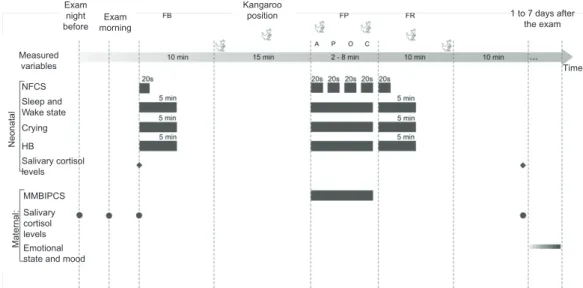
is presented in Figure 1.
The mothers’ and infants’ behavioral data were
ilmed by two digital SONY Handycam model DVD92
camcorders. Two trained individuals coded,
second-by-second, the neonatal behavioral variables (facial actions,
sleep and wake states) in addition to the maternal
variable (behavior), using digital images through the
Magix Movie Editor 15 Pro Plus. Three facial actions
(eyebrow bulge, squeezed eyes, and naso-labial furrow)
of newborns and ive sleep-wake states (deep sleep,
active sleep, quiet wake, active wake, and crying)(13) were coded through the Neonatal Facial Coding System
(NFCS)(12). The 23 categories of mothers’ behavior were coded through the Maternal Mood and Behavior
during her Infant Pain Coding System (MMBIPCS) and
later grouped into ‘typical’ and ‘typically depressed’(14). Inter-rater reliability was computed through the Kappa
coeficient with the Generalized Sequential Querier
(GSEQ), version 5.0, and the following was obtained:
Figure 1 – Organization chart of the data collection and measured variables
Ma
te
rn
a
l:
MMBIPCS
Salivary cortisol levels
Emotional state and mood
Exam night before
N
e
o
n
a
ta
l
Measured variables
NFCS
Crying
HB Sleep and Wake state
Salivary cortisol levels
Exam morning
Kangaroo
position 1 to 7 days after
the exam
Time
FB = Fase Basal, FP = Fase Procedimento, FR = Fase Recuperação, A = Antissepsia, O = Ordenha, C = Compressão Neonatal HR was obtained using three Red Dot
2258-3 electrodes, installed on all the newborns, and
connected to the Polar RS200 heart rate monitor.
A psychologist assessed the mothers’ anxiety and
depression levels using the Beck Depression Inventory
(BDI) and the Beck Anxiety Inventory (BAI)(15). The general introductory part of the Structured Clinical
Interview DSM-IV-SCID-CV(16) was used to describe the psychiatric history of mothers. Based on the scores
obtained in the BDI and BAI and the duration of anxiety
in mothers during the procedure, newborns were
divided into two groups: ‘exposed’ (BDI≥18, BAI≥20 and
MMBIPCS>30s) (n=17) and ‘non-exposed’ (BDI<18,
BAI<20 and MMBIPCS≤30s) (n=25) to maternal
depression and/or anxiety. Nursing assistants, nurses
and the psychologist, trained prior to data collection,
collaborated in the study.
After the mothers and/or legal guardians signed
free and informed consent forms, the mothers received
identiied Salivettes® tubes with written instructions to collect two samples of saliva, one at the night prior to
the exam, and the other on the morning of the exam
day. Another saliva sample was collected from both the
newborn and the mother prior to the neonatal screening
test while the infant was in a supine position, either in
the incubator or crib, and the mother was seated close
to her child. For the next 10 minutes, the newborn’s
HR was monitored and his/her face was ilmed while in
the incubator or crib (baseline phase). Afterward, the
newborn was positioned in maternal kangaroo care for
15 minutes(17). A nurse collected blood for the neonatal screening test in accordance with the unit’s protocol
using a Unistik® lancet (procedure phase) while the mother’s behavior and interaction with the newborn
were also ilmed. After the exam, the newborn was
kept in the kangaroo position for another ten minutes
(recovery phase). The video recording and cardiac
monitoring ceased and the newborn was transferred to
the incubator or crib where s/he remained without any
manipulation for another ten minutes when an additional
sample of saliva after the procedure was collected from
both the mother and child. A psychologist applied the
BDI, BAI and the SCID-CV within one to seven days
after the procedure (Figure 1).
Colored envelops marked the beginning of each
phase of data collection during ilming. The infants’ and
mothers’ medical records were searched so that their
clinical and demographic variables were collected. The
number of painful procedures performed in the 24 hours
prior to the screening test was obtained through records
in the infants’ medical iles and exams requests.
Data were stored in the Statistical Package for the
Social Sciences version 17.0 through double entry. The
duration (seconds) and percentage of time [(duration
of behavior/duration of phase) x 100] of neonatal and
maternal behaviors were computed through GSEQ and
the mean duration calculated for the NFCS, neonatal
HR and maternal and neonatal salivary cortisol levels in
each phase of the data collection (baseline, procedure,
recovery).
The relationship between the newborns’ response
variables (NFCS score, percentage of time of crying,
HR and salivary cortisol levels) and the mothers’
explanatory variables (percentage of time of behavior
and salivary cortisol levels) were initially examined
Castral TC, Warnock FF, Ribeiro LM, Vasconcelos MGL, Leite AM, Scochi CGS. 439
Characteristics f (%) Average±
Newborns
Gestational age (weeks) 32.5±1.8
Birth weight (g) 1795.6±618.4
Apgar at the 5th minute 9.5±0.7
Gender (Male) 30 (71.4)
C-section 29 (69.0)
Twins 8 (19.0)
Mothers
Age 24.5±5.9
Number of people living in the house 4.3± 1.7
Primigravida 20 (47.6)
Marital status
Cohabitating 17 (40.5)
Married 13 (30.9)
Single 10 (23.8)
Divorced 2 (4.8)
Education
Primary school 21(50.0)
Secondary school 17(40.5)
College 4 (9.5)
Occupation
Employed 29(69.0)
Unemployed 13(31.0)
Table 1 – Clinical and demographic characteristics of
newborns and mothers
x=average; ±=standard deviation; f=absolute frequency; %=percentage. α=0.20. Repeated Measures Analysis of Variance was performed for the explanatory variables, the mothers’
depression and/or anxiety. A multiple regression
analysis was performed for each neonatal variable
(NFCS score, percentage of time of cry, HR, and levels
of salivary cortisol after the procedure) to verify
which maternal explanatory variables influenced the
neonatal response variables during the procedure; the
alpha was fixed at 0.05.
Results
The neonatal screening test lasted an average of
4±1.6 minutes (2.5 to 8.7 minutes); 33 (78.6%) infants
were punctured only once during the blood collection.
The clinical and demographic characteristics of newborns
and their mothers are presented in Table 1.
anxiety. Eleven (26.2%) out of the total number of mothers
presented depression and anxiety simultaneously. The
average scores obtained by the mothers on the BDI and
BDA were 11.4±8.2 and 12.0±9.9, respectively. The irst
time most mothers (71.4%) used the kangaroo position
was during this study.
Associations were found between the NFCS scores
obtained during the procedure phase and: the mothers’
levels of salivary cortisol collected prior to the puncture
(r=0.32; p=0.040); the percentage of time newborns cried
during the procedure and the levels of mothers’ salivary
cortisol collected prior to the procedure (r=-0.32; p=0.047);
the neonatal HR measured during the procedure and the
mothers’ salivary cortisol collected the night before (r=-0.49;
p=0.002), collected before puncture (r=-0.34; p=0.025),
and after the puncture (r=-0.51; p=0.001); neonatal HR
measured during recovery and the mothers’ levels of salivary
cortisol collected the night before (r=-0.45; p=0.004), before
the puncture (r=-0.41; p=0.007), and after the puncture
(r=-0.50; p=0.001); the newborns’ levels of salivary cortisol
collected before the puncture and the mothers’ salivary
cortisol collected the night before (r=0.39; p=0.016); and
also the levels of salivary cortisol of newborns and mothers
collected after the puncture (r=0.34; p=0.027). Neither
the mothers’ anxiety and depression nor their behavior
inluenced the infants’ facial actions [Wilk’s Lambda=0.976;
F(2.39)=0.480; p=0.623], crying [Wilk’s Lambda=0.990;
F(2.39)=0.201; p=0.818], HR [F(1.88;75.07)=1.715;
p=0.189] or the newborns’ levels of salivary cortisol
[F(1.39)=0.367; p=0.548].
Before proceeding to the regression analysis, the
following potential confounding variables were tested
in relation to the neonatal response variables (NFCS
score, percentage of time of crying, average HR, and
average level of salivary cortisol after the puncture was
performed) using Person’s coeficient of correlation: the
neonatal variables (gender, GA, age, number of pain
events in the 24 hrs prior to the procedure, and average
percentage of times of the sleep and wake states
during the baseline phase); the maternal variables
(use of corticosteroids during pregnancy and previous
experience with the kangaroo method); and variables
related to the neonatal screening test (number of
punctures and duration of the procedure). We veriied
the relationship among the confounding variables to
test the multicollinearity among variables. Only some
neonatal and maternal variables presented a statistically
signiicant relationship (p<0.05) among them or with the neonatal dependent variables (Table 2).
Multiple regression analysis was not performed for
the variables ‘facial actions’ and ‘crying’ because these
did not meet the homoscedasticity assumption. Most mothers (61.9%) did not present depression
or only mild depression (14.9%). Ten (23.8%) mothers
presented moderate depression and none presented
severe depression. Similarly, most mothers did not present
anxiety (52.4%) or it was mild (26.2%). Nine (21.4%)
GA Age Gender Pain DS SA QW AW CR MK
GA -0.51† n.s 0.34* n.s n.s n.s n.s n.s 0.42*
Age -0.51† n.s -0.52† n.s n.s n.s n.s n.s -0.53†
Gender n.s n.s n.s n.s n.s n.s n.s n.s n.s
Pain 0.34* -0.52† n.s n.s n.s n.s n.s n.s n.s
DS n.s n.s n.s n.s n.s -0.54† -0.47* n.s n.s
AS n.s n.s n.s n.s n.s -0.49† -0.51† -0.40* n.s
QW n.s n.s n.s n.s -0.54† -0.49† n.s n.s n.s
AW n.s n.s n.s n.s -0.47* -0.51† n.s n.s n.s
CR n.s n.s n.s n.s n.s -0.40* n.s n.s n.s
MK 0.42* -0.53† n.s n.s n.s n.s n.s n.s n.s
NFCS 0.37* n.s n.s n.s n.s n.s n.s n.s n.s 0.37*
Crying n.s n.s n.s -0.36† n.s -0.32* n.s n.s n.s -0.36*
HR n.s 0.47* n.s n.s n.s -0.37* n.s n.s n.s -0.33*
Cortisol n.s -0.34* n.s n.s n.s n.s n.s n.s n.s 0.38*
Table 2 – Person’s linear correlation matrix (r) and values of p probabilities among the neonatal response variables during the procedure and neonatal and maternal confounding variables.
GA=gestational Age; Pain=number of pain events in the 24 hrs prior to the procedure; DS=average percentage of time in baseline deep sleep; AS= average time in baseline active sleep; QW= average percentage of time in baseline quiet wake state; AW= average percentage of time in baseline active wake state; CR= average percentage of time in baseline crying; MK=maternal experience with kangaroo method before the procedure; NFCS= score obtained on the pain scale; Cry= average percentage of time crying; HR=average neonatal HR. Cortisol=levels of salivary cortisol before the puncture. *0.01 < p <0.05; †p<0.01;
n.s.= not statistically signiicant.
Independent variables β t p
Mothers’ salivary cortisol from the night before the procedure -0.35 -2.243 0.031*
Newborns’ age 0.32 2.088 0.044*
Newborn’s percentage of time in active sleep (baseline) -0.21 -1.461 0.153
Newborn’s exposure to the mother’s depression/anxiety -0.15 -1.074 0.290
Mother’s salivary cortisol levels right before the procedure -0.10 -0.601 0.552
Mother’s experience with kangaroo prior to the procedure -0.03 -0.168 0.868 Table 3 – Linear regression model for neonatal HR during procedure
β=standardized weight; t=statistics t; *p<0.05
Independent variables β t p
Mothers’ salivary cortisol levels before the procedure 0,34 2,183 0,036*
Mothers’ salivary cortisol levels from the night before 0,22 1,355 0,184
Mothers’ experience with kangaroo prior to the procedure 0,24 1,492 0,145
Newborns’ age -0,21 -1,081 0,287
Mothers’ salivary cortisol levels after the procedure 0,08 0,437 0,665 Table 4 – Linear regression model for the newborns’ levels of salivary cortisol after the procedure
β=standardized weight; t=statistics t; * p<0.05
The explanatory model of the neonatal HR during
the procedure is presented in Table 3. The mothers’ levels
of salivary cortisol and the newborns’ age contributed
signiicantly to the model; the mothers’ levels of salivary
cortisol collected the night before the procedure had a
greater contribution. These two variables explained 28.2%
of the variance of newborns’ HR during the procedure
[adjusted coeficient R2 =0.282; F(2.35)=8.219; p=0.001].
The model proposed to explain the variation in
the salivary cortisol levels of newborns before the
procedure is presented in Table 4. The mothers’ levels
of salivary cortisol before the procedure significantly
contributed to the model, explaining 9.2% of the
variance in the newborns’ salivary cortisol levels
before the procedure [adjusted coefficient R2 =0.092;
Castral TC, Warnock FF, Ribeiro LM, Vasconcelos MGL, Leite AM, Scochi CGS. 441
Discussion
This paper presented an investigation of maternal
factors related to newborns’ responses to pain and stress
when exposed to the neonatal screening test while in
the kangaroo position. Various signiicant associations
were found, suggesting the existence of a co-regulation
between mother and child in the context of neonatal
pain and stress while the infant is held in the kangaroo
position. Maternal salivary cortisol levels, which are
an indicator of stress, were associated with various
neonatal variables (NFCS score, duration of crying, HR,
and salivary cortisol levels), though no association was
found between the mothers’ salivary cortisol levels and
their own behavior (typical and typically depressed) or
depression and/or anxiety. The relationship between the
mothers’ salivary cortisol levels and neonatal variables
is still seldom studied in the context of neonatal pain.
No other study has examined this relationship when the
infant experiences such a painful event while held in the
kangaroo position.
The mothers’ levels of salivary cortisol before the
procedure explained the variance in the newborns’
levels of salivary cortisol after the procedure. Such
indings are similar to those of another study addressing
the relationship between plasma levels of cortisol and
maternal psychosocial stress with the behavioral and
physiological responses of full-term newborns to calcaneal
heel puncture. The study reports that high levels of
plasma cortisol observed in mothers during pregnancy
explained high levels of salivary cortisol observed in their
infants after the procedure and during recovery(18). This study’s results add to such evidence beyond the prenatal
period to the population of preterm newborns.
There was also a positive association between the
mothers’ salivary cortisol levels and the newborns’ pain
scores (NFCS). This is the irst time this relationship is
reported in the literature. Such a relationship, however,
requires further investigation through statistical analysis
that would allow adjusting for potential confounding
variables. A more reined analysis of this variable was
not possible in this study due to restrictions imposed by
the statistical assumption of homoscedasticity.
The mothers’ levels of salivary cortisol from
the night before, along with the newborns’ GA, were
predictors of neonatal HR. The relationship between
the autonomic nervous system and the
hypothalamic-pituitary-adrenal (HPA) axis is very complex. The inverse
relationship between the cortisol level and HR variability
may be explained by a system of negative feedback in
which appropriate HPA axis regulation is inluenced,
in part, by the modulation of the autonomic nervous
system(19). Since the kangaroo position involves very close contact between mother and child, the inverse
relationship between the newborns’ HR and the mothers’
salivary cortisol levels suggests there is mediation of the
kangaroo position in relation to the newborns’ autonomic
nervous system and HPA axis. The close contact also
encourages the self-regulation of maternal stress,
which contributes to the effectiveness of the kangaroo
position in alleviating neonatal pain and stress. Even
though these assumptions cannot be appropriately
conirmed due to the lack of a control group not using
the kangaroo position, we observed that the mothers’
stress contributed to their newborns’ responses to pain
and stress caused by the neonatal screening test.
In contrast with the mothers’ salivary cortisol levels,
the mothers’ behavior and depression and/or anxiety did
not affect the newborns’ responses to pain and stress.
Six studies, addressing only full-term infants in the
context of vaccination, also evaluated maternal behavior
during a painful event experienced by newborns(20-24). Even though a positive association was found between
the maternal behavior and the responses of infants
to pain, such an association was weak in most cases.
Additionally, only two studies used a validated scale to
measure neonatal pain, while the maternal behavior was
evaluated differently in the different the studies. Both
the infants’ and the mothers’ behavior was coded in
intervals of time (e.g. at each ive second point) and not
second-by-second as we did in this study.
Depression and/or anxiety of mothers has been
seldom investigated in the context of neonatal pain.
Among the factors that may have contributed to the
fact that no positive association was found between the
mothers’ depression and/or anxiety and the responses
of their newborns to pain is the reduced number of
mothers with depression and/or anxiety in the sample,
the exclusive use of self-reporting instruments, and
evaluation in the post delivery period. Depression and/
or anxiety experienced during pregnancy may expose
newborns to a greater risk of presenting an altered
response to pain and stress. Future studies should assess
mothers both in the prenatal and post-natal periods, as
well as use both self-reporting scales and observation.
Finally, maternal kangaroo care may have softened
the negative effect of depression and anxiety in the
response and regulation of newborns. The prevalence of
post delivery depression in mothers using the mother-child
kangaroo method during the hospitalization of infants in
a neonatal unit decreased, from 37.3% at admission, to
relationship between the kangaroo position and a lack
of negative effects in the exposure of newborns to their
mothers’ depression and/or anxiety was not established
in this study due to the non-existence of a control group
(lacking kangaroo position).
Conclusion
Maternal stress, measured through the mothers’
levels of salivary cortisol collected during the post delivery
period, inluenced the response of newborns to pain and
stress when subject to the neonatal screening test in the
kangaroo position. The newborns’ HR variations were
explained by the mothers’ salivary cortisol levels taken the
night before and newborns’ age; with a greater contribution
of the mothers’ cortisol levels to the model. The mothers’
cortisol levels observed before the procedure explained the
newborns’ cortisol levels in response to the painful exam.
This study’s limitations are the relatively small number of
mothers in the group with depression and/or anxiety in
addition to the impossibility to establish a causal relationship
among variables due to the study’s cross-sectional nature.
We expect this study to contribute to the acknowledgement
that mothers play an important role in the regulation of
stress and acute pain for preterm infants while being held
in the kangaroo position. This study’s indings can also
support the development of protocols to implement the
kangaroo position for the management of neonatal acute
pain, favoring the interaction between mother and newborn
and the establishment of more integrated and humanized
neonatal care with the active participation of mothers.
Acknowledgement
We acknowledge Professor Claudia Benedita dos
Santos for the statistical assistance, Professor Sonir R. R.
Antonini for the assistance with analysis of salivary cortisol,
the laboratory technician José Roberto for the trials with
salivary cortisol, the nurses Andreara, Mariana, Laiane
and Fernanda for their help with the coding of behavioral
images, the research assistants Aline, Carol, Joselaine,
Leticia, Mayra and Mariana for their help in data collection,
the nurse Thaiomara for the recruitment of subjects and
the psychologists Leticia and Laura for the assessment of
the emotional state and mood of the mothers.
References
1. Stevens BJ, Anand K, McGrath PJ. An overview of pain in
neonates and infants. In: Stevens BJ, Anand KJS, McGrath
PJ. Pain in neonates and infants. 4th ed. Philadelphia (PA):
Elsevier; 2007. p. 1-9.
2. Finley GA, Franck LS, Grunau RE, von Baeyer
CL. Why children’s pain matter? Pain Clin Updates.
2005;13(4):1-6.
3. Carbajal R, Rousset A, Danan C, Coquery S, Nolent
P, Ducrocq S et al. Epidemiology and treatment of painful
procedures in neonates in intensive care units. JAMA.
2008;300(1):60-70.
4. Grunau RE, Holsti L, Haley DW, Oberlander T, Weinberg
J, Solimano A, et al. Neonatal procedural pain exposure
predicts lower cortisol and behavioral reactivity in preterm
infants in the NICU. Pain. 2005;113(3):293-300.
5. Grunau RE, Tu MT, Whitield MF, Oberlander TF, Weinberg J, Yu W et al. Cortisol, behavior, and heart rate
reactivity to immunization pain at 4 months corrected
age in infants born very preterm. Clin J Pain. 2010;
26(8):698-704.
6. Gunnar M, Quevedo K. The neurobiology of stress and
development. Annu Rev Psychol. 2007;58:145-73.
7. Warnock F, Castral TC, Brant R, Sekilian M, Leite AM,
Owens Sde L et al. Brief report: Maternal kangaroo care
for neonatal pain relief: a systematic narrative review. J
Pediatr Psychol. 2010;35(9):975-84.
8. Ludington-Hoe SM, Swinth JY. Developmental aspects
of kangaroo care. JOGNN. 1996;25(8):691-703.
9. Hofer MA. Hidden regulators in attachment,
separation, and loss. Monogr Soc Res Child Dev.
1994;59(2-3):192-207.
10. Schore AN. Back to basics: attachment, affect
regulation, and the developing right brain: linking
developmental neuroscience to pediatrics. Pediatr Rev.
2005;26(6):204-17.
11. Rolim KMC, Cardoso MVLML. Discourse and practice
of care to newborns at risk: Relecting about humanized
care. Rev. Latino-Am. Enfermagem. 2006;14(1):85-92.
12. Grunau RV, Craig KD. Pain expression in neonates:
Facial action and cry. Pain. 1987;28(3):395-410.
13. Prechtl H. The behavioural states of the newborn
infant (a review). Brain Res. 1974;76(2):185-212.
14. Warnock F, Bakeman R, Shearer K, Misri S, Oberlander
T. Caregiving behavior and interactions of prenatally
depressed mothers (antidepressant-treated and
non-antidepressant-treated) during newborn acute pain.
Infant Ment Health J. 2009;30(4):384-406.
15. Cunha J. Manual da versão em português das Escalas
Beck. São Paulo (SP): Casa do Psicólogo; 2001.
16. Del-Ben CM, Rodrigues CR, Zuardi AW. Reliability of
the Portuguese version of the structured clinical interview
for DSM-III-R (SCID) in a Brazilian sample of psychiatric
outpatients. Braz J Med Biol Res. 1996;29(12):1675-82.
17. Castral TC, Warnock F, Leite AM, Haas VJ, Scochi CG.
The effects of skin-to-skin contact during acute pain in
Castral TC, Warnock FF, Ribeiro LM, Vasconcelos MGL, Leite AM, Scochi CGS. 443
18. Davis EP, Sandman CA. The timing of prenatal
exposure to maternal cortisol and psychosocial stress
is associated with human infant cognitive development.
Child Dev. 2010;81(1):131-48.
19. Thayer JF, Hall M, Sollers III JJ, Fischer JE. Alcohol use,
urinary cortisol, and heart rate variability in apparently
healthy men: Evidence for impaired inhibitory control
of the HPA axis in heavy drinkers. Int J Psychophysiol.
2006;59(3):244-50.
20. Jahromi LB, Putnam SP, Stifter CA. Maternal regulation
of infant reactivity from 2 to 6 months. Dev Psychol.
2004;40(4):477-87.
21. Axia G, Bonichini S. Are Babies Sensitive to the
Context of Acute Pain Episodes? Infant Distress and
Maternal Soothing During Immunization Routines at 3 and
5 Months of Age? Infant Child Dev. 2005;14:51-62.
22. Braarud HC, Stormark KM. Maternal soothing
and infant stress responses: soothing, crying and
adrenocortical activity during inoculation. Infant Behav
Dev. 2006;29(1):70-9.
23. Piira T, Champion GD, Bustos T, Donnelly N,
Lui K . Factors associated with infant pain response
following an immunization injection. Early Human Dev.
2007;83(5):319-26.
24. Din L, Pillai Riddell R, Gordner S. Brief report: maternal
emotional availability and infant pain-related distress. J
Pediatr Psychol. 2009;34(7):722-6.
25. De Alencar AE, Arraes LC, De Albuquerque EC,
Alves JG. Effect of kangaroo mother care on postpartum
depression. J Trop Pediatr. 2009;55(1):36-8.