ISSN: 2383-2568 Quarterly of International Archives of Health Sciences 2015;2(4):151-155
C I T A T I O N L I N K S
Article History
Received: October 15, 2015 Accepted: December 9, 2015 ePublished: December 31, 2015 Correspondence
Address: Faculty of Environment Health, Social Determinant of Health Research Center, Kashan University of Medical Sciences, Qotb-e-Ravandi Boulevard, Kashan, Iran
Phone: +983155540111 Fax: +983155540111 [email protected] *”Social Determinants of Health (SDH) Research Center” and “Environmental Health Department, Health Faculty”, Kashan University of Medical Sciences, Kashan, Iran
1”Social Determinants of Health (SDH) Research Center” and “Environmental Health Department, Health Faculty”, Kashan University of Medical Sciences, Kashan, Iran
2Biostatistics & Public Health Depart-ment, Health Faculty, Kashan Univer-sity of Medical Sciences, Kashan, Iran 3Health, Safety & Environment Faculty, Shahid Beheshti University of Medical Sciences, Tehran, Iran
4English Translation Studies Depart-ment, Foreign Language Faculty, Isfahan Branch, Islamic Azad University, Isfahan, Iran
[1] Evaluation of bacterial quality and trace elements concentrations in 25 brands of Iranian bottled drinking water [2] Chemical quality evaluation for the inlet and outlet water taken from of the desalination plants utilized in Kashan during 2008 [3] Measurement of size and number of suspended and dissolved nanoparticles in water for evaluation of colloidal fouling in RO membranes [4] Y2K generation FILMTEC RO membranes combined with new pretreatment techniques to treat raw water with high fouling potential: Summary of experience [5] Seasonal fouling on seawater desalination RO membrane [6]
Electrodialysis on RO concentrate to improve water recovery in wastewater reclamation
[7] Biofouling in membrane systemsj-a review [8] Magnetic resonance imaging and 3D
simulation studies of biofilm accumulation and cleaning on reverse osmosis membranes
[9] Ultrasonic defouling of reverse osmosis membranes used to treat wastewater effluents
[10] Investigation of membrane fouling [11] Guidelines for drinking-water quality:
Recommendations [12] Performance of aromatic polyamide RO membranes synthesized
by interfacial polycondensation process in a water-tetrahydrofuran system [13] Standard setting processes and regulations for environmental contaminants in drinking water: State versus federal needs and viewpoints [14] Using SDI, SDI+ and MFI to evaluate fouling in a UF/RO desalination pilot plant [15] Antiscale magnetic pretreatment of reverse osmosis feedwater [16] Fouling of reverse osmosis and ultrafiltration membranes: a
critical review [17] Operational optimization of air conditioning cooling water system with UF-RO desalination [18] Periodic air/water cleaning for control of biofouling in
spiral wound membrane elements [19] High recovery of concentrated RO brines using
forward osmosis and membrane distillation [20] A simplified simulation model of
RO systems for seawater desalination [21] Standards Methods for the Examination of
Water and Wastewater; 2012 [22] Guidelines for drinking-water quality [23] Biological approaches for addressing the grand challenge of providing access to clean drinking water
Aims One of the consequences of taking ground water into surface is changing its chemical quality, specially increasing the concentration of dissolved salts. This research was performed in order to analyze growth possibility of heterotrophic bacteria in the membrane of active desalination plants in Kashan City, Iran.
Instrument & Methods This descriptive cross-sectional study was done on water output of 20 active desalination plants in 2013 in Kashan City, Iran and 200 specimens of input and output water was randomly extracted from desalination plants. Awareness and education
level of system operators, filter changing intervals, HPC of input and output water and
chlorine concentration of input and output water were measured and recorded. Obtained data were analyzed statistically with SPSS 18 software using one-way ANOVA, Chi-square, McNemar and one-sample T tests.
Findings There was a significant relation between the interval time and output HPC level
of the plants (p<0.05). The mean number of HPC was decreased from 16.7±24.5CFU/ml in
input water to 14.4±23.7CFU/ml in output water which was not significant (p>0.05). The
mean concentration of chlorine in samples of 20 desalination plants was 0.76±0.44mg/l in
input water and 0.64±0.52mg/l in output water (p>0.05). Level of awareness had significant
relation with the output water pollution with HPC (p<0.05) but their education level had no
such relation (p>0.05).
Conclusion The mean level of HPC pollution in output water of desalination plants of Kashan City, Iran, is much less than WHO standards.
A B S T R A C T A R T I C L E I N F O
Article Type Descriptive Study
Authors
Hosseindoost Gh.1MSc, Mazaheri Tehrani A.1MSc, Ghilasi H.R.2PhD, Ahmadi Marzaleh M.3BSc, Sabuhi H.4MSc,
Miranzadeh M.B.* PhD
Keywords Osmosis; Water Purification; Biofilms; Heterotrophic Growth
How to cite this article Hosseindoost Gh, Mazaheri Tehrani A, Ghilasi H.R,Ahmadi Marzaleh M, Sabuhi H, Miranzadeh M.B. Analysis the Existence of Heterotrophic Bacteria in Active Water Desalination Plant Output of Kashan City, Iran. International Archives of Health Sciences. 2015;2(4):151-155.
Analysis the Existence of Heterotrophic Bacteria in Active
Water Desalination Plant Output of Kashan City, Iran
Analysis the Existence of Heterotrophic Bacteria in Active Water Desalination Plant Output… 152
Int Arch Health Sci Fall 2015, Vol. 2, Iss. 4
Introduction
According to increasing of population and developing industrial and agricultural activities in recent years, water extraction rate from ground resources has ascended. One of the consequences of taking ground water into surface is changing its chemical quality, specially increasing the concentration of dissolved salts or TDS (total dissolved solid) due to invasion of salty water into fresh water
[1, 2].
This quality changing and water salinization is very obvious in many cities of Iran, especially in tropical regions and deserts that are very poor in terms of surface water resources. At the moment, more than 80% of consumable water in Kashan City, Iran, with a population more than 250.000 is provided by 65 deep wells that have been dogged inside the city and its suburb. During the last two decades, ground water level of Kashan region has been dropped off due to indiscriminate extraction and successive droughts that one of its clear consequences is uptrend of TDS concentration and salinity increasing of well water. This quality changing of water has caused Kashan residents to look for new options of providing fresh water for drinking uses. One of the well-known options is desalination plants which are more than 20 in Kashan region at this time
[2].
Desalting process and making water fresh in these machines is done by reverse osmosis (RO) process. In RO process one of the main parts of the machine is filter or semi permeable membrane that plays the role of separating salts from water. This membrane is made of different materials, e.g. propylene, carboxy metal cellulose and etc. Membrane materials, their changing interval, using condition and machine maintaining have a great effect on the output water quality [1, 3-6].
Although desalination machines are capable to remove the main part of water TDS and provide desired taste which satisfies the consumers, but one of the discussed topics about them is possible growth of heterotrophic bacteria (HPC), that is so-called biofilm, on the membrane [5, 7-10]. Although
HPC existence in refined water is not considered as water pollution and unhealthy condition, but high number of HPC can be a sign of defect in refinery or water disinfection systems [7, 11-13].
Although there are some strategies to prevent HPC growth in these refining water systems but using chlorine and other oxidant ion compounds to prevent biofilm growth in membranes is not a good choice because these compounds cause decomposition of the membranes tissue and decrease their useful life [14-17]. Moreover, in storage tanks, the
output water from desalination plants is mostly open and because of the lack of utilization condition and suitable maintenance, remained chlorine can make secondary bacterial pollution that will be dangerous for consumers’ health [9, 16, 18-20].
This research was performed in order to analyze growth possibility of heterotrophic bacteria in the membrane of active desalination plants in Kashan region and identify some parameters affecting it and also control remaining chlorine concentration in delivered water.
Instrument & Methods
This descriptive cross-sectional study was done on water output of 20 active desalination plants during January to November 2013 in Kashan City, Iran. 100 specimens of input water (5 from each plant) and 100 specimens of output water (5 from each plant) was randomly extracted from each desalination plant (totally 200 specimens) in glass sterile containers and were transferred to Microbiology Laboratory of the Health School of Kashan University of Medical Sciences and maintained at 4°C. From each plant, 5 operators were selected randomly to fill a questionnaire (totally 100 operators). A researcher-made questionnaire (10 questions) was used to evaluate the level of knowledge of system operators regarding health and water quality (the questionnaire can be find as an attachment). Questions had different points but the sum was 100 points. Points more than 75 was considered as “good”, 50-75 as “moderate” and less than 50 as “weak”. The validity of the questionnaire was confirmed by the 10 environmental health and statistic experts. The Cronbach’s alpha method was used to confirm the reliability of the instrument (α=0.75).
To analyze the biofilm growth possibility, the HPC index or heterotrophic bacteria enumeration was used [11, 21, 22]. The
input and output water was done based on presented instruction in the last print of Standard Method Book [21]. Filter changing
interval of each plant was measured by the mean of last 5 changings from the recorded documents in the plant offices.
Obtained data were analyzed statistically with SPSS 18 software. The relation between filter changing intervals and output HPC level of the plants was analyzed by one-way ANOVA test, awareness and education level with output HPC level of the plants was analyzed by Chi-square test, the difference between input and output HPC level was analyzed by McNemar test and the difference between input and output chlorine concentration was analyzed by one-sample T test.
Findings
The filter changing interval in 20 desalination plants were between 6 and 12 months with the mean of 9.6±3.8 months. There was a significant relation between the interval time and output HPC level of the plants (p<0.05).
Figure 1) Comparing the input and output HPC level of 20 desalination plants of Kashan City, Iran, in 2013 with
McNemar test
Plant No.
Filter changing interval
(month)
Input HPC
(CFU/ml)
Output HPC
(CFU/ml)
p Value
1 12.12±4.12 0.6±0.9 10.3±12.2 0.07
2 10.01±3.25 42.2±67.2 32.5±17.9 0.08
3 10.41±3.15 2.4±4.5 16.9±23.2 0.27
4 8.29±2.13 2.8±3.5 0.6±0.2 0.06
5 8.15±2.69 0.8±8.9 0.8±0.1 0.1
6 10.35±3.26 2.9±4.5 6.1±8.9 0.13
7 12.19±3.78 12.8±17.9 70.6±87.5 0.09
8 11.16±2.28 6.3±8.9 24.5±43.3 0.09
9 12.26±2.89 8.9±8.4 24.2±15.2 0.12
10 8.21±2.75 8.8±17.9 26.3±52.7 0.06
11 9.16±2.98 52.0±68.7 82.6±177.8 0.08
12 6.85±2.13 4.7±5.5 0.4±0.5 0.07
13 9.59±2.26 4.6±8.9 0.8±0.9 0.14
14 8.28±2.58 22.3±43.8 0.8±0.2 0.11
15 8.69±2.38 52.6±73.9 4.7±8.9 0.06
16 9.79±2.39 2.6±4.5 8.6±10.9 0.09
17 9.56±2.84 92.7±104.4 0.7±0.3 0.32
18 12.22±3.52 2.4±4.5 24±25.1 0.15
19 11.41±2.65 2.1±4.8 8.5±8.4 0.21
20 10.29±3.71 12.6±13.0 6.9±5.5 0.09
Mean 9.6±3.8 16.7±24.5 14.4±23.7 0.1
The mean number of HPC was decreased from 16.7±24.5CFU/ml in input water to 14.4±23.7CFU/ml in output water which was
not significant (p>0.05). The minimum number of HPC in both input and output water samples were zero and the maximum number of HPC in input and output water was 92.7±104.4CFU/ml (Plant No. 17) and 82.6±177.8CFU/ml, (Plant No. 11) respectively (Figure 1).
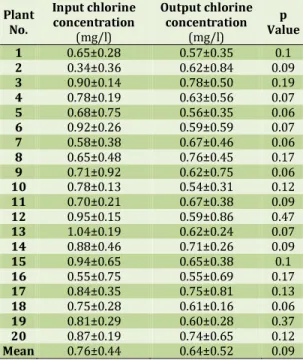
The mean concentration of chlorine in samples of 20 desalination plants was 0.76±0.44mg/l in input water and 0.64±0.52mg/l in output water (p>0.05). The minimum mean of chlorine concentration was seen in Plant No. 10 (0.54±0.31mg/l) and the maximum in Plant No. 3 (0.78±0.50mg/l; Figure 2).
Figure 2) Comparing the input and output chlorine concentration of 20 desalination plants of Kashan City,
Iran, in 2013 with one-sample T test
Plant No.
Input chlorine concentration
(mg/l)
Output chlorine concentration
(mg/l)
p Value
1 0.65±0.28 0.57±0.35 0.1
2 0.34±0.36 0.62±0.84 0.09
3 0.90±0.14 0.78±0.50 0.19
4 0.78±0.19 0.63±0.56 0.07
5 0.68±0.75 0.56±0.35 0.06
6 0.92±0.26 0.59±0.59 0.07
7 0.58±0.38 0.67±0.46 0.06
8 0.65±0.48 0.76±0.45 0.17
9 0.71±0.92 0.62±0.75 0.06
10 0.78±0.13 0.54±0.31 0.12
11 0.70±0.21 0.67±0.38 0.09
12 0.95±0.15 0.59±0.86 0.47
13 1.04±0.19 0.62±0.24 0.07
14 0.88±0.46 0.71±0.26 0.09
15 0.94±0.65 0.65±0.38 0.1
16 0.55±0.75 0.55±0.69 0.17
17 0.84±0.35 0.75±0.81 0.13
18 0.75±0.28 0.61±0.16 0.06
19 0.81±0.29 0.60±0.28 0.37
20 0.87±0.19 0.74±0.65 0.12
Mean 0.76±0.44 0.64±0.52 0.09
Analysis the Existence of Heterotrophic Bacteria in Active Water Desalination Plant Output… 154
Int Arch Health Sci Fall 2015, Vol. 2, Iss. 4
Discussion
In this study, desalination plant operators’ awareness, their education level, chlorine concentration in input and output water and filter changing interval was determined and heterotrophic bacteria growth in refined output water of active desalination plants in Kashan City, Iran, was analyzed.
Less interval between reverse osmosis filters washing, decreased heterotrophic bacteria growth in refined output water significantly, that was because of preventing biofilm growth and washing other impurities from filters membrane. One of the reasons of increasing the HPC number in output water of desalination plants in reverse osmosis method is the lack of periodic washing of membranes or long time interval between two washings that can have a deep impact on output quality and also filters useful life [8, 9, 22].
Chlorine concentration in input water of desalination plants which had germicidal and disinfection features caused the decreasing of HPC growth in filters and less HPC numbers in output water [10, 16]. It should be noted that in
used filters in the reverse osmosis process, remaining chlorine is removed like other salts of course, since high oxidizer products, e.g. chlorine, on RO membranes have negative influence and decrease its useful life, so increasing additional chlorine in the water is prevented except than what exists in input water routinely [7, 15, 23].
Based on World Health Organization (WHO) guidelines, HPC legal number in drinking water is 500CFU/ml [11, 13] that by comparing
this number with provided results from our study (14.4CFU/ml), it can be said that there is no problem in output water from desalination plant in terms of HPC number and their number is far less than maximum allowable number in drinking water. It is worth noting that in some specimens, HPC number was higher than 500CFU/ml which could not indicate inappropriateness of refined water quality because based on WHO instructions, high HPC in drinking water has only hygienic danger for the consumers. High number of HPC can provide appropriate conditions for other microorganisms growth, e.g. Legionella, Escherichia coli and etc., that product flavor, adore and corrosion in drinking water [11, 13].
Awareness level of operators had a significant relation with output water pollutions level of desalination plants (p<0.05) but education level of operators had no significant relation with it (p>0.05). It can be due to having related working experience or passing professional training periods by the operators that improve the utilization condition and observing technical points in effective desalination plants even with a degree less that high school diploma.
We were not faced with any limitations in performing this study. The authors suggest similar studies to be carried on microbial quality of desalinated water in other cities of Iran.
Conclusion
The mean level of HPC pollution in output water of desalination plants of Kashan City, Iran, is much less than WHO standards; decreasing the interval of filter changing is suggested to reduce the level of HPC in output water.
Acknowledgements: We would like to thank
research center of Kashan University of Medical Sciences for their financial support.
Ethical Permission: None declared by
authors.
Conflicts of Interests: None declared by
authors.
Funding/Support: This article is resulted
from the research project No. 9193 that has been performed by financial support from research center of Kashan University of Medical Sciences.
References
1- Miranzadeh MB, Ehsanifar M, Iranshahi L. Evaluation of bacterial quality and trace elements concentrations in 25 brands of Iranian bottled drinking water. Am Eurasian J Agri Environ Sci. 2011;11(3): 341-5.
2- Miranzadeh MB, Rabbani DK. Chemical quality evaluation for the inlet and outlet water taken from of the desalination plants utilized in Kashan during 2008. Feyz. 2010;14(2):120-5. [Persian]
3- Park K., Park JY, Lee S, Cho J. Measurement of size and number of suspended and dissolved nanoparticles in water for evaluation of colloidal fouling in RO membranes. Desalination. 2009;238(1-3):78-89. 4- Redondo J, Lomax I. Y2K generation FILMTEC RO
membranes combined with new pretreatment
techniques to treat raw water with high fouling
potential: Summary of experience. Desalination.
5- Yang, HL, Huang C, Lin JC. Seasonal fouling on seawater desalination RO membrane. Desalination. 2010;250(2):548-52.
6- Zhang Y, Ghyselbrecht K, Meesschaert B, Pinoyc L, Van der Bruggen B. Electrodialysis on RO concentrate to improve water recovery in wastewater reclamation. J Membr Sci. 2011;378(1-2):101-10.
7- Baker JS, Dudley LY. Biofouling in membrane systemsj-a review. Desalination. 1998;118(1-3):81-9. 8- Creber SA, Pintelon TRR, Graf von der Schulenburg DAW, Vrouwenvelder JS, van Loosdrecht MCM, Johns ML. Magnetic resonance imaging and 3D simulation studies of biofilm accumulation and cleaning on reverse
osmosis membranes. Food Bioprod Process.
2010;88(4):401-8.
9- Feng D, van Deventer JSJ, Aldrich C. Ultrasonic defouling of reverse osmosis membranes used to treat
wastewater effluents. Sep Purif Technol.
2006;50(3):318-323.
10- Mohammadi T, Madaeni SS, Moghadam MK. Investigation of membrane fouling. Desalination. 2003;153(1):155-60.
11- World Health Organization. Guidelines for drinking-water quality: Recommendations. Geneva: World Health Organization; 2004.
12- Shawky H. Performance of aromatic polyamide RO membranes synthesized by interfacial polycondensation process in a water-tetrahydrofuran system. J Membr Sci. 2009;339(1):209-14.
13- Sidhu KS. Standard setting processes and regulations for environmental contaminants in drinking water: State versus federal needs and viewpoints. Regul Toxicol Pharmacol. 1991;13(3):293-308.
14- Alhadidi A, Kemperman AJB, Schurer R, Schippers JC, Wessling M, van der Meer WGJ. Using SDI, SDI+ and MFI
to evaluate fouling in a UF/RO desalination pilot plant. Desalination. 2012;285:153-62.
15- Baker JS, Judd SJ, Parsons SA. Antiscale magnetic
pretreatment of reverse osmosis feedwater.
Desalination. 1997;110(1-2):151-65.
16- Goosen MFA, Sabalani SS, Al-Hinai H, Al-Obeidani S, Al-Belushi S, Jackson D. Fouling of reverse osmosis and ultrafiltration membranes: a critical review. Sep Sci Technol. 2004;39(10):2261-97.
17- Han Y, LiFen L, FengLin Y, Takaoka D, ChanChan W. Operational optimization of air conditioning cooling water system with UF-RO desalination. Desalination. 2010;251(1):53-7.
18- Cornelissen ER, Vrouwenvelder JS, Heijman SGJ, Viallefont X.D, Van Der Kooij D, Wessels LP. Periodic air/water cleaning for control of biofouling in spiral
wound membrane elements. J Membr Sci.
2007;287(1):94-101.
19- Martinetti CR, Childress AE, Cath TY. High recovery of concentrated RO brines using forward osmosis and membrane distillation. J Membr Sci. 2009. 331(1):31-39. 20- Oh HJ, Hwang TM, Lee S. A simplified simulation model of RO systems for seawater desalination. Desalination. 2009;238:128-39.
21- APHA, AWWA, WEF. Standards Methods for the Examination of Water and Wastewater; 2012. Available from: http://www.standardmethods.org/
22- World Health Organization. Guidelines for
drinking-water quality. 4th edition. Available from:
http://www.who.int/water_sanitation_health/publicati ons/dwq_guidelines/en/