Rev Saúde Pública 2004;38(3) www.fsp.usp.br/rsp
Pharmacists’ knowledge of sanitary legislation
and professional regulations
Luci Rodrigues da Silvaa and Elisabeth M eloni Vieirab
aSecretaria de Saúde do Município de Ribeirão Preto. Ribeirão Preto, SP, Brasil. bDepartamento de
Medicina Social. Faculdade de Medicina de Ribeirão Preto. Universidade de São Paulo. Ribeirão Preto, SP, Brasil
Correspondence to:
Departamento de Medicina Social
Faculdade de Medicina de Ribeirão Preto - USP Av. dos Bandeirantes, 3900
14490-900 Ribeirão Preto, SP, Brasil E-mail: [email protected]
Keywords
Pharmacists. Legislation, pharmacy. Pharmaceutical services. Knowledge, attitudes, practice. Legislation, health. Education, pharmacy.
Abstract
Objective
To characterize the profile of pharmacists employed as technical supervisors in drugstores and evaluate their knowledge regarding certain aspects of the legislation controlling drugstores and the profession in general.
Methods
Based on 175 drugstores in the city of Ribeirão Preto, southeastern Brazil, 100 pharmacists/technical supervisors were randomly selected. Data collection was done by means of in-person interviews, and was guided by a questionnaire evaluating knowledge and attitudes. Data were processed and analyzed using Epi Info and Stata software. Associations were sought between dependent and independent variables using Pearson’s chi-squared and Fisher’s exact tests.
Results
Most pharmacists were women (64%), aged 22-29 years (47%), graduated approximately three years prior to data collection, trained to work in the pharmaceutical industry (36%) or in clinical analysis (29%). Pharmacist’s knowledge of sanitary legislation was considered as insufficient for 28% of subjects, regular for 50%, and good for 22%. Low levels of knowledge were observed regarding the legal requirement for the presence of a pharmacist during the entire drugstore opening hours, pharmacists’ attributions, sale of antibiotics, and penicillin administration. It was found that most professionals have difficulties handling the concepts of ‘generic’ and ‘similar’ drugs. Low level of knowledge was not associated with any of the independent variables, indicating that this is a generalized phenomenon, i.e., one present among pharmacists of all age groups and both sexes, irrespective of the time since graduation, institution attended, and modality of graduation, among others.
Conclusions
We conclude that training in the field of drug pharmaceutical care, during undergraduate studies and, especially, during traineeship in pharmacies and drugstores is deficient. It is necessary to divulge information concerning sanitary legislation so that pharmacists may fully exert their profession, without risk of legal threats or hazard to the population.
INTRODUCTION
Until the mid Nineteenth Century, pharmacists were single-handedly responsible for the process of drug manufacture. With the industrialization of
medica-ments, serums, and vaccines, Pharmacy began includ-ing, in addition to the compounding of products, the sale of pharmaceutical specialties as well.2 Pharmacy
is slowly changing its major characteristics, a fact which directly affects the profile of the pharmacist.
The present study was supported by the Fundação de Apoio ao Ensino, Pesquisa e Assistência do Hospital das Clínicas da Faculdade de Medicina de Ribeirão Preto, Universidade de São Paulo (FAEPA – Process n. 672/2001).
Based on the Master’s dissertation presented at the Department of Social Medicine, Faculdade de Medicina de Ribeirão Preto, Universidade de São Paulo, 2002.
Rev Saúde Pública 2004;38(3) www.fsp.usp.br/rsp Farmacêuticos e legislação sanitária
Silva LR & Vieira EM
Resolution 328 of 22 May 1999, approved by the National Sanitary Surveillance Agency (Anvisa) es-tablishes the responsibilities and attributions of phar-macists and drugstore proprietors, ‘pharmacist’ being defined as “the person responsible for supervision and dispensation, which must possess the necessary scien-tific skills and formal training for the activity”, and that the proprietor “must predict and provide the re-sources necessary for running the establishment.
Since drugs have lately become predominantly market-oriented products, it has become increasingly difficult for pharmacists to assert themselves through their technical knowledge, further estranging these professionals from their original function: promot-ing the rational use of medication. As with several other healthcare professionals, pharmacists are in-serted into a labor market whose homogeneous ra-tionale is profit at any expense. Labor relationships often impose upon pharmacists the choice between maintaining their positions and violating both sani-tary legislation and the profession’s code of ethics. As a qualified professional performing an activity under state regulation, pharmacists are answerable not only for their own technical acts, but also for the decisions of other parties imposed upon them in the fields in which they work. Pharmacists are thus sub-ject to ethical, civil, and criminal implication. In ad-dition, Pharmacists are subject also to sanitary legis-lation and its regulegis-lations and, as a consequence of their acts, may suffer severe penalties if professional inability, negligence, and/or omission are proven.
Based on the concepts above, and considering the difficulties faced by pharmacists when attempting to assert their technical knowledge given the commer-cial scenario into which the medication issue is in-serted, the present study is aimed at evaluating the knowledge and attitudes of pharmacists employed as technical supervisors in drugstores concerning their duties, and the legislation of drugstore operation and of the pharmaceutical profession in general.14 In the
present article, only issues related to pharmacists’ knowledge of legislation are addressed.
M ETH O D S
Our sample comprised one hundred pharmacists employed as technical supervisors in drugstores – not including drugstores with drug compounding services or those whose technical supervisors were pharmacy officers – in Ribeirão Preto, southeastern Brazil.
Dependent variable ‘knowledge’ included: 1) knowl-edge of the legal requirement that drugstores have a pharmacist available during all opening hours; 2) From the category’s perspective, the most attractive
professional field – not only for financial reasons but also due to the possibility of applying technical knowledge – is now the pharmaceutical industry.13
The estrangement of the pharmacist from his origi-nal place of work (the drugstore), associated with the technological and functional transformations char-acterized, according to Santos,13 a process of
‘dis-professionalization’, understood as the loss of one’s specific qualities, especially in terms of the monopoly of knowledge, public trust, and perspectives of pro-fessional autonomy.
Current Brazilian sanitary legislation, established in 1973, prescribes that all pharmacies and drugstores may work only under the technical supervision of a pharma-cist, at all times. In practice, it is well known that the majority of these places work without the presence of a pharmacist most of the time, usually without any legal consequences.1,4,14 The withdrawal of the pharmacist from
the drugstore has given room for laypeople and com-merce workers lacking in technical knowledge to fill the gap created behind the counter, hence stimulating the irrational consumption of drugs and creating hazard for population health. According to Perini,12 a
conse-quence of the technological evolution was the transfor-mation of the pharmacist’s role, which formerly placed these professionals in close contact with physicians and their clients, into an empty activity which transcends into the field of commercial relationships. The pharma-cist’s former ‘health house’ was transformed into a ‘busi-ness establishment’, an emporium.
Pharmaceutical care
The World Health Organization11 defines
pharma-ceutical care as: “The set of attitudes, behaviors, ethi-cal values, knowledge, and responsibilities of the pharmacist during the act of dispensing drugs, aimed at contributing towards the obtainment of the de-sired therapeutic results and the improvement of the patient’s quality of life.”
!
Rev Saúde Pública 2004;38(3) www.fsp.usp.br/rsp
Farmacêuticos e legislação sanitária Silva LR & Vieira EM
knowledge of the pharmacist’s duties – some of which are cited in Resolution 328/99-ANVISA – which in-clude: a) evaluating medical prescriptions; b) ensur-ing adequate conditions for product conservation and dispensing; c) keeping controlled medication records up to date; d) providing initial and continued staff training; and e) providing safe and clear instructions to clients; 3) knowledge of prescription-free medica-tion; 4) knowledge of generic or equivalent drugs (based on Statute 9787/99); 5) performance of serv-ices permitted in the drugstore, such as administering injectable penicillin, and those not permitted, such as collecting biological materials, fractioning medication, and selling compounded medication.
Independent variables are those that may be asso-ciated with greater or lesser knowledge of current sani-tary legislation and its attribution. These include worker’s characteristics – sex, age, time since gradua-tion, institution attended, modality of graduagradua-tion, time working in drugstores, daily work hours, receiv-ing sales commissions, havreceiv-ing another job, earnreceiv-ing the category’s minimum wage, drugstore ownership, and working in franchise or network drugstore.
Data collection was performed by means of a ques-tionnaire comprising 68 open or true/false closed questions. The questionnaire also included statements with which subjects were to agree or disagree, aimed at evaluating subjects’ attitudes with respect to a given regulation.
Subjects were randomly selected based on the sam-pling of the 175 drugstores distributed throughout 42 neighborhoods in the city of Ribeirão Preto. The sample was probabilistic and was stratified propor-tionally to its geographical distribution in order to be representative of all pharmacists, from those work-ing in small drugstores in the furthermost neighbor-hoods to those working in large establishments in the central area. Sample selection included only workers registered in the Regional Council of Pharmacy of the State of São Paulo (CRF-SP) as of May 2001. When a selected drugstore employed more than one pharmacist, a single pharmacist was randomly se-lected. In case of refusal, another drugstore from the same neighborhood was drawn. Interviews were car-ried out one-on-one by six previously trained (6) in-terviewers, between 28 May and 28 August 2001, at a place determined by the subject and at a time ad-equate for both parties. Interviews lasted in average 30 minutes. The study was approved by the Research Ethics Committee of the Hospital das Clínicas – Faculdade de Medicina de Ribeirão Preto – USP. All subjects participated in the study by their own will and signed an informed consent form, as determined
by Ministry of Health resolution 196/96. Subject’s identities were preserved, and data were kept anony-mous. Data were entered using Epi Info 6.0 software, and analyzed/processed using both Epi Info and Stata 6.0 software. Statistical associations were sought be-tween dependent and independent variables using Pearson’s Chi Squared test and Fisher’s Exact Test. Association was established at p=0.05.
RESU LTS
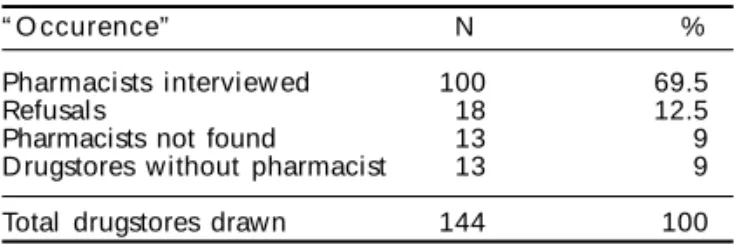
Of the 144 drugstores selected, 13 (9%) were work-ing without a pharmacist. Of the 131 pharmacists met, 18 (13.7%) refused to participate and 13 (10%) were not located after three attempts (Table 1).
The majority (64%) of the pharmacists working in drugstores were young women, aged between 22 and 29 years (47%), graduated from a local private uni-versity (44%) roughly three years prior to the inter-view, and, despite working in a drugstore, had under-gone training directed basically towards the indus-trial (36%) or clinical analysis (29%) fields. The number of daily work hours varied between 2 and 15 hours, with a mean 7.1 hours; 28% of subjects re-ported working 8 hours daily and 46% rere-ported work-ing 6.5 hours. Only 16% reported receivwork-ing sales commissions, 22% reported having another job, and only 5% admitted to earning less than the category’s minimum wage. Concerning the drugstores in which they worked, 19% were employed by the three large networks working in the municipality. Most drugstores (73%) were not owned by the pharmacist interviewed, and only 5% of pharmacies employed substitute phar-macists. Half of the drugstores had prescription-free medication exposed for self-service purchase. In av-erage, drugstores were open 12 hours daily and most of them (64%) had at least four other staff members besides the pharmacist.
Of the 24 questions on which knowledge evalua-tion was based, 23 were weighted 1, and a single ques-tion (duties) was weighted 6. The maximum score obtainable was therefore 29 points. However, the score range among interviewed subjects was 8-25, mean 15.8, standard deviation 3.39. Levels of knowledge were classified as follows:
Table 1 - Summary of the drugstore sample, Ribeirão Preto, 2001.
“ O ccurence” N %
Pharmacists interview ed 100 69.5
Refusals 18 12.5
Pharmacists not found 13 9
Drugstores without pharmacist 13 9
" Rev Saúde Pública 2004;38(3) www.fsp.usp.br/rsp Farmacêuticos e legislação sanitária
Silva LR & Vieira EM
• Good knowledge: score =19 points; • Medium knowledge: 14-18 points; • Insufficient knowledge: =13 points.
The level of knowledge of the legislation control-ling drugstore operation and of professional regula-tions was considered as medium for 50% of subjects, insufficient for 28%, and good for only 22%. That is, roughly one in five subjects has a good knowledge of the sanitary legislation controlling her profession.
No association was found between level of knowl-edge and variables: age, sex, time since graduation, daily work hours, receiving sales commissions, earn-ing the category’s minimum wage, havearn-ing another job, drugstore ownership, and working in franchise or network drugstore.
In order to evaluate knowledge of the pharmacist’s duties in the drugstore, an open question and a closed question about the administration of inject-able drugs were formulated. Of the subjects inter-viewed, 99% cited at least one duty, whereas a sin-gle subject reported that the pharmacist had no du-ties in the drugstore. Dudu-ties cited included: evalua-tion of the prescripevalua-tion (31%), orientaevalua-tion on drug usage (81%), storage of controlled medication (65%), registry keeping (55%), keeping controlled medication records in chronological order (24%), maintaining medication storage conditions (35%), and training staff members (25%). More than half of the subjects (55%) mentioned other duties not in-cluded among the above. These inin-cluded control-ling medication expiry dates (23%) and administer-ing injectable drugs (15%).
In order to verify the common ‘myth’ among phar-macists concerning the prohibition of administering injectable drugs, the following statement was given, which subjects were to classify as true or false: “the pharmacist is prohibited by law from administering injectable drugs”. Of all the subjects interviewed, 23% provided either the wrong or no answer to this
ques-tion, that is, there is still a significant share of profes-sionals who believe they are legally prohibited from administering injectable drugs.
Forty-seven pharmacists mentioned at least one sys-temic antibiotic and/or chemotherapeutic as being free for over-the-counter sale. One of the subjects said there were several, but did not mention any names. Another subject mistakenly mentioned an anti-inflammatory, nimesulide, as an example. According to Brazilian drug legislation, no systemic antibiotics may be sold on a prescription-free basis. Therefore, 49% of pharmacists answered this question incorrectly.
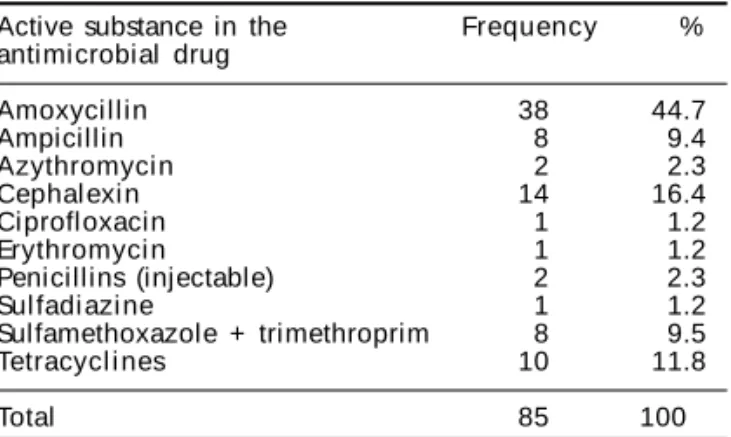
Among antibiotics, amoxycillin was mentioned by 38 pharmacists (45%), followed by cephalexin, tioned by 14 subjects (16%), and tetracycline, men-tioned by 10 subjects (12%) (Table 2). When the ques-tion was posed as a true/false statement – “there are no systemic antibiotics for over-the-counter sale” – 23% of subjects gave the incorrect answer and three reported not knowing the answer.
The majority of pharmacists (65%) agreed about the existence of a list which defines which drugs are free form over-the-counter sale; 35% were not aware of the existence of such list. For 46% of subjects, the muscu-lar relaxant Dorflex (containing and association of orphenadrine, dipyrone, and caffeine) is free for over-the-counter sale, that is, 46% are not aware of the re-quirement of a prescription for selling this medication
Answers concerning the definition of the term ‘simi-lar drug’ were considered correct if approaching the definition established by Statute 9787/99. Only 18 pharmacists were able to correctly define similar drug. Among the answers considered as wrong, 33% de-fined the concept based solely on similarity of com-position or active ingredient. In 26% of the incorrect answers, the term ‘ethical’ was used as a synonym for ‘reference’ or ‘innovative’ drug. 23% of the incorrect answers contained different conceptual errors, such as “competitor of the original”, “identical to the brand name”, and “similar to the ethical medication”.
Only 29 pharmacists were able to correctly define the term ‘generic drug’. Among the answers consid-ered as incorrect, 24% used the term ‘ethical’ as a synonym for ‘reference’ or ‘innovative’ drug. Many subjects also used the definition based only on simi-larity of composition and active ingredient, which was considered as incorrect. Incorrect answers also included different conceptual errors, such as “same drug, without marketing”, “contains the same active ingredient; cheaper”, and “contains the same active ingredient without associations”.
Table 2 - Distribution of antimicrobials mentioned as free for over-the-counter sale, Ribeirão Preto, 2001.
Active substance in the Frequency %
antimicrobial drug
Amoxycillin 38 44.7
Ampicillin 8 9.4
Azythromyci n 2 2.3
Cephal exi n 14 16.4
Ciprofloxacin 1 1.2
Erythromyci n 1 1.2
Penicillins (injectable) 2 2.3
Sul fadi azi ne 1 1.2
Sulfamethoxazole + trimethroprim 8 9.5
Tetracycl i nes 10 11.8
#
Rev Saúde Pública 2004;38(3) www.fsp.usp.br/rsp
Farmacêuticos e legislação sanitária Silva LR & Vieira EM
When questioned about the possibility of substi-tuting a brand name product only with a generic drug, 78% of the pharmacists interviewed considered this statement as true, which is the correct answer. When questioned about the possibility of substituting a product with a similar drug, 70% of subjects consid-ered this statement as false, that is, 30% of subjects considered it to be possible to replace a brand name drug with a similar drug, which is against generic drug sales regulations.
Collection of biological material: 94% of subjects considered as false the statement “the drugstore is allowed to perform biological material collection serv-ices”, which is the correct answer.
Fractioning of pharmaceutical specialties: 68% subjects knew the correct definition of ‘fractioning’, and 79% knew that is the fractioning of pharmaceuti-cal specialties is not allowed in the drugstore.
Sale of compounded drugs: 75% of subjects knew that the sale of compounded drugs is not allowed in drugstores.
Administration of injectable penicillin: 85% of subjects considered as true the statement “the admin-istration of injectable penicillin in a drugstore is pro-hibited”, and 3% did not know. This means that only 12% of the pharmacists interviewed knew that such administration is allowed by law.
D ISCU SSIO N
Ribeirão Preto cannot be characterized as an in-dustrial municipality. There are 1,065 inin-dustrial plants in the municipality,12 most of which are of small
size. Of these, only six are pharmaceutical plants, which indicates the lack of a labor market for the pharmacists trained for work in the industrial field. These professionals seem to have ‘drifted’ towards drugstores and pharmacies. Notwithstanding, the municipality currently has four different undergradu-ate Pharmacy schools.
We found only 22% of pharmacists with a good level of knowledge of sanitary legislation. We found a low level of knowledge concerning the legal re-quirement of the presence of a pharmacist in the drugstore during opening hours, the pharmacist’s duties, antibiotic sales regulations, and the adminis-tration of injectable penicillin. Furthermore, most pharmacists interviewed had difficulty handling the concepts of ‘similar’ and ‘generic’ drugs.
This low level of knowledge was not associated
with any of the independent variables, which sug-gests that it is a general phenomenon, i.e., one that is observable among pharmacists regardless of age, sex, time since graduation, institution attended, modality of graduation, etc.
Answers were discrepant in terms of the legal re-quirement of the presence of a pharmacist in the drugstore, both when the issue was formulated as an open question and, later, as a statement. In the open question, only 16% gave the correct answer, whereas 69% stated that drugstores are required by law to pro-vide a pharmacist for at least 50% of opening time. 41% of subjects answered correctly to the statement.
In 1997, CRF-SP established, as an internal regula-tion, that, in order for a drugstore to be registered it must present a statement of opening hours and of the presence of a pharmacist for at least half this period. After four years, this which was an administrative policy of a controlling agency was assimilated by pharmacists as a ‘law’. This is a mistake, for, in the juridical hierarchy, category decisions cannot over-rule governmental statutes.
Over 50% of the pharmacists in our sample believed the regulation that prevents pharmacists from being tech-nical supervisors for more than one drugstore to be a restriction imposed by CRF-SP rather than a regulation determined by sanitary legislation. Such confusion may be due to the fact that, until not long ago, in a number of Brazilian states, state Councils of Pharmacy were grant-ing double and sometimes even triple supervisgrant-ing posi-tions, which is against sanitary legislation.
Costa5 argues that, in the field of Sanitary
Surveil-lance, responsibility is an ubiquitous concept through-out the many ‘links’ of a chain, in which not only private entities (producers/service providers, techni-cal supervisors, suppliers, sales representatives) are responsible for the quality of products and services offered to the population, as well as for any eventual health damage caused by them, but so it the State, through the enforcement of specific health protec-tion laws. In the practice of Sanitary Surveillance, the concept of responsibility in the provision of healthcare service and in the production, distribution, and sale of health-related products is formalized in the person of the technical supervisor, which is a legal requirement and a condition for performing such activities.
men-$ Rev Saúde Pública 2004;38(3) www.fsp.usp.br/rsp Farmacêuticos e legislação sanitária
Silva LR & Vieira EM
tioned ensuring adequate conditions for medication storage, and only 25% mentioned staff training. Con-trolling medication expiry dates was mentioned by 23 subjects. A great deal of discrepancy was observed when these data were compared with the list of sanitary leg-islation infractions verified in the lawsuits filed by the local Sanitary Surveillance (SS) agency (Table 3). In-fractions related to the irregular sale of controlled medi-cation prevail in this list (39%), whereas approximately 10% of infractions were related to the exposure/stor-age of expired products. In other words, the regula-tions most frequently infringed according to the local SS are exactly those most widely known.
The use of antibiotics without a medical prescrip-tion is a public health problem, for the irraprescrip-tional use of this type of drug is promoting the emergence of multiple-antimicrobial-resistant strains of bacteria. The correlation between the increase of bacterial re-sistance and the patterns of antibiotic consumption has attracted the attention of several medical institu-tions and periodicals. This issue was the subject of 45 articles published in journals from different coun-tries between 1984 and 1990.3 In 1995, Barros1
veri-fied that antibiotics were among the three drug groups most ‘prescribed’ by drugstore clerks in Recife, north-eastern Brazil. Gir,9 in an evaluation of the behavior
of drugstore clerks in response to a costumer with complaints typical of gonorrhea, found that, in roughly 70% of cases, the clerk indicated drugs, es-pecially penicillins, to the costumer.
The discrepancy observed between the two ques-tions dealing with antibiotic sales suggests that phar-macists are aware of the inexistence of antibiotics free for over-the-counter sale. Nevertheless, the retail sale of antibiotics without medical prescription is part of the daily routine of drugstores, being incorporated by pharmacists as a normal procedure. In other words, “it’s
a law but it doesn’t stand”. Although the free sale (with-out a practitioner’s prescription) of antibiotics is pro-hibited, these drugs are sold as if it were legal. Such practice is not supervised by control organs, and es-tablishments that indulge in it are not held liable.
This indicates a predominance of juridical instru-ments in sanitary control measures, which reinforces the role of Sanitary Surveillance as a bureaucratic/ registry organ. Without questioning the efficacy of this system, there is o need for advancement in sani-tary instruments in order to enforce such regulations. In Brazil, a country governed by the Rule of Law,7 in
which all administrative activity is controlled by leg-islation, there is an abundance of regulations con-cerned with the consumption of health-related prod-ucts, especially in relation to production. Nonethe-less, when observing certain practices of medication retailers, we verify that sanitary legislation has showed little advance in the field of commercialization. As an example, Costa6 argues that it is not enough for
the production of a given drug to be authorized, for the industry to have a technical supervisor, and for the technical requirements for production facilities and processes be fulfilled; it is also necessary to ex-pand sanitary regulations in order to control other aspects of quality, such as efficacy, safety, and the occurrence and intensity of side effects.
Most subjects showed a good level of understand-ing concernunderstand-ing the collection of biological materi-als, fractioning of pharmaceutical specialties, and sale of compounded drugs. We verified, however, that 85% of pharmacists believe the administration of penicil-lin in drugstores and pharmacies to be prohibited. The population that frequently requires injectable penicillin does not have access to this type of medi-cation in private services. In 1995, the São Paulo State Center for Sanitary Surveillance (CVS-SP) issued a Table 3 - Distribution of the types of infraction verified by inspection in drugstores between January 1997 and May 2001. Sanitary Surveillance, Ribeirão Preto, SP.
Description of the infraction Frequency %
W orking without a pharmacist 66 35.3
Failing to keep special control medication records up to date 34 18.2
Selling medication subject to special control without prior SS authorization 20 10.7
Selling medication subject to special control without observing legal requirements
(irregular medical prescription) 11 5.9
Failing to adequaly store medication subject to special control 2 1.1
Selling medication subject to special control without in the absence of a pharmacist 6 3.2
Exposing expired medication for sale 18 9.6
Working without an SS permit 7 3.7
Selling medication not registered by the Ministry of Health 5 2.7
Expose prescription-restricted medication for self service purchase 4 2.1
Disobeying acts issued by SS 4 2.1
Storing medication intended for free distribution 2 1.1
Preventing SS operation 2 1.1
O thers 6 3.2
Total 187 100
%
Rev Saúde Pública 2004;38(3) www.fsp.usp.br/rsp
Farmacêuticos e legislação sanitária Silva LR & Vieira EM
regulation (Regulation CVS-DITEP 02/95) prohibit-ing São Paulo State drugstores and pharmacies from performing penicillin sensitivity tests. We thus ob-serve a great deal of confusion amongst pharmacists, who understood that, in addition to the test, the ad-ministration of penicillin itself was prohibited, and that only healthcare facilities and hospitals were al-lowed to perform this service. This Regulation was revoked in May 2000 by Regulation CVS – 5/00, which was much more detailed than its predecessor, and which maintained the prohibition of penicillin sensitivity testing in drugstores. Benzathine penicil-lin is the main resource available for reducing the levels of morbi-mortality associated with rheumatic carditis; it is also the treatment of choice for treating streptococcal pharyngitis and the most efficacious drug in treating syphilis, in addition to being very affordable. A study7 carried out with 300 healthcare
professionals including physicians, pharmacists, and nurses demonstrated that Regulation CVS 02/95 had a strong negative impact on the prescription and ad-ministration of benzathine penicillin outside the emergency-room/hospital environment, where the majority of professionals also believe the adminis-tration of benzathine penicillin to be prohibited in drugstores and pharmacies, showing a lack of knowl-edge of usage and/or sensitivity testing regulations. There is, therefore, a clear need for discussing this subject with all professionals involved, clarifying the contents of the aforementioned regulation, as well as the risks and benefits of the use of penicillin.
Concerning the definitions of generic and simi-lar drugs, we found that the term ‘ethical drug’ was frequently employed as a synonym for innovative or reference drug. This is a non-technical term, in-corporated into the professional jargon due to phar-maceutical industry marketing, following a mar-ket-oriented logic promoted by the large pharma-ceutical laboratories who own the rights for devel-oping these drugs.
We observed a large amount of confusion among pharmacists concerning the term ‘similar drug’, with only 18% of subjects being able to correctly define the term, whereas the definition of generic drug was chosen by 29% of subjects. Such confusion may be due to the recently issued legislation controlling the production and sale of generic drugs, established by Statute 9,787, of 10 February 2000.
However, we found that approximately 70% of sub-jects knew about the interchangeability between ge-neric and brand name drugs, i.e., know that a pre-scribed drug may be replaced exclusively by the cor-responding generic drug. Since the Generic Drug
Stat-ute was issued, pharmacists have been provided, by both control organs and phramaceutical associations with divulgation and clarification material contain-ing technical information on the subject, which have greatly contributed towards the involvement of these professionals in the generic drug issue.
The Statute allowing the sale of generic drugs has been an important instrument for nationwide medi-cation policies. Sanitary Surveillance is a function strictly governmental in character, intended to har-monize economic and social interests for the protec-tion of individual and collective health. Hence, it is its job to promote measures which stimulate the adop-tion and use of generic drugs, providing means to ensure widespread communication, information, and education concerning these drugs.
The present study was aimed at proving the hy-pothesis that training in the field of drug-related phar-macological care is deficient at both the undergradu-ate level and, especially, during traineeship in phar-macies or drugstores.
According to our results, which show that knowl-edge was not associated with any independent vari-able – thus suggesting a generalized phenomenon, i.e., one present among pharmacists of several age groups, both sexes, regardless of time since gradua-tion, school attended, modality of graduagradua-tion, etc. –, it is likely that Pharmacy schools do not provide the basic theoretical and practical knowledge that would allow future pharmacists to act in drug dispensation.
Pharmacists that work in drugstores receive train-ing directed towards the practice of pharmaceutical care, most of them being trained for the fields of in-dustrial production and clinical analysis.
In particular, we identified the need for training based on knowledge of drugs and sanitary legisla-tion, so that pharmacists are able, in the future, to fully exert their profession without the threat of legal prosecution or hazard to the population. Training (and retraining in the work environment) in the field of drug dispensation, along with direct supervision and continued education should also be part of the policy proposals forwarded by pharmacist unions and asso-ciations, with the effective participation of the edu-cational institutions.
& Rev Saúde Pública 2004;38(3) www.fsp.usp.br/rsp Farmacêuticos e legislação sanitária
Silva LR & Vieira EM
REFEREN CES
1. Barros JAC. Propaganda de medicamentos: atentado à saúde? São Paulo: Hucitec-Sobravime; 1995.
2. Bermudez JAZ. Indústria farmacêutica, estado e sociedade: crítica da política de medicamentos no Brasil. São Paulo: H ucitec-Sobravime; 1995.
3. Chetley A. Medicamentos problema. 2a ed. Lima: HAI/AIS; 1995.
4. Conselho Regional de Farmácia do Estado de S. Paulo. Fiscalização do Conselho cresceu significati-vamente nos últimos 5 anos. Rev Farmacêutico 2001;52:10-1.
5. Costa EA. Vigilância sanitária: proteção e defesa da saúde. São Paulo: Hucitec-Sobravime; 1999.
6. Dallari SG. Os estados brasileiros e o direito à saúde. São Paulo: Hucitec; 1995
7. Filho José M. Avaliação da prescrição e aplicação da penicilina benzatina na região Noroeste do Estado de São Paulo. In: Anais do 23º Congresso Brasileiro de Reumatologia; 2000 set 16-19; São Paulo, SP. Rio de Janeiro: Sociedade de Reumatologia; 2000.
8. Fundação IBGE. Censo IBGE/2000: Ri bei rão Preto. Ribeirão Preto (SP): Prefeitura M unicipal; 2000. D i sponível em: http//w w w.coderp.com.br. [ 2001 mai 20] .
9. Gir E, Moriya TM, Costa, JC, Duarte G, Oliveira MHP, Bueno SMV et al. Estudo das condutas adotadas por balconistas de farmácias frente a casos relatados de gonorréia. Medicina (Ribeirão Preto) 1991;24:15-25.
10. Ministério da Saúde. Relatório final: 1º Encontro Nacional de Assistência Farmacêutica e Políticas de Medicamentos. Brasília (DF); 1988.
11. Organizacion Mundial de la Salud. El papel del farmaceutico en el sistema de atención de salud: informe de un Grupo de Consulta de la OMS. Genebra: OM S; 1990.
12. Perini E. A questão do farmacêutico: remédio ou discurso? In: Bonfim JRA, Mercucci VL, organizadores. A construção da política de medicamentos. São Paulo: Hucitec-Sobravime; 1997. p. 323-34.
13. Santos MR. Do boticário ao bioquímico: as transfor-mações ocorridas com a profissão farmacêutica no Brasil [dissertação de mestrado]. Rio de Janeiro: Escola Nacional de Saúde Pública/ Fundação Oswaldo Cruz; 1993.