R a m p a s o R a m p a s o R a m p a s o R a m p a s o R a m p a s o
Evaluation of prevalence in the treatment of mandible condyle fractures 373
Rev. Col. Bras. Cir. 2012; 39(5): 373-376
Original Article Original Article Original Article Original Article Original Article
Evaluation of prevalence in the treatment of mandible condyle
Evaluation of prevalence in the treatment of mandible condyle
Evaluation of prevalence in the treatment of mandible condyle
Evaluation of prevalence in the treatment of mandible condyle
Evaluation of prevalence in the treatment of mandible condyle
fractures
fractures
fractures
fractures
fractures
Avaliação da prevalência do tratamento das fraturas de côndilo mandibular
Avaliação da prevalência do tratamento das fraturas de côndilo mandibular
Avaliação da prevalência do tratamento das fraturas de côndilo mandibular
Avaliação da prevalência do tratamento das fraturas de côndilo mandibular
Avaliação da prevalência do tratamento das fraturas de côndilo mandibular
CÁSSIO LEANDRO RAMPASO1; TATIANA MARIA FOLADOR MATTIOLI2; JOSIASDE ANDRADE SOBRINHO, ECBC-SP3; ABRÃO RAPOPORT, ECBC-SP3
A B S T R A C T A B S T R A C T A B S T R A C T A B S T R A C T A B S T R A C T
Objective Objective Objective Objective
Objective: To study the treatment of fractures of the mandibular condyle and discuss conservative versus surgical therapy. Methods
Methods Methods Methods
Methods: We examined the medical records of 892 bucofacial traumas, from which we selected only those who had: reports of condylar fractures, isolated or associated with other facial bones, identification data, dental care history and treatment applied for the condylar fracture. Data were analyzed using descriptive statistics, and the conservative and surgical therapies were compared. Results
Results Results Results
Results: Condyle fractures were present in 124 cases. Males represented 72.0% of the sample, the age group most affected being the one between 21 and 30 years. Conservative treatment was used in 61.0% of patients. ConclusionConclusionConclusionConclusionConclusion: Surgical treatment was predominantly used in patients over ten years old, victims of traffic accidents and falls, followed by assaults, firearms and sporting accidents.
Key words Key words Key words Key words
Key words: Jaw fractures. Mandibular condyle. Therapeutics. Child. Adolescent.
Work performed at the Santa Marcelina Hospital, São Paulo from 2000 to 2007.
1. Master’s Degree Graduate, Health Sciences, Heliópolis Hospital, Sao Paulo – Brazil; 2. Master’s Degree Graduate, Stomatology - PUC-PR; 3. Assistant Professor, Post-Graduation in Health Sciences, Heliópolis Hospital - São Paulo – Brazil.
INTRODUCTION
INTRODUCTION
INTRODUCTION
INTRODUCTION
INTRODUCTION
T
he treatment of condylar fractures is controversial because of their prognosis. Epidemiological studies regarding the incidence of fractures of the mandibular condyle and the choice of therapeutic option collaborate to analyze the occurrence, distribution and determinants of maxillofacial trauma. Besides describing the health status of populations, it is possible to investigate the determinants of etiology, as well as assess the impact of actions to change the status of the disease.The treatment of condyle fractures should target the maximum reduction of morbidity, postoperative complications and esthetic and/or functional impairment. Treatment may be conservative, using the maxillo-mandi-bular block, followed by intensive postoperative physiotherapy. Surgical treatment comprises fracture reduction and internal fixation by using titanium miniplates and screws, lag screws or Kirschner wires1.
Cosmetic asymmetries such as deformities and malocclusion2 and functional ones such as mobility, joint changes,
static and/or dynamic muscle pain, or even neurological disorders are complications that can occur after surgery or conservative treatment3. After open reduction of fractures of
the condylar process, infection, facial paralysis, salivary fistula, Frey syndrome, auriculotemporal nerve dysfunction and appearance of hypertrophic scar or keloid may occur4,5.
The growth of the mandible condyle does not determine the growth of the whole jaw, but it is essential for normal growth, especially of the ramus. Extrinsic mechanical factors resulting from the functional activity of the joint promote stimulus for d i f f e r e n t i a t i o n o f t h e p r o l i f e r a t i v e z o n e i n t o chondroblasts, which, being multipotential, may form bone or cartilage6.
Interference in the growth of the jaw can influence the growth of the maxilla because of the occlusal plane. The intercuspal occlusal and the oclusal plane provide the accompanying growth of the maxilla and mandible so the mandibular teeth move distally and temporomandibular joint follows later. The same phenomenon may occur in reverse, the jaw following the growth of the maxilla through intercuspidation7.
The choice of therapy should follow analysis criteria and assessment of anatomic and functional impariments, patient age, edentulism, presence of foreign bodies and association with other disorders of the temporomandibular joint5.
374
Rev. Col. Bras. Cir. 2012; 39(5): 373-376
R a m p a s o R a m p a s oR a m p a s o R a m p a s oR a m p a s o Evaluation of prevalence in the treatment of mandible condyle fractures
METHODS
METHODS
METHODS
METHODS
METHODS
This research evaluated the medical records of 892 facial trauma victims treated at the Maxillofacial Trau-ma and Surgery Service of the Santa Marcelina Hospital, São Paulo, in the period from January 2000 to December 2007. The study included the records of individuals with mandibular condylar fracture, whether isolated or associated with other maxillomandibular fractures. Besides etiology, we analyzed fracture site, if restricted to the mandibular condyle or associate, and type of treatment employed.
Patients were classified according to established treatment into two groups: 1) conservative – patients treated only with medication or dressings, and subsequently referred to other specialties or submitted only to the clinical follow-up; 2) surgical – patients undergoing a surgical procedure, like dental retainers, sutures, open or closed reduction of fractures, and drainage.
The records were obtained from the medical fi-les of the Department of Orthopaedics, with prior authorization for handling them (CEP No. 640).
RESULTS
RESULTS
RESULTS
RESULTS
RESULTS
After the analysis of 892 patient records, 124 were included in the study. The analysis of the 124 records showed that 72.0% of subjects were male and 28.0% female.
Regarding trauma etiology, there was a predominance of traffic accidents (car, bicycle, motorcycle and pedestrian accidents) in 55 cases (44%), followed by fall in 47 cases (39%), assaults in 13 cases (10%), gunshot wounds in 6 cases (5%) and sporting accidents in 3 cases (2%).
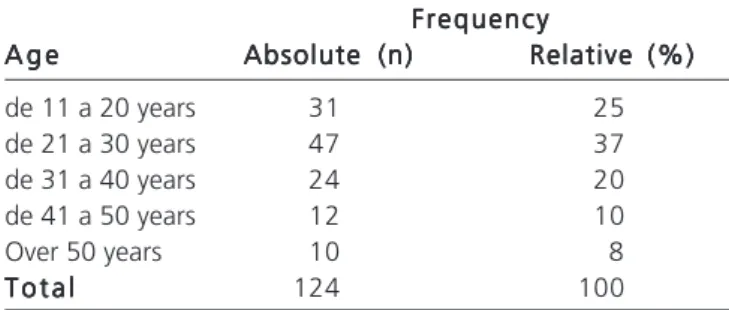
Multiple face fractures occurred in 31.0% of patients and 69% of the fractures were restricted to the mandibular condyle. Surgical treatment was most often employed in patients whose ages ranged from 21 to 30 years, being carried out in 37% of patients (Table 1).
It was found that the mandibular condyle fractures were treated mostly (76 cases – 61.0%) conservatively, surgical treatment being indicated in 48 cases (39.0%), which presented with fracture with displacement and dislocation of the condyle from the glenoid cavity.
DISCUSSION
DISCUSSION
DISCUSSION
DISCUSSION
DISCUSSION
Condylar fractures, if not properly treated, can lead to limited mobility, bone and muscle facial asymmetries with varying degrees of commitment, especially in children and adolescents, due to the discrepancy in height of the ramus and decrease of growth stimuli8.
High condylar fractures, with large displacements, must be surgically reduced through pre-auricular approaches
due to the proximity of the fractured fragment to the facial nerve9 and median and low fractures of the condylar region
can be reduced by submandibular and retro-mandibular Hinds approaches. The latter, being parallel to the mandi-bular ramus, provides good view of the fracture and low morbidity in relation to the facial nerve and blood vessels. The treatment of fractures of the mandibular condyle has, as initial objectives, to prevent infection, to restore soft parts, to fix the fracture with proper alignment and to provide sufficient stability for patient comfort in order to that allow dressings and other procedures10.
When there is immediate protrusion mobilization of the fractured condylar, for the orthopedic functional treatment of the mandibular condyle fracture, there is a satisfactory reduction and permanent mobilization, as there is opposition to contraction of the levator muscles11. This
author has analyzed, in several respects, the diversity of treatments instituted in 113 cases of fractures of the man-dibular condyle, which were proposed in accordance with the classification of the fracture, so that for high and low fractures without condylar displacement, conservative treatment was recommended and, in the case of low fracture with condylar displacement, the degree of displacement was taken into account. Usually, we indicate open surgical methods for displacements greater than or equal to 90° and closed surgical method for displacements smaller than 90°12.
There is indocation for surgical treatment with open reduction and fixation for low subcondylar fractures, with the goal of restoring the posterior vertical dimension, for patients over the age of eight13. Fractures of the
mandi-bular ramus, angle and body with significant degrees of displacement have indication for surgical open reduction14.
Conservative treatment is a therapeutic decision when a fracture is favorable, as it is not displaced by the action of the muscles of mastication, with no displacement of the bone fragments. In these cases, with clinical follow-up and guidance, there will be bone consolidation. However, in some cases, the surgeon performs only one intermaxillary fixation. There were many complications of the different methods used for the reduction of fractures, such as infections, subcutaneous emphysema, edema, osteomyelitis, cardiorespiratory complications, secondary emphysema and bleeding15.
Table 1 Table 1Table 1
Table 1Table 1 - Frequency distribution of the age variable.
Frequency Frequency Frequency Frequency Frequency A g e
A g eA g e
A g eA g e Absolute (n)Absolute (n)Absolute (n)Absolute (n)Absolute (n) Relative (%)Relative (%)Relative (%)Relative (%)Relative (%)
de 11 a 20 years 31 25
de 21 a 30 years 47 37
de 31 a 40 years 24 20
de 41 a 50 years 12 10
Over 50 years 10 8
T o t a l T o t a lT o t a l
R a m p a s o R a m p a s o R a m p a s o R a m p a s o R a m p a s o
Evaluation of prevalence in the treatment of mandible condyle fractures 375
Rev. Col. Bras. Cir. 2012; 39(5): 373-376
Despite the eventual use of intraoral access, most surgeons prefer the extraoral one for the open treatment of condylar fractures. The rigid internal fixation has been most frequently used for fixation with steel wire, since it promotes primary bone consolidation without the need for postoperative jaw locking, resulting in increased benefit to the patient15.
Regarding the indication for surgical treatment, when considered the patient’s age, we noticed a tendency of surgical indication for patients above the age of ten, the conservative technique (mobilization and physical therapy) being reserved for patients under this age. There is an agreement among the authors that the treatment to be indicated for fractures of the mandibular condyle basically depends on patient’s age, on the functions of the articulation and on deviations of mouth opening, for the
well being of the patient through the lowest possible trau-ma combined with a satisfactory recovery12. Although high,
the fractures should be treated conservatively, regardless of age, through drug therapy and physiotherapy, as well as the low fractures that do not cause dislocation of the condyle in relation to the joint cavity. The condyle will almost always be able to maintain its function, or at least be induced to a remodeling that allows proper function11,12.
We found that several factors influence the decision of conservative or surgical treatment, including patient’s age. In fractures with dislocation there is indication of surgical treatment with condylar fixation to restore the vertical dimension in patients with age greater than ten years. Surgical treatment was used in patients over ten years old, in victims of traffic accidents, falls, injury by firearms and sporting accidents.
R E S U M O R E S U M O R E S U M O R E S U M O R E S U M O
Objetivo: Objetivo: Objetivo: Objetivo:
Objetivo: Realizar um estudo do tratamento das fraturas do côndilo mandibular e discutir a terapêutica conservadora versus a cirúrgica. Métodos: Métodos: Métodos: Métodos: Métodos: Foram examinados 892 prontuários de traumatismo bucofacial, e selecionados aqueles em que haviam: relatos de fraturas condilares isoladas ou associadas a outros ossos da face, dados relativos à identificação, a história médico-odontológica, e o tratamento para a fratura de côndilo. Os dados foram analisados através de estatística descritiva e comparados a~ terapêuticas conservadora e cirúrgica. Resultados: Resultados: Resultados: Resultados: As fraturas de côndilo perfizeram um total de 124 casos. O sexoResultados: masculino representou 72,0% da amostra, e a faixa etária mais acometida foi aquela dos 21 a 30 anos. O tratamento conserva-dor foi empregado em 61,0% dos pacientes. Conclusão: Conclusão: Conclusão: Conclusão: Conclusão: O tratamento cirúrgico foi utilizado em pacientes acima de dez anos de idade, vítimas de acidentes de trânsito e quedas, predominantemente, seguido de agressões, armas de fogo e acidente esportivo.
Descritores: Descritores: Descritores: Descritores:
Descritores: Fraturas maxilomandibulares. Côndilo mandibular.Terapêutica. Criança. Adolescente.
REFERENCES
REFERENCES
REFERENCES
REFERENCES
REFERENCES
1. Sugiura T, Yamamoto K, Murakami K, Sugimura M. A comparative evaluation of osteosynthesis with lag screws, miniplates, or Kirschner wires for mandibular condylar process fractures. J Oral Maxillofac Surg 2001; 59(10):1161-8; discussion 1169-70.
2. Ellis E 3rd, McFadden D, Simon P, Throckmorton G. Surgical complications with open treatment of mandibular condylar process fractures. J Oral Maxillofac Surg 2000; 58(9):950-8.
3. Bianchini EMG. Traumas de face: atuação fonoaudiológica, ca-racterização, proposta terapêutica e resultados. In: Comitê de Motricidade Oral da Sociedade Brasileira de Fonoaudiologia. Motricidade orofacial: como atuam os especialistas. São José dos Campos: Pulso; 2004.
4. Marcantonio E. Fratura do côndilo mandibular. In: Barros JJ, Sou-za LCM. Traumatismo buco-maxilo-facial. 2a ed. São Paulo: Roca;
2000. p.231-64.
5. Meikle MC. The role of the condyle in the postnatal growth of the mandible. Am J Orthod 1973; 64(1):50-62.
6. Enlow DH, Harvold EP, Latham RA, Moffett BC, Christiansen RL, Hausch HG. Research on control of craniofacial morphogenesis: an NIDR State-of-the-Art Worhshop. Am J Orthod 1977; 71(5):509-30.
7. Haug RH, Assael LA. Outcomes of open versus closed treatment of mandibular subcondylar fractures. J Oral Maxillofac Surg 2001; 59(4):370-5; discussion 375-6.
8. Bueno L, Trawitzki LVV. Contribuição fonoaudiológica nas fratu-ras mandibulares. In: Marchesan IQ, Zorzi JL. Tópicos em fonoaudiologia 2002/2003. Rio de Janeiro: Revinter; 2002. p.269-77.
9. Siqueira JTT. Fratura bicondilar em crianças: tratamento conser-vador com aparelho ortopédico. J bras ortodontia ortop maxilar 1997; 2(9):19-34.
10. Crivello O. Lesões traumáticas agudas da ATM. In: Barros JJ, Rode SM, editores. Tratamento das disfunções craniomandibulares, ATM. São Paulo: Santos; 1995. p.331-9.
11. Lobo SE. Incidência de fraturas de côndilo mandibular no Serviço de Cirurgia e Traumatologia Buco-Maxilo-Facial de Bauru, no pe-ríodo de 1991 a 1995 [monografia]. São Paulo: Universidade de São Paulo, Faculdade de Odontologia de Bauru; 1998.
12. Hayward JR, Scott RF. Fractures of the mandibular condyle. J Oral Maxillofac Surg 1993; 51(1):57-61.
13. Toledo Filho JL, Marzola C, Pastori CM, Zorzetto DLG. Utilização de miniplacas no tratamento de fraturas da mandíbula. Rev Assoc Paul Cir Dent 1998; 52(1): 55-62.
14. Jeter TS, Van Sickels JE, Nishioka GJ. Intraoral open reduction with rigid internal fixation of mandibular subcondylar fractures. J Oral Maxillofac Surg 1988; 46(12):1113-6.
376
Rev. Col. Bras. Cir. 2012; 39(5): 373-376
R a m p a s o R a m p a s oR a m p a s o R a m p a s oR a m p a s o Evaluation of prevalence in the treatment of mandible condyle fractures
Received on 02/03/2012
Accepted for publication 03/05/2012 Conflict of interest: none
Source of funding: no
How to cite this article: How to cite this article:How to cite this article: How to cite this article: How to cite this article:
Rampaso CL, Mattioli TMF, Andrade Sobrinho J, Rapoport A. Mandible condyle fractures: assessment of treatment. Rev Col Bras Cir.
[periódi-co na Internet] 2011; 38(5). Disponível em URL: http://www.scielo.br/ rcbc