Auriculotherapy effectiveness in the
reduction of anxiety in nursing students
O
RIGINAL
A
R
TICLE
1 Acupuncturist Nurse. Professor of the Mid-Level Professional Technical Qualifi cation Course for Auxiliary Nurses and Nursing Technicians Member of the
Complementary and Alternative Health Practices Study Group, registered at CNPq. São Paulo, SP, Brazil. [email protected] 2 Acupuncturist Nurse.
Doctoral student of the University of São Paulo School of Nursing. Member of the Complementary and Alternative Health Practices Study Group, registered at CNPq. [email protected] 3 Registered Nurse. Full professor of the University of São Paulo School of Nursing. Coordinator of the Complementary
EFICÁCIA DA AURICULOTERAPIA NA REDUÇÃO DE ANSIEDADE EM ESTUDANTES DE ENFERMAGEM
EFICACIA DE LA AURICULOTERAPIA EN LA REDUCCIÓN DE ANSIEDAD EN ESTUDIANTES DE ENFERMERÍA
Juliana Miyuki do Prado1, Leonice Fumiko Sato Kurebayashi2, Maria Júlia Paes da Silva3
RESUMO
Este Ensaio Clínico Randomizado simples--cego verifi cou níveis de ansiedade dos
es-tudantes de Enfermagem de nível médio da Escola de Enfermagem São Joaquim, do Hos-pital Benefi cência Portuguesa, e a efi cácia da auriculoterapia na redução desses níveis. Foi aplicado o Inventário de Ansiedade Traço--Estado no início, após 8 e 12 sessões e no follow-up (quinze dias). A amostra foi com-posta por 71 indivíduos divididos em três grupos: Controle sem intervenção (25), Auri-culoterapia (24), e Placebo (22). Resultados: Na análise de variância (ANOVA) houve dife-rença esta s camente signifi ca va pelo Post Hoc entre os grupos controle/auriculoterapia na segunda (p=0.000), terceira (p=0.012) e quarta avaliações (p=0.005); e entre grupos placebo/controle, somente na 2a avaliação (p=0.003). A auriculoterapia com os pontos Shenmen e Tronco Cerebral foi mais efi caz para a diminuição dos níveis de ansiedade em estudantes de Enfermagem (20,97%), em comparação com os pontos sham (13,74%), porém, estudos com amostragem mais re-presenta va se fazem necessários.
DESCRITORES
Estudantes de enfermagem Auriculoterapia
Ansiedade
Terapias complementares
ABSTRACT
The objec ve of this single-blinded ran-domized controlled trial was to assess anxiety levels in nursing school students
of the Benefi cência Portuguesa Hospital
(São Paulo) and the eff ec veness of
au-riculotherapy in the reduc on of these levels. The Trait-Anxiety Inventory State was applied at the beginning of the study, a er 8 and 12 sessions, and at follow-up (15 days). The sample was comprised of 71 students divided into 3 groups: control without interven on (25), auriculothera-py (24), and placebo (22). The analysis of variance (ANOVA) showed sta s cally sig-nifi cant diff erences post hoc between the control and auriculotherapy groups at 2nd (p=0.000), 3rd (p=0.012) and 4th assess-ments (p=0.005), and between placebo and control groups at 2nd assessment (p=0.003). Auriculotherapy with Shenmen
and Brain Stem points was more eff ec ve
(20.97%) than sham points (13.74%) for reduc on of anxiety levels in Nursing stu-dents, but studies with more
ve samples are recommended.
DESCRIPTORS
Students, nursing Auriculotherapy Anxiety
Complementary therapies
RESUMEN
Ensayo clínico randomizado simple-ciego
verifi cando niveles de ansiedad de
estu-diantes de Enfermería de nivel medio de la Escuela de Enfermería São Joaquim del Hospital Benefi cencia Portuguesa y la efi -cacia de auriculoterapia en reducción de tales niveles. Se aplicó Inventario de Ansie-dad Estado-Rasgo al inicio, luego de 8 y 12 sesiones y en follow-up (15 días). Muestra compuesta por 71 individuos divididos en tres grupos: Control (25), Auriculoterapia (24) y Placebo (22). Resultados: En análisis de varianza (ANOVA) exis ó diferencia es-tadís camente signifi ca va por el Post Hoc entre los grupos control/auriculoterapia en la segunda (p=0,000), tercera (p=0,012) y cuarta (p=0,003) evaluación, y entre los grupos placebo/control, sólo en la segunda evaluación (p=0,003). La auriculoterapia en puntos Shenmen y Tronco Cerebral fue más efi caz para disminuir niveles de ansiedad en estudiantes de Enfermería (20,97%) en comparación con los puntos Sham (13,74%), no obstante, se expresa la necesidad de es-tudios con muestras más signifi ca vas.
DESCRIPTORES
Estudiantes de enfermería Auriculoterapia
Ansiedad
INTRODUCTION
The school evalua on is a me of great anxiety for the students, as it tradi onally assumed a classifi catory purpose
among them. To evaluate is also related to measuring. While the measurement indicates how much of a par cular skill the student has, the evalua on reports on the value of this skill. Evalua on includes the defi ni on that measurements and
criteria must be used to judge performance. Therefore, the aims of the evalua on of learning are to inform and guide the improvement of the teaching-learning process(1).
In the São Joaquim School of Nursing of the Benefi
cên-cia Portuguesa Hospital of São Paulo, the evalua on is procedural. It is based on criteria which compare the ob-served performance of each student, i.e. the profi le of
competence and the criteria of excellence for each edu-ca onal unit are used as the reference. The
criterion-referenced evalua on encourages collabora on and discourages compe on between students, and establishes a dia-logue of great educa onal depth between the teachers and students. Although the evalua on, in an integrated curriculum guid-ed by competence, provides a refl ec on on
the teaching-learning process, it s ll gener-ates great fear among students, due to the historical origin of the assessment.
Students enrolling on the professional course present difficulties when entering an unknown context, which contribute to the emergence of tensions and anxiet-ies. As well as experiencing an unknown world during the formation process, they are subject to emotional wear based on their past school experiences and con-cerns related to their entrance into the labor market. Even with all these difficul-ties, the student support services of the educational institutions generally only
provide administrative-pedagogic information. There is a lack of attention for the student as a person who ex-periences a difficult situation, whether in the physical, psychological or socio-economic contexts(2).
Anxiety is a universal human experience and is defi ned
as a persistent feeling of fear, apprehension and impending disaster, or tension and restlessness(3). The term anxiety
dis-order is used for various condi ons, including panic disdis-order, phobias, obsessive-compulsive disorder, generalized anxiety, post-trauma c stress and anxiety due to a general medical condi on(4). In general, anxiety is regarded as a natural
physi-ological response, but may be related to certain diseases, among them asthma, gastrointes nal disorders and coronary artery disease.This has caused anxiety to become a major target of studies, since these diseases are of high incidence in the general popula on.
In order to overcome these altered emo onal states, people o en seek complementary therapies. As these imbal-ances are extremely common in the modern age and these therapies gain credibility in scien fi c circles with the
increas-ing use of tradi onal prac ces of popular culture, it becomes important to verify the effi cacy and the scope of
cs such as auriculotherapy. The complementary prac ces have proven eff ec ve in the control and treatment of many diseases, as well as providing a be er quality of life.
Auriculotherapy or auricular acupuncture, is part of a set of therapeu c techniques based on the principles of
onal Chinese Medicine (TCM). Auriculotherapy is believed to have been developed in conjunc on with systemic acu-puncture, which is currently one of the most popular Eastern prac ces in various countries and has been widely used in the preven ve and cura ve aspects of healthcare(5).
The ear and auriculotherapy are oned in the oldest book of Chinese medicine, the Yellow Emperor’s Classic of Internal Medi-cine, published 2000 years ago. The pinna is associated with all the body parts and all the meridians converge at the ear(6). In 1957, Paul
Nogier, a French neurosurgeon, made a careful study of the of the ear and auricular
ons, drawing a picture of an inverted fetus that corresponded to the shape of the ear, fi
nd-ing diff erent points for neural s mula on and the treatment of various diseases(7). Due to
dis-agreements over nomenclature and loca ons of acupuncture points, since 1982 the World Health Organiza on (WHO) has ordered, along with other ins tu ons, the standardiza on of systemic and auricular acupuncture points(8).
The present study proposed the use of auriculotherapy as a safe, fast, inexpensive treatment, which is easily adaptable to en-vironmental condi ons and places for its re-aliza on, in the expecta on of providing an improvement in the quality of life and the ac-ademic and pre-professional performance of the students. It has also been asked whether the selected protocol points would be more eff ec ve in rela on to the points of the pla-cebo group, since there is s ll no consensus on the diff er-ent loca ons and indica ons for the auricular points, which makes the selec on of the sham points diffi cult.
It should be remembered that the exercise of acupunc-ture by the nurse is assured by the Federal Council of Nursing (COFEN), which recognized alterna ve therapies, including acupuncture, as a specialty and/or qualifi ca on of the
pro-fessional nurse, by the COFEN Resolu on No. 197/97(9), fi
x-ing the special es of Nursx-ing by the COFEN Resolu on No. 290/2004(10). From Regula on 971, complementary and
in-tegra ve prac ces were adopted in the Brazilian Na onal Health System (SUS), among which, acupuncture stands out as achievable by all healthcare professionals as specialists(11). The present study
proposed the use of auriculotherapy as a safe, fast, inexpensive
treatment, which is easily adaptable
to environmental conditions and places
for its realization, in the expectation
of providing an improvement in the
quality of life and the academic and
pre-professional performance of the
scale, which consists of 20 statements that describe how the person feels in general and the anxiety-state scale that is also composed of 20 statements, through which a scores is ob-tained regarding how the person is feeling at a given me. The STAI was designed to be self-administered and can be performed individually or in groups. Each statement is com-posed of a score from 1 to 4. In both scales, higher scores indicate higher levels of anxiety. The score for each ques on-naire ranges from 20 to 80, with scores between 20 and 34 indica ng low anxiety, between 35 and 49 moderate levels of anxiety, between 50 and 64 high anxiety, and between 65 and 80 very high anxiety, in both scales . The instrument was applied at the beginning, before the treatment, a er 8 and12 sessions and 15 days a er the end (follow-up)(12).
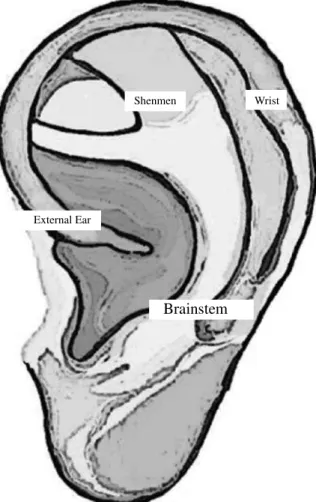
The auriculotherapy group received 12 sessions (1 per week), with each session las ng 5 to 10 minutes, in the Shen-men and Brainstem points (Figure 2). These points present tranquilizing and seda ve eff ects(5). The placebo group also
received the same number of sessions in sham points, points not indica ve for the proposed treatment. The points chosen were the Wrist and External Ear points. Regarding the place-ment of semi-permanent needles, a er the proper loca on of the reac ve points using a point locator, the pinna was cleaned with co on and 70% ethyl alcohol and the needles were applied and affi xed with micropore tape.
OBJECTIVE
To iden fy the anxiety levels of mid-level nursing students of the São Joaquim School of Nursing of the Benefi cência Portuguesa Hospital of São Paulo and to
evaluate the therapeu c effi cacy of auriculotherapy in re-ducing the anxiety levels iden fi ed.
METHOD
This is a single-blind randomized controlled clinical trial, with three groups: control group (no treatment), au-riculotherapy group (interven on) and placebo group (us-ing sham points), performed in the School of Nursing cited
above, from January to July 2011.
Data were collected a er approval by the Research Ethics Commi ee of the Benefi cência Portuguesa Hospital
of São Paulo under protocol No. 672-11 and CONEP/CAAE 0107.0.360.000-11. There was an explana on about the study and the consent of the subjects was gained by them signing the Terms of Free Prior Informed Consent.
A sample calcula on was not made for this study because the popula on was small and it was decided to invite all the students of the Nursing School to par cipate in the trial. The inclusion criteria were: to be a Nursing student of the Mid-Level Professional Technical Educa on Course for Auxiliary Nurses and Nursing Technicians of the ins tu on, to par ci-pate voluntarily, to have me available for the auriculother-apy sessions, to not be pregnant, to complete the State-Trait Anxiety Inventory (STAI) and the social-demographic form, and to not be performing any other treatment for anxiety. A er the necessary exclusions were made a sample of 71 Nursing students was obtained. The reasons for dropouts are shown in the fl ow diagram (Figure 1). The Control Group was
cons tuted by 25 subjects, the Auricular Group 24 subjects and Placebo Group 22 subjects. Data collec on was carried out at the school and all the sessions were conducted by the same interven onist, a nurse acupuncturist with over 5 years experience in auriculotherapy (fi rst author of the work).
85
71
Auriculo Group:
24 Control
Group: 25
Placebo Group:
22 1. Sick Licence (2) 2. Colateral Effect - pain (1) 3. Dropots from the course (6) 4. Missed the session (4) 5. Pregnant (1)
Figure 1 – Flow diagram of the subjects - São Paulo, 2011
Brainstem
External Ear
Shenmen Wrist
Figure 2 - Auricular points and Sham points - Sao Paulo, 2011 The instrument used was the State-Trait Anxiety
RESULTS
Of the par cipa ng subjects, 5.63% (4) had low anxi-ety levels, 36.62% (26) moderate levels, 43.66% (31) high levels and 14.08% (10) very high levels. A er ran-domiza on of the subjects, the following distribu on percentage of students into the three groups was ob-tained, according to levels of anxiety, with 50% of the auriculotherapy group subjects with moderate levels of anxiety and 41% of the placebo group subjects with high levels. A total of 60% of the subjects of the control group had high levels of anxiety.
The mean and standard devia on for the descrip ve sta s cs were calculated. The data regarding age, gender and anxiety trait and state are presented in Table 1.
s cal analysis showed that the data presented normal distribu on in the three test groups with regard to these aspects (p>0.05).
Regarding the distribu on of males and females and complaints of anxiety in the three groups sta s cally
homogeneous data were also obtained (p>0.05), with frequencies of women in the groups of 88% (control), 83.33% (auriculotherapy) and 100% (placebo) (p=0.154). Regarding complaints of anxiety, 92% (control), 91.66% (auricular) and 100% (placebo) were obtained, with p=0.391. This sa sfi ed the precondi ons for the
in-feren al sta s cal analysis: adherence to the normal curve of the means of the three groups, based on the Kolmogorov-Smirnov test and the Levene’s homogeneity of variance test. As a normal distribu on was obtained for the data, parametric tests were used in the sta s cal analysis, the Analysis of Variance (ANOVA) for repeated measures. These tests were performed using the SPSS 17.0 sta s cal program.
The p values for the test of adherence to the normal were found to be p>0.05, confi rming the normality of the
data and allowing the con nuity of the tests. Concern-ing the result of the ANOVA test for repeated measures, sta s cal diff erences were found between the diff erenc-es of the means of the groups at the three merenc-es, when compared between STAI2/STAI1 (P=0.000), STAI3/STAI1 (P=0.016) and STAI4/STAI1 (P=0.006).
In Tukey’s Post hoc test for multiple comparisons, it was observed that the statistically significant difference was between the Control and Auriculotherapy Groups between STAI2/STAI1 (P=0.000), STAI3/STAI1 (P=0.012) and between STAI4/STAI1 (p=0.005). The Placebo Group also resented significant differences between STAI2/ STAI1 (P=0.003). There were no differences between the auriculotherapy and placebo groups, as shown in Figure 3.
Table 1 - Distribution of means and standard deviations accor-ding to age and baseline levels of anxiety trait and state - São Paulo, 2011
Control Mean (SD)
Auriculothe-rapy Mean (SD)
Placebo
Mean (SD) p
Age (years) 28.68 (6.57) 27.21 (5.97) 30.91 (8.34) 0.307
STAI trait 49.48 (7.57) 52.58 (9.29) 51.18 (10.32) 0.491
STAI state (10.79)50.16 54.04 (10.74) 51.59 (11.70) 0.468
Figure 3 - Evolution of state-anxiety levels of the according to the groups - Sao Paulo, 2011
* Statistically signifi cant difference (p<0.05) in the STAI 2-1 between the control and placebo groups.
* Statistically signifi cant difference (p<0.05) in the STAI 2-1, STAI 3-1, STAI 4-1 between the control and auricular groups. Anxiety state over time
1 0
10 20 30 40 50 60
2 3 4
Anxiety score
Auriculo
Control
The improvements in the auricular and placebo groups were obtained in terms of percentages, as shown in Table 2.
DISCUSSION
This study showed that the Shenmen and Brainstem auriculotherapy points were eff ec ve in reducing anxiety. The Shenmen point, located in the fossa triangularis of the pinna, is commonly used as an analgesic, seda ve and an -infl ammatory point and the Brainstem point, located
at the upper edge of the intertragic notch, is characterized by the func on of seda on, due to being s mula ng for the mind and calming for the spirit(13).
In the compara ve analysis, sta s cally signifi cant
ons in anxiety were obtained when diff erences between the means of the control group, without the interven on, and the auriculotherapy group were observed, a er the three evalua ons (8, 12 sessions and in the follow-up). The best result was obtained at the fi rst evalua on, a er eight
sessions, with an improvement of 20.97%, showing that 8 sessions seem to be suffi cient to evaluate the effi cacy of the technique in the control of symptoms of anxiety. In fact, the Shenmen and Brainstem points were used successfully in 14 university students, applied with mustard seeds, showing sta s cally signifi cant diff erences in anxiety levels before and
a er 7 sessions twice a week (p<0.05)(14).
The same points were also used for stress with 41 Nurs-ing professionals from the Intensive Care Unit of the Samari-tano Hospital. The results show that the symptoms present-ed were: deteriora on, back pain, excessive ea ng, fa gue, and 85.4% of the popula on presented improvements in the symptoms a er treatment(15). Although this study was not
performed for the treatment of anxiety, it can be stated that there is an intrinsic rela onship between anxiety and stress. Anxiety can be an presage of stress and high levels of anxiety are accompanied by high levels of stress(16).
Regarding the Placebo Group, an improvement of 13.74% was found in in the fi rst evalua on only, with no
signifi cant diff erences in the other evalua ons. For the
Placebo Group two sham points were used: the Wrist point and the External Ear point. The ar cula on of the wrist point is located approximately 5 mm below the
fl ange point and is indicated for carpal tunnel syndrome
and tenosynovi s. The Outer Ear point is located around the area that forms the depression between the scaphoid fossa and the helix and it is used for treatment for dis-orders of the ear, such as: nnitus, hypoacusis, deafness, labyrinthi s, and ver go(13). Therefore, neither of the two
points would, in principle, be indicated for the treatment of anxiety.
The reasons for the improvements presented by the Placebo Group are ques onable, even though they were smaller than in the Auriculotherapy Group. A er survey-ing other auricular maps, a point called the Insomnia point was found, which is also indicated for the treatment of sleep disorders and presents anxioly c ac on. Also in rela on to another sham point used, the Outer Ear point, a similar nearby point, the Interferon point, was found in a French map, which presents immunomodulatory eff ects and an -infl ammatory ac vity(17). The posi ve results of
the sham group can be jus fi ed as a result of this bias,
i.e. the inappropriate choice of false points. The diff erent auriculotherapy maps, without consensus in the literature regarding the loca ons of the points and their indica ons, make it diffi cult to choose sham auricular points.
It should be considered that the literature indicates that a placebo eff ect can be expected, in acupuncture or body prac ces, of up to 30%, thus, the selec on of points for this purpose is rather diffi cult(18). Acupuncture
stud-ies using a placebo commonly use: minimal or superfi cial
acupuncture (inser on of a needle in the skin), placebo acupuncture (needles into acupuncture points that have no eff ect), or placebo acupuncture needles (the needle p breaks off and touches the skin without penetra ng). However, the light touch on the skin can s mulate mecha-noreceptors, resul ng in ac vity in the ssue region, lead-ing to the s mula on of the soma c sensory cortex and the limbic system. This will trigger hormonal and
onal responses. These reac ons can explain the fact that acupuncture with placebo needle presents posi ve responses. However, this fact does not diminish acupunc-ture as a treatment as the technique shows similar results when compared with pharmacological treatments(19).
Regarding the poten al of auriculotherapy for the control of anxiety, further studies can be cited. A study of auricular acupressure was carried out in Austria, for treat-ment of anxiety in pa ents with gastrointes nal prob-lems, who needed an ambulance to reach the hospital. The authors found that auricular acupuncture is an eff
ve treatment for reducing stress and anxiety displayed by pa ents during transport to the hospital(20).
Another study compared the effi cacy of auriculother-apy in rela on to intranasal midazolam medica on to re-duce anxiety related to odontological treatment. A total of 67 pa ents who underwent tooth extrac on were ran-domized into auriculotherapy, placebo-auriculotherapy and intranasal midazolam groups, compared with a group that received no treatment (the control group). The auric-ulotherapy group and the midazolam group were less anx-ious a er 30 minutes compared with the placebo group of pa ents. Furthermore, the pa ent adherence, evaluated by the den st, was signifi cantly be er with auricular
acu-puncture or intranasal midazolam applica on(21).
Table 2 - Percentage of improvement at the three times, for the auriculotherapy and placebo groups - São Paulo, 2011
STAI 2-1 STAI 3-1 STAI 4-1
Auricular 20.97% 19.19% 16.96%
REFERENCES
1. Depresbiteris L. Avaliação educacional em três atos. 3a ed.
São Paulo: SENAC; 2004.
2. Jorge MSB. Situações vivenciadas pelos alunos de enfermagem, durante o curso, no contexto universitário, apontadas como norteadoras de crises. Rev Esc Enferm USP. 1996;30(1):138-48.
3. Neves Neto AR. Acupuntura e o tratamento da ansiedade: da MTC à psicologia. In: Guilhardi HJ, organizador. Sobre comportamento e cognição. Santo André: Esetec; 2005. p. 95-116.
4. Pilkington K. Anxiety, depression and acupuncture: a review of the clinical research. Auton Neurosci. 2010;157(1-2):91-5.
5. Souza MP. Tratado de auriculoterapia.Brasília: Look; 2001.
6. Suen LKP, Wong TKS, Leung AWN. Is there a place for auricular therapy in the realm of nursing? Complement Ther Nurs Midwifery.2001;7(3):132-9.
7. Nogier R. Auriculotherapy. New York: Thieme; 2009.
8. World Health Organiza on (WHO). WHO Standard Acupuncture Point Loca ons in the Western Pacifi c Region [summary] [Internet]. [cited 2011 Aug 23]. Available from: h p://apps.who.int/bookorders/anglais/detart1.jsp?codlan =1&codcol=52&codcch=114
9. Conselho Federal de Enfermagem (COFEN). Resolução COFEN-197/1997. Estabelece e reconhece as Terapias Alterna vas como especialidade e/ ou qualifi cação do profi ssional de Enfermagem. In: Conselho Regional de Enfermagem de São Paulo (COREn-SP). Documentosbásicos de enfermagem: enfermeiros, técnicos, auxiliares. São Paulo; 2001. p.159-60.
In Cuba, in 2008, a cross-sec onal descrip ve study used auriculotherapy associated with phytotherapy for the treatment of generalized anxiety disorder. The subjects were 30 pa ents who came to a natural and tradi onal medicine consulta on in a clinic in a province of Havana, with the data processed by the Department of Neuro-physiology of the Havana Psychiatric Hospital. Among the results, it was found that 86.7% of the pa ents responded posi vely to the treatment, with improvements in the
al symptoms and perceived sa sfac on(22).
The three studies reported on the control of anxiety by auricular using other points and achieved posi ve results, showing that there are indeed other points that could be used for the same purpose. The present study did not eval-uate the change in the quality of life and academic and pro-fessional performance of the undergraduate students with the presence and a decreased in levels of anxiety, how-ever, there were subjec ve reports of improvements that were not formally analyzed. In future studies it would be important to defi ne what the aspects of improvement are,
evalua ng in greater detail the scope of the technique in the psychic, mental and physical aspects, and which points have the best indica ons for anxiety and stress in auriculo-therapy, considering the diff erent exis ng maps.
Regarding the results obtained with the Shenmen and Brainstem points, the effi cacy of these points for anxiety may be extensible and generalizable, not only for stu-dents but also for professionals, as demonstrated by this trial and other previously cited studies with signifi cant
im-provements for students and Nursing professionals. How-ever, the improvement obtained in 8 sessions seems to be the therapeu c limit of the points protocol. There was no sta s cally signifi cant diff erence between the 8th and
12th session. In the daily clinical prac ce, the
acupunctur-ist does not only use closed protocols, because the treat-ment consists of matching the points to the change ob-tained, i.e. the evolu on of the treatment depends on the signs and symptoms presented. Further studies are sug-ges ve about the use of protocols or not, with a medium and long term period of follow-up to evaluate more fully the benefi ts of the auriculotherapy. In the present study,
the improvements obtained with 8 sessions were main-tained for the following 15 days, however, in decline.
The limita ons of this study were the sample and sh-am point protocol chosen. Further studies need to be per-formed in order to ascertain whether such points (Wrist and Outer Ear) are really eff ec ve in controlling anxiety, as indicated by the posi ve result achieved in the second evalua on, or if this fi nding was due to the placebo eff ect,
the belief, and the therapeu c rela onship established between the interven onist and the research subjects.
CONCLUSION
It was concluded that, of the subjects studied, 43.66% of the students presented high levels of anxiety and 36.62% moderate levels. From the auriculotherapy treatment, us-ing semi-permanent needles, a reduc on in anxiety levels was obtained a er eight sessions, 12 sessions and 15 days a er the end of the applica ons for the Auriculotherapy Group and a reduc on in anxiety a er 8 sessions for the Placebo Group compared with the Control Group. The fi rst
10. Conselho Federal de Enfermagem (COFEN). Resolução COFEN 290/2004. Fixa as Especialidades de Enfermagem. In: Conselho Regional de Enfermagem (COREn-SP). Legislação. São Paulo; 2004.
11. Brasil. Ministério da Saúde. Portaria n. 971/2006. Aprova a Polí ca Nacional de Prá cas Integra vas e Complementares (PNPIC) no Sistema Único de Saúde. Diário Ofi cial da União, Brasília, 4 maio 2006. Seção 1, p. 20-5.
12. Spielberger CD, Biaggio AMB, Natalício L. Manual do inventário de ansiedade Traço-Estado (IDATE). Rio de Janeiro: CEPA; 1979.
13. Garcia E. Auriculoterapia Escola Huang Li Chun. São Paulo: Roca; 2006.
14. Nakai L, Lyra CS, Marques AP. Efi cácia da auriculoterapia no tratamento de estresse e ansiedade em jovens saudáveis [Internet]. 2007 [citado 2011 ago. 23]. Disponível em: h ps:// sistemas.usp.br/siicusp/cdOnlineTrabalhoVisualizarResumo? numeroInscricaoTrabalho=1763&numeroEdicao=16
15. Giaponesi ANL, Leão ER. A auriculoterapia como intervenção para redução do estresse da equipe de Enfermagem em terapia intensiva. Nursing (São Paulo). 2009;12(139):575-9.
16. Price S. Aromaterapia e as emoções: como usar óleos essenciais para equilibrar o corpo e a mente. Rio de Janeiro: Bertrand Brasil; 2006.
17. Landgren K. Ear acupuncture: a prac cal guide. Philadelphia: Churchill Livinsgtone; 2008.
18. Birch S. Controlling for non-specifi c eff ects of acupuncture in clinical trials. Clin Acupunct Orient Med [Internet]. 2003 [cited 2011 Aug 23];4(1):59-70. Available from: h p://www.sciencedirect.com/science/ar cle/pii/
S1461144903000252
19. Lund I, Lundeberg T. Are minimal, superfi cial or sham
acupuncture procedures acceptable as inert placebo controls? Acupunct Med. 2006;24(1):13-5.
20. Kober A, Scheck T, Schubert B, Strasser H, Gustorff B, Bertalanff y P, et al. Auricular acupressure as a treatment for anxiety in prehospital transport se ngs. Anesthesiology. 2003;98(6):1328-32.
21. Karst M, Winterhalter M, Münte S, Francki B, Hondronikos A, Eckardt A, et al. Auricular acupuncture for dental anxiety: a randomized controlled trial. Anesth Analg. 2007;104(2):295-300.