Ibero-American Symposium on History of
Nursing: new perspectives of intellectual
production in the history of nursing
SIMPÓSIO IBERO-AMERICANO DE HISTÓRIA DA ENFERMAGEM: NOVAS PERSPECTIVAS DA PRODUÇÃO INTELECTUAL EM HISTÓRIA DA ENFERMAGEM
COLOQUIO IBERO-AMERICANO DE HISTORIA DE LA ENFERMERÍA: NUEVAS PERSPECTIVAS DE LA PRODUCCIÓN INTELECTUAL EN HISTORIA DE LA ENFERMERÍA
1 Ph.D. Professor. Alfredo Pinto School of Nursing at Federal University of Rio de Janeiro. Rio de Janeiro, RJ, Brazil. [email protected] 2 Student of the post doctorate program. School of Nursing, University of São Paulo. Professor at Alfredo Pinto School of Nursing at Federal University of Rio de Janeiro. Rio de Janeiro, RJ, Brazil. [email protected] 3 Ph.D. Professor. School of Nursing, University of São Paulo. São Paulo, SP, Brazil.
C
RITICAL
R
EVIEW
RESUMO
A produção intelectual apresentada no I Simpósio Ibero-Americano de História da Enfermagem foi organizada a partir de três eixos temáticos: antropologia do cuidado, história das instituições de ensino, de as-sistência e agremiações de enfermagem e história de vida, totalizando 198 estudos. Mediante os resultados apresentados a produção mostrada no simpósio apontou para a tendência dos estudos em história da enfermagem, nos eixos temáticos, pela ordem de interesse dos pesquisadores em: história das instituições, antropologia do cuidado e história de vida.
DESCRITORES História da enfermagem. Cultura.
Cuidados de enfermagem.
Almerinda Moreira1, Fernando Porto2, Genival Fernandes de Freitas3, Paulo Fernando de Souza Campos4
ABSTRACT
Intellectual production presented in the I Symposium Ibero-American of Nursing His-tory was organized in three thematic bases: anthropology care, history of the institu-tions of teaching, caring and associainstitu-tions of nursing and history of life, totalizing 198 researches. Results of production in the Symposium showed that tendency of the researches in the nursing history in the the-matic bases, according with interest of re-searchers in: history of institutions, anthro-pology of care and history of life.
KEY WORDS Nursing history. Culture. Nursing care.
RESUMEN
La producción intelectual presentada en el I Simposio Ibero-Americano de Historia de la Enfermería fue organizada a partir de tres bases temáticas: antropología del cui-dado, historia de las instituciones de ense-ñanza, asistencia y agremiaciones de en-fermería y historia de vida, totalizando 198 estudios. Mediante los resultados presen-tados, la producción presentada en el sim-posio reveló la tendencia de los estudios en historia de la enfermería, en las bases temáticas, por la orden de interés de los investigadores en: historia de las institu-ciones, antropología del cuidado y historia de vida.
DESCRIPTORES Historia de la enfermería. Cultura.
1353
Rev Esc Enferm USP 2009; 43(Spe 2):1352-6 www.ee.usp.br/reeusp/ Ibero-American Symposium on History of Nursing: new
perspectives of intellectual production in the history...
Moreira A, Porto F, Freitas GF, Campos PFS
INTRODUCTION
From October 29 to 31 2007, in the city of São Paulo, the 1st Ibero-American Symposium in History of Nursing (I SIHAE,
abbreviation in Portuguese) was held, with the central theme Memory and Professional Identity. The event was promoted by the University of São Paulo School of Nursing (EEUSP, abbreviation in Portuguese), with the support from four-teen institutions including public and funding departments, public and private hospitals, schools and professional as-sociations, as the International Council of Nurses. The sym-posium promotion integrated the celebration of the 65 years of EEUSP and the 15 years of the Culture History Center of Ibero-American Nursing. Furthermore, it contrib-uted with the integration of researchers and study groups, with discussions about the difficulties involved in knowl-edge production, and analyzing the past of nursing his-tory and the social role of nurses.
The purposes of this 1st Symposium were to promote
the discussion about academic production regarding the History of Nursing. Without underestimating the classic studies, about the great characters in
nurs-ing, the event permitted to acknowledge other histories of the many nursing practitioners, offering a significant contribution for the debates about memory and professional iden-tity, what it means to be a nurse and its so-cial representations.
From this perspective, the event permit-ted to evaluate that a history that is politics in essence, seen from above, written by he-gemonic, secularly established groups, should not be the only possibility for review-ing the past. The I SIHAE was a moment to
hold discussions about culturally differentiated themes and focuses. The studies addressed the long history of care, a branch of the history of nursing under construc-tion in Brazil, and permitted to acknowledge the studies about ethnics, gender and institutional issues, with spe-cial emphasis on the memory of nursing schools, as well as issues regarding nursing education and care.
Before the SIHAE was held, the organizers used an-nouncement strategies such as posters and virtual bulle-tins before the event. A website was created to provide information for those interested in participating in the event, and was informed among the academic community one year before the established date, with general infor-mation and the norms for submission.
The Symposium counted with the participation of re-searchers from countries of the Ibero-American world, such as Portugal, Spain, Chile, Peru, Colombia and Brazil, as well as representatives from the African and Asian conti-nents, such as Cape Verde, Angola and Japan. Hiroko Minami, President of the International Council of Nurses -ICN, headquartered in Geneva, Switzerland, held the
open-ing conference named History of the ICN: challenges and perspectives, which shows the prestige and position achieved by Brazil with the most accredited nursing orga-nization in the world, mainly for the effective collabora-tion of one Brazilian nursing representative, Taka Oguisso, who worked with the ICN staff from 1980 to1990, and was the Honorary President of the event.
On the second day of the Symposium, the lecture Enfermería y cultura de los cuidados: una evolución histórica determinante para la construcción social, científica y profes-sional de la disciplina, delivered by José Siles González, Professor at Universidad de Alicante, Spain, revealed the interfaces of nursing care considering values, behaviors, moral rules, and religion; and showed the how these themes can affect the process of care. The approached of life his-tories, of interest to nursing history, was addressed in the lectures Teresa Benides Vargas y la Evolución de la Enfermería Peruana and Maria Fernanda Rezende e Maria Nazareth Palheiro: duas enfermeiras portuguesas a não esquecer delivered by Lúcia Aranda Moreno, from Universidad Pedro Ruiz, Peru and by the President of the Portuguese Association of Nurses, Marília Viterbo de
Freitas, respectively.
During the three days, several nurs-ing history researchers presented and dis-cussed themes pertinent to the areas pro-posed as theme lines. In this sense, present-ing the intellectual production revealed in the 1st Ibero-American Symposium on the
History of Nursing sets a landmark on the field of research and shows the potential of the theme, a course that is relegated as a detriment of the perspective of knowing how to perform, as revealed by the current teach-ing legislation(1).
The Symposium, considering its multiple dimensions, can be considered a result of a feminine fight for keeping the historical memory of nursing alive in Brazil; a lesson learnt and taught by Edith de Magalhães Fraenkel, Waleska Paixão, Maria Rosa Sousa Pinheiro, Glete de Alcântara, Amália Correia de Carvalho, Anayde Correia de Carvalho, and more contemporarily, Ieda de Alencar Barreira, Nalva Pereira Caldas and Taka Oguisso, who organized the event. Other women dedicated themselves incessantly to preserv-ing nurspreserv-ing history education as a legitimate field, impe-rious to professional development, specifically for those concerned not only with knowing how to perform and know-ing to learn but knowknow-ing how to be a nurse.
Memory and Professional Identity: analysis of the intellectual
production presented in the 1st Ibero-American Symposium
on the History of Nursing
To identify the intellectual production revealed by the SIAHE, a matrix was used, based on the pre-established theme lines and the researchers’ names. By using the matrix
The Symposium, considering its multiple
dimensions, can be considered a result of
a feminine fight for keeping the historical
to analyze the program of the event and the data from the annals, two demonstrative charts were obtained. The intel-lectual production, presented in the table, aimed at identi-fying the number of studies, according to the proposed theme lines, which included Care Anthropology, History of Nurs-ing TeachNurs-ing and Care Institutions and Associations, and History of life, with a total of 198 studies presented.
The theme line Culture of Care emphasized the compre-hension of care as a product of reflecting about ideas, actions and circumstances (theoretical, practical and situ-ational thought) related with the process of health needs, guaranteeing the integrity and harmony of each and every stage that compose human life(2-4). Therefore, the
anthro-pological study of care consist of a basic instrument to identify, on one hand, variants in the form of satisfying needs, and on the other hand, to explain the causes of that diversity and its corresponding meanings. In this perspec-tive, culture has been considered, in essence, as the group of patent and latent behaviors of a community and im-plied in the process of meeting needs. Hence, with no doubt, we should study the mechanism of satisfying those needs, considering the different social contexts(3).
In this perspective, Madeleine Leininger’s Culture Care Diversity and Universality Theory (CCDUT) has been used in different countries and is considered an important theory for the development of culturally-based care. We believe that the overall view of the context experienced by Leininger and its influences for the construction of an in-ternationally acknowledged nursing theory can be useful for those who wish to conduct cross-cultural nursing re-search to find a path to guide their care, teaching, and research practice(5).
The theme line characterized as History of Nursing Teach-ing and Care Institutions and Associations assembled stud-ies about social movements involving the nursing profes-sional development (such as the creation of schools and workstation), the political needs of associations (creation and management of class organizations such as the Bra-zilian Nursing Association-ABEN, Federal Nursing Bard-COFEN and Regional Nursing Board-COREN), and similar organizations. By addressing the memory of education and work areas, the theme line joined most of the presented study communications, permitting to consider the ap-proaches that the theme raised as one of the great centers of investigation in the history of nursing in Brazil.
The theme line identified as History of Life gathered re-searchers interested in the possibilities of biographies, micro-history, and recovering individual memories, that is, history agents, illustrious or unnamed, who constructed the history of nursing in the Ibero-American world. Symp-tomatically, the small number of studies about the personal trajectories of women (and men) permitted to recognize the need for investments in adequate research methodologies for the (new) fields of investigation in nursing, as revealed by the women’s history. Though reduced, the potential of the
theme line was perfectly adequate considering the tenden-cies of nursing history research, as did the gender issues.
The most expressive theme line on Table 1 was the His-tory of Institutions, followed by Anthropology of Care and History of Life, with the smallest percentage. The result suggests that nursing history researchers study themes regarding teaching and health institutions. On the other hand, the table showed that there should be more invest-ment from national researchers on the history of life of the main nursing protagonists in Brazil.
Another piece of information on Table 1 that should be emphasized is the theme line Anthropology of Care. This theme line showed the existing potential of the history of care and caregivers, which is practically unexplored re-ferring to the mystical-religious, domestic, pprofes-sional, and professional periods. It is inferred that re-searchers, especially those from teaching institutions in Rio de Janeiro, have dedicated to studying symbolic as-pects, rescuing the history of nursing by interpreting rites, emblems, and other symbols that comprise the nursing profession, revealing facts and improve the chances of analyzing the past of nursing.
The analysis matrix also evidenced the production of re-searchers regarding the frequency of their participation in studies. In other words, there were 309 researchers involved, 217 of which participated in one study; 41 in two studies; 24 in three studies; eight in four studies; and one in five studies. Based on the latter quantitative data, there was a cumulative increase in the participation of some researchers.
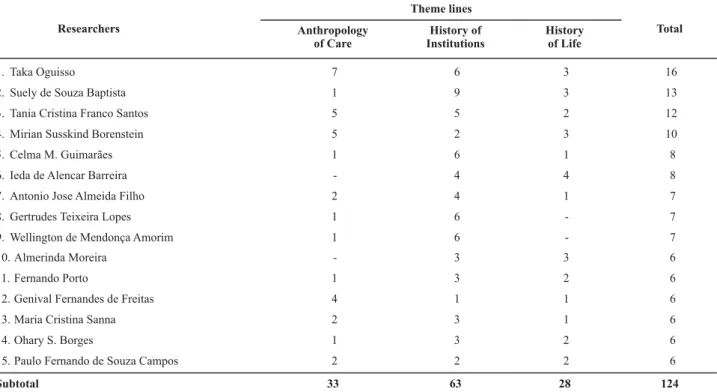
The increase occurred with six researchers in six stud-ies; three in seven studstud-ies; two in eight studstud-ies; one in ten, 12, 13 and 16 studies. These data can mean associations among researchers in the sense of accumulating produc-tions and strengthening research groups in the referred field of knowledge. Taking this information into consideration, Table 2 was created based on the criterion of producing a minimum of six studies per researcher participation.
The study presentations, a criterion used to define the volume of intellectual production in the field of nursing history, in most cases, present an overlap of authors. The data that permitted to quantify the results, though raising the indexes for some researchers, cannot be evaluated as a one-way path. On the contrary, it permits to consider the existence of associations established between different re-Table 1 - The intellectual production of nursing history by theme
line - São Paulo - 2007
Theme lines
Anthropology of care History of Institutions History of Life
Total
N %
66 33.3
91 45.9
41 20.7
198 100
1355
Rev Esc Enferm USP 2009; 43(Spe 2):1352-6 www.ee.usp.br/reeusp/ Ibero-American Symposium on History of Nursing: new
perspectives of intellectual production in the history...
Moreira A, Porto F, Freitas GF, Campos PFS
search centers and groups, they reveal a potential increase of advisors for nursing history research, and show the nec-essary union for including this theme as a line of research, making it official with the funding and research organiza-tions in Brazil and Latin America, especially considering
that the vast majority of studies presented were originally developed in public higher education institutions.
Table 2 shows the names of researchers who participated in at least six studies. In this sense, the theme line History of Institutions remained in evidence, ratifying Table 1. Table 2 - Ranking of researchers by theme line - São Paulo - 2007
Theme lines
Researchers Anthropology
of Care
History of Institutions
History of Life
Total
1. Taka Oguisso
2. Suely de Souza Baptista 3. Tania Cristina Franco Santos 4. Mirian Susskind Borenstein 5. Celma M. Guimarães 6. Ieda de Alencar Barreira 7. Antonio Jose Almeida Filho 8. Gertrudes Teixeira Lopes 9. Wellington de Mendonça Amorim 10. Almerinda Moreira
11. Fernando Porto
12. Genival Fernandes de Freitas 13. Maria Cristina Sanna 14. Ohary S. Borges
15. Paulo Fernando de Souza Campos
7 1 5 5 1 -2 1 1 -1 4 2 1 2
6 9 5 2 6 4 4 6 6 3 3 1 3 3 2
3 3 2 3 1 4 1 -3 2 1 1 2 2
16 13 12 10 8 8 7 7 7 6 6 6 6 6 6
Subtotal 33 63 28 124
Source: Annals of the 1st Ibero-American Symposium on the History of Nursing– EEUSP(7)
It should, however, be stressed that the production of the author ranking first place pointed at the tendency of History of Institutions and Anthropology of Care, which did not occur with the second-place researcher, who potentially invested in History of Institutions. As for the author ranking third place in terms of presentations in the Symposium, there was production in different theme lines, which in-cluded Anthropology of Care and History of Institutions besides History of Life, but with more emphasis on the two former lines. The interests of the next researcher permit to consider the development of studies in the areas of History of Institutions and History of Life and also in the field con-sidered as Anthropology of Care. Therefore, it is inferred that most researchers of the History of Nursing have been producing studies in the three theme lines quite success-fully, which reveals the vigor of these areas in the produc-tion of historical knowledge in Ibero-American Nursing.
Overall, this analysis cannot be evaluated as the only possibility, but as the result of a preliminary analysis of the interests of groups that study the history of nursing. This is revealed by the rank position of one of the great Brazilian researchers of this theme, Ieda de Alencar Barreira, who has recurring intellectual production in the different theme lines, evidenced by the historiography of Brazilian nursing.
The results presented in Tables 1 and 2 are comple-mentary in the sense that the researchers’ investments strengthen the studies on nursing history, through institu-tions, or the anthropology of care or by the possibilities of the history of the lives of nursing characters.
It should be stressed that the event prepared the exhibi-tion called Do Sagrado ao Profano: a indumentária e as re-presentações da enfermagem (From Sacred to Profane: nurs-ing clothnurs-ing and representations), which presented, besides print and photographic documents, uniforms used by EEUSP students, as well as replicates of the clothes used by the renowned pioneer Florence Nightingale and the Daughters of Charity of Saint Vincent de Paul, caregivers by vocation(8).
respective advisors, and was also a result of the consolida-tion of the Núcleo de Pesquisa em História da Enfermagem Brasileira – NUPHEBRAS/EEAN/UFRJ (Research Center for the History of Brazilian Nursing) and Laboratório de Pesquisa em História da Enfermagem – LAPHE/EEAP/UNIRO ( Labora-tory for the Research on the HisLabora-tory of Nursing).
The outstanding presence of the research nurses from Federal University of Santa Catarina – UFSC deserves em-phasis, more specifically the studies coordinated by Mirian Susskind Borenstein. In this sense, the SIAHE was considered a landmark for the history of nursing, under consolidation in the field of nursing research, consider-ing the acknowledgement from nurse researchers and pro-fessionals such as historians, sociologists and anthro-pologists, who also participated in the event, communi-cating studies or delivering lectures in round tables. The presence of the latter professionals marks the importance of nursing in the context of human sciences as it assumes the position of an interdisciplinary field.
The results achieved by the event– quantitative and qualitative – permit to consider that nursing history, re-dimensioned by the culture of care, should be considered fundamental for the development of health care delivery. Acknowledging the experiences that constructed the foun-dations of the nursing profession, as revealed by the par-ticipation of researchers from countries of the Ibero-Ameri-can world, indicates that the critical and dialectical analy-sis of the paths pursued by nursing is the effective means to strengthen the profession. Without memory it is impos-sible to maintain professional identity and to project the future and the actions that compose it.
It should be considered that the aforementioned infor-mation agrees with the experience of using quantitative and qualitative approaches to produce nursing knowledge, as reported by Odaléa Maria Bruggemann and Mary Ângela
Parpinelli when they stated that the combination between the referred approaches is a research strategy to better address certain nursing phenomena to be studied(9).
The interchange of knowledge regarding the history of nursing made it possible for the first edition of the Ibero-American Symposium on the History of Nursing Memory and Professional Identity, to stress the commitment with the documentation of a history that recovers the experi-ence of men and women, illustrious or unnamed, and write the history of care in the periods before the profession was officially or unofficially established.
FINAL CONSIDERATIONS
The referred event revealed the potential of historical-cultural research in Ibero-American nursing studies. In the case of Brazil, where research groups consolidated the need for historical research, developing studies and preserving documents, in print, iconographic, and imagetic, of various origins with the purpose of recovering the his-torical memory of nursing in its multiple temporalities.
The 1st Ibero-American Symposium on the History of
Nursing integrated different areas of interest for research in the field of history, making it possible to establish dia-logues among researchers of different theoretical matri-ces and to create international partnerships with research-ers in other continents. Especially in Latin America, it ben-efited the exchange of ideas, the creation of virtual dis-cussions about themes involving the area of knowledge in the different settings of nursing practice, the representa-tive elements or providing guidance by means of the ob-ject of care culture. In this direction, the group of research-ers from Portugal, present in the SIAHE, took responsibil-ity for holding, in 2009, the 2nd Ibero-American
Sympo-sium on the History of Nursing in that country.
REFERENCES
1. Brasil. Lei n. 9394, de 20 de dezembro de 1996. Estabele-ce as diretrizes e bases da educação nacional. Lei de Diretrizes e Baes da Educação-LDB [texto na Internet]. Brasília; 1996. [citado 2008 set. 18]. Disponível em: tttp/ /www.planalto.gov.br/ccivil_03/LEIS/L9394.htm
2. Siles JG. Antropología narrativa de los cuidados. Valencia: Consejo de Enfermería de la Comunidad Valenciana; 1996.
3. Siles JG. Historia de la Enfermería. Alicante: Aguaclara; 1999.
4. Collière M. Utilización de la antropología para abordar las situaciones de cuidados. Rol Rev Enferm. 1989;10(80):17-25.
5. Oriá MOB, Ximenes LB, Alves MDS. Madeleine Leininger and the Theory of the Cultural Care Diversity and Universality: an historical overview [text on the Internet]. 2005 [cited fev. 2]. Available from: www.uff.br/nepae/objn402oriaetal.htm
6. Programa do 1º Simpósio Ibero-Americano de História da Enfermagem. Memória e Identidade, Profissional; 2007 out. 29-31; São Paulo, BR. São Paulo: Escola de En-fermagem da USP; 2007.
7. Anais do 1º Simpósio Ibero-Americano de História da Enfermagem. Memória e Identidade Profissional; 2007 out. 29-31; São Paulo, BR [CD-ROM]. São Paulo: Escola de Enfermagem da USP; 2007.
8. Campos PFS, Oguisso T, Freitas GF. Do sagrado ao profa-no. São Paulo: Escola de Enfermagem, Universidade de São Paulo; 2007.