Rev Saúde Pública 2008;42(1)
Vera Maria Freitas da SilveiraI
Bernardo Lessa HortaII
I Programa de Pós graduação em
Epidemiologia. Universidade Federal de Pelotas (UFPel). Pelotas, RS, Brasil
II Departamento de Medicina Social e
Comunitária. Faculdade de Medicina. UFPel. Pelotas, RS, Brasil
Correspondence:
Vera Maria Freitas da Silveira Departamento de Clínica Médica Faculdade de Medicina Universidade Federal de Pelotas Av. Duque de Caxias, 250 96030-000 Pelotas, RS, Brasil E-mail: [email protected]
Received: 3/6/2007 Reviewed: 7/30/2007 Approved: 9/11/2007
Birth weight and metabolic
syndrome in adults:
meta-analysis
ABSTRACT
OBJECTIVES: To assess published evidences of the effect of birth weight
on metabolic syndrome in adults.
METHODS: PubMed and LILACS databases were searched for articles
published from 1966 through May 2006. The terms used were: “birth weight”, “birthweight”, “intra-uterine growth restriction (IUGR)”, “fetal growth retardation”, “metabolic syndrome”, “syndrome X”, “Reaven’s X syndrome”. Two hundred and twenty-four studies reporting estimates of the association between birth weight and metabolic syndrome or its components were considered eligible. Eleven studies provided odds ratios and were included in the meta-analysis.
RESULTS: All but two studies reported an inverse relationship between
birth weight and metabolic syndrome. A comparison between low birth weight vs. normal birth weight subjects showed the random effects odds ratio for metabolic syndrome was 2.53 (95% CI: 1.57;4.08). The funnel plot graphic suggests a publication bias but, even in the studies with more than 400 subjects, the results remained signifi cant (pooled odds ratio: 2.37 (95% CI: 1.15;4.90).
CONCLUSIONS: Low birth weight increases the risk of metabolic syndrome
in adults.
KEY WORDS: Birth weight. Metabolic syndrome. Nutritional and metabolic diseases. Meta-analysis.
INTRODUCTION
Low birth weight (LBW) is a marker of intra-uterine environment, and a pre-dictor of neonatal and child mortality57. Barker3 proposed that low birth weight would be associated with adult chronic diseases such as coronary heart disease, hypertension, stroke21 and type 2 diabetes.44
Children with intra-uterine growth retardation are at greater risk to gain adi-posity after birth. This can cause obesity in childhood and adolescence and insulin resistance (IR), which are the main suggested mechanisms of metabolic syndrome.46,58
Metabolic syndrome is described as a cluster of the following components: central obesity, IR, atherogenic dyslipidemia, hypertension, vascular infl amma-tory markers, and impaired glucose tolerance, which are associated to greater risk of cardiovascular disease (CVD) and type 2 diabetes.13
In regard to hypertension,Adair & Dahly1 recently reviewed the evidence on the association between hypertension and BW and found negative regression coeffi cients ranging from 0.35 mmHg to 5.9 mmHg per kg. Schluchter45, in a meta-analysis of 55 studies on the association of BW and hypertension, includ-ing subjects aged 0 to 75, found a reduction of 1.38 mmHg in the systolic blood pressure for each increase of 1 kilogram in the BW. This author pointed out that there was probably publication bias since the effect of BW was higher in small studies. Huxley23 found similar results in another meta-analysis of 55 studies: the pooled coeffi cient was –1.9 mmHg per kg of BW in the studies with less than 1000 subjects whereas among those with more than 3000 subjects the pooled coeffi cient was –0.6 mmHg per kg.
With respect to the relationship between BW and cho-lesterol levels, Huxley et al.24 conducted a systematic review and meta-analysis and found a pooled effect of –1.39 mg/dL (95% CI –1.81 to –0.97 mg/dL), i.e., each increase of one kg in BW was associated with a decrease of 1.39 mg/dL in total cholesterol. Studies of infants and those with small sample size showed the larger effect sizes and the conclusion was that publication bias and results from uncontrolled studies for confounders have resulted in a strong negative relationship between BW and seric cholesterol. Besides, the effect of intrauterine growth in the cholesterol levels was weak and unlike to affect the risk of vascular disease. According to Laurén et al.31, there is no evidence that BW is associated with
seric lipids levels in later life while the evidence is inconclusive for triglycerides.
Newsome et al,38 in a systematic review of BW and glucose metabolism disturbances, found that most of the 48 studies reported an inverse relationship between BW and fasting and postchallenge glucose, fasting insulin, prevalence of type 2 diabetes, and insulin resistance and secretion measures, although these last measures had inconsistent results in adults.
Kuh et al,29 in the United Kingdom, did not fi nd an as-sociation between waist circumference and BW, only an negative effect on waist-hip ratio in women after adjusting for current body weight. A study with adults in China found that those who had the highest and the lowest BW presented a higher risk of developing abdominal obesity.52
According to Kramer28 part of the skepticism about the evidence of association between BW and later chronic adult disease shifted from criticism of the analytical approaches – with many studies showing the association only after adjustment for current obesity –, to question-ing the impact of this association on public health.
The studies in the literature on the association between BW and metabolic syndrome are not consistent. Some studies show a direct relationship between LBW and
metabolic syndrome while others show a protective, though not signifi cant, effect with large confi dence intervals. Although several meta-analysis and reviews on the association between BW and components of metabolic syndrome have been published, to the au-thors’ bets knowledge, none of them has assessed the evidence on the direct association between BW and metabolic syndrome. Also, there may be publication bias: small studies or those with negative results are less likely to be published.30
The purpose of the present study was to review the published evidences of the effect of BW on the occur-rence of metabolic syndrome in adults.
METHODS
MEDLINE and LILACS databases were searched fol-lowing the Meta-analysis of Observational Studies in Epidemiology50 (MOOSE) Group guidelines to identify studies published from 1966 through May 2006 on the association between BW and metabolic syndrome. The following MeSH terms were used: “fetal growth retardation,” “intrauterine growth restriction” (IUGR), “birth weight,” “birthweight” with “metabolic syn-drome,” “syndrome X” e “Reaven’s syndrome X”.
Any paper reporting on the association between BW and metabolic syndrome (using any diagnostic crite-ria) or its components was eligible to be included in this review. Of 918 published studies identifi ed, 694 were excluded after reading their abstracts. Most were studies in animals, reporting metabolic and syndromic alterations in newborns or management of critically ill neonates. There was no restriction of age groups in the selection of the articles. However, since there is no consensus on metabolic syndrome criteria in children and adolescents, only studies with adults were included in the meta-analysis. There were included only papers published in English, Portuguese, French, Italian or Spanish.
3 Rev Saúde Pública 2008;42(1)
A total of 11 studies provided OR. Since Byberg et al7 population was interviewed at the age of 50 and 70, there were included only the results of 70. Barker et al4 article comprised two different populations, and both were included. When a metabolic syndrome criterion was not that from NCEP-ATPIII, the simultaneous oc-currence of one criterion of dyslipidemia, dysglycemia and hypertension was considered.
The studies were reviewed by two authors. A checklist was used comprising the following criteria: author’s name, year of publication, study country, study type, year of birth of the study population, mean age of the population, number of subjects, sex, losses, BW clas-sifi cation, metabolic syndrome criteria, confounders and mediators, BW categories, ORs and confi dence intervals.
Losses were estimated based on the original population minus deaths. STATA v 9.0 was used in data analyses. Q test was used to check for heterogeneity between studies39 and, in case of heterogeneity, randomic models were preferred.11 Publication bias was evaluated by Egger’s and Begg’s tests and funnel plot.14. The analyses were stratifi ed by sample size to detect the impact of publication bias on the pooled effect.
Infl uence analysis was performed excluding each study from the data set, and recalculating the pooled estimated of the remaining studies.
RESULTS
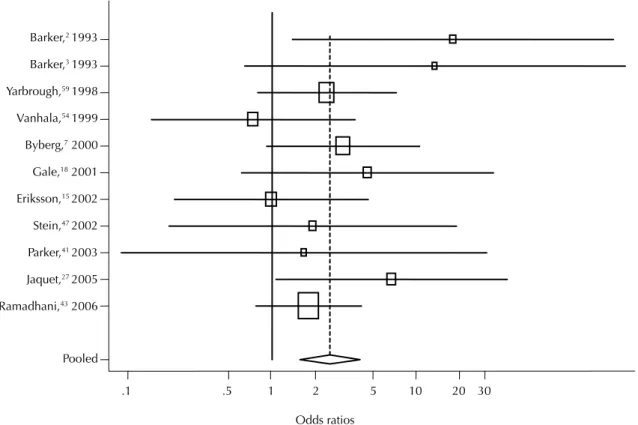
Study design and baseline characteristics of the 10 articles (11 studies) included in the meta-analysis are shown in Table 1. A total of 5,867 subjects were involved, with a mean age of 50.7 years, and median birth year of 1939. The average losses were 68.4%. Figure 1shows that there was heterogeneity among studies: two studies reported a non-statistically signifi -cant, protective effect of LBW. Nine studies showed a greater chance of metabolic syndrome in people with LBW. However, the Q test was 16.612, p=0.083 and a randomic model was used. The pooled effect was 2.53 (95% CI 1:57;4.08, p<0.0001).
Odds ratios Pooled
Ramadhani,43 2006
Jaquet,272005
Parker,412003
Stein,472002
Eriksson,152002
Gale,18 2001
Byberg,7 2000
Vanhala,541999
Yarbrough,591998
Barker,31993
Barker,21993
.1 .5 1 2 5 10 20 30
Figure 1. Odds ratios of metabolic syndrome in low birth weighted compared to normal.
0
.5
1
1.5
SE of lnor
5 10 15 20 25
exp(lnor), log scale
Birth weight and metabolic syndrome: meta-analysis Da Silv
eir
a
VMF & Horta BL
Author Publication year, country Study type Year of birth Age (years) Sex Sample size (% loss) Source of birth weight
Criteria for metabolic syndrome Birth weight (kg) Confounders
Control for mediators Metabolic syndrome prevalence (%) OR (95% CI) Adjusted OR* (95% CI) Barker,4 1993, England
Cohort 1920–1930 64 Male (64.8)407 Midwife
Impaired glucose tolerance(IGT) or DM, SBP 160 or treatment, TG >
median 1.4 mmol
> 2.5 > 4.31
Tobacco and alcohol use, social condition (current and at birth)
BMI LBW 6/20(30) AGA 2/32(6)
-18. 0 (2.6-118. 0) Barker,4 1993, England Cohort 1935–
1943 50 Both 266
(47.1) Midwife
SPB 150 or treatment, TG > median 1.4 mmol, Impaired glucose tolerance(IGT) or DM (ADA)
> 2.5 > 3.41
Tobacco and alcohol use, social condition (current and at birth)
BMI and sex
> 2.5 4/30 (13) >3.41 1/82 (1)
-13. 5 (1.4-129.
0)
Yarbrough,59
1998, US Cohort 1917 67 Female 303 (80.1)
53% recall, 47% other
records
SBP >160 or DBP >90 or treatment, TGS >2.3mmol or HDL-C < 1.4 mmol; IGT or diabetes, or treatment
LT 1.12-3.06 HT 3.6-5.85
Adjusted each
component for age No
LT 11/92 (12) HT 4/99 (4.3)
-2.41 (1.06-5.51) Vanhala,54 1999, Finland Cohort 1947, 1952, 1957
41 Both 428 (57.5)
Other records*
BP >140 or > 90 or treatment, TG >1.7mmo/L, HDL-C <1.0 mmol in men and <1.2 in women; IR, DM, IGT or hyperinsulinemia >13 mU/L
< 3.3 for men < 3.05 for women
>3.9 for men >3.7 for women
Age and sex BMI LW6/108 (5.6) HW8/109 (7.3)
-0.74 (0.22-2.47) Byberg,7 2000, Sweden
Cohort 1922 70 Male 734 (61.4)
Hospital registry
SBP >154 or treatment; low insulin sensitivity index <3.65 mg/min or IGT or DM; TG >1.57mmol/L or treatment or HDL-C <1.1y ; PAI1 >19.2 U/ml
< 3.25
> 4.25 Age BMI
LT 35/174 (20.1) HT 7/68 (10.3)
2.17 (0.93-5.26) 3.12 (1.25-7.69)
Gale,18 2001,
England Cohort 1924 72 Both 143 (93.6)
Hospital
registry NCEP-ATP III
> 2.5 > 4.31
Socioeconomic
condition No
4.5 (1.02-19.8) 4.6 (1.02-20.4) Eriksson,15 2002, Finland
Cohort 1924–1933 70 Both (93.3)474 Hospital registry NCEP-ATP III > 4.31> 2.5 Socioeconomic condition No Total 107/464 (23) 0.99(0.3-3.3)
Stein,47 2002,
Guatemala Cohort 1973 24 Both 385 (49.5)
Other
records** NCEP-ATP III
> 2.5 > 4.31
Socioeconomic condition No
LBW 2/28(7.1) HBW 5/99 (5)
1.46 (0.30-7.09) 1.92 (0.35-10.6) Parker,41 2003, England
Cohort 1947 50 Both (68.6)358 records**Other NCEP-ATPIII > 4.31> 2.5 Socioeconomic condition No Total 41/358 (11.5)
1.19 (0.14-9.98) 1.67 (0.19-14.0) Jaquet,26 2005, France Case-control 1971–
1985 22 Both 1620 (65.2)
Hospital
registry NCEP-ATP III
SGA (<10th percentile) AGA (25th< 75th)
Age, sex, tobacco, oral contraception, family history of metabolic and CVD
BMI SGA17/734 (2.3) AGA 3/886 (0,3) 1,8 (1,0-3,5) 6.76(1.93-30.02) Ramadhani,43 2006, Netherlands Cohort 1970–
1973 28 Both 749 (82.2)
Other
records** NCEP-ATP III
LT 1.25-3.20 HT: 3.65-5.50
Sex, family history of CVD, education
-LT (11.6)
HT (7.1)
-1.8 (1.0-3.5)
IGT: impaired glucose tolerance; DM: diabetes mellitus; SBP: systolic blood pressure, in mmHg; TG: triglycerides; DBP: diastolic blood pressure; HDL-C: high-density lipoprotein cholesterol; IR: insulin resistance; PAI 1: plasminogen activator inhibitor1; LBW: low birth weight; HBW: high birth weight; BMI: body mass index; LT: lower tertile; HT: upper tertile; LW: lower weight; HW: higher weight; SGA: small for gestational age; AGA: appropriate for gestational age; CVD: cardiovascular disease; NCEP-ATP III: National Cholesterol Education Program Expert Panel III.
* Adjusted for socioeconomic factors
5 Rev Saúde Pública 2008;42(1)
The funnel plot (Figure 2) suggests publication bias with few small studies reporting a protective effect. But neither Begg’s (p=0.28) nor Egger’s test (p=0.20) were statistically signifi cant. In a homogeneous set of trials the points will scatter about a line that runs through the origin at standard normal deviate zero. If there is no selection bias, the plot of the trials’ effect estimates against sample size will resemble a sym-metrical inverted funnel.
The polled effect was slightly higher among small studies: OR=2.87 (95%CI: 1.56;5.30) for studies with less than 400 subjects compared to OR=2.37 (95%CI: 1.15;4.90) for those with 400 or more (Table 2). There was no statistically signifi cant difference in the OR in the analysis stratifi ed by age, sex and controlled for confounders or according to the year of birth. There were no differences among studies concerning the defi nition criteria for metabolic syndrome or BW categories (LBW or tertile) or comparison categories (LBW and high BW, or lower tertile and upper tertile). Losses to follow-up were associated with the heterogeneity of the studies: the effect of LBW was higher in those studies with losses between 60% and 79% (pooled OR=4.26; 95%CI: 1.34;13.60). Studies published in the 1990s showed an OR=3.18 (95%CI: 1.29;7.86) compared to an OR=2.14 (95%CI: 1.27;3.62) in those published from 2000.
DISCUSSION
The results of the present review confi rmthe inverse relationship between BW and metabolic syndrome: LBW children are two and a half times more to have metabolic syndrome in their adult life (OR=2.53; 95%CI: 1.57;4.08).
The funnel plot suggests publication bias. Although Egger’s and Begg’s tests did not show any statistical signifi cance, they are less powerful in small sample analysis (less than 20 studies).49 In the analysis stratifi ed by sample size, there was still a signifi cant effect (OR) in studies with larger sample size, suggesting that only a small part of the effect was due to publication bias. Heterogeneity of the studies was seen as the pooled effect was greater in studies with intermediate losses, and published in earlier years.
The majority of the studies, except for Gale et al,18 Parker et al,41 Stein et al,47 Eriksson et al,15 and Rama-dhani et al,43 adjusted for the effect of BW to current body mass index (BMI). This is considered statistically inappropriate9 since adult weight can be associated to BW and then an outcome would be adjusted for a mediator35 as most components of metabolic syndrome are related to obesity. This methodological difference may explain the greater effect found in early studies. Some authors such as Parker et al,41 Eriksson et al,15 and Ramadhani et al,43 excluded diabetics and patients receiving cholesterol drugs, and this possibly could reduce the effect. Some studies7,43,59 did not use LBW (≤2.5 kg) but rather the fi rst tertile as a comparison category and this could underestimate the effect of BW. But the stratifi ed analysis did not show heterogeneity in BW classifi cations and probably it did not affect the pooled effect of the present analysis.
Most studies obtained BW information from hospital records or health clinics to reduce recall bias. Yarbrough et al.59 used data from family records (47%) and parents
Table 2. Stratifi ed meta-analysis of birth weight and metabolic syndrome studies
Variable Odds ratio p-value Number
of studies Sample size
< 400 2.87 (1.56;5.30) 0.001 5
> 400 2.37 (1.15;4.90) 0.020 6
Age (years)
< 50 2.25 (108;4.65) 0.030 6
> 50 2.92 (1.44;5.91) 0.003 5
Birth year
1917-1929 2.92 (1.44;5.91) 0.003 5
1943-1952 2.10 (0.39;11.2) 0.390 3
1973-1978 2.52 (1.14;5.58) 0.020 3
Publication year
< 1999 3.18 (1.29;7.86) 0.012 5
> 2001 2.14 (1.27;3.62) 0.005 6
Sex
Male 6.08 (1.15;32.24) 0.034 2
Female 2.41 (1.06;5.50) 0.036 1
Both 2.12 (1.17;3.83) 0.013 8
Losses to follow-up (%)
< 60 2.92 (0.80;10.70) 0.105 4
60-79 4.26 (1.34;13.60) 0.014 3
> 80 1.94 (1.25;3.01) 0.003 4
Adjustment for confounders
No 1.62 (0.77;3.42) 0.204 3
Yes 3.19 (1.72;5.90) <0.0001 8
Birth weight exposure
LBW 3.37 (1.29;8.83) 0.013 6
Others 2.22 (1.30;3.80) 0.004 5
Birth weight comparison
LBW x HBW 3.37 (1.29;8.83) 0.013 6
LBW x AGA 2.22 (1.43;3.44) <0.0001 3
Metabolic syndrome classifi cation
NCEP-ATPIII 2.14 (1.27;3.62) 0.005 6
Other 3.18 (1.29;7.86) 0.012 5
LBW: low birth weight;HBW: high birth weight; AGA:
information (53%) but this possibly did not infl uence this study results because the pooled effect was 2.61 (95%CI: 1.49;4.58; p=0.001) after excluding their data from the analysis.
The 13 studies whose authors did not provide any infor-mation may have introduced a selection bias with nega-tive studies tending not to be included. But nine of these studies were with children and adolescents and would have been excluded5,10,12,17,20,32,34,55,56 from the meta-analysis. Two studies36,53 found an association between LBW and metabolic syndrome components. Fagerberg et al.16 found an association between BW and metabolic syndrome only in those LBW subjects who had a catch-up growth, and selection bias is thus unlikely.
The relationship between LBW and metabolic syn-drome is not yet fully understood. In a recent review, Lévy-Marchal & Czernichow33 described some theo-ries, from the fetal origins proposed by Barker et al3 and Hales et al.21 Barker et al3 suggested that LBW was a marker of poor fetal nutrition which caused the fetus to adapt in order to survive in deleterious situa-tions which would have consequences later in life. The “thrifty phenotype hypothesis,” proposed by Hales et al,21 suggested that the key mechanism was impaired
insulin secretion due to an small beta cell mass but this
has not been confi rmed in children who were small for
gestational age (SGA).5,27 It has also been proposed that
genetic factors play a role in the relationship between BW and chronic adult diseases and genes that promote fetal growth would favor insulin resistance in postnatal
environment.2,8 More recently, with the development of
euglycemic clamp techniques, studies suggested that
insulin resistance occurs in SGA children and adults,42 especially if they become obese or had a catch-up growth and abnormal adipose tissue deposition at birth would modify the metabolic role of adipocytes.26,55
Today, it is believed that a greater risk of metabolic syndrome and cardiovascular risk seems to be a con-sequence of genetic and environmental interactions that infl uence BW.
In conclusion, the results of this unprecedented meta-analysis confi rm the 2.53 risk of metabolic syndrome in adults born with LBW. This fi nding has a major impact in terms of cardiovascular diseases, the leading cause of mortality nowadays.
ACKNOWLEDGEMENTS
7 Rev Saúde Pública 2008;42(1)
1. Adair L, Dahly D. Developmental determinants of
blood pressure in adults. Annu Rev Nutr.
2005;25:407-34.
2. Almind K, Ahlgren MG, Hansen T, Urhammer SA, Clausen JO, Pedersen O. Discovery of a Met300Val variant in Shc and studies of its relationship to birth weight and length, impaired insulin secretion, insulin resistance, and type 2 diabetes mellitus. J Clin Endocrinol Metab. 1999;84(6):2241-4.
3. Barker DJ, Bull AR, Osmond C, Simmonds SJ. Fetal and placental size and risk of hypertension in adult life.
BMJ. 1990;301(6746):259-62.
4. Barker DJ, Hales CN, Fall CH, Osmond C, Phipps K, Clark PM. Type 2 (non-insulin-dependent) diabetes mellitus, hypertension and hyperlipidaemia (syndrome X): relation to reduced fetal growth. Diabetologia.
1993;36(1):62-7.
5. Bavdekar A, Yajnik CS, Fall CH, Bapat S, Pandit AN, Deshpande V, et al. Insulin resistance syndrome in 8-year-old Indian children: small at birth, big at 8 years,
or both? Diabetes. 1999;48(12):2422-9.
6. Bo S, Cavallo-Perin P, Ciccone G, Scaglione L, Pagano G. The metabolic syndrome in twins: a consequence of low birth weight or of being a twin? Exp Clin Endocrinol Diabetes. 2001;109(3):135-40.
7. Byberg L, McKeigue PM, Zethelius B, Lithell HO. Birth weight and the insulin resistance syndrome: association of low birth weight with truncal obesity and raised plasminogen activator inhibitor-1 but not with abdominal obesity or plasma lipid disturbances.
Diabetologia. 2000;43(1):54-60.
8. Casteels K, Ong K, Phillips D, Bendall H, Pembrey M. Mitochondrial 16189 variant, thinness at birth, and type-2 diabetes. ALSPAC study team. Avon Longitudinal Study of Pregnancy and Childhood.
Lancet. 1999;353(9163):1499-500.
9. Cole TJ. Modeling postnatal exposures and their interactions with birth size. J Nutr. 2004;134(1):201-4.
10. Crowther NJ, Cameron N, Trusler J, Gray IP.
Association between poor glucose tolerance and rapid post natal weight gain in seven-year-old children.
Diabetologia. 1998;41(10):1163-7.
11. DerSimonian R, Laird N. Meta-analysis in clinical trials. Control Clin Trials. 1986;7(3):177-88.
12. Dwyer T, Blizzard L, Venn A, Stankovich JM, Ponsonby AL, Morley R. Syndrome X in 8-y-old Australian children: stronger associations with current body fatness than with infant size or growth. Int J Obes Relat Metab Disord. 2002;26(10):1301-9.
13. Eckel RH, Grundy SM, Zimmet PZ. The metabolic
syndrome. Lancet. 2005;365(9468):1415-28.
14. Egger M, Davey Smith G, Schneider M, Minder C. Bias in meta-analysis detected by a simple, graphical test.
BMJ. 1997;315(7109):629-34.
15. Eriksson JG, Forsen T, Tuomilehto J, Jaddoe VW, Osmond C, Barker DJ. Effects of size at birth and childhood growth on the insulin resistance syndrome in elderly individuals. Diabetologia. 2002;45(3):342-8.
16. Fagerberg B, Bondjers L, Nilsson P. Low birth weight in combination with catch-up growth predicts the occurrence of the metabolic syndrome in men at late middle age: the Atherosclerosis and Insulin Resistance study. J Intern Med. 2004;256(3):254-9.
17. Frontini MG, Srinivasan SR, Xu J, Berenson GS. Low birth weight and longitudinal trends of cardiovascular risk factor variables from childhood to adolescence:
the bogalusa heart study. BMC Pediatr. 2004;4(1):22.
18. Gale CR, Martyn CN, Kellingray S, Eastell R, Cooper C.
Intrauterine programming of adult body composition. J
Clin Endocrinol Metab. 2001;86(1):267-72.
19. Garcia de Quevedo-Landa I, Vega-Franco L, Inarritu Mdel C, Thompson-Chagoyan OC, Lopez-Moreno M, Huerta M, et al. Diferencias somáticas, bioquímicas y de presión arterial al fi nalizar la adolescencia, según el
peso al nacer. Gac Med Mex. 2005;141(4):297-303.
20. Goran MI, Ball GD, Cruz ML. Obesity and risk of type 2 diabetes and cardiovascular disease in
children and adolescents. J Clin Endocrinol Metab.
2003;88(4):1417-27.
21. Hales CN, Barker DJ, Clark PM, Cox LJ, Fall C, Osmond C, et al. Fetal and infant growth and
impaired glucose tolerance at age 64. BMJ.
1991;303(6809):1019-22.
22. Henriksson KM, Lindblad U, Agren B, Nilsson-Ehle P, Rastam L. Associations between body height, body composition and cholesterol levels in middle-aged men. the coronary risk factor study in southern Sweden (CRISS). Eur J Epidemiol. 2001;17(6):521-6.
23. Huxley R, Neil A, Collins R. Unravelling the fetal origins hypothesis: is there really an inverse association between birthweight and subsequent blood pressure?
Lancet. 2002;360(9334):659-65.
24. Huxley R, Owen CG, Whincup PH, Cook DG, Colman S, Collins R. Birth weight and subsequent cholesterol levels: exploration of the “fetal origins” hypothesis.
JAMA. 2004;292(22):2755-64.
25. Hypponen E, Power C, Smith GD. Prenatal growth, BMI, and risk of type 2 diabetes by early midlife.
Diabetes Care. 2003;26(9):2512-7.
26. Jaquet D, Deghmoun S, Chevenne D, Collin D, Czernichow P, Levy-Marchal C. Dynamic change in adiposity from fetal to postnatal life is involved in the metabolic syndrome associated with reduced fetal
growth. Diabetologia. 2005;48(5):849-55.
27. Jaquet D, Tregouet DA, Godefroy T, Nicaud V, Chevenne D, Tiret L, et al. Combined effects of genetic and environmental factors on insulin resistance
associated with reduced fetal growth. Diabetes.
2002;51(12):3473-8.
28. Kramer MS. Invited commentary: association between restricted fetal growth and adult chronic disease: is it causal? Is it important? Am J Epidemiol.
2000;152(7):605-8.
29. Kuh D, Hardy R, Chaturvedi N, Wadsworth ME. Birth weight, childhood growth and abdominal obesity in adult life. Int J Obes Relat Metab Disord.
2002;26(1):40-7.
30. Last J. Dictionary of Epidemiology. New York: Oxford University Press; 1999.
31. Lauren L, Jarvelin MR, Elliott P, Sovio U, Spellman A, McCarthy M, et al. Relationship between
birthweight and blood lipid concentrations in later life: evidence from the existing literature. Int J Epidemiol.
2003;32(5):862-76.
32. Lawlor DA, Riddoch CJ, Page AS, Andersen LB, Wedderkopp N, Harro M, et al. Infant feeding and components of the metabolic syndrome: fi ndings
from the European Youth Heart Study. Arch Dis Child.
2005;90(6):582-8.
33. Levy-Marchal C, Czernichow P. Small for gestational age and the metabolic syndrome: which mechanism is suggested by epidemiological and clinical studies?
Horm Res. 2006;65(Supl 3):123-30.
34. Li C, Johnson MS, Goran MI. Effects of low birth weight on insulin resistance syndrome in caucasian
and African-American children. Diabetes Care.
2001;24(12):2035-42.
35. Lucas A, Fewtrell MS, Cole TJ. Fetal origins of adult disease-the hypothesis revisited. BMJ.
1999;319(7204):245-9.
36. Mi J, Law C, Zhang KL, Osmond C, Stein C, Barker D.. Effects of infant birthweight and maternal body mass index in pregnancy on components of the
insulin resistance syndrome in China. Ann Intern
Med.2000;132(4): 253-60.
37. National Cholesterol Education Program. Executive summary of the third report of the National Cholesterol Education Program (NCEP) expert panel on detection, evaluation, and treatment of high blood cholesterol in adults (Adult Treatment Panel III). JAMA.
2001;285(19):2486-97.
38. Newsome CA, Shiell AW, Fall CH, Phillips DI, Shier R, Law CM. Is birth weight related to later glucose and
insulin metabolism? A systematic review. Diabet Med.
2003;20(5):339-48.
39. Normand SL. Meta-analysis: formulating, evaluating,
combining, and reporting. Stat Med.
1999;18(3):321-59.
40. Ong KK, Dunger DB. Birth weight, infant growth and insulin resistance. Eur J Endocrinol.
2004;151(Supl 3):131-9.
41. Parker L, Lamont DW, Unwin N, Pearce MS, Bennett SM, Dickinson HO, et al. A lifecourse study of risk for hyperinsulinaemia, dyslipidaemia and obesity (the central metabolic syndrome) at age 49-51 years.
Diabet Med. 2003;20(5):406-15.
42. Phillips DI, Barker DJ, Hales CN, Hirst S, Osmond C. Thinness at birth and insulin resistance in adult life.
Diabetologia. 1994;37(2):150-4.
43. Ramadhani MKG, Grobbee DE, Bots ML, Cabezas MC, Vos LE, Oren, A, et al. Lower birth weight predicts metabolic syndrome in young adults: The Atherosclerosis Risk in Young Adults (ARYA)-study.
Atherosclerosis. 2006;184(1):21-7.
44. Rich-Edwards JW, Colditz GA, Stampfer MJ, Willett WC, Gillman MW, Hennekens CH, et al. Birthweight and the risk for type 2 diabetes mellitus in adult
women. Ann Intern Med. 1999;130(4 Pt 1):278-84.
45. Schluchter MD. Publication bias and heterogeneity in the relationship between systolic blood pressure,
birth weight, and catch-up growth-a meta analysis. J
Hypertens. 2003;21(2):273-9.
46. Soto INM, Mericq GV. Restricción del crecimiento fetal e insulinorresistencia: nuevos hallazgos y revisión
de la literatura. Rev Med Chil. 2005;133(1):97-104.
47. Stein AD, Conlisk A, Torun B, Schroeder DG, Grajeda R, Martorell R. Cardiovascular disease risk factors are related to adult adiposity but not birth weight in young
guatemalan adults. J Nutr. 2002;132(8):2208-14.
48. Stern MP, Bartley M, Duggirala R, Bradshaw B. Birth weight and the metabolic syndrome: thrifty phenotype
or thrifty genotype? Diabetes Metab Res Rev.
2000;16(2):88-93.
49. Sterne JA, Gavaghan D, Egger M. Publication and related bias in meta-analysis: power of statistical tests and prevalence in the literature. J Clin Epidemiol.
2000;53(11):1119-29.
50. Stroup DF, Berlin JA, Morton SC, Olkin I, Williamson GD, Rennie D, et al. Meta-analysis of observational studies in epidemiology: a proposal for reporting. Meta-analysis Of Observational
Studies in Epidemiology (MOOSE) group. JAMA.
2000;283(15):2008-12.
51. Te Velde SJ, Twisk JW, Van Mechelen W, Kemper HC. A birth-weight questionnaire indicated that life style modifi es the birth weight and metabolic
syndrome relationship at age 36. J Clin Epidemiol.
2005;58(11):1172-9.
52. Tian JY, Cheng Q, Song XM, Li G, Jiang GX, Gu YY, et al. Birth weight and risk of type 2 diabetes, abdominal
obesity and hypertension among Chinese adults. Eur J
Endocrinol. 2006;155(4):601-7.
53. Valdez R, Athens MA, Thompson GH, Bradshaw BS, Stern MP.Birthweight and adult health outcomes in a biethnic population in the USA.
Diabetologia.1994;37(6):624-31.
54. Vanhala M. Childhood weight and metabolic
syndrome in adults. Ann Med. 1999;31(4):236-9.
55. Veening MA, Van Weissenbruch MM, Van de Waal HAD. Glucose tolerance, insulin sensitivity, and insulin secretion in children born small for gestational age. J Clin Endocrinol Metab. 2002;87(10):4657-61.
56. Weiss R, Dziura J, Burgert TS, Tamborlane WV, Taksali SE, Yeckel CW, et al. Obesity and the metabolic
syndrome in children and adolescents. N Engl J Med.
2004;350(23):2362-74.
57. Wilcox AJ. On the importance-and the unimportance-of birthweight. Int J Epidemiol. 2001;30(6):1233-41.
58. Wilkin TJ, Metcalf BS, Murphy MJ, Kirkby J, Jeffery AN, Voss LD. The relative contributions of birth weight, weight change, and current weight to insulin resistance in contemporary 5-year-olds: the EarlyBird Study.
Diabetes. 2002;51(12):3468-72.
59. Yarbrough DE, Barrett-Connor E, Kritz-Silverstein D, Wingard DL. Birth weight, adult weight, and girth as predictors of the metabolic syndrome in postmenopausal women: the Rancho Bernardo Study.