20
www.scielo.br/rsbmt
Revista da Sociedade Brasileira de Medicina Tropical 46(1):20-23, Jan-Feb, 2013 http://dx.doi.org/10.1590/0037-868215432013
Major Article
Address to: Dra. Ivanete do Socorro Abraçado Amaral. FSCMPA/UEPA. Rua Oliveira Belo 395, 66050-380 Belém, PA, Brasil.
Phone: 55 91 3242-9022; 55 91 9118-0222; Fax: 55 91 3210-2299
e-mail: [email protected]
Received in 12/02/2012
Accepted in 21/11/2012
Evaluation of the therapeutic response of hepatitis C in
coinfected patients (HIV/HCV): a study of cases from a
hospital for chronic liver diseases in the
Eastern Brazilian Amazon
Ivanete do Socorro Abraçado Amaral
[1],{2], Lizomar de Jesus Maués Pereira Móia
[1],[2],[3],
Maria Silvia de Brito Barbosa
[1],[3], Samia Demachki
[3], Marialva Tereza Ferreira de Araújo
[3]and Manoel do Carmo Soares
[4][1]. Programa de Hepatopatias Crônicas, Fundação Santa Casa de Misericórdia do Pará, Belém, PA. [2]. Centro de Ciências Biológicas e de Saúde, Universidade do Estado do Pará, Belém, PA. [3]. Faculdade de Medicina, Universidade Federal do Pará, Belém, PA. [4]. Laboratório de Biologia Molecular, Instituto Evandro Chagas, Fundação Nacional de Saúde, Ministério da Saúde, Belém, PA.
ABSTRACT
Introduction: The aim of this study was to evaluate the therapeutic response of hepatitis C in patients coinfected with human immunodeiciency virus (HIV-1). Methods: A retrospective study of 20 patients coinfected with HIV-1/HCV who were treated in the outpatient liver clinic at the Sacred House of Mercy Foundation Hospital of Pará (Fundação Santa Casa de Misericórdia do Pará - FSCMPA) from April 2004 to June 2009. Patients were treated with 180µg PEG interferon-α2a in combination with ribavirin (1,000 to 1,250mg/day) for 48 weeks. The end point was the sustained virological response (SVR) rate (HCV RNA negative 24 weeks after completing treatment). Results: The mean age of the patients was 40±9.5 years, of which 89% (n=17) were male, and the HCV genotypes were genotype 1 (55%, n=11/20), genotype 2 (10%, n=2/20) and genotype 3 (35%, n=7/20). The mean CD4+ lymphocyte count was 507.8, and the liver ibrosis stages were (METAVIR) F1 (25%), F2 (55%), F3 (10%) and F4 (10%). The early virological response (EVR) was 60%, the end-of-treatment virological response (EOTVR) was 45% and the SVR was 45%. Conclusions: The median HCV viral load was high, and in 85% of cases in which highly active antiretroviral therapy (HAART) was used, none of the patients with F3-F4 ibrosis responded to treatment. Of the twenty patients treated, 45% achieved SVR and 45% achieved EOTVR. Studies that include cases from a wider region are needed to better evaluate these indings.
Keywords: HIV/HCV coinfection. Human immunodeiciency virus. Hepatitis C treatment.
INTRODUCTION
With the introduction of highly active antiretroviral therapy (HAART) in 1996, there have been many important changes in the natural history of human immunodeiciency virus-1 (HIV-1) infection1. Studies show that the progression
of liver disease caused by the hepatitis C virus (HCV) is more severe and progresses more rapidly in people coinfected with human immunodeiciency virus/hepatitis C virus (HIV/HCV) compared with those only infected with HCV2.This effect can
be explained by the high viremia and cytotoxicity of HCV, resulting in accelerated ibrosis processes, increased risk of cirrhosis, increased morbidity and mortality due to terminal liver disease, earlier development of hepatocellular carcinoma and increased incidence of liver toxicity associated with the use of antiretrovirals3. HIV-coinfection is included among the
factors that may contribute to the accelerated progression of
liver disease in patients with hepatitis C4,5. The presence of HIV
appears to alter the natural history of HCV infection in terms of its progression towards hepatic cirrhosis, hepatocellular carcinoma and liver failure6.In a cohort study of a group of
coinfected patients, there was an increase in the progression of liver ibrosis and its evolution to cirrhosis compared with a monoinfected group of HCV patients7.
These studies illustrate the importance of treating these coinfected patients. Recently, studies have shown that the successful treatment of hepatitis C drastically reduces the complications of pre-existing liver disease8. Treatment is
especially recommended for patients with a high probability of achieving sustained virological response (SVR), for patients with genotype 2 or genotype 3 and for patients infected with genotype 1 who have a low viral load (less than 400,000 to 500,000IU/ml)9.The treatment of choice for patients coinfected
with HIV/HCV is PEG-interferon10,11 in combination with
ribavirin (RBV) at the same doses used in HIV-negative patients, independent of the viral genotype, with the presence of mild to severe ibrosis (F1 by the METAVIR or the Brazilian Society of Pathology classiications)12.The early virological response
21
www.scielo.br/rsbmt
Amaral ISA et al - The therapeutic response of hepatitis c in coinfected patients (HIV/HcV)
RESULTS
TABLE 1 - Epidemiologic and laboratory group and control liver outpatient clinic Fundação Santa Casa de Misericórdia do Pará FSCMPA of the period April 2007 to April 2009.
Variables HIV/HCV (n=20) HCV (n=49) (%) (%)
Origin: Belém 17/20 (85.0) 39/49 (79.5)
Gender: male 18/20 (90.0) 38/49 (77.5)
Age (Y) (n=)
mean 41.6 52.0
SD ±10 ±9.97
Genotype 1 (n=) 11/20 (55.0) 44/49 (89.7)
Genotype 2 (n=) 2/20 (10.0) 3/49 (6.1)
Genotype 3 (n=) 7/20 (35.0) 2/49 (4.0)
ALT (UI/L) (mean) 90UI/L 21,490UI/ml
AST (UI/L)( mean) 71UI/L 89,480UI/ml
CD4+ cels/mm3 (mean) 507.8 —
Taking HAART 18/20 (90.0) —
HIV-RNA undetectable (%) 13/20 (65.0) —
HIV-RNA copies/ml (median) 40
HCV RNA UI/mL (median) 850,000 491,181
Stages of ibrosis (METAVIR)
F0 0 0
F1 4/20 (20.0) 4/49 (8.2)
F2 12/20 (60.0) 24/49 (49.0)
F3 2/20 (10.0) 12/49 (24.5)
F4 2/20 (10.0) 9/49 (18.3)
SVR 9/20 (45.0) 25/49 (51.0)
FSCMPA: Fundação Santa Casa de Misericórdia; HIV: human immunodeficiency virus;
HCV: hepatitis C virus; SD: standard deviation; HAART: highly active antiretroviral therapy;
SVR: sustained virological response; ALT: alanine aminotransferase;AST: aspartame aminotransferase;. CD4: cluster of differentiation 4; RNA: ribonucleic acid; METAVIR: score-histological features of liver biopsy according to the Metavir scoring system.
Case studies
This was a retrospective study of patients with HIV-HCV coinfection using the research protocol containing demographic information, laboratory tests, histopathology of liver biopsy, early virological response, end-of-treatment virological response (EOTVR), sustained virological response (SVR) and non-responders to treatment with 180µg PEG-Interferon (PEG-IFN) α-2a in combination with ribavirin (1,000mg for patients under 75kg and 1,250mg for patients ≥ 75kg). Twenty patients being treated at the outpatient liver clinic at the Sacred House of Mercy Foundation Hospital of Pará (Fundação Santa Casa de Misericórdia do Pará - FSCMPA, Belém, State of Pará, Brazil) who met the indication criteria for treatment according to the Brazilian Ministry of Health (the inclusion criteria) were selected. EVR was considered to be a reduction ≤ 2 log of the baseline levels of hepatitis C virus ribonucleic acid (HCV RNA) at week 12, and EOTVR and SVR were deined as undetectable serum levels of HCV RNA at weeks 48 and 72, respectively. The patients who participated in the study were 15 years of age or older, both male and female, serologically conirmed HIV carriers (ELISA + indirect immunoluorescence or western blot), positive for anti-HCV antibodies by enzyme-linked immunosorbent assay (ELISA) and conirmed by reverse transcription-polymerase chain reaction (RT-PCR). Samples were forwarded to the HIV reference services in the State of Pará. All of the patients were treated at the outpatient clinic of the FSCMPA hospital between April 2004 and June 2009. The following tests were performed: serum aminotransferase levels were assessed at the FSCMPA laboratory using an auto-analyzer. The HIV viral load and cluster of differentiation 4 (CD4)+ T-lymphocyte levels were assessed at the Central Laboratory of the State of Pará (Laboratório Central do Estado do Pará - LACEN-PA). The serological markers for viral hepatitis (HBsAg, anti-HCV) were used and molecular biology tests (HCV genotyping and HCV viral load) performed at the Laboratory of Serology and Molecular Biology, Hepatology Section, Evandro Chagas Institute. The patients received histological evaluations via liver biopsy prior to treatment (when indicated), which were performed at FSCMPA by professionals in the chronic liver diseases program in the aforementioned hospital as a routine service. METAVIR scores were used for staging ibrosis and hepatic inlammatory activity. The data were subjected to statistical analysis. The analysis, organization and tabulation of the study data were generated using the software EPI INFO (version 6.2) and the software Biostat 5.0 (Ayres et al., 2008). The control group included 49 patients treated at FSCMPA, only with HCV infection who received PEG interferon and ribavirin.
Ethical considerations
The Ethics Committee at Fundação Santa Casa de Misericórdia do Pará approved the study (Resolution n. 196/96-CNS/MS, Item VII, 13d).
Only twenty patients who were selected to receive treatment with 180μg PEG-IFN α-2a in combination with ribavirin were studied. Eighteen (90%) patients were male, 5/20 (25%) were married, 14/20 (70%) were single and 1/20 (5%) was divorced. All of the patients had CD4+ lymphocyte counts above 200 cells/mm3, 18/20 (90%) patients were on antiretroviral therapy
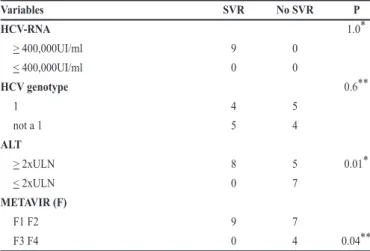
and 7/20 (35%) patients had undetectable levels of serum HIV RNA. The biochemical data, molecular biology tests and stage of ibrosis based on the METAVIR classiication are summarized in Table 1. Early virological response was observed in 12/20 (60%) patients, EOTVR in 9/20 (45%) patients and SVR in 9/20 (45%) patients. With respect to HCV genotype and SVR, there was no statistically signiicant correlation. When SVR was compared with HCV RNA levels, there was also no statistically signiicant correlation. For aminotransferase levels, only patients whose alanine aminotransferase (ALT) levels were 2.5 times the upper limit of normal (ULN) responded to treatment (SVR), p<0.05 (Table 2).
22
www.scielo.br/rsbmt Rev Soc Bras Med Trop 46(1):20-23, Jan-Feb, 2013
DISCUSSION
TABLE 2 -The biochemical data, molecular biology tests and stage of ibrosis based on the METAVIR classiication.
Variables SVR No SVR P
HCV-RNA 1.0*
> 400,000UI/ml 9 0
< 400,000UI/ml 0 0
HCV genotype 0.6**
1 4 5
not a 1 5 4
ALT
> 2xULN 8 5 0.01*
< 2xULN 0 7
METAVIR (F)
F1 F2 9 7
F3 F4 0 4 0.04**
METAVIR: score histological features of liver biopsy according to the Metavir scoring system;
SVR: sustained virological response; HCV-RNA: hepatitis C virus-ribonucleic acid;
HCV: hepatitis C virus; ALT: alanine aminotransferase; ULN: upper limit of normal; *Fisher’s exact test; **chi-squared test.
TABLE 3 -Studies on hepatitis C treatment with PEG-IFN and ribavirin in patients coinfected with HIV/HCV*.
APRICOT RIBAVIC LAGUNO PRESCO FSCMPA
Number of patients 289 184 52 389 20 Hepatic cirrhosis (%) 15 39 (F3-F4) 19 28 (F3-F4) 20 (F3-F4)
Normal ALT (%) 0 16 0 0 0
Mean CD4+ Count 520 477 570 546 507.8
HAART scheme (%) 83 83 94 74 89.5
UIVD 62 80 75 70 47.4
Discontinuation due to AE (%) 25 17 17 9 15.78
EOTVR Rate 49 35 52 67 45
SVR Rate 40 27 44 50 45
*Table modified from HepatologyTextbook. Mauss S, et al. 2009. Available from: www. hepatologytextbook.com/; PEG-IFN: Peginterferon; HIV/HCV: human immunodeiciency virus/ hepatitis C virus; APRICOT: Aids Pegasys Ribavirin International Coinfection Trial; RIBAVIC: Ribavirin Study Team (France); LAGUNO: Infectious Diseases Service the Hospital Clinic, Barcelona, Spain (Montserrat Laguno); PRESCO: Peginterferon Ribavarin España Coinfection Trial Study Group; FSCMPA:Fundação Santa Casa de Misericórdia do Pará; ALT: alanine aminotransferase; CD4: cluster of differentiation 4; HAART: highly active antiretroviral therapy antiretroviral therapy; UIVD: Use of intravenous drugs; AE: adverse effects. EOTVR: end of treatment virological response; SVR: sustained virological response.
The reasons for treating hepatitis C in patients coinfected with HIV/HCV vary. In these patients, HAART is more hepatotoxic, the evolution of liver disease is faster and the risk of developing hepatocellular carcinoma is higher14.
Successful treatment reduces the complications of liver disease. Unfortunately, many patients do not meet the prerequisites for inclusion in the scheme for HCV antiviral treatment. The virologic response rates found were similar to those of large studies, although with a smaller sample. PRESCO (Peginterferon Ribavarin España Coinfection Trial Study Group) study with larger samples involving 389 patients, found SVR rate of 50% and LAGUNO (Infectious Diseases Service the Hospital Clinic, Barcelona, Spain (Montserrat Laguno) study with a smaller sample of 52 patients, found SVR rate of 44%. When ALT levels are evaluated, no patient had normal ALT level, similar to the large studies. When grouped together ALT levels greater than 2.5 x ULN and below this limit and relating them to the SVR, signiicant correlation was observed among patients with values above 2x ULN. HCV genotypes 2 or 3, low HCV viral load, absence of liver cirrhosis, age younger than 40 years old, elevated ALT levels, elevated CD4 counts, and low or undetectable plasmaHIV-RNA, are the best candidates for HCV treatment in coinfected group of HIV/HCV15. The biochemical
response in HCV-HIV co-infected patients is not a good marker of SVR. In the, APRICOT (Aids Pegasys Ribavirin International Coinfection Trial), RIBAVIC, LAGUNO and PRESCO studies studies16-19, patients were using the HAART scheme in more
than 70% of the cases, the mean CD4+ lymphocyte counts were above 500 cells/mm3 and the ALT levels were normal in only
16% of cases in the RIBAVIC study. In the RIBAVIC (Ribavirin Study Team (France) and PRESCO studies, the stages of ibrosis were measured by the METAVIR classiication (F3/F4) and were reported in 28 and 39% of cases, respectively. These data are similar to the presented study (FSCMPA), even with the
smaller sample size. In a study using PEG-IFN and ribavirin in 68 coinfected patients, the researchers found an SVR rate of 35%20, which is lower than the rate found in the present study.
In the PRESCO study, in which 28% of the patients had F3-F4 ibrosis, the response rate at the end of treatment and SVR were 67% and 50%, respectively, which is higher than the present study; however, the sample size was much larger.
The RIBAVIC study, which included 194 patients, reported that 39% of patients had F3-F4 ibrosis, with EOTVR and SVR rates of 35% and 27%, respectively. In the APRICOT study, which included 289 patients, 15% of whom had hepatic cirrhosis, the EOTVR and SVR rates were 49% and 40%, respectively. The SVR results reported in the present study were similar to those found in the LAGUNO study
(Table 3). Studies have shown that the percentage of SVR is higher, either in monoinfected or coinfected patients, for patients infected with genotypes 2 and 3 and when pre-treatment HCV RNA levels are lower21. Patients coinfected with HIV/HCV
have higher levels of HCV RNA22 in the present study, only
11.2% of patients presented with HCV RNA levels below 400,000IU/ml. Importantly, in the present study, patients with a stage of severe ibrosis (F3, F4), did not achieve a sustained virological response to treatment. Although the sample size in the present study was small, several studies have shown that one of the predictive factors for being non-responsive to treatment is an advanced stage of ibrosis15. In the control group is shown
that the patients respond to anti HCV similarly, slightly worse compared to monoinfectado. Is important to select the patients coinfected for anti HCV treatment in order that achieve a SVR similarity monoinfected patients.
23
www.scielo.br/rsbmt 1. Gonzales SA, Talal AH. Hepatitis C virus in human immunodeiciency
virus-infected individuals: an emerging comorbidity with signiicant implications. Seminar Liver Dis 2003; 23:149-166.
2. Bonacini M, Puoti M. Hepatitis C in patients with HIV-infection. Arc Intern Med 200; 160:3365-3373.
3. Vallet-Pichard A, Pol S. Natural history and predictors of severity of chronic Hepatitis C virus (HCV) and human immunodeiciency virus (HIV) co-infection. J Hepatol 2006; 44:S28-S34.
4. Eyster EM, Fried MW, Di Bisceglie AM, Goedert JJ. Increasing hepatitis C virus RNA levels in hemophiliacs: relationship to human immunodeiciency virus infection and liver disease. Blood J Hematol 1994; 84:1020-1023. 5. Martinez-Sierra C, Arizcorreta A, Díaz F, Roldán R, Martín-Herrera L,
Pérez-Guzmán E, et al. Progresión of chronic hepatitis C to liver ibrosis and cirrhosis in patients coinfected with hepatitis C virus and human immunodeiciency virus. Clin Infect Dis 2003; 36:491-498.
6. Greub G, Ledergerber B, Battegay M, Grob P, Perrin L, Furrer H, et al. Clinical progression, survival, and immune recovery during antiretroviral therapy in patients whit HIV-1 and hepatitis C virus coinfection: the Swiss HIV Cohort Study. The Lancet 2000; 356:1800-1805.
7. Kelleher TB, Mehta SH, Bhaskar R, Sulkowski M, Astemborski J, David L. Thomas et al. Prediction of hepatic ibrosis in HIV/HCV co-infected patients using serum ibrosis markers: The SHASTA index. Journal of Hepatology 2005; 43:78-84. 8. Mauss S, Berg T, Rockstroh J, Sarrazin C, Wedemeyer H. Hepatology: a clinical
textbook [Internet] Germany: Flying Publisher. 2009; [Cited 2012 December 12]. Available from: www.hepatologytextbook.com/.
9. Rockstroh JK, Bhagani S, Benhamou Y, Bruno R, Mauss S, Peters L. European AIDS Clinical Society (EACS) guidelines for the clinical management and treatment of chronic hepatitis B and C coinfection in HIV-infected dults. HIV Med 2008; 9:82-88.
10. Alberti A, Clumeck N, Collins S, Gerlich W, Lundgren J, Palu G, et al. statement of the irst European consensus conference on the tratment of chonic hepatitis B and C in HIV co-infected patients. J Hepatol 2005; 42:615-624.
Amaral ISA et al - The therapeutic response of hepatitis c in coinfected patients (HIV/HcV)
The authors declare that there is no conlict of interest.
CONFLICT OF INTEREST
REFERENCES
11. Fleming CA, Craven DE, Thornton D, Tumilty S, Nunes D. Hepatitis C virus and human immunodeiciency virus coinfection in a urban population: low eligibility for interferon treatment. Clin Inf Dis 2003; 36:97-100.
12. Mello ES, Alves VAF. Chronic hepatitis C: pathological anatomy. Braz J Infect Dis 2007; 11 (suppl I):28-32.
13. Layden-Aimer JE, Layden TJ. Viral kinetics in hepatitis C virus: special patient populations. Seminars Liver Dis 2007; 11 (suppl I): 28-32.
14. Thomas DL, Vlahov D, Solomon L, Cohn S, Taylor E, Garfein R, et al. Correlates of hepatitis C virus infections among drug users. Medicine (Baltimore) 1995; 74:212-220.
15. Torriani FJ, Rodriguez-Torres M, Rockstroh JK, Gonzalez-Garcia J, Lazzarin A, Carosi G, et al. Peginterferon alfa-2b plus ribavirin compared with interferon alfa-2b plus ribavirin for treatment of HIV/HCV co-infected patients. N Engl J Med 2004; 351:438-450.
16. Carrat F, Bani-Sadr F, Pol S, Rosenthal E, Lunel-Fabiane F, Benzekri A, et al. Pegylated interferon alfa-2b vs standard interferon alfa-2b, plus ribavirin, for chronic hepatitis C in HIV-infected patients: a randomized controlled trial. JAMA 2005; 293:1323.
17. Laguno M, Cifuentes C, Murillas J, Veloso S, Larrousse M, Payeras A, et al. Randomized trial comparing pegylated interferon 2b versus pegylated interferon 2a, both plus ribavirin, to treat chronic hepatitis C in human immunodeiciency virus patients. Hepatol 2009; 49:22-31.
18. Núñez M, Miralles C, Berdún MA, Losada E, Aguirrebengoa K, Ocampo A, et al. Role of weight-based ribavirin dosing and extended duration of therapy in chronic hepatitis C in HIV-infected patients: The Presco Trial. Aids Res Hum Retroviruses 2007; 23:972-982.
19. Perez-Olmeda M, Romero M, Gonzalez J, Castro A, Arribas JR, Pedreira J, et al. Pegylated IFN-alfa-2b plus ribavirin as therapy for chronic hepatitis C, in HIV-infected patients. AIDS 2003; 17:1023-1028.
20. Thomas DL. Options for treatment of hepatitis C in HIV-infected persons J Hepatol 2006; 44:S40-S43.
21. Beld M, Penning M, Lukashov V, McMorrow M, Roos M, Pakker N, et al. Evidence that both HIV-induced immunodeiciency enhance HCV Replication among HCV Seroconverters. Virology 1998; 244:504-512.