AIDS and jail: social representations of women in freedom deprivation situations
* Extracted from the thesis “Representações
sociais sobre aids e sexo entre mulheres em situação de privação de liberdade”, Universidade Federal da Paraíba, 2015.
1 Universidade Federal da Paraíba,
Programa de Pós-Graduação em Enfermagem, João Pessoa, PB, Brazil.
2 Escola de Enfermagem Nova Esperança,
Programa de Mestrado Proissional em Saúde da Família, João Pessoa, PB, Brazil.
3 Universidade Federal da Paraíba, Departamento
de Enfermagem em Saúde Pública e Psiquiátrica, João Pessoa, PB, Brazil.
4 Universidade de São Paulo, Escola de
Enfermagem de Ribeirão Preto, Departamento de Enfermagem Materno Infantil e Saúde Pública, Ribeirão Preto, SP, Brazil.
5 Universidade Federal da Paraíba, Departamento
de Medicina Interna, João Pessoa, PB, Brazil.
6 Universidade Federal da Paraíba, Departamento
de Enfermagem Clínica, João Pessoa, PB, Brazil.
ABSTRACT
Objective: To graspthe AIDS social representations built by freedom-deprived women. Method: Descriptive study with a quali-quantitative approach that involved 174 convicted women in a women’s prison in a capital city of the Brazilian northeastern region. A word-association test was applied in October and November 2014, using AIDS as a stimulus. he corpuswas processed using Iramuteq software. Descending Hierarchical Classiication and Correspondence Factor Analysis were applied. Results: he content that comprises the social representation of AIDS was inluenced by the prison context, which was pervaded by a lack of assistance, lack of knowledge, discrimination, and sufering that disclosed vulnerability to HIV/AIDS factors such as unprotected sex and object sharing. his underlines the stigma and fear of the illness, in addition to favoring and supporting negative feelings and a sense of rejection. Conclusion: To consider the use of this representational amalgam to ensure a comprehensive, contextualized care can help redirect practices, motivate self-care practices, and reduce prejudiced attitudes.
DESCRIPTORS
Acquired Immunodeiciency Syndrome; Prisoners; Women; Health Vulnerability.
AIDS and jail: social representations of women
in freedom deprivation situations*
Aids e cárcere: representações sociais de mulheres em situação de privação de liberdade Sida y cárcel: representaciones sociales de mujeres en situación de privación de libertad
Débora Raquel Soares Guedes Trigueiro1,2, Sandra Aparecida de Almeida3, Aline Aparecida Monroe4, Gilka Paiva Oliveira Costa5, Valéria Peixoto Bezerra6, Jordana de Almeida Nogueira6
How to cite this article:
Trigueiro DRSG, Almeida SA, Monroe AA, Costa GPO, Bezerra VP, Nogueira JA. AIDS and jail: social representations of women in freedom deprivation situations. Rev Esc Enferm USP. 2016;50(4):554-561. DOI: http://dx.doi.org/10.1590/S0080-623420160000500003
Received: 12/20/2015 Approved: 06/15/2016
ORIGINAL ARTICLE DOI: http://dx.doi.org/10.1590/S0080-623420160000500003
Corresponding author:
Débora Raquel Soares Guedes Trigueiro Cidade Universitária
INTRODUCTION
Although one may recognize the advances in discus-sions, research, therapies, educational campaigns, and pre-ventive programs regarding the transmission of the human immunodeiciency virus (HIV), not everyone has equal ac-cess to these resources and services. hroughout the years, the diversity in the infection distribution standard gave it various epidemiological conigurations and resulted in ex-pansion to marginalized groups that have less social support and fewer developmental opportunities.
his scenario has been shaping discriminatory practices and behaviors, strengthening the stigma and compromising programs that respond to HIV, hindering access to health-care services on the part of those who live with HIV and those who face a high risk of contracting the virus(1).
Among the priorities listed by the Declaration of Melbourne(1) and the Brazilian Ministry of Health,
mea-sures and actions to ight the illness in its diferent mani-festations and expressions must be strengthened in order to focus on the most vulnerable populations, including women and people deprived of freedom(2). Among women, it is
esti-mated that HIV infection is more prevalent in the context of prison(3).
he usual perspective of attributing a collective health state to individual behaviors creates diiculties for the im-plementation of prevention and control actions. It is neces-sary to invest in the quality of socio-cultural diagnoses of health problems, particularly when they lead to changes in socially established behaviors(4).
he historical and social aspects of HIV infection, as well as its epidemic characteristics, have exerted a strong inluence on behaviors and groups. At the onset of AIDS, the lack of medical-scientiic information and the way the media took over this “unknown” evil gave it a life of its own in people’s minds(5). he media published heavily emotional
stories characterized by death, contamination, and sex, fa-voring the rise of moral, social, and biological conceptions(6).
Although there is a set of therapeutic procedures and a consequent change in the meaning of living with the infec-tion, the social representations (SR) of AIDS still remain closely associated with exclusion and lack of morality. In so-cieties where the infection afected women, this fact became typically associated with inappropriate sexual behavior, ac-cording to the local gender rules(7).
herefore, the focus of this study is to point out the characteristics of the subjective experience of women de-prived of freedom. hese characteristics will allow for or-ganizing and analyzing SR of AIDS as latent knowledge that results from the mindset and ways of acting socially in unique shared realities, pointing to approaches to or with-drawals from the scientiic deinitions of AIDS from the standpoint of practical knowledge.
Upon consulting to the SciELO database, we found no studies that portrayed AIDS SR in the prison system. From this perspective, addressing women in prison is justiied by the opportunity to understand the various ways of represent-ing AIDS and attitudes in the face of this phenomenon(8).
herefore, this study’s objective is to grasp the social repre-sentations of AIDS built by women deprived of freedom.
METHOD
his is an exploratory, descriptive study with a quali-quantitative approach, supported by the theoretical input of social representations (SR). Systematically, three dimen-sions are present in SR (information, image, and attitude) and there are two main socio-cognitive processes (objec-tiication and anchoring). he information corresponds to the knowledge organization by a particular group concern-ing a social object, varyconcern-ing accordconcern-ing to the amount and quality of this knowledge. he images comprehend the senses associated with the object, and the attitude refers to the stand one takes regarding the social representation object. Objectiication, in its turn, explains how the ele-ments represented by a theory integrate the social reality, and anchoring enables an understanding of the way through which these elements help reveal and form social relations(9).
Complementarily, as an analysis proposition to anchoring, four typologies are highlighted: psychological; psycho-soci-ological; sociological(10); and biological/physical(11).
his study was conducted at the Centro de Reeducação Maria Júlia Maranhão prison, located in the city of João Pessoa. his site was chosen because it is the only prison in the city and because it gathers the largest number of impris-oned women in the state of Paraíba. he population con-sisted of 268 imprisoned women in a closed system and the sample size was calculated through a statistic program (us-ing the commands “Several means”, ANOVA, 1-way). he parameters were as follows: probability α= 0.05; probability
β= 0.20; variation as error= 0.2, with a correction of 10% for potential losses. he sample, thus, consisted of 174 women.
he participants were selected through non-probability convenience sampling (voluntary participation) and the in-clusion criterion was to be sentenced in a closed system. It is important to mention that researchers did not have access to the prisoners’ serological condition.
For data collection, a multiple choice structured ques-tionnaire was applied, which contained sociodemograph-ic information (age, race, marital status, religious belief, schooling, prison time) and a word-association test, whose inductive stimulus was the word “AIDS.” his technique comprises an open inquiry that stimulates the elicitation of answers given from one or more inductive words. It allows for evidencing the semantic universes connected with the representation object(12).
AIDS and jail: social representations of women in freedom deprivation situations
he instrument was applied individually by ive pre-viously trained and qualiied researchers. Each partici-pant received information on the nature and objectives of the study. heir participation occurred upon signing an Informed Consent. Before the introduction of the above-mentioned stimulus, a simulation mas conducted with an example to make participants familiar with the instru-ment functionality. After that, the inductive stimulus was introduced, followed by the questions: What comes to your mind when I say the word AIDS? and Say the irst ive words that remind you of AIDS. he answers were recorded by the researchers.
he collected results comprised the corpusthat was transcribed to the Word program,submitted to reinement for exclusion of word repetitions, grouping the words by
semantic similarity, and the elaboration of a dictionary. Two researchers were called upon to validate the diction-ary. After that, the information was processed by the literal analysis software Iramuteq (Interface de R pour les Analyses Multidimensionnelles de Textes et de Questionnaires,Version 0.6 alpha 3)to enable multivariate analyses, especially the descending hierarchical classiication method and the cor-respondence factor analysis(13).
A descending hierarchical classiication (DHC)(14)
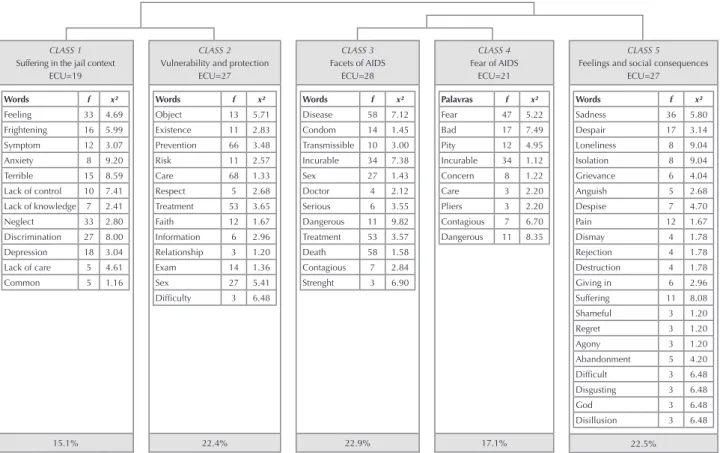
qualiied the text segments due to their respective vocabu-laries, analyzed the text lexicographically, and categorized ive classes of answers associated with the stimulus “AIDS.” Of the total 174 Initial Context Units (ICU) in the corpus, 122 Elementary Context Units (ECU) remained, selected in accordance with the values of (x²).
CLASS 1 Suffering in the jail context
ECU=19
Words f x²
Feeling 33 4.69
Frightening 16 5.99
Symptom 12 3.07
Anxiety 8 9.20
Terrible 15 8.59 Lack of control 10 7.41 Lack of knowledge 7 2.41
Neglect 33 2.80
Discrimination 27 8.00 Depression 18 3.04 Lack of care 5 4.61
Common 5 1.16
15.1%
CLASS 5 Feelings and social consequences
ECU=27
Words f x²
Sadness 36 5.80
Despair 17 3.14
Loneliness 8 9.04
Isolation 8 9.04
Grievance 6 4.04
Anguish 5 2.68
Despise 7 4.70
Pain 12 1.67
Dismay 4 1.78
Rejection 4 1.78
Destruction 4 1.78
Giving in 6 2.96
Suffering 11 8.08
Shameful 3 1.20
Regret 3 1.20
Agony 3 1.20
Abandonment 5 4.20
Dificult 3 6.48 Disgusting 3 6.48
God 3 6.48
Disillusion 3 6.48
22.5% CLASS 4
Fear of AIDS ECU=21
Palavras f x²
Fear 47 5.22
Bad 17 7.49
Pity 12 4.95
Incurable 34 1.12 Concern 8 1.22
Care 3 2.20
Pliers 3 2.20
Contagious 7 6.70 Dangerous 11 8.35
17.1% CLASS 2
Vulnerability and protection ECU=27
Words f x²
Object 13 5.71
Existence 11 2.83 Prevention 66 3.48
Risk 11 2.57
Care 68 1.33
Respect 5 2.68
Treatment 53 3.65
Faith 12 1.67
Information 6 2.96 Relationship 3 1.20
Exam 14 1.36
Sex 27 5.41
Dificulty 3 6.48
22.4%
CLASS 3 Facets of AIDS
ECU=28
Words f x²
Disease 58 7.12 Condom 14 1.45 Transmissible 10 3.00 Incurable 34 7.38
Sex 27 1.43
Doctor 4 2.12
Serious 6 3.55 Dangerous 11 9.82 Treatment 53 3.57
Death 58 1.58
Contagious 7 2.84 Strenght 3 6.90
22.9%
Figure 1 – Dendogram referring to the distribution of the class vocabulary according to Descending Hierarchical Classification in rela-tion to the stimulus “AIDS” – João Pessoa, Paraíba, 2014.
As presented in the dendogram (Figure 1), the corpus was divided into two sub corpora. he irst one, which originated in Class 5 and later in Classes 3 and 4, connects the “social feelings and consequences” related to AIDS to the “fear” that the illness causes and its multiple “facets.” he second corpus, which constituted Classes 1 and 2, connects AIDS with “suf-fering in the jail context,” and the elements that condition “vulnerability and protection” in terms of the disease.
Following the DHC, a correspondence factor analysis (CFA) was applied, which depicts the diferent words asso-ciated to each one of the DHC classes in a Cartesian plane. his interface allows for recovering in the original corpus the text segments associated with each class. At that mo-ment, the context of the statistically signiicant words was
obtained, enabling a more qualitative data analysis. It also enabled a detailed examination of the connection between individual answer proiles, expressing connections and op-positions and showing the existing bonds between diferent representational content in graphs(14).
A parameter above 70% is considered a good use of the software (Version 0.6 alpha 3). he current study’s relevance was 70.4% of the corpus.
RESULTS
In the researched sample (n=174), there was a predomi-nance of 67.2% in the age range between 18 and 34 years old, mixed skin color (55.2%), single (59.2%), with up to eight years of schooling (70.1%), and evangelical religion (42.5%). As far as the prison time was concerned, 50.0% had been serving their time for less than one year, 32.8% between one and three years, and 17.2% had been in the closed system for more than three years.
Class one – sufering in the jail context concentrated
15.1% of the ECU. here was no evidence of a positive association in terms of inmates’ age ranges. In this class, the content that comprise the AIDS SR is inluenced by the prison context. Prison is a space where health care and necessary care are limited, both in terms of prevention and in terms of healing aspects, in addition to lack of care, ne-glect, and lack of knowledge about the disease. his pro-duces discrimination against the people who live with HIV/ AIDS, a common feature in prison. Most of the prisoners know people infected with visible symptomsthat can be observed because of the closely shared space that is typical of imprisonment situations, anchored in common aspects of the biological/physical dimension.
Attitudes about AIDS create the rejection seen at the interviews in prisoners’ facial expressions even before they verbalized the reminders. Together with the prison situa-tion, this becomes even more terrible and appalling,which results in sufering conditions such as lack of control, anxi-ety, and depression,in addition tofeelingsthat have a psy-chological anchoring.
Class two–vulnerability and protection concentrated
22.4% of the ECU that remained. It was predominantly comprised of women between 35 and 49 years of age. his class includes elements that are connected to being infected with HIV in the prison context, characterized by situations that make them vulnerable – relationships, sex,andobjects.
he determination of the disease, represented as an at-tribute of “risk behaviors,” connects with sexual practices experienced by this group. Sex,as a consequence of relation-ships between inmates during their serving time, consists of unprotected practices homosexual (biological/physical dimension).
Another practical dimension of the AIDS SR associated with knowledge about contamination is characterized by object sharing. he most common practices mentioned in the prison environment and grouped in this category were: sewing needles; shaving razors; piercings; clamps; nail iles; pliers; toothbrushes; underwear; toilet seats; cups; and sil-verware shared for routine use.
Regarding the HIV risk condition, this class also evoked positive elements that refer to care.Prevention measures, treatment,and faith were mentioned. In the reality of pris-on, from the perspective of protecting inmates’ health, care is anchored in the physical/biological and psychological dimensions.
Prevention strategies integrate a set of practices and behaviors such as using condoms, not sharing objects, and
knowing who you interact with. his shows that trusting the other is still a reason for not using condoms.
As far as treatment is concerned, the horror of immedi-ate death seems to have been overcome. he development of new therapies capable of changing the infection into a chronic problem posed new challenges and changed the representational content.
Class three –facetsof AIDS concentrated 22.9% of the
ECU that remained. here was no signiicant association with the inmates’ age range. he content of this class were not distant from the AIDS SR elaborated in the last few decades. he idea ofcontagious/transmissibleillness that spreads mainly via sexual relationswithout condoms,feared by its nature as a serious and dangerousinfection, requir-ing the igure of a doctorto establish a treatmentthat will prevent its most concerning aspect – being incurable and therefore leading to death – clearly shows a social mark or scar in the understanding of AIDS, airming the anchoring of this representation in the sociological dimension.
Class four –fear of AIDSconcentrated17.1% of the
ECU that remained. It was predominantly composed of women between 18 and 34 years of age. In this semantic context, the AIDS representation is anchored in the psy-cho-sociological dimension, mainly expressed by the feeling of fear. he idea that it is something bad and incurable, whichgives people a sentimentof pity,inevitably leads to an imminentconcernabout having this type of problem.
Class ive –social feelings and consequences concentrated
22.5% of the ECU. here was no signiicant association be-tween the inmates’ age ranges. It focuses mainly on negative feelings that emerge from the process of thinking about AIDS and from its social consequences. he socio-cognitive contents of psycho-sociological anchoring denote a nega-tive view of the disease, associated with an image of despair, sadness, solitude, pain, sufering, destruction,and attitudes ofrejection, disdain, disgust, abandonment, and isolation.
ObjectificatiOnOf aiDS accOrDingtOthe intervieweDpriSOnerS
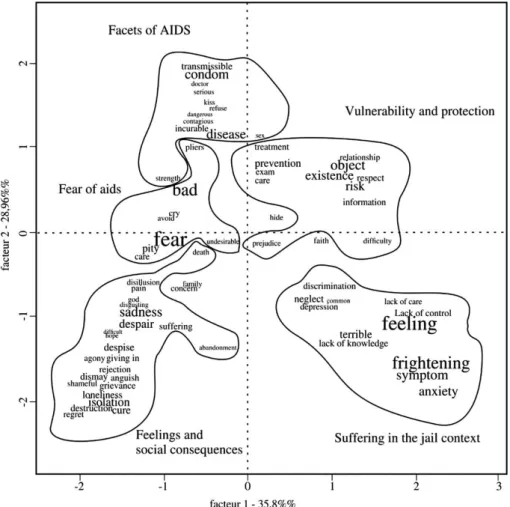
he AIDS objectiication processpresented in the graphs was elaborated from the AFC technique, allowing for vi-sualization, under the coniguration of a factor plan, of the oppositions that resulted from the DHC. In the two factors, the value of total variance was 64.86%. Factor 1, which cor-responds to the horizontal axis, explained 35.85% of the total variance of answers. Factor 2, which corresponds to the verti-cal axis, explained 29.01% of the total answers (Figure 2).
In the irst factor (Axis 1), on the right side, the words that stand out are grouped in Class 1, which associates AIDS with negative feelings caused by the discrimination and lack of assistance that characterize imprisonment. he image of body degradation, as objectiied by the expression symptom, remains, having contributed with 57% to explain this factor. In contrast, on the negative side of the same axis, the presence of the disease is translated into the feelings of sadness, despair, solitude, and isolation.
AIDS and jail: social representations of women in freedom deprivation situations
the disease, represented by objects that are usually shared during imprisonment. In opposition to the risk factors, the precaution against sexual transmission would be the use of condoms, which contributed 50% to explain this factor.
Regarding the second factor (Axis 2), the transmissible characteristic of the diseaseand the unfeasibility of its cure demandcareand preventionmeasures. his counters the
occurrence of negative consequences such as sufering, dis-dain, abandonment,andrejection.
Fear,in prominence in the neutrality zone, may show that even though it expresses a signiicant element in the representation of the social stigma of AIDS, it does not shape a type of attitude by the interviewed female prisoners in terms of facing AIDS in their daily lives.
Figure 2 – Correspondence Factor Analysis with the representation of the coordinates (Axis 1 and 2), highlighting five classes and words with heavier factor loads – João Pessoa, Paraíba, 2014.
DISCUSSION
In the formation of the AIDS SR, inluences from the media, the incipient scientiic discoveries, and early medi-cal knowledge from the onset of the epidemic shaped the stereotypes of the people who live with HIV/AIDS. In ac-cordance with the reiied knowledge about managing the disease, the information was spread by the press through images of weak people, and associated with the idea of death and the behaviors of risk groups(15). his association
opened up a space for the development of preconceptions against minorities, in addition to moral and social stigma that strengthened feelings of guilt(16-17).
his attitude stressesthat the initial limitation of medi-cal information, proceeding from scientiic research that demanded time, favored the social qualiication of the dis-ease. People elaborated their SR based on the information they had about ways of transmission and proiles of the people stricken. In agreement with the information that
circulated in society, the SR were gradually elaborated by social groups, guiding the public’s discriminatory behaviors based on socially and culturally constructed SR(16).
Consequently, this lack of understanding and discrimi-nation became obstacles that hinder or prevent access to health care. When a particular group sufers discrimination, abuse, and repression, there is a greater chance that they will not go for exams, prevention, or AIDS treatment services. he opposite behavior is also expected because the lack of assistance may lead to neglect, lack of knowledge, and dis-crimination, taking into account that one of these factors may inluence the occurrence of another(1).
National Policy of Comprehensive Healthcare for Women), the fulillment of the right to health among imprisoned women faces the impediments of prison logistics(18).
he transmission risk, in its turn, is another expres-sive component in the representation of AIDS, as seen in Class 2. Regarding the contagion aspect, sex remains as the element that coexists between the reiied universe and the consensual universe of AIDS. he impact of the alarming news of a new, unknown disease that was devastating and irreversible, with emphasis on the fact that it is sexually transmitted, transformed the worldwide sexuality scenario and produced turmoil in the way people face sexual activity.
However, the imprisoned women’s perception of the possibility of being infected by HIV obeys the logic of the onset of the outbreak, when the idea of contamination via contact with an infected person’s luids would transmit the most feared disease of current times. here is no distinction between prejudice and veracity.
Research shows that there are still mistakes or solid mistaken beliefs in terms of ways of transmission. Some people marked insect bites, swimming pools, use of toilets, physical proximity, and sharing personal objects as ways of contamination, in addition to a supericial knowledge of AIDS prevention(8,19).
Parallel to vulnerability, there is the need for care. Although mentioning it is a healthy observation, research-ers must shed light on the fact that this is not enough to en-gender protective behaviors among individuals. his would require perception, understanding, assimilation, and the capacity to transform knowledge into practice, in addition to people’s access to protective inputs, especially condoms, which are not available in prison.
When ighting illnesses, especially those socially marked as death sentences or extremely dangerous, faith poses as another mean of protection. Nevertheless, the exercise of spirituality in jail and faith in the divine cure show that the AIDS SR is marked by a polarity. On one hand, the illness is incurable according to the reiied universe appropriation of thoughts. On the other hand, there is the belief in a cure associated with values and beliefs that are present in the common sense to bear the sufering.
Sufering does not occur solely as a result of the ill-ness process, but it is also related to the facets of AIDS. hese make up Class 3, according to the women prisoners, through key elements from which the social scar produced by this disease can be understood.
Illnesses can bestow social marks because of their devas-tating character. his may be the case when it comes to the destruction of Europe by the Black Plague; the frightening Spanish lu in the Twentieth Century; syphilis; leprosy; and inally cancer, which is seen as the plague of this century. However, none of these illnesses are as stigmatizing, accord-ing to society, compared to AIDS, which devastated thou-sands of people and produced irreversible consequences in the social, economic, and political spheres in a short period(20).
To worsen the picture, facing the condition of women deprived of freedom, in total economic restriction, is like placing them in parallel places that are main universal
sources of AIDS-related stigmatization and discrimination. here is the stigma related to sexuality, the stigma related to gender, the stigma related to race or ethnicity – which is paraphrased here as the groups where they belong – and the stigma related to economic marginalization or poverty(7).
he irreversible nature of the consequences of AIDS is the worst characteristic of this disease: the fact that it is incurable. One can say that, in the general population’s SR, AIDS is the illness that kills the most when compared to others. his springs from another strong binomial – AIDS and death – present in the hegemonic representation of the disease. For imprisoned women, it is no diferent. he AIDS SR carries the meaning of death and because it is associ-ated with deprivation of freedom, it is considered a double punishment or a death sentenced twice. his creates fear of the illness, which stands out in Class 4.
he well-known “epidemic of fear” brought to the sym-bolic universe of AIDS various representations of fear: fear of the sick person; fear of being infected with the sick person’s virus; fear of death; fear of physical changes; fear of prejudice and discrimination; and even fear of having fear(21-22).
Fear is part of human activity and can be an alert for danger; however, when people speak or think about AIDS, fear assumes a negative representational connotation be-cause it is part of a twisted or unrealistic AIDS SR that still organizes reality in a haunting, unwise way.
It is necessary to rethink ways of ighting the fear that is so pervasive in the AIDS SR by various audiences that have maintained over time a proliferation of frightening mean-ings around the epidemic, which subtly hinder the ways to prevent or control the disease.
In summary, one’s cognition in terms of the possibility of preventing a lethal illness feared by all and whose social consequences lead to a myriad of agonizing feelings(21,23) of
self-pity and self-destruction, is seen in Class 5.
his study highlights that, by gathering main consen-sual elements that integrate the AIDS SR – a frighten-ing disease that causes suferfrighten-ing and fear when one thinks about HIV contamination, and is associated with socially reproachable behaviors (sex and drugs) – it is possible to understand the reasons that support the stereotype that forms the AIDS stigma, which consequently reproduces and stresses prejudices that favor marginalization and its social consequences(7,24-25).
CONCLUSION
AIDS and jail: social representations of women in freedom deprivation situations
RESUMO
Objetivo: Apreenderas representações sociais sobre a aids construídas por mulheres privadas de liberdade. Método: Estudo descritivo, com abordagem quali-quantitativa que envolveu 174 apenadas de Presídio Feminino situado em capital do nordeste brasileiro. Aplicou-se o Teste de Associação Livre de Palavras, em outubro e novembro de 2014, utilizando-Aplicou-se do estímulo aids. O corpus foi processado pelo software Iramuteq, sendo efetuadas a Classiicação Hierárquica Descendente e Análise Fatorial de Correspondência. Resultados: Os conteúdos que compõem a representação social sobre aids são inluenciados pelo contexto prisional, permeado de desassistência, desconhecimento, discriminação e condições de sofrimento, revelando fatores de vulnerabilidade ao HIV/Aids como atividade sexual desprotegida e compartilhamento de objetos; reiterando o estigma e o temor à doença; e favorecendo e sustentando sentimentos negativos e de rejeição. Conclusão: Considerar este amálgama representacional na garantia de um cuidado integral e contextualizado pode contribuir para redirecionar práticas, motivar condutas de autocuidado e reduzir atitudes preconceituosas.
DESCRITORES
Síndrome de Imunodeiciência Adquirida; Prisioneiros; Mulheres; Vulnerabilidade em Saúde.
RESUMEN
Objetivo: Aprehender las representaciones sociales acerca del Sida construidas por mujeres privadas de libertad. Método: Estudio descriptivo, con abordaje cualitativo y cuantitativo que involucró a 174 apenadas de Presidio Femenino ubicado en capital del nordeste brasileño. Se aplicó la Prueba de Asociación Libre de Palabras, en octubre y noviembre de 2014, utilizándose el estímulo Sida. El
corpus fue procesado por el software Iramuteq, siendo llevados a cabo la Clasiicación Jerárquica Descendiente y el Análisis Factorial de Correspondencia. Resultados: Los contenidos que componen la representación social acerca del Sida los inluencia el contexto carcelario, permeado por desasistencia, desconocimiento, discriminación y condiciones de sufrimiento, revelando factores de vulnerabilidad al VIH/ Sida como actividad sexual desprotegida y el acto de compartir objetos, lo que reitera el estigma y el temor a la enfermedad y favorece y sostiene sentimientos negativos y de rechazo. Conclusión: Considerar ese amalgama representativo en la garantía de un cuidado integral y contextualizado puede contribuir para redirigir prácticas, motivar conductas de autocuidado y reducir actitudes prejuiciosas.
DESCRIPTORES
Síndrome de Inmunodeiciencia Adquirida; Prisioneros; Mujeres; Vulnerabilidad em Salud.
REFERENCES
1. UNAIDS Brasil. Programa Conjunto das Nações Unidas sobre HIV Aids [Internet]. Brasília; 2015 [citado 2015 dez. 20]. Disponível em: http://www.unaids.org.br/
2. Paschoal EP, Santo CCE, Gomes AMT, Santos EI, Oliveira DC, Pontes APM. Adherence to antirretroviral therapy and its representations for people living with HIV/AIDS. Esc Anna Nery. 2014;18(1):32-40.
3. Gois SM, Santos Junior HPO, Silveira MFA, Gaudêncio MMP. Para além das grades e punições: uma revisão sistemática sobre a saúde penitenciária. Ciênc Saúde Coletiva. 2012;17(5):1235-46.
4. Justo AM, Camargo BV. Corpo e cognições sociais. Liber [Internet]. 2013 [citado 2015 dez. 20];19(1):21-32. Disponível em: http://www. scielo.org.pe/pdf/liber/v19n1/a03v19n1.pdf
5. Gomes AMT, Oliveira DCD, Santos ÉID, Santo CCE, Valois BRG, Pontes APMD. As facetas do convívio com o HIV: formas de relações sociais e representações sociais da AIDS para pessoas soropositivas hospitalizadas. Esc Anna Nery [Internet]. 2012 [citado 2015 dez. 20];16(1):111-20. Disponível em: http://www.scielo.br/pdf/ean/v16n1/v16n1a15.pdf
6. Gomes AMT, Silva EMP, Oliveira DC. Social representations of AIDS and their quotidian interfaces for people living with HIV. Rev Latino Am Enfermagem. 2011;19(3):485-92.
7. Sousa PJ, Ferreira LOC, Sá JB. Estudo descritivo da homofobia e vulnerabilidade ao HIV/Aids das travestis da Região Metropolitana de Recife, Brasil. Ciênc Saúde Coletiva. 2013;18(8):2239-51.
8. Oliveira NAI, Ribeiro SG, Lessa PRA, Monte AS, Bernardo EBR, Pinheiro AKB. Knowledge, attitude and practices regarding condom use among women prisoners: the prevention of STD/HIV in the prison setting. Rev Esc Enferm USP [Internet]. 2012 [cited 2016 Feb 19];46(3):711-9. Available from: http://www.scielo.br/pdf/reeusp/v46n3/en_25.pdf
9. Moscovici S. Representações sociais: investigações em psicologia social. Petrópolis: Vozes; 2012.
is possible to ind the incorporation of new elements in its representations such as prevention, treatment, and increases in survival rates.
In the face of these relections, this study warns of the need to rethink the logistics and guarantees for health care at all complexity levels, in addition to local actions that in-volve critical health education regarding the reality of the prison context. his will allow an opportunity for relection on the social phenomenon through identiication of inap-propriate knowledge about the disease, demystifying preju-dices, destroying discriminatory attitudes, and stimulating
the adoption of protective attitudes regarding both physical and psychological health.
10. Doise W. L’ancrage dans les études sur les représentations sociales. Bull Psychol. 1992;45(405):189-95.
11. Moreira ASP, Camargo BV, organizadores. Contribuições para a teoria e o método de estudos das representações sociais. João Pessoa: Ed. Universitária UFPB; 2007.
12. De Rosa AS. A rede associativa: uma técnica para captar a estrutura, os conteúdos, e os índices de polaridade, neutralidade e estereotipia dos campos semânticos relacionados com as representações sociais. In: Moreira ASP, Camargo BV, Jesuíno JC, Nóbrega SM, editoras. Perspectivas teórico-metodológicas em representações sociais. João Pessoa: Ed. Universitária UFPB; 2005. p. 61-127.
13. Ratinaud P. IRAMUTEQ: Interface de R pour les analyses multidimensionnelles de textes et de questionnaires [computer software]. 2009 [cited 2015 Feb 5]. Available from: http://www.iramuteq.org
14. Camargo BV, Justo AM. IRAMUTEQ: um software gratuito para análise de dados textuais. Temas Psicol [Internet]. 2013 [citado 2015 fev. 9];21(2):513-18. Disponível em: http://pepsic.bvsalud.org/pdf/tp/v21n2/v21n2a16.pdf
15. Parker R. Stigma, prejudice and discrimination in global public health. Cad Saúde Pública. 2012;28(1):164-9.
16. Costa TL, Oliveira DC, Formozo GA. Qualidade de vida e AIDS sob a óticsa de pessoas vivendo com o agravo: contribuição da abordagem estrutural das representações sociais. Cad Saúde Pública. 2015;31(2):365-76.
17. Cunha GH, Fiuza MLT, Gir E, Aquino PS, Pinheiro AKB, Galvão MTG. Quality of life of men with AIDS and the model of social determinants of health. Rev Latino Am Enfermagem. 2015;23(2):183-91.
18. Oliveira LV, Costa GMC, Medeiros KKAS, Cavalcanti AL. Epidemiological proile of female detainees in the Brazilian state of Paraíba:
a descriptive study. Online Braz J Nurs [Internet]. 2013 [cited 2015 June 30];12(4):892-901. Available from: http://dx.doi. org/10.5935/1676-4285.20134284.
19. Andrade SSC, Zaccara AAL, Leite KNS, Brito KKG, Soares MJGO, Costa MML, et al. Knowledge, attitude and practice of condom use by women of an impoverished urban área. Rev Esc Enferm USP [Internet]. 2015 [cited 2016 May 13];49(3):364-71. Available from: http:// www.scielo.br/pdf/reeusp/v49n3/0080-6234-reeusp-49-03-0364.pdf
20. Oliveira DC. Construction and transformation of social representations of AIDS and implications for health care. Rev Latino Am Enfermagem. 2013;21(n.spe):276-86.
21. Alvarenga WA, Dupas G. Experience of taking care of children exposed to HIV: a trajectory of expectations. Rev Latino Am Enfermagem. 2014;22(5):848-56.
22. Soares GB, Garbin CAS, Rovida TAS, Garbin AJI. Quality of life of people living with HIV/AIDS treated by the specialized service in Vitória-ES, Brazil. Ciênc Saúde Coletiva. 2015;20(4):1075-84.
23. Lowther K, Selman L, Harding R, Higginson IJ. Experience of persistent psychological symptoms and perceived stigma among people with HIV on antiretroviral therapy (ART): a systematic review. Int J Nurs Stud. 2014;51(8):1171-89.
24. Renesto HMF, Falbo AR, Souza E, Vasconcelos MG. Coping and perception of women with HIV infection. Rev Saúde Pública. 2014;48(1):36-42. 25. Strauss M, Rhodes B, George G. A qualitative analysis of the barriers and facilitators of HIV counselling and testing perceived by adolescents in South Africa. BMC Health Serv Res [Internet]. 2015 [cited 2015 June 30];15:250. Available from: http://www.ncbi.nlm.nih.gov/pmc/ articles/PMC4484707/
Financial support: Conselho Nacional de Desenvolvimento Científico e