* Corresponding author. +989122489294
E-mail addresses: ardehshir tajzadeh-namin <[email protected]> © 2012 Growing Science Ltd. All rights reserved.
doi: 10.5267/j.msl.2011.10.013
Contents lists available atGrowingScience
Management Science Letters
homepage: www.GrowingScience.com/msl
Barriers to establish e-business for developing tourism industry: A case study of Kish Island
Ardeshir Tajzadeh Namin
Faculty of Management and Accounting, Allameh Tabataba'i University, Tehran, Iran
A R T I C L E I N F O A B S T R A C T
Article history:
Received July 20, 2011 Received in Revised form October, 12, 2011 Accepted 15 October 2011 Available online 25 October 2011
This is an empirical study for ranking different barriers on developing e-business in one of the free zones called Kish Island. This Island is located in south part of Iran and it is one of the most beautiful free zones of this country with tremendous opportunities for tourism industry. The proposed study gathers important factors in five different groups of economical, social and cultural, political, technology and software packages. In each group, decision makers determine various influencing factors and after three rounds of brainstorming, analytical hierarchy process is used to rank these factors. Based on the results, the lack of a good infrastructure (0.206), the lack of good culture among ordinary people to use e-businesses (0.205), the lack of good knowledge on internet services among ordinary people (0.204) are some of the most important factors preventing e-business in this region.
© 2012 Growing Science Ltd. All rights reserved.
Keywords:
e-business
Analytical hierarchy process Tourism industry
Barriers Kish Island
1. Introduction
analytic hierarchy process (AHP) approach. The study disclosed various relative importance of each website quality factor and priority of alternative websites across e-business domains and between stakeholders and reported that the website with the highest quality produced the highest business performance. Zheng et al. (2004) discussed the impact of cost/benefit of implementing e-businesses.
Kshetri (2007) discussed barriers to e-commerce and competitive business models in developing countries. Kshetri incorporated three groups of feedback systems–economic, sociopolitical and cognitive to provide a simple model of e-commerce barriers in the developing world. The framework examined characteristics of e-business models, which could be successfully employed in developing countries. Howard et al. (2006) presented a comprehensive method on automotive business to
business, e-hubs, by exploring motivations and barriers to collaboration and interaction. During the
past few years, many organizations are using e-hubs to reduce their costs. They investigated
collaboration and interaction by examining four cases of e-hub adoption by vehicle manufacturers and suppliers. They developed a conceptual framework to evaluate the real benefits of electronic applications by revealing firm and industry level motivations and barriers. The framework explained the dissonance between expected and realized benefits, and extended the literature on the barriers. They concluded with recommendations for how best to adopt e-hubs in terms of supply topology, buyer–supplier relationships, leadership, and the threat of from e-hubs.
Soto-Acosta et al. (2008) analyzed e-business value creation from a resource-based perspective. They developed a framework, grounded in the resource-based theory, for assessing e-business value creation. The proposed model considered three relationships including internet resources and business value, Internet resources and business capabilities, and business capabilities and e-business value. They used a sample of 1010 Spanish firms to test their hypotheses and reported that internet resources per se were not positively correlated with e-business value. In addition, although internet resources were not positively correlated to e-business value, they play an essential role in creating e-business capabilities.
The proposed study of this paper performs a comprehensive study to collect all-important factors influencing implementation of e-business for developing tourism industry in Kish Island. The orientation of this paper first proposes the structure of the research in section 2. Section 3 presents the results of our survey and the paper finishes by concluding remarks in section 4.
2. The proposed study
During the last few years, internet has changed world, significantly. The recent changes in Middle East political changes especially in Egypt were partly initiated through different discussions held on social websites. The increase use of internet facilities has many advantages since many organizations prefer to sell their products or services via internet facilities. There are different barriers in developing e-business units in many countries and the present study performed an empirical study on one of free zone areas of Iran called Kish Island. The study gathered different factors through three rounds of brainstorming and Delphi discussions.
A. Tajzadeh Namin et al. / Management Science Letters 2 (2012)
923
technology. Since Iran is experiencing various economic sanctions, it is virtually impossible to purchase goods and services via international credit cards making it more difficult to sell goods and services in this area.
Table 1
Important economical factors preventing implementation of e-business in Kish Island free zone
Item Title Frequency Percent
1 High levels of the cost of building infrastructure, satellite, etc. 28 93
2 Inability of private sector to invest in this sector 20 66
3 Inadequate support for private organizations to invest in e-business sector 29 96
4 Unknown rate of return of investment in this sector 19 63
5 The high cost of using internet for ordinary people 27 90
6 The high cost of hiring IT experts as well as doing e-business 17 56
7 The lack of a difference between the regular and e-business prices 15 50
8 Economic sanction 26 86
9 The high cost of upgrading e-business infrastructures 26 86
10 Rapid change in laws and regulations 21 70
The other important barriers are social and cultural factors influencing implementation of e-business for the case study of the proposed study and we have collected seven factors summarized in Table 2.
Table 2
Important social and cultural factors preventing implementation of e-business in Kish Island free zone
Item Title Frequency Percent
1 The lack of a good culture for using e-business among people 30 100
2 The lack of people's familiarity with the advantages of using e-business 20 66
3 The lack of a mutual trust among people for disclosing their private information 29 96
4 The unknown nature of e-business 22 73
5 Inadequate e-business culture (e.g., training, e-enhancement, etc.) by private and
public sectors
25 83
6 Resistance of private and public sectors against rapid changes 23 76
7 The conflict between religious and cultural values with e-business 13 43
As we can observe from the results of Table 2, the lack of a good culture for using e-business among people plays an important role since all decision makers agreed on this item. The other important factor was that people do not trust in e-business system. Our decision makers did not mostly agree on other items. Regulation and political issues are other important factors preventing people to use e-business in this region. Table 3 summarizes details of our survey.
Table 3
Important political factors preventing implementation of e-business in Kish Island free zone
Item Title Frequency Percent
1 The lack of a good secure internet system and the laws to support them 29 96
2 The sanction imposed on the country 24 80
3 Not adequate policy and strategic planning 30 100
4 The lack of a comprehensive regulation 22 73
5 Filtering website(s) based on political considerations 19 63
6 The lack of a good support and intellectual property laws 23 76
7 The lack of a good standard system and different decision makers 24 80
8 The lack of a proper use of e-business due to weak knowledge 27 90
information technology infrastructures, which are summarized in Table 4.
Table 4
Important technology factors preventing implementation of e-business in Kish Island free zone
Item Title Frequency Percent
1 All people do not have equal access to internet facilities 28 93
2 The lack of a good infrastructure 30 100
3 The lack of high speed internet facilities 29 96
4 The lack of a good marketing system 22 73
5 Weakness in upgrading security systems 27 90
6 Weakness in local intranet and internet systems 26 86
7 Few numbers of service provider 20 66
8 The lack of a good supervision of proper use of e-business system 23 76
According to the survey, all decision makers blamed weak infrastructure as the most important barriers for implementing e-business. In addition, the lack of a good infrastructure, low internet services and weakness in upgrading security systems are other important factors.
Table 5
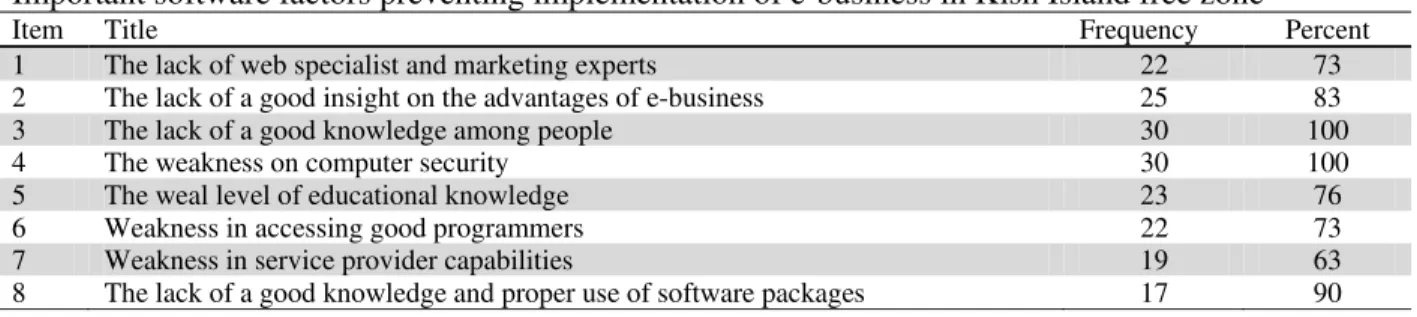
Important software factors preventing implementation of e-business in Kish Island free zone
Item Title Frequency Percent
1 The lack of web specialist and marketing experts 22 73
2 The lack of a good insight on the advantages of e-business 25 83
3 The lack of a good knowledge among people 30 100
4 The weakness on computer security 30 100
5 The weal level of educational knowledge 23 76
6 Weakness in accessing good programmers 22 73
7 Weakness in service provider capabilities 19 63
8 The lack of a good knowledge and proper use of software packages 17 90
According to the results of Table 5, the lacks of good knowledge among people as well as the weakness on computer security are to blame as the most important barriers of e-business.
3. The results
In this section, we present details of implementation of analytical hierarchy process (AHP) for ranking five groups of economical, social and cultural, political, technological and software issues (Saaty, 1996). Fig. 1 demonstrates the ranking for each component.
A. Tajzadeh Namin et al. / Management Science Letters 2 (2012)
925
As Fig.1 shows, social factors are the most important item followed by economical and political issues are other important factors. The pairwise comparison of all mentioned components is made in section 2 for each group.
3.1. Economical factors
The economical factors play important role on developing e-business and the pairwise comparisons are made among these factors summarized in Fig. 2.
Fig. 2. Ranking of economical factors, inconsistency ration <.01
3.2. Social and cultural factors
Social and cultural factors are other important factors playing vital role in developing e-business and the results of pairwise comparison and AHP implementation are shown in Fig 3.
Fig. 3. Ranking of social and cultural factors, inconsistency ration <.01
considered as the secondary issues.
4. Conclusion
This paper presented an empirical study for ranking different barriers on developing e-business in one of the free zones called Kish Island, which is one of the most beautiful free zones of this country. The proposed study gathered important factors in five different groups of economical, social and cultural, political, technology and software packages. In each group, decision makers determined various influencing factors and after three rounds of brainstorming, analytical hierarchy process has been used to rank these factors. Based on the results, the lack of a good infrastructure (0.206), the lack of good culture among ordinary people to use e-businesses (0.205), the lack of good knowledge on internet services among ordinary people (0.204) are the first most important factors on developing e-business. The other important issues were the lack of mutual trust among people (0.186), the inadequate policy and strategic planning from the government (0.170), the lack of good educational background (0.153), the lack of equal access among all people (0.152), the high cost of upgrading infrastructure (0.151), weak regulation policy (0.150), weak internet services (0.149), shortage of senior software engineers and the lack of familiarity with e-business advantages are considered as the secondary issues.
Acknowledgment
The authors would like to thank the anonymous referees for constructive comments on earlier version of this work.
References
Howard, M., Vidgen, R., & Powell, P. (2006). Automotive e-hubs: Exploring motivations and
barriers to collaboration and interaction. The Journal of Strategic Information Systems, 15(1),
51-75.
Kshetri, N. (2007). Barriers to e-commerce and competitive business models in developing countries:
A case study. Electronic Commerce Research and Applications, 6(4), 443-452.
Lee, Y., & Kozar, K.A. (2006). Investigating the effect of website quality on e-business success: An
analytic hierarchy process (AHP) approach. Decision Support Systems, 42(3), 1383-1401.
Leonidou, L.C. (1999). Barriers to international purchasing: the relevance of firm characteristics.
International Business Review, 8(4), 487-512.
Phillips, P.A., & Wright, C. (2009). E-business's impact on organizational flexibility. Journal of
Business Research, 62(11), 1071-1080.
Walczuch, R., Van Braven, G., & Lundgren, H. (2000). Internet adoption barriers for small firms in
The Netherlands. European Management Journal, 18(5), 561-572.
Saaty, T.I. (1996). The Analytical Network Procedures, Planning Resource, Allocation. USA: RWS
publication.
Soto-Acosta, P., & Meroño-Cerdan, A. L. (2008). Analyzing e-business value creation from a
resource-based perspective. International Journal of Information Management, 28(1), 49-60.
Zheng, J., Caldwell, N., Harland, C., Powell, P., Woerndl, M., Xu, S. (2004). Small firms and
e-business: cautiousness, contingency and cost-benefit. Journal of Purchasing and Supply