Communications works
1DOI: 10.1590/1809-5844201718
Karla Regina Macena P. Patriota Carolina Cavalcanti Falcão
(Universidade Federal de Pernambuco, Centro de Artes e Comunicação, Programa de Pós-Gradu-ação em ComunicPós-Gradu-ação. Recife – PE, Brasil)
Emanuelle Gonçalves Brandão Rodrigues
(Universidade Federal de Alagoas, Instituto de Ciências Humanas, Comunicação e Arte, Curso de Relações Públicas. Maceió – AL, Brasil)
Abstract
This work presents a cartographic summary regarding four zones (a metaphor borrowed from the cartography of road web) of the academic production which group, during the last ten years, articles, dissertations and theses developed under the thematic of religion and consumption on Communica-tion Studies. This paper aims to debate about epistemological bonds and levels of articulaCommunica-tion among different theoretical chains that, sometimes, get close and, sometimes, far. It is an exploratory study which proposes to sum up, through a map, the key-approaches found in the researches in Communi-cation, indicating particularities regarding these studies and what distinguish Communication when deals with researches regarding theses thematic.
Keywords: Communication research. Religion. Consumption. Cartography. Academic production.
Introduction
The notable growth of the interest in religion among Communications researchers in Brazil has made it a common theme of academic discussion. We may come to this conclusion by observing the continuous conversations taking place in numerous conferences as well as by looking at the prominence reached by several articles, dissertations and theses published in our ield. The intersection of these two ields of study (that is media and religion) is not, however, new. There have been many authors who studied these themes in the communications, such as Martino (2012).
What we have veriied is that, beyond any discussions on the changes promoted by these two ields in their respective social and discursive practices, these works are inluenced by other areas of study and research that are fundamental for their development. Taking different forms and directing to very distinct objects, consumption seems to wrap around a fraction of the studies and point to an increasingly evident conclusion: religion, much like consumption, are almost inseparable in modernity, especially when we study the former by taking a closer look at media processes.
Considering the particular interest on consumption, media and religion in studies
promoted by the research Advertising in New Media and Consumption Narratives2, we
have developed a project – combining the efforts of undergradate, graduate and post-graduate researchers – to map religion and consumption research in our ield. This article encompasses the preliminary results of our endeavors.
We intend to explore the key approaches employed in research in our area, pointing to the peculiarities of the studies and to what distinguishes the communications ield when it comes to the articulation of such themes.
With that idea in mind and starting by reviewing the literature of the ield, our compilation includes articles published in scientiic journals graded B1, A2 and A13 in 2014,
along with theses and dissertations published by all graduate programs in communications in the country in a period of 10 years. From the outset, going over the publications we found (105 studies), we attempted to answer the following questions: What do researchers in the ield think about religion and consumption? What are their epistemological foundations? And, inally, what can 10 years of research reveal to us regarding the future of the studies in the ield?
Before we proceed to the answers to these questions, it is important to situate the archeological efforts on the research of Religion and Communications in Brazil. In that sense, as we have mentioned, Martino’s (2012) research4 is of great importance, showing
us that from the 2000s foward media and religion studies started to grow signiicantly, both by employing new approaches from other areas and by tying itself to the Communications ield.
Thus media and consumption studies are legitimized and point to a strong connection between the religious, the material, and the symbolic (MARTINO, 2012). These three spheres possess luid borders, but their limits can be viewed more clearly by a careful reading of the literature. So, in the next stage, we excluded works whose treatment of consumption
2 Available in: dgp.cnpq.br/dgp/espelhogrupo/8590792395281136. Acessed in July 10th 2016. 3 Highly qualiied articles.
and religion were tangential only. We then arrived at the number of 36 publications whose approaches presented a few regularities.
Four larger epistemological approaches could be identiied5. It is important to
emphasize that these approaches are not immutable, airtight categories. Rather, they have been shown to be able to establish a dialogue and articulate relations among themselves. As such, we have resorted to a metaphor to explain them.
The “urban network” metaphor was chosen because its components reinforce the imagery of a map, establishing a fully ledged cartography of a research ield, and illustrating reasonably well how several approaches intersect. Far from looking at a rigid hierarchy in theoretical or conceptual importance, the idea of employing a metaphor to describe the connections we found in our readings came from the attempt to transfer the features of one element (the names that organize the road networks) to another (the paths followed by studies on religion and consumption). We tried to highlight similarities in both, given that we present a map of transforming landforms. We, thus, utilize images that are employed to illustrate the more ixed and stable formations of standard cartography of land, reaching a map of the research ield of religion and consumption at the end.
Approaches to the study of religious consumption: paths, orientations, and
epistemological issues
Being Communications a relatively new area of study, debates on its legitimacy as a science and ield of knowledge, with its own characteristics as well as unique methods, have always been valuable to researchers. In the same vein, it is very challenging to speak properly about the uniqueness of media and religion studies, requiring careful delimitation of its speciicities and distinguishing features as social and human sciences.
Following Foucault (2008), who understands epistéme as the set of relationships
that articulate discursive practices from a given period resulting in – what he calls – epistemological images, sciences, or formalizing systems, we attempt to think about the unique theoretical and methodological features of the works we chose. Thus, we concentrate on discursive regularities, intending to ind sets of relations that make these works particular objects of the communications studies.
Since this is but the beginning of a larger enterprise that intends to analyze the production of research literature on consumption and religion in the Brazilian ield of Communications, our goal here is to present an assessment on the main theoretical paths followed by consumption studies in their intersection with religion. For that reason, as an
initital perspective, the road metaphor seemed appropriate to relect about the routes being taken: as a path with interpositions, crosses, detours, shortcuts, shared spaces, and two-way lows that have helped us construct helpful analogies in which we frame the works we chose.
Before we explain the metaphor and attempt to highlight which approaches we were able to ind, we must consider that, while some works have focused on a single theory, author, or school of thought, several result from the interconnection of many of these factors. As such, here we do not want to indicate distinct categories, but to think of them as a set of characteristics – or, in Foucault’s (2008) words, discursive regularities.
We believe, furthermore, that lacking a clear delimitation or even more restrictive categories encompassing both religion and consumption, the metaphor we suggest is appropriate to describe the “paths” and the “trafic ways” traversed in the works we analyze. As a starting point, we use a hierarchy employed to deine urban public pathways. Its classiication in groups, generally, presents a few variations in nomenclature and quantities. However, for this preliminary study, we will use only three of them.
We chose to classify the three pathways that cross the research we analyzed in: 1. Expressways (highways around urban areas); 2. Parkways (the main pathways in the city, getting the largest amount of trafic, deining the main entrances and urban connections); and 3. Freeways (a set of pathways designed for heavy trafic, generally limited to the city outskirts)6.
Before we proceed, we consider it useful to point to an important piece of data: the four approaches group together common theories on consumption. We realized that, in reviewing the literature, most works tend to offer little criticism of religion, especially its contemporary reconigurations, be it because of a conformation to their tenets or for being a reaction to it. Supposedly, the relection on the theme should be consolidated by presenting an object understood as religious. That is, marches, processions, masses with concerts, celebrity priests, kosher products, meetings of churchgoers, chains, magic objects, and so on, are already inserted in a historical, economic, cultural or social perspective and seem to ill the gap of the theoretical discussion on the space religion occupies in social life, leaving consumption as the most elaborate form of criticism. This relative downplaying of the necessity of religion criticism in favor of consumption debate is what calls for a stronger emphasis on Communications studies.
We understand that this strategy reveals more than the mere abstaining from relecting upon the religious experience, or that it is an assimetry that should be corrected. Rather,
it inserts itself within the historical path of Media and Communications studies. As stated by Martino (2012), we see that religion occupies a privileged place in the social sciences, something that only occasionally allowed for its discussion along with media spaces. Only in the 1970s, when the Sociology of Religion was decoupled from religion studies, we were able to notice the emergence of a ield that would be called “Media and Religion”. It would be a marginal area of research until the 1980s. According to the author, in that decade, religion, as a study subject, was taken over by Communications – especially in the area of Eclesiastic Communications7. Concurrently, neopentecostal churches started their
astounding growth, making large inroads into the media – something that highlighted the need for a relection on media and religion.
In the early 2000s, a period that we cover in this work, a new approach was born from the intersections with communications. The religious message gained importance in our ield simply because it started to gain traction in the same mediatic context as other kinds of message: its status was elevated in Communications.
Greater themes of religion were also not well covered by the Sociology of Consumption. These limitations were noticed by Foucault (2008), as he relected on “scansions, discrepancies, and coincidences that are established and undone”, thus forming an epistéme. These limitations are, nevertheless, productive, since “in discursive practices, the existence of epistemological and scientiic igures becomes possible” (FOUCAULT, 2008, p.215 – Our translation).
Objects in pathways (or in the pathways of the objects): a cartographic
at-tempt to remap a ield
How can a ield of knowledge interspaced by several scientiic ields highlight the singularities and possibilities of our understanding of the relation between religion and consumption? Does not the problematic nature of communications itself bring about enough objects and issues in its epistemology that the task of encompassing the whole debate over those two ields becomes unnecessary?
Various questions echo the numerous possible relations raised by the epistéme. In our search for answers, we start from the scientiic works that concern the keys to our research:
religion and consumption, as presented by communications studies. In an approach that
fancies itself as cartographic, this search, as Fonseca and Costa (2013) remark, intensiies the paradox of our look at the intentional production of luid consistencies, which take place via the relations that consitute the very subjects we intend to explain. Alas, within
this perspective, investigations through the cartographic method8 force us to consider that reality, as a result of diferent ways of viewing and telling produced in a given historical moment (FOUCAULT apud ESCÓSSIA; TODESCO, 2012, p.95), will be illustrated as a moving map. Even if we employ the metaphor of the pathways and an image of a territory that, at irst glance, seems ixed. That occurs because, “far from limiting its look to the ixed reality, as posited by the representation approach, cartography intends to amplify our concept of the world to include the moving plane of the reality of things” (ESCÓSSIA; TODESCO, 2012, p.92 – Our translation).
The map presented here will, therefore, be a procedure in search of knowledge. Hence, we will not restrict ourselves to the description or the classiication of our objects of analysis. Rather, we will try to reveal the movements and peculiar crossings of a ield that structures itself in an intermitent process of production and in the multiplication of possibilities, paths, lows, and interactions in the “road network”.
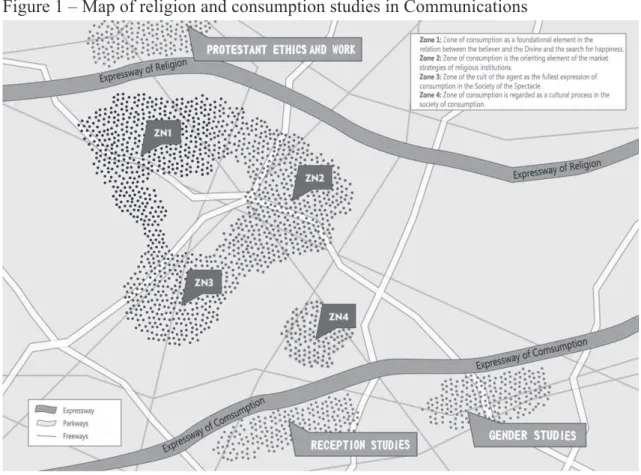
In traveling these paths, we noticed that we could claim the formation of a few theoretical routes, large axes through which the analyzed works organize themselves and around which they coalesce. This group was described as a perimeter – more as an attempt to perceive negotiations between them than to create borders. Thus, we construed four zones bordered by theoretical perimeters. They are: Zone 1 – consumption as a foundational element in the relation between the believer and the Divine and the search for happiness; Zone 2 – consumption is the orienting element of the market strategies of religious institutions; Zone 3 – the cult of the agent as the fullest expression of consumption in the Society of the Spectacle; Zone 4 – consumption is regarded as a cultural process in the society of consumption.
Figure 1 – Map of religion and consumption studies in Communications
In the map above, the expressways of religion and consumption are the upper limits of our research. The works studied are positioned relative to those pathways, but not entirely in their function. It is the same logic applied to the road network system. Expressways are located near the urban roads, allowing access to them and high-speed trafic. Through those two expressways the zones set up their access and circulation points.
After getting within a certain perimeter, parkways become the main axes of transportation and movement. They promote access to a given location and, for that reason, are used more frequently. In our map, parkways are helpful in joining together the common features of a certain zone. The recurrent use of a set of theoretical premises or positions, or even the choice of certain subjects, allow us to see which direction the parkways follow and how they are able to create circulation regions. Thus, parkways do not only allow for access to a given zone, but they determine how it is possible to circulate within it.
theories, and methods that are uncommon in the production of the last 10 years). Thinking about the analogy starting from the Communications studies, it is easy to understand, in the cases we study, how the freeways are used: in them, interrelations are made possible. Freeways develop a not entirely interdisciplinary function, but they do display the ability to engage in dialogue with theories that compose the complexity of a given zone. Freeways, after all, allow connections between zones, lending the works their sense of unity and the zones their sense of transience and interconnectedness.
The “road network” of our discoveries: the four zones in the ield of religion
and consumption
Consumption being the foundational element of the relation between the believer and the Divine and the search for happiness, our irst zone emerges. We have found a few works that start from theories and concepts based mostly on a view of the Protestant (or Puritan) ethic that helped deine the spirit of capitalism, as deined by Weber (2004). Few publications, however, employ the update by means of the “romantic ethic”, as advanced by Campbell, which operates and allows the “spirit of consumerism” (CAMPBELL, 2001, p.15 – Our translation). Rationality, as a core concept, becomes one of the foundations of the relections on the relation between consumption and the modern religious individual9.
Such relation unites consumption to the ideal of earthly happiness, which, as remarked by Baudrillard (2011), is the absolute reference and equivalent to salvation offered by the Society of Consumption. In this sense, happiness is necessarily measurable, through visible criteria.
We were able to observe that a fraction of the publications that involve religion and consumption, in the irst zone, understand rationality as reaching ends through certain means, as justiied by Weber, to whom social actions are mediated by some kind of sujective interest. They are anchored to the contributions of instrumental rationalism, under a utilitarian guise, in which the (religious) means are justiied by the search of certain (consumer) ends.
As a limited zone in the map, this approach is relevant for the consideration of such works as a group, but not all of them travel the same paths. We have also identiied distinct access points through the conversations that include Bauman (2008), Barbosa (2004), Beck (2011), Freire Filho (2003), Furedi (2004), Illouz (2011), among others. They amplify and help channeling a good part of the theoretical trafic in the irst zone.
For instance, that is the case of the relationship between the development of the therapeutic culture and the new conigurations of the sacred, or of the construction of an identity through a lifestyle, which is not only a right, but becomes a duty, proving that someone is successful. Moreover, it is notable in this group of studies at the irst zone the clear prevalence of the ethics of self-realization in modernity. It can only be reached by personal effort, rationality (as described above), and the attitude of “following” or “imitating” models (thus the importance given to testimonies and the examples of religious actors in many works), which serve as reference for an ascension provided by consumer objects.
The second zone encompasses works in which consumption is the directing element for market strategies and communications in religious institutions. They approach the actions undertaken by modern religion in the marketplace, where several social subjects articulate with individuals to produce meaning and stimulus to the (already in place) consumer desires.
Studies under this umbrella reveal the signiicant transformations of the numerous religious institutions that operate in the Brazilian market – from the reshaping of their discourse to practical actions for the opening of international markets. In these texts, we ind a plethora of descriptions of various strategies for the offering of religious products, which, as observed by Guerra (2000), are presented “similarly to other symbolic goods, such as lifestyles and cultural identities”.
Therefore, we have, in studies found inside zone 2, consumption treated as market representative of many religous institutions that intend to create and sustain their ties to the believer, or even to expand and solidify as brands in a highly competitive marketplace.
The breadth of theoretical references is remarkable in zone 2. Authors commonly read in Business schools, such as Philip Kotler (the most widely cited), or writers in the ield of Institutional Communications are highlighted in several analyses that emphasize the actions in the market competition, not restrictive to the religious sphere. Such approaches promote an approximation to the irst zone, especially if we think about the supply of salvation goods, advice, stories of overcoming, and exemplary life models available to the religious.
The third zone explored in the map of religion and consumption concentrates works that establish a dialogue with the Society of the Spectacle. Its parkways cut through the afinity existing between consumption and spectacle. Unsurprisingly, this zone shifts away slightly from the others and sets itself in a perimeter marked by the emergence of igures, institutions, and rituals that articulate a culture that is both material and symbolic-religious.
What we treat as spectacle comes from Debord’s (1997, p.17) work, where he proposes the spectacle as the means through which society expresses itself. The author (1997, p.18-19) argues that, in a later stage of capitalism, a general shift from having
into seeming10 took place. Such dynamic has made spectacle become much like capital,
abundantly accumulated. That is what Freire Filho (2003), in his critique to the spectacular critique of the spectacle11, points to the complete realization of the commodity fetishism,
whereby waves of enthusiasm for certain products propagate themselves through the media, generating various roles and lifestyles individuals can identify with (FREIRE FILHO, 2003, p.40). In this process, there are the agents of the spectacle – “admirable people who embody the system” (DEBORD, 1997, p.40 – Our translation).
Works in the third zone are anchored by the reference to agents of the spectacle. Studies on priests, pastors, and religious celebrities sustain this approach and show us how they are built to be consumed by a public that gets their religious message within the same logic, equally mediatized and consumeristic. It is important to note that, in this perimeter, we do not only ind human igures. The rituals, such as masses with concerts, processions, and marches are prone to spectacularization, since they exhibit a greater potential of being consumed by the believer.
If the access to this zone happens through the spectacle, it is possible to think that some freeways help reducing trafic in this congested road. Relections on mass culture, the emergence of celebrities, and the culture of consumption are necessary to support the more intense trafic of spectacular content. In these ancillary routes, a few exits and entrances are visible, much like the shortcut that allows us to reach the last parkway in the map, leading us to the fourth zone: the Society of Consumption.
In the fourth zone, the theme of consumption emerges as a cultural process within the Society of Consumption, involving various authors who, even if not engaging directly, converge to a common conceptual thinking. Among the most cited are Garcia Canclini (2010), Hall (2011), Martín-Barbero (2009), Baudrillard (2011), Campbell (2001), Lipovetsky (2007), Bourdieu (2012) and Barbosa (2004).
Understood as a set of socio-cultural processes of appropriation and uses of products
10 During the mercantilist stage, having became more important than being, for instance.
(GARCIA CANCLINI, 2010), consumption appears as an integrating element of the individual with him or herself and the world, in a way that both construct their identity in the communities they take part in, but also differentiates them from the outsiders. As such, terms and concepts like identity, identiication, differentiation, distinction, culture, behavior, lifestyle, social, social practices, and processes are very common throughout the pages from this zone.
Considering its productive relation with identity processes, consumption is considered an element for both “thinking about” and questioning. Therefore, it is not a stage, but as stated several times (something inherited from Cultural Studies), it is rather a necessarily uninished process. In that sense, we resort to Martín-Barbero (2009), who, much like several authors present in the works of this group, remarks that consumption is always a mediated process. Institutions like the church, the State, schools, media, and so on, are cultural mediators of profound inluence in the process and, for that reason, are followed attentively by the market. At this point, it is possible to notice the intersections with the other zones, something that conirms our thesis that they are mobile and luid.
Thus, the fourth zone is deined by the context in which the above processes take place: the Society of Consumption (BAUDRILLARD, 2011; BAUMAN, 2008; BARBOSA, 2004; BARBOSA & CAMPBELL, 2006). Several types of “culture” permeate the latter (among others, consumption, terapeutic, self-help, corporate, selie cultures). It is constituted in the contemporary world and directs all investment to the consumption and the individual. “The customer is always right!” is a very representative motto of this society, present not only in the corporate universe, but also in religion, since, after all, religious institutions compete against every type of organization for the promotion of solutions for all kinds of day-to-day questions and problems. Happiness, as proof or means to salvation, is the reference for this society and consumption. More than a way to deepen our crisis of identity, it becomes a means to solve it (BARBOSA; CAMPBELL, 2006).
Final thoughts
Common sense dictates that, to explore a place you do not know, it is wise to consult a map. Even though it is useful, we should know that to read a map it is necessary to have more than a sense of location. In the present paper, we also need to understand the transitions taking place when entering a different zone, or when we leave one for the other. In this perspective, almost as important as deining perimeters or axes around which several works luctuate, we should consider, too, the possible interfaces. Thus, besides sticking to what lends unity to a zone, it is paramount to think of perimeters and areas of transition, of the borders that separate (and connect) the zones that make up the map of religion and consumption.
What the work of putting this map together has shown us is that these borders are more and more lexible. The circulation of objects, theories and approaches can even lead to a work being present at two zones at once. Works on the Society of the Spectacle are an example: derivative from the Marxist tradition, and (one could argue, for that very reason), able to engage with Cultural Studies, as both approach religion as a way of thinking about cultural identities.
Questions relating to identity make up a busy road, as well. They take back and forth works that deal, at one time, with market strategies for religious products or, at another, with discussions of a given type of consumer behavior. Most studies, however, travel through the process of mediatization of society, especially when they try to explain the transformation of the relations between institutions and social actors, focusing on the religious denominations that have started to operate under a media and consumption logic.
Generally, considering the epistemological debate brewing in the Communications, the tensions, conversations and pluralities delineated in the irst map we propose have led us to see how all works distributed in the four zones are interrelated, even with all their speciicities. The academic production (that has merged religion and consumption together in the last ten years) also relates to zones beyond what we mapped.
References
BARBOSA, Lívia. A sociedade de consumo. Rio de Janeiro: Jorge Zahar Editor, 2004. 68p.
BARBOSA, Lívia; CAMPBELL, Colin (org). Cultura, consumo e identidade. Rio de Janeiro: Editora FGY, 2006. p.21-44.
BAUDRILLARD, Jean. A sociedade de consumo. 3ª edição. Lisboa: Edições 70, 2011. 272p.
BAUMAN, Zygmunt. Vida para consumo: A transformação das pessoas em mercadoria. Rio de Janeiro: Jorge Zahar Ed., 2008. 199p.
BECK, Ulrich. Sociedade de risco: rumo a uma outra modernidade. 2ª ed. São Paulo: Editora 34, 2011. BOURDIEU, Pierre. O poder simbólico. Rio de Janeiro: Bertrand Brasil, 2012.
CAMPBELL, Colin. A ética romântica e o espírito do consumismo moderno. Rio de Janeiro: Rocco, 2001. 400p.
DEBORD, Guy. A sociedade do espetáculo. Rio de Janeiro: Contraponto, 1997.
ESCÓSSIA, Liliana da; TEDESCO; Silvia. O coletivo de forças como plano de experiência cartográica. In:
PASSOS, Eduardo; KASTRUP, Virgínia; ESCÓSSIA, Liliana da. Pistas do método da cartograia: pesquisa-intervenção e produção de subjetividade. Porto Alegre: Sulina, 2012. 207p.
FREIRE FILHO, João. A sociedade do espetáculo revisitada. Revista FAMECOS. Porto Alegre, v.22, n.25, p.33-45, dez. 2003.
FONSECA, Tania Maria Galli.; COSTA, Luis Artur. As durações do devir: como construir objetos-problema
com a cartograia. Fractal, Revista de Psicologia, v.25, n.2, p.415-432, May/August. 2013.
FOUCAULT, Michel. A arqueologia do saber. Rio de Janeiro: Forense Universitária, 2008. 236p. FUREDI, Frank. Não quero ser grande. Folha de S. Paulo, São Paulo, 25 jul. 2004. Caderno Mais!, p. 1-6 GARCIA CANCLINI, Nestór. Consumidores e Cidadãos. 8ª Ed. Rio de Janeiro: Editora UFRJ, 2010.228p. GUERRA, Lemuel. D. A lógica do mercado na esfera da religião: competição, demanda e a dinâmica dos discursos e práticas religiosas no Brasil. In: Cadernos Religare, v.1, n.2, p.25-38, UFPB, 2000.
LIPOVETSKY, Gilles. Felicidade paradoxal: ensaio sobre a sociedade de hiperconsumo. São Paulo: Companhia das Letras, 2007.
MARTÍN-BARBERO, J. Dos Meios às Mediações – comunicação, cultura e hegemonia. (6ª ed.) Rio de Janeiro: Editora UFRJ 2009.
MARTINO, Luis Mauro Sá. Mediações e midiatização da religião – um levantamento de hipóteses e problemáticas. In: MATTOS, Maria Ângela; JANOTTI JUNIOR, Jeder; JACKS, Nilda (Orgs). Mediação & Midiatizações. Salvador – Brasília: EDUFBA-COMPÓS, 2012. 239p.
MESQUITA, Wania A. B. Um pé no reino e outro no mundo: consumo e lazer entre pentecostais. Horizontes Antropológicos. [on-line], v.13, n.28, p.117-144, 2007.
MORAES, Márcia. Sobre a noção de rede e a singularidade das ciências. Revista Documenta. Ano VIII, n.12/13, p.57-70, 2001-2002.
PASSOS, E.; BENEVIDES DE BARROS, R. A cartograia como método de pesquisa-intervenção. In: PASSOS,
E.; KASTRUP, V.; ESCÓSSIA, L. (Org.). Pistas do método da cartograia: pesquisa-intervenção e produção de subjetividade. Porto Alegre: Sulina, 2009. 207p.
WEBER, Max. A ética protestante e o espírito do capitalismo. São Paulo: Martin Claret, 2004. 336p.
Karla Regina Macena P. Patriota
Professor of the Graduate Program in Cmmunication of the Federal University of Pernambuco. PhD In Sociology and Master in Comunication from UFPE. Post Doctorate from the University of Cambridge, in England. Has experience in the Coomunication ield, acting mainly in the following themes: media, advertising, campaign planning, marketing, digital media and religious discourse. She is the author and organizer of the books: “Ilimited Advertising: Relects and relections about Communication and Consumption”; “50 ears of Marplan Researches” and “The nature of Digital Media: New Paradigms for Advertising”. Leader of the Research Group certiied by CNPq, “Ad -vertising on New Media and Narratives of Consumption” since 2008. E-mail: [email protected]
Carolina Cavalcanti Falcão
Profesor of the Federal University of Paraíba and UNIFAVIP. She is doing her Doctorate studies in Communications at the Graduate Program in Communication of the Federal University of Pernam-buco (UFPE). Holds a master’s degree in Communications from the same institution. Also has spe-cialization in Public Management from the Federal Institute of Pernambuco (IFPE) and is graduated in Journalism from UFPE. E-mail: [email protected].
Emanuelle Gonçalves Brandão Rodrigues
-munication and Reception”, “Com-munication and Cultural Studies”, “Com-munication, Media and Religion”, “Religion and Consumption”, acting mainly in the following themes: mediatic reception studies, consumption studies, discourse analysis, narratives of myself and self-help, entrepenership and religion, market and religion and Communication Epistemology. Integrates the Research Groups “Advertising on New Media and Narratives of Consumption” (UFPE) and “Communication, Entre-peneur Culture and Consumption” (ESPM). E-mail: [email protected]