gamification
Ángel Torres-Toukoumidis
Universidad Politécnica Salesiana Cuenca / Ecuador
Luis M. Romero-Rodríguez
ESAI Business School, Universidad Espíritu Santo, Ecuador Universidad Internacional de La Rioja , España
Ignacio Aguaded
Universidad de Huelva / Universidad de Educación y Comunicación Huelva / España
Amor Pérez-Rodríguez
Universidad de Huelva / Departamento de Filología Española y Didáctica Huelva / España
Yamile Sandoval
Red Alfamed Colombia Cali / Colombia
his article proposes a procedural model designed to optimize the experience of citizens in decision making of public policies through gamiication. he study assumes that gamiication increases motivation and contributes to increase involvement within a speciic area. In this case, gamiication is used to encourage citizens’ engagement in decision-making, based on three models of evaluation of public policies that incorporate civil participation in three diferent roles: auditor, passive and active. Ater applying the Delphi methodology, the results of reliability and internal consistency show that experts attribute a higher value to the model of active participation using gamiication. In conclusion, the model designed opens a new area of knowledge within the evaluation of public policies, embedded in the interactivity of the media context.
Keywords: public policies; citizen participation; gamiication; evaluation model; user experience.
Modelo procedimental de la evaluación de las políticas públicas a través de la ludificación
Este artículo tiene por objeto proponer un modelo procedimental diseñado para optimizar la experiencia de la ciudadanía en la toma de decisiones de las políticas públicas a través de la ludiicación. Se parte de la consideración que la ludiicación promueve la motivación hacia una actividad prolongando su participación dentro de un ámbito especíico. En este caso, se encamina su aplicación para motivar la integración de los ciudadanos en la toma de decisiones. Para ello se contrastan tres modelos de evaluación de políticas públicas que incorporan la participación civil en tres roles diferentes: auditor, pasivo y activo. Al aplicar la metodología Delphi, los resultados de iabilidad y consistencia interna demuestran que el modelo de participación activa tiene mayor valoración por parte de los expertos respecto a la ludiicación, Como conclusión, el modelo generado abre una nueva área de conocimiento dentro de la evaluación de políticas públicas imbuida en la interactividad del contexto mediático.
Palabras clave: políticas públicas; participación ciudadana; ludiicación; modelo de evaluación; experiencia del
usuario.
DOI: http://dx.doi.org/10.1590/0034-7612170058
Article received on October 2, 2016 and accepted on June 27, 2017.
Modelo procedimental na avaliação das políticas públicas por meio da gamificação
Este artigo tem como objetivo propor um modelo procedimental concebido para otimizar a experiência dos cidadãos na tomada de decisões de políticas públicas por meio da gamiicação. Parte-se do pressuposto de que a gamiicação promove a motivação para uma atividade, aumentando a participação dentro de um âmbito especíico. Nesse caso, a gamiicação é utilizada para incentivar o envolvimento dos cidadãos na tomada de decisões. Com esse objetivo, comparam-se três modelos de avaliação de políticas públicas que incorporam a participação civil em três papéis diferentes: auditor, passiva e ativa. Ao aplicar a metodologia Delphi, os resultados de idelidade e consistência interna revelam que o modelo de participação ativa é alvo de uma va-loração superior por parte dos especialistas, no que se refere à gamiicação. Em conclusão, o modelo gerado abre uma nova área de conhecimento no âmbito da avaliação de políticas públicas, integrada na interatividade do contexto midiático
Palavras-chave: políticas públicas; participação cidadã; gamiicação; modelo de avaliação; experiência do usuário.
1. INTRODUCTION
At the present time, technological innovation is presented as a resource used to see to the needs of the citizens and to motivate participation through inclusive dynamics, and is raised as a banner in the processes of political representation and democratization (Zurbriggen and Lago, 2014). herefore, the integration of techniques, as in the case of gamiication, serves as an alternative to involve civil society in processes that are exclusively granted to the public administration’s civil servants.
he term gamiication can be deined as the use of game design elements in non-game contexts (Deterding et al., 2011:2). In general terms, its objective is focused on people’s behavior, appealing to persuasion for prolonging their participation within a speciic area (Scoltock, 2016; Werbach and Hunter, 2012). his means that it focuses on increasing people’s commitment and motivation towards an activity, making it more fun, with the aim of stimulating learning (Landers and Callan, 2011; Simões, Redondo and Fernández-Vilas, 2013). he link between gamiication and public pol-icies can be mainly viewed as a use of gamiication as a resource for optimizing behavioral changes, favoring participation (Bista et al., 2014) and strengthening community values (Dirienzo, Krishnan and Santos, 2014; Martí et al., 2012; Sox, Kline y Crews, 2014).
he analysis of the public policy ield can be deined as a proliic ield comprised at the same time of an analytical framework for politics and for policies. Public policies have made available, in agreement with the theoretical frameworks of the social sciences, a wide terrain for exploring political behavior and the institutions.
he goals and the relation of the analysis with public policies are diverse. In many cases, the analysis is a process of determining the problems and solutions that could be considered a range of activities. his range is given from two perspectives: knowledge of public policies and knowledge for
public policies (Parsons, 1999).
de-scription of the policy and its background, and it can also be comprised of a theoretical or analytical framework.
he monitoring and evaluation process does not belong to any of these two categories, and is speciically responsible for measuring the performance with respect to the policy’s speciic objectives. It is important that the impact on the problem is considered, which merits a new examination of the target community or society. he results can provide innovation and better practices that can be implemented in the future in order to ofer a solution.
he analysis for the policies has two stages. First, the support of the policies involves modifying the agenda within and outside of the government. his explicitly refers to arguments and research on the policies in order to elicit changes within them. Second, the information for the policies tries to provide detailed research, advice or judgement in order to help generate better options for the speciic solutions that the policies put forward.
In this line of study, the inclusion of civil society is evaluated in the understanding of the knowl-edge of public policy, in the monitoring and evaluation, and lastly, in the transmission of knowlknowl-edge for public policies. As there are speciic references that back the usefulness of using game elements (Asquer, 2013; Hu and Chen, 2015; Mahnic, 2014; Nacke and Deterding, 2017; hiel and Fröhlich, 2017), this research tries to take a step further into the academic world by creating a procedural model that is supported by the use of gamiication.
In line with the theory reviewed, the adaptation of gamiication is evaluated within three generic models of evaluation of public policies that integrate civil society into the process. herefore, the general objective of this research is based on proposing a procedural model for the establishing of public policies that is associated to gamiication. he speciic objectives of this research are: (1) to contrast the models of evaluation of policies based on the categorization of the dimensions associated to gamiication; and (2) to apply the indicators of gamiication to the model of evaluation of public policies that has the greatest acceptance among the experts.
2. BACKGROUND AND THEORETICAL CONSIDERATIONS
he interdisciplinary character of the aspects from public policies, new technologies and psychology shape this unprecedented research study, particularly when the concept of gamiication is incorporated as an innovative factor of the approach.
Within the ield of public policies, no similar studies have been found. However, the Modeling and Simulation of the Impact of Public Policies on SMEs (MOSIPS) analyzes the public policies without delving into the citizen’s education, applying game elements but without specifying gamiication (Pablo-Martí et al., 2012). In fact, Koch (2014) explains that it is about a process of execution of public policy that considers the need to include the participation of multiple social actors, strengthening the feedback through the social networks, and empowering the citizens by granting them the opportunity to gather information and discuss public policies.
in this case, the success of gamiication is observed through the creation of an attractive experience among the users, a competitive atmosphere in the forum, and creating changes within a system that was considered as being ineicient (Bremner and Zastrow, 2008) and destructive (Zastrow, 2014).
However, the ield of new technologies within the European stage is present in this subject matter through the research and innovation program Horizon 2020, in which a space is proposed for projects related to Advanced digital gaming/gamiication technologies with the aim of developing new meth-odologies, tools and scientiic evidence in non-game digital contexts for the beneit of governments, businesses and individuals. Among the 28 projects selected, none of them list the evaluation of public policies within their objectives.
Accordingly, the theoretical basis that allows for connecting game elements with the non-game con-text is developed according to principles of interactions of the User Experience (Deterding et al., 2013; Kumar, 2013). his means that in order to apply gamiication, it is necessary that the mechanisms are embedded within the principles accepted by the User Experience, highlighting its subjective char-acter. his is because it depends on the resulting emotional aspects of each user (Hassenzahl, 2003; Battarbee and Koskinen, 2005; Law et al., 2009) and its holistic character, as the interaction produced is observed as an all (Battarbee and Koskinen, 2005; Hassenzahl and Tractinsky, 2006; Bargas-Avila and Hornbæk, 2011) and its dynamic character, since that the experience can change during the process of interaction (Law et al., 2009; Karapanos et al., 2009; Bargas-Avila y Hornbæk, 2011). Ultimately, the user’s experience can be deined as the subjective, holistic and dynamic evaluation of the interaction process of the citizens in the evaluation of public policies.
Although there are multiple categorizations with respect to the elements that comprise the user’s experience (Castañeda, Muñoz-Leiva and Luque, 2007; Law et al., 2009; Garrett, 2010; Park et al., 2013; Jang et al., 2016), the proposal by Jang and partners (2016) exclusively evidences its association with the design of game elements in a non-game context. herefore, the model designed towards the public policies is prescribed according to the following dimensions:
Hedonic goals: his refers to internal experiences of user enjoyment.
Serendipity: Unexpected positive experience. his is related to unpredictability, creativity and the facilitation of the user’s experience.
Playability: Enjoyable internal experiences of the users with respect to a service in particular within a speciic context.
Utilitarian goal: Practical purpose of the service. his refers to factors of performance, providing of useful experiences, instrumental beneits and the performing of tasks.
Compatibility: Degree in which technology its with existing values and experiences with the aim of increasing the perception of eicacy and to reduce the perception of risk due to its use. Consistency: Transfer of abilities of the experience to other situations, increasing conidence and the utilitarian value of the service.
Degree of autonomy goal: his refers to the degree of control or independence of the user with respect to the service the user interacts with.
and on providing the user with the freedom of management in speciic circumstances.
Adaptability: It is focused on evaluating how the system is organized according to the user’s wishes. he users judge the importance and the value of using the information gathered.
As for the evaluation of public policy, Johnson (1975), Epstein and partners (1977), Peters (2012) and Villoria (2014), believe that it is a coordinated set of processes whose aim is to measure, analyze, plan and interpret the fulillment of the objectives, evaluate the policy’s results, receive feedback, and control the distribution of resources of the public administration. More speciically, the need to evaluate public policies has three purposes: legitimize the public action of the institutions, account for the management of public resources (accountability), and lastly, to strengthen democratic val-ues. Emery, Mulder and Frewer (2015) have stated the problems with respect to its evaluation, more speciically on the monitoring of the impact, the understanding and the supervision that are already formalized as policy.
When focusing on the approach of the evaluation of public policy in current models that allow for the interposing of gamiication techniques without producing axiomatic changes within the evaluation, three models are prioritized, which have the feature of incorporating the citizens in the process of understanding of the knowledge of the public policies, the monitoring and evaluation, and the transmission of knowledge for public policies. he models are: client oriented (Vedung, 2009), evaluation of user’s satisfaction (Vargas, 2009) and participative evaluation (Vargas, 2009).
he client oriented model is deined by Vedung (2009) as the value expressed by the wishes, expec-tations, assumptions and issues of the clients. he idea of considering the relationship State-citizens is a reaction to the client relationship from the capitalist system’s political ideology, as in the free market it is believed that the consumer’s pressure towards a service can generate changes in their provision, leading to its improvement and an increase in satisfaction.
his model is speciically applied to the evaluation of the provision of local services (medical services, crime prevention, services for the disabled and the young), cultural programs (libraries, museums, theaters), recreation programs (national parks, swimming pools, football ields), and other programs (cleaning and maintenance, urban traic). he essence of the evaluation of this model is focused on the citizen’s own criteria for the evaluation. According to Schmidt (1977), these criteria can be determined according to the following dimensions: quality of service, satisfaction with the service, understandability of the procedures, client-centered orientation, adaptability of rules to client needs, and coordination of the personnel.
On its part, the achievement of goals criteria limits the client dimensions to the objectives of the level of government that is evaluated. his means that the assessment of the priorities from the national, state or local levels will never be the same, although this model will preferentially be used at the local level (Stulebeam, 1983:34). he six dimensions referred by Schmidt (1977) are the only ones from which evidence exists on the application of the “client-focused model” in the public sector: — Quality of service: degree of fulillment of the citizens’ expectations in the long term. Overall
attitude towards a service.
— Understandability of the procedure: he procedure required for the obtaining of services should be easy to understand. It depends on the experience and knowledge of the citizens on the processing of applications.
— Client-centered orientation: It is the degree in which the citizens perceive that the public admin-istration is looking out for their interests.
— Adaptability of the rules to the client’s speciic needs: Personalization of the interaction and lexi-bility of the norms for satisfying the speciic needs of the citizens.
— Coordination of the personnel: Perspective of the citizens on the synchronization of the civil ser-vants when working together in the activities for satisfying their needs.
In second place, the model of evaluation of the user’s satisfaction has been precisely steered towards the evaluation of health policies (Crow et al., 2002; Ruggeri, Farrington and Brayne, 2013). Likewise, the advances in information and the new technologies have facilitated their implementation, resulting in new experiences that are able to identify society’s requirements (Alawneh, Al-Refai, and Batiha, 2013). In general terms, this type of model, which was previously designed to measure private services, has been adapted to the perception of quality of public service according to two paradigms: expectations-dissatisfaction of the citizens and the performing of the tasks by the civil servants of the public administration (Carvalho and Brito, 2012). Although the evaluation of performance has its own prominent system of measurement named Servperf (Cronin and Taylor, 1992), this same is constructed based on a previous system of expectations-dissatisfactions named Servqual, which currently has three versions: 1st: Original version (Parasuraman, Zeithaml and Berry, 1988); 2nd:
Modiications and theoretical basis that is posterior to the creation of the measuring system of quality performance (Parasuraman, Zeithaml and Berry, 1994); and 3rd: Electronic version (Parasuraman,
Zeithaml and Malhotra, 2005).
In the three versions, the application of ive dimensions proposed in the original version persists (Parasuraman, Zeithaml and Berry, 1988): (1) reliability: the ability to fulill the objectives with the least number of possible errors; (2) responsiveness: willingness to help users and provide immedi-ate service; (3) assurance: professionalism, ability to inspire conidence in the service provided; (4) empathy: individualized and personalized attention to the needs of the citizens; and (5) tangibles: appearance and usefulness of equipment, infrastructure, installations and communication materials.
Lastly, the participative evaluation model, deined as “expert or non-expert intervention or research on a speciic subject matter working together at the same level in a speciic project” (Úcar, 2014:15). Indeed, it is deined as an endogenous model formed on the values and aspirations of the participants of a pluralist society through the long process of evaluation. In agreement with Izquierdo (2008) and Dos Santos (2016), it implicates the citizens in the collaboration and participation of the process, magnifying the sense of belonging in the design of policies and in the results, creating actions that motivate collective learning.
stating that “the general level of participation in public policies is derived from the size of the partic-ipant’s diversity, degree of participation and control”. Control in the making of decisions means that this is prioritized on the basis of equilibrium in the decisions that underpin the program (balanced, the participants predominate, the technicians predominate, the evaluator predominate). Participant selection refers to the groups that are legitimate, who beneit and who are authorized to make deci-sions and implement the program (primary users, legitimate users, non-speciied). Finally, depth of participation means the number of phases which the citizens can participate in (limited, moderate and extensive).
In conclusion, the client-oriented evaluation model (Vedung, 2009) considers the citizen as an active auditor of the activities and services related to public service, explicitly guided by their own wishes, values, aims, worries, expectations and assumptions; the user satisfaction model (Vargas, 2009) considers the citizens as passive actors, who are not involved in the public sector, trying to delegate the decision making to their representatives, only participating in speciic situations; and the partic-ipative evaluation model (Vargas, 2009) considers the notion of the active citizen who participates in the activities of the public sector, focused on fulilling the common needs in a society.
3. METHODOLOGY
he present research adopts a non-experimental design, with a systematic approach using the Delphi methodology, ensuring the validation of the process ater the identiication of the dimensions that illustrate the standardization of the decision making of the main model that related to the experience of the user and the evaluation of public policy. he questionnaire is a common instrument in the Del-phy methodology, as it systematizes and shows the convergence of opinions from a group of experts (Astigarraga, 2003; García-Valdés and Suárez-Marín, 2013). With respect to the size of the panel of experts that comprise the Delphi, there is little empirical evidence on the efect of the number of par-ticipants in the processes of consensus oriented to the reliability and validity that vary according to the resources and the focus of the problem (Keeney, Hasson and McKenna, 2001). Ultimately, Powell (2003) believes that for the size of the panel, the expert’s qualiication has a greater repercussion in the impartial view of the indings and the fulillment of the objectives. herefore, in this study, the experts were divided into two groups, the irst formed by experts in Communication Technologies, Orientation and Socio-cultural Intervention, who supervised the questionnaire in content editing as well as statistical inferences, providing the corrections needed to create the inal version.
TABLE 1 CRONBACH’S COEFFICIENT FROM MODEL 1
Model 1: Client-oriented model
Hedonic goals Utilitarian goals Degree of autonomy
Cronbach’s Alpha: .943 Cronbach’s Alpha: ,767 Cronbach’s Alpha: ,738
Number of indicators: 17 Number of indicators: 6 Number of indicators: 7
Source: Elaborated by the authors.
TABLE 2 CRONBACH’S COEFFICIENT FROM MODEL 2
Model 2: User satisfaction evaluation model
Hedonic goals Utilitarian goals Degree of autonomy
Cronbach’s Alpha: .957 Cronbach’s Alpha: .931 Cronbach’s Alpha: .897
Number of indicators: 12 Number of indicators: 5 Number of indicators: 7
Source: Elaborated by the authors.
TABLE 3 CRONBACH’S COEFFICIENT FROM MODEL 3
Model 3: Participative evaluation model
Hedonic goals Utilitarian goals Degree of autonomy
Cronbach’s Alpha: .717 Cronbach’s Alpha: .800 Cronbach’s Alpha: .719
Number of indicators: 7 Number of indicators: 6 Number of indicators: 4
Source: Elaborated by the authors.
4. RESULTS
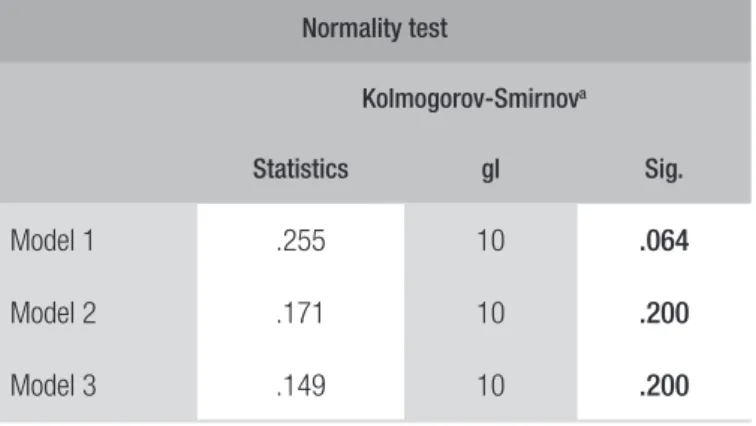
Ater obtaining responses from the second group, the degree of acceptance was calculated taking into account the means from each model, observing that the model of participative evaluation had the highest degree of acceptance. However, to make the results more rigorous, an Anova was also performed. According to Gueorguieva and Krystal (2004), the Anova is a type of parametric test that is applied when there are more than two independent samples to contrast the null hypothesis. he statistical signiicance (Sig.) was also calculated, which gives information on the data’s Normality (>0.05). heir compliance for all three models are shown in table 4.
TABLE 4 NORMALITY TESTS OF THE THREE MODELS
Normality test
Kolmogorov-Smirnova
Statistics gl Sig.
Model 1 .255 10 .064
Model 2 .171 10 .200
Model 3 .149 10 .200
Source: Elaborated by the authors.
he statistical tests show that the model of participative evaluation (Vargas, 2009) and the degree of autonomy had the greatest degree of agreement among the experts with respect to the evaluation of the user’s experience. he most important diferences were found between model 2 and model 3, with these being the ones that had, respectively the least and greater degree of agreement, and a greater and lesser standard deviation with respect to the responses obtained.
he third model, the model of participative evaluation (Vargas, 2009), is characterized by the intervention of civil society actors who represent the plurality of value systems in the management, design and implementation of public policies. his type of evaluation is discerned as an especial-ly-eicient method for the formulation of recommendations for the appropriate authorities in the program or the policy (Horta and Ysa, 2007).
he user’s experience, from the model of Jang and partners (2016), takes into account the quality of the experience and judgement criteria according to the user’s perception, validating the interaction of the factors that comprise it. More speciically, its association with game design, digital platforms and with dimensions related to behavior formalize its framing within the model of participative evaluation.
Item 1: he unexpected positive experiences of the users afect the control of the making of de-cisions (hedonic).
Item 5: he fun experiences of the users afect the control in the making of decisions (hedonic). Item 8: he use of technology in the user’s experience afects the making of decisions (utilitarian) Item 10: he use of technology in the user’s experience afects the depth of participation in the making of decisions (utilitarian).
Item 13: he adaptation of the system to the wishes of the users afects the depth of participation in the making of decisions (utilitarian).
he high degree of acceptance of the results obtained with respect to the model of participative evaluation, combined with the goals of experience of the user, grants it a theoretical and method-ological consistency which set the basis before the addition of gamiication elements.
herefore, the last objective, the application of gamiication indicators to the model of evaluation of public policy with the greatest acceptance among the experts, implies that the acceptance of the third model provides the opportunity for adding gamiication elements, thereby providing elements for each goal of the user’s experience.
Serendipity and playability, both derived from the hedonic goal, commend the use of game design elements. Serendipity is understood as an unexpected positive experience, and therefore, random game elements depict their impact when they generate surprise, delight and feelings, fomenting changes in behavior (Liang, 2012). Independent of the tool applied, chance should be promoted as the objective within the game activity. On its part, playability refers to the pleasant internal experiences of the users with respect to a service in particular, albeit it will depend on the service provided. he study by Fitz-Walter and partners (2013) assesses the insertion of a system of achievements, tutorials and competitive elements.
Compatibility and consistency, indicators from the utilitarian goal, also prescribe the use of game elements. Compatibility is the degree in which technology allows for the itting of existing values and experiences. In this case, technology should not become a limitation when applying game elements, but the use of interfaces should produce a sense of assurance in the users and facilitate interaction. he more compatible the platform, the greater feedback received from the user. Consistency in the user’s experience is the transfer of abilities from the experience to other situations. he challenges and levels are game elements applied to evaluate the acquisition of abil-ities, operating as a system of classiication on the progress accomplished (Silpasuwanchai, Ma, Shigemasu and Ren, 2016).
Ultimately, the design of gamiication for the evaluation of public policies from the perspective of the user’s experience is composed of random elements, systems of achievements, tutorials, com-petitive elements, feedback, challenges, levels and personalization of the user’s proile. Likewise, the platform should utilize terminology that is adapted to the user, language, expressions and discursive resources with the objective of creating a feeling of belonging.
he random elements promote uncertainty and diversion, breaking the linearity of an activity. he most common system of randomness are dice, cards and random number generators, among others. Randomness afects decision making and, therefore, an equilibrium should be created between the user’s sense of mastery of the platform and the randomly-placed elements. In this case, randomness should be oriented towards extra beneits for the user as unexpected rewards.
System of achievements means that a reward is given when a goal is achieved. here are multiple elements, among which we ind historical information, progress, points, medals, etc. In this case, the implementation of the PBL (points, badges and leaderboards) mechanics will be opted for. hese are the points granted continuously when completing an activity, the medals when accumulating a series of activities performed, and a visible and public leaderboard.
he tutorials element means that at the start, the presence of a didactic explanation on the use of the platform is needed. Mission, vision and values are anachronistic. In this case, a clear and precise goal should be promoted, allowing the fomenting of a common objective in order to be able to explain the game dynamics that comprise it.
Elements of competition is used to bolster intrinsic motivation. It is more feasible that people in-ternalize the objectives when they understand that they possess abilities that are relevant for achieving them. Ultimately, the obstacles and challenges stimulate a person to move forward. he challenges and the levels, as well as providing consistency to the system, also foster playability.
Feedback is the most important mechanism in the gamiication process, as it re-enforces behav-iors that must be repeated. It is presented as the information that is given back to the player ater performing an action, and due to this, it is considered to be intimately related to points and progress. It allows players to recognize their performance in the activities and evaluate the opportunity of continuing participating. In the public policy sphere, a certain priority is placed on the use of in-terpretative feedback that is focused on the perception of the citizens on the aspects of the political program that exert inluence on their lifestyles. However, the recursive feedback is also incorporated in a speciied manner in order to shape the patterns of behavior that determine the civil capacity and participation of the citizens.
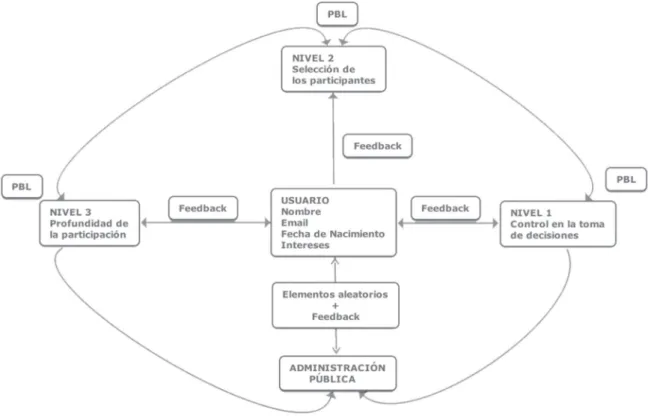
FIGURE 1 FINAL MODEL OF EVALUATION OF PUBLIC POLICIES
Source: Elaborated by the authors.
Figure 1 presents the inal model of evaluation of public policies. In the model, the user is viewed as the main focus of the process. To access it, the user identiies him or herself with his or her name and last name, email (another method of contact), date of birth (+16 or +18 years of age allows the user to participate) and interests, which depends on the governmental level to which they will be applied. To start, a tutorial that explains the use of the platform and its challenges is shown.
he system is organized in real time to the program of public policy. However, the user decides when he or she joins the participation, and the only condition is that this should be done during the period of discussion or ater it. his model is composed of three levels, and although the user can foray in all of them in an unspeciied order, it is understood that the challenges in level 3 are more diicult that the challenges in level 1.
Level 1 is based on the control of the decisions, and in this case it is reduced to knowing the opin-ions of the authorized representatives expressed anonymously in the interface, accepting and rejecting each argument, with acceptance implying freedom, and rejection limitation. Each intervention has a random number of points, and the greater the number of interventions that are interacted with, the greater the opportunity to gain points. On their part, the medals are given with respect to the accumulation of a speciic number of points.
education and professional experience in the area of the person who expressed the argument, who remains anonymous. he closer the user is to the right answer, the greater will be the number of points, and a medal will also be given for fulilling objectives.
In level 3, depth of participation, the user must broadcast his or her opinion on the degree of depth of the arguments given in the discussions on the speciic piece of public policy. Just as in level 1, each argument has a randomly assigned score, and the more answered questions, the greater the score obtained and the closer to the medals the user is. Although it may seem that the level of diiculty is the same as in level 1, this level merits a series of previous knowledge on the terminology before making the posting of an answer available. Likewise, completing the third step implies the anonymous transmission of the data from the third phase to the public administration.
In the lower section, all the users registered at the start of each session randomly uncover three cards. he image of the user’s Town Hall or Council, if at the local level, or the Parliament if at the central level, will appear, and an email will be sent automatically asking for a date and time for a meeting with the council of a speciic area. his will therefore facilitate the personal interaction of civil society with speciic representatives of public policy.
In this last instance, this model of evaluation seeks that the user evaluate the decisions of the public administration, make decisions and become actively involved in the programs of public policy, especially the youth, who will face the direction of future public policy.
5. CONCLUSIONS
In conjunction with the objectives presented, the main goal was to propose a procedural model for the establishment of public policy associated to gamiication, which was shaped based on the mod-el of participative evaluation (Vargas, 2009) through the application of the following gamiication components: random elements, system of achievements, tutorials, elements of competition, feedback, challenges, levels and personalization of the user proile. he speciic objectives of contrasting of the models of evaluation of policies based on the categorization of the dimensions of the user’s experi-ence and of applying gamiication indicators to the model of evaluation of public policies that had the greatest acceptance among the experts were, therefore, satisied.
According to the irst objective, the Model of Participative Evaluation (Vargas, 2009) and the de-gree of autonomy were the ones that obtained the greatest dede-gree of ade-greement among the experts as far the evaluation of the user’s experience. his means that the model selected for the incorporation of the gamiication elements was the one that envisaged the active citizen who participates in the activities of the public sector, focused on fulilling the common needs of a society.
Although at the theoretical level the participative evaluation stood out as the method of evaluation of the public administration, the data gathered in this work showed that this model of evaluation of public policy was adapted to the factors of inluence of the user’s experience. he model of partici-pative evaluation, besides being eicient, was also compatible within the area of new technologies. Also, the perspective of the user’s experience was considered to drive the capacitation and inluence of the active citizen in the evaluation of public policy.
elements of competition, feedback, challenges, levels and personalization of the user’s proile, which were added to the inal design, maintaining the user as the center of the model. Ultimately, this is a irst drat that allows for the opening of a new area of knowledge within the new technologies and innovation, formally showing and following methodological parameters from the social sciences, and the possibility of adding game elements in a model of evaluation of public policy.
he major contribution is related to gamiication. he technique of gamiication has turned from being an emergent technology to a ixed technology within digital marketing. However, in the the-oretical arena, beyond behaviorism, gamiication has been subjected to empirical studies within the business sphere. his study tries to take a step forward in the acceptance of gamiication within the academic environment, within which its substitution as a multidisciplinary technique that tries to make use of the addition of points, medals and leaderboards to ind short-term beneits is sought for a process derived from the perspective of the user’s experience and at the same time generate changes in behavior in any area of study.
he innovative approach of this research has invited the conducting of a tour through the pos-sibilities that the new technologies and games ofer. Although there is still a domain of games from the trivial perspective, the portability, the advanced multimedia capacity, the cloud services, the three-dimensional graphics and the touchscreens have facilitated their incursion into the public sector as an applied technique in speciic programs of public policies, among which the education and health areas are highlighted, setting aside their application in the evaluation of public policies.
Ultimately, it is understood that this procedural model seeks to make society evaluate, in an interactive and entertaining way, the civil servants during the making of public decisions processes, giving enough importance to the discourse they construct and the ideas they express with respect to the common needs of the population, thus activating popular participation.
REFERENCES
ALAWNEH, Ali; AL-REFAI, Hasan; BATIHA, Khaldoun. Measuring user satisfaction from e-Government services: Llessons from Jordan.
Government Information Quarterly, v. 30, n. 3,
p. 277-288, 2013.
ASQUER, Alberto. Not just videogames: gamiica-tion and its potential applicagamiica-tion to public services. In: DIGITAL PUBLIC ADMINISTRATION AND E-GOVERNMENT IN DEVELOPING NATIONS: POLICY AND PRACTICE, 2013, IGI Global.
ASTIGARRAGA, Eneko. El método Delphi. San
Sebastián: Universidad de Deusto, 2003.
BARGAS-AVILA, Javier A.; HORNBÆK, Kasper. Old wine in new bottles or novel challenges: a critical analysis of empirical studies of user experience. En: PROCEEDINGS OF THE SIGCHI CONFERENCE ON HUMAN FACTORS IN COMPUTING SYS-TEMS, 2011, ACM.
BATTARBEE, Katja; KOSKINEN, Ilpo. Co-expe-rience: user experience as interaction. CoDesign, v. 1, n. 1, p. 5-18, 2005.
BISTA, Sanat Kumar et al, Gamiication for online communities: a case study for delivering government services. International Journal of Cooperative Infor-mation Systems, v. 23, n. 2, p. 201-225, 2014.
BREMNER, Judith; ZASTROW, Charles. Advanced standing revisited: current status, structure, and issues. Journal of Teaching in Social Work, v. 28, n. 1-2, p. 101-116, 2008.
CARVALHO, Cláudia; BRITO, Carlos. Assessing users’ perceptions on how to Improve public servi-ces quality. Public Management Review, v. 14, n. 4, p. 451-472, 2012.
CASTAÑEDA, J. Alberto; MUÑOZ-LEIVA, Fran-cisco; LUQUE, Teodoro. Web Acceptance Model (WAM): moderating efects of user experience. Infor-mation & Management, v. 44, n. 4, p. 384-396, 2007.
CHAUHAN, Jyoti; TANEJA, Shilpi; GOEL, Anita. Enhancing Mooc with augmented reality, adaptive learning and gamiication. In: MOOCS, INNOVA-TION AND TECHNOLOGY IN EDUCAINNOVA-TION (MITE), IEEE 3rd INTERNATIONAL CONFE-RENCE, 2015, IEEE.
COUSINS, J. Bradley; WHITMORE, Elizabeth. Framing participatory evaluation. New Directions for Evaluation, v. 19, n. 80, p. 5-23, 1998.
CRONIN JR., J. Joseph; TAYLOR, Steven A. Measu-ring service quality: a reexamination and extension.
he Journal of Marketing, v. 56, n. 3, p. 55-68, 1992.
CROW, Rosemarie et al. he measurement of sa-tisfaction with healthcare: implications for practice from a systematic review of the literature. Health Technol Assess, v. 6, n. 32, p. 1-244, 2002.
DAIGNEAULT, Pierre-Marc; JACOB, Steve. Unex-pected but most welcome mixed methods for the va-lidation and revision of the participatory evaluation measurement instrument. Journal of Mixed Methods Research, v. 8, n. 1, p. 6-24, 2014.
DETERDING, Sebastian et al. From game design elements to gamefulness: deining gamiication. In: PROCEEDINGS OF THE 15th INTERNATIONAL ACADEMIC MINDTREK CONFERENCE: ENVI-SIONING FUTURE MEDIA ENVIRONMENTS, 2011, ACM.
DETERDING, Sebastian et al. Designing gamiica-tion: creating gameful and playful experiences. In: CHI’13 EXTENDED ABSTRACTS ON HUMAN FACTORS IN COMPUTING SYSTEMS, 2013, ACM.
DIRIENZO, homas; KRISHNAN, Nathan; SAN-TOS, Joost. Efects of smart appliances on residential consumption patterns. In: SYSTEMS AND INFOR-MATION ENGINEERING DESIGN SYMPOSIUM (SIEDS),2014, IEEE.
DOS SANTOS, Priscilla R. Inovações participativas, diálogo social e construção de consensos. Rev. Adm. Pública, v. 50, n. 3, p. 501-511, May/June 2016.
EMERY, Steven; MULDER, Henk; FREWER, Lynn. Maximizing the policy impacts of public engage-ment: a European study. Science, Technology, & Human Values, v. 40, n. 3, p. 421-444, 2015.
EPSTEIN, Irwin et al. Research techniques for
pro-gram planning, monitoring, and evaluation. New
York: Columbia University Press, 1977.
GAMEFUL DESIGN, RESEARCH, AND APPLI-CATIONS, 2013, ACM.
GARCÍA VALDÉS, Margarita; SUÁREZ MARÍN, Mario. El método Delphi para la consulta a exper-tos en la investigación cientíica. Revista Cubana de Salud Pública, v. 39, n. 2, p. 253-267, 2013.
GARRETT, Jesse James. Elements of user experience: the user-centered design for the web and beyond. New Jersey: Pearson Education, 2010.
GUEORGUIEVA, Ralitza; KRYSTAL, John H. Move over Anova: progress in analyzing repeated-measu-res data andBits relection in papers published in the archives of general psychiatry. Archives of General Psychiatry, v. 61, n. 3, p. 310-317, 2004.
HASSENZAHL, Marc. he thing and I: understan-ding the relationship between user and product. In: BLYTHE, Mark et al. (Ed.). Funology. Houten: Springer Netherlands, 2003. p. 31-42.
HASSENZAHL, Marc; TRACTINSKY, Noam. User experience-a research agenda. Behaviour & Informa-tion Technology, v. 25, n. 2, p. 91-97, 2006.
HORTA, Xavier Bertrana; YSA, Tamyko. Los retos de la evaluación de políticas públicas: entre la participa-ción y la responsabilidad. Nuevas Políticas Públicas: Anuario Multidisciplinar para la Modernización de las Administraciones Públicas, n. 3, p. 129-142, 2007.
HU, Shueh-Cheng; CHEN, I-Ching. A gamiied online forum inspiring group intelligence distillation for policy making. In: INTERNATIONAL CON-FERENCE IN SWARM INTELLIGENCE, 2015, Springer International Publishing.
IZQUIERDO, Beatriz. De la evaluación clásica a la evaluación pluralista: criterios para clasiicar los distintos tipos de evaluación. Empiria: Revista de Me-todología de Ciencias Sociales, n. 16, p. 115-134, 2008.
JANG, Jinkyu et al. Application of experiential locus of control to understand users’ judgments toward useful experience. Computers in Human Behavior, v. 54, p. 326-340, 2016.
JOHNSON, Ronald W. Research objectives for policy analysis. Public Policy Evaluation, v. 2, p. 76-83, 1975.
KARAPANOS, Evangelos et al. Measuring the dy-namics of remembered experience over time. Inte-racting with Computers, v. 22, n. 5, p. 328-335, 2010.
KEENEY, Sinead; HASSON, Felicity; MCKENNA, Hugh. A critical review of the Delphi technique as a research methodology for nursing. International Journal of Nursing Studies, v. 38, n. 2, p.195-200, 2001.
KOCH, Andreas. Strengthening intangible
infrastruc-tures: a commitment to communities. Newcastle:
Cambridge Scholars Publishing, 2014.
KUMAR, Janaki. Design gamiication at work: De-signing engaging business sotware. User experience, and usability. Health, learning, playing, cultural, and cross-cultural user experience. Lecture Notes Computer Sci, v. 8013, p. 528-537, 2013.
LANDERS, Richard N.; CALLAN, Rachel C. Casual social games as serious games: the psychology of gamiication in undergraduate education and em-ployee training. In: MA, Minhua; OIKONOMOU, Andreas; JAIN, Lakhmi (Ed.). Serious games and
edutainment applications. London: Springer, 2011.
p. 399-423.
LAW, Eie Lai-Chong et al. Understanding, scoping and deining user experience: a survey approach. In: PROCEEDINGS OF THE SIGCHI CONFERENCE ON HUMAN FACTORS IN COMPUTING SYS-TEMS, 2009, ACM.
LIANG, Rung-Huei. Designing for unexpected encounters with digital products: case studies of serendipity as felt experience. International Journal of Design, v. 6, n. 1, p. 41-58, 2012.
MAHNIC, Nika. Gamiication of politics: start a new game! Teorija in Praksa, v. 51, n. 1, p. 143-161, 2014.
MARTÍ, Irene et al. Mobile application for noise pollution monitoring through gamiication techni-ques. In: ENTERTAINMENT COMPUTING-ICEC, 2012, Springer-Verlag.
NACKE, Lennart; DETERDING, Sebastian. he maturing of gamiication research. Computers in
Human Behavior, v. 71, p. 450-454, 2017.
OWEN, John M.; LAMBERT, Faye C. Roles for evaluation in learning organizations. Evaluation, v. 1, n. 2, p. 237-250, 1995.
PARASURAMAN, Arun; ZEITHAML, Valarie A.; BERRY, Leonard L. Servqual. Journal of Retailing, v. 64, n. 1, p. 12-40, 1988.
PARASURAMAN, Ananthanarayanan; ZEI-THAML, Valarie A.; BERRY, Leonard L. Reassess-ment of expectations as a comparison standard in measuring service quality: implications for further research. The Journal of Marketing, v. 58, n. 1, p. 111-124, 1994.
PARASURAMAN, Ananthanarayanan; ZEI-THAML, Valarie A.; MALHOTRA, Arvind. ES-QUAL a multiple-item scale for assessing electronic service quality. Journal of Service Research, v. 7, n. 3, p. 213-233, 2005.
PARK, Jaehyun et al. Developing elements of user experience for mobile phones and services: survey,
interview, and observation approaches. Human
Factors and Ergonomics in Manufacturing & Service Industries, v. 23, n. 4, p. 279-293, 2013.
PARSONS, Wayne. Public policy: an introduction to the theory and practice of policy analysis. Nor-thampton: Edward Elgar, 1999.
PETERS, Guy. American public policy: promise and performance. Washington: Cq Press, 2012.
POWELL, Catherine. he Delphi technique: myths and realities. Journal of Advanced Nursing, v. 41, n. 4, p. 376-382, 2003.
PURSLEY, Linda Arlene. Empowerment and
utili-zation through participatory evaluation. New York:
Cornell University, 1996.
RUGGERI, Kai; FARRINGTON, Conor; BRAYNE, Carol. A global model for efective use and evalua-tion of e-learning in health. Telemedicine and e-He-alth, v. 19, n. 4, p. 312-321, 2013.
SCHMIDT, Stuart M. Client-oriented evaluation of public agency efectiveness. Administration & Society, v. 8, n. 4, p. 403-422, 1977.
SCOLTOCK, Judith. Adaptive design: how to build an efective learning experience. In: CONFERENCE PROCEEDINGS. THE FUTURE OF EDUCATION, 2016, libreriauniversitaria. it Edizioni.
SILPASUWANCHAI, Chaklam; MA, Xiaojuan; SHIGEMASU Hiroaki; REN, Xiangshi. Developing a comprehensive engagement framework of
gamiica-tion for relective learning. In: PROCEEDINGS OF THE 2016 ACM CONFERENCE ON DESIGNING INTERACTIVE SYSTEMS, 2016, ACM.
SIMÕES, Jorge; REDONDO, Rebeca; FERNÁN-DEZ-VILAS, Ana. A social gamiication framework for a K-6 learning platform. Computers in Human Behavior, v. 29, n. 2, p. 345-353, 2013.
SOX, Carole B.; KLINE, Sheryl; CREWS Tena. Identifying best practices, opportunities and bar-riers in meeting planning for Generation Y. Inter-national Journal of Hospitality Management, n. 36, p. 244-254, 2014.
STUFFLEBEAM, Daniel L. he CIPP model for program evaluation. In: EVALUATION MODELS, pp. 117-141. Springer Netherlands, 1983.
THIEL, Sarah-Kristin; FRÖHLICH, Peter. Gami-ication as motivation to engage in location-based public participation? In: PROGRESS IN LOCATION -BASED SERVICES, 2017, Springer International Publishing.
TORRES, Rosalie T.; PRESKILL, Hallie S.; PION-TEK, Mary E. Communicating and reporting: practices and concerns of internal and external evaluators. American Journal of Evaluation, v. 18, n. 2, p. 105-125, 1997.
ÚCAR, Xavier. Evaluación participativa y empo-deramiento. Pedagogía Social, n. 24, p. 13-19, 2014.
VARGAS, Carlos S. La evaluación y el análisis de políticas públicas. Opera, v. 9, n. 9, p. 23-51, 2009.
VEDUNG, Evert. Public policy and program evalua-tion. New Brunswick: Transaction Publishers, 2009.
VILLORIA, Manuel. Integridad. Eunomía. Revista en Cultura de la Legalidad, v. 2, n. 1, p. 107-113, 2014.
WERBACH, Kevin; HUNTER, Dan. For the win:
how game thinking can revolutionize your business. Pennsylvania: Wharton Digital Press, 2012.
ZASTROW, Charles. Social work with groups: a comprehensive worktext. Boston: Congage Lear-ning, 2014.
Ángel Torres-Toukoumidis
Lecturer and technician of scientiic journals at the Politecnica Salesiana University, Cuenca, Ecuador. PhD in Communication from the Interuniversity Doctorate Program in Communication, in the research area “Edu-communication and Media Literacy” (2014), of the universities of Huelva, Sevilla, Málaga and Cádiz. Graduated in Liberal Studies from the Metropolitan University (Venezuela), graduated in Political Science from the Complutense University and Master in Communication with Social Purposes from the University of Valladolid. E-mail: [email protected].
Luis M. Romero-Rodríguez
Lecturer (level III) at the International University of La Rioja, Spain. PhD in Communication, irst graduate from the Interuniversity Doctorate Program in Communication in the research area “Edu-communication and Media Literacy” (2014), of the universities of Huelva, Sevilla, Málaga and Cadiz. His doctoral thesis en-titled Pragmática de la desinformación: Estratagemas e incidencia de la calidad informativa de los medios (Pragmatics of disinformation: Strategies and incidence of media’s information quality) was approved with distinction Cum Lauden by unanimity, with international recognition. He e is Communications and Research Coordinator for the Euroamerican Interuniversity Network on Media Competence for Citizenship “Alfamed” (www.redalfamed.org); Research associate of the Ágora Group of the University of Huelva; Visiting Professor of the International University of Andalusia. E-mail: [email protected].
Ignacio Aguaded
Professor of Education and Communication at the University of Huelva. He chairs the Comunicar Group, a traditional collective in Spain working on ‘media literacy’, and is the director of the Ibero-American scientiic journal on communication and education, also called Comunicar. Director of the research Group “Ágora” within the Andalusian Research Plan (PAI-HUM-648). Director of the Master Degree in Communication and Audiovisual Education (UHU/Unia) and the Master (TP) in Multimedia Content Management (Unia). E-mail: [email protected].
Amor Pérez-Rodríguez
Professor at the Department of Spanish Philology and Didactics at the University of Huelva. Her publications focus on the integration of the media in the curriculum in general and in the area of Spanish Language and Literature in particular, taking into account the possibilities brought by new technologies. She has recently published in Paidós (Barcelona): Los nuevos lenguajes de la comunicación. Enseñar y aprender con los medios (he new languages of communication. Teach and learn from the media). Email: [email protected].
Yamile Sandoval