R E S E A R C H
Open Access
Positive solution for a class of coupled
(
p
,
q
)
-Laplacian nonlinear systems
Eder M Martins
*and Wenderson M Ferreira
*Correspondence: [email protected]
Departamento de Matemática, Universidade Federal de Ouro Preto, Ouro Preto, MG 35.400-000, Brazil
Abstract
In this article, we prove the existence of a nontrivial positive solution for the elliptic system
⎧
⎨
⎩
–
pu=ω
(x)f(v) in,–
qv=ρ
(x)g(u) in,(u,v) = (0, 0) on
∂
,where
pdenotes thep-Laplacian operator,p,q> 1 andis a smooth boundeddomain inRN(N≥2). Theweightfunctions
ω
andρ
are continuous, nonnegativeand not identically null in
, and the nonlinearitiesfandgare continuous and satisfy simple hypotheses oflocalbehavior, without involving monotonicity hypotheses or conditions at∞. We apply the fixed point theorem in a cone to obtain our result. MSC: 35B09; 35J47; 58J201 Introduction
Coupled systems involving quasilinear operators as thep-Laplacian have been a theme of interest for researchers of partial differential equations. In this paper we prove the exis-tence of a nontrivial positive solution for the elliptic system
⎧
⎪ ⎨
⎪ ⎩
–pu=ω(x)f(v) in, –qv=ρ(x)g(u) in, (u,v) = (, ) on∂,
(P)
wherep denotes thep-Laplacian operator defined by pu:=div(|∇u|p–∇u), p,q> anddenotes a smooth bounded domain inRN (N≥). In other words, we will prove the existence of a pair (u,v)∈C,α()×C,α() such that (u,v) satisfies (P), withuand
vstrictly positive in. Theweightfunctionsω,ρ:→Rare continuous, nonnegative inand positive inε={x∈: <dist(x,∂) <ε}for someε> . The nonlinearities f,g: [,∞)×[,∞)→[,∞) are continuous,gis positive in (,λ) for someλ> , and both satisfy simple hypotheses oflocalbehavior.
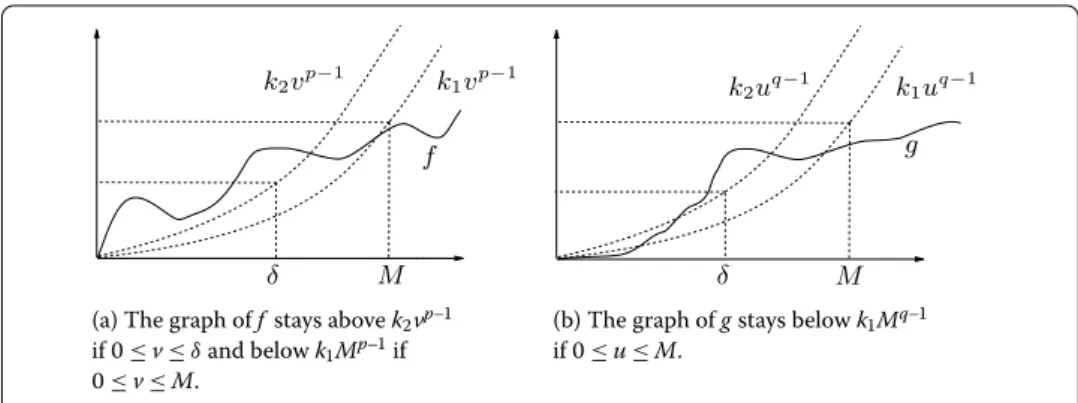
We suppose that the nonlinearityf is superlinear at origin andf,gare allowed to be sub- or superlinear at∞. Moreover, there is no monotonicity hypotheses on these non-linearities. We suppose the existence of positive constants <δ<Msuch that
(H) ≤f(v)≤kMp–,≤g(u)≤kMq–if≤u,v≤M,
(H) f(v)≥kvp–if≤v≤δ,
(a) The graph offstays abovekvp–
if ≤v≤δand belowkMp–if
≤v≤M.
(b) The graph ofgstays belowkMq–
if ≤u≤M.
Figure 1 The nonlinearitiesfandgsatisfy (H1) and (H2).
where the constantskandkdepend only onω,ρand(see Figure ). These constants
will be defined later on in this paper and, as proved in [],k<λp<k, whereλpis the first eigenvalue of thep-Laplacian operator.
Elliptic problems concerning the existence of positive solutions for equations and sys-tems of equations related to Dirichlet problems have been studied in several papers during the last decades. In this way, many existence results for systems involving thep-Laplacian operator in general bounded domains inRN have been considered in recent articles. In particular, systems as (P) have been studied in articles in [–] for example.
The main interest of this paper is studying systems whose nonlinearities present some kind of coupling as (P). A paper which deals with this sort of problem is [], where problem (P) is considered under the assumptionsp=q= ,ω=ρ≡. In this paper, among other hypotheses, the nonlinearitiesf andgare supposed to be at least continuous ifN= and locally Holder continuous with exponentβ∈(; ] ifN≥. Moreover, both are supposed to be nondecreasing in [,∞), nonnegative at origin and satisfying (forp= ) the funda-mental condition
lim x→+∞
f(Mg(x)p–)
xp– = for everyM> . ()
Schauder’s fixed point theorem, the Leray-Schauder degree and a variant of Krasnoselskii’s method are applied to guarantee the existence of a positive solution for (P).
The studies of [] were extended by Hai and Shivaji in [] (forp=q> ), [] (forp=q= ) and by Hai in [] (forp,q> ). In these papers, the authors deal with problem (P),ω≡λ
andρ≡μ(in [] and [],λ=μ), with no sign conditions on f() org() and without monotonicity conditions onf org. In this way, semipositone cases were also considered in these papers (for more details about semipositone problems, see [] and the references therein).
In [], the nonlinearitiesf andgin (P) are supposed to beC, monotone and satisfying
the following conditions at∞
lim
x→+∞f(x) =x→lim+∞g(x) =∞ ()
in addition to condition (). The existence of a positive solution is guaranteed for largeλ
The paper [] deals with problem (P) in the particular casep= and a positive solution is guaranteed by applying the sub- and supersolution method and Schauder’s fixed point theorem. The nonlinearitiesf,g: [;∞)→Rconsidered are continuous and there exist positive numbersL,K such thatf(x)≥Landg(x)≥Lforx≥K. Moreover, the authors considered, as it has been done in [], condition () withp= .
In [], the author obtains necessary and sufficient conditions for the existence of pos-itive solutions for problem (P). The nonlinearitiesf andg are positive, continuous and nondecreasing in [, +∞), withgstrictly positive forx> , and
fp–
cgq–(x)
()
sublinear at and∞. In this paper, the maximum principle and fixed point arguments are applied to guarantee the existence of a solution.
Another paper dealing with the existence of a positive solution for a class of coupled systems is []. In this paper, the authors studied problem (P), withw(x) =λa(x) andρ(x) =
λb(x), in whichλis a positive parameter. The existence of a solution is guaranteed via the method of sub- and supersolution if, among other assumptions, the functionsaand bconsidered areCsign-changing functions that may be negative near the boundary and
the positive nonlinearitiesf andgare supposed to beCand nondecreasing.
Recently, many articles have applied fixed point results to prove the existence of posi-tive solutions of partial differential equations or systems (see, for example, [, –]). In this paper we study problem (P) in general domains, assuming that (H) and (H) hold. As system (P) has no variational structure, our main arguments are based on fixed-point index and comparison theorems, following the ideas of [, ] and []. In particular, our assumptions on the nonlinearities do not involve monotonicity hypotheses or sublinearity conditions at∞.
Our strategy is as follows. At first, we show an existence result for the radial case when
=B:={x∈RN:|x|= }, applying a fixed point theorem in a cone. Afterwards, we utilize
this result to prove our main existence result for (P), when⊂RN is a bounded smooth domain. In this case, we do a symmetrization ofweighfunctions and combine comparison theorems with a new application of the fixed point theorem.
For completeness, we will consider concrete examples of coupled systems for which it is possible to apply our method to guarantee the existence of at least one positive solution. It will be clear in some of these examples that conditions (), () and () are not required in our method.
2 The radial case
Let us consider the radial version of problem (P)
⎧
⎪ ⎨
⎪ ⎩
–pu=w(x)f(v) inB,
–qv=ρ(x)g(u) inB,
(u,v) = (, ) on∂B,
(Pr)
whereB={x∈RN :|x|< }and the weight functionsw,ρ:B→Rare radial,
Letψp′(t) =t
p–(the inverse of the well-known functionψp(t) =|t|p–t), and let us define
ζp(r) =
r
ψp′
r
s
θ N–
w(s)ds
dθ. ()
Considerξ> the real number such that
ζp(ξ) = max
≤r≤ζp(r). ()
Moreover, define the positive constantskandkby
k=min
ψp′
θ
s
θ N–
w(s)ds
dθ –p , ψq′
θ
s
θ N–
ρ(s)ds
dθ
–q
()
and
k=
ξ ψp′
ξ s θ N–
w(s)ds
dθ –p
. ()
It is easy to see that <k<k. In fact,
ψp′
θ
s
θ N–
w(s)ds
dθ >
ξ ψp′
ξ
s
θ N–
w(s)ds
dθ
>
ξ ψp′
ξ s θ N–
w(s)ds
dθ.
Remark IfB⊂RN (N> ) is the unitary ball andρ(x) =w(x) = are the weight
func-tions in problem (P), it is easy to see thatkandkare given by
k:=minNp′p–,Nq′q– ()
and
k:=
NN(ep′)p– ifN=p,
NN(p′)p–(N p)
N
(p–N)(–p) ifN=p, ()
in whichp′andq′are the conjugate exponents ofpandq, respectively.
Finally we assume that the nonlinearitiesf andgsatisfy the local conditions. (H) ≤f(v)≤kMp–,≤g(u)≤kMq–if <u,v≤Mfor someM> .
(H) f(v)≥kvp–if <v≤δfor some <δ<M.
Theorem Suppose that f,g: [, +∞)→[, +∞)are positive,continuous nonlinearities satisfying(H)and(H) (with constants kand kdefined in()and()),and let the
ra-dial weight functions w,ρ:B→Rbe continuous,nonnegative and not identically null.
Then problem(Pr)has at least a nontrivial positive solution.Moreover,if(u,v)is a positive
solution for(Pr),then
δ≤(u,v)
∞=max
u∞,v∞≤M.
To prove the last theorem, we will apply a well-known result of the fixed-point index theory, known as a fixed point cone theorem (see, for example, []).
Lemma Let E be a Banach space and · be its norm.Let K be a cone in E.For R> , define KR={x∈K:x ≤R}and denote its boundary by∂KR,that is,∂KR={x∈K:x= R}.Suppose that
T:KR→K
is completely continuous.
(i) If there existsx∈K–{}such that
x–Tx=tx for allx∈∂KRandt≥,
then
i(T,KR,K) = .
(ii) IfTx ≤ xforx∈∂KRandTx=xforx∈∂KR,then
i(T,KR,K) = .
In what follows, we will considerX:=C[, ]×C[, ] with the norm
(u,v)
∞=max
u∞,v∞
and the coneK={(u,v)∈X:u,v≥} ⊂X.
Proof of Theorem It is easy to see that (u,v) is a solution of (Pr) if and only if (u,v) is a
fixed point ofT:K→Kgiven by
T(u,v) =
T(u,v),T(u,v)
, ()
where
Tu(r),v(r)=
r
ψp′ θ
s
θ N–
w(s)f
v(s)
ds
and
Tu(r),v(r)=
r
ψq′ θ
s
θ N–
ρ(s)g
u(s)
ds
dθ.
Moreover, it is straightforward that the operatorT is completely continuous. If (u,v)∈Kis such that(u,v)∞=M, we have
T(u,v)
∞≤M=
(u,v)
∞.
In fact, by (H) we obtain
T(u,v)
∞≤k
p–
M
ψp′
θ
s
θ N–
w(s)ds
dθ=M
and
T(u,v)
∞≤k
q–
M
ψp′
θ
s
θ N–
ρ(s)ds
dθ=M.
As a consequence of Lemma , it follows that
i(T,KM,K) = .
Now, we will prove thati(T,Kδ,K) = . In order to prove that, we will show that exists
(u,v)∈Kδsuch that
(u,v) –T(u,v)=t(u,v) for all (u,v)∈∂Kδ andt> .
Let∈C[, ], ≤≤, be defined by
(r) =
ifr∈[,ξ], ifr∈[ξ, ],
and let
u(r),v(r)
=
(r),(r)
.
We claim that
(u,v) –T(u,v)=t
(r),(r)
for all (u,v)∈∂Kδandt> .
In fact, let us suppose that there are (u∗,v∗)∈K
δandt≥ such that
u∗,v∗–Tu∗,v∗=t
(r),(r)
. ()
SinceT(u∗,v∗)∈K, we obtain
u∗(r)≥t
(r),
v∗(r)≥t
Lett∗∈Rbe such that
t∗=sup
t:u∗(r)≥t(r) andv∗(r)≥t(r) for allr∈[, ]
. ()
(Note that it is immediate thatt∗<∞. In fact, ift∗=∞and if(r)= , we haveu∗(r) =∞,
which contradictsu∗∈K δ.)
As(u∗,u∗)
∞=δ, we have ≤v∗(r)≤δfor allr∈[, ]. Ifr∈[,ξ], by () and (H)
we obtain
u∗(r) =
r
ψp′ θ
s
θ N–
w(s)f
v∗(s)
ds
dθ+t(r)
≥k p– r
ψp′ θ
s
θ N–
w(s)
v∗(s)p–
ds
dθ+t(r)
≥k
p–
t∗
r
ψp′ θ
s
θ N–
w(s) (s)p–
ds
dθ+t(r)
≥k p– t ∗ ξ ψp′
ξ
s
θ N–
w(s) (s)p–
ds
dθ+t(r)
≥k p– t ∗ ξ ψp′
ξ s θ N–
w(s) (s)p–
ds
dθ+t(r)
=k
p–
t∗
ξ ψp′
ξ s θ N–
w(s)ds
dθ+t(r)
≥t∗+t(r)
≥
t∗+t(r).
Since(r) = forr∈[ξ, ], it follows that
u∗(r)≥
t∗+t(r) for allr∈[, ],
which contradicts (). Then
i(T,Kδ,K) =
and, consequently,
i(T,KM\Kδ,K) =i(T,KM,K) –i(T,Kδ,K) = .
Thus,Thas a nontrivial fixed point inKM\Kδ. The regularity of the solution follows from
classical results of Lieberman and Tolksdorf (see [] and []).
3 The general case
3.1 The constantsk1andk2in
For the general problem
⎧
⎪ ⎨
⎪ ⎩
–pu=w(x)f(v) in, –qv=ρ(x)g(u) in, (u,v) = (, ) on∂,
(P)
we defineT:K→Kby
T(u,v) =
T(u,v),T(u,v)= (z,z),
where
⎧
⎪ ⎨
⎪ ⎩
–pz=w(x)f(v) in,
–qz=ρ(x)g(u) in,
(z,z) = (, ) on∂.
()
It is well known inp-Laplacian operator theory thatTis completely continuous. Moreover, a simple maximum principle argument guarantees thatzi> infori= , .
As it has been done in the radial case, in order to obtain a result of existence for (P), we will apply Lemma .
Let us denote byφs,h∈C,α() the solution of
–su=h(x) in, u= on∂,
whereh∈Ls′() ands′is such that
s+
s′ = . Asρandwsatisfy the same hypotheses as
h, we can define
k=minφp,w∞–p,φq,ρ–∞q
. ()
Fixx∈such thatw(x)= , let R> be such thatB(x,R)⊂and
w∗(s) =
min{w(y) :|y–x|=s} if <s≤R,
w(x) ifs= .
()
Furthermore, let us definekby
k=
R
ξ ψp′
ξ
s r
N–
w∗(s)ds
dθ –p
()
(whereξis defined similarly as it has been done in () and ()).
3.2 Main theorem
Theorem Suppose that f,g: [, +∞)→[, +∞)are positive,continuous nonlinearities satisfying(H)and(H) (with constants k and k defined in()and(),respectively),
null.Then problem(P)has at least a nontrivial positive solution.Moreover,if(u,v)is a positive solution for(P),then
δ≤(u,v)
∞=max
u∞,v∞
≤M.
Proof Let (u,v)∈Kbe such that(u,v)∞=M. It follows from (H) and () that
–pz=w(x)f(v)≤w(x)kMp–= –p
k
p–
Mφp,w
in
and
z= =k
p–
Mφp,w in∂.
Therefore, by the maximum principle, we conclude that
z≤k
p–
Mφp,w≤k
p–
Mφp,w∞≤M
and, consequently,
z∞≤M.
In the same way, we obtain
z∞≤M,
and, as a consequence of the last two inequalities, we have
T(u,v)
∞≤M=
(u,v)
∞.
It follows from Lemma that
i(T,KM,K) = .
We claim thati(T,Kδ,K) = . To prove our claim, we will show, as it has been done in
the radial case, that there exists (u,v)∈Kδsuch that
(u,v) –T(u,v)=t(u,v) for all (u,v)∈∂Kδ andt> .
For fixedx∈, let∈C() be such that(x)∈[, ] and
(x) =
|x–x|=
if ≤ |x–x| ≤ξ,
ifξ≤ |x–x| ≤R.
Consider
u(r),v(r)
=
(r),(r)
,
We claim that
(u,v) –T(u,v)=t(,) for all (u,v)∈∂Kδandt> .
In fact, suppose that there exist (u∗,v∗)∈K
δ andt≥ such that
u∗,v∗
–
z∗
,z∗
=t(,), ()
where (z∗
,z∗) =T(u∗,v∗).
SinceT(u∗,v∗)∈K, it follows that
u∗(x)≥t
(x),
v∗(x)≥t
(x).
Letz∗
Rbe the solution of
–pz∗R=w∗(r)f∗(r) inB(x,R),
z∗
R= on∂B(x,R),
where
f∗(s) =
min{f(v∗(y)) :|y–x
|=s} if <s≤R,
f(v∗(x
)) ifs= .
()
Then
z∗
R(x) =z∗R
|x|=
R
|x–x| ψp′
θ
s
θ N–
w∗(s)f∗(s)ds
dθ.
Note that givenx∈B(x,R), we obtain
–pz∗R(|x|) =w∗(s)f∗(s)≤w(x)f(v∗(x)) = –pz∗ inB(x,R),
z∗
R= <z∗ on∂B(x,R),
and by the maximum principle, we have
z∗R≤z∗ for everyx∈B(x,R).
Thus, by () we obtain
u∗(x) =z∗(x) +t(x)≥z∗R(x) +t(x) for allx∈B(x,R).
Moreover, ifx∈B(x,ξ)⊂B(x,R), we have
u∗(x)≥
R
|x–x|
ψp′ θ
s
θ N–
w∗(s)f∗(s)ds
dθ+t(r)
≥
R
ξ ψp′
ξ
s
θ N–
w∗(s)f∗(s)ds
Ass∈[,ξ], we conclude from () that there isy∈B(x,ξ/) such that
f∗(s) =f
v∗(y)
.
Noting thatf(v∗(y))≥k
(v∗)p–(y) and considering
t∗:=sup
t:u∗(x)≥t(x) andv∗(x)≥t(x) for allx∈
, ()
we have
u∗(x)≥
R
ξ ψp′
ξ
s
θ N–
w∗(s)f∗(s)ds
dθ+t(x)
=
R
ξ ψp′
ξ
s
θ N–
w∗(s)f
v∗(y)
ds
dθ+t(x)
≥
R
ξ ψp′
ξ
s
θ N–
w∗(s)k
v∗p–(y)ds
dθ+t(x)
≥k
p–
t
∗ R ξ
ψp′
ξ
s
θ N–
w∗(s)p–(y)ds
dθ+t(x)
=k
p–
t
∗ R ξ
ψp′
ξ
s
θ N–
w∗(s)ds
dθ+t(x)
by the fact that(y) = ify∈B(x,ξ/). Repeating the same ideas of the radial case, we
conclude that
u∗(x)≥
t+t∗(x),
which contradicts (). By the additivity of index, it follows that
i(T,KM\Kδ,K) =
proving the theorem. As in the radial case, the regularity follows from [] and []. Remark Due to the hypotheses on the nonlinearities and on the weight functions, sim-ple applications of the maximum princisim-ple allow us to guarantee that if (u,v) is a solution of problem (P), then bothuandvare strictly positive in.
4 Examples
Example Let us consider the problem
⎧
⎪ ⎨
⎪ ⎩
–pu=αvβ in, –qv=γuμ in, (u,v) = (, ) on∂,
()
Considering constants () and (), it is enough to consider <δ<Msuch that
M≥max α k
(p–)– β
, γ k
(q–)– μ
()
and
<δ≤ α
k (p–)– β
. ()
Sincek<k, we haveδ<M.
ChoosingδandMas above, hypotheses (H) and (H) are verified and, as a consequence of Theorem , we guarantee the existence of a positive solution for coupled system (). Furthermore, according to Theorem , it is easy to see that if (u,v) is the considered pos-itive solution, we have(u,v)∞as large asαis.
One of the advantages of our method is that conditions (), () and () are not required. Let us see examples of these situations.
Consider the problem
⎧
⎪ ⎨
⎪ ⎩
–pu=f(v) in,
–qv=γuμ in, (u,v) = (, ) on∂,
()
whereγ,μ> ,⊂RN(N> ) is a smooth domain andf
is a nonlinearity satisfying (H)
and (H). Examples offwill be presented in the following examples.
Example Consider the nonlinearityfin problem () given by
f(v) :=
αvβ if ≤v≤M,
α(vk–Mk+Mβ) ifv>M, ()
whereα> ,k> andMis the positive constant whose existence is guaranteed in Exam-ple . Ifp– >β andq– >μ, the same arguments as those applied in Example can guarantee the existence of a positive solution to ().
It is clear that according to the constantk, condition () is not satisfied by the nonlin-earities of problem (). In fact, ifp=qandk>(p–)μ, simple calculations show that
lim x→+∞
f(Mg(x)p–)
xp– =αM
kγpk– lim
x→+∞u
μk–(p–)
p– = +∞
and condition () does not hold.
Example Now, let us considerfgiven by () as the nonlinearity of problem (). In
this case, we have
lim x→+∞
(f(cg(x)q–))p–
xp– =
αckγqk–p– lim
x→+∞u
In this way, (f(cg(x)q– ))p–can be either sub- or superlinear at +∞according to the
con-stantk. Therefore, we have an example in which we guarantee the existence of a positive solution even if condition () is not satisfied.
Example Finally, let us consider problem (), with the nonlinearityfgiven by
f(v) :=
αvβ if ≤v≤M, αMβ ifv>M
in whichMis the positive constant whose existence is guaranteed in Example ,p– >β
andq– >μ. As a consequence of previous examples, it is straightforward to guarantee the existence of a positive solution to this problem. Furthermore, it is clear that condition () does not hold.
Competing interests
The authors declare that they have no competing interests.
Authors’ contributions
All authors contributed equally to the manuscript and read and approved the final manuscript.
Acknowledgements
The authors thank for the support of FAPEMIG and Universidade Federal de Ouro Preto.
Received: 21 May 2013 Accepted: 20 November 2013 Published:20 Jan 2014
References
1. Bueno, H, Ercole, G, Zumpano, A: Positive solutions for thep-Laplacian and bounds for its first eigenvalue. Adv. Nonlinear Stud.9, 313-338 (2009)
2. Dalmasso, R: Existence and uniqueness of positive solutions for some quasilinear elliptic systems. Nonlinear Anal.39, 559-568 (2000)
3. Hai, DD: Existence and uniqueness of solutions for quasilinear elliptic systems. Proc. Am. Math. Soc.133(1), 223-228 (2004)
4. Hai, DD, Shivaji, R: An existence result on positive solutions for a class ofp-Laplacian systems. Nonlinear Anal.56, 1007-1010 (2004)
5. Hai, DD, Shivaji, R: An existence result on positive solutions for a class of semilinear elliptic systems. Proc. R. Soc. Edinb. A134, 137-141 (2004)
6. Rasouli, SH, Halimi, Z, Mashhadban, Z: A remark on the existence of positive weak solution for a class of (p-q)-Laplacian nonlinear system with sign-changing weight. Nonlinear Anal.73, 385-389 (2010)
7. Castro, A, Maya, C, Shivaji, R: Nonlinear eigenvalue problems with semipositone structure. Electron. J. Differ. Equ.5, 33-49 (2000)
8. Bueno, H, Ercole, G, Ferreira, W, Zumpano, A: Existence and multiplicity of positive solutions for thep-Laplacian with nonlocal coefficient. J. Math. Anal. Appl.343, 151-158 (2008)
9. Hai, DD, Wang, H: Nontrivial solutions forp-Laplacian systems. J. Math. Anal. Appl.330, 186-194 (2007) 10. O’Regan, D, Wang, H: Positive radial solutions forp-Laplacian systems. Aequ. Math.75, 43-50 (2008) 11. Wang, H: An existence theorem for quasilinear systems. Proc. Edinb. Math. Soc.49, 505-511 (2006)
12. Wang, H: Existence and nonexistence of positive radial solutions for quasilinear systems. Discrete Contin. Dyn. Syst. 2009, suppl., 810-817 (2009)
13. Deimling, K: Nonlinear Functional Analysis. Springer, Berlin (1985)
14. Lieberman, GM: Boundary regularity for solutions of degenerate elliptic equations. Nonlinear Anal.12, 1203-1219 (1988)
15. Tolksdorf, P: Regularity for a more general class of quasilinear elliptic equations. J. Differ. Equ.51, 126-150 (1984)
10.1186/1687-2770-2014-21