ISSN 1517-7076 artigo 11560, pp.325-344, 2014
Corresponding Author: Ji-Huan He. Received on: 07/08/2014 Accepted on: 24/11/2014
Mini-review on Bubbfil spinning process
for mass-production of nanofibers
Rou-Xi CHEN1,2, Ya LI 1,2 Ji-Huan HE 1,2
1
Nantong Textile Institute, Soochow University, Nantong, China
2
National Engineering Laboratory for Modern Silk, College of Textile and Clothing Engineering, Soochow University,199
Ren-Ai Road, Suzhou, China e-mail: [email protected]
ABSTRACT
Bubbfil spinning is to use polymers’ or melts’ bubbles or membranes for fabrication of nanomaterials including smooth nanofibers and discontinuous nanofibers by using electrostatic force, blowing air or mechanical force to overcome the surface tension, it mainly includes the bubble-electrospinning, blown bubble spinning and membrane spinning. The initial ejecting velocity of the Bubbfil spinning process is as high as 100 meters per second. A history of the development of Bubbfil spinning is briefly elucidated, its main properties are emphasized, some effective modifications are discussed for different applications including single bubble electrospinning, blown bubble spinning, air-jet assisted bubble electrospinning, electrostatic-field-assisted blown bubble spinning, and vibration bubble electrospinning which is suitable for melts or high-concentration solutions. Morphology properties are also discussed for different applications.
Keywords: Bubble electrospinning, modifications, development, properties.
1. INTRODUCTION
With nanometer era's advent, nanotechnology will deeply affect both human's life and modern science, and it is of indispensable importance for the scientific and economical revival. Generally, nanomaterials can remarkably enhance the mechanical properties, remarkably improve surface energy and surface reactivity, and have excellent thermal and electric conductivity, independent of their bulk materials. Because of ultra improvement of the high specific surface, nanoporous materials are potentially of great technological interest for the development of electronic, catalytic and hydrogen-storage systems, invisibility device (e.g. stealth plane), photonic structures, sensors, medicine, pharmacy and drug deliver, adsorption, separation, filtering, catalysis, fluid storage and transport, electrode materials or as reactors. Far-reaching implications are emerging for applications including radiation protection, medical implants, cell supports, materials that can be used as instructive three-dimensional environments for tissue regeneration and others [1]. But the nano-industrialization is still under development, in this review article, we give a detailed introduction to a new technology for mass-production of nanofiber, which is termed as Bubbfil spinning process [2] where polymer/melts bubbles/membranes are used for fabrication of nanofibers using electrostatic force, flowing air or mechanical force (e.g. centrifugal force) to overcome the surface tension of bubbles, including the bubble-electrospinning [3-10], blown bubble spinning [11,12], membrane spinning [13,14] and others. Before introduction to the new technology, we begin with electrospinning [15-19], which is the simplest way to producing ultrafine fibers with diameters ranging from 10mdown to 10nm by forcing a viscous polymer solution or melt through a spinnerette with an electric field. When the electric force overcomes its surface tension of the Taylor cone, a charged jet is formed.
326
/ B
Ae
(1)
where
is the surface tension,
is the viscosity, A and B are constants. According to Mark-Houwink formulation [21, 22], a higher molecular weight of a solution yields a higher viscosity:w
M
(2)
Where
M
w is the molecular weight,
is the scaling exponent, the value of
lies between 1/3 and 1. Eqs.(1) and (2) imply that higher viscosity or higher molecular weight results in higher surface tension of the Taylor cone, as a result, a higher electrostatic force is needed. When the molecular weight/viscosity increases to a threshold, the polymer solution becomes coagulated, and cannot be used for fabrication of ultrafine fibers by the classical electrospinning [23]. There are other disadvantages for the electrospinning, e.g., low production ratio, in controllability of the spinning process. To overcome these problems, few technologies were appeared [1], among which the bubble-electrospinning [3-9] has been caught much attention, and it has been developed into a matured technology termed as Bubbfil spinning process [2], which is a potential candidate for mass production of various nanomaterials, including smooth nanofibers, nanoparticles, thin films, nanoporous materials and crimped nanofibers [24].2. BUBBLE ELECTROSPINNING
Bubble-electrospinning [3-10], the initial stage of Bubbfil spinning process [2], was first invented in 2007 by Ji-Huan He and his collogues (CHN Patent No. ZLGL2007030001), which has an intrinsic property that uses an electrostatic force to overcome the surface tension of a polymer bubble instead of that of a Taylor cone in classic electrospinning, however, it is very difficult to control the bubble number on the solution surface [25]. To overcome the shortcoming Ji-Huan He and his collogues patented a single bubble electrospinning system (CHN Patent No. 200710036447.4), where only one single bubble is produced [26], such experimental is suitable for scientific analysis but not for industrial applications. It is, therefore, very much urgent to design a suitable bubble electrospinning system that can be used for both scientific analysis and mass-production of micro/nano fibers.
2.1 Young-Laplace Equation
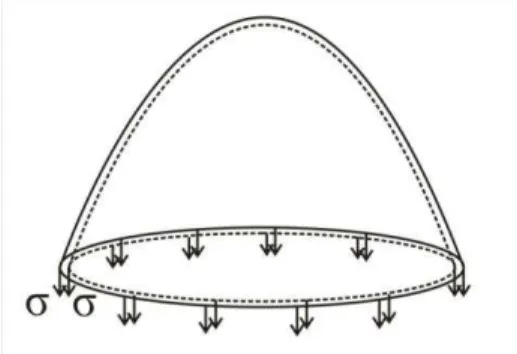
It is interesting to be noted that the surface tension of a bubble does not depend upon solution properties but its size and temperature. Consider a bubble (see Fig.1) made by a polymer solution, and assume that the air pressures inside and outside the bubble are respectively P andi P , its radius is r. o
Figure 1: Surface tension of a bubble
327 2
0
2 2
r r (PiP) (3)The surface tension of a bubble can be expressed in the form
0 1
( )
4r Pi P
(4)
This is the well-known Young-Laplace equation, Liu et al. suggested a modification [8]. Eq. (4) means the surface tension of a bubble geometrically depends upon its size. For a nano bubble, it requires a very small force to overcome the surface tension of a polymer bubble for fabrication of nanofibers. So far, we produced nanofibers with diameter of about 5 nm [27].
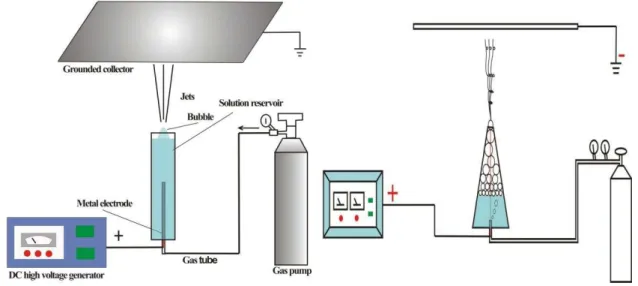
Figure 2 gives a bubble electrospinning set up. Bubbles are produced by a controllable syringe pump, and number of bubbles depends upon the size of tube. The number of bubbles reduces with decrease of the diameter of the tube, when the tube reduces to a threshold value, only a single bubble is formed [26]. A single bubble is suitable for study of the effect of various spinning parameters, such as bubble size, applied voltage, on production quality. These controlling parameters can be used during mass-production of micro/nano fibers by increasing the tube size, the tube can be also an irregular form, it can be like a pool, a square when applied for industry applications.
The voltage is applied to overcome the surface tensions of bubbles, when the voltage reaches a threshold, multiple jets are ejected from bubbles. A metal receiver above is used for collecting fibers.
Figure 2: Bubble electrospinning setup for tunable bubble size
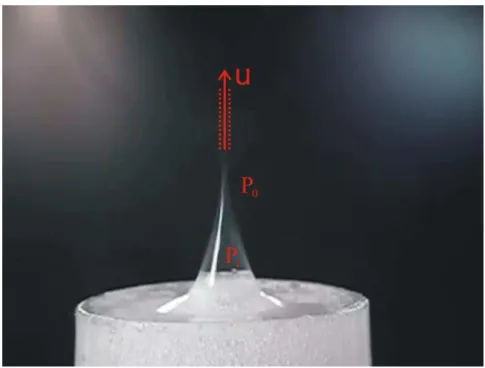
Assume that the velocity of the air inside of the bubble is zero, when the bubble is broken, according to Bernoulli equation, we have
2
0 1 0
2
i
P P
u
r + = r + (5)
328
2 P u
r D
= (6)
By the state equation, P= ark, where a is a constant, k=1.405 for dry air, we have
p k p
r r
D D
= (7)
Assume that the pressure inside of the bubble Pi= 2 atmospheres=202650Pa, and air density r = 1.2041 kg/m3, and Dr r/ = 2%, according to Eq. (7), that means
1.405 202650 0.02 5694.465
p pa
D = ´ ´ = (8)
The velocity of the air jet reaches
2 2 2847
97 / 1.2041
p
u m s
r
D ´
= = = (9)
When a bubble is broken, the initial jet velocity is almost 100m per second. Generally, the receptor distance is about 10cm, so the spinning process is finished within 0.001 seconds. During this short period, the fluid jet is solidified into fibers.
When a bubble is broken, film fragments are ejected with high initial velocity of about 100m/s and high acceleration, which are further attenuated by the electronic force, at the same time, the surface tension of the film leads to its minimal surface, as a result, cylindrical nanofibers can be obtained.
329
2.2 Effect of temperature on a bubble’s surface tension
The surface tension of a bubble can be effectively controlled by the bubble size and temperature [28]. According to state equation for ideal gas, we have
i i i P
RT
(10)
and
o o o P
RT
(11)
where R is the gas constant,
T
i andT
0 are the absolute temperatures inside and outside of the bubble,respectively,
i and
o are densities of the air inside and outside of the bubble, respectively.By a simple derivation, we have
1
( )
4rR Ti i To o
(12)
In case Ti
iTo
o is very small, i.e.,1
i i o o
T
T
, (13)the surface tension of a polymer bubble becomes extremely small, any a small external force can be used to pull the bubble for fiber fabrication. This property is suitable for optimal design of blown bubble spinning [11,12], a kind of Bubbfil spinning [2].
2.3 FIBER MORPHOLOGY PROPERTIES
330
Figure 4: Rupture process of a bubble under an electrostatic field.
331
2.3.1 Smooth cylindrical fibers
Smooth cylindrical fibers are always obtained in Bubbfil spinning process, see Figure 5. The fiber diameter depends mainly on the wall width of the bubble and electronic filed. During the spinning process, the surface of the strip-like jet is minimized by its surface, as a result, a cylindrical fiber is obtained after solidification.
Figure 6: Smooth nanofibers by Bubbfil spinning process
2.3.2 Hierarchical Ruptured Bubbles for Nanofiber Fabrication
When an electric field is present, it induces charges into the bubble surface, these quickly relax to the bubble surface. The coupling of surface charge and the external electric field creates a tangential stress, resulting in the deformation of the bubble. Once the electric field exceeds the critical value needed to overcome the surface tension, the bubble is broken, and smaller daughter bubbles are formed around the broken bubble, see Figure 6, and sub-daughter bubbles are formed when a daughter bubble is broken due to the electronic field, the process continues until some a hierarchical ruptured bubble is pulled upwards to form a charged jet, which is then received on the metal receiver as nanofibers. This event typically occurs within milliseconds, Bird et al. [29] demonstrated, both experimentally and numerically, that the curved film of a ruptured bubble can fold and entrap air as it retracts. The resulting toroidal geometry of the trapped air is unstable, leading to the creation of a ring of smaller bubbles.
332
2.3.3 Nanoscale hollow fibers
When a bubble is broken, the fragments with various forms are formed, and the minimization of surface energy and action of the electronic field result in nanoscale hollow fibers, which have many potential applications in filtration and invisibility device (e.g. stealth plane) and radiation protection.
Figure 8: A nanoscale hollow fibers is formed from a thin film due to surface tension
2.3.4 Superthin films
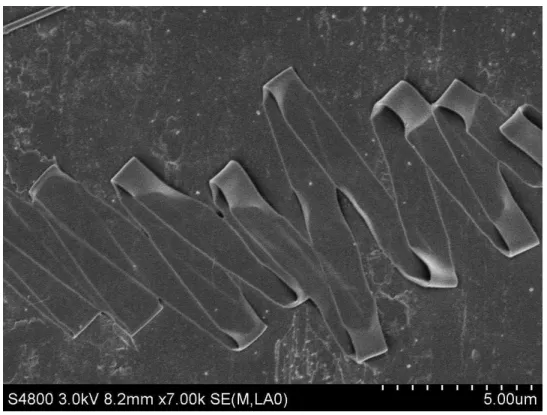
Minimization of the jet surface always results in smooth fibers, however, when the width of a film is too large, the surface tension to minimize the surface area is not large enough to overcome the bending force of the film, as a result, a strip-like fiber, or a superthin film [6, 7] is obtained as illustrated in Fig.9.
333
2.3.5 Nanoporous fibers
Nanoporous fibers are formed when the solvent evaporation is extremely fast during the spinning process, as shown in Fig. 9. The solvent evaporation results in much energy lose of the moving jet, as a result, the moving velocity becomes smaller. According to mass conversation,
uA Q
(14)where u is velocity,
is the liquid density, A is the section area, Q is the flow rate, the diameter of the jet become bigger.Figure 10: Nanoporous fibers with the average diameter of pores of about 50nm.
2.3.6 Beaded fibers
Beaded fibers are obtained due to oscillation of the moving jet. The oscillation of the jet results in change of jet radius during the spinning process, and the wave crests are solidified to beads due to the surface tension of the jet. The theoretical analysis is available in Ref.[30].
334
2.3.7 Crimped nanofibers
Transverse vibration of a moving fiber will result in crimped nanofibers, the process is similar to the stuffer box crimping for fabrication of crimped fibers [24]. Crimped fibers, especially crimped nanofibers, have many potential applications in air filtration, water filtration, radiation protection, fuel cell, and many others due to high surface-to-volume ratio. The mechanism of fiber crimp is due to the transverse vibration of an axially moving slender fiber of viscoelastic fluid before solidification.
The velocity of the axially moving slender fiber plays a key role in mass-production of crimped fibers. A higher velocity is much needed for a higher production ratio, however an increase of u might result in no transverse vibration, as a result, no crimped fibers can be produced. Therefore, it is necessary to pick out the main factors affecting the critical velocity of the axially moving slender fiber, a complete theoretical analysis is available in Ref. [24].
Figure 12: Crimped fibers by bubble-electrospinning by Bubbfil spinning
2.3.8 Orientation nanofibers
335
Figure 13: Orientation nanofibers by bubble-electrospinning
2.3.9. Micro Yarn
Recent years, much attention has been paid to approaches for directly producing nanofibers along with a rising trend for their exploration and application in wide fields. Considering the melt blowing and bubble-electrospinning, a novel method called blown bubble spinning was introduced by forcing airflow onto the polymer bubble. Other morphologies by Bubbfil spinning method are summarized in Tab.1[1].
Figure 14: SEM of a micro yarn by the blown bubble-spinning [11]
Table 1: Morphologies of the various obtained materials by the bubble electrospinning
CONDITIONS (a is width , h is thickness
of the film of the bubble) MORPHOLOGIES
10.6
a
h
Irregular particles10.6
a
h
Spheres with diameter of 6h10.6
h
a
4
h
Irregular structure between sphere and fiber, spindle-like, diamond-like and ellipsoid structure.h
a
4
Cylindrical fibers with diameter of 4h4
a
h
anda
h
Stable stripsa
h
Discontinuous backbone-like wrinkled materials4
a
h
Daughter bubbles3. BUBBFIL SPINNING PROCESS
336
3.1 Blown bubble spinning
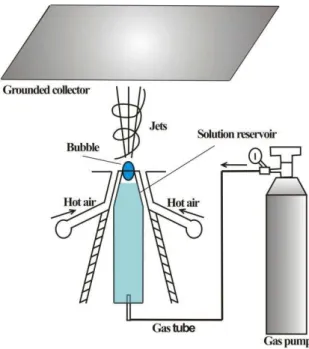
Blown bubble spinning is to use blowing air to overcome the surface tension of a polymer bubble without electronic force [1,6,11], which is used commercially as a one-step process for converting polymer resin directly into a nonwoven mat of fibers or yarns. In the process, a very high velocity gas impacts a polymer bubble as illustrated in Figure 15. As a result, the bubble is broken, and the blowing air, the resultant fibers are collected upon a screen as a nonwoven mat or nano/micro-fiber yarn, attenuates multiple jets rapidly.
The blown bubble spinning can be greatly enhanced by adding a small electronic field, the process is called as electrostatic-field-assisted blown bubble spinning, see Figure 16, which can also be used as air-jet assisted bubble electrospinning depending upon the main acting force.
337
Figure 16: Air-jet assisted bubble electrospinning or electrostatic-field-assisted blown bubble spinning
When a small electrostatic field is applied, which does not exceed the threshold for breaking the bubble, the wall thickness of the bubble become much thinner, and a blowing air can be used as an acting force in the spinning process. On the other hand, we can use a small airflow to control the air pressure and temperature outside the bubble. According to Eq. (12), we can adjust the surface tension of a bubble easily.
Figure 17: A polymer bubble in presence of an electrostatic field
3. 2 Ultrasonic-assisted bubble electrospinning
338
Figure 18: Coagulated PEO solution, which can be spun by classic electrospinning
Our observation shows that the viscosity greatly affects the bubble size and bubble number, which are two important factors in bubble electrospinning. Multiple bubbles are formed on the solution surface, and smaller bubbles will be merged into the bigger ones, making the bubble electrospinning relatively difficult. To solve the problem, we found that small tube for the solution container is much suitable for highly viscous solutions. When the diameter of the container tube reduces to 11mm, the spinning process can be well performed. In order to increase output of PEO nanofibers, multiple container tubes should be used.
The spinability of bubble electrospinning for high viscous PEO solution can be enhanced by ultrasonic vibration, see Fig.19. When a ultrasonic vibration is added to the solution, its viscosity reduces greatly, and its spinability increases greatly, additionally when ultrasonic vibration induces oscillation of a bubble, when the frequency of ultrasonic vibration closes to the natural frequency of the bubble, resonance occurs, which explodes the bubble with an extremely ejecting velocity of the fragments. According to the mass conservation for one-dimensional steady flow, see Eq.(14), higher velocity of the spinning jets results in smaller of fibers. According to Ref.[35], the minaret resonance can be expressed as
1 3 2
p
r g w
p r
= (15)
Eq.(15) implies a smaller bubble results a higher minaret resonance. A detailed discussion on effect of ultrasonic vibration on the spinning process is available in Ref.[36].
Figure 19: Ultrasonic-assisted bubble electrospinning
3.3. Bubble size control
339
The new experimental set-up is illustrated in Figure 20. A single bubble is produced on the top of the roller, the size of the bubble is controllable by the whole diameter on the roller’s surface, which is connected with the gas suppler. When the roller rotates, the bubble, under the electronic force, is broken, and multiple jets are formed, which are received on the metal receiver above as nanofibers.
Figure 20: The experimental set-up of the bubble electrospinning.
Another bubble is produced when the adjacent hole reaches its top, so the motor can exactly control the frequency of the bubble formation.
In the spinning process, the motor can exactly control the bubble formation frequency mechanically, and the bubble size depends mainly on the whole size and the pressure and velocity of the input air. The experiment shows that a continuous spinning process is realized with almost same bubble size for nanofiber fabrication.
3.4. Other modifications
340
Figure 21: Gule et al.’s bubble electrospinning set-up
In the bubble electrospinning as illustrated in Figure21, multiple bubbles are produced on the surface the spun solution, where bubbles are interacted with each other, and smaller ones will bulge into a larger bubble, as a result the bubbles grow up larger and larger in the bubble container as illustrated in Figure21, which was used by Gule et al.[37]. According to Eq. (1), it requires a higher voltage for a larger bubble. In our experimental observation, large bubbles are difficult for spinning, and the bubbles will flow over the edges of the container into the ground.
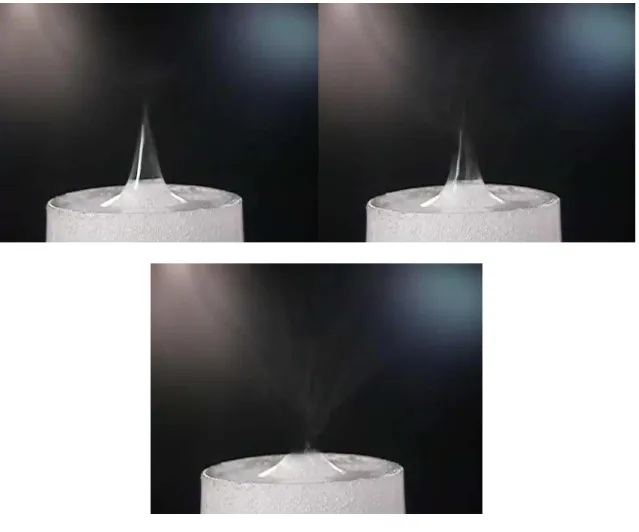
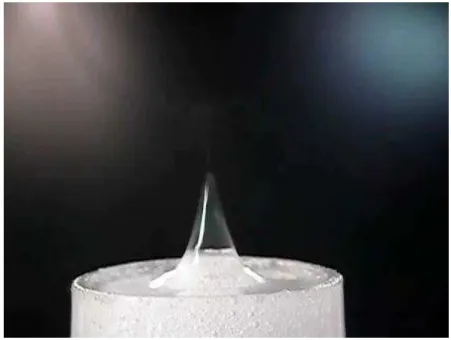
In a multiple bubble electrospinning, the interaction of bubbles results in a higher voltage, and in some case only the daughter bubbles of a ruptured large bubble can be used for producing fibers [1], see Figure 22, photos of the multiple ellectrospinning process, where smog-like multiple jets are produced mainly by daughter bubbles of a ruptured large bubble.
To overcome the problem arising in multiple bubble electrospinning, a single bubble electrospinnin g was proposed [21], and an inverted cup-like bubble container as illustrated in Figure 2 might be more suitable for experimental use.
Multiple bubbles are interacted with each other within the bubble container, and a single bubble is formed on the top of the container if its diameter is small enough. The frequently produced bubble on the top container has almost same size, as a result, morphology of the nanofibers can be easily controlled by adjusting the bubble’s diameter.
Figure 22: Multiple bubble electrospinning. Larger bubbles cannot used for fiber fabrication
341
shows the same spinning process as given in Fig.2.
Figure 23: Pu et al.’s bubble electrospinning set-up
4. SUMMARY
Nanoscience bridges between the deterministic classic mechanics and the in deterministic quantum mechanics [39]. As pointed out by El Naschie [39], nanotechnology for the scientific and economic revival is of indispensable importance. Similar to the nuclear age, and maybe far more so, the nanoage will be something of a Hemingway line of demarcation between the have and the have notes, and Bubbfil spinning provides the best candidate for mass-production of nanofibers. The ejection velocity in the Bubbfil spinning process can be as high as 100 m/s, and the spinning process is finished within 0.001 seconds, the minimal diameter of the obtained fiber is as small as 5 nm. The morphologies by Bubbfil spinning can be controlled by various methods for various applications, especially the nanoprous fibers, crimped nanofibers can be applied in catalytic and hydrogen-storage systems, invisibility device (e.g. stealth plane), and radiation protection.
5. ACKNOWLEDGMENTS
The work is supported by Priority Academic Program Development of Jiangsu Higher Education Institutions (PAPD) , National Natural Science Foundation of China under grant No. 11372205 and Project for Six Kinds of Top Talents in Jiangsu Province under grant No. ZBZZ-035, Science & Technology Pillar Program of Jiangsu Province under grant No. BE2013072, Jiangsu Province Key Laboratory No.KJS1314 and Jiangsu Planned Projects for Postdoctoral Research Funds1401076B.
6. BIBLIOGRAPHY
[1] HE, J.H., KONG, H.Y., YANG, R.R., et al., “Review on fiber morphology obtained by bubble electrospin-ning and blown bubble spinelectrospin-ning”, Therma l Science, v. 16, n.5, pp. 1263-1279, 2012.
[2] HE,J.H., KONG,H.Y., et al.“Variational iteration method for Bratu-like equation arising in electrospin-ning”, Ca rbohydrate polymer, v.105, pp.229-230, 2014
[3] LIU,Y.,HE, J.H., “Bubble electrospinning for mass production of nanofibers”, Int. J. Nonlin. Sci. Num., v.8,n.3, pp. 393-396, 2007
342
[5] LIU,Y., HE, J.H., et al. “The principle of bubble electrospinning and its experimental verification”, J. Polym. Eng.,v. 28, pp. 55-65, 2008.
[6] DOU, H., LIU, H.Y., et al. “A belt-like superfine film fabricated by bubble-electrospinning”, Therma l Sci-ence, v. 17, n. 5, pp. 1508-1510, 2013
[7] KONG, H.Y., HE, J.H., “Superthin combined PVA-graphene film”, Therma l Science, v.16, n.5, 1560-1561, 2012.
[8] LIU,F.J., DOU, H. “A modified Young-Laplace equation for the bubble electrospinning considering the effect of humidity”, Therma l Science, v. 17, n. 5, pp. 629-630, 2013
[9] YANG, R.R., HE, J.H., XU, L., et al.,”Bubble-electrospinning for fabricating nanofibers”, Polymer, v.50,N. 24, pp. 5846–5850 , 2009
[10] CHEN, R.X. “Burst of a fast axially moving micro/nano jet”, Bubbfil Nanotechnology, v. 1, n.1, pp.13-23, 2014
[11] DOU, H., ZUO, B.Q., HE, J.H.,”Blown bubble-spinning for fabrication of superfine fibers”, Therma l Sci-ence,v. 16,n.5, 1465-1466 , 2012.
[12] DOU,H., LIU,H.Y., MO, L.F.,” Blown bubble-spinning and micro yarns”, Bubbfil Nanotechnology, v. 1, n.1, pp. 24-28, 2014
[13] KONG, H.Y., He, J.H., et al., “Polymer liquid membrane for nanofiber fabrication”, Therma l Science, v. 17, n. 5, pp. 1479-1482, 2013
[14] KONG, H.Y., HE,J.H. “A Modified Bubble Electrospinning for Fabrication of Nanofibers”, Journa l of Na no Resea rch, v. 23, pp. 125-128, 2013
[15] XU, L., SI, N., Lee, E.W.M., et al., “ A multi-phase flow model for electrospinning process”, Therma l Science, v. 17, n. 5, pp. 1299-1304, 2013
[16] LI, H.B., KONG,H.Y., et al., “Particle-like beads and daughter jet cascades in electrospinning”, Therma l Science, v. 17, n. 5, pp. 1421-1424, 2013
[17] PANG, J., KONG, H.Y., et al., “PVA-based nanographene film by electrospinning”, Therma l Science, v. 17, n. 5, pp. 1449-1452, 2013
[18] WANG, P., HE, J.H. “Electrospun polyvinyl alcohol-milk nanofibers”, Therma l Science, v. 17, n. 5, pp. 1515-1516, 2013
[19] WANG, P., HE, J.H. “ Electrospun polyvinyl alcohol-honey nanofibers”, Therma l Science, v. 17, n. 5, pp. 1549-1550, 2013
[20] PELOFSKY,H., J. Chem. Eng. Da ta, v.11, pp. 394-397, 1966.
[21] REN, Z.F., LIU, B.Z., SHAO, Z.Y., et al., “Allometric scaling law between average polymer molecular weight and electrospun nanofiber diameter”, Journa l of Polymer Enegineering, v. 28, pp.19-26 , 2008 [22] TATRO,S.R.,BAKER,G.R., et al., “Matrix-assisted laser desorption/ionization(MALDI) mass spectrome-try: determining Mark-Houwink-Sakurada parameters and analyzing the breadth of polymer molecular weight distributions”, Polymer, v.43, pp. 2329-2335, 2002
[23] WAN, Y.Q., HE,J.H., et al., “Electrospinning of high-molecule PEO solution” , Journa l of Applied Poly-mer Science, v. 103, n.6, pp.3840-3843 , 2007
[24] CHEN, R.X., ZHANF,L., et al., “Mechanism of nanofiber crimp”, Therma l Science, v. 17, n. 5, pp. 1473-1477, 2013
[25] HE, J.H., LIU, Y.,”Control of bubble size and bubble number in bubble electrospinning”, Computer and Ma thematics with Applica tions , v.64 , 1033-1035, 2012.
[26] REN, Z.F., HE, J.H.”Single Polymeric Bubble for the Preparation of Multiple Micro/Nano Fibers”, Jour-na l of Applied Polymer Science, v.119, pp. 1161-1165, 2011.
[27] KONG, H.Y., HE,J.H. “Electrospinning for fabrication of nanofibers with minimal diameter of about 5 nm”, Journa l of Controlled Relea se ,v. 172, n. 1, pp. E127-E128, 2013
343
[29] BIRD,J.C., et al. “Daughter bubble cascades produced by folding of ruptured thin films”, Na ture, v. 465, 759, 2010
[30] HE, J. H.; KONG, H. -Y. “Criterion for an oscillatory charged jet during the bubble spinning process” ,
Scientia Iranica, v. 21, n. 1 , pp.98-100, 2014
[31] WAN, Y.Q. , HE,J.H., YU,J.Y.,WU, Y. ,” Vibrorheological effect on electrospun polyacrylonitrile (PAN) nanofibers”, Ma ter. Lett., v.60, pp. 3296-3300, 2006.
[32] WAN,Y.Q., HE, J.H., YU,J.Y., et al.,” Electrospinning of high-molecule PEO solution”, J. Appl. Polym. Sci., v.103,n.6, pp. 3840-3843,2007.
[33] WAN, Y. Q., HE, J.H., YU, J.Y., et al., “Carbon nanotube-reinforced polyacrylonitrile nanofibers by vi-bration-electrospinning”, Polym. Int., v.56, n.11, pp. 1367-1370 ,2007.
[34] WAN,Y.Q., HE,J.H. WU,Y., et al., “Vibrorheological effect on electrospun polyacrylonitrile (PAN) nano-fibers”, Ma ter. Lett., v.60, n.27, pp.3296-3300, 2006.
[35] MINNAERT, M., "On musical air-bubbles and the sound of running water", Philosophica l Ma ga zine, v.16, n.10, pp. 235–248,1933
[36] LIU, H.Y.; KONG, H.-Y.; et. Al., “Lightning-like Charged Jet Cascade in Bubble Electrospinning with Ultrasonic Vibration”, Journa l of Nano Resea rch, v. 27 , pp. 111-119, 2014
[37] GULE, N. P., et al., “Furanone-containing poly(vinyl alcohol) nanofibers for cell-adhesion inhibition”,
Wa ter Resea rch,v. 47, pp. 1049-1059 , 2013.
[38] PU, C., HE, J., CUI, S., GAO, W., Fiber. Polym.,v. 14, p.382, 2013