Engineering
www.abeq.org.br/bjchePrinted in BrazilVol. 34, No. 02, pp. 493 - 505, April - June, 2017 dx.doi.org/10.1590/0104-6632.20170342s20150399
HYDRODYNAMICS OF AN EXTERNAL–LOOP
AIRLIFT REACTOR WITH INSERTED MEMBRANE
P. S. Kojić
1*, S. S. Popović
1, M. S. Tokić
2, I. M. Šijački
1,
N. Lj. Lukić
1, D. Z. Jovičević
1and D. Lj. Petrović
11Department of Chemical Engineering, Faculty of Technology, University of Novi Sad, Bulevar Cara Lazara 1, 21000 Novi Sad, Serbia.
E-mail: [email protected]
2Laboratory of Computational Systems Biotechnology (LCSB), Ecole Polytechnique Federale de Lausane, CH 1015 Lausanne, Switzerland.
(Submitted: June 24, 2015; Revised: November 25, 2015; Accepted: January 15, 2016)
Abstract – The objective of this study was to investigate the hydrodynamics of an external-loop airlift membrane reactor (ELAMR). The ELAMR was operated in two modes: without (mode A) and with bubbles in the downcomer
(mode B), depending on the liquid level in the gas separator. The inluence of the gas distributor’s geometry and
various alcohol solutions on the hydrodynamics of the ELAMR was studied. Results for the gas holdup and the downcomer liquid velocity are commented with respect to an external-loop airlift reactor of the same geometry but without the membrane in the downcomer (ELAR). Due to the presence of the membrane in the downcomer, acting as the local hydrodynamic resistance, the gas holdup in the riser of the ELAMR increases maximally by 16%, while the liquid velocity in the downcomer decreases up to 50%. The values of the gas holdup and liquid velocity predicted by the application of empirical power law correlations and a feed forward back propagation neural network (ANN) are in very good agreement with experimental values.
Keywords: membrane air lift reactor; hydrodynamics; dilute alcohol solution; geometry of distributor; multichannel membrane.
INTRODUCTION
Over the past few decades airlift reactors have been widely used in chemical and biotechnological processes, wastewater treatment and various fermentation systems. The airlift reactors have many advantages, such as the self-generated liquid circulation caused by hydrostatic pressure diferences, simple construction, good heat transfer, good mixing, low costs, absence of moving parts, high capacity, relatively low energy consumption and minimal space requirements. Also, they easily enable luidization of solid particles. There are many variations of these reactors, but the two major groups are: internal loop airlift reactors (ILAR) and external-loop airlift reactors (ELAR).
The progress in waste water treatment, chemical processes and biotechnology industries requires reactors with in situ product removal. In situ separation processes recover desired product or remove harmful components from the reactor. Therefore, airlift reactors were combined with separation processes such as: liquid−liquid extraction (Gianetto et al., 1988; Yuan et al., 2001) and adsorption or ion exchange (Sun et al., 1999). Nowadays, in situ
quality, compact equipment, high volumetric load and less surplus sludge production (Liu et al., 2000). One of the newest types of MBRs is the airlift MBR (Futselaar et al., 2007). This reactor has lower energy consumption, compared to conventional cross-low MBR, because it preferably uses air to control membrane fouling and to recirculate liquid (Futselaar et al., 2007). Namely, the liquid circulation is induced without a circulation pump. Therefore, in the past years diferent types of airlift MBR conigurations have been designed and investigated. Liu et al. (2000) investigated hydrodynamics and its efect on transmembrane pressure in an internal airlift membrane bioreactor. They found that the cross low velocities increase with an increase of the supericial gas velocity. Jajuee et al. (2006) conducted experiments in a 25 dm3 three-phase concentric airlift reactor with a semipermeable membrane. They observed that the mass transfer coeicient was strongly afected by p-xylene, naphthalene and solid loadings. The efect of hydrodynamic conditions and operating modes on the permeate lux in a submerged airlift hollow iber membrane system was studied by Bérubé and Lei (2006). Li et al. (2008) developed an innovative single stage continuously aerated internal-loop membrane airlift bioreactor for simultaneous nitriication and denitriication of synthetic domestic wastewaters. Xu and Yu (2008) investigated the hydrodynamics of a novel multi-airlifting membrane bioreactor, constructed with four sintered stainless steel tubular ilters serving as the risers and downcomers. In several studies the hydrodynamics in a draft tube airlift reactor with and without membrane have been simulated using computational luid dynamics software (CFD) (Moraveji et al., 2012; Prieske et al., 2008). They concluded that the presence of membrane caused an increase in the gas holdup and decreased the driving force for liquid movement. Mihaľ et al. (2013) used a hybrid system consisting of an ILAR and membrane module immersed in the downcomer for in situ 2-phenylethanol removal from the fermentation medium.
In all mentioned airlift MBRs the membranes were submerged in the reactor. The key problem of this set-up is that the reactor requires small bubbles for high gas holdup and good gas-liquid mass transfer, while the membrane requires large bubbles to control membrane fouling (Cui et al., 2003; Futselaar et al., 2007). To overcome these problems, external-loop airlift membrane reactors (ELAMR) have been developed. In the ELAMR the riser acts as the reactor, while the separation takes place in the downcomer with an inserted membrane. One of the irst conigurations of this type of reactor was constructed by Norit for commercial application (Futselaar et al., 2007). Fan et al. (2006) successfully used an H-type recycling pipe external-loop airlift membrane bioreactor to treat and reuse municipal wastewater. Shariati et al. (2010) removed acetaminophen as the main pollutant of pharmaceutical wastewater in a rectangular ELAMR. The removal
eiciency of acetaminophen was signiicantly higher for the ELAMR, in comparison to a conventional activated sludge laboratory system.
The hydrodynamics in an ELAMR has signiicance in the control of membrane fouling and maintenance of the steady operation (Liu et al., 2000). The gas holdup and the downcomer liquid velocity are the most important hydrodynamic parameters (Chisti, 1988). It is well known that gas holdup and downcomer liquid velocity in the ELAR depend on parameters such as supericial gas velocity, ratio of the downcomer to riser cross-sectional area, horizontal connector geometries, hydrodynamic resistance to the liquid low, liquid height in the gas separator, type of gas distributor and physical properties of the liquid phase (Bello et al., 1984; Bentifraouine et al., 1997; Merchuk and Stein, 1981; Rujiruttanakul and Pavasant, 2011). A membrane module inserted in the downcomer represents hydrodynamic resistance to the liquid low. Higher resistance in the ELAR leads to a decrease in the liquid velocity and an increase in the gas holdup (Bendjaballah et al., 1999; Cao et al., 2008; Merchuk and Stein, 1981; Pošarac, 1988; Verlaan et al., 1989; Vial et al., 2002).
The liquid height in the gas separator has an efect on the gas holdup and the downcomer liquid velocity (Al-Masry, 1999). The critical level of the liquid in the gas separator prevents the gas bubbles from entering into the downcomer. If the liquid level is below the critical level, the downcomer drags in gas slugs. This situation is preferable in the ELAMR, because of a bigger shear stress in the multiphase low and minimization of membrane fouling (Bérubé and Lei, 2006; Böhm et al., 2012; Ratkovich et al., 2009).
Al-Masry and Dukkan (1997) and Miyahara and Nagatani (2009) found a marginal efect of alcohol solutions on the liquid velocity.
Gas distributor design has a major efect on the initial bubble size and, hence, on the hydrodynamics of the airlift reactor (Bendjaballah et al., 1999; Cao et al., 2008; Lin et al., 2004; Snape et al., 1995; Vial et al., 2000). Cao et al. (2008) performed the most comprehensive study about the inluence of the gas distributor on the gas holdup and liquid velocity in the ELAR. They observed that the gas distributor had a noticeable efect on the gas holdup up to the supericial gas velocity of 0.25 m/s. At higher gas inputs, the distributor’s inluence was negligible. However, the efect of the gas distributor on the liquid velocity was evident in the range of gas velocities from 0.025 m/s to 0.045 m/s.
In this paper, the hydrodynamics of an ELAMR with a short multichannel ceramic membrane inserted at the bottom of the downcomer was investigated. Such a coniguration enables high hydrostatic head pressure, which decreases the power necessary for permeate removal. Furthermore, by changing the liquid level in the gas separator, the set of experiments were done with gas slug entrainment in the downcomer. This operation mode is useful for preventing membrane fouling. Also, the inluences of the gas distributor’s geometry and the addition of aliphatic alcohols on the riser gas holdup and downcomer liquid velocity of the ELAMR were studied. Also, this reactor has been designed for possible use as a high eiciency equipment for removal of organic and inorganic pollutants from wastewater.
MATERIALS AND METHODS
Experimental setup
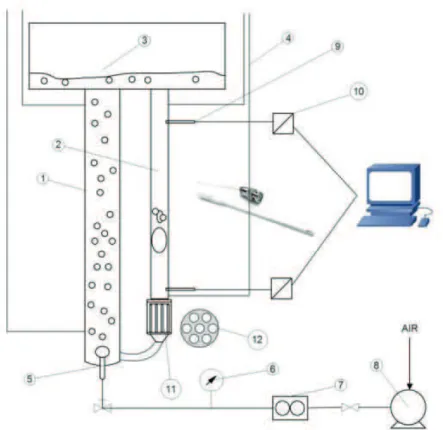
A schematic illustration of the setup is shown in Figure 1. The cylindrical external-loop airlift reactor made of Plexiglas consisted of a riser (54 mm i.d. and 2000 mm in height), downcomer (25 mm i.d. and 1950 mm in height) and rectangular gas separator (400×310×300 mm). The distance between the riser and the downcomer was 100 mm. When the ELAMR was operated without gas bubbles in the downcomer (mode A), the unaerated liquid level in the gas separator was 4 cm. Lowering the liquid level to 3 cm, gas bubbles were dragged into the downcomer (mode B). The air, sparged into the riser, was used as the gas phase. Three diferent gas distributors were tested: single oriice (4 mm i.d.), perforated plate (7 holes of 1 mm i.d., triangular pitch) and sinter plate (100-160 µm, average pore size 115 µm, porosity 8%). Porosity and average pore size of the sinter plate were obtained with a porosimeter (Porosimeter 2000 with Macropore Unit 120). The gas low rates were controlled and measured by an electronic mass low controller (model Bronkhorst High Tech F 201AV). The
supericial gas velocity, based on the riser cross-sectional area, was varied in the range 0.02 to 0.22 m/s for mode A. In mode B, the entrainment of gas bubbles in the downcomer started at UG = 0.15 m/s, so the investigated range of UG was 0.15 to 0.22 m/s. Two eDAQ (Australia) conductivity isoPods with miniature dip-in conductivity electrodes were used to determine downcomer liquid velocity. The tubular ceramic membrane (ZrO2/TiO2, Novasep, France) 20 cm in length and 2.3 cm in diameter, with 7 channels (6 mm i.d.), was installed in the downcomer. The iltration was disabled in the membrane module since our aim was to investigate only the inluence of the membrane acting as additional resistance on the hydrodynamics in the reactor. Also, it was considered that the permeate lux would not afect the hydrodynamics (Böhm et al., 2012).
Gas-liquid systems
Tap water and dilute alcohol solutions (0.046 wt% ethanol, 0.011 wt% n-butanol and 0.0051 wt% n-hexanol) were used as the liquid phase. Added amounts of each alcohol correspond to their critical concentration reported by Keitel (1978). Increasing the alcohol concentration above the upper limiting concentration value, only enhances the liquid phase frothing and bubble coalescence (Camarasa et al., 1999; Freitas and Teixeira, 1998). Surface tensions of liquid phases and the surface tension gradient (dσ/dCA) data were taken from Šijački et al. (2011).
Measurement of hydrodynamic characteristics
Gas holdup
The gas holdup values in the riser (εGR) and the downcomer (εGD) were obtained by measuring the pressures at the bottom and the top of the riser and downcomer using piezometric tubes, and calculated from the equation:
In order to reduce the liquid surface luctuations in the piezometric tubes, capillaries (50 mm in length and 0.7 mm i.d.) were inserted at the entrance of the piezometric tubes. Therefore, the relative average error of these measurements was reduced to max ±2%. This experimental method was adopted from Zahradník et al. (1974). Also, it was visually observed that the gas bubbles did not enter into the piezometric tube due to frothing in the riser and the downcomer.
Liquid velocity in the downcomer
The liquid velocity in the downcomer (WLD) was determined by the tracer response method. Two conductivity probes were placed in the downcomer section at a distance (L) of 1.4 m from each other. A volume of 25 cm3 of 4 M
�
�=
∆�
NaCl, used as a tracer, was instantaneously injected 15 cm above the top electrode. Liquid velocity in the downcomer was calculated from the measured time interval between the tracer peaks from the two conductivity probes and the known vertical distance between them, by the following equation:
The cross low velocity inside the membrane could be calculated using the continuity equations by knowing WLD. Signals were recorded at a frequency of 0.1 s. For each value of a gas low rate two measurements were performed and the average value of WLD was calculated. The relative average error of this method was ±3%.
Friction coeicient
To quantify the hydrodynamic resistance of the membrane itself, it was necessary to calculate the overall friction coeicient (Kf) in both reactors. The Kf was derived according to Verlaan (1987) by plotting the square of the measured supericial liquid velocity as a function of the diference between gas holdups in the riser and the downcomer:
The commercial software pipe low expert was used to calculate Kf(calc). Kf(calc) was estimated according to Garcia-Calvo (1992) and Milivojević (2011) as the sum of speciic ittings in each reactor separately. In the estimation of Kf(calc) the itting that represented the resistance of the membrane was taken as a partially open valve for the ELAMR and as a fully open valve for the ELAR. The assumption was made that the type of distributor and alcohol do not inluence Kf(calc). A good agreement between calculated and experimental Kf values, with maximal relative error of 15%, was achieved.
RESULTS AND DISCUSSION
Hydrodynamic regimes
It is well known that the hydrodynamics of a bubble column (riser of the ELAR) in the gas-liquid co-current operation mode is characterized by diferent low patterns depending on the gas low rate: homogenous (bubble low),
�
��=
�
�
2− �
1�
��2=
2
��
�
�(
�
��− �
��)
�
Figure 1. Experimental setup: 1-riser, 2-downcomer, 3-gas separator, 4-piezometric tubes, 5-gas distributor, 6-manometer, 7-mass low controller, 8-air compressor, 9-conductivity electrode, 10-conductivity isopod, 11-membrane module, 12-membrane.
(2)
transition, heterogeneous (churn-turbulent low) regimes and slug low(Govier, 1972; Hatch, 1975; Wallis, 1969).
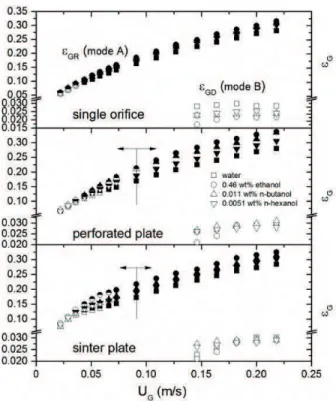
In both reactors, ELAR and ELAMR, for operating mode A the existence of all regimes was conirmed (Figures 2ac and 3a-c). The transition between regimes was identiied by the change of the slope of the gas holdup vs. the gas velocity curves. A more detailed analysis of hydrodynamic regimes and transition supericial gas velocities was described in our earlier study (Kojić et al., 2015). The transition points in the ELAMR appeared at a slightly lower UG compared to the ELAR. This is because the larger hydrodynamic resistance in the ELAMR caused lower WLD that induced more intensive bubble coalescence. Joshi et al. (1990) and Bendjaballah et al. (1999) also noted that the resistance in the ELAR, and thereby WLD, and the geometry of the downcomer inluenced the regime transitions. On the other hand, Vial et al. (2002) reported that the hydrodynamic resistance had a minor inluence on the regime transitions. As can be seen in Figures 2 and 3, added alcohol had a noticeable inluence on the transition between regimes in both ELAR and ELAMR for the sinter plate and perforated plate. But, for a single oriice this transition was the same for all alcohol solutions. The presence of alcohols delayed the heterogeneous regime, due to their coalescence inhibiting nature (Pošarac, 1988; Weiland and Onken, 1981). The efect of the gas distributor type on the regime transition in the ELAR and ELAMR was also observed. When a single oriice was used, the absence of bubble low was noted even at the lowest UG. Both reactors operated instantly in the transition regime, that is in agreement with the observations of Bendjaballah et al. (1999) and Vial et al. (2001). In mode B, at UG ≥ 0.15 m/s, gas slugs started to be dragged into the downcomer. The length of the slugs was ~5 cm in water and ~ 3 cm in alcohol solutions. When the alcohols were added, smaller number of gas slugs were created in the downcomer, in comparison to water. Mode B is signiicant for the mitigation of membrane fouling. Large bubbles or slugs are more beneicial as they have larger wake regions, create stronger secondary lows and are more efective in promoting local mixing than smaller bubbles. Also, for a ixed bubble volume, an increase in bubbling frequency means more falling ilms and bubble wakes per unit time (Cui et al., 2003). According to Ratkovich et al. (2009) gas slugs increase the shear stress across the membrane and prevent membrane fouling.
Gas Holdup
Inluence of the supericial gas velocity on the gas holdup
The inluence of the supericial gas velocity on the riser gas holdup is presented in Figures 2 and 3 for the ELAR and ELAMR, respectively. For all the gas-liquid systems and both reactors (ELAR and ELAMR), the gas holdup increased with an increase in the supericial gas velocity,
and it was higher in the ELAMR than in the ELAR. The increase in εGR was the highest for the single oriice (about 16%), while for the perforated plate and the sinter plate it was lower (about 8%). When the ELAMR was operated in mode B, εGD was up to 0.03, while εGR was unchanged. εGD values were about 10 times lower, compared to εGR (Figure 3).
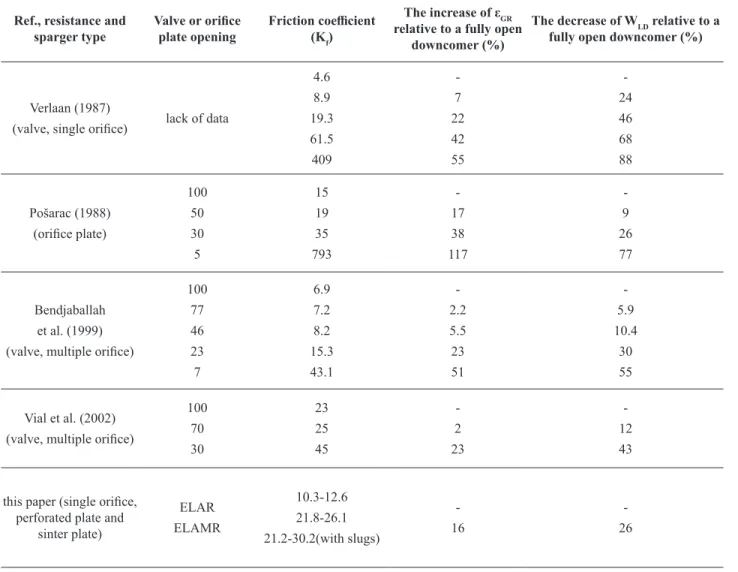
To quantify the inluence of the membrane as the resistance to the low in the ELAMR, the overall friction coeicient was calculated from equation 3 by itting the experimental data. The insertion of the membrane in the downcomer of our ELAR increased the overall friction coeicient by 90% while εGR was slightly increased. Table 1 illustrates that increasing the resistance in the downcomer of the ELAR results in an increase in εGR. This efect is the most pronounced when the cross section of the downcomer is reduced by more than 50%. Furthermore, this contributed to an increase of Kf by more than 100%. Reduced liquid velocity decreased the rise velocity of the bubbles and consequently increased εGR.
Inluence of added alcohol on the gas holdup
The efect of alcohols on the gas holdup in both reactors, without and with membrane, was the same (Figures 2 and 3). The addition of alcohols led to an increase in εGR, in comparison to water for all distributors, but more intensively for the sinter plate (SP) and perforated plate (PP). At UG ≤ 0.05 m/s only slight diferences in εGR were observed, regardless of the geometry of the distributor and type of alcohol. In the bubble low no coalescence was observed, even in the water. However, in the transition and churn-turbulent low εGR was about 22, 17.5, and 10% higher for ethanol, n-butanol and n-hexanol solutions, respectively for SP and PP, in comparison to water. At high gas velocities, corresponding to the transition and heterogeneous low, coalescence was much stronger with frequent bubble collisions. The inertial forces dominated over the surface forces and the efect of coalescence inhibition due to added alcohol was more pronounced. The efect of added alcohol on εGR for the single oriice (SO) (Figures 2 and 3) was lower than for the PP and the SP, so in the transition and the churn-turbulent regime alcohol solutions had only about a 7% higher εGR compared to water. The SO produced large bubbles and the gas-liquid system was instantly in the transition regime; therefore, it was diicult for alcohols to form monolayer around the bubbles and prevent coalescence. When the ELAMR was operated in mode B, added alcohols slightly decreased εGD, compared to water.
Inluence of distributor type on the gas holdup
Table 1. List of the inluence of hydrodynamic resistance on the riser gas holdup and downcomer liquid velocity in the external-loop
airlift reactors.
Ref., resistance and sparger type
Valve or oriice plate opening
Friction coeicient (Kf)
The increase of εGR relative to a fully open
downcomer (%)
The decrease of WLD relative to a fully open downcomer (%)
Verlaan (1987)
(valve, single oriice) lack of data
4.6 8.9 19.3 61.5 409 -7 22 42 55 -24 46 68 88 Pošarac (1988) (oriice plate) 100 50 30 5 15 19 35 793 -17 38 117 -9 26 77 Bendjaballah et al. (1999)
(valve, multiple oriice)
100 77 46 23 7 6.9 7.2 8.2 15.3 43.1 -2.2 5.5 23 51 -5.9 10.4 30 55
Vial et al. (2002)
(valve, multiple oriice)
100 70 30 23 25 45 -2 23 -12 43
this paper (single oriice,
perforated plate and sinter plate) ELAR ELAMR 10.3-12.6 21.8-26.1 21.2-30.2(with slugs) -16 -26
all used gas-liquid systems produced the highest εGR. It is obvious that the SP and PP are more eicient distributors than the SO. The membrane module reduced the efect of the SP and PP on εGR in comparison to SO (by 25% to 50% depending on the gas-liquid systems). The eiciency of both the SP and PP started to decrease at lower UG in the ELAMR, because of the fact that the churn-turbulent low appeared earlier than in the ELAR. The SP was more eicient than the PP (UG ≤ 0.09 m/s) until the inertial forces started to be dominant. Therefore, at higher UG diferences in εGR were less than 3%. Alcohols improved the eiciency of the SP and PP compared to SO (which remained the least eicient distributor), especially in churn-turbulent low. For instance, in the region of surface forces domination εGR was higher up to 40%. However, at UG> 0.09 m/s, when coalescence was intensive, εGR produced by the SP and PP was only 4% higher for water and about 20% for alcohol solutions. When the ELAMR was operated in mode B, the
SO produced slightly smaller εGD compared to the SP and PP.
Downcomer liquid velocity
Inluence of supericial gas velocity on the downcomer
liquid velocity
Figure 2. Inluence of gas distributor type and added alcohol on the gas holdup in the ELAR. Hydrodynamic regime legend: open symbols, homogeneous regime; half solid symbols, transition regime; solid symbols, heterogeneous regime and slug low.
Figure 3. Inluence of gas distributor type, operation mode and added alcohol on the gas holdup in the ELAMR. Hydrodynamic regime legend: open symbols, homogeneous regime; half solid symbols, transition regime; solid symbols, heterogeneous regime and slug low.
velocity). A continuity equation was used for its estimation. This velocity was about 2.5 times higher than WLD. Our ELAMR at higher UG can achieve the cross low velocity for microiltration and ultrailtration (2-3 m/s), which was proposed by Rossignol et al. (1999) and Choi et al. (2005). When the ELAMR was operated in mode B, the slugs in the downcomer reduced WLD by 5-15%, depending on the gas-liquid system and type of gas distributor. The velocities of the gas slugs in the downcomer were 35-46 cm/s, in the range of applied UG.
Inluence of added alcohol on the downcomer liquid
velocity
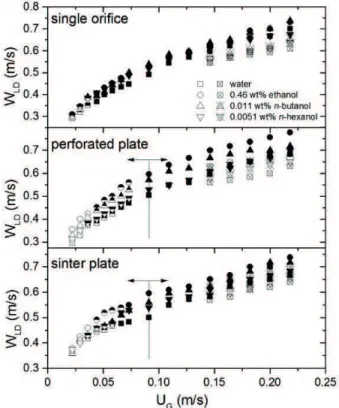
The results in Figures 4 and 5 showed that the downcomer liquid velocity in the majority of the investigated gas-liquid systems and gas distributors changed with added alcohol. The reason for this is a higher driving force for the liquid circulation. Namely, the driving force is proportional to the hydrostatic pressure diference between the two vertical columns in the ELAR. Added alcohol increased the riser gas holdup, while the downcomer gas holdup remained unchanged because there
was no bubble entrainment in the downcomer (mode A). Therefore, WLD was highest in the ethanol and n-butanol solutions for all distributors. The membrane, inserted in the downcomer of the ELAR, diminished the efect of alcohol on WLD. For instance, added alcohols increased WLD from 10% to 15.5% in comparison to water in the ELAR with SP, while in the ELAMR the increase was only 3.7% to 10%, depending on the alcohol solution. In both operating modes, the efect of added alcohols on WLD was the same.
Inluence of gas distributor on the downcomer liquid
velocity
inertial forces dominated, WLD tended to be equal for all three distributors, as the diferences in the WLD between distributors were less than 3%. In both operating modes, the same inluence of the gas distributor on WLD was noticed.
CORRELATIONS
Empirical power law correlations
According to experimental results in both operating modes examined the general comment is that εGR and WLD in the ELAR and ELAMR depend on the supericial gas velocity, distributor type, surface properties of the gas-liquid system and overall friction coeicient. Distributor type has a strong inluence on the primary bubble dispersion and therefore on the global hydrodynamics. The main parameter that describes the gas distributor, i.e., initial bubble size, is the oriice diameter (do) (Šijački et al., 2011). The inluence of alcohols on εGR and subsequently on WLD, should be linked to changes in the surface tension gradient, i.e., to the coalescence suppression strength of
individual alcohols (Albijanić et al., 2007; Camarasa et al., 1999). The efect of hydrodynamic resistance on the liquid velocity in the downcomer depends on the friction coeicient (Kf) in the ELAR and ELAMR, in both operating modes. Therefore, the general form of the correlations we applied was:
The correlations were itted for the following ranges of independent variables: 0.022 < UG < 0.218 m/s, 0.027 < (dσ/ dCA) < 1.985 mNm2/mol, 0.115 < d
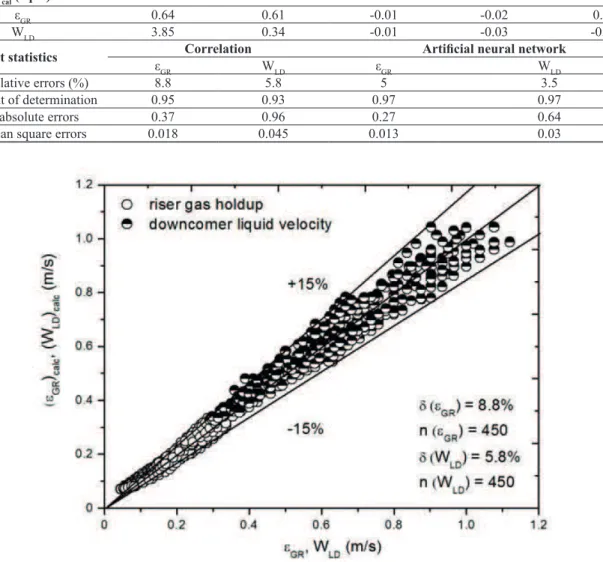
o < 4 mm, 9 < Kf(calc) < 30. The coeicients were determined by minimizing the least-square sums over nonlinear correlations. These calculations were performed in Mathcad software. Table 2 contains the values of estimated parameters in the proposed correlations (eq. 4) and the goodness of it. The parity plot of calculated values versus experimental ones is presented in Figure 6.
(y)calc = AUGB 1+ − dσ
dCA C
doDKf(calc)E
Figure 5. Inluence of gas distributor type and added alcohol on the downcomer liquid velocity in the ELAMR. Hydrodynamic regime legend: open symbols, homogeneous regime; half solid symbols, transition regime; solid symbols, heterogeneous regime and slug low; crossed open symbols, operation mode B.
Figure 4. Inluence of gas distributor type and added alcohol on the downcomer liquid velocity in the ELAR. Hydrodynamic regime legend: open symbols, homogeneous regime; half solid symbols, transition regime; solid symbols, heterogeneous regime and slug low.
Table 2. Values of correlations parameters for the riser gas holdup and downcomer liquid velocity and it statistics
ycal (eq. 4) A B C D E
εGR 0.64 0.61 -0.01 -0.02 0.06
WLD 3.85 0.34 -0.01 -0.03 -0.38
Fit statistics Correlation Artiicial neural network
εGR WLD εGR WLD
mean relative errors (%) 8.8 5.8 5 3.5
coeicient of determination 0.95 0.93 0.97 0.97
mean absolute errors 0.37 0.96 0.27 0.64 root mean square errors 0.018 0.045 0.013 0.03
Figure 6. Comparison of experimental and predicted values for the riser gas holdup and downcomer liquid velocity using the proposed correlations (4).
Neural network simulations
In this study the feed-forward artiicial neural network model (ANN) was used, beside the previously proposed empirical power law correlations, to predict εGR and WLD. Al-Masry (2006), and Chen et al. (2013) pointed out that an ANN reasonably predicted experimental values for liquid velocities, gas holdup and volumetric gas-liquid mass transfer coeicient in the ELAR. Neural network inputs were UG, -dσ/dCA, do and Kf(calc), the ranges of network inputs were the same as in the correlations (eq. 4) mentioned above. The number of neurons was 20 and 2 in
Figure 7. Comparison of experimental and predicted values for the riser gas holdup and downcomer liquid velocity using an artiicial neural network.
CONCLUSION
The following conclusions could be drawn from the present study for both external-loop airlift reactors, with and without inserted membrane in the downcomer:
The insertion of the membrane in the downcomer caused a rise of the overall friction coeicient by 90% and a decrease of the downcomer liquid velocity up to 50%. However, the cross-low velocity remained in the recommended range of velocities for ultrailtration and microiltration given in the literature. Decreased downcomer liquid velocity resulted in up to a 16% increase of the gas holdup, while the regime transitions shifted toward the lower supericial gas velocities. The presence of bubbles in the downcomer decreased the downcomer liquid velocity up to 15% and resulted in a downcomer gas holdup up to 0.03. An artiicial neural network gave a good prediction of riser gas holdup and downcomer liquid velocity for both reactor conigurations studied. Future research should be oriented toward enabling iltration within an external-loop airlift reactor with membrane in the downcomer.
ACKNOWLEDGMENT
This research was supported by the Ministry of Education and Science of the Republic of Serbia. (Project No. 172025).
NOMENCLATURE
do diameter of oriice (mm)
g gravitational acceleration rate (m/s2) H column height (m)
Kf friction coeicient
L distance between conductivity electrodes (m)
t time (s)
UG supericial gas velocity (m/s) WLD downcomer liquid velocity (m/s)
Greek letters
ΔH distance between two measuring points (mm) Δz pressure drop between two measuring points δ mean relative error (%)
εGR riser gas holdup εGD downcomer gas holdup
-dσ/dCA surface tension gradient (N m2/mol)
Abbreviations
ANN artiicial neural network ELAR external-loop airlift reactor
ELAMR external-loop airlift membrane reactor MBR membrane bioreactor
REFERENCES
Al-Masry, W. A., Analysis of Hydrodynamics of External Loop Circulating Bubble Columns with Open Channel Gas Separators Using Neural Networks. Chem. Eng. Res. Des., 84, 483-486 (2006).
Al-Masry, W. A., Efect of liquid volume in the gas-separator on the hydrodynamics of airlift reactors. J. Chem. Technol. Biotechnol., 74, 931-936 (1999). Al-Masry, W. A., Dukkan, A. R., The role of gas
disengagement and surface active agents on hydrodynamic and mass transfer characteristics of airlift reactors. Chem. Eng. J., 65, 263-271 (1997). Albijanić, B., Havran, V., Petrović, D. L., Đurić, M., Tekić,
M. N., Hydrodynamics and mass transfer in a draft tube airlift reactor with dilute alcohol solutions. AlChE J., 53, 2897-2904 (2007).
Bello, R. A., Robinson, C. W., Moo-Young, M., Liquid circulation and mixing characteristics of airlift contactors. Can. J. Chem. Eng., 62, 573-577 (1984). Bendjaballah, N., Dhaouadi, H., Poncin, S., Midoux, N.,
Hornut, J. M., Wild, G., Hydrodynamics and low regimes in external loop airlift reactors. Chem. Eng. Sci., 54, 5211-5221 (1999).
Bentifraouine, C., Xuereb, C., Riba, J.-P., An Experimental Study of the Hydrodynamic Characteristics of External Loop Airlift Contactors. J. Chem. Technol. Biotechnol., 69, 345-349 (1997).
Bérubé, P. R., Lei, E., The efect of hydrodynamic conditions and system conigurations on the permeate lux in a submerged hollow iber membrane system. J. Membr. Sci., 271, 29-37 (2006).
Böhm, L., Drews, A., Prieske, H., Bérubé, P. R., Kraume, M., The importance of luid dynamics for MBR fouling mitigation. Bioresour. Technol., 122, 50-61 (2012). Camarasa, E., Vial, C., Poncin, S., Wild, G., Midoux, N.,
Bouillard, J., Inluence of coalescence behaviour of the liquid and of gas sparging on hydrodynamics and bubble characteristics in a bubble column. Chem. Eng. Process., 38, 329-344 (1999).
Cao, C., Dong, S., Geng, Q., Guo, Q., Hydrodynamics and Axial Dispersion in a Gas−Liquid−(Solid) EL-ALR with Diferent Sparger Designs. Ind. Eng. Chem. Res., 47, 4008-4017 (2008).
Carstensen, F., Apel, A., Wessling, M., In situ product recovery: Submerged membranes vs. external loop membranes. J. Membr. Sci., 394–395, 1-36 (2012). Chen, Z., Liu, H., Zhang, H., Ying, W., Fang, D., Oxygen
mass transfer coeicient in bubble column slurry reactor with ultraine suspended particles and neural network prediction. Can. J. Chem. Eng., 91, 532-541 (2013).
Chisti, M. Y., Airlift bioreactors. Elsevier Applied Science, London (1988).
Choi, H., Zhang, K., Dionysiou, D. D., Oerther, D. B., Sorial, G. A., Inluence of cross-low velocity on membrane performance during iltration of biological suspension. J. Membr. Sci., 248, 189-199 (2005). Cui, Z. F., Chang, S., Fane, A. G., The use of gas bubbling
to enhance membrane processes. J. Membr. Sci., 221, 1-35 (2003).
Fan, Y., Li, G., Wu, L., Yang, W., Dong, C., Xu, H., Fan, W., Treatment and reuse of toilet wastewater by an airlift external circulation membrane bioreactor. Process Biochem., 41, 1364-1370 (2006).
Freitas, C., Teixeira, J. A., Efect of liquid-phase surface tension on hydrodynamics of a three-phase airlift reactor with an enlarged degassing zone. Bioprocess. Eng., 19, 451-457 (1998).
Futselaar, H., Schonewille, H., de Vente, D., Broens, L., NORIT AirLift MBR: side-stream system for municipal waste water treatment. Desalination, 204, 1-7 (2007). Garcia-Calvo, E., Fluid dynamics of airlift reactors:
Two-phase friction factors. AIChE J., 38, 1662-1666 (1992). Gharib, J., Keshavarz Moraveji, M., Davarnejad, R.,
Malool, M. E., Hydrodynamics and mass transfer study of aliphatic alcohols in airlift reactors. Chem. Eng. Res. Des., 91, 925-932 (2013).
Gianetto, A., Ruggeri, B., Specchia, V., Sassi, G., Forna, R., Continuous extraction loop reactor (CELR): Alcoholic fermentation by luidized entrapped biomass. Chem. Eng. Sci., 43, 1891-1896 (1988).
Govier, G. W. A. K., The low of complex mixtures in pipes. Van Nostrand Reinhold Co., New York (1972). Hatch, R. T., Fermenter design, in: Single Cell Protein
II (S. R. Tannenbaum and D. I. C. Wang, eds.). MIT Press, Cambridge (1975); p 46–68.
Jajuee, B., Margaritis, A., Karamanev, D., Bergougnou, M. A., Mass transfer characteristics of a novel three-phase airlift contactor with a semipermeable membrane. Chem. Eng. J., 125, 119-126 (2006).
Jamialahmadi, M., Müller-Steinhagen, H., Efect of alcohol, organic acid and potassium chloride concentration on bubble size, bubble rise velocity and gas hold-up in bubble columns. Chem. Eng. J., 50, 47-56 (1992). Joshi, J. B., Ranade, V. V., Gharat, S. D., Lele, S. S.,
Sparged loop reactors. Can. J. Chem. Eng., 68, 705-741 (1990).
Keitel, G. Untersuchungen zum Stofaustausch in Gas-Flüssig-Dispersionen in Rührschlaufenreaktor und Blasensäule. PhD Thesis, Universität Dortmund, Dortmund, Germany (1978).
of alcohols on gas holdup and backmixing in bubble columns. AIChE J., 29, 361-369 (1983).
Kojić, P. S., Tokić, M. S., Šijački, I. M., Lukić, N. L., Petrović, D. L., Jovičević, D. Z., Popović, S. S., Inluence of the Sparger Type and Added Alcohol on the Gas Holdup of an External-Loop Airlift Reactor. Chem. Eng. Technol., 38, 701-708 (2015).
Li, Y. Z., He, Y. L., Ohandja, D. G., Ji, J., Li, J. F., Zhou, T., Simultaneous nitriication–denitriication achieved by an innovative internal-loop airlift MBR: Comparative study. Bioresour. Technol., 99, 5867-5872 (2008). Lin, J., Han, M., Wang, T., Zhang, T., Wang, J., Jin,
Y., Inluence of the gas distributor on the local hydrodynamic behavior of an external loop airlift reactor. Chem. Eng. J., 102, 51-59 (2004).
Liu, R., Huang, X., Wang, C., Chen, L., Qian, Y., Study on hydraulic characteristics in a submerged membrane bioreactor process. Process Biochem., 36, 249-254 (2000).
McClure, D. D., Deligny, J., Kavanagh, J. M., Fletcher, D. F., Barton, G. W., Impact of Surfactant Chemistry on Bubble Column Systems. Chem. Eng. Technol., 37, 652-658 (2014).
Merchuk, J. C., Stein, Y., Local hold-up and liquid velocity in air-lift reactors. AIChE J., 27, 377-388 (1981). Mihaľ, M., Gavin, S., Markoš, J., Airlift reactor —
membrane extraction hybrid system for aroma production. Chemical Papers, 67, 1485-1494 (2013). Milivojević, M. Brzina tečnosti u dvofaznim i trofaznim
pneumatskim reaktorima sa spoljašnjom cirkulacijom. PhD Thesis, University of Belgrade, Belgrade, Serbia (2011).
Miyahara, T., Nagatani, N., Inluence of Alcohol Addition on Liquid-Phase Volumetric Mass Transfer Coeicient in an External-Loop Airlift Reactor with a Porous Plate. J. Chem. Eng. Jpn., 42, 713-719 (2009).
Moraveji, M. K., Sajjadi, B., Davarnejad, R., CFD Simulation of hold-up and liquid circulation velocity in a membrane airlift reactor. Theor. Found. Chem. Eng., 46, 266-273 (2012).
Pošarac, D. Investigation of hydrodynamics and mass-transfer in a three phase external-loop airlift reactor. PhD Thesis, University of Novi Sad, Novi Sad, Serbia (1988).
Prieske, H., Drews, A., Kraume, M., Prediction of the circulation velocity in a membrane bioreactor. Desalination, 231, 219-226 (2008).
Ratkovich, N., Chan, C. C. V., Berube, P. R., Nopens, I., Experimental study and CFD modelling of a two-phase slug low for an airlift tubular membrane. Chem. Eng. Sci., 64, 3576-3584 (2009).
Rossignol, N., Vandanjon, L., Jaouen, P., Quéméneur, F.,
Membrane technology for the continuous separation microalgae/culture medium: compared performances of cross-low microiltration and ultrailtration. Aquacult. Eng., 20, 191-208 (1999).
Rujiruttanakul, Y., Pavasant, P., Inluence of coniguration on the performance of external loop airlift contactors. Chem. Eng. Res. Des., 89, 2254-2261 (2011).
Schügerl, K., Lücke, J., Oels, U., Bubble column bioreactors. In Advances in Biochemical Engineering, Volume 7, Springer Berlin Heidelberg: 1977; Vol. 7, pp 1-84.
Shariati, F. P., Mehrnia, M. R., Salmasi, B. M., Heran, M., Wisniewski, C., Sarrafzadeh, M. H., Membrane bioreactor for treatment of pharmaceutical wastewater containing acetaminophen. Desalination, 250, 798-800 (2010).
Šijački, I. M., Tokić, M. S., Kojić, P. S., Petrović, D. L., Tekić, M. N., Djurić, M. S., Milovančev, S. S., Sparger Type Inluence on the Hydrodynamics of the Draft Tube Airlift Reactor with Diluted Alcohol Solutions. Ind. Eng. Chem. Res., 50, 3580-3591 (2011).
Snape, J. B., Zahradník, J., Fialová, M., Thomas, N. H., Liquid-phase properties and sparger design efects in an external-loop airlift reactor. Chem. Eng. Sci., 50, 3175-3186 (1995).
Sun, Y., Li, Y. L., Bai, S., Hu, Z. D., Modeling and Simulation of an In Situ Product Removal Process for Lactic Acid Production in an Airlift Bioreactor. Ind. Eng. Chem. Res., 38, 3290-3295 (1999).
Verlaan, P. Modelling and characterization of an airlift-loop bioreactor. PhD Thesis, Wageningen University, Wageningen, Netherlands (1987).
Verlaan, P., Vos, J.-C., Van T Riet, K., Hydrodynamics of the low transition from a bubble column to an airlift-loop reactor. J. Chem. Technol. Biotechnol., 45, 109-121 (1989).
Vial, C., Camarasa, E., Poncin, S., Wild, G., Midoux, N., Bouillard, J., Study of hydrodynamic behaviour in bubble columns and external loop airlift reactors through analysis of pressure luctuations. Chem. Eng. Sci., 55, 2957-2973 (2000).
Vial, C., Poncin, S., Wild, G., Midoux, N., Experimental and theoretical analysis of the hydrodynamics in the riser of an external loop airlift reactor. Chem. Eng. Sci., 57, 4745-4762 (2002).
Vial, C., Poncin, S., Wild, G., Midoux, N., A simple method for regime identiication and low characterisation in bubble columns and airlift reactors. Chem. Eng. Process., 40, 135-151 (2001).
Wallis, G. B., One-dimensional two-phase low. McGraw-Hill, New York (1969).
in an Airlift Fermenter with External Loop. Ger.Chem. Eng., 4, 42-50 (1981).
Xu, Z., Yu, J., Hydrodynamics and mass transfer in a novel multi-airlifting membrane bioreactor. Chem. Eng. Sci., 63, 1941-1949 (2008).
Yuan, Y.-J., Wei, Z.-J., Wu, Z.-L., Wu, J.-C., Improved Taxol production in suspension cultures of Taxus
chinensis var. mairei by in situ extraction combined with precursor feeding and additional carbon source introduction in an airlift loop reactor. Biotechnol. Lett, 23, 1659-1662 (2001).