MEN’S HEALTH: HOSPITAL ADMISSIONS FOR POISONING
RECORDED IN A TOXICOLOGY TREATMENT CENTER
ABSTRACT
Objective: the study aims to characterize hospitalization among men with diagnoses of poisoning in a toxicology information and treatment center in the Brazilian state of Paraná. Methods: Descriptive research, with a quantitative approach, on records in the Monthly Listing of Hospitalized Patients, in the period 2006 - 2010. Results: 2448 hospitalizations of men were analyzed, representing 60.9%. The men had a mean age of 36.5 years; 1610 (65.8%) were adults, and the majority (77.8%) were hospitalized with the diagnosis of poisoning by abuse drugs. Of the 505 (20.5%) hospitalizations resulting from individual accidents, 252 (49.9%) involved children. Suicide attempts were responsible for 440 (18.0%) hospitalizations, of which 110 (25.0%) occurred among adolescents. The mean length of hospitalization was five days, although 81 (3.3%) men occupied beds in intensive care, and 106 (4.3%) died. Conclusion: Due to the ratio of hospitalizations from poisoning among the sexes, one can infer greater seriousness in poisoning in men at all age ranges.
1 Master’s Degree in Nursing - (Master’s student in Nursing – State University of Maringá - Maringá – Paraná (PR) – Brazil. E-mail: [email protected] 2 Master’s student in Nursing – State University of Maringá - Maringá - PR – Brazil. E-mail: [email protected]
3 Master’s student in Nursing – State University of Maringá - Maringá - PR – Brazil. E-mail: [email protected]
4 Nurse. Doctorate in Public Health from theUniversity of São Paulo – State University of Maringá - Maringá - PR – Brazil. E-mail: [email protected]
5 Nurse. Doctorate in Collective Health from the University of Campinas.Assistant professor at the State University of Maringá. – State University of Maringá - Maringá - PR – Brazil. E-mail: [email protected]
PESQUISA
Saúde do homem: internações hospitalares por intoxicação registradas em um centro de assistência toxicoló
Lúcia Margarete dos Reis1, Beatriz Ferreira Martins2, Aroldo Gavioli3, Thais Aidar de Freitas Mathias4,
Magda Lúcia Félix de Oliveira5
Salud del hombre: internaciones hospitalarias por envenenamiento registradas en un centro de asistencia toxicológica
Men's health; Poisoning; Hospitalization.
RESUMO
Metodos: Pesquisa descritiva, com abordagem quantitativa de registros da Listagem Mensal de Pacientes Internados do período de 2006 a 2010. Resultados: Foram analisadas 2.448 internações masculinas, representado 60,9%. Os homens tinham idade média de 36,5 anos, 1.610 (65,8%) eram adultos, e a maioria (77,8%) foi internada com diagnóstico de intoxicação por drogas de abuso. Das 505 (20,5%) internações decorrentes de acidente individual, 252 (49,9%) envolviam crianças. A tentativa de suicídio foi responsável por 440 (18,0%) internações, sendo 110 (25,0%) em adolescentes. O tempo médio de internação foi de cinco dias, mas 81 (3,3%) homens ocuparam leitos em terapia intensiva e 106 (4,3%) morreram. Conclusão: Pela razão de internações por intoxicação entre os sexos, pode-se inferir maior gravidade nas intoxicações em homens em todas as faixas etárias.
Saúde do homem; Envenenamento; Hospitalização.
RESUMEN
Objetivo: Caracterizar las internaciones hospitalarias de hombres con diagnóstico de intoxicación registradas en un centro de información y asistencia toxicológica del Paraná. Métodos: Estudio descriptivo con enfoque cuantitativo de los listados mensuales de registros de pacientes hospitalizados en el período de 2006 a 2010. Resultados: Fueron analizadas 2448 internaciones masculinas (60,9%). Los hombres tenían una edad media de 36,5 años, 1610 (65,8%) eran adultos y la mayoría (77,8%) fue ingresada con el diagnóstico de intoxicación por abuso de drogas. De los 505 (20,5%) ingresos procedentes de accidentes individuales, 252 (49,9%) envolvían niños. El intento de suicidio fue responsable por 440 (18,0%) hospitalizaciones, siendo 110 (25,0%) en adolescentes. Conclusión: En razón de las hospitalizaciones por intoxicación entre los sexos, se puede inferir mayor gravedad en los casos de envenenamiento en hombres de todas las edades.
Salud del Hombre; Envenenamiento; Hospitalización.
Submitted on 08/10/2012
Palavras-chave: Keywords:
INTRODUCTION
This article is anchored in the discussion on men's health, which is a challenge for the health services, given that the paradigms involving men and masculinity remain focussed on masculine invulnerability and invincibility. Men, due to a number of cultural and educational matters, are still considered invulnerable and immune to any sort of ill-ness, which contributes to their lack of care for their health and the fact that they expose themselves to more risks than women1.
Several studies have discussed the question of male health, seeking to comprehend the different reasons for the high profiles of morbimortality among men. The main causes of the high rate for morbimortality among men compared to women, during all phases of the life cycle are tobacco use, cancers, high blood pressure, diabetes, obesity, violence and alcoholism1.
Regarding healthcare, the low demand from the male population for the primary care services constitutes a relevant problem for public health; in general, when men seek the health services, it is linked to a clinical situation which is already chronic, with biopsychosocial consequenc-es for this population group's quality of life, bconsequenc-esidconsequenc-es sig-nificantly overburdening the Unified Health System (SUS)2.
These differences between the sexes show a health situation which is unfavorable for men, and which needs to be considered and faced by the health services3. In 2008,
the Ministry of Health announced the Brazilian Compre-hensive Healthcare Policy for Men, with the objective of covering all the aspects of men's health in their different stages of life through actions and services, humanization and qualification of health care for men, and guidance for the male population, to family members, and the community on promotion and prevention in health, as well as protec-tion, treatment and recovery from health problems affect-ing men1.
The hope is to promote improvement in the male population's health conditions, contributing effectively to a reduction in this population's morbidity and mortal-ity, through the rational confrontation of risk factors and through facilitating access to actions and services of com-prehensive health care1.
The differentials in health characteristics between the sexes are well-known. Studies show that, generally, women live longer than men3,4. The majority of the
tradi-tional health indicators show the existence of this differ-ential, with male mortality being greater at practically all ages and for all causes. Also, life expectancy at birth is also always lower for men4.
Some questions have been the object of concern among health professionals, with the growth of external causes as an important cause of mortality and morbidity
standing out, both in developed countries and those in development1. The expression "external causes" covers
health threats such as falls, drownings, traffic and work ac-cidents, and poisonings1,5.
Poisoning is a manifestation, through clinical signs and symptoms, of harmful effects, produced by the inter-action of a chemical substance in the organism. There are more than twelve million known chemical products, of which approximately three thousand cause the majority of poisonings; however, any substance ingested in sufficient quantity can be toxic6.
Of the notified cases, 50.8% occur among men, as do 69.1% of the deaths resulting from poisoning5,6,
evi-dencing that for the male sex there is greater seriousness in cases of poisoning. In this context, the present study aimed to characterize the hospitalizations of men with di-agnosis of poisoning registered in a toxicology informa-tion and treatment center in the state of Paraná, Brazil, with a view to contributing to knowledge on men's health, and to making the information on hospitalizations due to poisoning in men registered in a toxicology information and treatment center available to health professionals, in particular the nursing professionals. Taking into account that poisoning among men has greater lethality among the cases, the nursing team professionals - because they are directly linked to the emergency care in hospital centers - must know this population's profile, as in this way they may be able to establish strategies directed at comprehensive health care for this population.
MATERIAL AND METHODS
This is descriptive research, with a quantitative ap-proach to the data. It was undertaken through a retrospec-tive analysis of the records in the Monthly Listing of Hos-pitalized Patients in a toxicology information and treatment center (CIAT) in Paraná.
This CIAT is a center of excellence for toxicologi-cal emergencies, linked to the National Health Surveillance Agency (ANVISA), attending requests for information for help with diagnosis and treatment procedures from health professionals and the population in general, as well as car-rying out the role of toxicological surveillance in the North-West region of Paraná.
variables were compiled: patient's age; circumstances and agent of the poisoning; duration and sector of hospitaliza-tion; and the case's clinical outcome.
Age was classified by stages in life cycle: child (zero to 11 years of age), adolescent (12 to 21 years of age), adult (22 to 59 years of age) and older adult (over 60 years of age). The circumstances of the poisoning and the tox-ic agent involved were classified according to the National System for Toxico-Pharmacological Information5, as: abuse,
individual accident, suicide attempt, occupational or other (self-medication, differential diagnosis, administration er-ror, adverse reaction, inappropriate use and therapeutic use); the agents were classified as abuse drugs (alcohol-ic beverages, marijuana, crack and cocaine), med(alcohol-ications, agrotoxins, animals (venomous and non-venomous) ro-denticides and others (food, cosmetics, household clean-ing chemicals, industrial chemical products, veterinary products, unknown products and plant toxins); the duration of hospitalization was grouped in days: one day, 2 to 4 days, 5 to 7 days, 8 to 15 days, 16 to 30 days, and over 30 days; the sector of hospitalization was categorized as Emergency Room (ER), ward or intensive care unit (ICU); and the clinical outcome of the case was classified as death or not.
A data base was set up using the Epi-info software version 3.5.1, in which the data was typed, processed and analyzed through simple descriptive statistics, so as to present the variables, giving them in terms of absolute and relative frequency.
The study was approved by the University of Mar-ingá's Standing Committee for Ethics in Research Involving Human Beings (COPEP/UEM), under decision nº 276/2011. As it was research using data from epidemiological records, a request was made for the Terms of Free and Informed Consent to be dispensed with.
RESULTS
In the period studied, 4020 hospitalizations were recorded with diagnoses resulting from the effects of poi-soning, of which the majority (60.9%) occurred in men, there being a ratio between the sexes of 1.5 men for each woman. The men had a mean age of 36.5 years (± 19.5), varying between four days and 93 years. Regarding the men's place in the life cycle, the majority - 1610 (65.8%) - were adults. The cases' distribution between children, ado-lescents and older adults presented numerical approxima-tion - being 299, 255 and 284 cases, respectively. (Table 1). It was observed that the most frequent circum-stances were abuse, individual accident, and suicide at-tempts. Drug abuse was present in 1340 (54.7%) cases. Of these, 1043 (77.8%) were adults, 222 (16.5%) were older adults, and 03 (0.2%) were children, aged 8, 10 and 11 years old. Accidental poisoning was recorded for 505
(20.5%) hospitalizations, of which 252 (49.9%) occurred in children. There were 440 (18.0%) hospitalizations due to suicide attempts, of which 308 (70.0%) occurred in adults and 110 in adolescents (25.0%); attention is drawn to the 04 (0.9%) children who also attempted suicide.
The group of toxic agents most-commonly involved in the poisonings was the abuse drugs, and the drug most related to hospitalization was alcohol, present in 1287 (96.0%) records. Medication was present in 385 (15.7%) hospitalizations, of which 189 (49.1%) occurred in adults and 116 (30.1%) in children, representing the most-com-monly encountered agent in poisoning among children. Agrotoxins were found in 230 (9.4%) hospitalizations, with attention called to 24 cases (10.4%) in children.
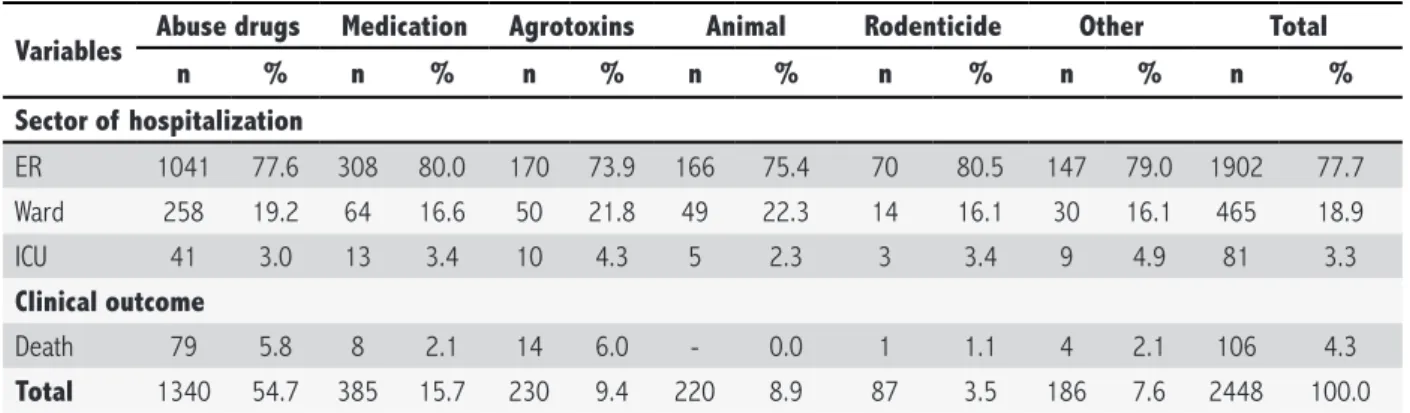
Hospitalization varied in length between one and 90 days. The majority of the patients registered (970 - 39.6%) were hospitalized for one day, but 54 (2.2%) patients were hospitalized for over 30 days, among whom four (7.4%) were children. The majority of the patients (1902 - 77.7%) were hospitalized in the ER, but 81 (3.3%) needed to be treated in ITU, of whom 18 (22.2%) were children. Of the patients registered, 106 (4.3%) died as a result of the poi-soning or its complications, including three (2.8%) children. Stratifying the variables of seriousness and agent, it was ascertained that agrotoxin agents are responsible for the greatest number of patients hospitalized in ICU (10 - 4.3%) and also for the greatest number of deaths (14 - 6.0%). Hos-pitalizations involving animals, on the other hand, had the low-est frequency of hospitalization in ICU (5 - 2.3%) and did not cause deaths among the men who were poisoned. (Table 2).
DISCUSSION
The present study backs up the data found in the literature, which indicates poisonings as important factors in illness, and poisonings in men as more frequent than in women3,7. Hospitalization, however, occurred in higher
pro-portions among men. While cases of poisoning in men in 2009 represented 50.8% of the notifications5, the
hospi-talizations involving men found in the present study repre-sented 60.9%. Considering that the hospitalization of the patients can indicate greater clinical seriousness, it may be inferred that the poisonings in men were more serious with-in the universe of the patients with-investigated.
Men tend to seek the health services when the health problems they present are already chronic, or in the face of the eminence of the worsening of the clinical status, either because of aspects related to masculine invulnerability or because of the demands of their job, as they still occupy the role of being the provider of the family's financial resources2.
Table 1. Distribution of hospitalizations from poisoning in men, by circumstance, agent, duration of hospitalization, sector of hospitalization, and clinical outcome. Paraná, 2011
Variables Child Adolescent Adult Older Adult Total
n % n % n % n % n %
Circ.s
Abuse 3 0.2 72 5.3 1043 77.8 222 16.5 1340 54.7
Ind. accident 252 49.9 49 9.7 173 34.3 31 6.1 505 20.5
Suicide att. 4 0.9 110 25.0 308 70.0 18 4.1 440 18.0
Occupational - - 16 21.3 54 72.0 5 6.7 75 3.1
Other 40 45.4 8 9.0 32 36.3 8 9.0 88 3.6
Agent
Abuse drugs 3 0.2 72 5.3 1043 77.8 222 16.5 1340 54.7
Medication 116 30.1 66 17.1 189 49.1 14 3.6 385 15.7
Agrotoxins 24 10.4 34 14.7 154 66.9 18 7.8 230 9.4
Animal 45 20.5 31 14.1 126 57.3 18 8.2 220 8.9
Rodenticide 26 29.8 17 19.5 41 47.1 3 3.4 87 3.5
Other 85 45.7 36 19.3 56 30.1 9 4.9 186 7.5
Hospitalization(days)
1 191 19.7 135 13.9 579 59.7 65 6.7 970 39.6
2 to 4 71 9.6 66 8.9 523 70.5 82 11.1 742 30.3
8 to 15 13 4.7 20 7.2 188 67.9 56 20.2 277 11.3
5 to 7 14 5.8 20 8.3 171 71.0 36 14.9 241 9.8
16 to 30 6 3.7 12 7.3 110 67.1 36 22.0 164 6.7
> 30 4 7.4 2 3.7 39 72.2 9 16.7 54 2.2
Sector of hosp.
ER 232 12.2 197 10.4 1274 67.0 199 10.5 1902 77.7
Ward 49 10.5 47 10.1 292 62.8 77 16.6 465 19
ICU 18 22.2 11 13.6 44 54.3 8 9.9 81 3.3
Clinical outcome
Death 3 2.8 2 1.9 74 69.8 27 25.5 106 4.3
Total 299 12.2 255 10.4 1610 65.8 284 11.6 2448 100
Table 2. Distribution of the variables of seriousness, by the poisoning's causal agent, in men. Paraná, 2011
Variables Abuse drugs Medication Agrotoxins Animal Rodenticide Other Total
n % n % n % n % n % n % n %
Sector of hospitalization
ER 1041 77.6 308 80.0 170 73.9 166 75.4 70 80.5 147 79.0 1902 77.7 Ward 258 19.2 64 16.6 50 21.8 49 22.3 14 16.1 30 16.1 465 18.9
ICU 41 3.0 13 3.4 10 4.3 5 2.3 3 3.4 9 4.9 81 3.3
Clinical outcome
Death 79 5.8 8 2.1 14 6.0 - 0.0 1 1.1 4 2.1 106 4.3
Total 1340 54.7 385 15.7 230 9.4 220 8.9 87 3.5 186 7.6 2448 100.0
Among the circumstances for the toxicological events and consequent hospitalization, drug abuse took first place, principally involving the abuse of alcohol. In the present study, the majority of the hospitalizations
The use of abuse drugs constitutes one of the most serious social and health problems of our age, affecting the individual in his biopsychosocial dimension8.
Those who use abuse drugs are hospitalized either because of the clinical effects caused by the drug in the organism, as a result of the physio-pathological changes originating in the prolonged use of these substances, or be-cause the use may be associated with violence and traumas. A study undertaken in a CIAT unit in Paraná, whose pur-pose was to characterize the hospitalizations from alcohol poisoning and involvement in violent acts, found 732 cases in the period between 2009 and 2010, with the majority (96.0%) occurring among men, with 253 (34.5%) cases presenting some type of violence associated; four men (1.6%) subsequently died9.
Accidental poisoning in children occupied second place in the circumstances of poisonings resulting in hospi-talization, which backs up data from Brazilian literature on the subject of the greater exposure of boys to agents which cause more serious poisoning. Boys, for cultural and gender reasons, are exposed earlier to accidents due to more "ad-venturesome" play10.
From a cultural perspective, as society tends to per-mit families to bring up male children with less vigilance, the boys acquire the liberty to carry out activities with less direct supervision from adults earlier than girls do. Thus, from the end of the first year of life onwards, the boys have double the girls' chances of suffering injuries11.
One's attention is called in the present study to the fact that for every 2.3 cases of hospitalization due to poi-soning in adolescents, one resulted from a suicide attempt. Among males, one can observe the predominance of the use of physical methods for suicide, followed by use of med-ications and other chemical substances12.
Adolescents face social, political, religious and eco-nomical aspects in the affective process to consolidate the formation of their personality and acquire conditions to care for their own destiny, so as to reach the condition of adult-hood12. During this transitional period, the availability and
access to medications and other chemical substances can increase the adolescent's vulnerability to suicide attempts.
Among the agents responsible for hospitalizations, the medications were in second place. The occurrence of poisoning in children may indicate the incorrect storage of the substances, associated with the characteristics typical of that age, such as curiosity and imitation of procedures undertaken by adults13.
One study undertaken to describe the profile of the acute poisonings in children attended in 2006 in a hospital in the public network in Goiânia, identified that the major-ity of the poisonings involved male children, and that the place of occurrence of 80.2% of the poisonings was the children's residence11.
Data from the National Toxicological-Pharmaceuti-cal Information System referent to the years 1999-2009 shows 1,007,690 cases of poisoning recorded, with a to-tal of 5,224 (0.5%) deaths. In this period, medications were responsible for 925 deaths. In 2009, the toxic agents involved in the greatest number of deaths were the agro-toxins, medications, and abuse drugs, repeating the data from 20085.
A study undertaken to describe the epidemiological profile of the mortality from poisoning with medications, in the Brazilian population between 1996 and 2005, based on the analysis of data recorded in the Ministry of Health's Mortality Information System indicated 4,403 (0.04%) deaths related to poisoning with medications, equivalent to the frequency of 4.6 deaths/10,000 records. The deaths occurred, above all, in men (53.9%) and the main circum-stance was suicide (57.2%)7.
The suicide attempts using medications and agro-toxins were the most serious events in the poisonings, probably due to the greater exposure to large quantities of the agent, causing an increase in the duration of hospi-talization as well as the need for treatment in ITU14, which
was also observed in the present study.
Although they lead to a lower frequency of hospi-talization, the agrotoxins represent a higher proportion of deaths. As in the present research, in 2009, the agrotox-ins were responsible for 174 (42.5%) deaths, of which the majority (127-84.2%) occurred in men5.
Research carried out to assess the impacts of use of agrotoxins on the health of those handling them, taking into account the characteristics of rural work and of their use in olive oil production in the city of Teresópolis in the state of Rio de Janeiro, showed that the chance of poison-ing for men is twice as high as it is for women1,15.
Suicide attempts using agrotoxins are commonly met in hospital centers. This fact may be associated with the population's knowledge about these substances' high toxicity, and to the easy access to these products, making them a dangerous weapon for those individuals who at-tempt suicide. The large number of cases of poisoning in-volving suicide attempts in men is related to men's greater involvement in occupational activities and, consequently, to their easy access to these products14.
There were, however, 24 cases of children being hospitalized with diagnoses of poisoning by agrotoxins, implying exposure to the substance in contaminated envi-ronments or negligence in storage, making it possible for the children to access these substances. The children who were poisoned by agrotoxins needed a longer period of hospitalization, and three died as a direct result of the poisoning or from clinical complications inherent to it.
those hospitalized remained in the emergency care unit, evidencing situations of acute poisoning, and there was a need for swift intervention to keep the patient alive, to re-establish the state of health, and to prevent the worsen-ing of the clinical situation. Nevertheless, 81 patients need-ed to be hospitalizneed-ed in the intensive care unit, due to the clinical seriousness of their cases, leading to financial and technological costs on the health system and, above all, high intangible social and financial costs to the hospitalized individuals and their families.
The family, being a structure organized by parental or affective affinity, suffers relevant changes and emotional impacts during the hospitalization of one of its members. Fear, suffering and routine doubts increase in the face of death, with the uncertainties about the treatment and the prognosis that are raised by longer inpatient treatment, or inpatient treatment in ICU16.
The percentage of deaths in the population investi-gated (106-4.3%) is high, even by the standards of inten-sive care, and is perverse, bearing in mind that the majority of the poisonings are avoidable by behavioral methods or public policies.
The deaths among the older adults occurred in greater proportions. For every ten poisoned older adults, there was one death as a result of the poisoning, whereas in adults one death occurred for every 22 people hospi-talized. Considering the social impact and the costs to the health services from the occurrences among older adults, whose number is set to rise in Brazil in the next few years, it is necessary to understand this type of event better, articu-lating this issue with the nursing care, bearing in mind that in educational actions and health surveillance the nurse has guiding axes for her professional role17.
The agent with the greatest lethal potential was agrotoxins, causing one death for every 16.4 patients. The high incidence of poisoning and the high morbimor-tality show the lack of information on these strong toxic agents, so recognizing these dangers to health early, di-recting steps which aim to restrict indiscriminate access to agrotoxins, raising awareness of the importance of use of personal protective equipment, encouraging the produc-tion and consumpproduc-tion of organic products and instituting toxicological surveillance are attitudes which need to be incorporated into routine health practice18.
CONCLUSION
Through this study it was identified that hospital-izations from poisoning are more frequent among men, adults, who are poisoned due to substance abuse, followed by individual accidents and suicide attempts, with a higher
number of poisonings in children and adolescents involving these last circumstances. The abuse drugs represented the agent found most, followed by medications and agrotoxins.
In the majority of hospitalizations, the duration was less than four days, with the majority of patients hospital-ized in emergency units; however, high numbers of hospi-talizations in intensive care units and deaths were found, involving children as well, and the agrotoxins presented the greatest lethality among the agents.
The data found, although referent to the study of hospitalizations recorded in a toxicology information and treatment center, indicates that investment in public poli-cies directed at men's health is necessary, as this is more susceptible to serious poisonings. In this regard, the health services which attend this demand perform an important role in the prevention of those poisonings understood as avoidable.
One has to bear in mind that the need for strategies for the prevention of poisoning must extend beyond the assessment of physical risks, and consider ways of encour-aging individuals to seek professional help when they face emotional problems or problems related to mental health or substance abuse, so as to reduce the feeling of masculine invulnerability.
It is worth emphasizing that the study does not present an exact profile of the male patients hospitalized with a diagnosis of poisoning in the territory covered by the center in question. This fact is related to the sub-noti-fication of cases of poisoning to the toxicology information and treatment centers. In this regard, studies are suggest-ed bassuggest-ed on the hospital units which attend the poisonsuggest-ed patient.
The importance of the health professional is stressed, particularly those of the nursing team, in the pro-cess of health education and in the surveillance of cases - informing parents and guardians about the principal risks to which children may be exposed, alerting young people and adults to preventing poisonings, recognizing at an ear-ly stage the cases of poisoned patients and establishing health surveillance in relation to the availability of chemical substances capable of causing poisoning in men - and also in the daily struggle to form citizens who are pro-active in prevention, with legislation and investment in wide-ranging public policies.
REFERENCES
2. Fontes WD, Barboza TM, Leite MC, Fonseca RLS, Santos LCF, Nery TCL. Atenção à saúde do homem: interlocução entre ensino e serviço. Acta paul. enferm. [periódico na internet]. 2011 [citado 2012 mai 18]; 24(3): 430-433. Disponivel em: <http://www.scielo.br/scielo.php?script=sci_arttext&pid =S0103-21002011000300020>.
3. Figueiredo W. Assistência à saúde dos homens: um desafio para os serviços de atenção primária. Ciênc. saúde Coletiva. 2005;10(1):105-9.
4. Laurenti R, Jorge JMHP, Gotlieb SLD. Perfil epidemiológi-co da morbi-mortalidade masculina. Ciênc. saúde epidemiológi-coletiva. 2005;10(1):35-46.
5. Sistema Nacional de Informações Tóxico-Farmacológicas - Si-nitox. Óbitos Registrados de Intoxicação Humana por Agente Tóxico e Circunstância. Brasil; 2009. [citado 2012 mai 25]. Disponível em: <http://www.fiocruz.br/sinitox_novo/media/ Tabela%2011%20-%202009.pdf>.
6. Zambolim CM, Oliveira TP, Hoffmann NA, Vilela CEB, Neves D, Anjos FR, et al. Perfil das intoxicações exógenas em um hospital universitário. Rev. Assoc. Méd. Minas Gerais. 2008;18(1):5-10. 7. Mota DM, Melo JRR, Freitas DRC, Machado M. Perfil da mor-talidade por intoxicação com medicamentos no Brasil, 1996-2005: retrato de uma década. Ciênc. saúde Coletiva. 2012 mai; 17(1):61-70.
8. Oliveira MLF, Arnauts I. Intoxicação alcoólica em crianças e adolescentes: dados de um centro de assistência toxicológica. Esc. Anna Nery Rev. Enferm. 2011 Jan/Mar; 15(1):83-9. 9. Reis LM, Antunes F, Inoue L, Silvino MCS, Oliveira MLF. Uso do
álcool associado à violências: dados de um centro de assis-tência toxicológica. Resumo dos trabalhos apresentados no IV Congresso Científico da Região Centro-Ocidental do Paraná; 2011 mai.; Campo Mourão (PR), Brasil. Colégio e Faculdade Integrado de Campo Mourão-PR; 2011. Acesso em: <http:// www.grupointegrado.br/conccepar2011/?action=anais_ resumo&id=837>.
10. Werneck GL, Hasselmann MH. Intoxicações exógenas em crian-ças menores de seis anos atendidas em hospitais da região Metropolitana do Rio de Janeiro. AMB rev. Assoc. Med. Bras. 2009;55(3):302-7.
11. Siqueira KM, Brandão JR, Lima HF, Garcia ACA, Gratone FM; Brasileiro MSE. Perfil das intoxicações exógenas infantis atendidas em um hospital especializado da rede pública de Goiânia-GO. Rev. eletrônica enferm. 2008;10(3):662-72. 12. Avanci RC, Pedrão LJ, Costa Júnior ML. Perfil do adolescente
que tenta suicídio em uma unidade de emergência. REBEN. 2005 set-out; 58(5):535-9.
13. Aleixo ÉCS, Itinose AM. Intoxicação Infantil: Experiência de Familiares de Crianças Intoxicadas no município de Maringá (PR). Ciênc. cuid. saúde. 2003 jul; 2(2):147-54.
14. Oliveira MLF, Buriola AA. Gravidade das intoxicações por inseti-cidas inibidores das colinesterases no noroeste do estado do Paraná, Brasil. Rev. gaúch. enferm. 2009 dez; 30(4):648-55. 15. Soares WL, Freitas EAV, Coutinho JAG. Trabalho rural e saúde:
intoxicações por agrotóxicos no município de Teresópolis (RJ). Rev. Econ. Sociol. Rural. 2005;43(4):685-701.
16. Lustosa M. A família do paciente internado. Rev. SBPH [peri-ódico na Internet]. 2007 jun.; [citado 2011 Jun 24]; 10(1)): [aprox. 6 telas]. Disponível em: <http://pepsic.bvsalud.org/ pdf/rsbph/v10n1/v10n1a02.pdf>.
17. Seleghim MR, Bellasalma ACM, Mathias TAF, Oliveira MLF. Ca-racterização das tentativas de suicídio entre idosos. Cogitare enferm. 2012 abr-jun; 17(2):277-83.