Efficacy of spermatic vein ligation in patients affected by
high grade left varicocele
_______________________________________________
Marco Grasso, Caterina Lania, Salvatore Blanco, Silvia Confalonieri, Angelica A. C. Grasso
Department of Urology, San Gerardo Hospital, University of Milano-Bicocca (MG, SB), Monza; Depart-ment of Urology, University Vita-Salute San Raffaele (CL), Milan; DepartDepart-ment of Urology, Desio Hospital (SC), Desio and Department of Urology, Fondazione IRCCS Ca’ Granda Ospedale Maggiore Policlinico, University of Milan (AACG), Milan, Italy
ABSTRACT
ARTICLE
INFO
______________________________________________________________ ______________________
Purpose: To study the effect of high grade varicocele treatment in infertile patients. Materials and Methods: Seventy-five patients were selected by the following criteria: in-fertility persisting for more than 1 year; abnormal semen parameters; no other inin-fertility- infertility--related disease; no obvious causes of infertility in the subject’s partner; basal eco-color Doppler ultrasound demonstrating continuous reflux in the spermatic vein. All patients considered for the study had at least a six months period from the diagnosis to the surgery due to waiting list, choice of the patient or time needed to complete diagnostic evaluation of the couple. The surgical procedure was performed through an inguinal ap-proach. All enrolled patients were counseled to have unprotected intercourse during the ovulation period in order to maximize the probability of pregnancy within the 6-month preoperative period. The achievement of pregnancy and semen parameters were recorded during the preoperative and postoperative period.
Results: Two of the seventy-five patients were excluded because of persistent varicocele after surgery. The preoperative pregnancy rate was 1.3% (1 couple). The postoperative pregnancy rate was 42.5%. The stratification of pregnancies by semester showed a sig-nificantly higher rate in the first postoperative period (p = 0.0012). Mean time to con-ception was 13.5 months. Mean preoperative sperm count was 17.6x10⁶/mL compared to 19.7x10⁶/mL in the postoperative period (p < 0.0001). Mean percentage of progressive sperm motility was 13.7%, compared to 17.6% in the postoperative period (p < 0.0001). Mean percentage of normal sperm morphology was 7.6%, compared to 15.2% postope-ratively (p < 0.0001).
Conclusion: Surgical treatment of high grade varicocele proved to effectively treat associa-ted infertility by improving seminal parameters and pregnancy rate in our patient cohort.
Key words:
Spermatic Cord; Varicocele; Ligation; Infertility
Int Braz J Urol. 2014; 40: 62-6
_____________________
Submitted for publication: May 10, 2013
_____________________
Accepted after revision: September 17, 2013
INTRODUCTION
Varicocele is a common scrotal condition characterized by the elongation and enlargement of the network of veins leaving the testis that join to form the testicular vein.
The exact association between reduced male fertility and varicocele is not known because prospective randomized studies on varicocele treat-ment in adults have given conflicting results (4-8). The largest study indicated a benefit (8,9), whereas meta-analysis of most of the prospective random-ized trials did not (10). However, in previous stud-ies, selection criteria based on the clinical and ul-trasonographic grade of varicocele did not take into consideration a homogeneous population. It would be probable that a lower grade of varicocele does not affect fertility as well as the quality of seminal parameters, and a significant bias might exist.
For this reason, our intent was to study a series of infertile patients with high grade varico-cele before and after surgical treatment. Our aim was to obtain reliable results from a homogeneous and selected patient population.
MATERIALS AND METHODS
From January 2006 to February 2011, we studied 75 patients with high grade left varico-cele who presented with infertility. Patients were selected by the following criteria: (a) infertility persisting for more than 1 year despite regular, unprotected intercourse; (b) abnormal semen pa-rameters as assessed by World Health Organiza-tion (WHO) guidelines 2010; (c) no other infertil-ity-related disease; and (d) no obvious causes of infertility in the subject’s partner.
All men underwent a standard diagnostic infertility evaluation (physical examination, blood tests, including hormonal dosages and testing for Y deletion and chromosomal defects when needed according to seminal and clinical features, eco-color Doppler ultrasound of the scrotum). The ex-amination was performed after the patient stood for various minutes in a warm room; the scrotum was inspected and palpated in the upright posi-tion. In all cases, an ultrasound with color-Doppler study was performed using a linear 7.5 MHz probe both in supine and upright position. According to this method, varicocele was graduated as follows: 1st grade, reflux was visible only under Valsalva maneuver; 2ndgrade, venous reflux was intermit-tent under basal conditions; 3rd grade, basal con-tinuous reflux was demonstrated (11,12).
Infertility was defined, according to the WHO, as the inability of a sexually active, non-contracepting couple to achieve pregnancy in one year (13).
At least two preoperative semen analyses were obtained by masturbation after 3 days of abstinence from sexual activity, and the average value was considered.
All possible causes of male infertility were ruled out, including history of maldescended tes-tis, infections, general diseases, or chronic medi-cation. The partner was studied in all cases to rule out any cause of infertility (such as anovulation, endometriosis, tubal blockage, etc.)
All patients considered for the study had periods between 6 and 9 months (mean: 7.2 months, SD 0.8) from the diagnosis to the sur-gery due to waiting list, choice of the patient or time needed to complete diagnostic evaluation of the couple.
All the enrolled patients fulfilled the study inclusion criteria and were counseled to have un-protected intercourse during the ovulation period in order to maximize the probability of getting pregnant during the 6 months before intervention, when the patient was on the surgical waiting list.
The patients underwent spermatic vein ligature through an inguinal approach with opti-cal magnification performed by a single-surgeon. Optical magnification using frontal loops (3x) was utilized to spare the spermatic artery and lym-phatic ducts.
The achievement of pregnancy and semen parameters were recorded during the preoperative and postoperative period. Postoperative semen analyses were obtained 6 months after surgery.
Categorical data were examined by the chi-square test; continuous variables were tested by t-test assuming p < 0.05 as significant. The re-sults were elaborated using the statistical program SigmaStat™ for Windows® V2.03.
RESULTS
years). The mean study follow-up time was 32.4 months (range 24-47 months). The mean age of the partners was 28.5 years (range 23-39 years). No patient reported previous episodesof cryptor-chidism, hydrocele, ortesticular trauma, nor had they undergone surgery of the urogenital tract. No other causes of infertility were found.
The mean infertility period was 23 months (SD ± 8.4, range 12-39 months).
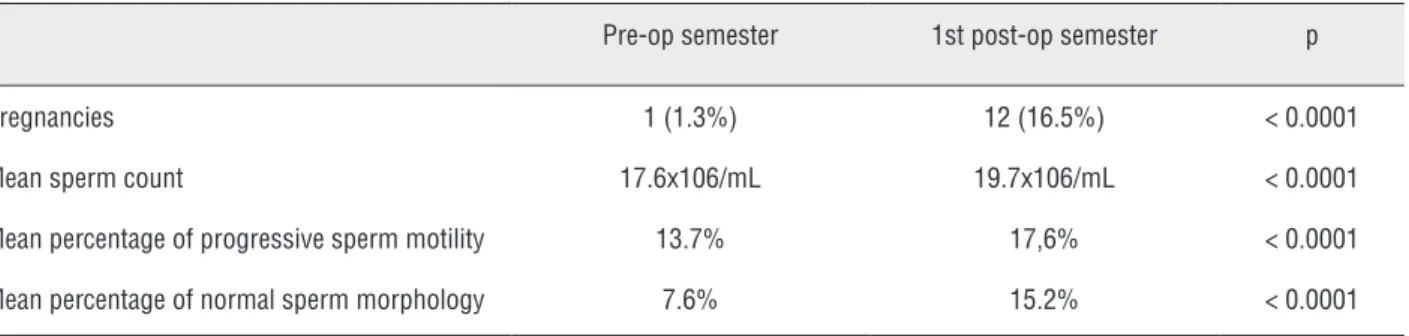
During the 6-9 months preoperative pe-riod while patients were on the surgery waiting list, pregnancy was achieved in 1 couple (1.3%).
The mean preoperative sperm count was 17.6x10⁶/mL compared to 19.7x10⁶/mL in the
postoperative period (p < 0.0001). The mean pre-operative percentage of progressive sperm motili-ty was 13.7% compared to 17.6% in the postoper-ative period (p < 0.0001). The mean preoperpostoper-ative percentage of normal sperm morphology was 7.6% compared to 15.2% in the postoperative pe-riod (p < 0.0001) (Table-1).
During the first 6-month postoperative period, 12 couples got pregnant (16.5%). A com-parison of the pregnancies occurring in the pre-operative period to the occurrence during the first postoperative semester showed a significant dif-ference (p < 0.0001). In the following months, 19 more pregnancies occurred. The stratification of pregnancies by semester showed a significantly higher rate during the first postoperative period (p = 0.0012) (Figure-1). The mean time to concep-tion was 13.5 months.
The persistence rate of varicocele was 2.6%, and no minor or major postoperative com-plications were registered. All patients were dis-charged within 24 hours.
DISCUSSION
The main point of discussion is the clear benefit for the rate of pregnancy when varico-cele is treated in infertile patients if other causes of male infertility, as well as obvious causes of female infertility, are ruled out. However, this point is debated by the scientific literature be-cause even prospective randomized controlled trials of varicocele treatment in adults have giv-en conflicting results. Studies on this topic are divided into those that conclude there is no in-fluence on infertility by treatment of varicocele (6,7,14,15) and those that find a real benefit on semen parameters and pregnancy rate (8,9).
However, the heterogeneous inclusion cri-teria, the small number of analyzed patients, and, in some cases, the high percentage of varicocele
Table 1 - Pregnancies and sperm characteristics before and after operation.
Pre-op semester 1st post-op semester p
Pregnancies 1 (1.3%) 12 (16.5%) < 0.0001
Mean sperm count 17.6x10⁶/mL 19.7x10⁶/mL < 0.0001
Mean percentage of progressive sperm motility 13.7% 17,6% < 0.0001
Mean percentage of normal sperm morphology 7.6% 15.2% < 0.0001
Figure 1 - Postoperative pregnancies stratified by semester.
14
12
10
8
6
4
2
0
first
second third fourth
Number of pregnancies
fifth
persistence after treatment do not allow to draw any final conclusion based on the evidence. We agree that the meta-analytic interpretation of these data does not provide information based on evidence that is useful in improving clinical prac-tice (16). In particular, the high rate of patients who dropped out and/or were lost to follow-up calls into question the propriety of randomized studies comprised of an untreated arm that may appear unethical in such patients. In this regard, our method might be closer to real clinical prac-tice than randomized clinical trials that have a higher percentage of randomization refusal. In our study, the same patients are their own con-trols because seminal parameters and pregnancy rate are measured before and after surgical treat-ment for varicocele in the same population.
Our positive results for pregnancy rate and improved seminal parameters may be explained by our selection criteria. Only 3rd grade varico-cele according to color Doppler classification was taken into consideration differently from previous randomized studies that usually consider clinical classifications, which are known to have low sen-sitivity (3).
Another bias present in previous studies is the different treatment used to correct the venous reflux and, in some cases, the high persistence rate of varicocele. In our series, treatment was the same in all patients and consisted in the microsur-gical inguinal ligation that, in our hands, had a lower persistence rate (2.6%).
Our study was prospective but not ran-domized, and this is the main limitation. We do not know if the simple counseling done during the waiting list months could be a treatment com-parable to surgical treatment of varicocele. To an-swer this question, we should have considered a randomized non-operated group of patients treat-ed by counseling alone. However, data on efficacy of counseling alone with no surgical procedures in infertile couples with associated varicocele are lacking therefore we are not able to assess if coun-seling alone might increase pregnancy rate in this selected group of patients.
In the absence of any significant data on counseling efficacy we think it is unethical not to treat patients strongly motivated to have children.
CONCLUSIONS
The surgical treatment of high grade varicocele effectively treats infertility, improving seminal parameters and pregnancy rate. Increased improvement occurs early after treatment. A mi-crosurgical inguinal approach seems to be a good treatment because the incidence of persistence is acceptable.
Study limitations: We did not have a con-trol group for comparison with our treatment data. We agree that a control would be ideal to provide high level evidence of treatment benefits, but is ethically questionable to exclude a well-defined patient group from a recommended therapy.
CONFLICT OF INTEREST
None declared.
REFERENCES
1. Pfeiffer D, Berger J, Schoop C, Tauber R: A Doppler-based study on the prevalence of varicocele in German children and adolescents. Andrologia. 2006; 38: 13-9.
2. Levinger U, Gornish M, Gat Y, Bachar GN: Is varicocele prevalence increasing with age? Andrologia. 2007; 39: 77-80. 3. Liguori G, Trombetta C, Garaffa G, Bucci S, Gattuccio I,
Salamè L, et al.: Color Doppler ultrasound investigation of varicocele. World J Urol. 2004; 22: 378-81.
4. Nieschlag E, Hertle L, Fischedick A, Behre HM: Treatment of varicocele: counselling as effective as occlusion of the vena spermatica. Hum Reprod. 1995; 10: 347-53.
5. Zini A, Azhar R, Baazeem A, Gabriel MS: Effect of microsurgical varicocelectomy on human sperm chromatin and DNA integrity: a prospective trial. Int J Androl. 2011; 34: 14-9.
6. Baazeem A, Belzile E, Ciampi A, Dohle G, Jarvi K, Salonia A, et al.: Varicocele and male factor infertility treatment: a new meta-analysis and review of the role of varicocele repair. Eur Urol. 2011; 60: 796-808.
7. Nieschlag E, Hertle L, Fischedick A, Abshagen K, Behre HM: Update on treatment of varicocele: counselling as effective as occlusion of the vena spermatica. Hum Reprod. 1998; 13: 2147-50.
9. Madgar I, Weissenberg R, Lunenfeld B, Karasik A, Goldwasser B: Controlled trial of high spermatic vein ligation for varicocele in infertile men. Fertil Steril. 1995; 63: 120-4. 10. Evers JL, Collins JA . Assessment of efficacy of varicocele
repair for male subfertility: a systematic review. Lancet. 2003; 361: 1849-52.
11. Grasso M, Lania C, Castelli M, Galli L, Franzoso F, Rigatti P: Low-grade left varicocele in patients over 30 years old:the effect of spermatic vein ligation on fertility. BJU Int. 2000; 85: 305-7.
12. Grasso M, Lania C, Castelli M, Galli L, Rigatti P: Bilateral varicocele: impact of right spermatic vein ligation on fertility. J Urol. 1995; 153: 1847-8.
13. World Health Organization. WHO Manual for the Standardised Investigation and Diagnosis of the Infertile Couple. Cambridge: Cambridge University Press; 2000. 14. Nilsson S, Edvinsson A, Nilsson B: Improvement of semen
and pregnancy rate after ligation and division of the internal spermatic vein: fact or fiction? Br J Urol. 1979; 51: 591-6. 15. Yamamoto M, Hibi H, Hirata Y, Miyake K, Ishigaki T: Effect
of varicocelectomy on sperm parameters and pregnancy rate in patients with subclinical varicocele: a randomized prospective controlled study. J Urol. 1996; 155: 1636-8. 16. Ficarra V, Cerruto MA, Liguori G, Mazzoni G, Minucci S, Tracia
A, et al.: Treatment of varicocele in subfertile men: The Cochrane Review--a contrary opinion. Eur Urol. 2006; 49: 258-63.