Polyacrylamide Hydrogel (Bulkamid®) in Female Patients of
80 or More Years with Urinary Incontinence
_______________________________________________
Carlo Vecchioli-Scaldazza, Carolina Morosetti, Berouz Azizi, Willy Giannubilo, Vincenzo Ferrara
Divisions of Urology (CVS, BA, WG, VF) and Clinical Pathology (CM), ASUR, Area Vasta nº 2, Jesi, Italy
ABSTRACT
ARTICLE
INFO
______________________________________________________________ ______________________
Introduction: To assess the effectiveness of polyacrylamide hydrogel (Bulkamid ®) in injection therapy for urinary incontinence in women of 80 or more years.
Materials and Methods: Twenty consecutive women mean age 84.5 (range 80-87) with stress or mixed urinary incontinence were enrolled in this prospective study. All sub-jects were evaluated at baseline and re-evaluated 7 days, 6,12,18 and 24 months after treatment. A detailed clinical evaluation, physical examination, daily pad count, uro-dynamic investigation and evaluation of urethral mobility by trans-labial ultrasound were performed.
Results: A statistically significant decrease in the number of pads was observed in the follow-up (p = 0.0002 after 24 months). Physical examination showed a statistically significant lack or reduced lost of urine with stress test (p = 0.0163 after 24 months). Urodynamic findings showed an increase of Valsalva leak point pressure, maximum urethral closure pressure and functional length. Maximum flow and post void residual were respectively observed to be significantly reduced and increased only after 7 days from injection therapy. Quality of life (QoL) assessed with the Incontinence Impact questionnaire short form (IIQ-7) showed a statistically significant improvement (p = 0.0001 after 24 months). Patient satisfaction assessed with the Visual Analogue Scale and Patient Global Impression of Improvement questionnaire respectively produced evaluation of “satisfied” and “much improved” even after 24 months.
Conclusions: Polyacrylamide hydrogel (Bulkamid®) is an effective treatment with low morbility in patients of 80 or more years.
Key words:
Injections; Neuromuscular Blocking Agents; Urinary Incontinence; Female; Quality of Life
Int Braz J Urol. 2014; 40: 37-43
_____________________
Submitted for publication: February 13, 2013
_____________________
Accepted after revision: January 16, 2014
INTRODUCTION
The first report on the use of urethral injec-tion therapy was in 1904 (1). Since then many sub-stances have been used in the treatment of stress urinary incontinence in women looking for “agents” that were durable, non-migratory, hypoallergenic, biocompatible and which does not evoke granuloma formation (2): polytetrafluorethylene, bovine colla-gen, autologous fat, silicone, carbon spheres, calcium hydroxylapatite, porcine dermal implant, ethylene vinyl alcohol copolymer, hyaluronic acid and poly-acrylamide hydrogel.
Polyacrylamide hydrogel (Bulkamid®) was introduced in Europe as a bulking agent in 2006 (3): it is a polymer gel consisting of 2.5% cross-linked polyacrylamide and 97.3% water for injection (4). It seems to have the necessary characteristics required of a bulking agent and appears to be effective and safe in women with stress or mixed incontinence (5).
Therefore we decided to evaluate the efficacy of Bulkamid® on women of 80 or more years in a follow-up of 24 months.
MATERIALS AND METHODS
From January 2010 to September 2010, 20 consecutive women of 80 or more years (mean age 84.5, range 80-87) with stress or mixed urinary in-continence were enrolled in this prospective study.
A detailed clinical evaluation including a complete history, physical examination , daily pad count, urodynamic investigation and evaluation of urethral mobility by trans-labial ultrasound were performed.
Urodynamic investigation was performed in-cluding spontaneous uroflowmetry with post void residual (PVR) measurement, urethral pressure pro-file at rest, water cystometry (filling rate 30mL/min.; catheter used: 6 Fr double lumen; patients’ position: sitting) with pressure/flow study and abdominal Val-salva leak point pressure (AVLPP).
All patients underwent transurethral in-jection in lithotomic position after local anesthesia (EMLA cream and after 10 minutes, lidocaine 5%: 8mL). Bulkamid® (2mL) was injected into the submu-cosa of the mid urethra using a 23 G needle and a special cystoscope (Bulkamid Urethral Bulking Sys-tem®). The drug was injected at 6,3 and 9 o’clock. All subjects were evaluated at baseline and re-evaluated 7 days, 6,12,18 and 24 months after treatment.
Patients with urge incontinence, urinary tract infection, neurological disease, bladder lithiasis, prolapse of anterior vaginal wall and/or prolapse of the apical segment of vagina ≥ stage II on POP-Q system or pelvic tumours were excluded.
End points: reduction in number of pad per 24 hours was considered the primary efficacy end-point in this study. Secondary end-end-points included changes in urodynamic findings evaluated (maxi-mum flow (Qmax), PVR, AVLPP, functional length (FL) and maximum urethral closure pressure (MUCP).
Stress test assessment was performed with patients coughing in lithotomy position and bladder filled with 300mL of saline solution.
Patients were divided into four groups ac-cording to the extent of leakage: (-) no leakage; (+) low leakage (a few drops from the urethral meatus);
(++) a discrete urine leakage (weak stream from the urethral meatus); (+++) a considerable urine leakage (strong jet from the urethral meatus).
Quality of life (QoL) was assessed with the Incontinence Impact Questionnaire short form (IIQ-7). The questionnaire consists of 7 items relating to the impact of UI on the woman’s life with 5 possible options ranging from “not at all” (score = 0) to “al-most always (score = 4) with a total score ranging from 0 (no impact of UI on the life of the subject) to 28 (maximum disturbance of UI on the life of the subject). Patient satisfaction was assessed with: a) Visual Analogue Scale (VAS) with the least satisfac-tion expressed as 0 and most satisfacsatisfac-tion expressed as 10. Results between 0-3 were considered as not satisfied, 4-7 moderately satisfied and 8-10 as sat-isfied. b) Patient Global Impression of Improvement Questionnaire (PGI-I). The PGI-I is a validated generic tool for assessment of the overall improvement or deterioration that patients experience following the treatment. It is a 7-point scale from “very much im-proved” (score = 1) to very much worse (score = 7).
Number of pads, urodynamic findings, stress test and quality of life were performed before and at every periodic control. VAS and PGI-I were per-formed only after treatment at every periodic control. All patients signed an informed consent be-fore starting treatment.
Statistical analyses: Statistical analysis was performed using the MedCalc® software package (version 9.4.2.0.). Data are expressed as means ± SD and median. Comparisons were carried out using Wilcoxon test.
For stress test, statistical analysis was per-formed by Chi square test.
A p value of < 0.05 was considered sig-nificant.
RESULTS
Patients’ characteristics are described in Table-1.
Average execution time of injection was 7 minutes (range 5-10).
In one patient mild urethral bleeding was ob-served. De novo urge incontinence was present in two patients only for a short period.
The number of pads showed a statistically significant reduction from the first control after 7 days, to the end of follow-up (Table-2).
Stress test showed both a statistically signifi-cant reduction of incontinent patients and a reduc-tion in the amount of urine lost in all the controls carried out (Table-3).
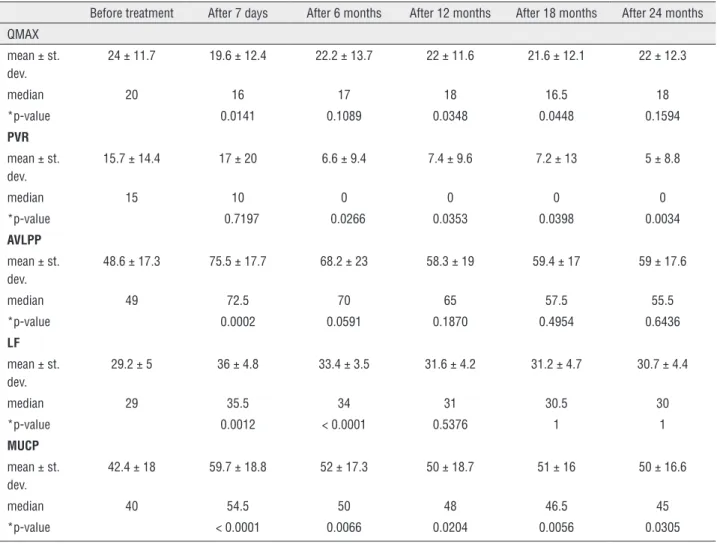
Table-4 describes urodynamic results.
After 7 days Qmax showed a reduction with a subsequent moderate increase. PVR increased only after 7 days without a statistical significance and then decreased.
AVLPP showed a statistically significant in-crease in the controls performed after 7 days and after 6 months, whilst in successive controls values were still higher than pre-operative results, but there was no statistical significance. FL showed a statistically significant increase after 7 days and after 6 months.
MUCP showed a statistically significant increase for all 24 months considered.
Responses to items in the IIQ-7 showed a considerable improvement in the women’s quality of life with a statistical significance that remained until the end of the follow-up (Table-5).
Table 1 - Patients’ characteristics.
Nº of patients at baseline 20
Nº of patients at 24 months 18
Mean age 84.5 (80-87)
Stress urinary incontinence 12
Mixed urinary incontinence 8
Previous anti-incontinence surgery 6
Body Mass Index 27 ( 20-34)
Hypermobility 7
Detrusor overactivity 7
Prolapse 4
Table 2 - Number of pads used by the patients before and after treatment with Bulkamid®.
Number of Pads
Before Treatment
After 7 days After 6 months After 12 months After 18 months After 24 months
mean ± st. dev. 5.5 ± 2.5 0.7 ± 1.6 1.1 ± 2.0 1.5 ± 2.6 1.6 ± 2.7 1.9 ± 2.8
median 5 0 0 0 0.5 1
*p-value < 0.0001 < 0.0001 0.0001 0.0001 0.0002
*Wilcoxon test (paired samples).
Table 3 - Degree of urinary incontinence assessed by stress test before and after treatment with Bulkamid®.
Stress Test
Before treatment After 7 days After 6 months After 12 months After 18 months After 24 months
Degree Patients Patients Patients Patients Patients Patients
- 3 8 7 5 4 4
+ 1 9 8 8 8 8
++ 10 2 3 3 4 3
+++ 6 1 1 3 2 3
*p-value 0.0005 0.0024 0.0135 0.0179 0.0163
Table-6 presents patient evaluations of the results by VAS and PGI-I. After 7 days VAS showed very satisfactory results which remained even af-ter 24 months, albeit with slightly lower values. Similar results were also obtained with PGI-I with
most patients reporting a great improvement after 24 months.
The eight patients with mixed urinary incon-tinence in seven cases had a detrusor overactivity in the urodynamic examination. Three of these seven Table 4 - Urodynamic findings before and after treatment with Bulkamid®.
Before treatment After 7 days After 6 months After 12 months After 18 months After 24 months
QMAX
mean ± st. dev.
24 ± 11.7 19.6 ± 12.4 22.2 ± 13.7 22 ± 11.6 21.6 ± 12.1 22 ± 12.3
median 20 16 17 18 16.5 18
*p-value 0.0141 0.1089 0.0348 0.0448 0.1594
PVR
mean ± st. dev.
15.7 ± 14.4 17 ± 20 6.6 ± 9.4 7.4 ± 9.6 7.2 ± 13 5 ± 8.8
median 15 10 0 0 0 0
*p-value 0.7197 0.0266 0.0353 0.0398 0.0034
AVLPP
mean ± st. dev.
48.6 ± 17.3 75.5 ± 17.7 68.2 ± 23 58.3 ± 19 59.4 ± 17 59 ± 17.6
median 49 72.5 70 65 57.5 55.5
*p-value 0.0002 0.0591 0.1870 0.4954 0.6436
LF
mean ± st. dev.
29.2 ± 5 36 ± 4.8 33.4 ± 3.5 31.6 ± 4.2 31.2 ± 4.7 30.7 ± 4.4
median 29 35.5 34 31 30.5 30
*p-value 0.0012 < 0.0001 0.5376 1 1
MUCP
mean ± st. dev.
42.4 ± 18 59.7 ± 18.8 52 ± 17.3 50 ± 18.7 51 ± 16 50 ± 16.6
median 40 54.5 50 48 46.5 45
*p-value < 0.0001 0.0066 0.0204 0.0056 0.0305
*Wilcoxon test (paired samples).
Table 5 - Quality of life (QoL) assessed by Incontinence Impact Questionnaire short form (IIQ-7).
IIQ-7 Before
treatment
After 7 days After 6 months After 12 months
After 18 months
After 24 months
mean ± st. dev. 19.5 ± 7 3.1 ± 5.7 3.4 ± 5.5 5.3 ± 8.7 5.5 ± 5.7 6 ± 9.3
median 22 0 0 0 0 0
*p-value < 0.0001 < 0.0001 < 0.0001 < 0.0001 0.0001
patients (45%) continued to have urgency after injec-tion therapy with worse clinical results (an average of 5.2 pads a day after 24 months). The six patients who previously underwent suburethral slings showed no clinical and urodynamic differences in the results compared to other patients. Furthermore no differ-ence was found in the results between patients with or without urethral hypermobility as well as in rela-tion to the body mass index.
DISCUSSION
The results of this study seem to confirm the validity of Bulkamid® in the treatment of stress urinary incontinence, even in women of 80 or more years who often suffer from a more severe level of uri-nary incontinence and who have a higher percentage of mix incontinence compared to younger women.
The reduced number of pads used by patients that stays low even 24 months after treatment is most probably the most important result of this study and which leads to a positive evaluation in the responses to items in the questionnaire about QoL and in the results of VAS and PGI-I. Regarding the stress test and urodynamic findings, the good results obtained with the former and the improvement in the urody-namic parameters used in the evaluation of urinary incontinence (AVLPP, LF, MUCP) should be under-lined. These results appear to be in agreement with finding of other authors (6-8).
Results of Qmax and PVR highlight the low obstructing capacity of Bulkamid® with Qmax values significantly reduced only at the 7th day control with values then returning approximately to normal. PVR shows a slight increase only at the 7 day control, then reduces. These results can explain the low incidence of post-treatment urine retention, reported also in other studies (3,5,9).
The presence of urgency and/or detrusor overactivity is very important in elderly women. In our experience 45 percent of patients with detrusor overactivity in the urodynamic study remain with ur-gency, with clinical results lower than patients with-out DO.
In previous articles some authors underlined that injection therapy was contraindicated in patients with DO (10-12). More recently, Chappel et al. (9) claimed that the success of injection therapy was re-duced in patients with DO, but that its use should not be excluded because surgical procedures such as col-posuspension and urethral slings more significantly cause de novo DO. Furthermore, positive results were achieved both in patients with stress incontinence and mixed incontinence (5).
In this study, the presence of previous anti-incontinence surgery (suburethral slings) did not in-fluenced the success of injection therapy. These data are in agreement with those reported by others au-thors (9,13-15).
Body mass index did not affect the results probably because few patients were overweight.
Moreover, Bulkamid® was effective regard-less of the presence or absence of urethral hypermo-bility confirming results described by other authors (16).
The study was partially conditioned by the fact that the patients we evaluated were aged 80 or more years. Almost from the start of the study we ob-served that the patients found it difficult to compile the micturition diary, normally used in this type of study, in particular those patients with severe incon-tinence who were not able correctly to quantify their loss of urine. For this reason we decided not to make use of this tool.
Compilation of the quality of life question-naire was performed under supervision of a physi-Table 6 - Patients’ satisfaction after treatment with Bulkamid®, assessed by Visual Analogue Scale (VAS) and Patient Global Impression of Improvement questionnaire (PGI-I).
After 7 days After 6 months After 12 months After 18 months After 24 months
VAS (mean) 9.0 8.5 8.2 8.2 8.1
PGI-I
cian not involved in the study to facilitate the in-terpretation of the questions without influencing patients’ assessments.
Indeed, the difficulties encountered in un-derstanding the QoL questions represented a pos-sible bias (9).
We also observed how these women were of-ten resigned to their condition and in some cases they only came to request pads. It was rare for them to ask to be cured of incontinence, whilst more often they simply wanted to improve their condition, to be able to lead a better life.
They accepted injection therapy for its char-acteristics of low invasiveness, rapidity of execution, use of local anesthesia, lack of hospitalization and low complication rate. They would not have accepted more invasive surgical procedures preferring to re-main incontinent.
In addition, the elderly woman is often af-fected by chronic diseases therefore more invasive surgical procedures are contraindicated.
Robinson et al. (17) suggested that women would choose to undergo less invasive procedures with a lower risk of complications, even though the chance of cure may be lower than with a major operation.
Although intervention for SUI is generally focused on minimizing urine leakage, the overall im-pact of treatment on patient QoL is arguably more important than the treatment outcome regarding leakage (2). This consideration is even truer for an aging patient. It is thus of great importance to inform elderly women of this treatment opportunity.
Another interesting question is if in elderly patients urodynamic assessment should be performed before injection therapy. Whilst there is no doubt re-garding the need to perform urodynamic assessment before more invasive surgical procedures (colposus-pension, suburethral slings), the evidence base to date supports the view that simple evaluation is adequate before injection therapy (14).
Studies published about injection therapy are numerous and often difficult to evaluate because of their heterogeneity: the various materials used, the technique (transurethral or periurethral), the injection site (bladder neck, mid-urethral), the heterogeneity of patients, the length of follow-up and the differ-ent urodynamic findings (presence of absence of DO).
The results are also heterogeneous with percent-ages of improvement or cure between 40 and 100% (18), 15 and 94% (16). In literature, we found only one study on very old women (older than 75 years) with a percentage of 77% of patients cured or im-proved (19).
In a recent analysis of 500 cases, Mohr et al., in a review of literature, underlined in an elderly population a subjective and objective improvement in incontinence after bulking therapy (8).
In spite of the complexity of the theme and the lack of consistency in results, injection therapy should be seen as an important surgical therapy, in particular in patients who cannot or do not accept to undergo other forms of therapy.
The moderate reduction of the positive ef-fects after 2 years also detected in other surgical procedures performed in patients with urinary in-continence and the occasional necessity to repeat the treatment do not reduce the validity of the therapy and allows a further period of good health. We must also emphasize that these patients have a low life ex-pectancy and every year spent in a satisfactory man-ner is a good result.
CONCLUSIONS
The results of this study showed the effective-ness and low morbidity of Bulkamid® in women of 80 or more years with stress and mixed urinary incon-tinence. In these patients, often affected by chronic diseases and other health problems, this treatment should be considered as first line therapy.
CONFLICT OF INTEREST
None declared.
REFERENCES
1. Meyer L: To tilfælde af incontinentia urinæ helbredede ved parafininjektioner. Ugeskr Læger 1904;104:5.
2. Kotb AF, Campeau L, Corcos J: Urethral bulking agents: techniques and outcomes. Curr Urol Rep. 2009; 10: 396-400. 3. Lose G, Mouritsen L, Nielsen JB: A new bulking agent
4. Bello G, Jackson IT, Keskin M, Kelly C, Dajani K, Studinger R, et al.: The use of polyacrylamide gel in soft-tissue augmentation: an experimental assessment. Plast Reconstr Surg. 2007; 119: 1326-36.
5. Lose G, Sørensen HC, Axelsen SM, Falconer C, Lobodasch K, Safwat T. An open multicenter study of polyacrylamide hydrogel (Bulkamid®) for female stress and mixed urinary incontinence. Int Urogynecol J. 2010; 21: 1471-7.
6. Kuhn A, Stadlmayr W, Lengsfeld D, Mueller MD: Where should bulking agents for female urodynamic stress incontinence be injected? Int Urogynecol J Pelvic Floor Dysfunct. 2008; 19: 817-21.
7. Faerber GJ: Endoscopic collagen injection therapy in elderly women with type I stress urinary incontinence.J Urol. 1996; 155: 512-4.
8. Mohr S, Siegenthaler M, Mueller MD, Kuhn A: Bulking agents: an analysis of 500 cases and review of the literature. Int Urogynecol J. 2013; 24: 241-7.
9. Chapple CR, Wein AJ, Brubaker L, Dmochowski R, Pons ME, Haab F, et al.: Stress incontinence injection therapy: what is best for our patients? Eur Urol. 2005; 48: 552-65.
10. Su TH, Hsu CY, Chen JC: Injection therapy for stress incontinence in women. Int Urogynecol J Pelvic Floor Dysfunct. 1999; 10: 200-6.
11. Bartholomew B, Grimaldi T: Collagen injection therapy for type III stress urinary incontinence. AORN J. 1996; 64: 75-83, 85-6. 12. Appell RA: Collagen injection therapy for urinary
incontinence. Urol Clin North Am. 1994; 21: 177-8.
13. Monga AK, Robinson D, Stanton SL: Periurethral collagen injections for genuine stress incontinence: a 2-year follow-up. Br J Urol. 1995; 76: 156-60.
14. Peeker R, Edlund C, Wennberg AL, Fall M: The treatment of sphincter incontinence with periurethral silicone implants (macroplastique). Scand J Urol Nephrol. 2002; 36: 194-8. 15. Haab F, Zimmern PE, Leach GE: Urinary stress incontinence
due to intrinsic sphincteric deficiency: experience with fat and collagen periurethral injections. J Urol. 1997; 157: 1283-6. Erratum in: J Urol 1997; 158: 188.
16. Lightner DJ, Itano NB, Sweat SD, Chrouser KL, Fick F: Injectable agents: present and future. Curr Urol Rep. 2002; 3: 408-13.
17. Robinson D, Anders K, Cardozo L, et al.: What do women want? Interpretation of the concept of cure. J Pelvic Med Surg. 2003;9:273-7.
18. Chapple CR, Wein AJ, Artibani W, Brubaker L, Haab F, Heesakkers JP, et al.: A critical review of diagnostic criteria for evaluating patients with symptomatic stress urinary incontinence. BJU Int. 2005; 95: 327-34.
19. Zullo MA, Ruggiero A, Montera R, Plotti F, Muzii L, Angioli R, et al.: An ultra-miniinvasive treatment for stress urinary incontinence in complicated older patients. Maturitas. 2010; 65: 292-5.
_______________________ Correspondence address: