Revista Gaúcha
de Enfermagem
DOI: http://dx.doi.org/10.1590/1983-1447.2015.02.49109
Perceived coercion of noninstitutionalized elderly
patients undergoing research for the diagnosis of
temporomandibular joint dysfunction
Avaliação da percepção de coerção em idosos não institucionalizados submetidos a pesquisa para diagnóstico da disfunção temporomandibular
Percepción de coerción en ancianos no institucionalizado sometidos a la investigación para diagnóstico de la disfunción temporomandibular
a Dental surgeon, graduated from the Universidade
Estadual da Paraíba (UEPB), Specialist in Dental Pros-thetics and Temporomandibular Joint Dysfunction, Master of Oral Diagnosis from the Universidade Federal da Paraíba (UFPB), Doctor of Biomedical Gerontology from the Pontifícia Universidade Católica do Rio Grande do Sul (PUCRS), Faculty member of the Escola Técnica de Saúde of the UFPB. João Pessoa, Paraíba, Brazil.
b Doctor, graduated from the Escola Bahiana de
Medicina e Saúde Pública, Master of Cellular and Molecular Biology from the Fundação Oswaldo Cruz, Doctor of Medicine from the Universidade Federal da Bahia, Adjunct Professor of the PUCRS at the Institute of Geriatrics and Gerontology (IGG). Porto Alegre, Rio Grande do Sul, Brazil.
c Biologist, graduated from the Universidade Federal
do Rio Grande do Sul (UFRGS), Master of Education from the UFRGS, Doctor of Medicine: Clinical Medicine from the UFRGS, Professor of the PUCRS at the Insti-tute of Geriatrics and Gerontology (IGG), Researcher in charge of Laboratório de Pesquisa em Bioética e Ética na Ciência of the Experimental Research Center at the Hospital de Clínicas de Porto Alegre. Porto Alegre, Rio Grande do Sul, Brazil.
Maria de Oliveira Alves Cavalcantia Irênio Gomesb
José Roberto Goldimc
ABSTRACT
Objective: To evaluate perceived coercion (PC) of noninstitutionalized elderly patients undergoing research for the diagnosis of tem-poromandibular joint dysfunction.
Method: A cross-sectional study conducted with 1,112 elderly individuals aged 60 or older, enrolled in the Family Health Programme of the municipality of Areia, State of Paraíba, Brazil, from January to June 2013. The data collection tool was the Perceived Cohesion Scale (PSC). Results: The participants were predominantly women (62.5%) in the 60 to 69 age group (45.9%), illiterate (57.9% percent), mar-ried or in a common law marriage (54.1%), retired (83.6%), and receiving a monthly income under the minimum wage (72.0%). The average overall PC was 1.25+ 1.15 and Trend 1 (41,4%). There was a diff erence between the group of individuals who were literate, married and in a common law marriage and the members of the other groups.
Conclusion: Results showed that the elderly patients were minimally coerced when deciding whether to participate in research for diagnosing temporomandibular joint dysfunction. They also revealed a signifi cant association of PC with literacy and marital status. Keywords: Self concept. Health of the elderly. Bioethics. Ethics, research.
RESUMO
Objetivo: Neste estudo, avaliou-se a percepção de coerção (PC) em idosos não institucionalizados submetidos a pesquisa para diag-nóstico da Disfunção Temporomandibular.
Método: Realizou-se estudo transversal com 1.112 idosos, com idade igual ou superior a 60 anos, inscritos no Programa da Saúde da Família do município de Areia, Estado da Paraíba, Brasil, no período de janeiro a junho de 2013. Utilizou-se como instrumento de coleta a Escala de Percepção de Coerção.
Resultados: Houve predominância de pessoas do sexo feminino (62,5%), com faixa etária de 60 a 69 anos (45,9%) não alfabetiza-dos (57,9%), casaalfabetiza-dos ou em união estável (54,1%), aposentaalfabetiza-dos (83,6%) e com renda mensal inferior a um salário mínimo (72,0%). A média geral de PC foi de 1,25+ 1,15 e Moda 1 (41,4%). Houve diferença da PC entre o grupo de alfabetizados, casados e em união estável versus os demais.
Conclusão: Percebeu-se o grupo de idosos pouco coagido ao decidir quanto à sua participação na pesquisa para diagnóstico da Disfunção Temporomandibular, com associação signifi cativa da PC com alfabetização e estado civil.
Palavras-chave: Autoimagem. Saúde do idoso. Bioética. Ética em pesquisa.
RESUMEN
Objetivo: En este estudio se evaluó la percepción de coerción (PC) en personas de edad avanzada, no institucionalizadas sometidas a la investigación para el diagnóstico de los trastornos temporomandibulares.
Método: Se hizo un estudio transversal con 1.112 ancianos de 60 años de edad o mayores, participantes del Programa de Salud de la Familia, en la ciudad de Areia, estado de Paraiba, Brasil, en el periodo de enero a junio del año de 2013. La recolección de datos se hizo con la escala de percepción de coerción.
Resultados: La mayoría de los pacientes eran mujeres (62,5%), de 60-69 años de edad (45,9%), casados o como pareja estable (57,9%), retirados (54,1%), analfabetos (83,6%) y con menos de un sueldo base menual (72,0%). El promedio general de PC fue de 1,25 ± 1,15 y Moda 1 (41,4%). Hubo diferencias de PC entre el grupo de analfabetos, casados o pareja estable en comparación con los demás. Conclusión: Se observó el grupo de ancianos poco coaccionado para decidir participar en la investigación del diagnóstico de los trastornos temporomandibulares, con una asociación signifi cativa de PC con la alfabetización y el estado civil.
INTRODUCTION
With the advance of science, issues like coercion in research become relevant due to the extensive history of abuse and disrespect for human liberty in the pursuit of profi t and technoscientifi c progress. These goals often lead researchers to neglect ethical principles like auton-omy, benefi cence and non malefi cence in the interests of discovery, and adopt practices that solely focus on the desired results(1-2).
From a historical perspective, it can be observed that, in the biomedical fi eld, the fi rst manifestations of the affi rma-tion of respect for the autonomy of individuals in biomed-icine emerged from the context of clinical research with human beings(3).
It is important to recall the Nuremberg trials where Nazi doctors were accused of performing cruel experiments on prisoners. The subsequent Nuremberg Code, which is considered a milestone of research with human beings, is based on respecting the autonomy and expression of will-ingness of research subjects(4).
Along these lines, the Declaration of Helsinki(5) also ad-dressed concerns that the subject of research should be informed in order to make voluntary decisions.
Currently, Resolution CNS 466/2012(6) regulates medical research in Brazil based on the respect for human dignity. From the perspective of individuals and collectivities, this resolution incorporates references of bioethics, such as autonomy, benefi cence, non-malefi cence, and justice and equity, and aims to ensure the rights and duties of research subjects, the scientifi c community and the State.
In addition, bioethics involves complex, shared and interdisciplinary thought on the appropriateness that in-volves life and living(7). Clinical research adopts a more refi ned outlook on aspects relating to the human subject of research, the relationship between researchers and sub-jects, and the risks and consequences of interventions for the subject and society(8).
One of the main concerns of this approach is the in-formed consent procedure, which aims to provide pa-tients with information on the research so they can decide whether or not to voluntarily participate in a study without any form of external pressure(8).
In the consent process, willingness is the ability to de-cide according to one´s best interest, free from external pressure. Individuals who preserve their willingness are capable of organizing their lives based on a set of beliefs, values, interests, desires and goals. These elements ensure that the decisions of each individual are unique. It is also important to know the diff erence between a personal
be-lief or value and the coercion of others or of being embar-rassed to choose a given alternative(8).
Coercion is defi ned as being “every relationship be-tween two or more individuals in which there is an inter-vening element of prestige or authority”(9). Yet, according to the author, “coercion exists to the extent that it is suf-fered or experienced, [...] regardless of the actual degree of existing reciprocity”(10).
In order to validate consent, the absence of coercion during the process must be guaranteed(11).
This specifi c factor can be measured using the Per-ceived Coercion Scale, which derives from a scale that assesses coercion in psychiatric hospitalization called the MacArthur Admission Experience Survey(12).
This study was conducted with an elderly population that, due to its very nature, may appear fragile. This factor and the inherent particularities of aging that imply phys-iological and pathological limitations, in addition to the low level of schooling of this specifi c study group, led re-searchers to perceive the importance of assessing coercion in research that evaluates the presence of temporoman-dibular joint dysfunction. This assessment was considered important because some of the instruments were applied by community health workers who had established a close welfare-based relationship with these elderly people, which could make them feel obliged to participate in the research in question.
Members of health care teams, especially doctors and nurses, should therefore observe the infl uence of the direct and constant contact, based on gratitude and respect, that they establish with patients when conducting research.
In relation to the autonomy or the bioethical principle of respect for individuals, Gerontology discusses the com-petence in dealing with and making decisions, even in comparison with other controlling factors, such as pathol-ogies, cognitive limitations, abuse, culture or the patient’s own family(13).
The aim of this study is to assess perceived cohesion (PC) among an elderly noninstitutionalized population who were undergoing research for the diagnosis of tem-poromandibular joint dysfunction.
METHOD
Biomedical Gerontology of the Institute of Geriatrics and Gerontology of the Pontifícia Universidade Católica do Rio Grande do Sul.
All the stages of this study observed the ethical guide-lines of research involving humans in accordance with Resolution CNS 466/12. The project was submitted to the Research Ethics Committee of the PUCRS and approved in the Plataforma Brasil under Protocol number 180.129.
The participants were invited to take part in this study by community health agents, who were trained by the research-er responsible for the research. All the participants who ac-cepted the invitation signed an informed consent statement. Data were collected from January to June 2013. The sample of the original study on TMD was composed of 1410 elderly individuals. Inclusion criteria were (i) elderly individuals enrolled in the Family Health Programme; (ii) elderly individuals who received home care provided by a community health worker; and (iii) elderly individuals over the age of 60. Exclusion criteria were (i) bedridden patients (the second stage of the study consisted of examining patients at the dental offi ce in the health care unit, which would require transportation); and (ii) patients who failed to answer the questionnaires. The fi nal sample of the study consisted of 1112 individuals. The other individuals stated they did not want to answer the perceived cohesion instru-ment used in this study.
The adopted Perceived Cohesion Scale derives from a scale that is used to evaluate cohesion in psychiatric hos-pitalization called the MacArthur Admission Experience Survey(12), which consists of 16 statements. This instrument was developed using the MacArthur Coercion Study and validated for use in Portuguese by Taborda(3). The coercion scale for research contains 5 statements to which the par-ticipants must agree or disagree. Each statement marked as “I agree” is considered a level of perceived of coercion. The questionnaire is completed in around 5 minutes.
In addition to the instrument of Perceived Coercion, a specifi c questionnaire was applied to diagnose temporo-mandibular joint dysfunction called the Fonseca´s Anam-nestic Index(14). This index contains ten questions on TMD that classify individuals in relation to the presence and se-verity of the dysfunction. This instrument was reassessed by some authors(15) who subsequently confi rmed its valid-ity and reliabilvalid-ity. These data, however, will not be the ob-ject of evaluation in this article.
Sociodemographic information, such as age, gender, household income, occupation, marital status and educa-tion, was also collected,
Descriptive statistics were used to analyze the collected data, namely average, median, mode, standard deviation
and absolute and relative frequencies. Pearson’s Chi-square test was applied to assess the association between the variables. The diff erences between the averages were ob-tained using the F- test. The established signifi cance level was 5% (P = 0.05). Statistical calculations were performed using the Statistical Package for the Social Sciences (SPSS) version 18.0.
RESULTS
The sociodemographic evaluation of the sample of 1112 elderly individuals of the municipality of Areia - Paraíba (Bra-zil) showed that the age of respondents ranged from 60 to 100 years. Average age was 73.32 years, standard deviation was 8.70 years, and the median was 71.00 years.
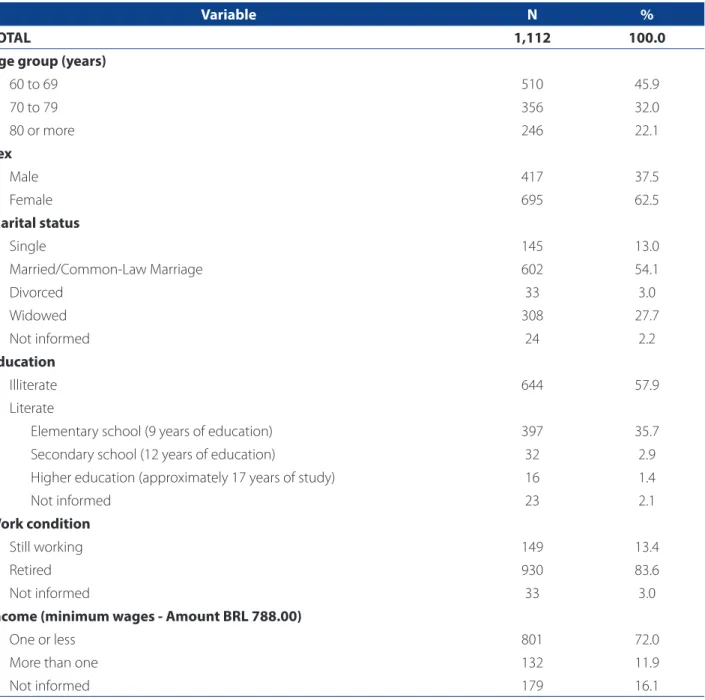
Most of the participants were women (62.5%), between the ages of 60 and 69 years (45.9%), illiterate (57.9%), mar-ried or in a common-law marriage (54.1%), retired (83.6%), and with a monthly income of less than one minimum wage (72.0%) (Table 1).
The overall average obtained using the Perceived Coer-cion Scale was 1.25 + 1.15, from a range of zero to fi ve. The results also ranged from zero (27.0%) to fi ve points (0.1%), and Trend reached one point (41.4%).
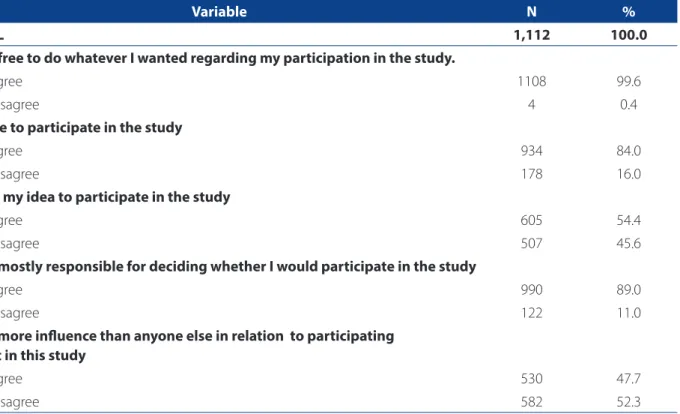
Closer examination of each of the fi ve questions re-vealed a similarity between two of the questions that were answered affi rmatively: “It was my idea to participate in the survey” (54.4%) and “I had more infl uence than anyone else in relation to participating or not in this study” (47.7%). There was one predominant alternative in the other three statements: “I was free to do whatever I wanted regarding my participation” (99.6%), “I was mostly responsible for de-ciding whether I would participate in the study” (89.0%), and “I chose to participate in the study” (84.0%) (Table 2).
There were no diff erences between the values obtained in the Perceived Coercion Scale and the sociodemographic variables of age, sex and income of the participants. Howev-er, there was a signifi cant diff erence in relation to the variable schooling between the participants who were literate and illiterate and those who were married or in a common law marriage, and the other participants. The illiterate individu-als resulted in a perceived coercion average (1.10 +1.06) that was signifi cantly lower (F = 29.65; P = 0.0001) than the av-erage of the literate individuals (1.49+1.25). The participants who were married or in a common law marriage obtained an average (1.19 +1.10) that was lower (F5.90; P = 0.015) than participants with a diff erent marital status (1.34 +1.21).
In relation to education, statement 1 – “I was free to do whatever I wanted regarding my participation in the study”, had no significant association (X 2 = 0.418; P > 0.05). All the remaining questions had significant asso-ciations. There was a significant association for state-ment 2, “I chose to participate in the study”(x2 = 28.86; P = 0.0001), and the illiterate individuals who claimed to have had a choice were proportionally higher than the literate individuals. There was also a significant
as-sociation for statement 3, “It was my idea to participate in the study” (X2 = 7.87; P = 0.003), being that the illit-erate individuals were associated in relation to having had the idea, while the literate individuals disagreed. The significant association in statement 4, “I was most-ly responsible for deciding whether I would participate in the study”(X2=20,46; P=0,0001) was that the num-ber of individuals who claimed they had freely decided to participate was higher than the number of literate
Variable N %
TOTAL 1,112 100.0
Age group (years)
60 to 69 510 45.9
70 to 79 356 32.0
80 or more 246 22.1
Sex
Male 417 37.5
Female 695 62.5
Marital status
Single 145 13.0
Married/Common-Law Marriage 602 54.1
Divorced 33 3.0
Widowed 308 27.7
Not informed 24 2.2
Education
Illiterate 644 57.9
Literate
Elementary school (9 years of education) 397 35.7
Secondary school (12 years of education) 32 2.9
Higher education (approximately 17 years of study) 16 1.4
Not informed 23 2.1
Work condition
Still working 149 13.4
Retired 930 83.6
Not informed 33 3.0
Income (minimum wages - Amount BRL 788.00)
One or less 801 72.0
More than one 132 11.9
Not informed 179 16.1
Table 1 – Sociodemographic distribution of 1,112 noninstitutionalized elderly people registered at the Family Health Pro-gramme of the municipality of Areia - Paraíba (Brazil)
participants. Finally, statement 5, “I had more influence than anyone else in relation to participating or not in this study”, which was equally significant (X2 = 9.72; P = 0.001), indicated that the literate individuals claimed they did not have more influence than anyone else.
With regard to marital status, only statement 1 – “I was free to do whatever I wanted regarding my participation in the study” - and statement 5 - “I had more infl uence than anyone else in relation to participating or not in this study” - showed signifi cant associations. The remaining statements, 2 (X2 = 2.66; P > 0.05), 3 (X2 = 0.654; P > 0.05) and 4 (X2 = 1.817; P > 0.05), showed no signifi cant associations with this variable. Statement 1, “I was free to do whatever I wanted regarding my participation in the study”, had a signifi -cant association (X2 = 4.973; P = 0.04) due to the fact that all participants who disagreed with this statement were not married or in a common-law marriage. The signifi cant association of statement 5, “I had more infl uence than any-one else in relation to participating or not in this study” (X2 = 8.15; P = 0.003), revealed a higher concordance among the individuals who were married or in a common-law marriage and a greater discordance among the remaining participants (51.5% x 43.1%).
DISCUSSION
The scientifi c community is showing an increasing inter-est in ethical appropriateness as the foundation of research with human beings in a way that protects the right of auton-omy, the dignity and the freedom to freely express the will of individuals. Along those lines, the discussion in academia generates ethical queries that trigger refl ection on several aspects involved in preparing and conducting research, and on assessing and controlled coercion in the consent process, which is a key element in ensuring that research subjects are freely exercising their right to choose without embarrass-ment or fragility in the researcher-researched relationship.
The decision to participate in research must be sup-ported by various skills, such as the ability to understand and evaluate the type of questioning, of involvement with the topic and, above all, the capacity to express prefer-ences(16), free from any external factors that characterize relations of fear, submission or subservience between the researcher and the researched.
The evaluation of perceived coercion primarily ob-serves the research subject and the feelings that are aroused during the consent and answering process(3.9).
Variable N %
TOTAL 1,112 100.0
I was free to do whatever I wanted regarding my participation in the study.
I agree 1108 99.6
I disagree 4 0.4
I chose to participate in the study
I agree 934 84.0
I disagree 178 16.0
It was my idea to participate in the study
I agree 605 54.4
I disagree 507 45.6
I was mostly responsible for deciding whether I would participate in the study
I agree 990 89.0
I disagree 122 11.0
I had more infl uence than anyone else in relation to participating or not in this study
I agree 530 47.7
I disagree 582 52.3
Table 2 – Distribution of statements of the Perceived Coercion Scale applied to 1,112 noninstitutionalized elderly individ-uals registered at the Family Health Programme of the municipality of Areia - Paraíba (Brazil).
In this study, 99.6% of the respondents felt free to do whatever they wanted in relation to their participation, 84% said they had chosen to participate in the survey, and 89 % claimed they were mostly responsible for de-ciding whether or not to participate in the study. These data show that willingness was preserved, and the fact that the will and values of these patients were respected corroborates with another study(8). Only 54.5% of partici-pants reported that it had been their idea to participate in the survey. This is consistent with the way in which this type of research is conducted, where the researcher in-vites the researched to participate in the study. However, less than half (47.7%) of the participants claimed that they had more infl uence than anyone else in relation to partic-ipating or not in this study.
There was also a signifi cant association between ceived coercion and education (p<0.01). Average per-ceived coercion among illiterate individuals (1.10 +1.06) was signifi cantly lower (F = 29.65; P = 0.0001) than the average of the literate individuals (1.49+1.25). Schooling is related to cognitive assessment procedures in health care and can lead to diff erences in perception depending on the educational level of individuals(17). Other authors(18), however, claim that people with little schooling may also have a psychological-moral development that allows them to evaluate the alternatives and decide on their best inter-ests. This study revealed that the literate elderly individuals felt more coerced that the illiterate individuals. This can be partly credited to the vulnerability of these populations, that is, more years of education may enable them to per-ceive the possible coercion(19). There was also a signifi cant association between perceived coercion and marital status, especially in the group of participants who were married or in a common-law marriage. This might be explained by the protective factor associated to being in a stable interper-sonal relationship.
It is important to mention that such a study derived from a doctoral thesis that assessed the prevalence and manifestation of orofacial pain and temporomandibular joint dysfunction among the elderly and the impact on their quality of life(20).
CONCLUSIONS
The data obtained with this sample in the conditions of the associated study revealed that the perceived coercion of the participants was low. This result is similar to the fi nd-ings of other studies.
The illiterate participants perceived less coercion than the literate participants.
Individuals who were in stable relationships, whether married or in a common-law marriage, had a lesser percep-tion of coercion than the other individuals. This may be associated with the protective factor provided by a stable emotional bond.
It is of utmost importance that nursing professionals and other health workers who conduct research and provide care comprehend the implicit peculiarities in the profession-al-patient relationship, especially in groups of recognized fragility such as the elderly population. These professionals should also seek to remove all elements of coercion estab-lished by fear or by the authority symbolized in the fi gure of the professional that may lead elderly patients to neglect their best interests when making a decision.
The limitations of this study were the large number of illiterate elderly participants or participants with low ed-ucational levels, which could interfere with their under-standing of the statements and the subsequent responses.
The present study contributes to the practices of health professionals who work directly with research and care by providing additional insight into the topic of coercion that can imperceptibly occur in the exercise of their activities with relatively fragile populations due to their unfamiliarity of lack of awareness on the topic.
Future studies could include literacy as a criterion for inclusion and a comparison with the results of this study.
REFERENCES
1. Volmann J, Winau R. Informed consent in human experimentation before the Nuremberg code. Br Med J. 1996;313(7070):1445-9.
2. Beecher HK. Ethics and clinical research. New England J Med. 1966;274(24):1354-60.
3. Taborda JGV. Percepção de coerção em pacientes psiquiátricos, cirúrgicos e clíni-cos hospitalizados [tese]. Porto Alegre(RS): Universidade Federal do Rio Grande do Sul; 2002.
4. Annas GH, Grodin MA. The nazi doctors and the Nuremberg code. New York: Oxford University Press; 1992.
5. World Medical Association (FR). WMA declaration of Helsinki: ethical princi-ples for medical research involving human subjects [Internet]. Ferney-Voltaire: World Medial Association; c1964- [cited in 07 oct 20]. Available at: http:// www.wma.net/en/30publications/10policies/b3/.
6. Ministério da Saúde (BR). Conselho Nacional de Saúde. Resolução nº 466, de 12 de dezembro de 2012. Diretrizes e normas regulamentadoras de pesquisas envolvendo seres humanos. Diário Ofi cial da União [da] República Federativa do Brasil. 2013 jun 13;150(112 Seção 1):59-62.
7. Goldim JR. Bioética: origens e complexidade. Rev HCPA. 2006;26(2):86-92. 8. Protas JS; Bittencourt VC, Wollmann L, Moreira CA, Fernandes CF, Fernandes MS,
et al. Avaliação da percepção de coerção no processo de consentimento. Rev HCPA. 2007;27(Supl.1):272.
10. Piaget J. Études sociologiques. 3. ed. Genevè: Groz; 1977.
11. Raymundo MM, Goldim JR. Do consentimento por procuração à autorização por representação. Bioethics. 2007;15(1):83-99.
12. Bergk J, Flammer E, Steinert T. “Coercion Experience Scale” (CES): validation of a questionnaire on coercive measures. BMC Psychiatry. 2010;10:5.
13. Saquetto S, Schettino L, Pinheiro P, Sena ELS, Yarid SD, Gomes Filho DL. Aspectos bioéticos da autonomia do idoso. Rev Bioét. 2013;21(3):518-24.
14. Fonseca DM, Bonfante G, Valle AL, Freitas SFT. Diagnóstico pela anamnese da disfunção craniomandibular. RGO. 1994;42(1):23-8.
15. Campos JADB, Carrascosa AC, Bonafé FSS, Maroco J. Severity of temporoman-dibular disorders in women: validity and reliability of the Fonseca Anamnestic Index. Braz Oral Res. 2014;28(1):16-21.
16. Erlen JA. Informed consent: the information component. Orthop Nurs.1994;13(2):75-8. 17. Paine PA. Atitudes sobre o papel de gênero e auto-avaliação de saúde em
mulheres brasileiras de três grupos socioeconômicos. Est Pesqui Psicol. 2001;1(1):[Artigo 8].
18. Bajotto AP, Goldim JR. Avaliação da qualidade de vida e tomada de decisão em idosos participantes de grupos socioterápicos da cidade de Arroio do Meio, RS, Brasil. Rev Bras Geriatr Gerontol. 2011;14:753-62.
19. Guimarães MCS, Novaes SC. Autonomia reduzida e vulnerabilidade: liberdade de decisão, diferença e desigualdade. Rev Bioética. 1999;7(1):[3 telas]. 20. Cavalcanti, MOA. Disfunção temporomandibular e dor orofacial em idosos: o
impacto na qualidade de vida. Porto Alegre [tese]. Porto Alegre (RS): Pontifícia Universidade Católica do Rio Grande do Sul; 2014.
Author’s address:
Maria de Oliveira Alves Cavalcanti
Rua Marieta Steimbach Silva, 106/1402,Miramar 58043-320 João Pessoa – PB
E-mail: [email protected]