Revista Gaúcha
de Enfermagem
DOI: http://dx.doi.org/10.1590/1983-1447.2015.02.46666
Chronic health conditions related to
quality of life for federal civil servants
Condições crônicas de saúde relacionadas à qualidade de vida de servidores federais
Enfermedades crónicas relativos a la calidad de vida de los servidores federales
Luciana Eduardo Fernandes Saraivaa
Lays Pinheiro de Medeirosb
Marjorie Dantas Medeiros Meloc
Manuela Pinto Tiburciod
Isabelle Katherinne Fernandes Costae
Gilson de Vasconcelos Torresf
a Nurse. Masters in nursing from the Nursing graduate program at the Universidade Federal do Rio Grande do Norte (UFRN). Natal, Rio Grande do Norte, Brazil. b Nurse. Masters student of the graduate program in nursing at UFRN. Natal, Rio Grande do Norte, Brazil.
c Nurse. Masters student of the graduate program in nursing at UFRN. Natal, Rio Grande do Norte, Brazil. d Nurse. Working on a PhD through the graduate program in nursing at UFRN. Natal, Rio Grande do Norte, Brazil. e Nurse. PhD adjunct Professor in the Department of Nursing/UFRN. Natal, Rio Grande do Norte, Brazil. f Nurse. Post-doctorate Professor in the Nursing De-partment/UFRN. Natal, Rio Grande do Norte, Brazil.
ABSTRACT
Objective: The aim of this study is to correlate the QOL domains of the civil servants to the type and number of chronic health conditions.
Method: A transversal, quantitative study, conducted at the Department of Civil Servant Assistance of the Federal University of Rio Grande do Norte with 215 civil servants, during the period from March to May 2011.
Results: Among the chronic health conditions studied, there was signifi cant relationship between non-communicable chronic dis-ease and QOL scores, correlating weakly (r <-376; p <0.008) in the other fi elds. It was found that the greater the number of chronic conditions, the lower the values on the QOL scale.
Conclusion: The quality of life of civil servants is negatively infl uenced by chronic health conditions, compromising, in general, their daily work and life activities.
Keywords: Quality of life. Chronic disease. Occupational health. Nursing.
RESUMO
Objetivo: O objetivo desse estudo é correlacionar os domínios da QV dos servidores com o tipo e a quantidade de condições crônicas de saúde.
Método: Estudo transversal, quantitativo, realizado no Departamento de Assistência ao Servidor da Universidade Federal do Rio Grande do Norte com 215 servidores, durante o período de março a maio de 2011.
Resultados: Dentre as condições crônicas de saúde estudadas, constatou-se relação signifi cativa entre a doença crônica não trans-missível e escores de QV, correlacionando-se de modo fraco (r<-376; p<0,008) nos demais domínios. Verifi cou-se que, quanto maior o número de condições crônicas, menores são os valores da escala de QV.
Conclusão: A qualidade de vida dos servidores é infl uenciada negativamente pelas condições crônicas de saúde, comprometendo de forma geral suas atividades diárias de vida e trabalho.
Palavras-chave: Qualidade de vida. Doença crônica. Saúde do trabalhador. Enfermagem.
RESUMEN
Objetivo: El objetivo de este estudio es correlacionar las áreas de la calidad de vida de los servidores al tipo y cantidad de problemas de salud crónicos.
Método: Estudio cuantitativo transversal, realizado en el Departamento de asistencia a la Universidad Federal de Rio Grande do Norte Server con 215 servidores, en el período de marzo a mayo de 2011.
Resultados: Entre las condiciones crónicas de salud, se ha observado una relación signifi cativa entre la enfermedad crónica intrans-ferible y puntajes QOL y se correlacionó débilmente (r <-376; p <0,008) en otras área. Se encontró que cuanto mayor es el número de condiciones crónicas, la parte inferior de los valores de escala QOL.
Conclusión: La calidad de vida de los servidores está infl uenciada negativamente por las condiciones de salud crónicas, que afectan en las actividades cotidianas generales de la vida y el trabajo.
INTRODUCTION
Chronic health conditions have gained singular impor-tance in Brazilian health care, as the country is undergoing a period of transformation that associates an accelerated demographic transition and epidemiological transition expressed by the triple burden of diseases, which are: an unsurpassed agenda of infectious and defi ciency diseases, a major load of external causes and a hegemonic presence
of chronic conditions(1).
Chronic conditions have had an impact on quality of life for individuals and their families. Permanent change, which lasts throughout life, is called a chronic condition. It has a strong impact on relationships with the physical and social environment and causes the individual to adapt to a new lifestyle(2).
According to the World Health Organization, chronic non-communicable diseases are a major health problem in Brazil, aff ecting mainly the poor population and the most vulnerable groups. In 2009, of all causes of death registered
in Brazil, 66.6% were due to non-communicable diseases(3).
Chronic diseases begin and evolve slowly. They last for more than three months and, in some cases, they tend to present in a defi nitive and permanent manner. They have a number of causes, which vary over time, including heredi-ty, lifestyle, exposure to environmental factors and physio-logical factors. Therefore, there are no determined regular
or predictable patterns for chronic conditions(1).
To this end, chronic conditions cause various symp-toms and loss of functional capacity, which is evaluated from the presence and extent of the restrictions imposed on physical capacity. This scale directly aff ects quality of life and is infl uenced by age and the presence of chronic co-morbidities, which act to diminish functional capacity and, consequently, quality of life(4-5).
The impact of chronic conditions on quality of life (QOL) is demonstrated by the relationship between QOL domains by number of chronic conditions, in which the higher the number of chronic comorbidities in one indi-vidual, the lower the QOL scores using an analysis of pain, fatigue, anxiety, depression, physical function, satisfaction with participation in social roles and satisfaction with
par-ticipation in social activities domains(5).
Another item that infl uences the quality of life is the ability to work, which decreases over the years. It is thus correlated to the current scenario of the aging population, resulting in a greater burden of chronic diseases on Brazil-ian health care, with a decreased ability to work at older ages, which, combined, cause negative eff ects on quality of life(1, 6).
Several factors aff ect the quality of life of workers, in-cluding the weekly work hours, age, sex, time basis (full-time, part-time and hourly), type of title, quality of services, satisfaction with the team, relationships at work, working conditions, work shift, and others, which aff ect the
psycho-logical, social relationship, spiritual/religious/personal
be-lief aspects, environment and physical domains(7-8).
Given the aforementioned, and understanding the quality of life as a measure of outcome, which can be used as an indicator for the evaluation of health promotion ac-tions, this study is justifi ed by the benefi ts granted to the civil servants and the institution, such as recognition of the principal quality of life domains that are aff ected, as well as major chronic conditions present in this population, al-lowing for targeted interventions, changes in lifestyle and consequent improvement of QOL. Accordingly, in order to Face these considerations, the main question of this study is formulated: What is the relationship between the quality of life domains for civil servants with chronic diseas-es? To answer this question, the purpose of the study was to correlate the quality of life domains of the servers with the type and number of chronic health conditions.
METHODS
This study derived from a dissertation presented in the Graduate Nursing Program at the Federal University of Rio Grande do Norte (UFRN)(9). It is a descriptive, transversal study with a quantitative approach, conducted at the De-partment of Civil Servant Assistance – DAS of UFRN, in the city of Natal / RN.
The target population for this study consisted of civ-il servants assisted by a member of the multidisciplinary
team, at the DAS outpatient clinic and the Dean of Human
Resources (PRH/UFRN). The sample was made up from the spontaneous demand for the DAS healthcare service and accessibility, totaling 215 civil servants of UFRN, carriers of morbidities defi ned as chronic conditions at the end of data collection, which lasted three months, from March 1 to May 27 2011, during which it was possible to obtain a
suffi cient number of subjects for the sample.
To calculate the sample from civil servants with a
chronic health condition, the Barbetta formula was used(10),
as follows:
N = population size
E0 = tolerable sampling error (5%)
n0 = fi rst approximation of the sample size
n = size of the sample
n = N . n0
N + n0
Calculation of the number of civil servants with chronic health conditions:
N = 465 (155x3) n = 400
So: n = 465 x 400/465 + 400 = 215.02
For sample selection, the following inclusion criteria were elected: being an active or inactive civil servant of the UFRN staff , having at least one chronic health condition, seeking out DAS for outpatient care of any kind, having the cognitive ability to respond to the instrument.
Data collection occurred at the DAS outpatient clinic, individually, respecting the privacy of each participant and, after, the Informed and Clear Consent form was signed. An interview was held for application of the socio-demo-graphic, environmental, labor and health characterization form, and then the SF-36 questionnaire.
The instrument for evaluating health-related quality of life, the Medical Outcome Study 36-Item Short Form (SF-36) questionnaire is calculated based on the values of the questions and transformed into scores by domains, where zero corresponds to the minimum value and 100 the max-imum. Thus, the closer the values of the SF-36 scales are to zero, the more dissatisfi ed we fi nd the civil servant
regard-ing that domain(11).
The SF-36 is a multidimensional instrument, consisting of 36 questions inserted into eight domains: functional ca-pacity (10 items), limitations on physical aspects (4 items), pain (2 items), general health (5 items), vitality (4 items), social functioning (2 items), emotional aspects (3 items) and mental health (5 items), plus a comparative question
between current health and health from a year prior(11).
From the results of the domains, we calculated the scores of the physical health domain, taking the average from the functional capacity, physical aspect, pain, general health and vitality domains, allowing us to broadly view the relationship of the civil servants with the physical aspects
and the interference of chronic conditions on them(11).
Before surveying the morbidities, the diseases found
in categories as established by WHO for chronic health
condition were reclassifi ed, as follows: chronic non-com-municable diseases (doenças crônicas não transmissíveis – DCNTs), persistent mental illness (transtorno mental persistente – TMP), structural and continuous physical dis-ability (defi ciência física contínua e estrutural – DFCE) and
long-term communicable diseases (doenças transmissíveis de longo prazo – DTLPs).
The study followed the basic precepts of the Ethical and Legal Aspects of Scientifi c Research, established in res-olution No. 196/1966 by the National Health Council, the project being assessed by the Ethics Committee of the On-ofre Lopes University Hospital (Hospital Universitário Onof-re Lopes – HUOL), with a concurring opinion and Protocol CEP/HUOL 488/2010 and CAAE nº 0046.0.294.000.10.
The data collected was entered into and arranged in
a spreadsheet using Microsoft Excel 2007 and exported to statistical software used for performing descriptive and inferential analyses of the data – Statistical Package for
So-cial Science (SPSS) version 15.0. As a result, the inferential
statistics allowed the identifi cation of correlations existing between the infl uence of chronic health conditions on
the quality of life of the active and inactive civil servants,
using the Kruskal-Wallis test, and Pearson correlation
co-effi cient (r) and the level of statistical signifi cance was of
5%, (p-value < 0.05), using the Spearman’s rank correlation coeffi cient (ρ).
RESULTS
Of the 215 civil servants studied, 153 were active, with male predominance of (59.1%), in the average age range of 58.3 years ± 8.04, married or in a common-law marriages (72.6%), Catholic (76.3%) and mixed-race (50.7%).
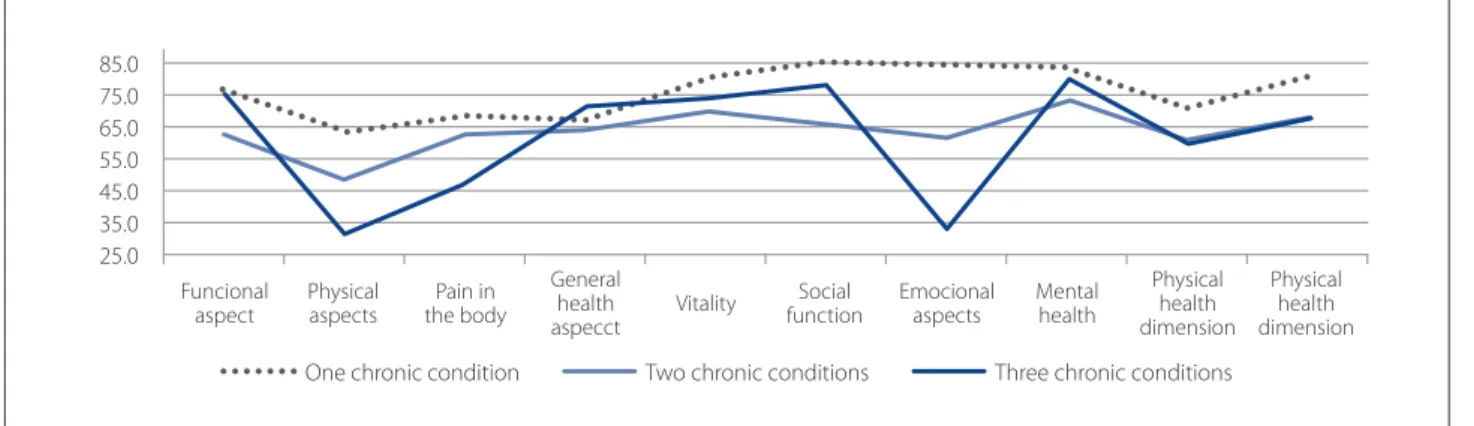
We analyzed the quality of life by domains, regarding the presence of one, two or three chronic health condi-tions. (Figure 1)
According to the results of the Spearman correlation, the correlation was verifi ed as weak and negative in most domains, demonstrating that the greater the number of chronic conditions, the lower the values from the domains of the quality of life scale are.
When analyzing the variance between chronic health conditions and the average quality of life scores, we ob-served a statistical signifi cance between most areas, with the exception of the physical aspect (ρ = 0.154), pain in the body (ρ = 0.469) and general health aspect (ρ = 0,461)
do-mains, which showed no statistical signifi cance. (Table 1)
In an analysis of the behavior of the variance for cate-gories of chronic conditions, it was found that Chronic non-communicable diseases + persistent mental illness and
persistent mental illness presented the lowest scores
(max-imum average of 64.9 points), regardless of the domains, with the exception of the functional aspect (77.1 points).
disability and chronic non-communicable diseases with persistent mental illness and structural and continuous physical disability, it was found that the average varied for both, interfering negatively on quality of life, respectively, in the physical aspect domains (48.3 and 31.2 points), pain in the body (63.8 and 47.5 points), physical health domains (63.8 and 67.7 points) and emotional aspects (33.2 points) for just the three chronic health conditions.
It was also identifi ed that, despite the small number of civil servants aff ected by persistent mental illness (n = 7) and chronic non-communicable disease + persistent men-tal illness (n = 29), these categories are most related to a decrease of the quality of life scores.
For a better understanding of which chronic health condition interferes the most with the quality of life of the
civil servants, we decided to analyze the correlations by
category and by domains of the SF-36. (Table 2)
Among the chronic health conditions studied, the sta-tistical analysis showed a signifi cant relationship between chronic non-communicable disease and quality of life scores, correlating weakly, negatively and signifi cantly in
the other domains.
The correlation between the chronic health condition
categories and quality of life showed that persistent men-tal illness and chronic non-communicable disease with persistent mental illness had a statistically signifi cant
cor-Figure 1 – Averages of the domains of the SF-36 according to the number of chronic conditions of the civil servants cared for at the DAS/UFRN. Natal/RN, 2011
Source: Research data, 2011. Funcional
aspect
Physical aspects
Pain in the body
General health aspecct
Vitality functionSocial Emocional aspects Mental health
Physical health dimension
Physical health dimension
25.0 35.0 45.0 55.0 65.0 75.0 85.0
One chronic condition Two chronic conditions Three chronic conditions
Domains of the SF-36
Categories of chronic health conditions DCNT1
(n=143)
TMP2
(n=7)
DFCE3
(n=2)
DCNT + DFCE (n=30)
DCNT +TMP (n=29)
DCNT, TMP +
DFCE (n=4) ANOVA (p-value)
Domains % % % % % %
Mental Health 84.7 53.7 100.0 83.6 62.3 80.0 0.001
Social Function 87.1 53.8 69.0 71.4 59.6 78.2 0.001
Emotional Aspects 86.7 19.0 100.0 82.2 40.2 33.2 0.001
Vitality 80.5 55.0 87.5 77.8 61.7 73.7 0.001
Functional aspect 75.2 77.1 100.0 60.1 64.8 75.0 0.016
Pain in the body 68.4 63.7 80.5 63.8 60.9 47.5 0.469
General Health Aspect 67.0 60.8 76.0 68.5 59.1 71.5 0.461
Physical Aspects 63.9 60.7 62.5 48.3 49.1 31.2 0.154
Table 1 – Averages of the domains of the SF-36 according to the chronic health condition categories of the civil servants cared for at the DAS/UFRN. Natal/RN, 2011 (n = 215)
Source: Research data, 2011.
relation for both, in the mental health and social function domains, emotional aspects and mental health domain.
It was demonstrated that structural and continuous physical disability contributed to poor quality of life, hav-ing a weak, negative and signifi cant correlation only for the mental health domain (r = -0.151; p = 0.026), functional as-pect (r = -0.136; p = 0.047) and the mental health domain (r = -0.049; p <0.001).
DISCUSSION
We observed that the higher the number of chron-ic conditions, the lower the values of the domains of the quality of life scale, where the most aff ected domains were
the physical and emotional aspects. This implies that the
presence of two or more chronic conditions caused the
most diffi culty to the performance of daily activities and
caused changes in work as a result of impaired physical health and emotional problems.
Studies show that patients with two or more chronic conditions suff er changes that have a major impact on their quality of life, compared to those patients who have only one chronic condition. These fi ndings corroborate
the results of our study, since affl icted the civil servants
affl icted with a chronic health condition had better
over-all total scores, followed by those with two, and three chronic health conditions, who had a lower mean total score(12-13).
By analyzing the variance between chronic health con-ditions and the average quality of life scores, the results show that the mental health, emotional, social function, vi-tality, functional aspect, mental health and physical health domains are statistically signifi cant. It was also found that despite the small number of civil servants aff ected by Per-sistent Mental Illness (TPM) along with Chronic Non-com-municable Diseases (NCDs), these categories are most re-lated to a decrease in the quality of life scores.
A study performed with individuals from 27 diff erent countries, with and without mental health issues, showed, in its results, that people with mental disorders may be at
a greater risk of losing their jobs, and have diffi culties in
getting a new job, compared with those who do not have
mental health issues(14).
One has to think that mental disorders aff ect civil ser-vants in the full production phase of development by in-creasing 4-14 times the odds of the employees declaring that their capacity to work is insuffi cient, as the study of 423 doctors at a hospital in the Netherlands shows, limiting
them to work and daily activities(15).
In Brazil conducted a study in the Family Health Unit was conducted, using 113 patients with TMP to assess the quality of life and the perception of disease among hyper-tensive patients. There was impairment in all domains of the quality of life scale, suggesting that the chronicity of hypertension can lead to impairment of the individual’s quality of life(16).
Domains of the SF-36
Chronic health condition categories
DCNT1 TMP2 DFCE
3
TMP
DCNT +
DFCE DCNT + TMP
DCNT, TMP + DFCE
R (ρ) r (ρ) r (ρ) R (ρ) r (ρ) r (ρ)
Mental health -0.248 (0.001) 0.160 (0.019) -0.152 (0.026) -0.019 (0.783) 0.319 (0.001) 0.008 (0.906)
Social Function -0.355 (0.001) 0.141 (0.038) 0.024 (0.723) 0.101 (0.140) 0.293 (0.001) 0.036 (0.597)
Emotional Aspects -0.376 (0.001) 0.284 (0.001) -0.063 (0.356) -0.046 (0.498) 0.378 (0.001) 0.147 (0.031)
Vitality -0.226 (0.001) 0.068 (0.319) -0.053 (0.436) -0.019 (0.779) 0.307 (0.001) 0.010 (0.887)
Functional aspect -0.180 (0.008) -0.046 (0.506) -0.136 (0.047) 0.183 (0.007) 0.125 (0.068) 0.001 (0.987)
Pain in the body -0.109 (0.112) 0.018 (0.791) -0.048 (0.486) 0.034 (0,619) 0.085 (0.214) 0.087 (0.204)
General Health
Aspect -0.074 (0.279) 0.049 (0.472) -0.040 (0.564) -0.036 (0.604) 0.128 (0.062) -0.009 (0.897)
Physical Aspects -0.173 (0.011) -0.014 (0.837) -0.012 (0.858) 0.117 (0.087) 0.096 (0.162) 0.091 (0.183)
Table 2 – Correlation between the scores of the domains of the SF-36 and the categories of chronic health conditions of the civil servants cared for at the DAS/UFRN. Natal/RN, 2011 (n = 215)
Source: Research data, 2011.
A study conducted in Australia, with the objective of examining the impact that depression and cardiovascular disease have on the worker’s life, shows that the presence of these comorbidities, simultaneously or separately, inter-feres with the workday. When presented simultaneously (depression and cardiovascular disease), the probability of generating losses at work is eight times higher, as the result
of absenteeism(17).
The results show a signifi cant correlation between chronic health condition categories and quality of life do-mains. Among the chronic conditions, chronic non-com-municable disease and quality of life scores correlate weak-ly and negativeweak-ly, particularweak-ly in the mental health domain.
The correlation between the chronic health condition
cat-egories and quality of life showed that persistent mental illness and chronic non-communicable disease with per-sistent mental illness had a statistically signifi cant correla-tion, revealing a decrease in the quality of life with relation to psychosocial capacity. And yet, it is clear that structural and continuous physical disability contributed to worsen-ing the quality of life.
A study conducted in the Netherlands, for the purpose of evaluating the contribution of chronic non-communi-cable diseases to the total burden of disability in mobility and daily activities among older people, demonstrates, in its results that those primarily responsible for fostering the
inability were cardiovascular diseases and arthritis(18).
A study conducted in South Carolina, in order to evalu-ate the association between the presence of COPD (chron-ic obstructive pulmonary disease) and quality of life scores, showed, in its results, that patients with COPD reported 14 days or more of mentally unhealthy days, and 14 days or more of limitations to their activities, in the last 30 days, as compared to respondents who did not have COPD, demonstrating that individuals with chronic obstructive pulmonary disease have a lower quality of life compared to
those without the disease(19).
A study on quality of life as related to DFCE, done with paraplegic individuals, following the methodology adopt-ed by the WHO, showadopt-ed a statistically signifi cant diff erence between the domains studied, where the environmental and physical obtained the worst evaluation scores, and the highest scores in the evaluation belonged to the
psycho-logical and social relationships domains(20).
Finally, the amount of information generated by the
values of various domains indicates the presence of a
cor-relation between CCS categories with all the quality of life scales analyzed for the civil servants, within the diff erent aspects of the SF-36. Thus, we can infer that the presence of CCS negatively eff ects the quality of life, causing active
and inactive civil servants impairment of their daily activi-ties, over the years, due to the aff ected morbidity.
CONCLUSION
With relation to the quality of life of the SF-36, coupled with the presence of the CCS number, in one, two or three, we verifi ed a weak and negative correlation between the domains, presenting as statistically signifi cant to the func-tional aspect, physical, vitality, social function , emofunc-tional, mental health, physical health and mental health domains, indicating that the greater the number of chronic condi-tions, the lower the values on the Quality of Life Scale. The most aff ected domains were the physical and emotional
aspects, especially for those aff ected with three CCS.
When analyzing the variance of chronic health condi-tion categories, in relacondi-tion to the SF-36 scores, it was found that the respondents aff ected with DCNT+TMP or TMP obtained the lowest levels of quality of life and the DFCE
category had the highest quality of life scores.
When analyzing correlations of the CCS category with the domains of quality of life scores, they indicated
that DCNT presented a relevant distribution in the study group, and a weak and negative (r <-376), but signifi cant (p <0.008) correlation with the mental health, social function-ing, emotional functionfunction-ing, vitality, physical features and functional aspect domains, as well as in the areas mental and physical health.
Among the CCS categories, it was found that TMP and DCNT+TMP showed a weak and statistically signifi cant correla-tion, leading to a drop of the SF-36 scores in several domains.
From this, we concluded that understanding the qual-ity of life of UFRN civil servants, with chronic health con-ditions, measured using the generic SF-36 instrument, provides indicators for tracking and identifi cation of health care needs, subsidizing the decisions made regarding pri-orities in the health care and nursing actions intended for civil servants, as well as resource allocation.
Finally, as for the limitations of the study, the diffi culty in
the application of the instrument with regards to the struc-tural similarity of the sixth and tenth questions stands out, resulting in doubt among the study subjects.
REFERENCES
1. Mendes EV. O cuidado das condições crônicas na atenção primária à saúde: o imperativo da consolidação da estratégia da saúde da família. Brasília (DF): Or-ganização Pan-Americana da Saúde; 2012.
3. Brazil. In: Health in the Americas 2012 edition: country volume [Internet]. Brasília: Pan American Health Organization; 2012. p. 129-145. Available at: http://www.paho.org/saludenlasamericas/index.php?option=com_doc-man&task=doc_view&gid=118&Itemid=
4. Campolina AG, Dini PS, Ciconelli RM. Impacto da doença crônica na qualidade de vida de idosos da comunidade em São Paulo (SP, Brasil). Ciênc Saúde Coletiva [Internet]. 2011 [cited 2013 aug. 12];16(6):2919-25. Available at: http://www. scielo.br/pdf/csc/v16n6/29.pdf
5. Rothrock NA, Hays RD, Sprintzer K, Yount SE, Riley W, Cella D. Relative to the general US population, chronic diseases are associated with poorer health-related quality of life as measured by the Patient-Reported Out-comes Measurement Information System (PROMIS). J Clin Epidemiol [Internet]. 2010 [cited 2013 aug. 12];63(11):1195-204. Available at: http://www.ncbi.nlm.nih.gov/pmc/articles/PMC2943571/pdf/ni-hms203742.pdf
6. Costa CSN, Freitas EG, Mendonça LCS, Alem MER, Coury HJCG. Capacidade para o trabalho e qualidade de vida de trabalhadores industriais. Ciênc Saúde Coletiva [Internet]. 2012 [cited 2013 aug. 12];17(6):1635-42. Available at: http://www. scielosp.org/pdf/csc/v17n6/v17n6a26.pdf
7. Koetz L, Rempel C, Périco E. Qualidade de vida de professores de instituições de ensino superior comunitárias do Rio Grande do Sul. Ciênc Saúde Coletiva [In-ternet]. 2013 [cited 2013 aug. 12];18(4):1019-28. Available at: http://www. scielosp.org/pdf/csc/v18n4/15.pdf
8. Souza SBC, Tavares JP, Macedo ABT, Moreira WP, Lautert L. Infl uência do turno de trabalho e cronotipo na qualidade de vida dos trabalhadores de enfermagem. Rev Gaúcha Enferm [Internet]. 2012 [cited 2013 aug. 15];33(4):79-85. Availa-ble at: http://www.scielo.br/pdf/rgenf/v33n4/en_10.pdf
9. Saraiva LEF. Qualidade de vida do servidor da Universidade Federal do Rio Gran-de do Norte em condição crônica Gran-de saúGran-de [dissertação]. Natal (RN): Centro Gran-de Ciências da Saúde, Universidade Federal do Rio Grande do Norte; 2011. 10. Barbetta PA. Estatística aplicada às ciências sociais. 7. ed. Florianópolis: UFSC;
2007.
11. Ciconelli RM, Ferraz MB, Santos W, Meinão I, Quaresma MR. Tradução para o português e validação do questionário genérico de avaliação de qualidade de vida: medical study sf-36 item short form health survey (SF36). Rev Bras Reu-matol. 1999;(39)3:143-50.
12. Brettschneider C, Leicht H, Bickel H, Dahlhaus A, Fuchs A, Gensichen J, et al. Relative im-pact of multimorbid chronic conditions on health-related quality of life: results from the MultiCare Cohort Study [Internet]. PLoS One. 2013 [cited 2014 aug. 12];8(6):e66742. Available at: http://www.ncbi.nlm.nih.gov/pmc/articles/PMC3691259
13. Horta PM, Cardoso AH, Lopes ACS, Santos LC. Qualidade de vida entre mulheres com excesso de peso e doenças crônicas não transmissíveis. Rev Gaúcha Enferm. 2013;34(4):121-9.
14. Evans-Lacko S, Knapp M, McCrone P, Thornicroft G, Mojtabai R. The mental health consequences of the recession: economic hardship and employment of people with mental health problems in 27 European countries. PLoS One. 2013;8(7):e69792.
15. Ruitenburg et al. The prevalence of common mental disorders among hospital physicians and their association with self-reported work ability: a cross-section-al study. BMC Hecross-section-alth Servi Res. 2012;12:292-8.
16. Carvalho MV, Siqueira LB, Sousa ALL, Jardim PCBV. A infl uência da hipertensão arterial na qualidade de vida. Arq Bras Cardiol. 2013;100(2):164-74.
17. O’Neil A, Williams EM, Stevenson CE, Oldenburg B, Sanderson K. Co-morbid depression is associated with poor work outcomes in persons with cardiovas-cular disease (CVD): a large, nationally representative survey in the Australian population. BMC Public Health. 2012;12:47.
18. Klijs B, Nusselder WJ, Looman CW, Mackenbach JP .Contribution of chronic dis-ease to the burden of disability. PLoS ONE. 2011;6(9):e25325.
19. Antwi S, Steck SE, Heidari K. Association between prevalence of chronic obstruc-tive pulmonary disease and health-related quality of life, South Carolina, 2011. Prev Chronic Dis. 2013;10:130192.
20. França ISX, Coura AS, França EG, Basílio NNV, Souto RQ. Qualidade de vida de adultos com lesão medular: um estudo com WHOQOL: bref. Rev Esc Enferm USP. 2011;45(6):1364-71.
Author’s address:
Gilson de Vasconcelos Torres
Rua das Massarandubas, 292, Nova Parnamirim 59150-630 Parnamirim – RN
E-mail: [email protected]