www.eerp.usp.br/rlae
Corresponding Author: Mariza Silva de Oliveira Rua 7, Casa 31 Bairro: Itaperi
CEP: 60761-310, Fortaleza, CE, Brasil E-mail: [email protected]
Evaluation of an educational handbook as a knowledge-acquisition
strategy for mastectomized women
1Mariza Silva de Oliveira
2Míria Conceição Lavinas Santos
3Paulo César de Almeida
4Marislei Sanches Panobianco
5Ana Fátima Carvalho Fernandes
6This descriptive, cross-sectional and quantitative study presents an analysis of knowledge
acquired by mastectomized women concerning breast cancer after reading an educational
handbook. The sample was composed of 125 women. Data were collected in a specialized
cancer facility in three phases: preparatory, operational I and operational II. As to the
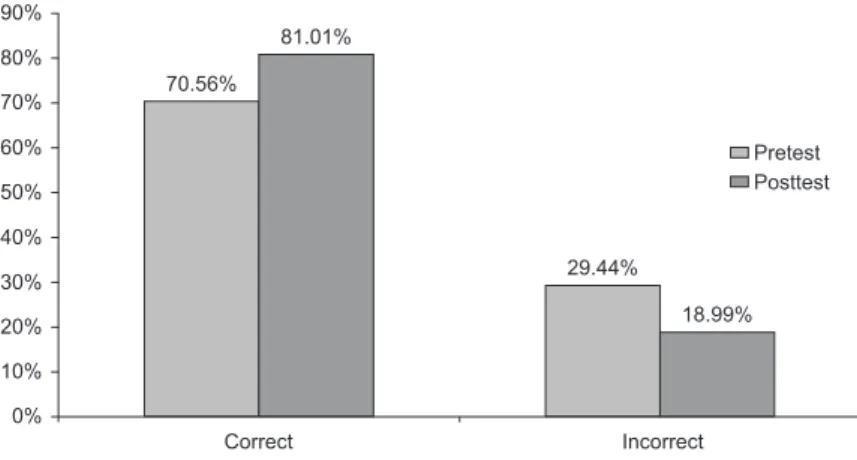
knowledge acquired, the posttest showed an 11% increase in the number of correct answers
compared to the pretest. The most frequent correct answer regarded a question asking the
name of the surgery (97.60%) while the question concerning breast reconstruction obtained
the lowest number of correct answers (58.40%). Answers to all the questions significantly
improved in the posttest, with the exception of a question addressing breast reconstruction
(p=0.754). The assessment of knowledge showed positive results after reading, suggesting
that cognition is essential to understanding and adhering to guidance, thus the handbook is
a favorable resource to be used in the rehabilitation of mastectomized women.
Descriptors: Breast Neoplasms; Evaluation of Research Programs and Tools; Knowledge.
1 Paper extracted from Doctoral Dissertation “Promoção da saúde à mulher mastectomizada: avaliação de estratégia educativa”,
presented to Universidade Federal do Ceará, Brazil.
2 PhD, Coordinator, Faculdade de Ensino e Cultura do Ceará, Brazil. 3 RN, PhD, Instituto Nacional de Câncer, Brazil.
4 PhD, Professor, Universidade Federal do Ceará, Brazil.
5 PhD, Professor, Escola de Enfermagem de Ribeirão Preto, Universidade de São Paulo, WHO Collaborating Centre for Nursing Research
Development, Brazil.
Avaliação de manual educativo como estratégia de conhecimento para mulheres mastectomizadas
Trata-se de estudo descritivo, transversal e quantitativo, cujo objetivo foi analisar o
conhecimento de mastectomizadas sobre os aspectos que envolvem o câncer de
mama, pela leitura de um manual educativo. A amostra correspondeu a 125 mulheres.
A coleta foi realizada em uma instituição especializada em oncologia, em três fases:
preparatória, operacional I e operacional II. Quanto ao conhecimento adquirido, o
pós-teste evidenciou aumento de 11% nos acertos, quando comparado ao pré-pós-teste. Das
questões, a mais acertada refere-se ao nome da cirurgia (97,60%) e a que obteve
menos acertos relaciona-se à reconstrução mamária (58,40%). Em todas as respostas
do pré-teste observou-se melhora estatisticamente signiicante, exceto naquela que diz
respeito à reconstrução mamária (p=0,754). A avaliação do conhecimento apresentou
resultados positivos após a leitura, evidenciando que a cognição é fundamental para a
compreensão das orientações e consequente adesão, tornando-se recurso favorável à
reabilitação de mulheres mastectomizadas.
Descritores: Neoplasias da Mama; Avaliação de Programas e Instrumentos de Pesquisa;
Conhecimento.
Evaluación de manual de educación como una estrategia para el conocimiento de las mujeres con mastectomía
Estudio descriptivo, transversal y cuantitativo, con objetivo de analizar el conocimiento
de mujeres con mastectomía acerca de cuestiones relacionadas al cáncer de mama,
mediante la lectura de manual educativo. La muestra correspondió a 125 mujeres. La
colección de datos se realizó en una institución especializada en oncología, con las fases:
preparación, funcionamiento I y II. El conocimiento adquirido, el post-test mostró un
aumento del 11% en visitas cuando se compara con la pre-prueba. La cuestión con mayor
éxito fue sobre el nombre de la cirugía (97,60%) y la de menor, fue la reconstrucción
de la mama (58,40%). En todos los asuntos que habían mejorado las respuestas
estadísticamente signiicativas en el post-test, excepto en la reconstrucción de la mama
(p=0,754). La evaluación de conocimientos señaló resultados positivos después de la
lectura, sugiriendo que el conocimiento es fundamental para comprensión y adhesión a
las orientaciones, convirtiendo en un recurso favorable para la rehabilitación de mujeres
con mastectomía.
Descriptores: Neoplasias de la Mama; Evaluación de Programas e Instrumentos de
Investigación; Conocimiento.
Introduction
The promotion of breast health among women can
be translated into actions that encourage protection in
relation to certain environmental factors and lifestyles,
which could be individually or collectively directed to the
search for a reduced incidence of breast cancer. Such
actions would permit, as recommended in one of the
principles of health promotion, a greater participation by
women in the control of this process, understanding and
sharing reasons, causes and consequences of breast
cancer as a strategy to actually improve health in the
face of the disease(1-2).
Given this context, it is worth noting that
studies have shown that breast surgery together with
cause unfavorable physical and emotional problems
in the lives of women affected(3). To cope with aspects
inherent to a mastectomy, women need support that enables more effective care, minimizing the risk of
complications resulting from the surgical process. It
is believed that this deicit of knowledge is present in
women before they experience the situation of having breast cancer. As observed in practice, they arrive at the
healthcare service with incipient knowledge concerning
the disease and in some cases, have never implemented practices or care that would enable them to detect the
disease earlier(4).
Currently, however, the emphasis is on replacing traditional care practices, which are focused on diseases,
with an early detection and health promotion program.
Among some practices that are replacing others, health
education implemented with the use of printed materials can be essential.
Health education is a tool to empower citizens that
emphasizes the patient as a potentially creative and sensitive being in which the education-care process
occurs in a horizontal, dialogical, reciprocal and truly
human relationship(5).
Nursing professionals currently focus on the quality
of care provided to patients and handbooks are a useful
strategy to facilitate guidance provided to patients and
family members concerning the treatment, recovery, and self-care process. The use of educational material and
tools facilitates and standardizes instructions that need
to be learned to implement care. At the same time, such tools help individuals to better understand the
health-disease continuum and follow the path to recovery(6).
Given the high incidence of breast cancer and the delayed search for health services by female patients,
this population needs to be sensitized to the importance
of implementing health promotion and breast cancer
prevention actions. Hence, this study’s objective was to analyze the knowledge acquired by mastectomized
women concerning aspects involving breast cancer after
reading an educational handbook.
Method
This is a descriptive and cross-sectional study with
a quantitative approach. The cross-sectional design
was chosen because it includes all the individuals from a population at the time data is collected. Additionally,
it is economical because it enables the investigation
of many variables at the same time, the comparison among subgroups, and allows the evaluation of health
programs and deinition of further studies(7-8).
The study was conducted from April to August 2009
in a philanthropic hospital facility that provides highly
complex services at an ambulatory and hospital level
in the city of Fortaleza, CE, Brazil. This facility was a
referral center for the diagnosis and treatment of cancer
patients and provided care to patients included in the
Brazilian Unique Health System (SUS), those with health
insurance plans and private clients in the state of Ceará.
The study’s population included (N=497) women
with breast cancer who underwent breast surgery in
2008 at this facility. Based on this information, the
study’s sample was computed with a level of signiicance ixed at 5% (t5%=1.96), and an absolute sample error of
5%, totaling 112 individuals. We added an extra 10%
of participants to take into account potential losses and
biases during the data collection process. Hence, the
inal sample was composed of 125 women.
The sample selection (N=125) was systematic
according to the demand of the studied facility
(postoperative/hospitalized patients) and previously
established inclusion criteria.
The inclusion criteria were: being older than 18
years of age; residing in the city where the study was
conducted to enable later contact, if necessary, with the
participants; not having any condition impeding reading
and comprehending the text; having attending more
than ive years of schooling as recommended in the
previous study that validated the handbook(9).
The studied educational handbook refers to a
compendium of instructions concerning breast cancer
and aspects related to its surgery and the treatment
and rehabilitation of mastectomized women, validated
by this study’s primary author in 2008(9). Those not
meeting the inclusion criteria were not included in the
study.
Data were collected through semi-structured
interviews implemented at three different points in
time: the preparatory, operational I, and operational II
phases. In the preparatory phase, we became familiar
with the study setting, and selected the sample and the
units where data would be collected.
The second phase, operational I, corresponded to
the application of the pretest. The questionnaire was
applied before the educational handbook was handed to
the participants. Then a second meeting was scheduled
according to the patients’ convenience and the time
required to read the handbook. The pretest questionnaire
was composed of three parts: the irst addressed
socio-demographic data, the second addressed
pathology, and the third part assessed knowledge.
This last part had multiple-choice questions, based on
the subjects addressed in the educational handbook(9)
such as: breast cancer prevention, treatment, pre- and
postoperative care, rehabilitation, rights and legislation.
It is worth noting that all the questions were based
on information provided in the handbook, providing
questions of easy, medium, and high levels of dificulty.
The third phase, operation II, is the posttest
after reading the educational handbook. The posttest
questionnaire only assessed knowledge, that is, it was
equivalent to the third part of the pretest questionnaire
and the scale that assessed the questionnaire. We
decided to present the same questions to verify
acquisition of knowledge through the number of correct
answers. The time elapsed between the operational
phases I and II was 15 days on average.
The data were processed in the Statistical Package
for Social Sciences (SPSS) version 15.0 through
descriptive analysis of the variables presented in
graphics and tables, and bivariate analysis through the
McNemar test.
Aiming to analyze the occurrence of knowledge
acquisition after reading the handbook, the four possible
answers to each of the questions (a, b, c and d) were
transformed into two options (correct or incorrect).
Because this is a qualitative nominal and dichotomous
variable and we wanted to compare the dependent
variables (pretest and posttest), the McNemar
non-parametric test was used.
Inferential analyses were considered statistically
signiicant when p<0.05.
This study was submitted to and approved by the
Ethics Research Committee at the Ceará Cancer Hospital
(Protocol No. 005/2009). In accordance with Resolution
196/96, the participants voluntarily provided written
consent after being informed of the study’s objectives,
their right to withdraw from the study at any time, and
conidentiality was ensured.
Results
The ages of the participants (N=125) ranged from
24 to 84 years old; the range 46-60 years old was the
most frequent (44%), with an average of 51.66 years old
and SD=±12.23. With regard to schooling, 44.8% had
either complete or incomplete primary school, 33.6%
had completed secondary school, and 21.6% had higher
education. In relation to family income, 44.8% earned
up to one time the minimum age, and 23.4% from three
to seven times the minimum wage, with a total average
of 2.57 times the minimum wage (SD=±2.82).
The knowledge acquired by mastectomized women
concerning the aspects involving breast cancer was
assessed through the application of a questionnaire with
questions related to the subject, before and after reading
the educational handbook. It should be noted that
after reading the instrument, the percentage of correct
answers increased approximately 11%. Therefore, we
considered the participants to have acquired knowledge
by reading and understanding of information.
Figure 1 presents the percentage of correct and
incorrect answers obtained by women before and after
reading the educational handbook.
70.56%
81.01%
29.44%
18.99%
Correct Incorrect
90%
80%
70%
60%
50%
40%
30%
20%
10%
0%
Pretest Posttest
Figure 1 – Distribution of knowledge acquisition according to the
comparison of correct and incorrect answers obtained before and after
Figure 2 presents the distribution of correct answers
according to the level of dificulty of the questions and test phase. The women signiicantly increased their
knowledge during the posttest, even when questions are
divided by the degree of complexity (easy, medium and
dificult). The results show improvement at all levels, including in relation to dificult questions.
It is worth noting that the criteria used to establish
the levels of dificulty, presented in the pre- and posttest questions were the complexity and speciicity of the
addressed subject in relation to the aspects involving
breast cancer.
Pretest Posttest
Easy Medium
90%
80%
70%
60%
50%
40%
30%
20%
10%
0% 100%
Difficult
84.80% 91.36%
65.60% 76.80%
61.28% 74.88%
Figure 2 – Distribution of the number of correct answers according to degree of
dificulty in the pre- and posttest questions.
Table 1 presents the statistical analysis concerning
knowledge acquisition through the questionnaires
applied in the pretest and posttest phases. The data
were compared between the two phases through a
non-parametric test, the McNemar χ2 test. The number
of correct and incorrect answers was compared in the
questionnaires applied before and after reading the
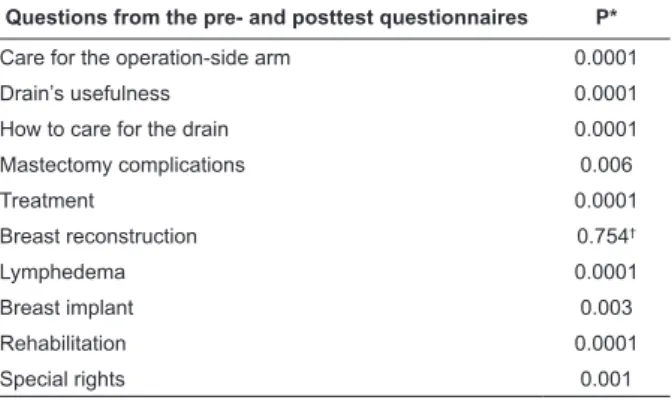
educational handbook. Table 1 shows that all the items
in the questionnaires present statistically signiicant differences (p<0.05), that is, the participants performed
better in the posttest, with the exception of question 11,
which refers to breast reconstruction (p=0.754); the
McNemar χ2 test did not present statistically signiicant
difference.
Questions from the pre- and posttest questionnaires P*
Care to prevent cancer 0.030
Breast self-exam 0.0001
How to proceed when a nodule is noticed 0.0001
Mammography 0.0001
Surgery’s name 0.0001
Table 1 – Evaluation of the participants’ knowledge
according to the pre- and posttest questionnaire using
the McNemar χ2 test. Fortaleza, CE, Brazil, 2009
Questions from the pre- and posttest questionnaires P*
Care for the operation-side arm 0.0001
Drain’s usefulness 0.0001
How to care for the drain 0.0001
Mastectomy complications 0.006
Treatment 0.0001
Breast reconstruction 0.754†
Lymphedema 0.0001
Breast implant 0.003
Rehabilitation 0.0001
Special rights 0.001
(continue...)
Table 1 - (continuation)
* McNemar χ2 test
† Does not apply because p<0.05 is considered
Figure 3 shows the percentage of questions
correctly answered in the posttest. We note that the
percentage of correct answers was above 50% on all
the questions, though, question 11, addressing breast
reconstruction, obtained the lowest number of correct
answers. In contrast, Question 5, which addresses
knowledge concerning the name of the surgery to
remove the breast, obtained the highest number of
Q1 Q2 Q3 Q4 Q5 Q6 Q7 Q8 Q9 Q10 Q11 Q12 Q13 Q14 Q15 120%
100%
80%
60%
40%
20%
0%
61.60% 80.80%
85.60%
75.20% 97.60%
77.60% 90.40%
86.40%
71.20% 96.80%
58.40% 79.20%
69.60% 96.00%
88.80%
Questions
Pe
rce
n
ta
g
e
Figure 3 – Distribution of the percentage of correct answers obtained in the
posttest questionnaire
Discussion
The results obtained in this study concerning age
are similar to those reported in previous studies(10), conirming that the age range with the highest incidence
of the disease is from 40 to 69 years old. One important
inding is regarding the young participants. Forty out the
125 studied women were younger than 45 years old.
This is cause of concern among experts because women
up to the age of 40 with early breast cancer present the
worst prognosis(11).
Differences were especially observed in clinical stage
I, in which survival free of the disease was signiicantly
lower in the younger group. Even though the reasons
younger patients present a worse prognosis are still
uncertain, some studies suggest that the poor prognosis
could be attributed to a late diagnosis in this group of
patients(12). The detection of early tumors among women
younger than 40 years old through mammography may
be hindered due to high breast density(11-12).
In terms of schooling, we note that this variable
should be considered by researchers and those working
with groups in the ield of breast health because
such information can guide the way communication
is implemented. Such information was extremely
important in this study because for women to properly
understand the information provided in the handbook,
they were required to know how to read. Thus, the
importance of the level of education is evident, both for
women’s knowledge and for the self-exam practice(13).
In relation to question 5, despite its scientiic name,
most women understood the term ‘mastectomy’. Such
knowledge may be explained by the fact that from the
time of their diagnosis, women listen to the professionals
who are providing care use the term frequently. The
same does not occur with ‘breast reconstruction’.
Additionally, it is the right of patients to learn about all
information concerning their surgery and/or treatment
and the importance of adherence to their therapies. Their
inclusion in the decision-making process concerning the
type of procedure to be adopted should be emphasized
and is essential for achieving success in the surgical
process and rehabilitation. Studies have shown that
education and age are related to knowledge concerning
the frequency with which breast self-exams should be
performed, and with early diagnosis, mammographies,
and having clinical exam(13-14). Hence, younger women
and those with higher levels of education were better
informed. As the women’s years of schooling decreased,
a greater probability of not receiving a Clinical Breast
Exam (CBE) was observed(15).
In relation to family income, there is still signiicant discrepancy in the data. The irst quartile corresponded
to up to one times the minimum wage and the third
quartile corresponded to three to seven times the
minimum wage. Such results inluence access to and
process of treatment due to the effect of socioeconomic
characteristics on the performance of primary care
related to breast health. These results corroborate the
educational level, or the lower the income level, the
lower the proportion of women who have their breasts
examined(15). The positive results observed among
women in terms of knowledge acquisition after reading
the educational handbook may be related to the quality
of the material. This kind of material is, in general,
incomprehensible, written with very technical language,
long paragraphs and confusing terms.
Such features may reduce one’s interest in reading
and/or hinder comprehension. Hence, inappropriate
material not only compromises understanding but also
interferes in the educational process(16-17), in contrast
with what was observed with the studied handbook.
Effective material with easy-to-understand information
contributes to improving the knowledge of patients
and to patient satisfaction, in addition to encouraging
actions that inluence patterns of health, facilitate
decision-making, and also collaborate to reduce the use
of services and expenditures on healthcare(18).
Technical terms should be avoided to improve the
quality of the educational material. Language should
be clear, simple and objective. Hence, complex phrases
or ones that are too long, or which have complicated
syntax, should be avoided, as well as any irrelevant
information. Vocabulary appropriate to the patient’s
level of understanding should be used to favor of
clarity and objectivity. Content should clearly convey
information and/or instructions designed to improve
understanding on the part of the target public and avoid
misinterpretation(19).
In this context, health educational material should
be written at a level compatible with six years of
schooling to reach and beneit a larger public since even
individuals with a higher reading level would understand
health information better and consequently adopt
healthier behavior(20).
Studies report women in the mastectomy
postoperative period are interested in obtaining
knowledge concerning the disease and in becoming
responsible for self-care, though little information
and professional support has been observed in this
respect(20-21). Such a fact is still the case and a recent
study investigating what information women affected
by breast cancer wished to acquire during the pre- and
postoperative, veriied that all the doubts they had
regarded treatment, surgery and hospitalization(21). The beneit of educational methods concerning the
acquisition of knowledge, breastfeeding and how to care
for newborns, through the use of educational games
was observed. The study’s results show a signiicant
improvement of knowledge after participating in the
game(22), corroborating the assumption that educational
tools are determinant in health promotion.
More speciically, in the case of breast cancer, one
should consider the acquisition of knowledge when
women are asked about the existence of information
concerning prevention or early detection. As previously
veriied, 80% of the studied women report the existence
of such information and 55.5% related it to breast
cancer(23).
As veriied in this investigation, studies have shown
that knowledge per se concerning established guidelines
is not enough; knowledge needs to be translated
into routine practice. There is no teaching without
learning and the latter does not occur except through
transformation, through the facilitating action of the one
who teaches, or through a quest for knowledge, which
should always start in the learner(17,23).
This study’s results allowed us to observe the
importance of meeting the learning needs of adult
individuals, using teaching strategies that, as much
as possible, make use of the learners’ experiences,
emphasizing their active participation and involvement.
Simply transmitting information is certainly not
effective in enabling individuals to acquire knowledge.
Information needs to be valued, adapted to the time
and language used in the context. Information can be
transformed into knowledge, enabling behavioral change
and consequently, change of attitude(24).
Another dificulty faced involves the strategy of
action to control risk factors, that is, health education
and time required by health workers to teach and
convince patients they need to change habits to reduce
risk factors and prevent disease(24).
The new Brazilian women’s health care policy
greatly contributed to the process of transformation
concerning the health paradigm for women. Women
began to be seen in their totality, as autonomous and
participative individuals in the decision-making process
concerning the development of public policies. As
women are included in the process, there is insurance
their real needs will be heeded, improving quality of
care(25). Hence, it is important to note that both women
and nursing professionals are subjects who participate
in a care relationship and, as organic beings, are in
constant transformation, imbued with thoughts and
actions that are rebuilt and modiied over the course of
Conclusion
An educational handbook was used as a
therapeutic support instrument. It was grounded in
scientiic terms, contained concepts inherent to breast
cancer and proposed activities to recover, develop, or
reinforce physical, mental and social abilities of women
with a view to promote health and social reinsertion,
improving the survival of women in general. Hence, we view that the supply of information concerning breast
health in printed material is an essential resource to
enable women to acquire self-knowledge related to the
complexity of breast cancer. Such a resource can be extremely important in actions to promote the breast
health of healthy women and to prevent complications
resulting from surgeries such as mastectomy for women
to return to routine activities.
However, due to the complexity of factors involved in the process and the limitations imposed by the
methodology used, one cannot be certain that women
will change their behavior. Accordingly, we suggest
that health promotion interventions associate the use of educational handbooks with another activity, such
as training. We believe that the handbook per se is
not suficient to promote the acquisition of skills and,
consequently, the adoption of healthy practices.
Finally, this study shows that the printed material provided to the mastectomized women with objective
information concerning the aspects involved in breast
cancer was an effective resource for the goal of improving
their level of knowledge on the subject; the percentage of correct answers increased to approximately 11%
after the participants read the material.
The study also contributed to giving visibility
to nurses in relation to the delivery of integral and
humanized healthcare in the ield of breast health,
inspiring the desire to dare and create, based on
the assumption that written information represents
simpliied, low cost educational technologies that are
accessible to most of the female population.
References
1. Ministério da Saúde (BR). Promoção da saúde:
Declaração de Alma-Ata. Carta de Ottawa. Declaração
de Adelaide. Declaração de Sundsvall. Declaração de Santafé de Bogotá. Declaração de Jacarta. Brasília (DF):
Ministério da Saúde; 2001.
2. Campos GW, Barros RB, Castro AM. Avaliação da
política nacional de promoção da saúde. Ciênc Saúde
Coletiva. 2004;9(3):745-9.
3. Panobianco MS, Mamede MV. Complicações e
intercorrências associadas ao edema de braço nos três
primeiros meses pós-mastectomia. Rev. Latino-Am.
Enfermagem. 2002;10(4):544-51.
4. Cappiello M, Cunningham RS, Knobf MT, Erdos D.
Breast cancer survivors: information and support after
treatment. Clin Nurs Res. 2007;16(4):278-93.
5. Alvim NAT, Ferreira MA. Perspectiva problematizadora
da educação popular em saúde e a enfermagem. Texto
Contexto Enferm. 2007;16(2):315-9.
6. Echer IC. Elaboração de manuais de orientação para
o cuidado em saúde. Rev. Latino-Am. Enfermagem.
2005;13(5):754-7.
7. Rothman KJ, Greenland S. Types of epidemiologic
study. In: Rothman KJ, Greenland S. Modern
epidemiology. 2nd ed. Philadelphia: Lippincott Williams
& Wilkins; 1998. p. 67-78.
8. Klein CH, Bloch KV. Estudos seccionais. In: Medronho
K. Epidemiologia. Rio de Janeiro (RJ): Atheneu; 2002.
p. 125-50.
9. Oliveira MS, Fernandes AFC, Sawada N.O. Manual
educativo para o autocuidado da mulher mastectomizada:
um estudo de validação. Texto Contexto Enferm.
2008;17(1):115-23.
10. Instituto Nacional do Câncer (INCA). Controle do
câncer de mama [Internet]. 2004. [acesso 5 abr 2010].
Disponível em: http//www.inca.gov.br.
11. Garicochea B, Morelle A, Andrighetti AE, Cancella
A, Bós A, Werrtsky G. Idade como fator prognóstico no
câncer de mama em estádio inicial. Rev Saúde Pública.
2009;43(2):3111-7.
12. Anderson BO, Senie RT, Vetto JT, Wong GY, Mccormick
B, Borgen PI. Improved survival in young women with
breast cancer. Ann Surg Oncol. 1995;2(5):407-15.
13. Freitas-Junior R, Koifman S, Santos NRM, Nunes
MOA, Melo GG, Ribeiro ACC, Melo AFB. Conhecimento e
prática do auto-exame da mama. Rev Assoc Med Bras.
2006;52(5):337-421.
14. Molina L, Dalben I, De Luca L. Análise das
oportunidades de diagnóstico precoce para as
neoplasias malignas de mama. Rev Assoc Med Bras.
2003;49(2):185-90.
15. Costa JSD, Olinto MTA, Gigante DP, Menezes AMB,
Macedo S, Fuchs SC. Cobertura do exame físico de
mama de base populacional em Pelotas, RS. Rev Bras
Epidemiol. 2003;6(1):39-48.
16. Moreira MF, Silva MIT. Readability of the educational
material written for diabetic patients. Online Braz J Nurs.
[periódico na Internet]. 2005 [acesso 15 jan 2006];4(2).
Received: Feb. 16th 2011
Accepted: May 7th 2012
17. Yonekura T, Soares CB. O jogo educativo como
estratégia de sensibilização para coleta de dados
com adolescents. Rev. Latino-Am. Enfermagem.
2010;18(5):968-74.
18. Serxner S. How readability of material affects
outcomes. J Vasc Nurs. 2000;18(3):97-101.
19. Garrud P, Wood M, Stainsby L. Impact of risk
information in a patient education leaflet. Patient Educ
Couns. 2001;43(3):303-6.
20. Johnson KM, Taylor VM, Lessler D, Thompson B,
Goldberg HI. Inner city care providers breast cancer
screening knowledge: implications for intervention. J
Community Health. 1998;3(1):1-13.
21. Barreto RAS, Suzuki K, Lima MA, Moreira
AA. As necessidades de informação de mulheres
mastectomizadas subsidiando a assistência de
enfermagem. Rev Eletr Enferm. [periódico na Internet].
2008 [acesso 13 dez 2010];10(1):110-23. Disponível
em: www.fen.ufg.br/revista/v10/n1/pdf/v10n1a10.pdf
22. Fonseca LMM, Schochi CGS, Mello DF. Educação
em saúde de puérperas em alojamento conjunto
neonatal: aquisição de conhecimento mediado pelo uso
de um jogo educativo. Rev. Latino-Am. Enfermagem.
2002;10(2):166-71.
23. Carvalho EC, Tonani M, Barbosa JS. Ações de
enfermagem para combate ao câncer desenvolvidas em
unidades básicas de saúde de um município do estado
de São Paulo. Rev Bras Cancerol. 2005;51(4):297-303.
24. Silveira DT, Catalan VN, Neutzling AL, Martinato
LHM. Objetos educacionais na consulta de enfermagem:
avaliação da tecnologia por estudantes de educação.
Rev. Latino-Am. Enfermagem. 2010;18(5):1005-12.
25. Freitas GL, Vasconcelos CTM, Moura ERF, Pinheiro
AKB. Discutindo a política de atenção à saúde da mulher
no contexto da promoção da saúde. Rev Eletron Enferm.
[periódico na Internet] 2009 [acesso 18 out 2009];
11(2): 424-8. Disponível em: http://www.fen.ufg.br/