ORIGINAL ARTICLE
Biting myself so I don’t bite the dust: prevalence and
predictors of deliberate self-harm and suicide ideation in
Azorean youths
Ce´lia Barreto Carvalho,
1,2Carolina da Motta,
1,2Marina Sousa,
1Joana Cabral
11Faculdade de Cieˆncias Sociais e Humanas, Universidade dos Ac
¸ores, Ponta Delgada, Portugal.
2Centro de Investigac
¸a˜o do Nu´cleo de
Estudos e Intervenc¸a˜o Cognitivo-Comportamental (CINEICC), Faculdade de Psicologia e de Cieˆncias da Educac¸a˜o, Universidade de Coimbra,
Coimbra, Portugal.
Objective:To characterize non-suicidal self-injury (NSSI) behaviors, methods, and functions as well
as suicide ideation in the adolescent population of a Portuguese community in Sa˜o Miguel Island, Azores. Increasing rates of NSSI behaviors among adolescents have been observed globally, while suicidal behavior has been pointed as a major cause of death during adolescence.
Methods:A sample of 1,763 adolescents, aged 14 to 22, was randomly drawn from public and private
schools and administered a set of self-report questionnaires. Descriptive and regression analyses were used to look for specific relationships and predictors of NSSI and suicide ideation in this isolated community.
Results:Approximately 30% of youths reported at least one NSSI behavior, a rate that is twice as high
as most studies carried out in mainland Portugal and in other European countries. Biting oneself was the most frequent form of NSSI, and NSSI behaviors served predominantly automatic reinforcement purposes (i.e., regulation of disruptive emotional states). NSSI and suicide ideation encompassed different distal and proximal risk factors.
Conclusions: Exploring and characterizing these phenomena is necessary to provide a better
understanding, enhance current conceptualizations, and guide the development of more effective prevention and intervention strategies in youths.
Keywords: Non-suicidal self-injury; suicide ideation; adolescence; risk-behaviors; impulsivity
Introduction
Increasingly high rates of self-harm behaviors have been found among adolescents over the past years,1a pheno-menon that constituted an important focus of research and professional intervention in several countries2due to the
physical and psychological consequences of this behavior in younger populations. Completed suicide, a distinct but related phenomenon, has also been pointed as a leading cause of death during adolescence and young adulthood (15-29 years) and as a personal tragedy that greatly affects those who are close to the deceased person.3,4
A large body of research has focused on deliberate self-harming behaviors or non-suicidal self-injury (NSSI), which is found across the lifespan and not bound to pathological functioning or entity (e.g., as a symptom of borderline personality disorder). Contrarily, NSSI was found to be present in a pervasive fashion, with many forms, and exerting different functions.5The current liter-ature notes that onset of NSSI usually occurs between
11 to 15 years of age,6 and that an alarmingly high prevalence of NSSI is found in non-clinical adolescent populations. However, despite recent proposals from the DSM-5, assessment of the prevalence of self-harming behaviors has been divergent and omissive in several aspects, stemming from issues related to the very defi-nition of NSSI and related terminology: to the lack of information on the development and course of NSSI, as current knowledge does not allow a complete under-standing and identification of risk or protective factors; and from cultural aspects that may influence the onset and course of NSSI behaviors.1,7,8 There is also little consensus concerning the frequency, severity, or taxon-omy of specific forms of NSSI.9 In addition, NSSI may draw unwanted clinical attention and can be regarded as shameful or stigmatizing, leading individuals to con-ceal this behavior, which further hinders study of this phenomenon.1,10
A high prevalence of self-harming behaviors and thoughts was reported in the Child & Adolescent Self-harm in Europe (CASE) study.8In a sample of 14-to-17-year-olds from six European countries and Australia, 13.5% of girls and 4.3% of boys reported at least one self-harm episode over their lifetime. Different studies have also pointed out a higher frequency of NSSI behaviors in female adolescents than in males,11while more recent
Correspondence: Ce´lia Barreto Carvalho, Faculdade de Cieˆncias Sociais e Humanas, Universidade dos Ac¸ores, Rua Ma˜e Deus,
Ponta Delgada, 9500-321, Ac¸ores, Portugal.
E-mail: [email protected]
Submitted Jan 22 2016, accepted Oct 11 2016, Epub Mar 30 2017.
research indicates similar percentages of self-harm across genders, generally occurring between the ages of 14 and 24.12
Current conceptualizations of NSSI postulate that these behaviors may serve complex social purposes, as a way to define social boundaries or exert interpersonal influ-ence, to communicate distress to others (‘‘to show how desperate I felt,’’ ‘‘to scare someone,’’ ‘‘I wanted to get back at someone,’’ ‘‘I wanted some attention’’), but also for self-regulation, self-punishment, to prevent dissocia-tive states, or for sensation-seeking purposes (‘‘to die,’’ ‘‘to punish myself,’’ ‘‘to free myself from psychological suffering’’). These motives can also co-exist.7,8,13
Several possible risk factors have been found to be associated with NSSI, including impulsivity, self-esteem, and stress14; impulsivity, anger, borderline personality disorder, depressive reactions, depression15; and less adaptive coping strategies.16Lower levels of education, sexual and physical abuse, emotional or psychological neglect in childhood,5,6,9 and self-criticism17 have also been reported as risk factors for NSSI (see Fliege et al.9
for a review). In adult samples, history of NSSI was associated with presence and number of suicide attempts and was a better predictor of suicide ideation and attempt than depression, hopelessness, and borderline person-ality traits.18 Studies of this nature often point to distal and proximal factors that can increase risk of NSSI in youths, such as adverse life experiences, negative par-ental styles (neglect, hostile criticism), history of victimi-zation, and negative affect; conversely, very few studies have explored the importance of more ‘‘positive’’ variables of development that can constitute protective factors against NSSI onset.19,20
Self-harm behavior can be often related to suicidal ideations and attempts, and constitutes the main risk factor for suicide.21Several studies have noted that self-harm behaviors result in suicide when untreated.22-25It is
possible that the increased reinforcement experienced by repetitive self-harm behaviors renders individuals more capable of sustaining the pain and fear resulting from those behaviors, and thus able to perform more severe forms of self-injurious behaviors that can progressively lead to suicide.18,26Similarly, it is possible that suicide is an unintentional result of NSSI,27to the extent that a fatal
consequence may result accidentally from NSSI behavior. Nevertheless, as noted above, these often associated behaviors are two distinct actions.28Despite several stud-ies suggesting that the risk of suicide attempt increases with the frequency of NSSI, more research is needed to understand the difference and relationship between these two behaviors.9,16
The observed differences in NSSI rates across gen-ders and countries call for multidimensional analysis of this phenomenon, to support adjustment of prevention strategies to cultural factors and treatment needs.29 In Portugal, one study on adolescents’ health included two questions about deliberate self-harm in youths aged 13 to 15; of these respondents, 15.5% reported engag-ing in one NSSI behavior over the past year, includengag-ing participants from mainland Portugal and those from Madeira Island.30 In a more recent study, 21.7% of
youths from the central region of the country reported having engaged in NSSI at least once in their lifetime.20 To the best of our knowledge, no study on self-harm and suicidal ideation among youths has focused extensively on participants from more isolated Portuguese com-munities. Research in this area is urgently required to support creation of intervention programs adapted to the specific needs of these populations. Considering that self-harm behavior is still an underestimated and under-researched issue, it is particularly relevant that additional studies be conducted in insular regions, such as the Azorean Islands, for which no data on self-harm and suicidal ideation exist.
Suicide rates can vary according to region, sex, age, and ethnicity. In more isolated places (e.g., Micronesia, Cuba, Sri Lanka, Fiji, Mauritius, Samoa, and the Seychelles), suicide rates tend to be higher than regional indicators.3 In countries where populations share the same culture but reside in isolated settings, such as islands, it can be particularly important to compare these insular populations with individuals from the mainland, in order to look for possible nuances in the prevalence of NSSI and suicide ideation and factors that may interfere with the onset and course of these behaviors.
Because adolescence is a period characterized by intense transformations, youths tend to develop more aggressive, impulsive, self-injurious, or even suicidal idea-tions and behaviors as ways of coping with their problems and conflicts; these conflicts, in turn, may predispose youths to psychic suffering, to more intense situations of crisis, and to suicidality.4,31It is thus important to under-stand the extent to which the aspects that characterize this developmental period may be misadjusted, leading to the adoption of more severe risk behaviors and psycho-pathology.32 Again, this aspect is particularly relevant in isolated communities.
Within this context, the goals of the present study are to characterize NSSI and suicide ideation in a large sample of Azorean adolescents. To this end, we will describe and explore the relationships between NSSI, disruptive emo-tional states, suicide ideation, anxiety, and depressive symptomatology, as well as search for possible predictors of NSSI, characterize the specific functions of NSSI, and establish the value of NSSI as a predictor of suicide ideation in these youths.
We adopted the more restrictive definition of NSSI behavior conceptualized by Mangnall & Yurkovich.27 In this concept, NSSI refers solely to direct behavior that causes slight to moderate physical injury, without conscious suicide intentions, and occurs in the absence of psychosis or organically determined intellectual dis-abilities.
Methods
Participants and procedures
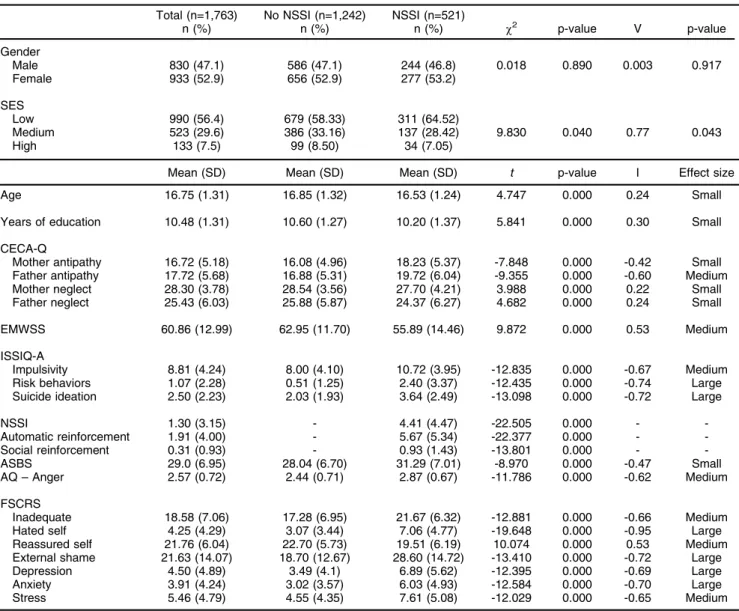
provided information on the total number of students and school councils for all schools in Sa˜o Miguel Island. School councils were contacted beforehand and agreed to cooperate. All classrooms were numbered, and 50% of students from each grade were randomly drawn through the ballot box method. Class directors then scheduled 2 days in which investigators could inform students and supervise questionnaire administration. During the first session, information on the study goals, anonymity, and confidentiality was provided to all par-ticipants, who were given informed consent forms to sign. During the second session, all students (or their legal guardians) who gave informed consent completed the assessment protocol in the classroom, under the supervision of the investigators. The sample was then divided into two groups: adolescents without a history of NSSI and adolescents with a current or prior history of NSSI (Table 1).
Measures
Impulse, Self-harm and Suicide Ideation Questionnaire for Adolescents (ISSIQ-A)33
The ISSIQ-A is a self-report questionnaire for adoles-cents, designed to assess risky behaviors (e.g., alcohol and substance use, reckless driving, promiscuous sexual behavior), impulsivity, suicide ideation, and self-harm. The items are assessed on a Likert-type frequency scale (ranging from 0 = never to 3 = always). This instrument also assesses two functions of self-harming behaviors (social reinforcement and automatic reinforcement) in an additional module with categorical responses (yes/no). Higher scores in each module (factor) indicate the pres-ence and frequency of each of those constructs, while the functions of self-harm subscale indicates the pre-dominant function for those who engage in self-harming
Table 1 Sample characteristics (n=1,763)
Total (n=1,763) No NSSI (n=1,242) NSSI (n=521)
n (%) n (%) n (%) w2 p-value V p-value
Gender
Male 830 (47.1) 586 (47.1) 244 (46.8) 0.018 0.890 0.003 0.917 Female 933 (52.9) 656 (52.9) 277 (53.2)
SES
Low 990 (56.4) 679 (58.33) 311 (64.52)
Medium 523 (29.6) 386 (33.16) 137 (28.42) 9.830 0.040 0.77 0.043
High 133 (7.5) 99 (8.50) 34 (7.05)
Mean (SD) Mean (SD) Mean (SD) t p-value I Effect size
Age 16.75 (1.31) 16.85 (1.32) 16.53 (1.24) 4.747 0.000 0.24 Small
Years of education 10.48 (1.31) 10.60 (1.27) 10.20 (1.37) 5.841 0.000 0.30 Small
CECA-Q
Mother antipathy 16.72 (5.18) 16.08 (4.96) 18.23 (5.37) -7.848 0.000 -0.42 Small Father antipathy 17.72 (5.68) 16.88 (5.31) 19.72 (6.04) -9.355 0.000 -0.60 Medium Mother neglect 28.30 (3.78) 28.54 (3.56) 27.70 (4.21) 3.988 0.000 0.22 Small Father neglect 25.43 (6.03) 25.88 (5.87) 24.37 (6.27) 4.682 0.000 0.24 Small
EMWSS 60.86 (12.99) 62.95 (11.70) 55.89 (14.46) 9.872 0.000 0.53 Medium
ISSIQ-A
Impulsivity 8.81 (4.24) 8.00 (4.10) 10.72 (3.95) -12.835 0.000 -0.67 Medium Risk behaviors 1.07 (2.28) 0.51 (1.25) 2.40 (3.37) -12.435 0.000 -0.74 Large Suicide ideation 2.50 (2.23) 2.03 (1.93) 3.64 (2.49) -13.098 0.000 -0.72 Large
NSSI 1.30 (3.15) - 4.41 (4.47) -22.505 0.000 -
-Automatic reinforcement 1.91 (4.00) - 5.67 (5.34) -22.377 0.000 - -Social reinforcement 0.31 (0.93) - 0.93 (1.43) -13.801 0.000 - -ASBS 29.0 (6.95) 28.04 (6.70) 31.29 (7.01) -8.970 0.000 -0.47 Small AQ – Anger 2.57 (0.72) 2.44 (0.71) 2.87 (0.67) -11.786 0.000 -0.62 Medium
FSCRS
Inadequate 18.58 (7.06) 17.28 (6.95) 21.67 (6.32) -12.881 0.000 -0.66 Medium Hated self 4.25 (4.29) 3.07 (3.44) 7.06 (4.77) -19.648 0.000 -0.95 Large Reassured self 21.76 (6.04) 22.70 (5.73) 19.51 (6.19) 10.074 0.000 0.53 Medium External shame 21.63 (14.07) 18.70 (12.67) 28.60 (14.72) -13.410 0.000 -0.72 Large Depression 4.50 (4.89) 3.49 (4.1) 6.89 (5.62) -12.395 0.000 -0.69 Large Anxiety 3.91 (4.24) 3.02 (3.57) 6.03 (4.93) -12.584 0.000 -0.70 Large Stress 5.46 (4.79) 4.55 (4.35) 7.61 (5.08) -12.029 0.000 -0.65 Medium
AQ = Aggression Questionnaire; ASBS = Adolescent Submissive Behavior Scale; CECA-Q = Childhood Experiences of Care and Abuse Questionnaire; EMWSS = Early Memories of Warmth and Safeness Scale;
behavior: automatic reinforcement or social reinforce-ment. Studies by Carvalho et al.33 confirmed the factor structure and psychometric properties of the ISSIQ-A, and revealed good internal consistencies (ranging from 0.77 to 0.93) and convergent validity with similar mea-sures. In the current study, Cronbach’s alpha ranged from 0.768 (Impulse and Social Function of NSSI subscales) to 0.932 (Automatic Reinforcement subscale).
Childhood Experiences of Care and Abuse Questionnaire (CECA-Q)34,35
The CECA-Q focuses on parental rearing styles experi-enced during childhood and on the identification of the parental figure that was most significant before age 17 years. It comprises set screening questions for sexual and physical abuse, as well as Neglect and Antipathy scales scored separately for each parental figure (e.g., mother and father). The Antipathy and Neglect scales comprise eight items each (e.g., He/she was critical towards me; He/she was interested in my problems). All items are presented twice in order to be rated sepa-rately for each parental figure on a five point Likert-type scale (1 = not at all to 5 = totally). In a study by Bifulco et al.,34 the CECA-Q was a good screening tool for assessing early adverse relationships with caretakers and studying of the role of these adverse experiences in the development of psychopathology. Internal consis-tency was 0.81 (Antipathy) and 0.80 (Neglect). In the Portuguese version, internal consistency ranged from 0.80 to 0.61. In the current study, internal consistencies ranged between 0.60 (Mother neglect) to 0.75 (Father antipathy).
Early Memories of Warmth and Safeness Scale – Adolescent Version (EMWSS-A)36,37
The EMWSS-A is a 21-item self-report scale that asses-ses retrospectively memories of experiences of warmth and affection during childhood. Each item is rated on a five-point Likert-type frequency scale (1 = rarely to 4 = most times). The scale is one-dimensional; higher scores indicate the presence of positive and nurturing rearing experiences. Original studies by Richter et al.36reported good internal consistency (alpha = 0.97), as did validation studies of the Portuguese version of this scale (alpha = 0.95).37 In the current study, internal consistency was also very good (alpha = 0.95).
Forms of Self Criticism/Attacking and Reassuring Scale (FSCRS)17,38
The FSCRS is a 22-item self-report questionnaire that evaluates the participants’ reaction in the face of mistakes or when something goes wrong for them. Items are scored on a five-point Likert scale (0 = not like me at all to 4 = exactly like me). The FSCRS assesses three different factors: Inadequate self, Hated self (both of which refer to different degrees of self-attacking and self-criticizing), and Reassured self (which refers to the ability to soothe oneself when facing adversities). Studies with the origi-nal version of the FSCRS by Gilbert et al.17 revealed
good internal consistency for all three subscales, and Portuguese studies have also found good or very good internal consistencies in both general and clini-cal samples.39Internal consistencies in a sample of 350 Portuguese adolescents were good, with alpha = 0.90 for Inadequate self, alpha = 0.75 for Hated self, and alpha = 0.86 for Reassuring self subscales. In the current study, internal consistency was very good: alpha = 0.82 for Inadequate self, alpha = 0.77 for Hated self, and alpha = 0.83 for Reassuring self.
Aggression Questionnaire (AQ)40,41
The AQ is a 29-item self-report questionnaire that asses-ses aggressiveness in four aspects: Hostility, Anger, Verbal aggression, and Physical aggression. Items are scored on a five-point Likert-type frequency scale (1 = never to 5 = always). These subscales allow measure-ment of aggressiveness in three dimensions: instrumen-tal, cognitive, and emotional. Internal consistencies of the original version range between 0.72 and 0.85, and the total scale presented a Cronbach’s alpha = 0.89.42 In the first study of the Portuguese version,43 internal consistencies ranged from 0.60 to 0.81, with alpha = 0.87 for the total scale. For the purposes of this study, only the total score and Anger subscale, which represents the emotional component of aggression, were used. The Anger subscale showed adequate internal consistency for the total sample (alpha = 0.89).
Adolescent Submissive Behavior Scale (ASBS)44 The language used in this scale was adapted from the adult version (unpublished). Composed of 12 items, it is rated on a Likert-type frequency scale (1 = never to 5 = always) and measures the frequency of submissive behaviors manifested by youths in their everyday lives. Scores can range from 0 to 60, with higher values indi-cating more frequent submissive behavior. The scale has a Cronbach’s alpha of 0.73 both in the original and in the current study.
Other as Shamer Scale (OAS)45,46
This scale measures current levels of external shame and comprises 18 items scored on a Likert-type frequency scale (from 0 = never to 4 = always). Scores can vary between 0 and 72, with higher values indicating higher levels of shame, or that individuals consider that they appear poorly in the eyes of others. The original and Portuguese validation studies of the scale found high internal consistency, with a Cronbach’s alpha of 0.92. In the present study, the Cronbach’s alpha for the total scale was 0.96, showing good internal consistency.
much). The original and Portuguese versions presented good internal consistency for the dimensions of depres-sion (original verdepres-sion: alpha = 0.94; Portuguese verdepres-sion: alpha = 0.85), anxiety (original version: alpha = 0.87; Portuguese version: alpha = 0.74), and stress (original version: alpha = 0.91; Portuguese version: alpha = 0.81).47,48 In the current study, internal consistencies were also high (depression, alpha = 0.91; anxiety, alpha = 0.86; stress, alpha = 0.89).
Statistical analysis
Data were analyzed using IBM SPSS version 20.0. Descriptive statistics are presented in the first part of the study, followed by bivariate correlation analysis and
t-tests for independent samples for all continuous and categorical variables included. Because of the statistical power of analyses with large samples, effect sizes were calculated to aid in distinguishing statistical significance with more practical implications from statistical signifi-cance due to test sensitivity. Odds ratios (OR) were also calculated to assess categorical variables, and logistic regression analyses were performed to estimate the pre-dictive value of each variable relevant to NSSI and suicide ideation. Analysis of missing data for the variables in this study showed that missing values were random and that no single dependent variable had45% missing values.
The series mean method was used for imputation.
Results
Sample characteristics
A sample of 1,763 adolescents, aged 14 to 22 years (mean = 16.75, standard deviation [SD] = 1.31), 830 males (47.1%) and 933 females (52.9%), was recruited from high schools in Sa˜o Miguel Island, Azores (Table 1). Participants had spent an average of 10.48 years in school (SD = 1.31). Socioeconomic status (SES) was estimated from parents’ professional situation. In 117 (6.6%) of cases, SES could not be estimated due to missing data.
Suicide ideation was reported by 387 (22%) of partic-ipants overall. In the total sample, gender differences were found in scores for suicide ideation. Although effect sizes were small, girls assigned significantly higher scores on suicide ideation than boys (MFem = 2.85;
SDFem = 2.24; MMale = 2.11; SDMale = 2.15; t(6,1761) =
-7.022; p = 0.000, d = 0-0.33). Boys presented
significantly higher scores of impulsivity (MFem = 8.43;
SDFem = 4.20; MMale = 9.22; SDMale = 4.24; t(6,1761) =
3.927; p = 0.000, d = 0.18) and high-risk behaviors (MFem= 0.71; SDFem= 1.7; MMale= 1.4; SDMale = 2.7);
t(6,1761)= 7.053; p = 0.000, d = 0.007). No gender
dif-ferences were found for NSSI behavior scores (MFem=
1.22; SDFem = 2.94; MMale = 1.39; SDMale = 3.37;
t(6,1761)= 1.105; p = 0.269), nor the functions of NSSI
behaviors (MFem = 1.94; SDFem = 4.06; MMale = 1.86;
SDMale= 3.94;t(6,1761)= -0.420; p = 0.675 for automatic
reinforcement and MFem= 0.27; SDFem= 0.85; MMale =
0.36; SDMale = 1.02; t(6,1761) = 0-1.826; p = 0.065 for
social reinforcement).
Overall, 521 (29.5%) participants reported having endorsed one form of NSSI behavior at least sometimes. Therefore, participants were separated into non-NSSI and NSSI groups for a more specific description of NSSI behaviors and related variables. Participants who engaged in NSSI tended to have lower SES when com-pared to their non-NSSI counterparts, and this difference in distribution reached statistical significance, although the effect size was small. The remaining variables also differed significantly between groups, with different effect sizes. Sample characteristics regarding the variables assessed in this study are presented in Table 1.
Characterization of NSSI
Considering the absence of significant differences in gender distributions and that the gender of participants did not confer increased risk of NSSI (OR = 1.014, confidence interval = 0.826-1.245), the following analysis included boys and girls that endorsed NSSI behaviors. Participants were able to rate the frequency with which they used each NSSI method. Table 2 presents the ISSIQ-A NSSI subscale items that refer to different meth-ods used when engaging in NSSI behaviors. In the cur-rent sample, biting was the most frequently use method of self-harm, endorsed by 67.17% of participants. The least used method was swallowing objects or noxious substances, with 14.77% of the participants having had recourse to this method.
As stated earlier, different motives underlying self-harm can coexist. Concerning their functions, assessed in the extra modules of the ISSIQ-A, 417 participants (80%) reported using self-harm as an automatic reinforcement, i.e., to exert control or regulate more disruptive emotional states. In addition, 218 participants (41.8%) reported using self-harm also for purposes of social reinforcement – in
Table 2 Methods and frequency of self-harm endorsed by participants with non-suicidal self injury (n=521)
Never Reported
I hurt myself on purpose 238 (45.7) 283 (54.3)
Hitting (the head, hands or other body parts, running against things) 288 (55.3) 233 (44.7)
Scratching and pinching 266 (51.1) 255 (48.9)
Biting (parts of the body or objects) 171 (32.8) 350 (67.1)
Cutting (with blades, scissors, knives, etc.) 352 (67.6) 169 (32.4) Burning (with cigarettes, lighters, oven, etc.) 417 (80.0) 104 (20.0) Sticking needles or other objects in the body 422 (81.0) 99 (19.0) Swallowing/introducing sharp objects or substances 444 (85.2) 77 (14.7)
other words, to control or manipulate their social environments and interactions.
Taking into account that most participants engage in NSSI behaviors for functions associated with emotional regulation or control, we explored the associations between NSSI, suicide ideation, disruptive emotional states, self-criticism, and psychopathological sympto-matology. As shown in Table 3, self-harm correlated moderately with engagement in high-risk behaviors and impulsivity, with a significant but weaker correla-tion with suicide ideacorrela-tion, as suggested by previous results. In addition, moderate correlations between self-harm and the more severe form of self-criticism (feelings of hatred towards the self), shame, and depressive and anxious symptomatology were found. Concerning suicide ideation, the strongest correlations were found with depressive symptoms and shame, followed by severe forms of self-criticism (hated self and inadequate self) and anxiety and stress symp-toms. As expected, the ability to be self-reassuring in the face of adversities was negatively associated with self-harm and suicidal ideation, with a more expres-sive association with the latter. Significant but weaker positive correlations were found between NSSI, sui-cide ideation, and adverse childhood memories, while early experiences of warmth and safeness correlated negatively and moderately with suicide ideation.
Proximal and distal predictors of NSSI and suicide ideation
Lastly, a logistic regression with the forward LR method was calculated for the total sample (n=1,763), includ-ing distal and proximal factors – in other words, factors that referred to events that took place in the past (during childhood) or closer in time (experienced recently or in the present) – in separate blocks. Distal predictors entered in the first block included positive and adverse childhood experiences measured by EMWSS and CECA-Q subscales, while proximal pre-dictors in the second block included submissive behavior, high-risk behavior, impulsivity, self-criticism and self-reassurance, anger, external shame, and symptoms of depression, anxiety, and stress. In addi-tion to the statistically significant differences found between groups (Table 1), prior to analysis, we tested for weak or moderate statistically significant correla-tions between the variables to be entered as pre-dictors of NSSI and suicide ideation. Results for the first logistic regression, distinguishing participants with and without NSSI, indicated that high-risk behaviors (bRisk Behaviors= 0.414;w2Wald(1)= 79.627; po0.001),
anger (bAQ_Anger= 0.270;w2Wald(1)= 5.618; p = 0.018),
and hated self (bHated Self= 0.117; w2Wald(1) = 32.500;
po0.001) had a stronger and significant effect over
the probability logit of a given occurrence (NSSI), followed by suicide ideation (bSuicideId = 0.105; w2Wald(1) = 7.558; p = 0.006), anxiety symptoms
(bEADS_Anxiety = 0.042;w2Wald(1) = 4.940; p = 0.026),
and submissive behavior (bASBS = 0.033; w2Wald(1) =
8.171; p = 0.004). The adjusted logit model was
statistically significant (G28= 17.318; p o0.001; R2CS=
0.273; R2N= 0.382). Using the forward LR procedure, a
new model was adjusted including the predictors deemed significant in the former model: high-risk behavior, hated self, submissive behavior, anger, and anxiety. The model was statistically significant (G28 = 21.179; p =
0.007; R2CS= 0.262; R2N= 0.373). The adjusted logistic
regression model presented in Table 4 correctly classified 78.1% of participants with and without NSSI behaviors. The model also had good sensitivity (44.3%) and high specificity (92.1%), indicating the model’s utility to classify both populations with good discriminant ability (area under the curve [AUC] = 0.830; po0.001).
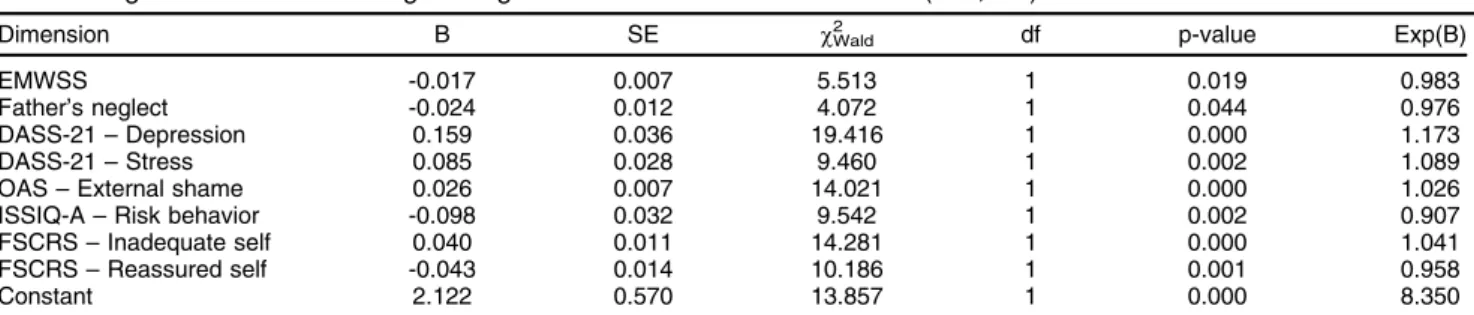
The same analyses were carried out for suicide idea-tion in the total sample, grouping participants according to the presence or absence of suicide ideation. The resulting model for the logistic regression, distinguishing partici-pants with and without suicide ideation, indicated that depressive symptoms presented a stronger and statisti-cally significant effect (bEADSDepression = 0.159;w2Wald(1)=
19.401; p o0.001) over the probability logit of a given
occurrence (suicide ideation), followed by risk behaviors (bRiskBehavior= -0.099;w2Wald(1)= 9.494; p = 0.002), stress
symptoms (bStress = 0.085;w2Wald(1) = 9.474; p = 0.002),
reassured self (bReassuredSelf= -0.043;w2Wald(1)= 9.983; p =
0.002), inadequate self (bInadequateSelf= 0.040; w2Wald(1)=
13.774; p o 0.001), external shame (bOAS = 0.026;
w2Wald(1) = 13.965; p o 0.001), neglect from father
(bFatherNegl = -0.024; w2Wald(1) = 4.014; p = 0.045), and
early memories of warmth and safeness (bEMWSS =
-0.017; w2Wald(1) = 5.282; p = 0.022). The adjusted logit
model was statistically significant (G28= 15.822; p = 0.045;
R2CS= 0.204; R2N= 0.314). The new model was adjusted
with the forward LR procedure, including the predictors deemed significant in the former model. The model was statistically significant (G2
8 = 16.526; p = 0.035; R2CS =
0.204; R2N = 0.314). The adjusted logistic regression
model presented in Table 5 correctly classified 81.5% of participants with and without suicide ideation. The model also had acceptable sensitivity (33.6%) and high specificity (94.9%), indicating utility to classify both pop-ulations with good discriminant ability (AUC = 0.740; po0.001).
Discussion
The main goal of the current study was to characterize NSSI behaviors and suicide ideation in the adolescent population of Sa˜o Miguel Island, Azores. This study also aimed to explore the relationship between NSSI and other variables reported in the literature: suicide idea-tion, impulsivity, high-risk behavior, self-criticism, disrup-tive emotional states such as anger and shame, and psychopathological symptomatology.
Alarmingly high prevalence of NSSI in youths has been found in recent studies; however, in some research, the distinction between NSSI and suicidal ideation/behaviors is unclear, and these prevalence estimates may be also inflated by their association with risk behavior.9,29,49 As suggested by the results of the current study, the differences in frequencies and trends of NSSI and risk behaviors justify the distinction of these two practices.23,50 Thus, self-harm was considered in a stricter sense and a clear distinction between these behaviors was taken into account, in order to obtain a more reliable estimate of the NSSI phenomenon. Even so, the percentage of
Table 5 Logit coefficients of the logistic regression model for suicide ideation (n=1,763)
Dimension B SE w2Wald df p-value Exp(B)
EMWSS -0.017 0.007 5.513 1 0.019 0.983
Father’s neglect -0.024 0.012 4.072 1 0.044 0.976
DASS-21 – Depression 0.159 0.036 19.416 1 0.000 1.173
DASS-21 – Stress 0.085 0.028 9.460 1 0.002 1.089
OAS – External shame 0.026 0.007 14.021 1 0.000 1.026
ISSIQ-A – Risk behavior -0.098 0.032 9.542 1 0.002 0.907
FSCRS – Inadequate self 0.040 0.011 14.281 1 0.000 1.041
FSCRS – Reassured self -0.043 0.014 10.186 1 0.001 0.958
Constant 2.122 0.570 13.857 1 0.000 8.350
DASS-21 = Depression, Anxiety, and Stress Scale; EMWSS = Early Memories of Warmth and Safeness Scale; FSCRS = Forms of Self Criticism/Attacking and Reassuring Scale; ISSIQ-A = Impulse, Self-harm and Suicide Ideation Questionnaire for Adolescents; OAS = Other as Shamer Scale; SE = standard error.
Table 4 Logit coefficients of the logistic regression model for non-suicidal self injury (n=1,763)
Dimension B SE w2Wald df p-value Exp(B)
FSCRS – Hated self 0.145 0.016 69.891 1 0.000 1.156
DASS-21 – Anxiety 0.040 0.011 5.905 1 0.015 1.041
ASBS 0.028 0.010 7.889 1 0.005 1.028
AQ – Anger 0.268 0.410 7.609 1 0.006 1.307
ISSIQ-A – Risk behaviors 0.385 - 102.220 - 0.000 1.470
ISSIQ-A – Suicide ideation 0.105 - 10.331 - 0.001 1.111
Constant -3.991 - 115.808 - 0.000 0.018
AQ = Aggression Questionnaire; ASBS = Adolescent Submissive Behavior Scale;
adolescents engaging in self-harm was high, with approx-imately 30% of adolescents endorsing at least one self-harming behavior, a percentage twice as high as that reported by Matos et al.30and exceeding the 21.7% life-time prevalence of at least one NSSI behavior estimated in youths from mainland Portugal.20In fact, 6 to 23% of our respondents reported resorting to NSSI behaviors regularly (often or always), and over 65% of participants reported biting as the main method of self-injury. Most youths that report NSSI behaviors come from a lower socioeconomic background, a factor that can signifi-cantly hinder access to health care and education; this reflects a trend that is generally observed in mental health research in regions with significant societal problems, like the Azores. This may explain our somewhat discrepant findings to other studies comparing rural with urban pop-ulations, in which urban populations presented increased rates of NSSI.51These results may be due to psychoso-cial factors (e.g., sopsychoso-cial isolation, access to employment/ education, problems at home), having a bigger influence than geographic or demographic (urban vs. rural, popula-tion density) factors alone.51Consistent with this hypoth-esis, our findings indicate that the presence of NSSI was associated mainly with high-risk behaviors, severe forms of self-criticism, and negative emotions (shame and anxiety). Our results also suggest that the functions of NSSI behaviors predominantly reflect automatic rein-forcement, with the purpose of regulating emotionally disruptive states, that is, to create a desired emotional state or to cease unwanted feelings and emotions; this, in turn, is consistent with recent biological findings on emotional regulation systems.52It is possible that biting is the most predominant form of NSSI not only because it is a more immediately available method, but possibly because it is a less criticizable/visible form of regulating one’s emotion. Youths seem to prefer methods that allow a more immediate engagement in NSSI, without need-ing to wait for a particular opportunity and availability of instruments (such as knives, box cutters, access to toxic substances, etc.) for self-harming and bringing relief from disruptive emotional states. It is arguable that the negative reinforcement provided by the NSSI can involve escalation of NSSI in terms of frequency, severity, and method, constituting a particular aggravating risk factor to adolescents who have previously engaged in any form of NSSI.
It is widely accepted that adolescence is a period dur-ing which a wide range of experimentation and learndur-ing experiences take place, and the characteristic vulnerabil-ities of this developmental phase are partially justified by processes governed mainly by a fully developed limbic system, while the prefrontal areas of the cortex continue to develop until individuals reach adulthood.53,54This may
explain the higher endorsement of NSSI behaviors by younger participants, although differences in coping and other mechanisms involved in the origins and mainte-nance of NSSI behaviors need to be further explored in different age ranges. Nevertheless, at any developmen-tal stage, self-harming behaviors are still a maladaptive coping strategy when disruptive emotional states arise, and escalation of this behavior may proceed to more
severe forms, especially when associated with impulsivity and high-risk or disruptive behaviors, as suggested by our findings. In addition, higher frequencies of NSSI were associated with increased levels of suicidal ideation, in agreement with what was suggested by Joiner26 and
other studies in clinical samples.16,51,55,56 Analyses of the distal and proximal predictors of NSSI showed that specific behavioral and emotional proximal factors are involved in engagement in these behaviors. Our model including the presence of high-risk and submissive behav-iors, anger, anxiety, severe self-criticism, and suicide idea-tion supports the hypothesis that NSSI can arise as a coping mechanism with more dysfunctional emotional states and interpersonal strategies in community samples as well.
Concerning suicide ideation, individuals who self-harmed and endorsed higher suicide ideation scores also exhibited stronger associations with depression, shame, severe self-criticism, stress, anxiety, and moderate forms of self-criticism (feelings of inadequacy). It is important to emphasize that NSSI behaviors were not among the predictors of suicide ideation, despite both variables pre-senting significant (but weak) associations. Should these results be consonant with findings in clinical samples in which NSSI is used as a strategy to cope with suicide ideation or inhibit suicide attempts,56this predictive power would possibly be significant and negative. It is arguable that NSSI may have different purposes or interact with different processes, especially in the presence of psy-chiatric problems, as both phenomena appear to be more likely to occur as one advances along the continuum of psychopathology. However, as advocated by Claes et al.,16current knowledge is still insufficient, and drawing this line may be a matter of interpretation in which wishing to end one’s life can be regarded as the ultimate way to escape an aversive situation. Thus, functional analyses and the search for interactions with psychopathological and biological processes52,57should be a particular con-cern for future research, as well as for mental health practitioners evaluating and treating NSSI and suicide ideation in their patients.
The strongest predictor of suicide ideation in youths was depressive symptomatology (which is consistent with previous findings29), in addition to self-criticism leading
risk behaviors or risk taking from NSSI and results show that more refined studies are needed in this regard.53,61,62 Despite the possible continuity or escalation between high-risk behavior, NSSI, and suicidal ideation/behaviors, our findings emphasize that these terms refer to distinct phenomena and encompass a distinct interplay between distal and/or proximal risk factors, as well as a possible differential role in protective factors affecting the degree of suicide ideation and NSSI.
Research findings reinforce the importance of devel-oping self-compassion and the ability to tolerate nega-tive feelings and emotions in interventions with youths, to the extent that developing skills to soothe oneself and cope with self-criticism (feelings of inadequacy, disgust, or hate towards oneself) may have a positive impact both on NSSI and suicidal ideation, as suggested by Gilbert et al.17 In consonance with other findings, the current study draws our attention to the high price of isolation and increased vulnerability of youths living in the more peripheral and impoverished areas of Europe, which also entails additional obstacles to mental health care access.63These findings should draw the attention of mental health professionals, local and European policy-makers, and stakeholders to the need to under-stand and address the specificities of these populat-ions not only for intervention, but on preventive levels as well. The current study showed that proximal factors such as engagement in high-risk behaviors, severe forms of self-criticism, and feelings of anger, shame, anxiety, and submissiveness explain a significant amo-unt of variance in the alarming prevalence of NSSI behaviors in these youths, as demonstrated in previous studies.7,14,16,17,62,64 In addition, reinforcement result-ing from NSSI may act as a maintenance factor for this maladaptive behavior, rendering it more stable over time.
This first effort to characterize NSSI in Azorean youths has limitations and raises several questions that should be addressed in future studies. Methodologically, the use of self-report measures and the cross-sectional design require caution regarding the implication of causality among variables, and may have induced bias in the esti-mation of NSSI behaviors by the respondents: while social desirability may influence youths to underestimate the practice or frequency of NSSI, on the other hand, the anonymity of self-report forms may allow youths to respond more sincerely and with less fear of stigmatiza-tion. The effect of these factors on possible under- or overestimation of NSSI rates are unknown. Despite these limitations, the current study contributes to a more sys-tematized and complete knowledge of self-harm behavior in adolescents in a representative sample of youths attending mandatory education in Sa˜o Miguel Island. Future studies – resorting to different assessment meth-ods, such as interviews and screening procedures, and with longitudinal designs – may provide a clearer under-standing of the causes of NSSI behaviors in this particular population. It would be of significant interest to explore the gender differences in suicide ideation found in the cur-rent sample,65,66 study the relationship between coping
strategies and processes underlying self-harm behaviors
in different age ranges and clinical samples, and carry out cross-cultural and intracultural comparisons (such as comparative studies of youths living in isolated commu-nities and on mainland areas that share a common cultural background).
This study constitutes an important step in under-standing the phenomenon of NSSI and the needs of youth engaging in these practices and experiencing suicide ideation, and should support the design of adequate, specific interventions to address these issues more effectively. For instance, best practices include imple-mentation of socioemotional skills development programs for youths in school settings where NSSI and suicide ideation has been identified and the development of therapeutic plans67 contemplating emotional regulation strategies and self-compassion in clinical settings.6 Research on the efficacy of different approaches and specific strategies in reducing NSSI and suicide ideation in youths should not be disregarded when providing more structured responses to this overarching issue.
Acknowledgements
The authors would like to thank the Direc¸a˜o Regional da
Educac¸a˜o (DRE), the staff at the participating schools,
and Vera Pereira and Carolina Portugal for their coopera-tion in this study.
Disclosure
The authors report no conflicts of interest.
References
1 Williams KA, Bydalek KA. Adolescent self-mutilation: diagnosis & treatment. J Psychosoc Nurs Ment Health Serv. 2007;45:19-23. 2 Glassman LH, Weierich MR, Hooley JM, Deliberto TL, Nock MK.
Child maltreatment, non-suicidal self-injury, and the mediating role of self-criticism. Behav Res Ther. 2007;45:2483-90.
3 World Health Organization (WHO). Preventing suicide: a global imperative [Internet]. Luxembourg: WHO; 2014 [cited 2016 Nov 16]. who.int/mental_health/suicide-prevention/world_report_2014/en/ 4 Stheneur C. Tentative de suicide: comment repe´rer un adolescent
en danger ? J Pe´diatrie Pue´riculture. 2006;19:218-22.
5 Rodav O, Levy S, Hamdan S. Clinical characteristics and functions of non-suicide self-injury in youth. Eur Psychiatry. 2014;29:503-8. 6 Catledge CB, Scharer K, Fuller S. Assessment and identification of
deliberate self-harm in adolescents and young adults. J Nurse Pract. 2012;8:299-305.
7 Scoliers G, Portzky G, Madge N, Hewitt A, Hawton K, de Wilde EJ, et al. Reasons for adolescent deliberate self-harm: a cry of pain and/or a cry for help? Findings from the child and adolescent self-harm in Europe (CASE) study. Soc Psychiatry Psychiatr Epidemiol. 2009;44:601-7.
8 Madge N, Hewitt A, Hawton K, de Wilde EJ, Corcoran P, Fekete S, et al. Deliberate self-harm within an international community sample of young people: comparative findings from the Child & Adolescent Self-harm in Europe (CASE) Study. J Child Psychol Psychiatry. 2008;49:667-77.
9 Fliege H, Lee JR, Grimm A, Klapp BF. Risk factors and correlates of deliberate self-harm behavior: a systematic review. J Psychosom Res. 2009;66:477-93.
10 American Psychiatric Association. Diagnostic and Statistical Manual of Mental Disorders, Fifth Edition (DSM-5). Arlington: American Psychiatric Publishing; 2013.
12 Messer JM, Fremouw WJ. A critical review of explanatory models for self-mutilating behaviors in adolescents. Clin Psychol Rev. 2008;28:162-78.
13 Peterson J, Freedenthal S, Sheldon C, Andersen R. Nonsuicidal self injury in adolescents. Psychiatry (Edgmont). 2008;5:20-6.
14 Madge N, Hawton K, McMahon EM, Corcoran P, De Leo D, de Wilde EJ, et al. Psychological characteristics, stressful life events and deliberate self-harm: findings from the Child & Adolescent Self-harm in Europe (CASE) Study. Eur Child Adolesc Psychiatry. 2011; 20:499-508.
15 Widlo¨cher D. Pre´face. In: Marcelli D, Braconnier A. Adolescence et psychopathologie [Internet]. 7th ed. 2008; p. vii-ix. sciencedirect.com/ science/article/pii/B978229408966450027X
16 Claes L, Muehlenkamp J, Vandereycken W, Hamelinck L, Martens H, Claes S. Comparison of non-suicidal self-injurious behavior and suicide attempts in patients admitted to a psychiatric crisis unit. Pers Individ Dif. 2010;48:83-7.
17 Gilbert P, Clarke M, Hempel S, Miles JN, Irons C. Criticizing and reassuring oneself: an exploration of forms, styles and reasons in female students. Br J Clin Psychol. 2004;43:31-50.
18 Andover MS, Gibb BE. Non-suicidal self-injury, attempted suicide, and suicidal intent among psychiatric inpatients. Psychiatry Res. 2010;178:101-5.
19 Law BM, Shek DT. Self-harm and suicide attempts among young chinese adolescents in Hong Kong: prevalence, correlates, and changes. J Pediatr Adolesc Gynecol. 2013;26:S26-32.
20 Xavier A, Cunha MA, Pinto-Gouveia J. Deliberate self-harm in ado-lescence: the impact of childhood experiences, negative affect and fears of compassion. Rev Psicopatol Psicol Clin. 2015;20:41-9. 21 House A, Owens D, Patchett L. Deliberate self harm. Qual Health
Care. 1999;8:137-43.
22 Hawton K, Houston K, Shepperd R. Suicide in young people. Study of 174 cases, aged under 25 years, based on coroners’ and medical records. Br J Psychiatry. 1999;175:271-6.
23 Brausch AM, Gutierrez PM. Differences in non-suicidal self-injury and suicide attempts in adolescents. J Youth Adolesc. 2010;39:233-42. 24 Martin G, Swannell SV, Hazell PL, Harrison JE, Taylor AW.
Self-injury in Australia: a community survey. Med J Aust. 2010;193: 506-10.
25 Zetterqvist M, Lundh LG, Dahlstro¨m O, Svedin CG. Prevalence and function of non-suicidal self-injury (NSSI) in a community sample of adolescents, using suggested DSM-5 criteria for a potential NSSI disorder. J Abnorm Child Psychol. 2013;41:759-73.
26 Joiner T. Why People Die by Suicide. Cambridge: Harvard University; 2005.
27 Mangnall J, Yurkovich E. A literature review of deliberate self-harm. Perspect Psychiatr Care. 2008;44:175-84.
28 Suyemoto KL. The functions of self-mutilation. Clin Psychol Rev. 1998;18:531-54.
29 Brunner R, Kaess M, Parzer P, Fischer G, Resch F, Carli V, et al. 3038 – Characteristics of non-suicidal self-injury and suicide attempts among adolescents in europe: results from the european research consortium seyle. Eur Psychiatry. 2013;28:1.
30 Matos MG, Simo˜es C, Tome´ G, Camacho I, Ferreira M, Ramiro L, et al. A Sau´de dos adolescentes portugueses. Relato´rio do estudo HBSC 2010 [Internet]. 2012 Mar [cited 2016 Nov 16]. aven-turasocial.com/arquivo/1334762276_Relatorio_HBSC_2010_PDF_ Finalissimo.pdf
31 Werlang BSG, Borges VR, Fensterseifer L. Fatores de risco ou protec¸a˜o para a presenc¸a de ideac¸a˜o suicida na adolesceˆncia.
Interam J Psychol. 2005;39:259-66.
32 Borges VR, Werlang BSG. Estudo de ideac¸a˜o suicida em
ado-lescentes de 15 a 19 anos. Estud Psicol (Natal). 2006;11:345-51. 33 Carvalho CB, Nunes C, Castilho P, da Motta C, Caldeira S,
Pinto-Gouveia J. Mapping non suicidal self-injury in adolescence: devel-opment and confirmatory factor analysis of the Impulse, Self-harm and Suicide Ideation Questionnaire for Adolescents (ISSIQ-A). Psy-chiatry Res. 2015;227:238-45.
34 Bifulco A, Bernazzani O, Moran PM, Jacobs C. The childhood experience of care and abuse questionnaire (CECA.Q): validation in a community series. Br J Clin Psychol. 2005;44:563-81.
35 Carvalho S, Gouveia JP, Pimentel P, Castilho P, Maia D, Mota-Pereira J. Propriedades psicome´tricas da escala de cuidado do
questiona´rio de experieˆncias de cuidado e abuso na infaˆncia. Psy-chologica. 2011;54:359-83.
36 Richter A, Gilbert P, McEwan K. Development of an early memories of warmth and safeness scale and its relationship to psychopathol-ogy. Psychol Psychother. 2009;82:171-84.
37 Cunha M, Xavier A, Martinho MI, Matos M. Measuring positive emotional memories in adolescents: psychometric properties and confirmatory factor analysis of the Early Memories of Warmth and Safeness Scale. Rev Int Psicol Ter Psicol. 2014;14:245-59. 38 Castilho P, Gouveia JP. Auto-criticismo: estudo de validac¸a˜o da
versa˜o portuguesa da Escala das Formas do Criticismo e Auto-Tranquilizac¸a˜o (FSCRS) e da Escala das Func¸o˜es do Auto-criticismo
e Auto-ataque (FSCS). Psychol. 2011;54:63-86.
39 Castilho P, Pinto-Gouveia J, Duarte J. Exploring self-criticism: con-firmatory factor analysis of the FSCRS in clinical and nonclinical samples. Clin Psychol Psychother. 2015;22:153-64.
40 Buss AH, Perry M. The aggression questionnaire. J Pers Soc Psy-chol. 1992;63:452-9.
41 Vieira A, Soeiro C. Agressividade e psicopatia. Temas penitencia´rios. 2002;8:25-35.
42 Buss AH, Perry M. The Aggression Questionnaire. J Pers Soc Psy-chol. 1992;63:452-9.
43 Simo˜es A. Sa˜o os homens mais agressivos que as mulheres? Rev Port Pedagog. 1993;27:387-404.
44 Irons C, Gilbert P. Evolved mechanisms in adolescent anxiety and depression symptoms: the role of the attachment and social rank systems. J Adolesc. 2005;28:325-41.
45 Goss K, Gilbert P, Allan S. An exploration of shame measures. I. The other as Shamer scale. Pers Individ Dif. 1994;17:713-7. 46 Lopes B, Pinto-Gouveia J, Castilho P. OAS. In: Lopes B. Paranoia e
ansiedade social na populac¸a˜o na˜o-clı´nica: dois feno´menos
difer-entes? [Internet]. Coimbra: Universidade de Coimbra; 2010. p. 93-93 [cited 2017 Feb 24]. https://estudogeral.sib.uc.pt/jspui/bitstream/ 10316/17792/2/TD%20Barbara%20Lopes%20ANEXOS.pdf 47 Antony MM, Bieling PJ, Cox BJ, Enns MW, Swinson RP.
Psycho-metric properties of the 42-item and 21-item versions of the Depres-sion Anxiety Stress Scales in clinical groups and a community sample. Psychol Assess. 1998;10:176-81.
48 Pais-Ribeiro JLP, Honrado AAJD, Leal IP. Contribuic¸a˜o para o
estudo da adaptac¸a˜o portuguesa das Escalas de Ansiedade,
Depressa˜o e Stress (DASS) de 21 itens de Lovibond e Lovibond. Psicol Saude Doencas. 2004;5:229-39.
49 Barrios LC, Everett SA, Simon TR, Brener ND. Suicide ideation among US college students. Associations with other injury risk behaviors. J Am Coll Health. 2000;48:229-33.
50 Muehlenkamp JJ, Gutierrez PM. An investigation of differences between self-injurious behavior and suicide attempts in a sample of adolescents. Suicide Life-Threatening Behav. 2004;34:12-23. 51 Harriss L, Hawton K. Deliberate self-harm in rural and urban regions:
a comparative study of prevalence and patient characteristics. Soc Sci Med. 2011;73:274-81.
52 Bresin K, Gordon KH. Endogenous opioids and nonsuicidal self-injury: a mechanism of affect regulation. Neurosci Biobehav Rev. 2013;37:374-83.
53 Steinberg L. Risk taking in adolescence: new perspectives from brain and behavioral science. Curr Dir Psychol Sci. 2007;16:55-9. 54 Boyer T. The development of risk-taking: a multi-perspective review.
Dev Rev. 2006;26:291-345.
55 Klonsky ED, May AM, Glenn CR. The relationship between non-suicidal self-injury and attempted suicide: converging evidence from four samples. J Abnorm Psychol. 2013;122:231-7.
56 Nock MK, Joiner TE Jr, Gordon KH, Lloyd-Richardson E, Prinstein MJ. Non-suicidal self-injury among adolescents: diagnostic correlates and relation to suicide attempts. Psychiatry Res. 2006;144:65-72. 57 Kirtley OJ, O’Carroll RE, O’Connor RC. The role of endogenous
opioids in non-suicidal self-injurious behavior: methodological chal-lenges. Neurosci Biobehav Rev. 2015;48:186-9.
58 Neff KD, McGehee P. Self-compassion and psychological resilience among adolescents and young adults. Self Identity. 2010;9:225-40. 59 Neff KK. Self-compassion and psychological well-being.
Con-structivism Hum Sci. 2004;9:27-37.
mental health, and self-compassion in child welfare adolescents. Child Abuse Negl. 2011;35:887-98.
61 Steinberg L. A social neuroscience perspective on adolescent risk-taking. Dev Rev. 2008;28:78-106.
62 Moran P, Coffey C, Romaniuk H, Olsson C, Borschmann R, Carlin JB, et al. The natural history of self-harm from adolescence to young adulthood: a population-based cohort study. Lancet. 2012;379: 236-43.
63 Saraceno B, van Ommeren M, Batniji R, Cohen A, Gureje O, Mahoney J, et al. Barriers to improvement of mental health services in low-income and middle-income countries. Lancet. 2007;370:1164-74. 64 Gilbert P, McEwan K, Bellew R, Mills A, Gale C. The dark side of competition: how competitive behaviour and striving to avoid
inferiority are linked to depression, anxiety, stress and self-harm. Psychol Psychother. 2009;82:123-36.
65 Tsirigotis K, Gruszczyn´ski W, Tsirigotis-Maniecka M. Gender differ-entiation in indirect self-destructiveness and suicide attempt methods (gender, indirect self-destructiveness, and suicide attempts). Psy-chiatr Q. 2014;85:197-209.
66 Tsirigotis K, Gruszczynski W, Lewik-Tsirigotis M. Manifestations of indirect self-destructiveness and methods of suicide attempts. Psy-chiatr Q. 2013;84:197-208.