(1) CEFAC Saúde e Educação, Belo Horizonte, MG, Brasil.
(2) Universidade Federal de Minas Gerais – UFMG – Belo Horizonte, MG, Brasil. (3) OPUS- Soluções em Saúde e Segurança
Ocupacional – Belo Horizonte, MG, Brasil.
Funding: Pró-reitoria de Pesquisa of Universidade Federal de Minas Gerais
Conlict of interest: non-existent
Otoneurological screening of civil construction workers
performing work at height
Triagem otoneurológica em operários da construção civil
que executam trabalho em altura
Najlla Lopes de Oliveira Burle(1)
Patrícia Cotta Mancini(2)
Natália BatistaCosta(1)
Angélica Maria Moreira Lemos(2)
Tiago Ferreira Martins(1)
André Lage Meira(3)
Received on: April 14, 2015 Accepted on: November 02, 2015
Mailing address: Patrícia Cotta Mancini Faculdade de Medicina da UFMG Av. Alfredo Balena, 190 sala 251– Santa Eigênia
Belo Horizonte – MG – Brasil CEP: 30130-100
E-mail: [email protected]
doi: 10.1590/1982-021620161814815
ABSTRACT
Purpose: to investigate the prevalence of neurotological signs and symptoms in construction workers on the health campus of Universidade Federal de Minas Gerais (UFMG) that perform their functions at height. Methods: cross-sectional observational study consisted of 33 construction workers. The Protocolo Ofício de Gestão de Diagnóstico Otoneurológico composed of history, vestibular tests including Dix Hallpike test and Positional Nystagmus, vestibular dynamics evaluation using Head Shaking Nystagmus, static and dynamic balance tests, cerebellar tests, investigation of the cranial nerves, completion/conduct and orientation was used. The data were fed into spreadsheet SPSS 13.0, considering signiicant differences the level of 5%.
Results: all participants were male. The average age was 38.1 years, ranging 21-65 years. One third of the participants showed changes in screening due to imbalance complaint and/or tinnitus. Chi-square test revealed a statistically signiicant difference between the group with complaints of imbalance to the variables of circulatory disorders, headache and medication use, the later also statistically signiicant in the group with tinnitus.
Conclusion: one-third of construction workers who perform work at height presented abnormal neuroto-logical screening
Keywords: Speech, Language and Hearing Sciences; Postural Balance; Occupational Groups; Construction Industry
RESUMO
Objetivo: avaliar a prevalência de sinais e sintomas otoneurológicos em operários da construção civil do campus saúde da Universidade Federal de Minas Gerais (UFMG) que trabalham expostos à altura. Métodos: estudo observacional transversal constituído por 33 trabalhadores da construção civil. Foi utilizado o Protocolo Ofício de Gestão de Diagnóstico Otoneurológico composto por anamnese, provas vestibulares realizadas por meio de Dix-Hallpike e nistagmo de posição, avaliação da dinâmica vestibular utilizando a prova de Head Shaking, provas de equilíbrio estático, dinâmico, cerebelares, investigação complementar dos pares cranianos, conclusão/conduta e orientação. Os dados foram lançados em pla-nilha do programa SPSS versão 13.0, sendo consideradas signiicantes as diferenças que apresentaram nível de signiicância de até 5%.
Resultados: todos os participantes eram do gênero masculino. A média de idade foi de 38,1 anos, variando de 21 a 65 anos. Um terço dos participantes apresentaram alteração na triagem devido a queixa de equilíbrio e/ou zumbido. Por meio do teste Qui-Quadrado foi possível observar diferença estatistica-mente signiicante entre o grupo com queixa de equilíbrio para as variáveis de distúrbios circulatórios, cefaleia e uso de medicamentos, sendo que este último estatisticamente signiicante também no grupo com queixa de zumbido.
Conclusão: um terço dos trabalhadores da construção civil que executam trabalho em altura apresentou triagem otoneurológica sugestiva de alteração.
Descritores: Fonoaudiologia; Equilíbrio Postural; Categorias de Trabalhadores; Indústria da Construção
Original articles
INTRODUCTION
Body balance is essential to practice postural reactions that allow the performance of movements with harmony, physical and mental comfort, maintaining an upright posture and avoiding falls¹. To maintain balance, an interaction among the vestibular, visual and proprioceptive systems² is required. A dysfunction among these three systems may be manifested through dizziness³.
Dizziness is the feeling of disturbance in body
balance and it can be deined as a misleading
perception, illusion or hallucination of movement, sensation of spatial disorientation, including the rotating type (vertigo) or non-rotating type (instability,
luctuation, oscillations)4. It can occur in individuals of
any age, but it is more common among adults and the elderly over age 405.
Patients with dizziness usually report having difi -culty with concentration, memory lapses, fatigue, insomnia or drowsiness, insecurity, irritability, anxiety and depression6. Constant imbalance, either in a slight
or intense degree, may lead an individual to a certain disability in several aspects of life, such as work, carrying the risk of falling at his/her workplace7.
Falls from heights is the occupational factor that presents the highest mortality risk in this environment, representing approximately 40% of the cases8. This
percentage is relevant mainly in relation to the civil construction industry, which presents poor work condi-tions and it is one of the economy sectors that has been developing the most over the past years, increasing the number of workers and, consequently, increasing the number of work accidents9.
According to the Regulatory Norm (NR) 35 of the Ministry of Labor and Employment10, every activity
performed above two meters in relation to the inferior level, when there is risk of falling, is considered work at heights. Causes of falls can be countless, such as dizziness, and other otoneurologic alterations,
balance disorders and postural stability deiciency11.
There may be other symptoms, associated with the aforementioned symptoms, that, directly or indirectly, tend to aggravate the worker’s clinical condition, such as headache, darkened vision, nystagmus, sleep disorders, tinnitus, hearing loss, instability, deviation of
the walk trajectory, dificulty with visual ixation, nausea
and vomit12.
In order to assess the frequency of signs and symptoms related to balance alterations in workers that need adequate balance to perform their activities
safely at height and/or those presenting complaints about dizziness, the Protocolo Ofício de Gestão de Diagnósticos Otonoeurológicos (Otoneurological
Diagnosis Management Service Protocol)13 was
created. This protocol is composed of medical case history, equilibriometric tests, complementary investi-gation of the cranial nerves, completion/conduct and orientation.
The purpose of this study is to analyze, through otoneurological screening, the frequency of otoneu-rological signs and symptoms in civil construction workers at the health campus of Universidade Federal de Minas Gerais (UFMG) that perform their functions at height.
METHODS
There was an analytical cross-sectional observa-tional study composed of 33 civil construction workers that perform their tasks at settings above two meters in relation to the inferior level, approved by the Research Ethics Committee of UFMG under the protocol number 719.442.
Initially, the workers were invited to attend a lecture called “Otoneurological screening of civil construction workers performing work at height”, in which pieces of information about the research were given, the
proce-dures used in it, its risks and beneits. After the lecture,
all workers were invited to take part in the research. The evaluations were scheduled and every participant that voluntarily attended the lecture signed an Informed Consent Form. The appointments took place in the Speech, Language and Hearing Sciences Laboratory of Medical School at UFMG.
Each individual was asked questions to formulate a medical case history. They were related to metabolic alterations, hormonal, circulatory dysfunctions, cervical alterations, regular use of medicine, caffeine, alcohol and nicotine consumption, family medical history of labyrinth diseases and complaints about balance alterations and tinnitus. In relation to balance, if the
patient conirmed having a symptom related to it, this
individual was asked questions about the type, when it began, its duration, intensity, frequency, factors that make the dizziness become better or worse, if there was a relation to the movement of the head and during ambulation or not. In relation to tinnitus, if the patient
conirmed feeling it, this individual was asked questions
After that, the Protocolo Ofício de Gestão de Diagnóstico Otoneurológico13 - Otoneurological
Diagnosis Management Service Protocol (Appendix 1) was used to assess all participants. This protocol was developed to be applied in an occupational environment and it consists of a practical and fast screening of the systems that are responsible for balance, identifying individuals that present signs and symptoms of alterations in corporal balance in order to prevent work accidents and the risk of falling from heights. The individuals that present alteration in the screening should be referred to a complete otoneu-rological assessment. The screening initially aims to determine if there are signs indicating peripheral or central lesions in the systems responsible for corporal balance, so that adequate measures and treatments decisions can be made. Constant vestibular tests in the screening protocol (Appendix 1) were selected in a way so that they did not demand any special equipment and due to the fact that they are easily applied in an occupational environment. To use a protocol, only a
room with a stretcher and a ixed chair is necessary,
and it needs to be in a space with a free area equivalent to one square meter approximately, so that the worker is able to take static and dynamic balance tests.
The standard form used in the otoneurological screening of civil construction workers performing work at height is composed of the following sessions: I. Complement of Clinic-Occupational Medical Case History; II. Balance Tests; III. Complementary Investigation of the Cranial Nerves; IV. Completion and Conduct, and V. Orientation (Appendix 1).
Among the balance tests that were taken, the irst
test was the vertigo and Positional Nystagmus research through Dix Hallpike test. This test assesses labyrinth mechanics, making it possible to identify the presence of otoconia in the semicircular canals14. Each patient
was placed on a stretcher, using sitting position, and was given instructions to look attentively upon a prede-termined point during each head movement. With the head turned 45 degrees to the side, the patient rapidly changes from a sitting position to a pendant head position, considering that this inclination is maintained during 40 seconds, while eye movements related to occasional nystagmus are observed, turning back to the sitting position afterwards. The same procedure was used on the other side. The test was considered positive in cases of benign paroxysmal positional vertigo, which is the most common cause of peripheral vertigo14. Then the vertigo and Positional Nystagmus
research was conducted, in which, still with the patient placed on a stretcher, head and body movements are made in the following positions: supine, right and left lateral, dorsal with head hanging, dorsal with head hanging to the right and to the left and sitting position. In each position the presence of nystagmus and its direction were observed. It is known that horizontal nystagmus is more evident in peripheral vertibular lesions, while vertical nystagmus can be found in central lesions14. The presence of nystagmus or vertigo
indicated alterations in these tests3.
Thereafter, the vestibular dynamics was assessed through Head Shaking test. This test is used to evaluate vestibular dynamics, which is useful when determining central disorders. Patients were given instructions to close their eyes and their heads were placed 30 degrees downwards to make the lateral semicircular canals horizontal. After that, their heads were under rotation to the right and to the left alternately, approxi-mately 45 degrees on each side, as fast as possible, during 30 seconds. After undergoing those oscillations, patients open their eyes and the examiner observes if there was nystagmus or not. In cases of unilateral peripheral lesion, it is possible to notice horizontal nystagmus, and in central lesions there is evidence of vertical nystagmus after horizontal Head Shaking14.
The test was considered altered when it was observed nystagmus after patients opened their eyes.
The cerebellum plays an important role in programming motor system actions and in coordinating
response relexes to maintain balance14. To evaluate it,
some tests were selected: the inger to inger test, in
which patients keep their arms extended and in parallel
at shoulder height, with their index ingers pointing to the front with their eyes closed; the inger to nose test,
in which the individual must touch their nose tip with
their index inger, alternating their arms; and the diado -chokinesia, in which patients alternate movements with their palm and back of the hand rapidly. The lack of coordination when performing those movements was considered as an alteration1.
The static balance analysis was done using Romberg’s test. Patients are given instructions to stand up, with their arms close to the body, initially with their eyes open, closing them a few seconds later. The difference between the oscillation with their eyes open and closed is observed. Sideways falls are noticed in peripheral labyrinth lesions, while other types of falls, specially to the back, are noticed in central lesions14.
Unterberger test, patients were asked to walk in place, initially with their eyes open and then with them closed. If there was a rotation to one side of the body, specially rotations above 45 degrees, it was considered as an evidence of peripheral vestibular disorder14.
In relation to the complementary investigation of the cranial nerves, in order to evaluate the cranial nerves III, IV and VI (the oculomotor, trochlear and abducens nerves), a pen was placed in different directions (upwards, downwards, right, left, right and left inferior oblique and circular positions). Patients were asked to follow the pen’s movement with their eyes, without moving their heads. Cranial nerve V (trigeminal nerve) was evaluated by touching each third of their faces with a piece of cotton wool and, with their eyes closed, patients should tell which part of their faces was being touched. Cranial nerve VII (facial nerve) was evaluated through the perception of gustatory stimulus (sweet and salty).
The screening was classiied as “pass” when
individuals did not report complaints about balance alteration and tinnitus, and they have not presented alterations in balance tests yet. In this case, the partici-pants only received instructions to suspend their work activities and search for the nearest health care service in case they feel any sign and/or symptom related to balance.
In the screening, it was considered as “failure” those individuals that presented complaints or medical case history of balance alteration and/or alterations in any of the balance tests. It is important to emphasize the fact that the screening itself does not allow specialists to establish an otoneurological diagnosis, however, it allows to identify cases in which there is an evidence
of alteration that should be referred to a complete otoneurological evaluation. The participants that failed the screening also received medical orientations about a healthy diet and tips of good daily habits related to body balance.
After analyzing the results, the participants were distributed into four groups, according to their results. Group 1 (G1) was composed of individuals that did not present complaints and/or alteration, that is, that passed the screening. The other groups were composed of participants that failed the screening. Group 2 (G2) was composed of individuals that presented complaints of imbalance. In Group 3 (G3) were included all individuals that reported complaints of tinnitus. Group 4 (G4) was composed of individuals that reported complaints of imbalance and tinnitus. The last
three groups were compared to the irst one in order to
relate the data found in the medical case history/evalu-ation in individuals with and without complaints/altera-tions of balance and tinnitus. The data were entered into a SPSS 13.0 spreadsheet.
The frequencies among the groups in relation to the analyzed variables were compared using the Chi-square test. The differences that presented a
signif-icance level up to 5% were considered signiicant.
RESULTS
100% of the 33 participants were male. The average age was 38,1 years (± 11,37), ranging from 21 to 65 years, considering that the largest group was composed of individuals from age 21 to 39 years (54,5%), followed by a group of individuals from age 40 and 59 years (42,4%). Table 1 presents the data related to the age of the participants.
Table 1. Distribution in relation to age
AGE N %
21 to 39 years 18 54,5
40 to 59 years 14 42,4
Above 59 years 1 3,1
due to the presence of complaints of imbalance and/ or tinnitus. Table 2 presents the data related to altered screenings.
All vestibular tests in this study did not present alter-ations, however, one third of the workers presented an indication of alteration in the otoneurological screening
Table 2. Individuals with and without alteration
Screening result N %
No alteration 22 66,7
Complaints of tinnitus or imbalance 11 33,3
Total 33 100,0
Legend: N: number of individuals
In relation to the participants’ function in the civil construction, 21,2% of them were bricklayers, 18,2% of them were painters, 12,1% of them were electricians
and 9,1% of them were itters, among other functions.
Table 3 contains the data related to the participants’ function.
Table 3. Data related to function
FUNCTION N %
Painter 7 21,2
Hodman 6 18,2
Electrician 4 12,1
Fitter 3 9,1
Bricklayer 2 6,1
Plumber 2 6,1
Others 9 27,8
Legend: N: number of individuals
In relation to the data found in the medical case history, 6,1% of the participants reported having metabolic alterations, 3% of them reported having hormonal dysfunction, 27,3% of them reported having circulatory dysfunctions and/or heart diseases, 24,2%
of them reported having alterations in the spinal column, 15,2% of them reported having headaches or migraines and 21,2% of them had medical case history of labyrinth diseases. Table 4 contains the data related to alterations found in the medical case history.
Table 4. Data related to alterations found in the medical case history
ALTERATIONS N %
Metabolic 2 6,1
Hormonal 1 3,0
Circulatory 9 27,3
Spinal Column 8 24,2
Headache 5 15,2
Medical case history 7 21,2
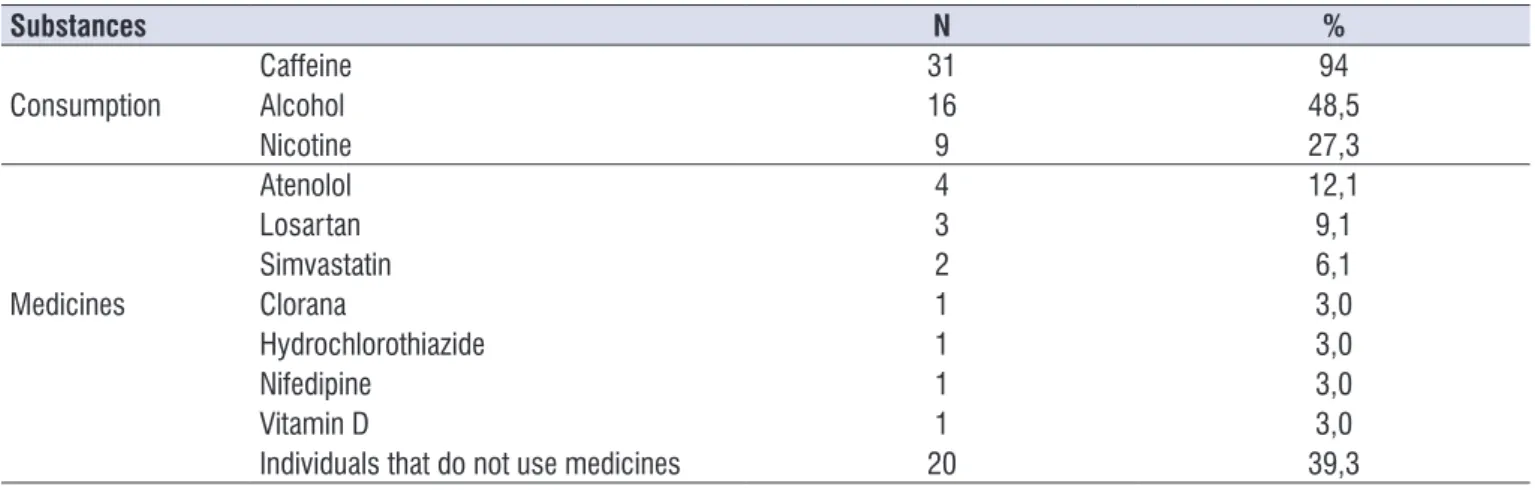
use and, among them, there are Atenolol, Losartan, Clorana, Hydrochlorothiazide, Simvastatin, Vitamin D and Nifedipine. Among these eight individuals, three of them use more than one of those medicines. Table 5 shows the data related to caffeine, alcohol, nicotine and medicine consumption.
Considering caffeine, alcohol and nicotine consumption, 31 (91%) individuals reported constant use of caffeine, 16 (48,5%) individuals reported drinking alcohol and nine (27,3%) individuals reported using nicotine. Only one individual reported using none of such substances. In relation to the use of medicines, eight individuals (24,2%) reported their constant
Table 5. Caffeine, alcohol, nicotine and medicine consumption
Substances N %
Consumption
Caffeine 31 94
Alcohol 16 48,5
Nicotine 9 27,3
Medicines
Atenolol 4 12,1
Losartan 3 9,1
Simvastatin 2 6,1
Clorana 1 3,0
Hydrochlorothiazide 1 3,0
Nifedipine 1 3,0
Vitamin D 1 3,0
Individuals that do not use medicines 20 39,3
Legend: N: number of individuals
In relation to the alteration of balance, six (18,2%) out of the 33 participants reported imbalance and, in relation to tinnitus, seven (21,2%) of them reported feeling such symptom. No individual presented alter-ation in balance tests and in complementary investi-gation of the cranial nerves.
The comparisons among G1 and all the other groups were made through Chi-square test, evidencing
signiicant statistical differences in relation to circulatory
dysfunctions and/or heart diseases, regular use of medicines, headache/migraine and caffeine consumption associated with alcohol consumption in
G2. In G3, a signiicant statistical difference in relation to regular use of medicines was noticed. No signiicant
were not found. Therefore, it is important to know the most prevailing kind of alteration, its intensity, and if the complaint jeopardize the individual during working hours.
In relation to function, 21,2% of the workers were bricklayers and 18,2% of them were painters. Together, they represented 39,4% of the sample, considering that one third of these workers reported complaints about balance and tinnitus. A study done in 2005 highlighted the fact that bricklayers represent 55,2% of the accidents to civil construction professionals and painters represent 7,5% of these accidents19. This
inding makes one need even more evident: the need
of using preventive measures in civil construction in order to decrease its risks.
Studies that compare metabolic and cervical altera-tions, hormonal dysfuncaltera-tions, and circulatory disorders in workers that perform work height were not found in the literature. However, it is known that several non-vestibular problems can affect the balance of an individual17. In this study, there was only one (3%)
report about this alteration from a workman.
DISCUSSION
In relation to gender, 100% of the sample was composed of male individuals. The same result was found in other study, which asserts that most part of male workers are concentrated in civil construction15.
The average age was 38,1 years and the largest group was composed of individuals between ages of 21 and 39. This result corroborates other study that reports there is a decrease in age in this sector related to the loss of physical ability or characteristics that are important when performing this activity16.
However, other studies claim that the Brazilian civil construction labor force exhibits workers that belong to older age groups17,18. Due to the expansion of the civil
construction industry, it is possible to assert that young
people enter into this ield searching for their irst job
opportunity and, progressively, they are conquering this activity, which demands their strength, agility and physical effort. In this study, one third of the workers reported complaints of balance and/or tinnitus and, therefore, the result in the otoneurological screening was altered. Other studies in the literature that could relate working at height to otoneurological screening
Table 6. Descriptive statistics and comparisons among groups
Variables
G1 - Normal (22 individuals)
N(%)
G2 - Complaint of imbalance (6 individuals)
N(%)
G3 - Complaint of tinnitus (7 individuals)
N(%)
G4 - Complaint of imbalance and
tinnitus (2 individuals)
N(%) Metabolic Alterations
p-value 0 (0%)
3 (50%) 0,3 2 (28,6%) 0,6 1 (50%) 0,1 Hormonal Dysfunctions
p-value 1 (4,5%)
0 (0%) 1,0 0 (0%) 1,0 0 (0%) 1,0 Circulatory Dysfunctions and/or Heart Diseases
p-value 4 (18,2%)
4 (66,7%) 0,03* 2 (28,6%) 0,6 1 (50%) 0,4 Alterations in the spinal column
p-value 5 (22,7%)
2 (33,3%) 0,6 2 (28,6) 0,6 1 (50%) 0,4 Regular use of medicines
p-value 2 (9,1%)
4 (66,7%) 0,02* 3 (42,9%) 0,008* 1 (50%) 0,4 Consumption Caffeine
p-value 11 (50%)
2 (33,3%) 0,3 3 (42,9%) 0,5 1 (50%) 0,2 Caffeine + Alcohol
p-value 3 (13,6%)
3 (50%) 0,05* 2 (28,6%) 0,3 0 (0%) 0,3 Caffeine + Alcohol + Nicotine
p-value 6 (27,3%)
1 (16,7%) 0,7 2 (28,6%) 0,3 1 (50%) 0,3 Headache or migraine
p-value 2 (9,1%)
3 (50%) 0,03* 1 (14,3%) 0,7 1 (50%) 0,2 Family medical history of labyrinth diseases
p-value 9 (40,7%)
that alterations in vestibular tests were not found. No study was encountered in the literature on construction workers that took the same tests used in this research.
The workers were divided into four groups according to their complaints. Group 1 was composed of workers with no complaints about balance alteration and/or tinnitus. The individuals that only reported complaints of imbalance were included in group 2. Group 3 was composed of workers that only reported complaints about tinnitus. Group 4 gathered the individuals that reported complaints of balance alteration and tinnitus.
The statistical analysis revealed signiicant statistical
differences in G2 in relation to the variables of circu-latory dysfunctions and/or heart diseases, regular use of medicines, caffeine consumption associated with alcohol consumption and headache/migraine. In G3, only the regular use of medicines was statistically
signiicant. In G4, no signiicant statistical difference
was found in none of the variables. Circulatory dysfunc-tions may cause peripheral and/or central damage in the auditory and/or vestibular systems4, but it was
not possible to ind studies that relate such alteration
with civil construction professionals. In this study, eight (24,2%) individuals use medicines to treat blood pressure, hypertension and cholesterol, similarly to other study that deals with an elderly population, and not with civil construction workers26. However,
researches reporting the types of medicine most used by workers with complaints of balance and/tinnitus were not found in the literature. In relation to caffeine and alcohol consumption, it was observed that half (50%) of the workers with complaints of imbalance
conirmed having such consumption. Studies that
investigate the consumption of those substances in civil construction workers were not found, however, one
study conirms the association between the presence
of vestibular symptoms and regular caffeine ingestion27.
The prevalence of 50% of the individuals with headache
or migraine corroborates other studies, which conirm
the report of headache crisis in individuals with balance disorders, mainly during the most productive phase of life, between the ages of 30 and 3920. Due
to the fact that this situation is dealing with a young population that is entering the job market prematurely, it is very important to implement screening programs to detect individuals with balance disorders and, when necessary, to establish a diagnosis in order to refer individuals with complaints and altered results in their
exams to an eficient treatment, decreasing the risks of
serious accidents in civil construction. In relation to circulatory disorders and/or diseases,
nine (27,3%) workers reported having these disorders.
Such inding corroborates another study found in the
literature that mentions cardiovascular disorders as the main causes of vertigo or dizziness20. The
occur-rence of cervical alteration was noticed in eight (24,2%)
workers. This inding was also noticed in other studies
that mention this alteration when dealing with an otoneurological clinical condition19.
In relation to headaches or migraines, it was noticed
that ive (15,2%) individuals reported having one of
these symptoms. However, in other studies headaches and/or migraines were prevailing symptoms, mainly in the condition in which dizziness and vertigo are associated20. Therefore, it is extremely important to
distinguish if a worker presents complaints about headache and/or migraine associated with a condition of auditory-vestibular dysfunction, because if such
situation is conirmed, it is possible that this individual
feels loss of balance and nausea, mainly jeopardizing the professional who needs to work at height.
In relation to family medical history of labyrinth diseases, it is known that there might be a relation between familial predisposition and the presence of metabolic alterations, headache or migraine, circulatory dysfunctions and hormonal dysfunctions12,
corrobo-rating the indings in this study, in which seven (21,2%)
of the 33 individuals that were analyzed reported having family history of these alterations.
In this study, it was noticed that eight (24,2%) workers use one or more medicines daily. This result
corrobo-rates the indings in other studies, which describe that
collateral effects and the amount of medicine taken can contribute to and/or trigger dizziness21,22.
In relation to caffeine, alcohol and nicotine consumption, it was noticed that 94% of the individuals reported using caffeine, 48,5% of them reported drinking alcohol and 27,3% of them reported using nicotine. According to other studies, caffeine has a diuretic effect and stimulant properties, making vertigo and tinnitus symptoms worse. Whereas alcohol affects the inner ear, altering the volume and concentration
of its luid, causing vestibulocochlear symptoms23,24.
Studies show that nicotine has systemic effects, measured by nicotinic receptors, found in the central nervous system (CNS) 25, and it also has peripheral
effects, ranging from headaches to diziness26.
8. Firetti VL. Trabalho em altura: legislação, soluções
e análise [monograia] Curitiba (Paraná):
Universidade Tecnológica Federal do Paraná; 2013.
9. Lima JL. Avaliação em trabalho com andaime suspenso da conformidade com a NR 35 em obra
de construção civil vertical [monograia]. Curitiba
(Paraná): Universidade Tecnológica Federal do Paraná; 2013.
10. MTe: Ministério do Trabalho. NR-35 Trabalho em
Altura. [citado em 27 de março de 2012]. Disponível em: http://portal.mte.gov.br/data/iles/8A7C81
6A3D63C1A0013DAB8EA3975DDA/NR-35%20 (Trabalho%20em%20Altura).pdf.
11. Manual de auxílio na interpretação e aplicação da Norma Regulamentadora 35 Trabalhos em Altura – NR 35 Comentada. Disponível
em http://www.siec.org.br/palestras/saude/
sst-4jornada/1NR35comentada.pdf
12. Gorski LP, Andrade MS, Canto JD. Proposta de triagem do equilíbrio corporal aplicada a um grupo da terceira idade. Rev Salus. 2008;2(1):37-45. 13. Meira AL, Silva CB, Lorentz D, Barbosa KR, Almeida
KN, Miranda LS. Veriicação da aplicabilidade
do Protocolo Ofício de Gestão de Diagnósticos Otoneurológicos. 27° Encontro Internacional de Audiologia; 14 a 17 de abril de 2012, Bauru; 2012 . 14. Zuma e Maia FC, Carmona S, Costa SS. Avaliação clínica do paciente vertiginoso. In: Zuma e Maia FC, Albernaz PLM, Carmona S. Otoneurologia Atual. Rio de Janeiro: Revinter; 2014. p.25-51.
15. Ogido R, Costa EA, Machado HC. Prevalência de sintomas auditivos e vestibulares em trabalhadores expostos a ruído ocupacional. Rev Saúde Pública. 2009;43(2):377-80.
16. Silva ARP. Peril dos operários da construção civil na cidade do Rio de Janeiro (Avaliação do nível de satisfação dos operários). IV Congresso Nacional em Gestão; 31 de julho a 02 de agosto de 2008, Rio de Janeiro.
17. DIEESE: Departamento Intersindical de estatística e estudos socioeconômicos. O trabalho por conta
própria na construção civil. [citado fevereiro 2011].
Disponível em: http://www.dieese.org.br/boletimtr abalhoeconstrucao/2011/2011boletimConstrucao Civil5.pdf.
18. DIEESE: Departamento Intersindical de estatística
e estudos socioeconômicos. Peril da construção
civil no estado da Bahia. [citado em setembro It must be highlighted the fact that this research had
a limited number of individuals and it lacked studies in
this ield to support it, considering that it is necessary
to do new researches with a larger number of civil construction workers.
CONCLUSION
Alterations in positional and positioning nystagmus, static and dynamic balance tests, cerebellar exams, vestibular dynamics evaluation and in complementary investigation of the cranial nerves of civil construction workers that perform work at height were not found, nevertheless, the number of complaints related to balance and tinnitus was high, representing one third of the workers. It is recommended an otoneurological screening during periodic and entrance exams in these workers, in order to prevent risks of falls from heights and work accidents.
ACKNOWLEDGMENT
To the engineer Vinicius Milleo and the civil construction workers at the health campus of UFMG.
REFERENCES
1. Flores FT, Rossi AG, Schmidt PS. Avaliação do equilíbrio corporal na doença de Parkinson. Arq Int Otorrinolaringol. 2011;15(2):142-50.
2. Kleiner AFR, Schlitter DXC, Arias MDRS. O papel dos sistemas visual, vestibular, somatossensorial e auditivo para o controle postural. Rev Neurocienc. 2011;19(2):349-57.
3. Hueb MM, Feliciano CP. Avaliação vertiginosa das síndromes vertiginosas. Rev Hosp Univ Pad Ern. 2012;11(3):23-35.
4. Ganança FF, Gazzola JM, Aratani MC, Perracini MR, Ganança MM. Circunstâncias e consequências de quedas em idosos com vestibulopatias crônicas. Rev Bras Otorrinolaringol. 2006;72(3):388-93. 5. Scherer S, Lisboa HRK, Psqualotti A. Tontura em
idosos: diagnostic otoneurológico e interferência na qualidade de vida. Rev Soc Bras Fonoaudiol. 2012;17(2):142-50.
6. Vieira AAU, Aprile MR, Paulino CA. Exercício físico, envelhecimento e queda em idosos: Revisão Narrativa. Rev Equi Corp Saú. 2014;6(1):25-33. 7. Teixeira CS, Korbes D, Rossi AG. Ruído e equilíbrio:
2012]. Disponível em: http://www.dieese.org.br/ projetos/informalidade/perilConstrucaoCivilBA.pdf.
19. Moreira MD, Costa VSP, Melo JJ, Marchiori LLM. Prevalência e associações da vertigem posicional paroxística benigna em idosos. Rev CEFAC. 2014;16(5):1533-40.
20. Cal R, Junior FB. Enxaqueca associada a disfunção auditivo-vestibular. Rev Bras Otorrinolaringol. 2008;74(4):606-12.
21. Maarsingh OR, Dros J, Schellevis FG, Weert HC van, Windt DA van der, Riet G, et al. Causes of Persistent Dizziness in Elderly Patients in Primary Care. Ann Fam Med. 2010;8(3):196-205.
22. Paulino CA, Doná F, Aprile MR. Ocorrência de queixas vestibulares e uso de medicamentos em adultos. Rev Equi Corp Saú. 2013;5(2):43-52. 23. Silva DF, Guimarães LC. Utilização da cafeína
como ergogênico nutricional no exercício físico. Rev Cient UNIFOR. 2013;8(1):59-74.
24. Tavares C, Sakata RK. Cafeína para tratamento de dor. Rev Bras Anestesiol. 2012;62:387-401.
25. Oliveira CB, Kniess CT, Dias LB, Bacaicoa MH. Estudo da nicotina através da quimioprevenção. Rev Ibirapuera. 2011;1(1):26-30.
26. Prezotto AO, Paulino CA, Aprile MR. Hábitos de vida, comobirdades e uso de medicamentos em idosas vestibulopatas. Rev Equil Corp Saú. 2010;2(2):2-15.
Appendix 1. Otoneurological Screening
Q U A L ITY OF LIFE AT WORK
I. COMPLEMENT OF CLINIC-OCCUPATIONAL MEDICAL
Name: Age:
Identification/ID: Function: Length of Service:
Date:
I. COMPLEMENT OF CLINIC-OCCUPATIONAL MEDICAL
CASE HISTORY
Personal Background:
( )Metabolic alterations: ( )Yes ( )No Which?
( )Hormonal dysfunctions: ( )Yes ( )No Which?
( )Circulatory dysfunctions and/or heart diseases: ( )Yes ( )No Observation.:
( )Alterations in the spinal column: ( )Yes ( )No Time period and type:
( )Regular use of medicines: ( )Yes ( )No Time period and type:
( )Consumption: ( )Caffeine ( )Alcohol ( )Nicotine Quantity and frequency:
( )Headache or Migraine: ( )Yes ( )No Description:
Family medical history of labyrinth diseases:
Observations:
Complaints About Balance Alterations:
( )No
( )Yes (The following items must be filled only in case of complaints)
Type: ( )Vertigo ( )Instability Observation: ___
Onset: ( )Sudden ( )Gradual Observation:_
Duration: ( )Short ( )Long Observation: _
Intensity: ( )Light ( )Moderate ( )Intense ( )Severe Observation:
Frequency: ( )Constant ( )Sporadic ( )Rare Observation:
Factor that makes the balance alteration worse:
Factor that relieves the balance alteration:_
Relation with head movement: ( )It worsens ( )It doesn't worsen Observation:
Walking: ( )Normal ( )With difficulties ( )Atypical Observation:
Complaint of
tinnitus:
( )No
( )Yes (The following items must be filled only in case of complaints)
( )Right ear ( )Left ear ( )Both ears Time period and type:
Intensity: ( )Light ( )Moderate ( )Intense ( )Severe Observation:
Frequency: ( )Constant ( )Sporadic ( )Rare Observation:
Factor that makes the tinnitus worse:
Factor that relieves the tinnitus:
II. BALANCE TESTS
Positioning Nystagmus:
Speech-Language
Pathologist/Occupational Physician
Positional Nystagmus:
( )Supine position: ( )Not present ( )Present Observation:
( )Right and left lateral: ( )Not present ( )Present Observation:
( )Dorsal with head hanging: ( )Not present ( )Present Observation:
( )Dorsal with head hanging to the right and to the left: ( )Not present ( )Present Observation:
( )Sitting position: ( )Not present ( )Present Observation:
Vestibular Dynamics Evaluation:
( )Head Shaking Induced Nystagmus – HSIN: ( )Normal ( )Altered Observation:
Cerebellar Exams:
( )Index-Index: ( )Normal ( )Harmonic deviations ( )Arms tend to move down Observation:
( )Finger to nose: ( )Normal ( )Altered Observation:
( )Diadochokinesia: ( )Normal ( )Altered Observation:
Static Balance Evaluation:
( )Romberg's test: ( )Normal ( )Lateral pulsion ( )Anteropulsion ( )Retropulsion Observation:
Dynamic Balance Evaluation:
( )Unterberger test: ( )Normal ( )Rotation on his own axis Observation:
III. COMPLEMENTARY INVESTIGATION OF THE CRANIAL NERVES
( )Cranial nerves evaluation III, IV and VI (oculomotor, trochlear and abducens
nerves):
( )Indication of normal ocular motricity.
( )Indication of altered ocular motricity. Observation:
( )Cranial Nerve V Examination (Trigeminal nerve):
( )Adequate sensibility of each third of the face.
( )Altered sensibility of each third of the face. Observation:
( )Cranial Nerve VII Examination (Facial Nerve):
( )Absence of facial asymmetry and/or motor alteration.
( )Presence of facial asymmetry and/or motor alteration. Observation:
IV. CONCLUSION AND CONDUCT
( )No alteration in this otoneurological screening. Provide orientation.
( )Indication of alteration in this otoneurological screening. Refer to a complete otoneurological assessment.
Observation: The conclusion and conduct were based on the joint analysis of the medical case history, data found in the audiologic exams and balance tests
results. It refers to the conditions of each individual on this day. This screening itself does not allow to establish an otoneurological diagnosis.
V. ORIENTATION
In case of any signs or symptoms related to balance, suspend work activities and immediately search for your
health care service.
I hereby declare that I took this evaluation and I received all the necessary orientation to understand the results.