Official Journal of the Brazilian Psychiatric Association Volume 34 • Supplement 2 • October/2012
Psychiatry
Revista Brasileira de Psiquiatria
Abstract
For the last 40 years, schizophrenia has been considered to be the result primarily of a dysfunction
in brain dopaminergic pathways. In this review, it is described and discussed indings concerning
nitric oxide-mediated neurotransmission in schizophrenia. Studies were searched in PubMed, SciELO, and LILACS using the terms schizophrenia and nitric oxide plasma levels or nitric oxide serum levels, with no time limit. The reference lists of selected articles were also hand-searched for additional articles. From 15 potential reports, 10 were eligible to be included in the review and meta-analysis. These studies included a total of 505 patients with schizophrenia and 339
healthy volunteers. No signiicant difference was found between patients and healthy controls
regarding total nitrite plasma/serum levels (effect size g = 0.285, 95%CI = -0.205 to 0.774, p = 0.254). However, when studies with patients under antipsychotic treatment were examined
separately, there was a signiicant difference between patients and healthy volunteers (effect
size g = 0.663, 95%CI = 0.365 to 0.961, p < 0.001), showing that patients under treatment have higher levels of plasma/serum nitric oxide than controls. These results suggest that antipsychotics increase nitric oxide plasma/serum levels and that the nitrergic pathway would be a fertile target for the development of new treatments for patients with schizophrenia.
Nitric oxide plasma/serum levels in patients with
schizophrenia: A systematic review and meta-analysis
João Paulo Maia-de-Oliveira,
1,5,6Clarissa Trzesniak,
1,2,6Irismar R. Oliveira,
3,6Matthew J. Kempton,
2Tatiana M. N. de Rezende,
1,6Sandro Iego,
3Glen B. Baker,
4Serdar M. Dursun,
4João Paulo Machado-de-Sousa,
1Jaime E. C. Hallak
1,61 Department of Neuroscience and Behavior, Faculdade de Medicina, Universidade de São Paulo (USP), Ribeirão Preto (SP), Brazil; Instituto Nacional de Ciência e Tecnologia (National Institute for
Science and Technology - INCT) Translational Medicine, Brazil
2 Department of Psychosis Studies, Institute of Psychiatry, King’s College London, UK 3 Affective Disorders Center, Universidade Federal da Bahia (UFBA), Salvador (BA), Brazil 4 Department of Psychiatry, University of Alberta, Edmonton, Canada
5 Department of Clinical Medicine, Universidade Federal do Rio Grande do Norte (UFRN), Natal, Brazil
6 Núcleo de Apoio à Pesquisa em Neurociência Aplicada (Center for Interdisciplinary Research on Applied Neurosciences: NAPNA), Brazil
Received on October 7, 2011; accepted on February 29, 2012.
DESCRIPTORS Nitric Oxide; Schizophrenia; Psychosis; Plasma levels; Serum levels; Meta-analysis; Systematic review. ARTICLE
Corresponding author: João Paulo Maia de Oliveira, Depto. de Neurociências e Ciências do Comportamento da Faculdade de Medicina de Ribeirão Preto – USP, Av. Tenente Catão Roxo, 2650, Ribeirão Preto, SP, Brazil. CEP: 14051-140. Phone: (+55 16) 3602.4607. Fax: (+55 16)
3602.4605. E-mail: [email protected]
1516-4446 - ©2012 Elsevier Editora Ltda. All rights reserved.
Introduction
Schizophrenia is a devastating disorder that occurs in about 1% of the population throughout life. Individuals are usually affected somewhere between the end of adolescence and the beginning of adult life and the course of schizophrenia is chronic and debilitating.1
For the last 40 years, schizophrenia was believed to be primarily the result of a dysfunction in brain dopaminergic pathways.2 However, antipsychotic drugs that act as
dopa-mine receptor antagonists have proven effective in treating only some of the symptoms of schizophrenia.
Recent research suggests that hypoactivity of a sub-type of glutamatergic receptor, the N-methyl-D-aspartate (NMDA) receptor, may be involved in schizophrenia.3,4 One
of the pieces of evidence supporting this hypothesis comes from the psychotic syndrome produced by NMDA receptor antagonists. This pharmacological model is the one that best mimics schizophrenia symptoms, as it induces both the positive and negative symptoms commonly seen in the disorder.5-8 However, research on NMDA receptor agonists for
the treatment of schizophrenia has produced inconsistent results9, possibly due to the development of rapid tolerance
to these compounds secondary to down-regulation of NMDA receptors.10
Accordingly, researchers have suggested the possible implication of nitric oxide (NO) in the pathophysiology of schizophrenia and other psychiatry disorders, such as bipolar disorder and depression.11,12
NO is a gas with a unique chemistry and has been shown
to inluence the release of neurotransmitters, learning,
memory, and neurodevelopment. In addition, questions have been raised about whether NO plays an important role in the maturation of neurons and synaptogenesis. The activation of
NMDA receptors by glutamate results in calcium inlux into
the cell, which binds to calmodulin and stimulates the neu-ronal nitric oxide synthase (nNOS) enzyme to produce NO in the nervous system. NO activates guanylate cyclase, which increases the levels of the second messenger cyclic GMP (cy-clic guanosine monophosphate). This “NMDA–NO–cy(cy-clic GMP pathway” has been demonstrated to modulate the release of neurotransmitters such as glutamate and dopamine. Although the direction of abnormalities in this pathway is still under debate, it has been repeatedly implicated in schizophrenia, and perhaps the development of drugs that act downstream NMDA receptors - on NO for instance - could circumvent the problem of the down-regulation of those receptors.12
In this review we describe empirical studies available in the literature that analyzed the role of NO in schizophrenia by examining NO plasma/serum levels in patients diagnosed with the condition.
Methods
The search was performed in the PubMed, SciELO, and LILACS databases using the keywords schizophrenia and
nitric oxide plasma levels or nitric oxide serum levels, with
no time limit. The reference lists of selected articles were also hand-searched for additional articles.
In order to be included in the analysis, studies had to meet the following criteria: 1) be published in any language; 2) include patients with schizophrenia diagnosed according
to DSM-IV-TR criteria; 3) have a comparison group of healthy
subjects; 4) measure total nitrite plasma (or serum) levels
to indirectly assess NO plasma levels.
Since NO is a very labile molecule and has a short half-life,
the detection of NO in its native form is very dificult.13 In
aqueous solution, NO reacts with molecular oxygen and ac-cumulates in plasma/serum as nitrite 2) and nitrate
(NO-3) ions. These ions can be measured in biological luids and
have been used as correlates of NO levels.14 In most studies,
plasma/serum NO metabolite levels are represented as total nitrite (nitrite + nitrate) after nitrate conversion to nitrite.15
Among the studies analyzed in this review, 80% inves-tigated differences in total nitrite plasma levels between schizophrenia patients and healthy volunteers, while the remaining 20% investigated differences in total nitrite se-rum levels between the two groups. Given the considerable agreement concerning the equivalence between serum and plasma concentrations of certain drugs and assuming that the same is true for NO,16 we decided to analyze studies using
plasma and serum as a single group.
Four studies measured patients’ total nitrite levels at two different times - before and after antipsychotic treat-ment.17-20 In these cases, we opted to work with measures
obtained before antipsychotic treatment to ensure equiva-lence with the results of the remaining studies.
In order to select potentially relevant studies, three in-dependent reviewers (JPMO, SI, CT) examined the abstracts
identiied in the literature search using the previously deined
inclusion criteria. Disagreement at any stage was resolved by consensus. The studies included in the review are summa-rized in Table 1, which also describes the sociodemographic characteristics of the samples in each study.
Statistical analyses were performed with STATA 10.1 (StataCorp, College Station, Texas) using the METAN
com-mand. For each study, odds ratios and 95% conidence in
-tervals were calculated. We used a random effects model that weighted the studies according to their inverse vari-ance and provided the odds ratio and the corresponding
conidence interval.
The between-study variability among the population effect sizes, i.e. heterogeneity, was assessed formally by ap-plying Cochran’s q test for homogeneity21 and informally by
assessing a sample size independent descriptive measure of inconsistency I2.22 The I2 index describes the percentage of
the total variability in a set of effect sizes due to true het-erogeneity, that is, between-study variability.23 For example,
a meta-analysis with I2 = 0 means that all variability in effect size estimates is due to sampling error within studies. On the other hand, a meta-analysis with I2 = 50 means that half of the total variability among effect sizes is caused not by sampling errors, but by true heterogeneity between studies. Higgins et al.22 proposed a tentative classiication of I2 values with the purpose of helping to interpret magnitude. Thus, percentages of around 25% (I2 = 25), 50% (I2 = 50), and 75% (I2 = 75) would indicate low, medium, and high heterogene-ity, respectively.
Publication bias
It was used Egger’s regression test, which is a formal method of assessing publication bias,24 implemented with the STATA
Meta-regression
The effects of mean duration of illness on total nitrite plasma levels were assessed in a random effects meta-regression model by using the METAREG25 command in STATA. The default
option using residual maximum likelihood (REML) was selected.
Sensitivity analysis
To test how robust the results were to variations in the meta-analysis methodology, we examined the effect of excluding the two studies which evaluated NO serum levels instead of NO plasma levels.17,26
Results
The search yielded 15 matches, of which 10 fulilled the
inclusion criteria for this meta-analysis. One study was
excluded due to the presence of subjects with less than six
months of disease duration. Based on the diagnostic criteria of DSM-IV TR, at least six months of illness are required for schizophrenia to be diagnosed.27 Four articles were excluded
because they measured levels of individual NO metabolites rather than total nitrite levels.28-31 Thus, 10 studies provided
comparative data from patients versus controls (Table 1). Among the 10 studies analyzed in this review, all in-vestigated differences in total nitrite plasma/serum levels between schizophrenia patients and healthy volunteers. The levels of plasma/serum total nitrite ranged from 3.37 ±
2.27 μmol/L20 to 69.2 ± 13.2 μmol/L32 in healthy volunteers
and from 1.85 ± 0.70 μmol/L20 to 102.8 ± 34.7 μmol/L32 in
patients with schizophrenia.
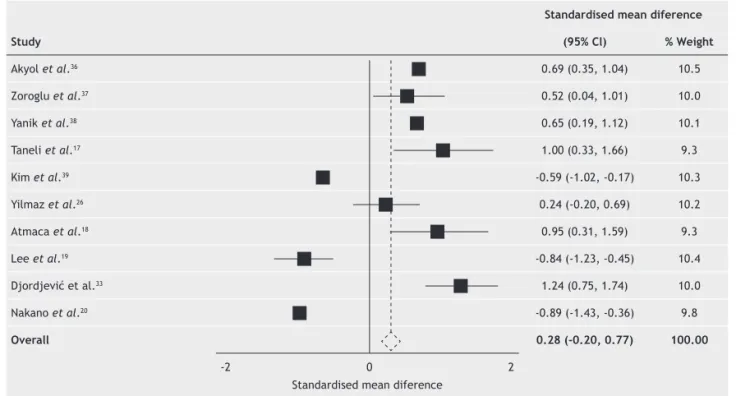
As shown in Figure 1, no signiicant difference was found
between patients and healthy controls regarding total
nitrite plasma/serum concentrations (effect size g = 0.285, 95%CI = -0.205 to 0.774, p = 0.254). Between-study hetero-geneity (I2 = 90.8%, Q = 98.22, p < 0.001) was found, but there was no evidence of publication bias (p = 0.466). The
meta-regression analysis showed a signiicant moderating
effect of mean duration of illness (7 studies; r = 0.153; p = 0.005).
When studies with drug-free patients were evaluated
separately (Figure 2), no signiicant difference was found
between patients and healthy controls regarding total ni-trite plasma/serum concentrations (effect size g = -0.109, 95%CI = -0.856 to 0.637, p = 0.774). There was between-study heterogeneity (I2 = 90.7%, Q = 43.01, p < 0.001), but no evi-dence of publication bias (p = 0.066). The meta-regression analysis showed no effect of duration of illness (4 studies; r = 0.147; p = 0.057).
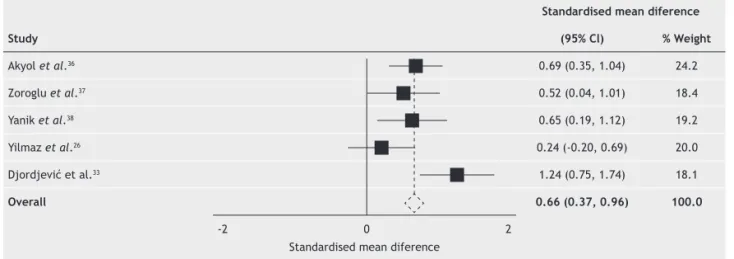
However, when we examined only the studies with
pa-tients under treatment (Figure 3), there was a signiicant
difference between patients and healthy volunteers (effect size g = 0.663, 95%CI = 0.365 to 0.961, p < 0.001), show-ing that patients under antipsychotic drug treatment have higher levels of plasma/serum total nitrite than controls. A moderate between-study heterogeneity (I2 = 56.0%, Q = 9.10, p = 0.059) was found and there was no evidence of publica-tion bias (p = 0.819). The meta-regression analyses showed
no signiicant interactions.
All the results of this meta-analysis remained the same when we excluded the two studies which worked with NO serum levels:17,26 all studies (effect size g = 0.209,
95%CI = -0.377 to 0.795, p = 0.484); drug-free studies (ef-fect size g = -0.378, 95%CI = -1.071 to 0.316, p = 0.286); and under-treatment studies (effect size g = 0.765, 95%CI = 0.482 to 1.048, p = 0.000).
Table 1 - Studies included in the meta-analysis
Reference Subjects N (M/F)
Duration of illness
(years) Antipsychotics
Mean age ± SD (years)
Age at onset ± SD (years)
Atmaca et al.18 SZ
CL
21 (14/7)
21 (14/7) ND No
30.4 ± 7.8
29.2 ± 6.7 ND
Taneli et al.17 SZ
CL
20 (4/16)
20 (13/7) 1.2 ± 1.0 No
26.8 ± 8.5
25.5 ± 5.8 23.4 ± 2.9
Akyol et al.36 SZ
CL
100 (68/32)
51 (35/16) 10.0 ± 6.9 Yes
34.29 ± 9.39
35.49 ± 10.69 24.3 ± 7.2
Zoroglu et al.37 SZ
CL
82 (59/23)
21 (15/6) 12.1 ± 8.9 Yes
33.64 ± 11.08
33.53 ± 10.92 ND
Nakano et al.20 SZ
CL
30 (18/12)
30 (18/12) 1.9 ± 0.7 No
38.0 ± 15.0
41.0 ± 19.0 ND
Yilmaz et al.26 SZ
CL
66 (66/0)
28 (28/0) 12.1 ± 10.0 Yes
33.6± 11.0
34.4 ± 12.0 22 ± 9
Lee et al.19 SZ
CL
55 (24/31)
55 (24/31) 5.6 ± 5.2 DN
33.6 ± 9.9
33.5 ± 9.9 27.5 ± 9.5
Yanik et al.38 SZ
CL
46 (36/10)
32 (22/10) ND Yes
34.0 ± 11.8
32.9 ± 13.1 ND
Kim et al.39 SZ
CL
45 (45/0)
45 (45/0) 4.3 ± 5.4 DN
30.3 ± 8.5
30.5 ± 8.2 26.5 ± 8.4
Djordjević et al.33 SZ
CL
40 (24/16)
36 (22/14) ND Yes
30.2 ± 7.9
29.8 ± 5.8 ND
Figure 1 - Comparison of plasma/serum levels of total nitrite between schizophrenic patients and healthy controls in the 10 studies under investigation.
No signiicant difference was found between patients and healthy controls (effect size g = 0.285, 95%CI = -0.205 to 0.774,
p = 0.254). Between-study heterogeneity was found (I2 = 90.8%, Q = 98.22, p < 0.001), but there was no evidence of
pub-lication bias (p = 0.466). The meta-regression analysis showed a signiicant moderating effect of mean duration of illness
(7 studies; r = 0.153; p = 0.005).
Study
Standardised mean diference
(95% Cl) % Weight
Akyol et al.36 0.69 (0.35, 1.04) 10.5
Zoroglu et al.37 0.52 (0.04, 1.01) 10.0
Yanik et al.38 0.65 (0.19, 1.12) 10.1
Taneli et al.17 1.00 (0.33, 1.66) 9.3
Kim et al.39 -0.59 (-1.02, -0.17) 10.3
Yilmaz et al.26 0.24 (-0.20, 0.69) 10.2
Atmaca et al.18 0.95 (0.31, 1.59) 9.3
Lee et al.19 -0.84 (-1.23, -0.45) 10.4
Djordjević et al.33 1.24 (0.75, 1.74) 10.0
Nakano et al.20 -0.89 (-1.43, -0.36) 9.8
Overall 0.28 (-0.20, 0.77) 100.00
-2 0 2 Standardised mean diference
Study
Standardised mean diference
(95% Cl) % Weight
Taneli et al.17 1.00 (0.33, 1.66) 19.0
Kim et al.39 -0.59 (-1.02, -0.17) 20.8
Atmaca et al.18 0.95 (0,31, 1.59) 19.2
Lee et al.19 -0.84 (-1.23, -0.45) 21.0
Nakano et al.20 -0,89 (-1.43, -0.36) 20.9
Overall 100.0
-2 0 2 Standardised mean diference
Figure 2 - Comparison of plasma/serum levels of total nitrite between drug-free schizophrenic patients and healthy controls.
No signiicant difference was found between patients and healthy controls (effect size g = -0.109, 95% CI = -0.856 to 0.637,
p = 0.774). Between-study heterogeneity was found (I2 = 90.7%,Q = 43.01, p < 0.001), but there was no evidence of publica-tion bias (p = 0.066). The meta-regression analysis showed no effect of durapublica-tion of illness (4 studies; r = 0.147; p = 0.057).
Discussion
The neurobiology of schizophrenia is characterized by abnor-malities in neurotransmission pathways including glutamate, GABA, and dopamine.3,33 The activation of glutamatergic
NMDA receptors results in calcium inlux into the cell, which
stimulates nNOS to produce NO, which in turn activates guanylate cyclase resulting in increased production of cyclic
GMP. Dysfunction in this “NMDA–NO–cyclicGMP” pathway has been implicated in schizophrenia.34,35
Because the direction of abnormalities in this pathway is still under debate, in this meta-analysis we tried to better understand the role of NO in patients with schizophrenia by investigating whether there were differences in its plasma/
Among the 10 selected studies, there were no signiicant
differences between patient groups and control groups
re-garding total nitrite plasma/serum levels. This inding may be
explained by the presence of several studies with apparently contradictory results. Seven out of the 10 manuscripts found increased total nitrite levels in patients;17,18,26,32,36-38 while the
remaining three found the opposite.1,9,20,39 Interestingly, all
of these studies showed signiicant results. This is probably
the reason why we detected between-study heterogeneity. Methodological variations across the studies may be the explanation for this discrepancy. For example, the dura-tion of disease could be a relevant factor for the levels of NO, given the possible adaptive mechanisms related to the evolution of symptoms. Seven out of 10 studies made refer-ence to the duration of disease in the patient group and the
meta-regression analysis showed a signiicant moderating
effect of mean duration of illness, showing a positive cor-relation between the latter and levels of NO. In this regard, there are two studies in the literature that measured NO
metabolite levels during the irst episode of schizophrenia.
In 1996, Das et al. found low plasma nitrate levels in
irst-episode patients, and in 2004 Ramirez et al.40 reported low concentrations of nitrite and nitrate in the cerebrospinal
luid of irst-episode patients.28,40 Studies with irst-episode
patients and a longitudinal design are likely to foster a greater understanding of the relationship between duration of illness and NO levels. For example, studies that measure NO serum levels could generate correlations between NO levels and different phases of schizophrenia.
The use of antipsychotics by patients may inluence the results of these studies. When the ive studies with drug-free patients were evaluated, no signiicant difference was found
between patients and healthy controls regarding total nitrite plasma/serum concentrations. However, when we examined
only the ive studies with patients under antipsychotic treat
-ment, a signiicant difference between patients and healthy
volunteers was found, showing that patients taking antipsy-chotics have higher levels of plasma/serum NO than controls. In 1996, Das et al. found decreased plasma nitrate levels in
irst-episode schizophrenic patients who were also drug naïve.28
In addition, a study in which the patients spent a longer period without taking antipsychotic medication before the beginning of the trials (drug-free for at least four weeks) reported de-creased total plasma nitrite levels in the patient group, and that six-week antipsychotic treatment with risperidone increased
these levels in correlation with clinical response. Signiicant
changes of nitrite plasma levels between baseline and the end of the treatment in the patient group were found and compared
between the 37 responders to treatment (≥ 30% improvement
in PANSS score) and the 18 non-responders to treatment. Among responders, total plasma nitrite levels after treatment
signiicantly increased when compared to baseline. However, there were no signiicant changes among non-responders. The
authors suggested that the improvement of psychiatric
symp-toms can lead to partial normalization of a deiciency in NO
after treatment.19 Finally, three articles reported an increase
in cerebrospinal luid levels of cyclic GMP in patients with
schizophrenia after treatment with antipsychotic drugs.41-43 As
observed previously, the mechanism of action of NO involves increases in cyclic GMP concentrations through the activation of soluble guanylate cyclase.
Although plasma and serum are not the same thing and
the decision to analyze studies that quantiied NO serum
levels and NO plasma levels together could be regarded as generating a potential confounding factor in this study. Nonetheless, the sensitivity analyses indicated that this deci-sion did not affect the main results of this meta-analysis. All the results of the meta-analysis remained the same when the two studies that evaluated NO serum levels were excluded.
It is essential that future studies be more careful in con-trolling for potential confounding factors that are known to be relevant in schizophrenia. In this regard, well-designed studies
Study
Standardised mean diference
(95% Cl) % Weight
Akyol et al.36 0.69 (0.35, 1.04) 24.2
Zoroglu et al.37 0.52 (0.04, 1.01) 18.4
Yanik et al.38 0.65 (0.19, 1.12) 19.2
Yilmaz et al.26 0.24 (-0.20, 0.69) 20.0
Djordjević et al.33 1.24 (0.75, 1.74) 18.1
Overall 0.66 (0.37, 0.96) 100.0
-2 0 2 Standardised mean diference
Figure 3 - Comparison of plasma/serum levels of total nitrite between schizophrenic patients receiving antipsychotics and healthy controls.
A signiicant difference between patients and healthy volunteers was found (effect size g = 0.663, 95%CI = 0.365 to 0.961,
p < 0.001), showing that patients under medication treatment have higher levels of plasma NO than controls. A moderate between-study heterogeneity (I2 = 56.0%, Q = 9.10, p = 0.059) and no evidence of publication bias (p = 0.819) were found.
must take into account variables such as disease duration and staging, schizophrenia subtype, tobacco use, and antipsychotic treatment.44 Also, further studies should examine potential
correlations between the intensity and quality of symptoms (as measured by scales like the PANSS), stage of disease, and plasma/serum levels of NO in schizophrenia patients.
Conclusion
High between-study heterogeneity was found and this could
be responsible for the meta-analysis inding of no signiicant
differences between the patient group and the control group regarding total nitrite plasma/serum levels. There were studies with apparently contradictory results and they could be divided into two groups: one group suggesting increased plasma/serum levels of total nitrites in patients when com-pared with healthy volunteers and another one supporting a possible decrease in such levels. It is thus likely that the results of one group were cancelled out by the results of the other.
One of the indings of this review was a positive correla
-tion between the dura-tion of disease and levels of NO. In other words, the longer the duration of the disease is, the greater the NO levels in patients. We speculate that this could be explained both by pathophysiological differences between the acute and chronic phases of schizophrenia as well as by the use of medications along the course of the disease.
Lastly, patients under antipsychotic treatment were found to have higher levels of NO metabolites than controls. This
inding might be related to a possible stimulation of the
nitrergic pathway by these drugs. It is believed that this pathway constitutes a fertile target for the development of new treatments for patients with schizophrenia.
Disclosures
João Paulo Maia-de-Oliveira
Employment: Department of Neuroscience and Behavior, Faculdade de Medicina, Universidade de São Paulo (USP), Ribeirão Preto (SP), Brazil; Instituto Nacional de Ciência e Tecnologia ( National Institute for Science and Technology - INCT) Translational Medicine, Brazil; Department of Clinical Medicine, Universidade Federal do Rio Grande do Norte (UFRN),
Natal, Brazil. Other: Núcleo de Apoio à Pesquisa em Neurociência Aplicada
(NAPNA), Universidade de São Paulo, São Paulo, Brazil.
Clarissa Trzesniak
Employment: Department of Neuroscience and Behavior, Faculdade de Medicina, Universidade de São Paulo (USP), Ribeirão Preto (SP), Brazil; Department of Psychosis Studies, Institute of Psychiatry, King’s College London, United Kingdom. Other: Núcleo de Apoio à Pesquisa em Neurociência
Aplicada (NAPNA), Universidade de São Paulo, São Paulo, Brazil.
Irismar R. Oliveira
Employment: Affective Disorders Center, Universidade Federal da Bahia (UFBA), Salvador (BA), Brazil. Other: Núcleo de Apoio à Pesquisa em
Neurociência Aplicada (NAPNA), Universidade de São Paulo, São Paulo,
Brazil.
Matthew J. Kempton
Employment: Department of Psychosis Studies, Institute of Psychiatry, King’s College London, United Kingdom.
Tatiana M. N. de Rezende
Employment: Department of Neuroscience and Behavior, Faculdade de Medicina, Universidade de São Paulo (USP), Ribeirão Preto (SP), Brazil.
Other: Núcleo de Apoio à Pesquisa em Neurociência Aplicada (NAPNA),
Universidade de São Paulo, São Paulo, Brazil.
Sandro Iego
Employment: Affective Disorders Center, Universidade Federal da Bahia (UFBA), Salvador (BA), Brazil.
Glen B. Baker
Employment: Department of Psychiatry, University of Alberta, Edmonton,
Canada.
Serdar M. Dursun
Employment: Department of Psychiatry, University of Alberta, Edmonton,
Canada.
João Paulo Machado-de-Sousa
Employment: Department of Neuroscience and Behavior, Faculdade de Medicina, Universidade de São Paulo (USP), Ribeirão Preto (SP), Brazil.
Jaime E. C. Hallak
Employment: Department of Neuroscience and Behavior, Faculdade de Medicina, Universidade de São Paulo (USP), Ribeirão Preto (SP), Brazil.
Other: Núcleo de Apoio à Pesquisa em Neurociência Aplicada (NAPNA),
Universidade de São Paulo, São Paulo, Brazil.
* Modest
** Signiicant
*** Signiicant. Amounts given to the author’s institution or to a colleague for research in which the author has participation, not directly to the author.
References
1. Peluso ET, Blay SL. Public stigma and schizophrenia in São Paulo city. Rev Bras Psiquiatr. 2011;33(2):130-6.
2. Meltzer HY, Stahl SM. The dopamine hypothesis of schizophrenia: a review. Schizophrenia Bull. 1976;l2:19-76.
3. Bressan RA, Pilowsky LS. Glutamatergic hypothesis of schizophrenia. Rev Bras Psiquitr. 2003;25(3):177-83.
4. Lindsley CW, Shipe WD, Wolkenberg SE et al. Progress towards validating the NMDA receptor hypofunction hypothesis of schizophrenia. Curr Top Med Chem. 2006;6:771-85.
5. Luby ED, Cohen BD, Rosenbaum G, Gottlieb JS, Kelley R. Study of a new schizophrenomimetic drug-Sernyl. Am Med Assoc Arch Neurol Psychiatry. 1959;81:363-9.
6. Al-Nuaimi S, Chaves C, Hallak JE, Baker GB, Dursun S. New perspectives and directions in schizophrenia therapeutics: advances related to non-dopaminergic systems. Rev Bras Psiquiatr. 2010;32:333-8.
7. Toru M, Kuramaji A, Ishimaru M. Excitatory amino acids:
implications for psychiatric disorders research. Life Sci. 1994;55:1683-99.
8. Thornberg SA, Saklad SR. A review of NMDA receptors and the phencyclidine model of schizophrenia. Pharmacotherapy. 1996;16:82-93.
9. Tuominen HJ, Tiihonen J, Wahlbeck K. Glutamatergic drugs for schizophrenia: a systematic review and meta-analysis. Schizophr Res. 2005;72:225-34.
10. Nong Y, Huang YQ, Ju W, Kalia LV, Ahmadian G; Wang, YT et al. Glycine binding primes NMDA receptor internalization. Nature. 2003;422:302-7.
11. Andreazza AC, Kauer-Sant’anna M, Frey BN, Bond DJ, Kapczinski F, Young LT, Yatham LN. Oxidative stress markers in bipolar disorder: a meta-analysis. J Affect Disord. 2008;111(2-3):135-44. 12. Oliveira JP, Zuardi AW, Hallak JE. Role of nitric oxide in patients
with schizophrenia –a systematic review of the literature. Curr Psychiatry Rev. 2008;4:219-27.
13. Moncada S, Palmer RM, Higgs EA. Nitric oxide: Physiology, pathophysiology, and pharmacology. Pharmacol Rev. 1991;43:109-42.
14. Koltuksuz U, Irmak MK, Karaman A, Uz E, Var A, Ozyurt H, Akyol O. Testicular nitric oxide levels after unilateral testicular torsion/detorsion in rats pretreated with caffeic acid phenethyl ester. Urol Res. 2000;28:360-3.
15. Fiddler RM. Collaborative study of modiied AOAC method of
analysis for nitrite in meat and meat products. J. AOAC (J Assoc
Ofic Anal Chem). 1977;60:594.
16. Saady JJ, Bloom VL, Narasimhachari N, Goldberg SC, Friedel RO. A comparison of plasma and serum levels of two tricyclic antidepressants: imipramine and desipramine. Psychopharmacology (Berl). 1981;75(2):173-4.
18. Atmaca M, Tezcan E, Ustundag B. Plasma nitric oxide and leptin values in patients with olanzapine-induced weight gain. J Psychiatr Res. 2007;41(1-2):74-9.
19. Lee BH, Kim YK. Reduced plasma nitric oxide metabolites before and after antipsychotic treatment in patients with schizophrenia compared to controls. Schizophr Res. 2008;104:36-43. 20. Nakano Y, Yoshimura R, Nakano H, Ikenouchi-Sugita A, Hori H,
Umene-Nakano W, Ueda N, Nakamura J. Association between plasma nitric oxide metabolites levels and negative symptoms of schizophrenia: a pilot study. Hum Psychopharmacol Clin Exp. 2010;25:139-44.
21. Sutton AJ, Abrams KR, Jones DR, Sheldon TA, Song F. Methods for meta-analysis in medical research. New York: Wiley, 2000. 22. Higgins JP, Thompson SG, Deeks JJ, Altman DG. Measuring
inconsistency in meta-analyses. BMJ. 2003;327:557-60. 23. Huedo-Medina TB, Sánchez-Meca J, Marín-Martínez F, Botella
J. Assessing heterogeneity in meta-analysis: Q statistic or I2 index? Psychol Methods. 2006;11(2):193-206.
24. Egger M, Davey Smith G, Schneider M, Minder C. Bias in meta-analysis detected by a simple, graphical test. BMJ. 1997;315(7109):629-34.
25. Sharp S. Metaanal regression. Stata Tech Bull. 1998;42:16-22. 26. Yilmaz N, Herken H, Cicek A, Celik A, Yurekli M, Akyol O.
Increased levels of nitric oxide, cortisol and adrenomedullin in patients with chronic schizophrenia. Med Princ Pract. 2006;16(2):137-41.
27. Arinola OG, Idonije OB. Status of plasma nitric oxide and
non-enzymatic antioxidants before and after antipsychotic treatment in Nigerian patients with schizophrenia. J Res Med Sci. 2009;14(1):37-42.
28. Das I, Khan NS, Puri BK, Hirsch SR. Elevated endogenous nitric
oxide synthase inhibitor in schizophrenic plasma may relect
abnormalities in brain nitric oxide production. Neurosci Lett. 1996;215(3):209-11.
29. Srivastava N, Barthwal MK, Dalal PK et al. Nitrite content and antioxidant enzyme levels in the blood of schizophrenic patients. Psychopharmacology. 2001;158:140-5.
30. Suzuki E, Nakaki T, Nakamura M, Miyaoka H. Plasma nitrate
levels in deicit versus non-deicit forms of schizophrenia. J
Psychiatr Neurosci. 2003;28:288-92.
31. Li HC, Chen QZ, Ma Y, Zhou JF. Imbalanced free radicals and antioxidant defense systems in schizophrenia: a comparative
study. J Zhejiang Univ Sci B. 2006;7(12):981-6.
32. Djordjević VV, Stojanović I, Stanković-Ferlez D, Ristić T, Lazarević D, Cosić V, Djordjević VB. Plasma nitrite/nitrate
concentrations in patients with schizophrenia. Clin Chem Lab Med. 2010;48(1):89-94.
33. Thornberg SA, Saklad SR. A review of NMDA receptors and the phencyclidine model of schizophrenia. Pharmacotherapy. 1996;16:82-93.
34. Bernstein HG, Bogerts B, Keilhoff G. The many faces of nitric oxide in schizophrenia. A review. Schizophr Res. 2005;78:69-86 35. Oliveira JP, Lobão B, Machado-de-Sousa JP, Baker GB, Dursun S, Hallak JE. Targeting the NMDA receptor-nitric oxide-cyclic GMP pathway to develop non-dopaminergic antipsychotic medications for schizophrenia. Rev Bras Psiquiatr. 2011;33:223-4.
36. Akyol O, Herken H, Uz E et al. The indices of endogenous oxidative and antioxidative processes in plasma from schizophrenic patients. The possible role of oxidant/antioxidant imbalance. Prog Neuropsychopharmacol Biol Psychiatry. 2002;26:995-1005.
37. Zoroglu SS, Herken H, Yurekli M et al. The possible pathophysiological role of plasma nitric oxide and adrenomedullin in schizophrenia. J Psychiatr Res. 2002;36:309-15.
38. Yanik M, Vural H, Tutkun H et al. Is the arginine-nitric oxide pathway involved in the pathogenesis of schizophrenia? Neuropsychobiology. 2003;47:61-5.
39. Kim YK, Lee BH, Park SH. Decreased plasma nitric oxide metabolite levels in schizophrenia. Psychiatry Invest. 2006;3:57-62.
40. Ramirez J, Garnica R, Boll MC, Montes S, Rios C. Low
concentration of nitrite and nitrate in the cerebrospinal luid
from schizophrenic patients: a pilot study. Schizophr Res. 2004;68:357-61.
41. Ebstein RP, Biederman J, Rimon R, Zohar J, Belmaker RJ. Cyclic GMP in the CSF of patients with schizophrenia before and after neuroleptic treatment. Psychopharmacology. 1976;51:71-4. 42. Ziimmer R, Teelken AW, Cramer H, Ackenheil M, Zandler
KJ, Fischer H. Short – and long – term effects on GABA and dopamine neurons during treatment with sulpiride. Adv Biochem Psychopharmacol. 1980;24:537-9.
43. Gattaz WF, Carmer H, Beckmann H. Low CSF concentrations of cyclic GMP in schizophrenia. Br J Psychiatry. 1983;142:288-91. 44. Pantelis C, Wood SJ, Velakoulis D, Testa R, Fontenelle LF,
Yücel M. Should we redeine the concept of endophenotype in