*Correspondence: T. M. Lima.Rua Rodolpho Paulo Rocco, s/n, Bloco A, 2° andar, sala 52 – Ilha do Fundão, 21941-617 – Rio de Janeiro – RJ, Brasil. E-mail: [email protected]
A
vol. 50, n. 3, jul./sep., 2014 http://dx.doi.org/10.1590/S1984-82502014000300016
Implementation of vancomycin dosing nomogram in an electronic
prescribing system: an innovative tool in antibiotic stewardship
Tácio de Mendonça Lima
1,2,*, Sabrina Calil Elias
1, Rita de Cássia Elias Estrela
2,
Fernando Luiz Lopes Cardoso
31Department of Pharmacy, Fluminense Federal University, Rio de Janeiro, RJ, Brazil, 2Faculty of Pharmacy, Federal
University of Rio de Janeiro, Rio de Janeiro, RJ, Brazil, 3Hospital Infection Control Team, University Hospital Clementino
Fraga Filho, Rio de Janeiro, RJ, Brazil
Vancomycin (VAN) is the gold standard therapy for Methicillin-resistant Staphylococcus aureus (MRSA) infections such as bacteremia and endocarditis. However, VAN suboptimal dosing for serious infections caused by S. aureus isolates that have elevated minimum inhibitory concentration (MIC), could be associated with poor outcome. Better understanding of VAN pharmacokinetics and pharmacodynamics (PK/PD) has led to the creation of new recommendations with optimized dosing regimens for the treatment of MRSA infections. For severe infectious, such as pneumonia and endocarditis, a VAN serum trough concentration of 15–20 mg/L at the steady state should be targeted. The aim of this study was to show how a nomogram with updated VAN dosing was devised and how it was implemented in the electronic prescribing (e-prescribing) system of a teaching hospital. VAN loading dose and maintenance doses were calculated from a pharmacokinetic equation using basic parameters: weight, estimated creatinine clearance, as well as peak and trough serum concentrations. The implementation of
the VAN dosing nomogram in the hospital e-prescribing system deinitively changed the long-standing medical prescription fallacy of “same dose its all”. Finally, this computer-based electronic program has
allowed a wide-ranging intervention and should be recognized as a powerful tool for implementation in antimicrobial stewardship programs.
Uniterms: Vancomycin/prescribing. Methicillin/use. Staphylococcus aureus/methicillin-resistant. Electronic prescribing system/application in hospital. Antibiotics/rational use. Antimicrobials/rational use.
Vancomicina (VAN) é utilizada como primeira escolha na terapia de infecções causadas por
Staphylococcus aureus resistentes à meticilina (MRSA), como bacteremia e endocardite. Entretanto, o aumento na concentração inibitória mínima (CIM) de isolados de S. aureus e doses subterapêuticas de VAN
podem estar associados à falha terapêutica. Para o melhor entendimento sobre o peril farmacocinético
e farmacodinâmico (PK/PD) da VAN foram elaboradas novas recomendações para terapia de infecções causadas por MRSA. Para terapia de infecções graves, como pneumonia e endocardite, a concentração sérica do vale de VAN de 15-20 mg/L no estado de equilíbrio dinâmico deve ser o alvo. O objetivo do estudo foi desenvolver um nomograma com doses atualizadas de VAN e demonstrar como ele foi implementado no sistema de prescrição eletrônica em um Hospital Universitário. As doses de ataque e manutenção foram calculadas a partir de equações farmacocinéticas, utilizando parâmetros fundamentais: peso, depuração de creatinina, concentrações séricas do pico e do vale. A implementação de um nomograma de doses de
VAN em um sistema de prescrição eletrônica modiicou deinitivamente o inadequado hábito de que “a mesma dose cabe em todos”. Finalmente, esta abrangente ferramenta tecnológica deve ser considerada
como uma robusta estratégia num programa de uso racional de antibióticos.
INTRODUCTION
Methicillin-resistant Staphylococcus aureus
(MRSA) is a major pathogen in hospital-acquired infections worldwide and, in some countries, has also become an emergent pathogen in community-acquired infections (David, Daum, 2010).
Alternative antimicrobial agents with proven efficacy against MRSA infections, such as linezolid, daptomycin and tigecycline, are available. However, except for daptomycin, these drugs are not FDA approved for the treatment of bacteremia and endocarditis. Vancomycin (VAN) remains the most widely used drug in clinical practice for MRSA infections and is comparatively less costly (Liu et al., 2011).
Better knowledge about VAN pharmacokinetics/ pharmacodynamics (PK/PD) has allowed proposals
to optimize VAN dosing. AUC24h/MIC (area under the
plasma-concentration curve in 24 hours divided by the minimal inhibitory concentration) has been considered in animal models, and in a study involving humans
with pneumonia caused by S. aureus, as the most
representative PK/PD index for VAN. The study in humans showed that clinical outcome and bacteriological eradication were superior in patients who attained
the VAN PK/PD index of ≥ 400 AUC24h/MIC
(Moise-Broder et al., 2004). In addition, for S. aureus with VAN
MIC of 1 mg/L, the AUC24h of 400 would be necessary
to reach the recommended PK/PD index of 400. It is noteworthy that for S. aureus with MIC > 1 mg/L VAN, a higher dosing regimen would be necessary to achieve
the recommended PK/PD target and the beneits of this
are uncertain. Therefore, in this scenario, alternative drugs should be considered because of increased risk of VAN toxicity and clinical failure. The VAN serum trough concentration of 15 mg/L or greater is correlated to an AUC24h of around 400, and higher doses are usually
necessary to attain this target (Rybak et al., 2009).
Based on these data, the Infectious Diseases Society of America (IDSA) and American Society of Health-System Pharmacists guidelines have updated VAN dosing to 15–20 mg/kg every 8–12 hours targeting a trough serum concentration of 15 to 20 mg/L for the treatment of severe infections such as pneumonia, endocarditis, osteomyelitis and meningitis in adult patients (Rybak et al., 2009; Liu et al., 2011).
An electronic prescribing (e-prescribing) system is a technology that improves the quality of patient care and the safety of medication management by decreasing medical errors through the feature of electronically sending an accurate and understandable prescription directly to a
pharmacy from the point-of-care. Utilization of electronic systems and e-prescribing in antibiotic stewardship
programs are an encouraging innovative ield but with
limited reports to date (Tamma, Cosgrove, 2011).
The aim of this study was to show how a nomogram with an updated VAN dosing regimen for adults was devised using a linear PK model and how it was implemented in an e-prescribing system.
MATERIAL AND METHODS
This study is a report of the VAN nomogram calculation with individualized PK parameters, and how it was subsequently implemented. The study was conducted in a public teaching hospital with 300 beds for adult patients located in Rio de Janeiro city. The hospital utilizes the MedTrak systems, an integrated Electronic Medical Record and Medical Practice Management Software Service that allow electronic prescribing and many electronic surveillance tools including microbiological culture results, MRSA chart flagging, notification of new orders for VAN prescriptions and, since 2010, the provision of antibiotic dosing regimen orientation through e-prescribing. For the development of the VAN dosing nomogram, a one-compartment model (the Bauer model) was used. Individualized parameters were applied in the equations to calculate the VAN maintenance dose regimens with the following PK parameters: VAN clearance (Clvanco), volume of distribution (Vd), K
elimination (K), half-life (t1/2) and dosing interval (DI). Total body weight in kg (TBW) and estimated creatinine
clearance in mL/min (ClCr) were stratiied into ranges.
For the dose calculations, the midpoint of each range was used to estimate the most adequate dose regimen for each patient category. For example, in patients in the TBW range of 71–80 kg and renal function with ClCr in the 50–59 mL/min range, the values used in the equation were 75 kg and 55 mL/min, respectively. For patients with
ClCr ≥ 120 mL/min, the value used was 130 mL/min. The
ClCr was calculated using the Cockcroft and Gault (1976) formula. VAN loading dose was calculated independently of renal function by multiplying TBW by 25 mg. The ClCr calculation and pharmacokinetic equations along with the variables employed are shown below:
Estimated creatinine clearance
ClCr (mL/min) = (140 – A) x W / SCr x 72. For females, the inal product is multiplied by 0.85.
VAN clearance
Volume of distribution
Vd (L) = 0.7 x TBW
Elimination rate constant
K (h-1) = Clvanco / Vd
Half-life
t1/2 (h) = 0.693 / K
Dosing interval
DI (h) = ln Peakd – ln Troughd / K
Maintenance dose
MD (mg) = Peakd x Vd x [1 - e - (K x DI)]
Symbol key: A represents age in years, W represents weight in kg, SCr represents serum creatinine in mg/
dL, TBW represents total body weight, while Peakd and
Troughd represent desired VAN serum peak and trough
concentrations both in mg/L.
Peak and trough concentrations of VAN were selected as 50 mg/L and 17.5 mg/L, respectively. This trough serum level is to achieve empirical optimal exposure to S. aureus with VAN MIC ≤ 1 mg/L according
to MRSA VAN MIC distribution (MIC90) from clinical
samples obtained at our hospital. VAN infusion rate was applied according to doses: 60 minutes of infusion for doses ≤1.0 g, 90 minutes for 1.1 to 1.5 g, 120 minutes for 1.6 to 2.0 g, and for doses >2.0 g the infusion rate was around 1.0 g/h.
The dosing intervals were planned to reduce the
unnecessary risk of developing toxicity by exposure to high doses (for instance 1.0 g q6h as opposed to 2.0 g q12h) and to guarantee obtention of the desired trough level. Dosage regimens were rounded according to VAN dose vial (500 mg) and to facilitate drug scheduling for nursing (6, 8, 12, 24, and 96 h). For patients on hemodialysis (i.e. ClCr<10 mL/min) the recommend drug interval was 4 days. It is important to consider that in this hospital, patients are submitted to hemodialysis using the
low-lux dialyzer and that VAN removal by this type of dialyzer is negligible regardless of blood or dialysate low.
For patients whose weight was under 50 kg or over 100 kg, it is recommended that assistance be sought to calculate VAN dosing individually.
RESULTS AND DISCUSSION
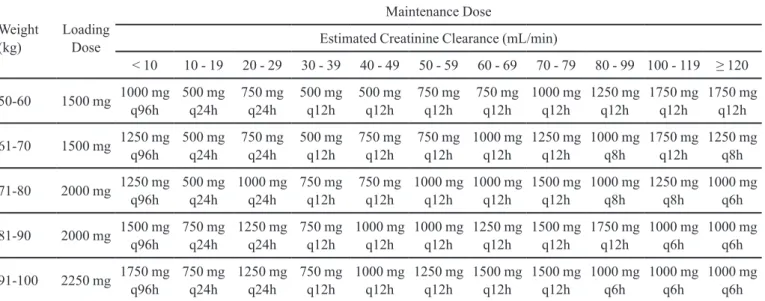
The VAN dosing nomogram for adults according to TBW and ClCr is shown in Table I. The nomogram
includes six weight ranges from ≥ 50 to ≤ 100 kg and
11 renal function ranges from patients on dialysis with ClCr<10 mL/min to patients with ClCr>120 mL/min.
The computer based program with the nomogram is accessed when VAN is typed into the e-prescribing sheet by the physician. The nomogram dosing adjustment window with the requested parameters is then automatically triggered (Figure 1). The prescriber must input values for the variables TBW and ClCr into the window for automatic display of the VAN dosage regimen and rate of infusion. For the beginning of therapy, the system automatically marks the option of loading dose, whereas for subsequent days the option of loading dose is left unmarked by default.
TABLE I - Vancomycin dosing nomogram for adults according to total body weight and renal function
Weight (kg)
Loading Dose
Maintenance Dose
Estimated Creatinine Clearance (mL/min)
< 10 10 - 19 20 - 29 30 - 39 40 - 49 50 - 59 60 - 69 70 - 79 80 - 99 100 - 119 ≥ 120
50-60 1500 mg 1000 mg q96h 500 mg q24h 750 mg q24h 500 mg q12h 500 mg q12h 750 mg q12h 750 mg q12h 1000 mg q12h 1250 mg q12h 1750 mg q12h 1750 mg q12h
61-70 1500 mg 1250 mg q96h 500 mg q24h 750 mg q24h 500 mg q12h 750 mg q12h 750 mg q12h 1000 mg q12h 1250 mg q12h 1000 mg q8h 1750 mg q12h 1250 mg q8h
71-80 2000 mg 1250 mg q96h 500 mg q24h 1000 mg q24h 750 mg q12h 750 mg q12h 1000 mg q12h 1000 mg q12h 1500 mg q12h 1000 mg q8h 1250 mg q8h 1000 mg q6h
81-90 2000 mg 1500 mg q96h 750 mg q24h 1250 mg q24h 750 mg q12h 1000 mg q12h 1000 mg q12h 1250 mg q12h 1500 mg q12h 1750 mg q12h 1000 mg q6h 1000 mg q6h
Updated renal function is notiied by the electronic system
for daily e-prescribing. For patients on hemodialysis, the
prescriber must check the irst box at the top (Patients on
hemodialysis) then the ClCr of 9.0 mL/min is selected automatically. For better control of the VAN prescription, a tool in the electronic chart that includes patient weight and height has been created. These patient parameters are displayed at the top right of the prescription sheet (Figure 1) allowing easy visual checking and when necessary, dose revision.
Severe infections caused by MRSA have to be promptly treated with the right choice of antimicrobial and dosing to achieve optimal drug exposure. Owing to increased MICs for VAN, more-intensive VAN dosing schedules have to be administered. VAN 1.0 g q12h has been the standard dose regimen prescribed in our institution. There was a pressing need to definitively
change this old practice of “same dose fits all”, and
therefore we decided to devise an updated VAN nomogram and implement this in the e-prescribing system. To our
knowledge, this is the irst report of a VAN dosing regimen
nomogram implemented in an e-prescribing system at a Brazilian hospital.
Several VAN PK models, such as Matze, Birt, Ambrose, Burton and Bauer methods based on linear regression, and Bayesian estimations based on nonlinear regression, have been created to estimate the PK parameters of VAN to facilitate the initial drug dosing
calculations.Although Bayesian PK models offer the
advantage of calculating VAN dosing for a population database through the use of two or three compartment equations, these models are not widely used in the
clinical ield. They are also complex models that demand
specialized PK knowledge and costly computer programs (Bauer, 2008).
We chose the Bauer method, a linear regression model that applies individualized PK equations and allows
simpliied and accurate VAN dosage calculations. In this
method, the utilization of intravenous bolus constitutes a limitation. However, VAN elimination during intravenous infusion is poor and PK equations that consider the loss of drug during the infusion time are not obligatory, as intravenous bolus equations can predict VAN peak concentration (Bauer, 2008).
According to recent guidelines and other experts, the desirable VAN serum trough concentration should be in the 15 to 20 mg/L range (Rybak et al., 2009; Liu et al., 2011). Considering the recommendation of a loading dose, a study showed that patients with a ClCr 80 mL/min who have received a VAN dose of 15 mg/kg q12h without a loading dose, only 23% achieved the desired serum target at 36 h (Drusano et al., 2007).In 2011, IDSA guidelines for MRSA therapy included the recommendation to administer a VAN loading dose of 25-30 mg/kg (TBW) in seriously ill patients with a limit of 2-g per dose (Liu
et al., 2011). In the present nomogram, a loading dose of
FIGURE 1 - Vancomycin e-prescribing chart sheet and window with requested patient parameters. Subtitle: Peso is Weight, Altura
2.250 mg was recommended for patients with a TBW of 91-100 kg.
It is relevant to ponder that in severe infections
during the irst hours of therapy when the bacteria burden
is high, and while the host still has to mount an appropriate immune response, the antibiotics should be as effective as possible during this critical period, justifying more intensive VAN dosing. Nonetheless, there is a genuine concern over VAN-induced nephrotoxicity by dose maximization (van Hal, Paterson, Lodise, 2013).
In 2010, as a part of the antibiotic stewardship program, the VAN nomogram was implemented into the Medtrak e-prescribing system. This program has promoted an immediate impact on patient VAN dosage needs, increasing the probability of obtaining an initial optimal VAN dose. In a recent study, the applications of VAN nomograms showed that target serum VAN concentration were achieved in a higher number of patients with optimized dose regimen (Kullar et al., 2011). One considerable limitation of the present study is that the nomogram has yet to be validated and VAN serum concentration monitoring is necessary for the adjustment of maintenance doses.
CONCLUSION
The implementation of a VAN nomogram in a computer-based electronic program allowed a wide-ranging intervention in patient care with an immediate impact on updating VAN dosing that should be recognized as a powerful tool in antimicrobial stewardship programs.
CONFLICT OF INTEREST
The authors of this manuscript declare no conlicts
of interest of any kind that would interfere with the development of this study.
ACKNOWLEDGMENTS
The authors would like to thank employees of the Hospital Infection Control Team and Ana Maria Pereira Rangel of the Computing and Network Centre of University Hospital Clementino Fraga Filho.
Rita de Cássia Elias Estrela Marins was funded by the Fundação de Amparo à Pesquisa do Estado do Rio de Janeiro (FAPERJ).
Tácio de Mendonça Lima was funded by the Coordenação de Aperfeiçoamento de Pessoal de Nível Superior (CAPES).
REFERENCES
BAUER, L.A. Applied clinical pharmacokinetics. 2.ed. New York: The McGraw-Hill Companies, 2008. 207p.
COCKCROFT, D.W.; GAULT, M.H. Prediction of creatinine clearance from serum creatinine. Nephron, v.16, n.1, p.31-41, 1976.
DAVID, M.Z.; DAUM, R.S. Community-associated methicillin-resistant staphylococcus aureus: epidemiology and clinical consequences of an emerging epidemic. Clin. Microbiol. Rev., v.23, n.3, p.616-687, 2010.
DRUSANO, G.L.; AMBROSE, P.G.; BHAVNANI, S.M.; RUBINO, C.M.; FORREST, A.; LOUIE, A.; LODISE, T.; RODVOLD, K.A. Vancomycin dose recommendations for hospital-, ventilator- or health care-associated pneumonia and the attainment of vancomycin trough concentrations of 15-20 mg/L: cognitive dissonance. In: ANNUAL MEETING OF THE INFECTIOUS DISEASES SOCIETY OF AMERICA, 45, 2007,San Diego. Abstracts. Virginia: Infectious Diseases Society of America, 2007. 447 p.
KULLAR, R.; LEONARD, S.N.; DAVIS, S.L.; DELGADO JR, G.; POGUE, J.M.; WAHBY, K.A.; FALCIONE, B.; RYBAK, M.J. Validation of the effectiveness of a vancomycin nomogram in achieving target trough concentrations of 15-20 mg/L suggested by the vancomycin consensus guidelines. Pharmacotherapy, v.31, n.5, p.411-418, 2011.
LIU, C.; BAYER, A.; COSGROVE, S.E., DAUM, R.S.; FRIDKIN, S.K.; GORWITZ, R.J.; KAPLAN, S.L.; KARCHMER, A.W.; LEVINE, D.P.; MURRAY, B.E.; RYBAK, M.J.; TALAN, D.A.; CHAMBERS, H.F. Clinical practice guidelines by the infectious diseases society of America for the treatment of methicillin-resistant staphylococcus aureus infections in adults and children. Clin. Infect. Dis., v.52, n.3, p.18-55, 2011.
RYBAK, M.; LOMAESTRO, B.; ROTSCHAFER, J.C.; MOELLERING JR, R.; CRAIG, W.; BILLETER, M.; DALOVISIO, J.R.; LEVINE, D.P. Therapeutic monitoring of vancomycin in adult patients: a consensus review of the American Society of Health-System Pharmacists, the Infectious Diseases Society of America, and the Society of Infectious Diseases Pharmacists. Am. J. Health Syst. Pharm., v.66, n.1, p.82-98, 2009.
TAMMA, P.D.; COSGROVE, S.E. Antimicrobial stewardship. Infect. Dis. Clin. North Am., v.25, n.1, p.245-260, 2011.
VAN HAL, S.J.; PATERSON, D.L.; LODISE, T.P. Systematic review and meta-analysis of vancomycin-induced nephrotoxicity associated with dosing schedules that maintain troughs between 15 and 20 milligrams per liter. Antimicrob Agents Chemother., v.57, n. 2, p. 734-744, 2013.
Received for publication on 23rd July 2013