540
Brazilian Journalof otorhinolaryngology 77 (4) July/august 2011
http://www.bjorl.org / e-mail: [email protected]
Anterior laryngeal membrane and 22q11 deletion syndrome
Rafael Fabiano Machado Rosa
1, Rosana Cardoso Manique Rosa
2, Rita Carolina Pozzer Krumenauer
3,
Marileila Varella-Garcia
4, Giorgio Adriano Paskulin
51 Master’s degree, medical geneicist at the UFCSPA/CHSCPA. Doctoral student in pathology (Graduate Program in Pathology), UFCSPA. 2 Specialist in pediatrics, master’s degree student in pathology (Graduate Program in Pathology), UFCSPA. Brazil. 3 Master’s degree in health sciences, otorhinolaryngologist, tutor at the Otorhinolaryngology Unit, HCSA/CHSCPA, Brazil.
4 Doctoral degree in biological science, professor and cytogeneicist in charge of the Cytogeneics Laboratory, Medical Oncology Division, University of Colorado Denver, US. 5 Doctoral degree in geneics and molecular biology, medical geneicist at UFCSPA/CHSCPA. Professor in the Clinical Geneics Discipline and the Graduate Program on Pathology,
UFCSPA. Cytogeneicist in charge of the Cytogeneics Laboratory of the UFCSPA, Brazil.
Santo Antonio Child Hospital (Hospital da Criança Santo Antônio - HCSA), Porto Alegre Health Science Federal University (Universidade Federal de Ciências da Saúde de Porto Alegre - UFCSPA), Porto Alegre Holy House Hospital Complex (Complexo Hospitalar Santa Casa de Porto Alegre - CHSCPA), and University of Colorado.
Send correspondence to: Prof. Dr. Giorgio Adriano Paskulin, Rua Sarmento Leite, 245/403, Bairro Centro, Porto Alegre - RS, Brazil. Phone. (0xx51) 3303-8771 - Fax: (0xx51)33038810
University of Colorado (US) and CAPES (Coordenação de Aperfeiçoamento de Pessoal de Nível Superior) (Brazil). Paper submited to the BJORL-SGP (Publishing Management System – Brazilian Journal of Otorhinolaryngology) on July 15, 2010;
and accepted on October 10, 2010. cod. 7209
CASE REPORT
Braz J Otorhinolaryngol. 2011;77(4):540.
BJORL
Keywords: chromosomes, human, pair 22, DiGeorge syndrome, in situ hybridization, fluorescence, larynx.
.org
INTRODUCTION
Anterior laryngeal webs (ALWs) are un-common abnormalities consisting of membranous tissues on the supraglottic, glottis, and/or subglottis at birth.1-3 These webs answer for about 5% of laryn-geal malformations;1 depending on how extensive they are, airway obstruction may ensue, resulting in symptoms such as crying, stridor, dysphonia, and respiratory dysfunction.2,4 Individuals with this condition often present other concomitant anoma-lies, such as congenital heart defects, and palatine anomalies, which often are part of known genetic syndromes.1-3
This paper presents a case report of a patient with an ALW and the 22q11 deletion syndrome (SD22q11), also known as the velocar-diofacial syndrome or DiGeorge syndrome (OMIM
188400/192430).5
CASE REPORT
A male Caucasian patient aged 12 years and 2 months was first admitted to hospital for surgery to correct a fossa ovalis type interatrial communication. The patient was the first child of young, healthy, and non-consanguineous parents. The family history was negative for congenital defects or genetic diseases. Pregnancy coursed uneventfully. The patient was delivered vaginally, at term, cephalic presentation, weighing 3,430 gr. (P50), measuring 50 cm (P25-50), with a 35 mm cephalic perimeter (P50-98). The baby was cyano-tic and did not cry during birth. Oxygen therapy was required, and the patient remained in hospital for 15 days after birth. At the age of 3 months, a laser laryngeal procedure was done to remove a subglottic membrane; at this point the patient had episodes of hypocalcemia that required treatment with calcium gluconate.
Neuropsychomotor, behavioral, and spe-ech development was compromised as the patient grew, requiring drug therapy - haloperidol and biperiden. The physical examination at age 12 years and 2 months was as follows: weight - 47 kg (P75-90), height - 147 cm (P50), cephalic perimeter - 53 cm (P2-50), elongated face, narrow palpebral fissures, bilateral epicanthic folds, hypoplasic nasal alae, dental malocclusion, prognathism, overfolded helices (horizontal and vertical rami), pectus cari -natum, protruding navel, right cryptorchidism, and
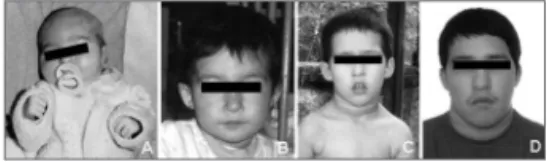
thin fingers of the hand. The palate was ogival, but there were no associated abnormalities such as velopharyngeal insufficiency. Figure 1 shows
the craniofacial features of the patient at different ages. The patient was referred to an otorhinola-ryngologist due to dysphonia of unknown origin. Nasofibrolaryngoscopy revealed the presence of an ALW associated with anterior subglottic steno-sis and decreased glottic lumen. The trachea and the carina were normal. The child did not present dyspnea. At this point the decision was in favor of watchful waiting. Abdominal ultrasound revealed only an accessory spleen. The blood calcium level was within normal limits. The initial cytogenetic evaluation - high resolution GTG band karyotyping (≥ 550 bands) - was normal (46,XY). Investigation of the 22q11.2 microdeletion with the fluorescent in situ hybridization technique (FISH), using a DNA DiGeorge/VCFS Region Probe (TUPLE 1) DNA probe, confirmed the diagnosis of the SD22q11.
DISCUSSION
ALWs are a mild form of laryngeal atresia (type III).4 Its association with the SD22q11 microde-letion has been described in a few published papers within the past two decades; most of these reports had a small number of patients.1-4 Miyamoto et al. (2004)3 reported a 65% frequency of the SD22q11 in 17 patients with ALWs, one of the few case series. Studies of patients with the SD22q11 have noted that this malformation has been described in 1 to 2% of cases.6
The SD22q11 is a relatively common gene-tic disease; it is caused by a deficiency in region 11 in the long arm of the chromosome 22. Although most cases of the SD22q11 are sporadic (because of new mutations), patients with this deletion have a 50% chance of passing it onto their offspring. The clinical features of this syndrome are varied; the phenotype includes several types of otorhino-laryngeal alterations. These changes have been given several names given before the syndrome was described in the beginning of the 1990s, such as the DiGeorge syndrome, the velocardiofacial syndrome, and Shprintzen’s syndrome. These names reflect the perception of different specialists about
the same disease.6
It should be noted that in some cases these features may not be so evident, especially younger children, making it more difficult to raise the possi-bility of this syndrome3,5 (see Fig. 1). Hypocalcemia may be latent, as in this case, and may become apparent only before surgery.7
COMMENTS
As has been reported in the literature,1-4 these findings suggest that patients with ALWs - and particularly those with other congenital mal-formations such as heart defects - should always be tested for the SD22q11 deletion syndrome. This has important implications for the management of patients and genetic counseling of the family.
REFERENCES
1. Stoler JM, Ladoulis M, Holmes LB. Anterior laryngeal webs and 22q11 deletions. Am J Med Genet. 1998;79:152.
2. McElhinney DB, Jacobs I, McDonald-McGinn DM, Zackai EH, Goldmuntz E. Chromosomal and cardiovascular anomalies associated with congenital laryngeal web. Int J Pediatr Otorhi-nolaryngol. 2002;66:23-7.
3. Miyamoto RC, Cotton RT, Rope AF, Hopkin RJ, Cohen AP, Shott SR, et al. Association of anterior glottic webs with velocardiofacial syndrome (chromosome 22q11.2 deletion). Otolaryngol Head Neck Surg. 2004;130:415-7.
4. Fokstuen S, Bottani A, Medeiros PFV, Antonarakis SE, Stoll C, Schinzel A. Laryngeal atresia type III (glotic web) with 22q11.2 microdeletion: report of three patients. Am J Med Genet. 1997;70:130-3. 5. Online Mendelian Inheritance in Man, OMIM
(TM) [homepage on the Internet]. Baltimore e Bethesda: BeMcKusick-Nathans Institute for Genetic Medicine, Johns Hopkins University and National Center for Biotechnology Information, National Library of Medicine [cited 2010 Aug 10]. Available from: http://www.ncbi.nlm.nih.gov/ omim/.
6. Rosa RFM, Zen PRG, Roman T, Graziadio C, Paskulin GA. Síndrome de deleção 22q11.2: compreendendo o CATCH22. Rev Paul Pediatr. 2009;27:211-20.
7. Schaan BD, Huber J, Leite JC, Kiss A. Cardiac surgery unmasks latent hypoparathyroidism in a child with the 22q11.2 deletion syndrome. J Pediatr Endocrinol Metab. 2006;19:943-6.