Work done in the Department of Speech-Language Pathology and Audiology, Bauru School of Dentistry, Universidade de São Paulo – USP – Bauru (SP), Brazil, with Scientific Initiation scholarship granted by the Conselho Nacional de Pesquisa (CNPq).
(1) Postgraduate Program (Ph.D) in Dentistry and Oral Biology, Department of Applied Dental Sciences, Bauru School of Dentistry, Universidade de São Paulo – USP – Bauru (SP), Brazil.
(2) Clinical Speech Therapist, Bauru (SP), Brazil.
(3) Graduate Program (Ph.D) in Speech-Language Pathology and Audiology, Bauru School of Dentistry, Universidade de São Paulo – USP – Bauru (SP), Brazil. (4) Department Speech-Language Pathology and Audiology, Bauru School of Dentistry, Universidade de São Paulo – USP – Bauru (SP), Brazil.
Conflict of interests: No
Author’s contribution: TSG lead researcher, schedule elaboration, literature review, data collection and data analysis, writing of scientific articles; TAPN lead researcher, writing schedule, literature review, data collection and data analysis, APN updated review of the literature , data analysis, writing and revision of the article; PAPN co-counselor, preparation of design research with the counselor, revision of article and approval of the final version; SALH counselor, preparation of design research, organizing the collection and analysis of data, schedule , data analysis, drafting and revision of article, approval of the final version of the article, submission and procedures.
Correspondence address: Simone Aparecida Lopes-Herrera. Al. Octávio Pinheiro Brisola, 9-75, Vila Universitária, Bauru (SP), Brazil, CEP: 17012-90. E-mail: [email protected]
Received: 6/28/2012; Accepted: 7/24/2013
Phonological awareness in children from public schools
and particularly during the process of literacy
Habilidades de consciência fonológica em crianças de escolas
pública e particular durante o processo de alfabetização
Thaís dos Santos Gonçalves1, Thaíla Affonso Pimenta Neves2, Ana Paola Nicolielo3, Patrícia Abreu Pinheiro
Crenitte4, Simone Aparecida Lopes-Herrera4
ABSTRACT
Purpose: To verify and compare phonological awareness (PA) abilities of public and private school children in the literacy process. Methods: A test of phonological awareness (PA) was applied in 70 children in the first grade of elementary school (35 students from public school and 35 from private school) at the beginning (pretest) and end (posttest) of the school year. Results: All children showed improvement in their perfor-mance when compared pre and posttest. In the pretest, the best scores were observed in the syllable level and in rhymes; however, comparing the pre with the posttests, the phonemic level showed the most significant improvement rates in the whole sample. The private school children had higher scores in most tests applied, as well as a higher total number of points compared to public school children in the pre and posttest. There was a decrease in the difference of the PA performance between schools at the end of the school year. Conclusion: All children showed impro-vement in PA skills with literacy process, although children from private schools had better performance, especially in the pretest, which can be a sign of the socioeconomic influence in the development of these skills. Syllabic and rhymes skills were developed before the literacy process and phonemic awareness skills were developed concurrently with this process. Also this study lays emphasis on the importance of the instruc-tion in public schools in reducing the discrepancy between the abilities of these schools at the end of the school year, in this sample.
Keywords: Learning; Language; Child language; Language develop-ment; Education
RESUMO
Objetivo: Verificar e comparar habilidades de consciência fonológica (CF) de crianças estudantes de escola pública e particular, em processo de alfa-betização. Métodos: Foi aplicado um teste de CF em 70 crianças da pri-meira série do Ensino Fundamental, sendo 35 estudantes de escola pública e 35 de escola particular, no início (pré-teste) e no final (pós-teste) do ano letivo. Resultados: Todas as crianças obtiveram melhora no desempenho, quando comparados o pré e o pós-teste. No pré-teste, os melhores escores foram relativos às provas que envolviam o nível silábico e rimas. No entan-to, comparando-se o pré-teste com o pós-teste, as provas de nível fonêmico foram as que resultaram em índices significativos de melhora em toda a amostra. As crianças da escola particular obtiveram maior pontuação na maioria das provas, assim como maior número total de pontos no pré-teste e no pós-teste, em relação às crianças da escola pública. Houve redução da diferença entre as escolas no desempenho da CF no final do ano letivo. Conclusão: Todas as crianças apresentaram melhora nas habilidades de CF com o processo de alfabetização. As crianças da escola particular de-monstraram melhor desempenho, principalmente no pré-teste, indicando possível influência dos aspectos socioeconômicos no desenvolvimento dessas habilidades. As habilidades de rimas e as habilidades silábicas desenvolveram-se antes do processo de alfabetização e as habilidades de consciência fonêmica foram desenvolvidas concomitantemente com esse processo. Enfatiza-se, ainda, na amostra estudada, a importância do ensino da escola pública na diminuição da discrepância dessas habilidades entre as escolas, no final do ano letivo.
INTRODUCTION
It is during the pre-school and early school years that children learn to read and write, developing the ability to pay attention to the speech, analyzing it in different segments, which are phonemes, syllables and words(1).
Awareness of the segmented nature of the speech, which derives from the ability to think and reflect consciously on the language itself, is called phonological awareness (PA). It is defined as a set of skills ranging from simple global perception of word length and phonological similarity between them, to the segmentation and manipulation of syllables and phonemes, developing gradually, as the child becomes aware of sound system of language(2).
Studies presented in the literature emphasize the importance of PA in the literacy process and the construction of written language, as well as the use of phonological awareness activities in a preventive or rehabilitation way(1-3). However, there are
controversies(4) when is discussed the influence of this ability
in the process of literacy in the early grades, questioning whe-ther whe-there is a causal relationship, a relationship of effect, or a relationship of reciprocal causality. Some authors consider PA as a predictor of performance in reading, with higher pre-valence of deficits linked to socioeconomic conditions, due to the stimulation and contact with reading material and writing from pre-school(5,6). Authors suggest that sociocultural factors
exert negative influence on child development (7).
The aim of this study was to verify and compare PA abili-ties of students from public and private schools in the literacy process.
METHODS
This study was approved by the Committee of Ethics on Research of the Bauru School of Dentistry (FOB), University of São Paulo (USP), under protocol number 39/2006.
The study included 70 children, students from the first grade of elementary school, being 35 students from public school and 35 from private school, aged between 6 and 7 years old. The schools were located in the same neighborhood in the city of Bauru (SP). There were included in the sample children without apparent vision problems, hearing and / or learning, as reported by their teachers in an interview with the researcher before data collection. Children who had any of these problems were not included in the sample. There was prior authorization from the State Department of Education (public school) and the school management of both schools (public and private). Parents and/ or guardians of the participants signed a consent form authori-zing the participation of children in the study.
The procedures described below were applied in classrooms provided by school managements (public and private). Data were collected at the beginning of the school year (February), when the children had not yet gone through the process of
literacy (pretest) and at the end of the school year (November), when they had gone through great part of this process (posttest).
For assessment of phonological awareness was used the assessment test for Phonological Awareness (ATPA)(8). This
procedure, of individual application, contains six subtests: identifying rhymes, counting syllables, matching initial pho-nemes, counting phoneme, comparing the length of the words and representing phonemes with letters. The maximum score for each task is five points, so there is a maximum score of 30 points. In each school, the both assessment times (beginning and end of the school year), the children were taken to a room where there were arranged tables and chairs (desks). Each child sat down at his/her desk, in order to individually perform the test, receiving a pencil, an eraser and a tests book prepared by compilation of tests sheets. We presented a set of demo pages to explain to students how ATPA should be done.
The results were subjected to quantitative, qualitative and comparative analysis verifying the level of significance of the differences found on them. We used the Mann-Whitney test in the comparative statistical analysis, in the comparison of performance between schools at the beginning and end of the year and the Wilcoxon test, comparing the performance of the sample in each test, also at the beginning and end of year. For both statistical tests we used the significance level p<0.05.
RESULTS
In total, the sample comprised 70 children, 37 boys and 33 girls (18 boys and 17 girls from public school, 19 boys and 16 girls from private school).
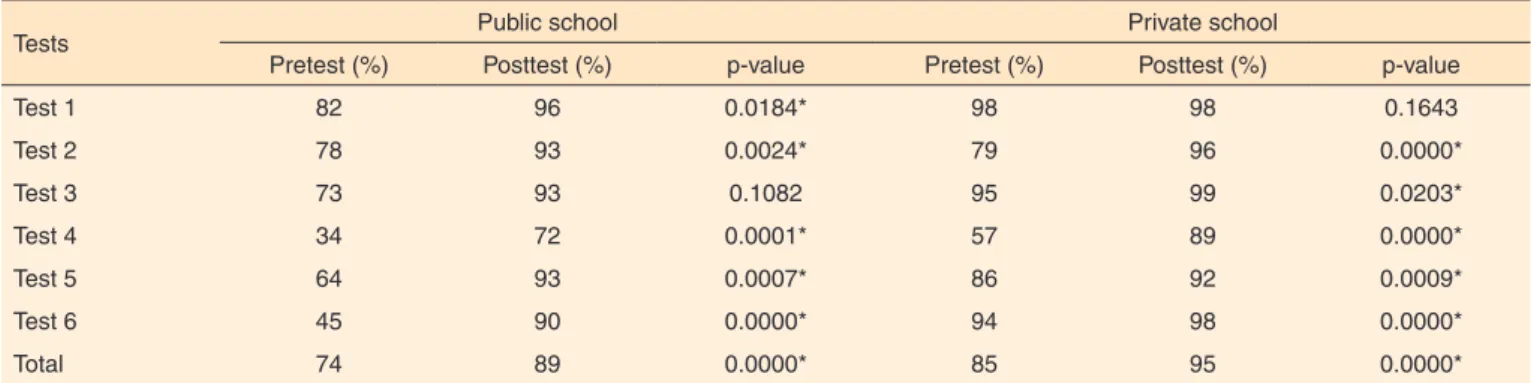
The average score for each test, on percentage and also the maximum total number of points obtained in the pretest and posttest in both children form the public and private school, are shown in Tables 1 and 2, respectively.
It was observed that there was a significant improvement in performance (p<0.05) between pre and posttest in tests 1 (identifying rhymes), 2 (counting syllables), 4 (counting phonemes), 5 (comparing the length of the words), 6 (repre-senting phonemes with letters) and in the total points for the public school children. In the tests 2 (counting syllables), 3 (combining initial phonemes), 4 (counting phonemes), 5 (comparing the length of the words) , 6 (representing phonemes with letters) and in the total points for children in private schools.
The comparison of the values obtained, in percentage, for the children of the public school and private school in each of the phonological awareness tests applied at pretest and posttest, and in the total amount of the test is shown in Table 3.
Comparing the pretest to posttest, we found that all the children in the sample improved performance in all tests, although this improvement was more marked in children from private school.
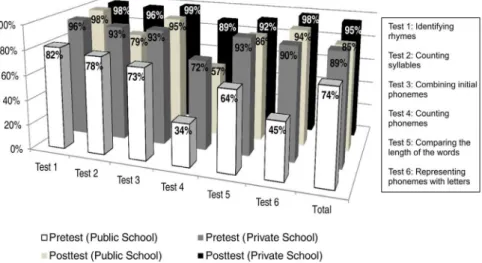
In the total score on the test, the private school children showed better results than those of public school children (89% and 95% in the pre-and posttest, respectively, versus 74% and 89%), but it was noted that the difference between the results were much lower in the posttest than at the pre-test. However, in both situations, all children in the sample had a significant improvement in the total score of the test (Figure 1).
DISCUSSION
In the present study, we observed that the performance
of phonological awareness was significantly improved with the acquisition of literacy in all children in the sample. This analysis could be made by comparing the performance of all children in each event in the pre and posttest in both schools, where there was a difference in most tests, except for test 1 (Identifying rhymes), in private school, in which children had already had a high success rate in the pretest, and test 3 (matching initial phonemes) in public school. According to the literature, the performance of PA enhances skills up as education increases(9).
The basic skills of PA develop before the process of li-teracy and other, more complex, are developed concurrently with this process(9) . In relation to this information, the results
of this study showed that the best performance achieved in the pretest, for all children in the sample occurred in tests involving syllabic rhymes and skills. This confirms the results
Table 1. Performance of children from public and private schools in phonological awareness tests applied at the beginning of the school year (pretest)
Tests Public school (%) Private school (%) p-value
Test 1: Identifying rhyme 82 98 0.1255
Test 2: Counting syllables 78 79 0.8751
Test 3: Combining initial phonemes 73 95 0.2045
Test 4: Counting phonemes 34 57 0.0447*
Test 5: Comparing the length of the words 64 86 0.1901 Test 6: Representing phonemes with letters 45 94 0.0016*
Total of tests 74 85 0.0133*
*Significant values (p<0.05) – Mann-Whitney test
Table 2. Performance of children from public and private schools in phonological awareness tests applied at the end of the school year (post test)
Test Public school (%) Private school (%) p-value
Test 1: Identifying rhymes 96 98 0.6569
Test 2: Counting syllabes 93 96 0.1436
Test 3: Combining initial phonemes 93 99 0.1764
Test 4: Counting phonemes 72 89 0.0001*
Test 5: Comparing the length of the words 93 92 0.6470 Test 6: Representing phonemes with letters 90 98 0.0544
Total of tests 89 95 0.0000*
*Significant values (p<0.05) – Mann-Whitney test
Table 3. Comparison of the values obtained by children from public and private schools in the tests of applied phonological awareness
Tests Public school Private school
Pretest (%) Posttest (%) p-value Pretest (%) Posttest (%) p-value
Test 1 82 96 0.0184* 98 98 0.1643
Test 2 78 93 0.0024* 79 96 0.0000*
Test 3 73 93 0.1082 95 99 0.0203*
Test 4 34 72 0.0001* 57 89 0.0000*
Test 5 64 93 0.0007* 86 92 0.0009*
Test 6 45 90 0.0000* 94 98 0.0000*
Total 74 89 0.0000* 85 95 0.0000*
of another study(10) , which pointed out that some skills are
more precocious than others, and sensitivity to rhymes is already present in very young children (3 years old) and the ability to segment words into syllables is observable in children from 4 years old. Confirming this information, other authors(11) showed that during the three grades of elementary
school, there was no significant difference in the skills of awareness and syllabic rhymes, but there was difference in phonemic awareness.
Thus, the results of this study indicate that the best per-formance of all children in the skills of rhyming and sylla-ble count and worse performance in phonemic awareness activities agreed with the literature(12,13), which states that
phonemic tasks are acquired later the syllabic. The phonemic segmentation requires the discovery of minimal units that do not separate the continuous chain of speech and, even at this level of targeting, some tasks are more difficult than others, depending on the segmental structure presented(14).
The fact that the children in this sample have developed skills in phonological awareness, literacy, especially involving phonemic awareness, as described, can relate to the event that, at the same time that phonetic awareness only develops with literacy, the acquisition of reading and writing that cons-ciousness depends on the phoneme to assign him a sign, the grapheme. However, phonemic awareness and knowledge of grapheme-phoneme correspondences go in parallel in order to have mastery of the principles of the alphabetic system(15)
, which was also observed in this study, i.e., to the improve-ment of phonemic awareness skills there was improveimprove-ment in phoneme-grapheme (test 6), in comparison with the pretest posttest.
Studies report that children who have undergone a training phonological awareness could score better on tests of phono-logical awareness and evolved in the development stage of writing(3,16). Children who have been through the process and
literacy levels are syllabic-alphabetic and alphabetic, perform
better on tests of phonological awareness than children who are not yet literate(17), i.e., that are in the pre-syllabic and
syllabic, which also agrees with the present study.
Therefore, in this study, it can be stated that there is a positive correlation between the development of phonemic awareness and improve the writing skills of the same, as when children come to have greater ability to perform a combination of the initial phonemes of words and phoneme score was also observed improvement in the representation of phonemes for the graphemes, or the ability to write words has been improved. Thus, phonological awareness is an important component for beginning readers(1,17,18) .
From this point of discussion, we will discuss the diffe-rences in performance of PA between the public and private schools. An important finding of this study was the observa-tion that children in private schools already had knowledge of phonemic level in the pretest because fared well on the combination of initial phonemes (test 4) and representation of phonemes for letters (test 6) undeveloped skill in public school children, those being the only skills that differed among the schools, although private school children have shown a better performance in all the tests of the pretest. However, it was observed that in the posttest, the evidence involving phonemic level were those that had the highest rate of improvement, especially in public schools.
Based on these findings, it can be said that the majority of children in private schools was already literate in the pretest because the test 6 (representing phonemes with letters), there was a high average accuracy, which did not occur in public school. A similar study also showed that literate children demonstrate greater phonological skills and pretest external factors such as socioeconomic status, cultural level, little stimulation in the teaching, learning and distortion and grade/ age seem to contribute to poor performance of phonological awareness(19).
Thus, the fact that children in private schools already have
better performance in phonological awareness that public school children at the beginning of the first series, mainly regarding phonemic awareness, allows two considerations: the first is the influence of socioeconomic factors on basic skills of phonological awareness and the second is the possibility that in the pre-school, private school children have received more stimulation for the development of these skills, not just in school but also in the home environment. So, this is a field that can be explored in future research.
The literature describes factors that seem to influence the overall school learning, such as family income, maternal de-pression, number of family members(20), resource availability
(appropriate games and toys), exposure to reading in the home environment(21), education and parental age(22).
Following this reasoning, from the familiar aspects, expo-sure to reading in the home environment, is quite relevant to the children’s school performance(21), specifically contributing
to word recognition(23) and the development of phonological
awareness, one of the best predictors of reading proficiency(24).
Thus, if the reading experience of the parents is not good, with personal history of school difficulties, linked to a low level of education, may be more difficult these parents act as mediators and stimulating the process of learning to read and write their children(7), which is possibly related to the
difference found in the pretest, the phonological awareness among the public and private schools.
Another important finding in this study was that in the posttest, the difference in performance between private and public schools occurred only in test 4 (counting phonemes), with better performance in the private school. As previou-sly described, the pretest, there were differences between schools in the test 4 and test 6 (representing phonemes with letters). Whereas the results of this study demonstrated that teaching public school downplayed the initial difference in performance between schools CF, we understand that, espe-cially in Brazilian public schools, teachers must be prepared to deal with the diversity of socio-cultural environments and knowledge base of children(25). Therefore, one can say that
the school aspects such as the quality of teachers and / or te-aching methods, have an impact on reading and writing skills of children in the early grades of schooling(26).
One study(27) demonstrated that the gains produced by the
training of phonological awareness and phoneme-matching graph of children of low socioeconomic status were greater than the gains of children of middle socioeconomic status. The authors explain this finding with the fact that children with higher socioeconomic status have other resources to solve their difficulties, as the family or teachers reinforce-ment, and children of low socioeconomic status do not have a family structure that encourages reading and writing, in other words, do not have an alternative source of information (in this case, family) that meets the educational failure and to provide basic instructions correspondence between letters
and sounds. According to the authors, the study cited offers schools an intervention procedure which constitutes an eco-nomic resource and effective aid to literacy of their students. Another similar study(28) showed that a few months after
the end of a training program for PA in preschoolers of public and private schools in the following school year (1st grade), between the experimental and control groups of private school the significant difference in performance on phonological awareness and reading in terms disappeared, leading us to believe that this has been due to the potential of enriching family environment of children in private school, during the holidays. Already in the public school students, after this vacation, it was observed that the significant difference be-tween the experimental and control groups in performance on phonological awareness and reading test remained. The results demonstrated the importance of phonological awareness trai-ning for public school students (who do not have that family support for educational reasons and social), as a prerequisite for understanding the alphabetic principle.
The results found in this study, the pre and posttest showed that in our sample, children from private schools performed better in all tests and the total number of points in the two situations. These results were similar to those found in another study, in which the private school children performed better on subtests handling syllabic, syllabic transposition and total scores on the phonological awareness test(29).
Although there is extensive literature on the development of PA skills, the socioeconomic and cultural factors that influence the development of these skills and also relate to difficulties in reading and writing, are poorly defined and explored in the scientific community, which should be the focus of future studies. It is known that the environment is important because it provides stimuli and enables experiences fundamental to the development of language, including writ-ten language as the primary means of social interaction(23,24).
However, evidence-based strategies in development of phonological awareness and their interrelationship with socioeconomic factors need to be disclosed for education professionals(11), with relevant training such skills as early as
possible, when any difficulty is detected, because children with phonological awareness difficulties (e.g., the ability to rhyme) appear to be a group of risk for problems in reading development(30).
CONCLUSION
The private school children showed improved phonolo-gical awareness skills in early literacy, especially regarding phonemic awareness, which is an indication of the influence of socioeconomic factors in the development of phonolo-gical awareness. The reduction of the discrepancy between the abilities of these schools at the end of the school year due to teaching public school. Thus, it is suggested that the socioeconomic and cultural aspects in the development of phonological awareness is the subject of future studies and further investigated.
REFERENCES
1. Dambrowski AB, Martins CL, Theodoro JL, Gomes E. Influência da consciência fonológica na escrita de pré-escolares. Rev CEFAC. 2008;10(2):175-81.
2. Nunes C, Frota S, Mousinho R. Consciência fonológica e o processo de aprendizagem da leitura e da escrita: implicações teóricos para o embasamento da prática fonoaudiológica. Rev CEFAC. 2009;11(2): 207-212.
3. Frohlich LP, Metz D, Petermann F. Program for the enhancement of phonological awareness in preschoolers. Kindheit und Entwicklung. 2009; 18(4):204-212.
4. Basso FPA. A estimulação da consciência fonológica e sua repercussão no processo de aprendizagem da lecto-escrita [dissertação]. Santa Maria: Universidade Federal de Santa Maria; 2006.
5. Billard C, Bricout L, Ducot B, Richard G, Ziegler J, Fluss J. Reading, spelling and comprehension level in low socioeconomic backgrounds: Outcome and predictive factors. Revue d’Épidémiologie et de Santé Publique. 2010Apr; 58(2):101-10. 6. Townsend M, Konold TR. Measuring early literacy skills: a latent
variable investigation of the phonological awareness literacy screening for preschool. J Psychoeduc Assess. 2010Apr;28(2):115-28.
7. Enricone JRB, Salles JF. Relação entre variáveis psicossociais familiares e desempenho em leitura/escrita em crianças. Psicologia Escolar e Educacional. 2011;15(2):199-210.
8. Adams MJ, Foorman BR, Lundberg I, Beeler T. Consciência fonológica em crianças pequenas. Porto Alegre: Artmed; 2006. 9. Alcock KJ, Ngorosho D, Deus C, Jukes MC. We don’t have
language at our house: disentangling the relationship between phonological awareness, schooling, and literacy. Br J Educ Psychol. 2010Mar;80(1):55-76.
10. Stanovich KE, Cunningham AE, Cramer BE. Assessing phonological awareness in kindergarter children: issues of task comparability. J Exp Child Psychol. 1984;38(2):175-90.
11. Berninger VW, Abbott RD, Nagy W, Carlisle J. Growth in phonological, orthographic, and morphological awareness in grades 1 to 6. J Psycholinguist Res. 2010Apr;39(2):141-63.
12. Thatcher KL. The development of phonological awareness with specific language-impaired and typical children. Psychology in the Schools. 2010May;47(5):467-80.
13. Vloedgraven D, Verhoeven L. The nature of phonological awareness throughout the elementary grades: An item response theory perspective. Learn Individ Differ. 2009Jun;19(2):161-69.
14. Godoy DMA. Testes de consciência fonológica e suas relações com a aprendizagem da leitura no português [dissertação]. Florianópolis: Universidade Federal de Santa Catarina; 2001.
15. Godoy DMA. O papel da consciência fonológica no processo de alfabetização. Pro Fono. 2003Set-Dez;15(3):241-49.
16. Fadine CC, Capellini AP. Treinamento de habilidades fonológicas em escolares de risco para a dislexia. Psicopedagogia. 2011;28(85):3-13. 17. Tenório SMPCP, Ávila CRB. Processamento fonológico e
desempenho escolar nas séries iniciais do ensino fundamental. Rev CEFAC. 2012;14(1):30-8.
18. Furlan SA, Fukuda MTH, Granzotti RBG. Habilidades de consciência fonológica em criança portadora de síndrome da imunodeficiência adquirida: pré e pós-terapia fonoaudiológica. J Soc Bras Fonoaudiol. 2012;24(1):86-90.
19. Paes CTS, Pessoa ACRG. Habilidades fonológicas em crianças não alfabetizadas e alfabetizadas. Rev CEFAC. 2005Abr-Jun;7(2):149-57.
20. Piccolo LR, Falcetol OG, Fernandes CL, Levandowski DC, Grassi-Oliveira R, Salles JF. Variáveis psicossociais e desempenho em leitura de crianças de baixo nível socioeconômico. Psic Teor e Pesq. 2012;4(28):389-98.
21. Duursma E, Pan BA, Raikes H. Predictors and outcomes of low-income fathers’reading with their toddlers. Early Child Res Q. 2008;23(3):351-65.
22. Skibbe LE, Justice LM, Zucker TA, McGinty AS. Relations among maternal literacy beliefs, home literacy practices, and the early literacy skills of preschoolers with specific language impairment. Early Education and Development. 2008;19(1):68-88.
23. Peeters M, Verhoeven L, de Moor J, van Balkom H, van Leeuwe J. Home literacy predictors of early reading development in children with cerebral palsy. Res Dev Disabil. 2009May-Jun;30(3):445-61. 24. Kim YS. The relationship between home literacy practices and
developmental trajectories of emergent literacy and conventional literacy skills for Korean children. Reading and Writing. 2009;22(1):57-84.
25. Carvalho AMP. Baixo rendimento escolar: uma visão a partir do professor. In: Funayama CAR (Org.). Problemas de aprendizagem: enfoque multidisciplinar. Campinas: Alínea; 2000. p. 115-46. 26. Leybaert J, Alégria J, Deltour JJ, Skinkel R. Aprender a ler: o papel
da linguagem, da consciência fonológica e da escola. In: Grégoire J, Piérart B (Orgs.). Avaliação dos problemas de leitura: os novos modelos teóricos e suas implicações diagnósticas. Porto Alegre: Artes Médicas; 1997. p. 143-66.
27. Capovilla AGS, Capovilla FC. Efeitos do treino de consciência fonológica em crianças com baixo nível sócio-econômico. Psicol Reflex Crit. 2000Jan-Jun;13(1):7-24.
29. Pedras CTPA, Geraldo T, Crenitte PAP. Consciência fonológica em crianças de escola pública e particular. Rev Soc Bras Fonoaudiol. 2006;11(2):65-9.
30. Krajewski K, Schneider W. Exploring the impact of phonological