Hematology in Latin America: Where are we?
Analysis of the reports of Societies of Hematology associated organization of the Highlights of
ASH in Latin America
1
Sociedad de Hematologia Del Uruguay
2
Associação Brasileira de Hematologia e Hemoterapia 3
American Society of Hematology 4
Sociedad Argentina de Hematologia 5
Sociedad Boliviana de Hematologia y Hemoterapia 6
Sociedad Chilena de Hematologia 7
Asociacion Colombiana de Hematologia y Oncologia 8
Agrupación Mexicana para Estudios Hematológicos 9
Sociedad Paraguaya de Hematologia 10
Sociedad Peruana de Hematologia 11
Sociedad Venezolana de Hematologia
Raul Gabús1
Sebastian Galeano1
Carmino Antonio de Souza2
Scott Howard3
Jorge Horacio Millone4
Mario Luis Tejerina Del Valle5
Jorge Alfaro Lucero6
Carmen Rosales7
Maria de los Angeles del Campo Martinez8
José Zarza9
Fernando Cauvi10
Gabriel Borelli1
Mercedes Prieto11
In recent years there has been great increase in the relationship between the Latin American Societies of Hematology and the American Society of Hematology. This led to the meeting Highlights of the American Society of Hematology (ASH) in Latin America (HOA-LA), first held in São Paulo and Rio de Janeiro, Brazil with its third meeting taking place in 2011 in Punta del Este in Uruguay.
With this exchange, it soon proved necessary to know the reality of hematology in Latin America and the context of development in different countries, so that the links between the different scientific societies of the area would become stronger.
With this in mind, information was collected using a standardized questionnaire provided to the participants of the 2011 HOA-LA accompanied by guidelines on how to complete the questionnaire.
The information provided was discussed during a specific section of the 2011 HOA-LA on April 30 coordinated by Drs. Raul Gabús, Carmino Antonio de Souza and Scott Howard. The session was attended by representatives of Argentina, Brazil, Bolivia, Chile, Colombia, Mexico, Paraguay, Peru, Uruguay and Venezuela as well as those from the United States of America, Canada, Spain and Italy.
The aim of the meeting was to prepare a document to evaluate the current status of hematology in Latin America in order to improve interactions between Latin American Societies of Hematology. An additional objective was to encourage the organization of cooperative projects on support and training for the diagnosis and treatment of patients with blood diseases in Latin America.
Member societies of the OAH-LA were asked to designate a spokesperson for this activity before 15 December 2010.
Questionnaires were distributed to these spokespeople to obtain a representative sample of partners and hematology services of each country. The questionnaires were then sent to the coordinators in January 2011.
In February 2011, each representative wrote a brief summary of data on the general situation in their country that reflected the opinion of the respective Society of Hematology.
Data were collected and analyzed by the coordinators of the LA-HOA in Uruguay in March 2011 with the reports being divulged to the participating scientific societies. In April 2011 the results were presented and the final text of the document was discussed.
The estimated population of the countries involved (Argentina, Bolivia, Brazil, Chile, Colombia, Mexico, Paraguay, Peru, Uruguay and Venezuela) is approximately 475 million people in an area of 19,046,336 km2. There are currently 4,306 hematologists for this population
which is a rate of 0.9/100,000 hematologists/inhabitants with a heterogeneous distribution between the countries and between regions within each country.
A total of 76.7% hematologists are connected to hematology institutions in their countries (range: 45-100%). In the case of Colombia, the Hematology Society is linked to oncology and in five countries (Bolivia, Brazil, Chile, Paraguay and Venezuela) to transfusion medicine. In seven countries (Argentina, Bolivia, Brazil, Colombia, Paraguay, Uruguay and Venezuela), there are formal medical fellowships programs in hematology.
Three countries (Brazil, Colombia and Uruguay) reported that it is the National Health System that regulates funds and supportive care. In the other countries the health care system is divided between the public health insurance, prepayments, loans and others.
The participation of the public sector in different countries varies between 25 and 73%. Exclusive private healthcare covers 10 and 20% of care.
Conflict-of-interest disclosure: The authors declare no competing financial interest
Submitted: 10/20/2011 Accepted: 11/15/2011
Corresponding author:
Raul Gabús
Hematology Service of the Hospital Maciel, Ministry of Public Health
25 de mayo 174
11.000, Montevideo, Uruguay Phone: 598 2 915 3000 extension 1443 [email protected]
www.rbhh.org or www.scielo.br/rbhh
Gabús R, Galeano S, de Souza CA, Howard S, Millone JH, Del Valle ML, et al
There are few national records and those that exist are limited to specific diseases. The registries are mainly of isolated Hematology Centers with partial data and with little intervention of Hematology Societies (Figure 1).
Figure 1 – Registry
Figure 2 – Healthcare in hematology accessibility
With regards to healthcare in hematology, although most people can easily have access to referral centers, however there are geographic areas far from these centers, such as the Brazilian Amazon and Bolivian Altiplano (Figure 2).
The availability of cytogenetics, flow cytometry, molecular biology, immunohistochemistry, computed tomography, magnetic resonance imaging (MRI) and positron emission tomography (PET-CT) was found to be heterogeneous across countries and even within the same country. Some complex techniques such as computed tomography or immunophenotyping by flow cytometry (IHC) are generally accessible to the public. Some countries do not have cytogenetics, molecular biology, MRI or PET-CT availability. Moreover, even in countries that rely on these resources, access to them is not universal for all inhabitants (Figure 3). The reports also mention a need to develop IHC to assist diagnosis of hematologic diseases.
Figure 3 – Healthcare in hematology diagnosis
Figure 5 – Access to treatment and medications
Figure 6 – Hemato-oncological protocol treatment
The financing of regular treatment is guaranteed by the state, by health insurance or medical organization to which the patient is affiliated. However, there are situations that hematological patients lack coverage (Figure 5).
There is no guarantee of coverage of high-cost treatments and medications to all populations. In some countries it is the responsibility of the state, parastatal
organizations, other health insurance institutions or medical organizations to which the patient is affiliated. Occasionally, this coverage is funded by a foundation or through a support program of the pharmaceutical industry (Figure 5).
Regarding the study protocol and / or treatment, some hematology centers with guidelines or consensus on certain
conditions, however almost none of them are national protocols. Most treatment programs follow international protocols with little or no adaptation to the country or region (Figure 6).
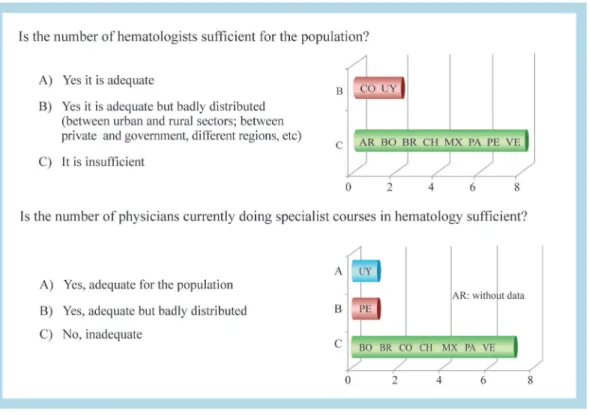
This survey showed that the number of hematologists is inadequate and they are unevenly distributed (Figure 7). Most societies stated that the number of doctors who are currently in hematology specialist courses is insufficient to meet the needs of the population (Figure 7).
Conclusions
The main motivation of this work was to obtain a better understanding of the current reality of hematology in Latin America and how the specialty is developing. There is great interest in better integration between hematologists and hematology societies throughout the region.
Some inferences can be from the data obtained. On comparing with data from the USA, where there is an estimated rate of 2.2:100.000 of hematologists per inhabitant (about 7,000 hematologists to 308,745,538 inhabitants), Latin America has a lower rate of specialists (0.9: 100,000).
Much of the region's health care is provided by the Public Sector (75%).
Hematology was considered a tertiary specialty of complex services with little prevention and primary care, no need to create "blood" rather than the exercise of hematologists isolated unrelated to infrastructure for diagnosis and treatment.
The hematologists are not properly distributed and the number of specialists is generally insufficient to meet the needs of the population.
As there is an insufficient number of hematologists in training programs, it was mentioned that there is little appeal to young for this medical specialty and the difficulty to replace more experienced hematologists was highlighted. Actions to make the specialty attractive are considered necessary. It was mentioned that in some countries there is a lack of specialists and related subspecialists, such as hematopathologists, laboratory technicians specializing in coagulation disorders, inherited thrombophilia and specialists in cytogenetics.
Ideas to improve cooperation on these issues were also suggested in the reports or during the debate.
It was said that the development of registries should be encouraged, especially nation registries. Diagnostic and treatment protocols with national guidelines that meet the needs of each country or region should also be developed.
Deficiencies were detected in cytogenetics and molecular biology and the need to develop techniques for IHC was identified. We also believe it is feasible exchange between centers in Latin America to transfer knowledge.
It is believed that there is a necessity to create imaging centers in some countries due to, in particular, the limited availability of MRI and PET.
For hematology-oncology treatment, the need for unrestricted access of basic hematology-oncology treatment
for all people is emphasized and to gradually evaluate the various models of access to high-cost treatments and the possibility of cooperation between Latin American centers to stimulate the development of HSCT programs in countries where they do not exist or where they have little experience.
In the training of specialists there is a need to develop programs to stimulate the formation of hematologists, as well as several specialties essential for the development of hematology such as pathologists specialized in flow
cytometry, molecular biologists and experts in image and HSCT.
Acknowledgements
The writers of this report wish to thank all Latin American colleagues who provided data or participated in the discussion, Van Dijk Gina and Amanda Benevides for data collection and Martha Liggett and American Society of Hematology for their cooperation and that resulted in the success of this event.
xxx