313
Rev Bras Med Esporte – Vol. 19, No 5 – Sep/Oct, 2013
POSTURE CONTROL AND VESTIBULAR OCULOMOTOR
SYSTEM IN PISTOL SPORT SHOOTERS
ORIGINAL ARTICLE
Carla Porto Lourenço (Physiotherapsit)1
André Luís dos Santos Silva (Physiotherapist)2
1. Augusto Motta University Center – UNISUAM 2. Vestibular Physiotherapy Rehabilitation Office
Mailing address:
Centro Universitário Augusto Motta - UNISUAM.
Programa de Mestrado em Ciências da Reabilitação. Praça das Nações, 34, 3º andar, Bonsucesso. 21041-021 – Rio de Janeiro, RJ, Brasil.
ABSTRACT
Introduction: Shooting sports develop dexterity, concentration and balance in the athletes. The stability of the shooter is dependent on his/her resistance against internal and external disturbance that affects his/her balance. Objective: To evaluate the posture control and vestibular-oculomotor system of athletic pistol shooters. Methods: A cross-sectional descriptive analysis. Eight subjects (mean age of 37 years; SD ± 8.11), affiliated to the Brazilian Confederation of Target Shooting were evaluated. A sociode-mographic questionnaire, besides stabilometry associated with the shooting simulator and computerized videonistagmoscopic system were used. Results: All volunteers presented right motor dominance; half shot with both eyes open; average practice time is 14 years (SD ± 9) and weekly training average is of 14 hours (SD ± 13). Half athletes reported injuries associated with shooting. Stabilometric correlation presented correlation in the anteroposterior and mediolateral velocities. None of the athletes presen-ted pathological alteration in the videonistagmoscopic evaluation. Conclusion: Posture control of the assessed athletes presents significant changes to the displacement of the center of pressure velocities in the anterior-posterior and medial-lateral directions. The vestibulo-ocular system was not correlated with posture control and functional changes were not observed in any of the volunteers.
Keywords: athletes, data collection, postural balance, vestibular apparatus.
Article received on 10/17/2012 and approved on 8/21/2013.
INTRODUCTION
It is relevant to assess posture control not only for athletes, but also for the entire technical staff which follows them. Research with athletes has been carried out with the goal to correlate pos-ture control with pospos-ture standards of each sport to performance of the athlete as well as to the dysfunctions or injuries occurred with it1-5. Posture control is the erect and stable position developed
by three systems: the visual, with information aobut cephalic move-ments and position concerning the environment; the vestibular, with static and dynamic information about cephalic movements and posi-tion concerning gravity; and the somatosensory, which sets the body in space concerning the body segments and the base of support6-10.
The integration of the posture control systems may have its function changed by pathological or even habitual conditions, such as, sports practice11-15. Sport shooting is a sport which has been practiced since
the first edition of the Olympic Games of the Modern Ages, in 1896, and its technique derives from the learning of its basic mechanics: stable position; breathing control; constancy at aiming; and squeezing the trigger, at which the individual must present motor skill and sufficient balance to reach the center of the target16-19. In order to be efficient,
the shooter must present, besides posture control, muscles ready for isometry, since he/she holds the total weight of the gun during practice of the sports basic movements16,17.
Thus, to assess and describe posture control of pistol sport shooting athletes and to verify correlations between the troll-like posture and the vestibular-oculomotor system in these athletes became the aim of this research, since this modality is of high-performance in which the athlete is demanded in his/her limit, in training many times exhaustive in the attempt for better performance3,20-22.
METHODOLOGY
The present analytical-descriptive transversal study was based on texts published between 2004 and 2011, in English and Portuguese languages searched in the scientific databases: PubMed, MedLine, Scielo, Science Direct, NCBI, Bireme/Lilacs,ScholarGoogle, besides the classical bibliography on sport shooting from 1985. Data were analyzed and collected in laboratories of human movement, neurofunctional performance and biomechanics analysis. The ethical assumptions for reasearch with human beings were respected according to the resolution 196/96 from the National Health Board23.
All volunteers spontaneously signed the Free and Clarified Consent Form. The sample consisted of eight athletes from the Brazilian Confederation of Target Shooting; seven men and one woman. The exclusion criteria were: clinical history of vestibular dysfunction; use of vestibular supressor medication for vertigo control; post-traumatic rehabilitation process or musculoskeletal episode which could make the evaluations impossible and alterations related to attention and concentration due to psychological dysfunctions. The analysis proposed for this research was based on three instruments: individual medical record designed by the researcher for sociodemographic characterization; stabilometry platform model Biomec 400, dimensions of 1x1 m, analogic-digital system of 16 bits, brandname EMG System® with acquisition collected in the sampling frequency of 100 Hz and associated with the NOPTEL®
shooting simulator, system NOS Sport version 4.208 with analysis program NOS 4.2, 38 mm caliber pistol, semi-automatic functioning, German manufacturing, brand name Walther®
314 Rev Bras Med Esporte – Vol. 19, No 5 – Sep/Oct, 2013
for the edges, distance between the center of the platform and the target of 6 m, measure proportional to the shooting event at 25 m; and the computerized videonistagmoscope system, by Contronic® Sistemas Automáticos Ltda., with a mask attached to
the infrared micro camera and interconnected to a Dell®
notebook. Each volunteer was examined in a 45-minute interval following the same procedures sequence for all of them. The athlete started from resting in sitting position for five minutes, when the sociodemographic form was filled out and the evaluation was explained. Subsequently, the stabilometric examination, which consisted of four aquisitions, with 30-second duration for each aquisition, took place. This time was based on the concept that prolonged aiming time harms the shooting accuracy16 and on
the protocol by Bastos et al.24. On the first acquisition (control-PC
position), the athlete should adopt orthostatic position on the platform, barefoot, upper limbs along the body, support base according standard guidelines of the platform, eyes open and aim at the target. On the second acquisition (shooting-PT position), the athlete should adopt shooting position on the platform, barefoot, aim the pistol to the target and press the trigger once, remaining at the position after this task. On the third acquisition (PT + TV visual task), the athlete should adopt shooting position on the platform, barefoot, aim the pistol to the target, simultaneously identify letters “X” distributed among many letters in a projection also made on the target direction (Epson data show multimedia projector), press the trigger once and remain at the position after the task. On the fourth acquisition (PT + TM mental task), the athlete should adopt shooting position on the platform, barefoot, aim the pistol to the target, simultaneously mentally count from 30 to zero in multiple of three, press the trigger once and remain at the position after the task. Finally, after three minutes of rest from stabilometry, the athlete sat on a chair and was examined by computerized videonistagmoscopy by the protocol of the quotient of movement sensitivity (QMS) which simulates 16 positions and movements experienced by humans in their routines who, when compromised, may present vestibular signs and symptoms such as vertigo, nausea, vomiting, posture instability and nystagms7,25. The eye movements
occurred on each position were recorded in a film for subsequent analysis. The results of this test are obtained through classification from intensity 0 to 5 and symptoms duration after the performed movements measured in seconds (from five to 10 = 1 point; 11 to 30 = 2 points; > 30 = 3 points). At the final result, it is considered: minimal involvement (1 to 10); moderate compromising (11 to 30); and higher than 31, severe state. Statistical analysis was performed with the Statistical Package for Social Sciences program, version 17.0 for
Windows. All data obtained were compared in the QMS test and in the stabilometry acquisition protocols. Mean and standard deviation were used for the continuous variables. Parametric ANOVA tests were used to relate the means of the stabilometric endings for elliptical area (EA), total dislocation (TD), dislocation velocities for the pressure center in the anteroposterior and mediolateral directions (APV and MLV). The considered p value was ≤ 0.05. Multiple comparisons used
post-hoc test between stabilometry protocols (PT, TV and TM) and the PC, considering confidence interval of 95%. The Spearman test correlated the sociodemographic vriables and stabilometry protocols and p value ≤ 0.05 was considered.
RESULTS
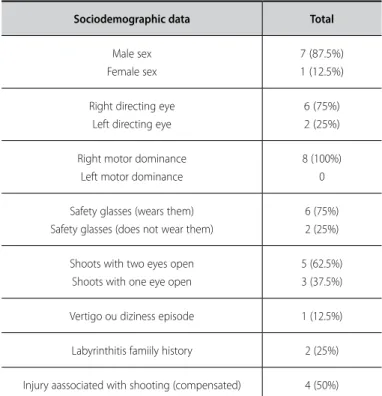
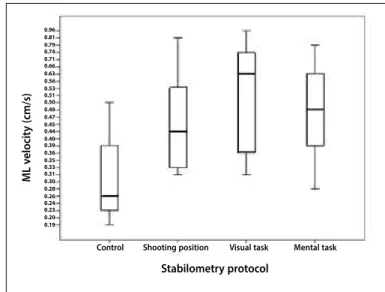
The data analyzed present eight right-handed athletes; two present left eye as the director eye; five athletes shoot with both eyes open; six wear safety glasses to train and compete. The mean of time of practice was of 14 years (SD ± 9), mean age among athletes was 37 years (SD ± 8) and mean training time was of 14 weekly hours (± 13). One athlete reported a vertigo episode, two present vestibulopathy family history and five athletes reported injuries associated with the sport, which were accordingly compensated at the collection moment (tables 1 and 2).The stabilometric results in theANOVA comparison found MLV significance with p = 0.23. In the post-hoc
comparison between the PC and the remaining tasks significance was found in the mean difference between PC and TM whose
p = 0.29 in a confidence interval of 95% = [0.06 – 0.5]. In the Spearman test, with p < 0.01, significance for AE and DT p =
0.90; AE and MLV p = 0.88; DT and APV p = 0.97; APV and MLV
p = 0.95. For p < 0.05 significance for AE and APV with p = 0.83. Correlation between stabilometric and sociodemographic data did not produce significant value. In all parameters median increase in TV was observed. In MLV, greater posture oscillation was found compared with the APV and an outlier in PT (Figures 1 to 4). In the examination of the vestibular-oculomotor system, the eight athletes were within the classification of minimal involvement (0 to 10). Physiological findings between corrective saccades, delay of the vestibular-ocular reflex and horizontal nystagmus have been observed in three athletes, respectively (table 3).
Table 1. Sociodemographic characterization of the sample.
Sociodemographic data Total
Male sex Female sex
7 (87.5%) 1 (12.5%)
Right directing eye Left directing eye
6 (75%) 2 (25%)
Right motor dominance Left motor dominance
8 (100%) 0
Safety glasses (wears them) Safety glasses (does not wear them)
6 (75%) 2 (25%)
Shoots with two eyes open Shoots with one eye open
5 (62.5%) 3 (37.5%)
Vertigo ou diziness episode 1 (12.5%)
Labyrinthitis famiily history 2 (25%)
Injury aassociated with shooting (compensated) 4 (50%)
Table 2. Description of the anthropometric data of the volunteers.
Anthropometric data Mean Standard deviation Min Max
Age (a) 37 8 18 44
Weight (kg) 83 14 60 112
315
Rev Bras Med Esporte – Vol. 19, No 5 – Sep/Oct, 2013 DISCUSSION
The analysis of the posture control considering sensory, cognitive and environmental stimuli, may help to understand the mechanisms of posture adjustments and their dysfunctions. In sports, suitable posture assessment produces data about the functional capacity
of the athlete, besides identifying specific alterations which compromise their posture control and consequent performance. Balance, sensory characteristics and vestibular system examinations get together as useful instruments in this investigation6,8,10,24,26,27. In
sport shooting and similar modalities, as arch shooting, the posture examination has been approached for performance improvement, injury investigation and alterations associated with this class of sport17,18,22,28-30. It must be highlighted that in these studies there
is no standardization in the evaluations, and the vestibular system is not directly included in the exams when it should be. Considering the concepts mentioned before and the technical demands of shooting basic mechanics, Yur’Yev16, in his technical literature on
shooting, mentions many times the importance of the sensory and vestibular-oculomotor connections for the practice of this sport. The stabilometric examination let us compare our sample with the one with recurve arch athletes evaluated by Wolff et al.29, who used
the same parameters of this research and found, as in the present study, remarkable oscillation in APV and AMV. When shooters, judo fighters and ballet dancers were compared in a protocol with visual supression, only the judo fighters presented good performance. Thus, it is considered that visual suppression or conflict as the aim of the TV of this study, may alter the posture control since ballet and shooting depend more on the visual system in comparison with judo. Judo fighters train the somatosensory system and do not depend as much on vision. The fact the TV had increased oscillation of APV and MLV may be explained by the difficulty in set vision in the presence of multiple targets8,10. The presence of an outlier
in the APV correlation and the stabilometric acquisitions may be attributed to reduced training volume of the mentioned athlete, which had total time of only three weekly hours at the time of the study. This athlete may have taken too long to perform the
Table 3. Description of the results of QMS by the SVNC.
Achados QSM-SVNC Quantity
Findings QMS-SVNC 1 (12.5%)
Slow vestibulo-ocular reflex 1 (12.5%)
Horizontal nystagmus 1 (12.5%)
Corrective Saccades 5 (62.5%)
No alteration Figure 1. Boxplot AE x stabilometry protocols.
Figure 3. Boxplot VAP x stabilometry protocols. Figure 2. Boxplot DT x stabilometry protocols.
Figure 4. Boxplot VML x stabilometry protocols.
Elliptical ar
ea (cm2)
D
isloca
tion (cm)
ML v
elocit
y (cm/s)
AP v
elocit
y (cm/s)
1.95 1.50 1.17 0.78 0.67 0.64 0.61 0.53 0.50 0.48 0.45 0.41 0.40 0.36 0.35 0.34 0.32 0.31 0.30 0.29 0.27 0.26 0.23 0.21 0.19 0.17 4.03 3.15 27.20 2.04 1.64 1.42 1.09 0.87 0.65 0.56 0.49 0.43 0.41 0.34 0.29 0.16
57.24 33.55 28.78 26.99 24.29 22.26 20.94 20.09 17.81 15.44 14.49 14.12 13.73 13.04 12.11 10.69
0.96 0.81 0.79 0.74 0.71 0.66 0.63 0.56 0.53 0.51 0.50 0.49 0.47 0.45 0.44 0.40 0.39 0.36 0.35 0.33 0.31 0.30 0.28 0.26 0.24 0.23 0.20 0.19
Stbilometry protocol
Stabilometry protocol Stabilometry protocol
Stabilometry protocol
Control Control
Control
Control
Shooting position Shooting position
Shooting position
Shooting position
Visual task Visual task
Visual task
Visual task
Mental task Mental task
Mental task
316 Rev Bras Med Esporte – Vol. 19, No 5 – Sep/Oct, 2013
stable position mechanics which is essential to posture control acquisition in this sport16. Another relevant fact about this athlete
which may be equally related to the training volume is that, when submitted to the examination of the vestibular-oculomotor system, he presented delay in the vestibulo-ocular reflex gain. The athlete who presented corrective saccades trains two weekly hours and has three years of practice. The one who presented horizontal nystagmus reported having 18 years of practice, but was away from training for personal reasons. That who reported a vertigo episode obtained an excellent vestibular-oculomotor examination, probably due to his training volume of 30 weekly hours and experience of 12 years in shooting. It is possible that regular practice of this volunteer has compensated for some vestibular hypofunction7. The fact none
of the athletes has presented functional alterations to the vestibular-oculomotor system test may be related to the shooting practice, in which this system is trained in a specific manner in the aiming and pressing the trigger basic mechanics16. Periodical examinations
of the vestibular-oculomotor system comparing it with the other posture control systems may be positive to the practical follow-up of shooters. However, further studies about sensory and environmental interactions in the posture control of pistol sport shooting athletes are necessary so that an optimum and complete analysis of the athlete can be standardized. Despite the pilot study designed in the
beginning of this research, there were methodological limitations concerning the sample. There was calculation of n = 20; however, adherence was of eight athletes, which can be attributed to the competitions volume in the period of the collection.
CONCLUSION
At the end of the study it could be concluded that the pistol sport shooting athletes presented posture control with significant alterations for the APV and MLV correlation, especially for the APV variation. The correlation between the vestibular-oculomotor system and posture control did not present significance.
Vestibular-oculomotor physiological findings may indicate proportional relations between time of sports practice and training volume of the assessed athletes. There was no conflict of interests involving the parts of this study.
ACKNOWLEDGEMENTS
To the Support Program to Post-Graduation of Private Educatio-nal Institutions of the Coordination for the Improvement of Higher Education Personnel (PROSUP-CAPES).
All authors have declared there is not any potential conflict of interests concerning this article.
REFERENCES
1. Oliveira SM & Deprá PP. Análise postural: um estudo em atletas juvenis. Rev Ed Fis/UEM 2008;16:163-70. 2. Cavanaugh JT, Guskiewicz KM, Giuliani C, Marshall S, Mercer V, Stergiou N. Detecting altered pos-tural control after cerebral concussion in athletes with normal pospos-tural stability. Br J Sports Med 2005;39:805-11.
3. Peres S, Simão R, Lima C, Souza A, Lamut ME, Estrazulas J, et al. Avaliação bidimensional da postura de atletas de alto rendimento. Fitness & Performance J 2007;6:247-50.
4. Dos Santos Araujo AG, Seefeld C & Alves JC. Relação entre alterações posturais e lesões osteomioar-ticulares em jogadores de futsal. Rev Bras Fisiol Exercício 2009;8:24-30.
5. Garcia C, Barela JA, Viana AR, Barela AMF. Influence of gymnastics training on the development of postural control. Neurosci Lett 2011;492:29-32.
6. Mochizuki L & Amadio AC. As informações sensoriais para o controle postural. Fisioter Mov 2006;19:11-8.
7. Herdman SJ. Vestibular Rehabilitation. 3rd ed. Philadelphia: F.A. Davis, 2007.
8. Carvalho RL & Almeida GL. Aspectos sensoriais e cognitivos do controle postural. Rev Neuroc 2009;17:156-60.
9. Mazzucato A & Borges APO. A influência da reabilitação vestibular em indivíduos com desequilíbrio postural. Rev Neuroc 2009;17:183-8.
10. Soares AV. Contribuição visual para o controle postural. Rev Neuroc 2010;18:370-9.
11. Evans T, Hertel J & Sebastianelli W. Bilateral deficits in postural control following lateral ankle sprain. Foot Ankle Int 2004;25:833-9.
12. Mann L, Kleinpaul JF, Mota CB, Santos SG. Equilíbrio corporal e exercícios físicos: uma revisão siste-mática. Motriz 2009;15:713-22.
13. Lemos LFC, Teixeira CS & Mota CB. Lombalgia e o equilíbrio corporal de atletas da seleção brasileira feminina de canoagem velocidade. Rev Bras Cineantropom Desempenho Hum 2010;12:457-63. 14. Cecchini LML, Alonso JLL & Salgado ASI. Análise estabilométrica em atletas e não atletas. Revista Digital
- Buenos Aires. 2008. Año 13 n 12. Disponível em: www.efdeportes.com. Acesso em dezembro de 2011. 15. Abrahao MRA & Mello D. Diferenças antropométricas entre o hemi-corpo direito e o esquerdo de
adultos instrutores de tênis e crianças iniciantes no esporte e incidência de desvios posturais. Fitness & Performance J 2008;4:264-70.
16. Yur’yev AA. Competitive Shooting. Washington: Book Service, 1985.
17. Dias LAC & Pitaluga Filho MV. A eficácia de um treinamento isométrico, com cargas individualizadas,
para a melhoria do desempenho no tiro-ao-alvo. Rev Ed Fis 2006;135:45-51.
18. Dias LAC, Dantas EHM, Moreira SB, Silva VF. A relação entre o nível de condicionamento aeróbico, execução de uma pista de obstáculos e o rendimento em um teste de tiro. Rev Bras Med Esporte 2005;11:341-6.
19. CONFEDERAÇÃO BRASILEIRA DE TIRO ESPORTIVO, Rio de Janeiro, Brasil. Disponível em: http:www. cbte.org.br. Acesso em agosto de 2010.
20. Costa LOP & Samulski DM. Overtraining em Atletas de Alto Nível – Uma Revisão Literária. Rev Bras Ci e Mov 2005;13:123-34.
21. Baca A & Kornfeind P. Stability analysis of motion patterns in biathlon shooting. Hum Mov Sci 2012;31:295-302.
22. Herpin G, Gauchard GC, Lion A, Collet P, Keller D, Perrin PP. Sensorimotor specificities in balance control of expert fencers and pistol shooters. J Electromyogr Kinesiol 2010;20:162-9.
23. MINISTÉRIO DA SAÚDE, Brasil. Diretrizes e normas regulamentadoras de pesquisa envolvendo seres humanos: Resolução 196/96. Conselho Nacional de Saúde, 1996.
24. Bastos AGD, Lima MAMT & Oliveira LF. Avaliação de pacientes com queixa de tontura e eletronistag-mografia normal por meio da estabilometria. Rev Bras Otorrinolaringol 2005;71:305-10.
25. Guidetti G, Monzani D & Rovatti V. Clinical examination of labyrinthine-defective patients out of the vertigo attack: sensitivity and specificity of three low-cost methods. Acta Otorhinolaryngol Ital 2006;26:96-101.
26. Fialho JVAP, Ugrinowitsch H. O Efeito da interferência contextual no treinamento de habilidades motoras esportivas. In: Emerson Silami Garcia; Kátia Lúcia Moreira Lemos (Eds.). Temas Atuais em Educação Física e Esportes IX. Belo Horizonte: Silveira, 2004; 21-35.
27. Tuma VC, Ganança CF, Ganança MM, Caovilla HH. Avaliação oculomotora em pacientes com disfunção vestibular periférica. Rev Bras Otorrinolaringol 2006;72:407-13.
28. Domingues CA, Machado S, Cavaleiro EG, Silva VF, Cagy M, Ribeiro P, et al. Alpha absolute power: motor learning of practical pistol shooting. Arq Neuropsiquiat 2008;66:336-40.
29. Wolf F, Krebs RJ, Detânico RC, Keulen GEV, Braga RK. Estudo do equilíbrio plantar do iniciante de tiro com arco recurvo. Rev Ed Fis/UEM 2008;19:1-9.