Article
ISSN 0102-695X http://dx.doi.org/10.1590/S0102-695X2012005000013 Received 17 Apr 2011 Accepted 29 Nov 2011 Available online 17 Jan 2012
development in
Lippia alba
Diego Pandeló,
1Talita D. Melo,
1Júnya L. Singulani,
1Fernanda
A. F. Guedes,
1Marco A. Machado,
2Cíntia M. Coelho,
1Lyderson
F. Viccini,
1Marcelo O. Santos
*,11Departamento de Biologia, Instituto de Ciências Biológicas, Universidade Federal
de Juiz de Fora, Campus Martelos, Brazil,
2Embrapa Gado de Leite, Brazil.
Abstract: The aim of this work was to analyze terpene oil production and terpene synthases (TPS) gene expression from leaves at different developmental stages of different chemotypes of Lippia alba (Mill.) N.E. Br. ex Britton & P. Wilson, Verbenaceae. Hydro-distilled essential oil were used for chemical analysis and gene expression of three monoterpene synthase genes called LaTPS12, LaTPS23 and
LaTPS25 were used for analyses of gene expression associated to oil production. The putative genes were associated to TPS-b gene class. Semi-quantitative PCR and quantitative PCR (qPCR) analysis were used to investigate the expression profile of those three putative genes in different leaf stages and different chemotypes. Additionally, total oil production and gene expression of putative TPS genes
cloned from L. alba chemotype linalool were evaluated at different stages of leaf development. The expression level of those three genes was higher when the highest oil production was observed, mainly in young leaves at the fourth nodal segment for all evaluated chemotypes. Total oil production was higher at leaves that had unopened trichomes. We also observed that the 1mM of MeJA treatment increased the gene expression in all chemotypes after 24 h elicitation.
Keywords: essential oil linalool limonene
Lippia alba
Verbenaceae qPCR
Introduction
Plants have a wide variety of terpene compounds that may produce diverse biological responses with differential expression mediated by developmental and stress-related programs response synthesized by terpene synthase (TPS) (Tholl, 2006). Lippia alba (Mill.) N.E. Br. ex Britton & P. Wilson, Verbenaceae, occupies an outstanding position among medicinal plants because of many therapeutic actions due to terpenic compounds (Hennebelle et al., 2008). The essential oil from L. alba has additional aromatic properties that could make the specie an excellent source of monoterpenes such as geraniol, limonene, linalool and others. Some advantages of L. alba
includes the vegetative propagation (Biase & Costa, 2003) and the simplicity of methods used for oil isolation. Some chemotypes yields a dextrogen form of linalool, which is the main compound of essential oil used in industry, with almost 100% of purity (Siani et al., 2002). Tepernes are synthesized by terpene synthases (TPS) a class of enzymes that carry a motif LQLYEASFLL that seems to be part of the active site of those enzymes (Crowell et al., 2002), and two other conserved domains DDXXD/E and the "NSE/ DTE" motif (N/D)DXX(S/T)XXXE that are involved in
magnesium binding during i xation of pyrophosphate substrate (Christianson, 2006). Molecular biology and genetic improvement of such enzyme and its genes are useful tools to improve the quality and quantity of essential oil (Siani et al., 2002).
The wealth of terpenic compounds in L. alba
make relevant the analyses of TPS genes expression to improve the quality and quantity of the essential oil. Thus, the objective of the present study was to evaluate the oil production and TPS gene expression during different leaf developmental stages among different chemotypes of L. alba.
Material and Methods
MS eluted in 200 μL of n-hexane (HPLC grade) followed by thin layer chromatography (TLC) T-6520 silica gel polyester plate. One microliter of each sample was injected in gas chromatograph (Shimadzu GCMS-QP2010 Plus) with auto injector (AOC-5000) coupled to the Rtx-5MS capillary column (30 m long, 0.25 mm internal diameter, 0.25 µm ilm thickness) (Supelco DB 5). The programmed temperature began at 50 oC and increased by 4 ºC/min up
to 220 oC (5 min). Injector and detector temperatures were
200 and 220 oC, respectively. Helium gas was used as
carrier. The area of the GC peak was used for quantitative determination. Kovats index (KI) was used for essential oil identiication by comparing their mass spectra with NIST98 (National Institute of Standards and Technology, Gaithersburg) mass spectral database and by comparing their GC retention indexes (RI), related to the retention time of a series of n-alkanes with linear interpolation, with those of literature data (Adams, 2007).
Two micrograms of total RNA was used for the irst strand cDNA synthesis. Reverse transcription reaction was done using oligo (dT) anchored primer and the enzyme MuMLV (Invitrogen, Carlsbad, CA, USA) in accordance to the manufacturer instructions. Genes were ampliied by Master Cycle Gradient thermocycler (Eppendorf, Westbury, USA), using GoTaq DNA polymerase (2.5U) (Promega, Madison, USA); MgCl2 (5 mM); dNTP mix (0.4 mM); forward primer (4 µM); reverse primer (4 µM) and DNA (200 ng) in a 25 µL total reaction volume. Each reaction was carried out during 3 min at 94 oC; 34x (94 oC 1 min; 54 oC 1 min and 72 oC 1 min) followed by inal extension with
10 min at 72 oC. PCR products were cloned into pGEM-T
Easy Vector (Promega, Madison, USA) and sequenced by ABI Prism 7300 Sequence Detection System (Applied Biosystems, USA). Leafs from I, II and III position from each chemotypes were evaluated by RT-PCR and qPCR analysis and the 18S rRNA gene was choose as control (Santos et al., 2005). The qPCR reactions were carried out using the kit iTaq SYBR Green Supermix with ROX (Bio-Rad, Hercules, USA), 50 ng of cDNA and 400 nM of speciic primer. The conditions of ampliication was 95 ºC during 3 min; 40 cycles of denaturation at 95 ºC during 15 s; and annealing and extension at 60 ºC during 60 s. After forty ampliication cycles, the samples were subjected to dissociation curve analysis in order to validate the absence of non-speciic products and dimmer formation. The samples were heated from 60 ºC up to 94 ºC, increasing 1 ºC at each 30 s.
Each ampliication reaction was carried out in ABI Prism 7300 Sequence Detection Systems (Applied Biosystems, USA) in separated wells using SYBR Green Dye. The results were analyzed using Relative Expression Software Tool (REST ©), v. 2.0.
Results and Discussion
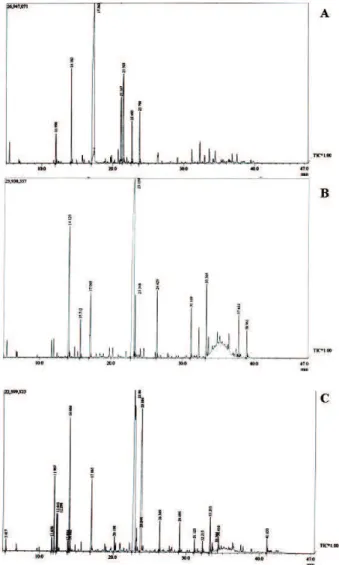
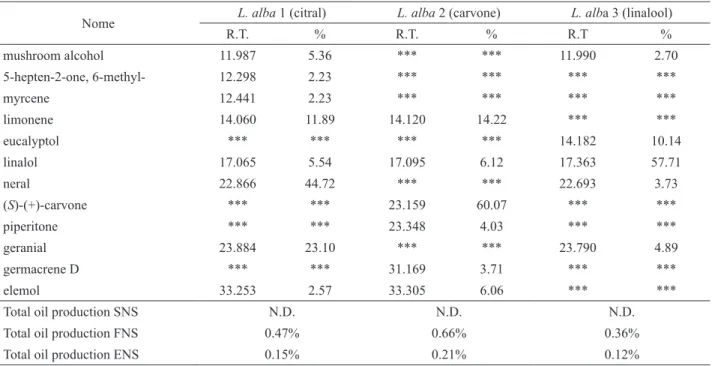
The analyses of gas chromatography coupled to a mass spectrometer were carried out and the major components of the three evaluated chemotypes and the nature of main terpene composition (Figure 1). The evaluation of total oil showed that high production was concentrated at the fourth leaf nodal segment in all evaluated chemotypes. Leaves at the irst analyzed stage of development do not produced oil (Table 1).
Figure 1. Chromatogram of essential oil analysis from chemotypes of Lippia alba: a) linalool; b) carvone and c) citral (neral/geranial).
According to E-values of blast-x algorithm, three different putative genes encoding terpene synthases were designated LaTPS12 (GQ279096), LaTPS23 (GQ279097) and LaTPS25 (GQ279098). The three sequences were highly similar to several other monoterpene synthases, mainly to limonene synthase of different plant species.
LaTPS12 showed an E-value ranging from 3 е-47 to 3
linalool synthase.
Two clones, LaTPS12 and LaTPS23, were 445 pb long and encodes 148 aminoacids, whereas LaTPS25 was 395 pb encoding a putative protein with 122 aminoacids. All sequences showed the motifs DDXXD and NSE/DTE (N,D)D(L,I,V)X(S,T)XXXE, both highly conserved in other terpene synthases, which apparently works as a metal ion cofactor and catalysis site (Crowell et al., 2002) in the C-terminal domain of these enzymes. Terpene synthase class of enzymes is classiied from a to g (Dudareva et al., 2003) and a phylogenetic tree was generated by the neighbor-joining method with 1,000 repetitions containing all enzyme class and we observed that the three putative TPS clone genes belongs to TPS-b monoterpene class.
In L. alba most of the production of essential oil takes place in leaf trichome (Bolzani et al., 1999) and it was veriied by semi-quantitative RT-PCR that unexpanded leaves at the fourth nodal segment (FNS) showed strongly expression followed by leaves situated in the second nodal segment (SNS) and leaves in a riper stage situated in the eighth node (ENS), respectively (Figure 2) for all genes and chemotypes evaluated. LaTPS12, LaTPS23 and LaTPS25
had already initiated in unexpanded leaves and continue up to their complete expansion. The higher expression transcription occurred in leaves situated in the fourth nodal segment and practically disappeared in riper stage leaves at the eighth nodal segment. Riper leaves situated around the eighth nodal segment showed little synthesis of mRNA and lower oil production. At this stage most of the leaf trichomes were collapsed as observed for Mentha (Sharma et al., 2003) and Lippia scaberrima (Combrink et al., 2007). In Magnolia grandilora, it was also observed a similar pattern of expression of three different TPS genes coding for two monoterpene and one sesquiterpene synthase (Lee & Chappell, 2008). The younger leaves showed higher expression compared to riper leafs for all analyzed genes.
Figure 2. Expression of the genes LaTPS12, LaTPS23 and
LaTPS25 in different leaf stages of three chemotypes. ENS: Leaf of eight nodal segment; SNS: leaf of second nodal segment; FNS: leaf of fourth nodal segment.
Comparing linalool and carvone chemotypes,
LaTPS12 and LaTPS23 gene expression by qPCR analysis showed that they were down-regulated in linalool chemotype with a relative expression ratio of 0.351 and 0.339, respectively and LaTPS25 gene was up regulated in the linalool chemotype showing around 16.42 more transcripts (Figure 3a).
The analysis between the chemotypes linalool and citral showed differential expression between LaTPS12
and LaTPS25 genes. The irst was down-regulated whose
ratio of relative expression was 0.248 and the second was up-regulated in linalool type, with relative expression ratio of 6.496. The gene LaTPS23 did not show signiicant
difference between these chemotypes (P (H1) =0.950) (Figure 3b).
The comparison between the chemotypes carvona and citral resulted in similar relative expression between the samples of all the genes and its expression was not statistically different between the analyzed chemotypes (Figure 3c). The values of P (H1) were 0.575 for LaTPS12; 0.878 for LaTPS23; and 0.740 for
LaTPS25.
Figure 3. Relative expression of TPS between chemotypes of
L. alba a) linalool and carvone; b) linalool and citral; c) carvone and citral. Red (18S); Blue LaTPS12; yellow LaTPS22; green
LaTPS25.
attack by pathogens and herbivores, drought, and excessive exposure to ultraviolet rays can induce the production of several defense substances, such as polyphenol oxidase. Under these conditions, different classes of secondary metabolites are produced as phenolic compounds, alkaloids and terpenic compounds (Bennett & Wallsgrove, 1994; Kessler & Baldwin, 2002). The leaves of L. alba were collected at the same time and under the same conditions from a greenhouse to avoid environmental inluence and the results are a consequence of genetic variation among the chemotypes. These results are in accordance to previous studies with these chemotypes of L. alba that when cultivated at different conditions did not affected the composition of essential oil from leaves (Tavares et al., 2005) showing the same composition of main components of terpenes. Similar studies by our group showed that the quality of essential oil was not affected by dry or wet season in Lippia and Lantana species reinforcing genetic control of essential oil production (Silva et al., 2010). The addition of kinetin, an artiicial cytokinin type of plant growth regulator in culture medium increased terpene production (Tavares et al., 2004). Increasing activity of FPP, the central precursor of terpenes, reduced the cytokinin level production since they share the same methabolic pathway (Masferrer et al., 2002). In Ocimum basilicum, the spraying of methyl jasmonate induced the production of several secondary metabolites, including linalool and other terpenoids (Zhigang et al., 2007). To test if elicitors may affect the putative TPS gene expression we also evaluated the expression of those cloned genes under
MeJA treatment and we observed an increase of 2-3 times on transcription levels when treated with 1 mM methyl jasmonate solution of. It was observed that developmental stage such as lowering and vegetative growth affect the total oil production but not the quality of oil in leaves of L. alba (Siani et al., 2002; Tavares et al., 2005), reinforcing the suggestion of genetic control of oil production.
Thus, the selection of genotypes showing higher linalool gene expression and oil production can help the development an elite cultivar for oil production. Moreover, the results of TPS gene expression may contribute to better understand how to increase the essential oil production, mainly linalool. It also helps to plan future strategies regarding L. alba breeding programs using biotechnological applications.
Acknowledgments
FAPEMIG, CNPq, CAPES. The authors would also like to thank Arthur Carpanez and Dr. Richard Grazul (UFJF) for assistance with essential oil extraction and GC/ MS analysis.
References
Adams RP 2007. Identiication of essential oil components by
gas chromatography/mass spectrometry, 4th ed. Allured:
Publishing Corporation.
Bennett RN, Wallsgrove RM 1994. Secondary metabolites in plant defense-mechanisms. New Phytol 127: 617-633. Table 1. Main composition of hydro-distilled essential oil from the chemotypes linalool, carvone and citral of Lippia alba and total oil production g/g dry weight leaves in different developmental stages.
Nome L. alba 1 (citral) L. alba 2 (carvone) L. alba 3 (linalool)
R.T. % R.T. % R.T %
mushroom alcohol 11.987 5.36 *** *** 11.990 2.70
5-hepten-2-one, 6-methyl- 12.298 2.23 *** *** *** ***
myrcene 12.441 2.23 *** *** *** ***
limonene 14.060 11.89 14.120 14.22 *** ***
eucalyptol *** *** *** *** 14.182 10.14
linalol 17.065 5.54 17.095 6.12 17.363 57.71
neral 22.866 44.72 *** *** 22.693 3.73
(S)-(+)-carvone *** *** 23.159 60.07 *** ***
piperitone *** *** 23.348 4.03 *** ***
geranial 23.884 23.10 *** *** 23.790 4.89
germacrene D *** *** 31.169 3.71 *** ***
elemol 33.253 2.57 33.305 6.06 *** ***
Total oil production SNS N.D. N.D. N.D.
Total oil production FNS 0.47% 0.66% 0.36%
Total oil production ENS 0.15% 0.21% 0.12%
Biasi AL, Costa G 2003. Propagação vegetativa de Lippia alba. Cienc Rural 33: 455-459.
Bolzani VS, Young MC, Furlan M, Cavalheiro AJ, Araújo AR, Silva DH, Lopes MN 1999. Search of antifungical and anticancer compounds from native plant species of cerrado and atlantic Forest. An Acad Bras Cien 71: 181-187.
Combrink S, Du Plooy GW, McCrindle RI and Botha BM 2007. Morphology and histochemistry of the glandular trichomes of Lippia scaberrima (Verbenaceae). Ann Bot 99: 1111-1119.
Christianson DW 2006. Structural biology and chemistry of the terpenoid cyclases. Chem Rev 106: 3412-3442.
Crowell AL, Williams DC, Davis EM, Wildung MR, Croteau R 2002. Molecular cloning and characterization of a new linalool synthase. Arch Biochem Biophys 405: 112-121. Dudareva N, Martin D, Kish CM, Kolosova N, Gorestein N,
Faldt J, Miller B, Bohlmann J 2003. (E)-beta-ocimene and myrcene synthase genes of loral scent biosynthesis in snapdragon: Function and expression of three terpene synthase genes of a new terpene synthase subfamily.
Plant Cell 15: 1227-1241.
Hennebelle T, Sahpaz S, Joseph H, Bailleul F 2008. Ethnopharmacology of Lippia alba. J Ethnopharmacol 116: 211-222.
Kessler A, Baldwin IT 2002. Plant responses to insect herbivory: The emerging molecular analysis. Annu Rev Plant Biol 53: 299-328.
Lee S, Chappell J 2008. Biochemical and genomic characterization of terpene synthases in Magnolia grandilora. Plant
Physiol 147: 1017-1033.
Masferrer A, Arro M, Manzano D, Schaller H, Fernandez-Busquets X, Moncalean P, Fernandez B, Cunillera N, Boronat A, Ferrer A 2002. Overexpression of
Arabidopsis thaliana farnesyl diphosphate synthase (FPS1S) in transgenic Arabidopsis induces a cell death/ senescence-like response and reduced cytokinin levels.
Plant J 30: 123-132.
Santos MD, Romano E, Yotoko KSC, Tinoco MLP, Dias BBA, Aragao FJL 2005. Characterisation of the cacao somatic embryogenesis receptor-like kinase (SERK) gene
expressed during somatic embryogenesis. Plant Sci 168: 723-729.
Sharma S, Sangwan NS, Sangwan RS 2003. Developmental process of essential oil glandular trichome collapsing in menthol mint. Current Sci 84: 554-550.
Siani AC, Tappin MR, Ramos MF, Mazzei JL, Ramos MC, De Aquino Neto FR, Frighetto N 2002. Linalool from Lippia alba: Study of the reproducibility of the essential oil
proile and the enantiomeric purity. J Agric Food Chem
50: 3518-3521.
Silva PS, Viccini LF, Singulani JL, Filho EP, Zani CL, Alves TMA 2010. Chemical composition of the essential oil and hexanic fraction of Lippia and Lantana species. Rev Bras Farmacogn 20: 843-849.
Tavares ES, Julião LS, Lopes D, Bizzo HR, Lage CLS, Leitão SG 2005. Análise do óleo essencial de folhas de três quimiotipos de Lippia alba (Mill.) N. E. Br. (Verbenaceae) cultivados em condições semelhantes.
Rev Bras Farmacogn 15: 1-5.
Tavares ES, Lopes D, Bizzo HR, Lage CLS, Leitão SG 2004. Kinetin enhanced linalool production by in vitro plantlets of Lippia alba. J Essent Oil Res 16: 405-408.
Tholl D 2006. Terpene synthases and the regulation, diversity and biological roles of terpene metabolism. Current Opinion in Plant Biol 9: 1-8.
Zhigang L, Wang X, Chen F, Kim HJ 2007. Chemical changes and overexpressed genes in sweet basil (Ocimum basilicum L.) upon methyl jasmonate treatment. J Agric Food Chem 55: 706-713.
*Correspondence
Marcelo O. Santos
Departamento de Biologia, Instituto de Ciências Biológicas, Universidade Federal de Juiz de Fora, Campus Martelos, MG, Brazil