Trazodone for the treatment of
sleep disorders in dementia
An open-label, observational and review study
Einstein Francisco Camargos 1, Marcela Basso Pandoli1, Marco Polo Dias Freitas1,2, Juliana Lima Quintas3,
Juliana de Oliveira Lima4, Leandra Camapum Miranda4, Luciano Wanderley Pimentel4, Patricia Medeiros-Souza5
ABSTRACT
Sleep disorders (SD) in patients with dementia are very common in clinical practice. The use of antidepressants with hypnotic actions, such as trazodone, plays an important role in these cases. The aim of this study is to present a profile of the use of trazodone in demented patients with SD, as well as a review of trazodone hydrochloride in SD. We evaluated 178 elderly patients with Alzheimer’s disease and other dementias, clinically presenting SD and treated with hypnosedative medications. In the one-year period comprising the study, 68 (38.2%) of the 178 had sleep disorders. Most patients (114; 64%) had a diagnosis of Alzheimer’s disease. Approximately 85% of patients with SD used hypnosedative drugs. Trazodone was the most commonly used drug among patients (N = 35), with an effectiveness of 65.7%. Trazodone has been shown to be a good option for treatment of the elderly with dementia and associated SD.
Key words: sleep, dementia, Alzheimer’s disease, trazodone, antidepressant.
Trazodona para o tratamento de distúrbios do sono em demência: um estudo aberto, observacional e de revisão
RESUMO
Distúrbios do sono (DS) em pacientes com demência são muito comuns na prática clínica. O uso de antidepressivos com ação hipnótica, como a trazodona, tem um papel importante nesses casos. O objetivo desse estudo é apresentar um perfil do uso da trazodona em pacientes com demência e com DS, bem como revisar o cloridrato de trazodona no DS. Nós avaliamos 178 idosos com doença de Alzheimer (DA) e outras demências, clinicamente apresentando DS e que foram tratados com medicações hipnossedativas. No período de um ano de estudo, 68 (38,2%) tiveram DS. A maioria (114; 64%) tinham diagnóstico de DA. Aproximadamente 85% usaram fármacos hipnossedativos. A trazodona foi a mais utilizada (N=35), com evidência de melhora de 65,7%. A trazodona mostrou-se ser uma boa opção no tratamento de idosos com demência e DS associado.
Palavras-chave: sono, demência, doença de Alzheimer, trazodona, antidepressivos.
Correspondence
Einstein F. Camargos
SGAN 605 Av. L2 Norte - Asa Norte 70840-901 Brasilia DF - Brasil E-mail: [email protected]
Received 8 July 2010
Received in final form 30 September 2010 Accepted 07 October 2010
1Assistent Geriatrician, Geriatric Medical Centre (CMI), University Hospital (HuB), Brasilia University (UnB), Brasilia DF, Brazil; 2Public Health and Aging Research Group, Oswaldo Cruz Foundation René Rachou Institute, Belo Horizonte MG, Brazil; 3Neuropsychologist,CMI/HUB/UnB; 4Pharmacists specializing in Clinical Pharmacy (UnB); 5Professor of Pharmacy, Department
of Health Sciences (UnB).
Sleep disorders are one of the major complications related to dementia and cause signiicant impacts on functional-ity and qualfunctional-ity of life in elderly patients1.
hese sleep disorders often contributes to institutionalization2.
pathophysiological changes associated with the disease it-self, sensory deprivations such as a reduction in audito-ry and visual acuity, and changes in environmental stim-uli such as light. Some studies have shown that damage to cholinergic neurons may contribute to changes in the sleep of patients with Alzheimer’s disease (AD)1.
Epidemiological surveys conducted in patients with AD have identiied a prevalence of sleep disorders in up to 40% of patients with any stage of the disease3.
A longitudinal study conducted with 76 elderly de-mented patients over two years revealed that 24% of study participants used a hypnosedative drug chronically, in-creasing from 3 to 17% in the irst year, and remaining high at 13% in the second year4. In the study of Grace
and colleagues, in which the use of hypnosedative drugs was recorded in less than 30% of patients with sleep dis-orders, the authors argued that there was reluctance by doctors to use hypnotic drugs in demented patients with sleep disorders5. Appropriate treatment of sleep disorders
may beneit both patients and their caregivers.
Antidepressants with hypnotic action, such as tra-zodone, have played important roles in treating the el-derly with sleep disorders, particularly in patients with dementia1. he therapeutic dose to induce sleep using
these drugs is much smaller than that used for depres-sion, showing efectiveness in inducing sleep and little mood alteration efects.
Trazodone has proved to be efective in the treatment of sleep disorders in depressed patients (not always old-er)6-8, in secondary sleep disorders when compared to
other substances9,10 and in healthy individuals11.
Assessments of the clinical response to trazodone hy-drochloride for the treatment of sleep disorders in de-mented patients may contribute to the pool of therapeu-tic options for these patients.
he objective of this analysis was to establish a proile of the use of hypnosedative drugs in demented patients with sleep disorders, with an emphasis on trazodone hy-drochloride and its efectiveness. his is an open-label, uncontrolled, observational study. General data and spe-ciic analysis of sleep disorders have been the aims of an-other publication.
METHOD
his is a retrospective study that was previously ap-proved by the Ethics Research Committee of the Univer-sity of Brasilia. To be included, patients had to be diag-nosed with dementia and followed for at least 12 months, during which time they were examined periodically ev-ery two months. he visits of each patient during 2008 and their records from visits in previous years since their irst consultation were considered for selection and anal-ysis. Among the 250 patients followed in the Geriatric
Medical Centre of the University’s General Hospital in 2008 (Cognitive Geriatric Unit), 128 were excluded: fol-low-up of less than one year (n=39), mild cognitive pairment (n=20), other possible causes of cognitive im-pairment cognitive (depression, hypothyroidism, syphilis, use of medication and alcohol intake) (n=13). Sleep dis-orders were present in 31.4% (56/178) of patients at the time of admission and in 38.2% (68/178) at end of follow-up. Baseline characteristics for the patients are summa-rized in Table 1. he Centre is accredited by the Ministry of Health as a reference center for patients with Alzheim-er’s disease in the Brazilian Federal District.
Demographic and clinical data collected by interview and evaluation consisted of: gender, age, educational lev-el, functionality, co-morbidities, aggressiveness, type of dementia and clinical data was gathered using the Objec-tive Geriatric Assessment, a screening instrument devel-oped for teaching and research in the Centre. Patients had complete physical examinations, laboratory tests [thy-roid-stimulating hormone (TSH), vitamin B12, VDRL, biochemistry screen, and blood count] and imaging ex-aminations [magnetic resonance imaging (MRI) and/or skull tomography].
The DSM-IV criteria12 were used for the diagnosis
of dementia and those of NINCDS-ADRDA13 for AD
(probable). Functionality was established using the As-sessment of Instrumental Activities of Daily Life14. Mini
Mental State Examination15 and Clinical Dementia
Rat-ing (CDR)16 were used in the cognitive assessment and in
the characterization of the dementia stage, respectively. he NPI (Nighttime Behavior) scale includes eight items that are rated as to how often they occurred dur-ing the past month17. Were considered to have a sleep
disorder when all the following criteria: [1] Complaint of sleep disorder from patient or caregiver (NPI items - nighttime behavior); [2] Exhaustion of caregiver (score ≥2; scale from 0 to 5, with 2 indicating mild distress).
Polysomnography and actigraphy were not per-formed, and structured sleep diaries were not requested because of the low educational level of patients and care-givers and the high proportion of patients with advanced degrees of dementia.
he presence of all of the items below (1 and 2) was the criterion for efectiveness in the treatment of sleep disorders: 1. Improvement of the sleep disorder com-plaint. 2. Reduction in the exhaustion of the caregiver in the item of NPI that deals with night behavior disorders for 1 (minimum) or 0 (absent).
Table 1. Baseline characteristics of subjects.
Characteristics N=178 (%) With SD (n=68) (%) Without SD (n=110) (%)
Educational level in years
Illiterate 33 (18.5) 15 (22.1) 18 (16.4)
Less than 4 years 80 (44.9) 33 (48.5) 47 (42.7)
Between 4 and 8 years 33 (18.5) 10 (14.7) 23 (20.9)
More than 8 years 32 (18.1) 10 (14.7) 22 (20)
Most frequent co-morbidities
Systemic blood hypertension 105 (59) 38 (55.9) 67 (60.9)
Dyslipidemia 38 (21.6) 13 (19.1) 25 (22.7)
Diabetes mellitus 35 (19.7) 16 (23.5) 19 (17.3)
Smoking 35 (19.7) 15 (22.1) 20 (18.2)
Hypothyroidism 25 (14) 10 (14.7) 15 (13.6)
Previous stroke 22 (12.4) 8 (11.8) 14 (12.7)
Coronary artery disease 12 (6.7) 3 (4.4) 9 (8.2)
Functionality (IADL instrument)
Dependent 137 (77) 52 (76.5) 85 (77.3)
Independent 41 (23) 16 (23.5) 25 (22.7)
Types of dementias
AD 114 (64) 43 (63.2) 71 (64.5)
Mixed 24 (13.5) 9 (13.2) 15 (13.7)
VD 13 (7.3) 7 (10.2) 6 (5.5)
FTD 9 (5) 5 (7.4) 4 (3.6)
LBD 7 (4) 2 (3) 5 (4.5)
Others 11 (6.2) 2 (3) 9 (8.2)
CDR
1 77 (43.2) 27 (39.7) 50 (45.5)
2 85 (47.8) 35 (51.5) 50 (45.5)
3 16 (9) 6 (8.8) 10 (9.1)
Report of aggressiveness
Yes 109 (61.2) 46 (67.6) 63 (57.3)
No 69 (38.8) 22 (32.4) 47 (42.7)
SD: sleep disorder; VD: vascular disease; FTD: frontotemporal dementia; LBD: Lewy body dementia; CDR: clinical dementia rating.
Table 2. Most commonly used drugs for the treatment of sleep disorders in patients with dementia in follow-up.
Drugs N improvement N (%)Evidence of (mg/day)Dose
Trazodone 35 23 (65.7) 50-100
Clonazepam 23 16 (69.5) 0.5-2
Mirtazapine 20 17 (85) 15-30
Mianserin 16 10 (62.5) 30
Statistical analysis was performed using SPSS ver-sion 14.0 for Windows (SPSS, Chicago, USA). he data frequency was examined using the chi-squared test and t-tests were used to investigate baseline diferences be-tween genders. Statistical signiicance was set at p<0.05.
RESULTS
Approximately 2/3 of patients (64.6%) were wom-en and the mean age of the sample cohort was 79.1+7.4 years. here was no diference between genders (p>0.05) with regards to average age. Most patients (114; 64%) had the diagnosis of AD.
he primary sleep disorder found among the elderly participants was diiculty in maintaining sleep at night (staying asleep). Difficulty in falling asleep, frequent arousals from sleep and early morning awakenings were observed. Although caregivers of our patients frequently complained about diiculties in sleep maintenance, the patients’ sleep disorders could not be classiied. Table 2 shows the most commonly used drugs for the treatment of sleep disorders in patients with dementia (some used more than one medication).
he other drugs (N=13) were combined into a sin-gle group known as “others”, represented by benzodiaz-epines (triazolam, estazolam, and midazolam), antipsy-chotics (olanzapine and thioridazine) and non-benzodi-azepine inducers (zolpidem).
he average time of use of antidepressants in months for the treatment of sleep disorders was 8.1 (±4) for tra-zodone, 18.6 (±10.1) for mirtazapine and 19.3 (±6.8) for mianserin.
Trazodone was used at a dose of 50 mg/day (at bed-time) in most patients (34) and 100 mg/day in one pa-tient. No adverse efects were reported (spontaneously).
In the cases where non-efectiveness of treatment was ex-perienced (12), such non-efectiveness was observed from the irst days of treatment, except for one case in which non-efectiveness began after 5 months of drug use.
DISCUSSION
Trazodone is among the antidepressants used with good tolerability in this sample, showing efectiveness in 2/3 of patients.
Antidepressants are a suitable option for the treat-ment of sleep disorders in the elderly18. Tricyclic
antide-pressants such as amitriptyline, imipramine and cloimip-ramine, have been used to induce sleep in patients with-out dementia, especially when the sleep disorder is asso-ciated with depression19. However, their anticholinergic
action may lead to impaired cognition and risk of men-tal confusion.
Trazodone ofers a dual action on serotonin recep-tors by blocking serotonergic receptor 2A (5HT2A) and inhibiting serotonin reuptake. Phenylpiperazines are dif-ferentiated from tricyclic antidepressants since they show greater selectivity for 5HT2A receptors. With regard to the blocking of serotonin reuptake, trazodone is less po-tent than tricyclic antidepressants or selective serotonin reuptake inhibitors (SSRIs), and also blocks alpha 1 re-ceptors. here is also a blockade of histaminergic recep-tors, thus difering from nefazodone; this blocking of his-taminergic receptors may be responsible for the extreme sedative efect of this drug. As a result of sleepiness in-duced as a side-efect, even with of-label use, trazodo-ne has been used in various circumstances in which the main goal is sleep induction20, but not in dements
pa-tients. Trazodone has also been used as an adjuvant to other antidepressants because it increases the
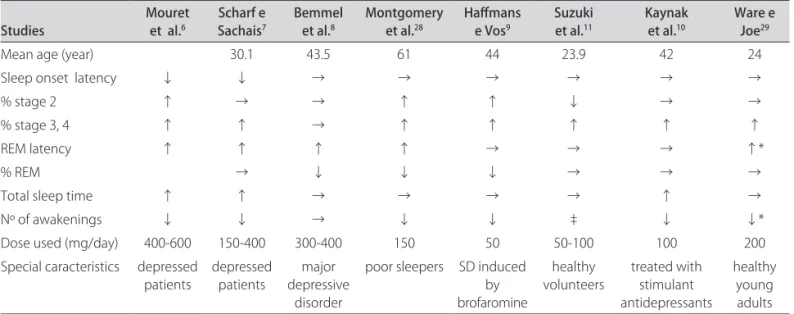
tolerabili-Table 3. Polysomnographic sleep variables with the use of trazodone in chosen studies.
Studies Mouret et al.6 Scharf e Sachais7 Bemmel et al.8 Montgomery et al.28 Hafmans e Vos9 Suzuki et al.11 Kaynak et al.10 Ware e Joe29
Mean age (year) 30.1 43.5 61 44 23.9 42 24
Sleep onset latency ↓ ↓ → → → → → →
% stage 2 ↑ → → ↑ ↑ ↓ → →
% stage 3, 4 ↑ ↑ → ↑ ↑ ↑ ↑ ↑
REM latency ↑ ↑ ↑ ↑ → → → ↑*
% REM → ↓ ↓ ↓ → → →
Total sleep time ↑ ↑ → → → → ↑ →
Nº of awakenings ↓ ↓ → ↓ ↓ ‡ ↓ ↓*
Dose used (mg/day) 400-600 150-400 300-400 150 50 50-100 100 200
Special caracteristics depressed patients
depressed patients
major depressive
disorder
poor sleepers SD induced by brofaromine
healthy volunteers
treated with stimulant antidepressants
ty of these antidepressant by working to reduce their in-duced adverse efects via the blocking of 5HT2A recep-tors (stimulated by SSRI)21.
he classic indication of trazodone is for depression, particularly when anxiety and insomnia are also present. he usual daily dose for improvement of the sleep disor-der complaint varies between 150 and 200 mg/day. Ex-treme doses of 50 and 600 mg/day may be used in specif-ic cases. Lower doses, between 25 and 100 mg/day, have been prescribed as a hypnosedative for patients with in-somnia and to correct the adverse effects of inin-somnia caused by SSRIs22. Due to its relative safety and its low
inhibition of cholinergic receptors, trazodone has been used in the treatment of depression in elderly patients with cardiovascular disease. Reduced anticholinergic ef-fect allows its use in elderly patients with cardiovascular impairments and delirium.
Most studies evaluating trazodone in the treatment of sleep disorders were conducted in patients with de-pression. Saletu-Zyhlarz and collaborators, using poly-somnography, evaluated 11 individuals with depression and sleep disorders and compared them to 11 healthy subjects. The authors observed an improvement in sleep parameters with the use of 100 mg/day of trazo-done23. here was an increase in sleep total time, as we
well as a reduction in nighttime and early awakenings. This study also reported improvements in the subjec-tive quality of sleep, sleep eiciency, numerical memo-ry and somatic complaints. his improvement in mem-ory may be welcomed in cases of patients with demen-tia. In our study, the patients did not use trazodone at doses higher than 100 mg/day, which may have contrib-uted to a lower effectiveness when compared to mir-tazapine. There appears to be some improvement in sleep parameters with increasing doses of trazodone6,7,10.
Nierenberg and colleagues reported good in subjec-tive sleep parameters (PSQI - Pittsburgh Index) with the use of 50 mg/day of trazodone while evaluating patients with secondary insomnia with the use of antidepres-sants24. Similar indings were observed by Kaynak using
trazodone at a dose of 100 mg/day, with subjective and objective improvement of quality of sleep after one week of treatment10.
Despite the improvement in sleep parameters re-ported in most studies, polysomnographic indings vary among studies, probably due to diferences in the dose used and age of the participants (Table 3).
Trazodone has been shown to be efective in the el-derly population mainly due to associated reduced anti-cholinergic efects and undetectable electrocardiograph-ic changes. Another important aspect of this drug is its good tolerability as a treatment for depression in elder-ly patients. In the current study, 1/3 terminated
treat-ment with trazodone due to a lack of efectiveness but not due to adverse efects. he study of Lebert and colleagues showed no increase in adverse efects of trazodone in pa-tients with dementia25.
The mechanism involved in the sedative effect of some antidepressants, among them trazodone, remains unclear. It is not known whether there is an improvement in sleep due to an improvement in depression or whether the improved sleep is due to the direct action of the med-ication11. Kaynak and collaborators suggest that the
ther-apeutic efect of trazodone on sleep is independent of its antidepressant efect10.
Trazodone and other antidepressants with strong an-tagonism of 5-HT2 receptors have properties that in-crease the slow-wave sleep in healthy volunteers and in depressed patients with insomnia26.
he risk of priapism and trazodone-related cardiac arrhythmia is low and is only associated with high dos-es. he alpha-adrenergic blockade caused by trazodone is thought to the mechanism responsible for priapism22.
Limitations of this study include: absence of an instrument to ensure that all patients met diagnostic criteria for sleep disorders; the lack of a double-blind design; drugs eligibility was determined on the basis of physician’s clinical judgment, because this study sought to relect the manner in which physicians treat SD in de-ment elderly; information regarding the efectiveness of these drugs cannot be so clearly, since different drugs might be selected for diferent purposes. For example, a highly efective drug might look inefective since doc-tors might tend to use it only in the most refractory pa-tients; absence of a placebo control group, it is not pos-sible to draw deinitive conclusions as one might with a randomized, blinded trial; under-reporting is a recog-nized limitation of studies based upon spontaneous ad-verse event reporting.
Nonetheless, the results of this study, in an apparently representative cohort of demented elderly, provide use-ful and clinically relevant information. his study was in-tended to show the efectiveness of drugs (trazodone, spe-cially) to SD in demented elderly under ‘real world’ con-ditions and make a review. References are cited spanning at least three decades of research.
According to Erman, the lack of studies on the chron-ic use of trazodone is a reflection of the lack of inter-est by health authorities and pharmaceutical industries to develop controlled studies with placebo and double-blind groups to assess the efectiveness and safety of the drug in these patients, since the drug has no more pat-ent reserves27. he literature reveals the need for
ACKNOWLEDGMENTS – We thank Prof. Pedro Tauil, MD, PhD, for assistance in method construction and data analysis.
REFERENCES
1. Vitiello MV, Borson S. Sleep disturbances in patients with Alzheim-er’s disease: epidemiology, pathophysiology and treatment. CNS Drugs 2001;15:777-796.
2. Hope T, Keene J, Gedling K, Fairburn CG, Jacoby R. Predictors of institution-alization for people with dementia living at home with a carer. Int J Geriatr Psychiatry 1998;13:682-690.
3. McCurry SM, Logsdon RG, Teri L, et al. Characteristics of sleep disturbance in community-dwelling Alzheimer’s disease patients. J Geriatr Psychiatry Neurol 1999;12:53-59.
4. Elmstahl S, Stenberg I, Annerstedt L, Ingvad B. Behavioral disturbances and pharmacological treatment of patients with dementia in family caregiving: a 2-year follow-up. Int Psychogeriatr 1998;10:239-252.
5. Grace JB, Walker MP, McKeith IG. A comparison of sleep proiles in patients with dementia with lewy bodies and Alzheimer’s disease. Int J Geriatr Psy-chiatry 2000;15:1028-1033.
6. Mouret J, Lemoine P, Minuit MP, Benkelfat C, Renardet M. Efects of trazo-done on the sleep of depressed subjects: a polygraphic study. Psychophar-macology (Berl) 1988;95(Suppl):S37-S43.
7. Scharf MB, Sachais BA. Sleep laboratory evaluation of the efects and eica-cy of trazodone in depressed insomniac patients. J Clin Psychiatry 1990;51 (Suppl):S13-S17.
8. van Bemmel AL, Havermans RG, van Diest R. Efects of trazodone on EEG sleep and clinical state in major depression. Psychopharmacology (Berl) 1992; 107:569-574.
9. Hafmans PM, Vos MS. The efects of trazodone on sleep disturbances in-duced by brofaromine. Eur Psychiatry 1999;14:167-171.
10. Kaynak H, Kaynak D, Gozukirmizi E, Guilleminault C. The efects of trazo-done on sleep in patients treated with stimulant antidepressants. Sleep Med 2004;5:15-20.
11. Suzuki H, Yamadera H, Nakamura S, Endo S. Efects of trazodone and imip-ramine on the biological rhythm: an analysis of sleep EEG and body core temperature. J Nippon Med Sch 2002;69:333-341.
12. APA. Diagnostic and statistical manual of mental disorders. 4th edition ed. Washington, DC: American Psychiatric Association; 1994.
13. McKhann G, Drachman D, Folstein M, Katzman R, Price D, Stadlan EM. Clin-ical diagnosis of Alzheimer’s disease: report of the NINCDS-ADRDA Work
Group under the auspices of Department of Health and Human Services Task Force on Alzheimer’s Disease. Neurology 1984;34:939-944. 14. Lawton MP, Brody EM. Assessment of older people: self-maintaining and
in-strumental activities of daily living. Gerontologist 1969;9:179-186. 15. Folstein MF, Folstein SE, McHugh PR. “Mini-mental state”. A practical
meth-od for grading the cognitive state of patients for the clinician. J Psychiatr Res 1975;12:189-198.
16. Hughes CP, Berg L, Danziger WL, Coben LA, Martin RL. A new clinical scale for the staging of dementia. Br J Psychiatry 1982;140:566-572.
17. Cummings JL, Mega M, Gray K, et al. The Neuropsychiatric inventory: comprehensive assessment of psychopathology in dementia. Neurology 1994;44: 2308-2314.
18. Doghramji K. Treatment strategies for sleep disturbance in patients with depression. J Clin Psychiatry 2003;64 (Suppl 14):S24-S29.
19. Wolkove N, Elkholy O, Baltzan M, Palayew M. Sleep and aging 2. Manage-ment of sleep disorders in older people. CMAJ 8 2007;176:1449-1454. 20. James SP, Mendelson WB. The use of trazodone as a hypnotic: a critical
re-view. J Clin Psychiatry 2004;65:752-755.
21. Stahl SM. Stahl’s essential psychopharmacology: neuroscientiic basis and practical applications. 3rd ed, Fully rev. and expanded. ed. Cambridge ; New York: Cambridge University Press; 2008.
22. Cantarelli MDG, Marcolin MA. Trazodona: farmacologia e interações med-icamentosas. Rev Psiquiatr Clin 2006;33:329-336.
23. Saletu-Zyhlarz GM, Abu-Bakr MH, Anderer P, et al. Insomnia in depression: diferences in objective and subjective sleep and awakening quality to nor-mal controls and acute efects of trazodone. Prog Neuropsychopharmacol Biol Psychiatry 2002;26:249-260.
24. Nierenberg AA, Adler LA, Peselow E, Zornberg G, Rosenthal M. Trazodone for antidepressant-associated insomnia. Am J Psychiatry 1994;151:1069-1072.
25. Lebert F, Stekke W, Hasenbroekx C, Pasquier F. Frontotemporal demen-tia: a randomised, controlled trial with trazodone. Dement Geriatr Cogn Disord 2004;17:355-359.
26. Yamadera H, Suzuki H, Nakamura S, Endo S. Efects of trazodone on poly-somnography, blood concentration and core body temperature in healthy volunteers. Psychiatry Clin Neurosci 1999;53:189-191.
27. Erman MK. Is it a sleeping pill? Primary Psychiatry 2000;15:34-36. 28. Montgomery I, Oswald I, Morgan K, Adam K. Trazodone enhances sleep in
subjective quality but not in objective duration. Br J Clin Pharmacol 1983;16: 139-144.