Warfarin or Aspirin in Embolism Prevention in Patients with Mitral
Valvulopathy and Atrial Fibrillation
Paulo de Lara Lavitola, Roney Orismar Sampaio, Walter Amorim de Oliveira, Berta Napchan Bôer, Flavio
Tarasoutchi, Guilherme Sobreira Spina, Max Grinberg
Instituto do Coração - HCFMUSP, São Paulo, SP - Brazil
Mailing address: Paulo de Lara Lavítola •
Rua Pamplona, 191/142 - Bela Vista - 01405-000 - São Paulo, SP - Brazil E-mail: [email protected]
Manuscript received November 04, 2009; revised manuscript received April 22, 2010; accepted April 30, 2010.
Abstract
Background: Atrial fibrillation (AF) associated to rheumatic mitral valve disease (RMVD) increases the incidence of thromboembolism (TE), with warfarin being the standard therapy, in spite of difficulties in treatment adherence and therapeutic control.
Objective: To compare the effectiveness of Aspirin vs. Warfarin in TE prevention in patients with AF and RMVD.
Methods: A total of 229 patients (pts) with AF and RMVD were followed in a prospective and randomized study. The first group consisted of 110 pts receiving Aspirin - 200 mg/day (Group Aspirin - GA) and the second group consisted of 119 pts receiving Warfarin at individually-adjusted doses (Group Warfarin - GW).
Results: There were 15 embolic events in GA and 24 in GW (p = 0.187), of which 21 presented INR < 2.0. Thus, after excluding patients with inadequate INR, there was a higher number of embolic events in GA than in GW (15 vs 3) (p < 0.0061). The GW showed lower treatment adherence (p = 0.001). Neither group presented episodes of major bleeding. Small bleeding episodes were more frequent in the GW (p < 0.01). Increased serum levels of cholesterol and triglycerides constituted a risk factor for a higher number of thromboembolic events in the studied population, with no difference between the groups.
Conclusion: In patients presenting RMVD with AF for less than a year and no previous embolism, Aspirin is little effective in preventing TE. Patients with lower-risk mitral valvulopathy (mitral regurgitation and mitral biological prosthesis), especially in cases presenting contraindication to or low adherence to Warfarin, Aspirin use can present some benefit in TE prevention. (Arq Bras Cardiol 2010;95(6):749-755)
Keywords: Tromboembolism; warfarin; aspirin; mitral valve/physiopathology; atrial fibrillation.
However, in spite of the better applicability of Aspirin as an anti-thrombotic in patients with RMVD with native valve or biological prosthesis associated to AF, this alternative is little explored, thus becoming a challenge7. The objective
of the present study was to evaluate whether the Aspirin therapy can be used in patients with RMVD and AF as an effective alternative to Warfarin, in a population at risk for thromboembolic events presenting treatment adherence difficulties when submitted to Warfarin therapy.
Methods
Patients with a diagnosis of atrial fibrillation, of which onset had been up to 12 months before and a history of rheumatic disease or echocardiographic diagnosis of previous rheumatic disease associated to: 1) mitral valve stenosis, mild to important, according to the classification established by the
American Society of Echocardiography (valve area ≥ 1.5 cm2
= mild, valve area < 1.5 cm2 = moderate/important); (2)
mitral valve regurgitation or mitral bioprosthesis (implanted for more than 6 months) with regurgitation, both quantified at the beginning of the study as of mild or mild/moderate degree, also according to the criteria established by the American
Introduction
There is a higher incidence of thromboembolic events in patients with rheumatic mitral valve disease (RMVD) associated to atrial fibrillation (AF), when compared to those that maintain sinus rhythm1,2.
The natural history of RMVD can be significantly modified after the occurrence of thromboembolism (TE), which unquestionably demonstrates the need for its prevention. Warfarin has become the drug of choice in TE prevention3,4.
Society of Echocardiography8. The study was approved by the
Scientific and Ethics Committee in Research of our institution. All patients agreed to participate in the study and signed the Free and Informed Consent Form. The patients were followed at the Outpatient Clinic Unit of our Service.
The exclusion criteria were: age < 18 years, current antithrombotic drug use, previous episodes of embolism or hemorrhagic disease, coronary disease, arterial hypertension (defined as BP > 140 x 90 mmHg), functional class III or IV according to the New York Heart Association or presence of left ventricular dysfunction, defined as ejection fraction < 60% calculated by Teichholz method, or < 55%, calculated by Simpson’s method8. Patients that went for more than eight days
without medication (voluntary medication withdrawal), who voluntarily missed the ambulatory treatment, whose laboratory control was not possible or those who failed to maintain contact by telephone were also excluded from the study.
Initially, 339 patients with rheumatic mitral valve disease (RMVD) were randomly selected for the study from a randomization list that was especially prepared for this purpose. The patients that withdrew from treatment in up to 18 months were excluded from the assessment. The remaining 229 patients comprised the study sample. The end of the protocol was considered when: 1) there was an embolic event; 2) there was a hemorrhagic event; 3) the study period finished (> 18 months up to a maximum of 7 years).
The remaining 229 patients were then divided in two groups, as follows: 110 received 200 mg/day of Aspirin, comprising Group A (GA) and 119 patients received Warfarin at a variable dose, although it was sufficient to maintain an average INR of 2.5 (ranging from 2.0-3.0), comprising Group W (GW). All patients had equal chances of receiving the drug and none of the patients were allowed to choose the drug individually. The maximum follow-up period was 84 months (mean of 57 ± 18 months).
The diagnosis of the injury was attained by complete physical examination, in addition to a transthoracic echocardiogram carried out at study enrollment, which supported the clinical impression of the valve pathology. The transesophageal echocardiogram (TEE) was carried out in 203 patients during the first six months of study enrollment, in order to allow the identification of eventual thrombus in the left atrium, with no TE events occurring during this period. The other 26 patients underwent the transesophageal echocardiogram after six months of study enrollment, due to technical problems. As none of these patients submitted at a later date to the TEE had left atrial and auricular thrombus, the statistical analysis included all 229 patients. The 12-lead electrocardiogram (ECG) allowed the selection of those patients that presented atrial fibrillation (AF).
In both groups, the assessment of treatment adherence was carried out by a questionnaire applied and repeated every 30 days, on average, which sought to evaluate the adherence to the suggested prescription and the onset of side effects.
The patients from the GW had to keep control of the INR, which was assessed by a single examiner every 30 days at most, as well as diet adherence, when an unvaried menu was insisted upon, with the ingestion of a constant amount of vegetables
(three tablespoons of cooked vegetables), preventing the fluctuation of plasma levels of vitamin K, the antidote for oral anticoagulants, in addition to taking fractionated doses of the drug. Furthermore, in this group, the contacts were anticipated when it was necessary to add a new drug to the pre-existing prescription. Thus, the following situations were considered to be non-adherence to treatment: (a) missing the appointment for INR control; (b) modified diets; (c) accidental or involuntary adherence failure or lack of adherence to the prescribed dose; (d) lack of information on the inclusion of new medications to the previously known regimen.
The information provided by the patients were entered into the database specifically created for this purpose and were obtained by telephone contact or during ambulatory return visits with the researcher.
The evaluation of the plasma levels of the drug (OAC) carried out by INR level control objectively showed whether the prescribed dose was effective. The correct ingestion of two daily acetylsalicylic acid (ASA) tablets were required for patients from the GA.
All patients were advised to contact the research center in case of onset of embolic or hemorrhagic events.
Other risk factors for TE events were assessed. The presence of diabetes mellitus9 (defined as fasting glycemia levels > 126
mg/dl), smoker status10 (defined as the habit of smoking more
than ten cigarettes/day), dyslipidemia11 (defined as plasma
levels of low-density lipoprotein-cholesterol (LDL) > 130 mmol/dl or high-density lipoprotein-cholesterol (HDL) < 35 mg/dl) and hypertriglyceridemia (defined as plasma levels of triglycerides > 150 mg/dl) were evaluated. All these values were considered in the absence of specific medication.
The statistical analysis employed the Chi-square test to compare the GA and GW regarding the homogeneity of proportions or Fisher’s exact test, when it was not possible to apply the Chi-square test. The Student’s t test was used to carry out the quantitative comparison between the two groups. The Wilcoxon method was used to compare the groups from the beginning of treatment to the onset of embolic or hemorrhagic event. The uni- and multivariate analyses were carried out by the repeated-measurement analysis of variance, logistic regression and Pearson’s coefficient of correlation.
Results
Thromboembolic events and risk factors
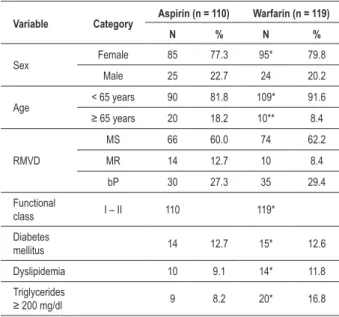
In the studied population, there was no difference regarding the distribution of patients between the GA and GW concerning sex, valve injury type, diabetes mellitus, smoking status, dyslipidemia or functional class (FC). Older patients (> 65 years) were more numerous among those receiving aspirin (p = 0.0319) (Table 1).
Table 2 - Occurrence and type of embolic and major bleeding events (gastrointestinal and gynecological) in the studied groups
Variable Category
Aspirin (n = 110)
Warfarin (n = 119)
N % N %
Thromboembolism 15 13.6 24* 20.2
Type Brain 10 66.7 19* 79.2
Peripheral 5 33.3 5 20.8
Sequelae Brain 5 50.0 8* 42.1 Peripheral 0 0
Bleeding
Gastrointestinal and Gynecological
21 19.0 44 36.9**
Associated
Pathologies 19 17.2 40 33.6**
* P = ns (Aspirin vs Warfarin). ** P < 0.05. Table 1 - Group distribution regarding sex, age, rheumatic valvular
disease, diabetes mellitus and dyslipidemia
Variable Category Aspirin (n = 110) Warfarin (n = 119)
N % N %
Sex Female 85 77.3 95* 79.8
Male 25 22.7 24 20.2
Age < 65 years 90 81.8 109* 91.6 ≥ 65 years 20 18.2 10** 8.4
RMVD
MS 66 60.0 74 62.2
MR 14 12.7 10 8.4
bP 30 27.3 35 29.4
Functional
class I – II 110 119*
Diabetes
mellitus 14 12.7 15* 12.6
Dyslipidemia 10 9.1 14* 11.8
Triglycerides
≥ 200 mg/dl 9 8.2 20* 16.8
* P = ns, ** P < 0,0319. RMVD – rheumatic mitral valve disease; MS - mitral stenosis; MR - mitral regurgitation; bP - biological prosthesis. Diabetes mellitus
(glycemia > 126 mg/dl); dyslipidemia deined as LDL cholesterol ≥ 130 mg/dl
or HDL < 40 mg/dl; hypertriglyceridemia deined as triglycerides > 200 mg/dl.
In the studied population, the 39 patients that presented TE were distributed as follows in relation to the groups and valve pathology: in the GA, 11 (16.6%) of the 66 pts had Mitral stenosis (MS) and four (9.0%) of the 44 pts presented mild/ moderate native valve regurgitation or bioprosthesis. In the GW, 17 (22.9%) of the 74 pts had MS and seven (15.5%) of the 45 pts presented mild/moderate native valve regurgitation or bioprosthesis (Table 3). The presence of spontaneous contrast was observed in all transesophageal echocardiograms carried out in the 229 patients and 39 (17.0%) of them presented thrombus in the left atrial appendage (Table 3).
The presence of left atrial or auricular thrombus was not a determinant of embolic event (Table 3) in the GW. However, there were more thromboembolic events in the group receiving aspirin, which presented intracavitary thrombus formation (p = 0.007) - Table 3.
Dyslipidemia and smoking, when considered in the entire study population, constituted an additional risk factor for
INR< 2.0 and only 3 presented an INR between 2.0 and 2.2 at the moment of the TE event. Thus, if the patients with INR out of the therapeutic range were excluded, there would be three embolic episodes in the GW versus 15 in the GA (p < 0.0061) (Chart 1). Additionally, when the groups were analyzed separately, the brain thromboembolism events were observed in 10 (66.7%) patients from GA, com some type of sequela in 50% of them and in 19 (79.2%) of the patients from GW, with some type of sequela in 42.1% of them (Table 2). Peripheral thromboembolic events occurred in 5 patients from the GA and GW, with no sequelae. There was no statistical difference between them (Table 2).
Chart 1 - INR values and thromboembolic events. There were more thromboembolic events in patients with inadequate INR.
78.2%
17.3%
p < 0.001
Table 3 - Frequencies and percentages of TE per group, sex and pathology in the presence and absence of thrombus
Aspirin (n = 110) Warfarin (n = 119)
Thrombus
Present (24) Absent (86) Present (15) Absent (104)
N % N % N % N %
TE 10 41.7 5 5.8* 6 40.0 18 17.3**
Female 19 66 13 82
TE 8 42.1 5 7.6* 6 46.2 15 18.3*
Male 5 20 2 22
TE 2 40.0 0 0 3 13.6*
Mitral stenosis 15 51 8 66
TE 7 46.7 4 7.8* 5 62.5 12 18.2*
Valve failure 9 35 7 38
TE 3 33.3 1 2.9* 1 14.3 6 15.8*
* Presence of thrombus in Aspirin group vs absence (p < 0.0007). ** Presence of thrombus in Warfarin group vs. absence (p = ns); TE - thromboembolism.
thromboembolic events (Table 4). However, the univariate analysis showed that, when considering only patients with increased levels of cholesterol and triglycerides, as well as smokers, the incidence of TE events did not show statistical significance (p = 1.000 - 0.431 and 0.322 respectively).
At the univariate analysis, when considering only patients with increased cholesterol levels in the GA (10 pts), four presented TE (40.0%). In the GW, of the 14 pts with increased cholesterol levels, six (42.9%) pts presented TE (p = 1.000). Similarly, also at the univariate analysis, and considering the nine pts with increased levels of triglycerides in the GA, two (22.0%) pts presented TE. In the GW, of the 20 pts with hypertriglyceridemia, eight (40.0%) pts presented TE (p = 0.431).
Table 4 - Levels of total cholesterol (TC), triglycerides (TG) and
number of smokers in relation to the number of episodes of
thromboembolism in the studied population
Variable
Thromboembolism
Present Absent
N % N %
Cholesterol
Increased
(n=24) 10 41.7 14 14 58.3
Normal
(n=205) 29* 14.2 176 176 85.8
Triglycerides
Increased
(n=29) 10 34.5 19 19 65.5
Normal
(n=200) 29** 14.5 171 171 86.5
Smoking
Present
(n=44) 13 29.6 31 31 70.4
Absent
(n=185) 26*** 14.1 159 159 85.9
*increased cholesterol vs normal in relation to thromboembolism (p = 0.002). **Increased triglycerides vs normal in relation to thromboembolism (p = 0.015). *** Smoking vs nonsmoking in relation to thromboembolism (p = 0.014).
Treatment adherence
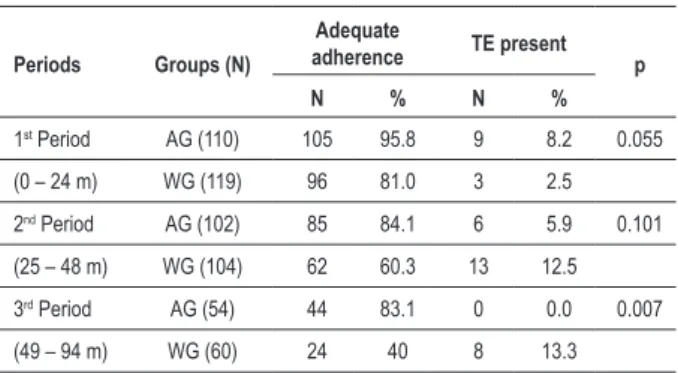
Treatment adherence was observed in 72.7% of the patients from the GA and 42% from the GW (p = 0.001). Adherence was decreased in the GW when compared to the GA throughout the three study periods, with a significant difference in the third period (Table 5). The difference in behavior regarding the treatment norms in the GW resulted in higher percentages of INR assessments < 2.0 during the study and a higher incidence of TE events in this group (Chart 1).
During the study period, the GW presented 37.54% of the INR assessments < 2.0, 51.28% between 2.0 and 3.0 and 11.18% > 3.0 (Chart 2). The multivariate analysis showed that with every 1% of INR levels < 2.0, the probability of a TE event increased by 8.4%.
Hemorrhagic events
The hemorrhagic complications were more frequent in the GW - 7.9% patient/year - when compared to the GA- 4.09% patient/year (p = 0.007). There were no episodes of brain hemorrhage in either group.
Table 5 - Distribution of adequate adherence da during the three study periods according to the TE group
Periods Groups (N)
Adequate
adherence TE present p
N % N %
1st Period AG (110) 105 95.8 9 8.2 0.055
(0 – 24 m) WG (119) 96 81.0 3 2.5
2nd Period AG (102) 85 84.1 6 5.9 0.101
(25 – 48 m) WG (104) 62 60.3 13 12.5
3rd Period AG (54) 44 83.1 0 0.0 0.007
(49 – 94 m) WG (60) 24 40 8 13.3
Chart 2 - Mean of INR values. INR - International normalized ratio. INR values
between 2.0 e 3.0 are considered target values and relect the adequate plasma
concentration of Warfarin. Only 51.28% of the laboratory tests presented an adequate INR.
11.18
51.28
37.54
2.0
3.0
The GW presented 44 hemorrhagic events (Table 2). Subclinical disease was identified in all 40 patients that presented hemorrhage with INR-target levels (2.0-3.0) or slightly higher levels. In the GA, of the 21 hemorrhagic events, only two (9.5%) did not have an associated disease that predisposed to bleeding. The difference in bleeding events between the groups was statistically significant (p = 0.0007) (Table 2).
Discussion
Patients with RMVD are systematically excluded from large studies assessing the consequences of AF12,13. The present
study focus on patients with AF and RMVD. All patients were randomized to receive either Aspirin or Warfarin as preventive therapy for TE events.
Warfarin is considered, in all large studies, as the most effective drug in TE prevention, due to its favorable pharmacological properties14. However, its action depends on
the observance of strict norms, such as unvaried diets; regular visits to the laboratory and physician to establish INR adequacy; adherence to the fractionated and frequently modified doses of Warfarin; control of heart dynamics, especially in patients with heart failure and mandatory communication whenever it is necessary to add a new medication to the pre-existing regimen. These conditions are strenuous for patients in the long term, in addition to being little practical and very often the cause of the lack of adherence to treatment, resulting in a decrease of the expected - and desired - effectiveness of Warfarin therapy. The anti-thrombotic treatment with Aspirin is a simpler one, promoting treatment adherence. The difference in treatment adherence, perhaps due to the aforementioned matters of convenience and simplicity, helps to explain the observed outcomes15.
In our study, the incidence of embolic events among the
110 patients that received 200 mg/day of Aspirin (GA) was 2.9% patient/year, in comparison with the 4.3% patients/ year that received Warfarin (GW) (p = 0.189). However, if one excludes patients whose INR was below the therapeutic value at the moment of the TE, a higher incidence of embolic episodes can be observed in patients who received Aspirin, as expected, as a matter of fact16.
The adequate treatment adherence, regardless of the chosen therapy, was associated with a lower number of thromboembolic events. In the present study, the better treatment adherence in the GA was noteworthy, when compared to the GW (Table 5). As the study progresses, a decrease in the adherence was observed in the GW, as well as an increase in embolic episodes. The decreased INR levels with desired values are a direct consequence of the difficulty in the adequacy of the treatment with the anti-vitamin K drug. There was a correlation between the inadequate INR levels, lower adherence to treatment and the incidence of TE (Chart 1 and Table 4), as previously identified17. It was also
demonstrated that for every 1% of INR values < 2.0, there was an 8.4% increase in TE events.
New drugs, such as activated factor X-inhibitors administered orally or direct anti-thrombinic drugs seem to be promising as substitutes for the traditional dicumarinic therapy. Recent publication on a large multicentric study in patients with atrial fibrillation demonstrated the effectiveness of Dabigatran, a direct thrombin inhibitor, in comparison to Warfarin18. Dabigatran at a dose of 110 mg was associated
with an equal number of brain and systemic TE episodes and a lower number of hemorrhagic complications18. Other
anti-thrombinic drugs, such as Edoxaban, Apixaban, Rivaroxaban, are being developed and can be equally promising19.
Hypercholesterolemia and hypertriglyceridemia contributed to a higher incidence of TE events. Such findings showed that this population of patients with AF and RMVD must keep an adequate control of dyslipidemia for TE prevention.
Patients with mitral stenosis presented a higher number of embolic events, when compared to those that presented regurgitation, although there was no statistical significance. Mitral stenosis is a disease that poses a higher risk for TE than mitral regurgitation. Moreover, Yamamoto et al20 demonstrated
that plasma levels of markers of coagulation system activation, such as D-dimer, thrombin-antithrombin III complex and prothrombin fragments (F1+2), were lower in AF associated with mitral valve regurgitation, when compared to isolated AF, which can help in these findings.
We observed a higher number of hemorrhagic events in GW when compared to GA. It is noteworthy that most patients that presented bleeding with an INR value within the therapeutic range also had some type of predisposing pathology - as previously observed21.
Conclusion
benefit from the preventive use of Aspirin, especially if the administration of Warfarin is contraindicated or if treatment adherence is low.
Potential Conflict of Interest
No potential conflict of interest relevant to this article was reported.
Sources of Funding
There were no external funding sources for this study.
Study Association
This article is part of the thesis of doctoral submitted by Paulo de Lara Lavitola, from Faculdade de Medicina da Universidade de São Paulo.
References
1. Coulshed N, Epstein EJ, Mckendrick CS, Gallaway RW, Walter E. Systemic embolism in mitral valve disease. Br Heart J. 1970; 32 (1): 26-34.
2. Wolf PA, Dawber TR, Thomas HE Jr, Kannel WB. Epidemiologic assessment of chronic atrial fibrillation and risk of stroke: the Framingham study. Neurology. 1978; 28 (10): 973-7.
3. Salem DH, Daudelin DH, Levine HJ, Pauker SG, Eckman MH, Riff J. Antithrombotic therapy in valvular heart disease. Chest. 2001; 119 (1 Suppl.): 207-19.
4. Ramanathan KB, Horn DH. Anticoagulation for the patient with mitral valve disease and atrial fibrillation. In: Alpert JS, Dalen JE, Rahimtoola SH (eds). Valvular heart disease. 3rd ed. Philadelphia: Lippincott; 1999.
5. Hellemons ML, Lodder J, Vermeer F, Schouten HJ, Lemmens T, VanRee JW, et al. Primary prevention of arterial thromboembolism in non-rheumatic atrial fibrillation in primary care: randomized controlled trial comparing two intensities of coumarin with aspirin. Br Med J. 1999; 319 (7215): 958-64.
6. Mohr JP, Thompson JLP, Lazar RM, Levin B, Sacco RL, Furie KL, et al. A comparison of warfarin and aspirin for the prevention of recurrent ischemic stroke. N Engl J Med. 2001; 345 (20): 1444-51.
7. Ansell JE. Oral anticoagulant therapy - 50 years later. Arch Intern Med. 1993; 153 (5): 586-96.
8. Schiller NB, Shah PM, Crawford M, DeMaria A, Devereux R, Feigenbaum H, et al. Recommendations for quantitation of the left ventricle by two-dimensional echocardiography. American Society of Echocardiography Committee on Standards, Subcommittee on Quantitation of Two-Dimensional Echocardiograms. J Am Soc Echocardiogr. 1989; 2 (6): 358-67.
9. Tuomilehto J, Lindstrom J, Eribson JG, Erikssom JG, Vale TT, Hamalainen H, et al. Finish Diabetes Prevention Study Group. Prevention of type 2 diabetes mellitus by changes in lifestyle amoung subjects with impaired glucose tolerance. N Engl J Med. 2001; 344 (18): 1343-50.
10. Auerbach O, Hammond EC, Garfinkel L. Smoking in relation to aterosclerosis of the coronary arteries. N Eng J Med. 1965; 273 (15): 775-9.
11. Chacra APM, Diament J, Forti NA. Classificação das dislipidemias. Rev Soc Cardiol Estado de São Paulo. 2005; 15 (6): 465-72.
12. Gorelick MD. Combining aspirin with oral anticoagulant therapy: is this a safe and effective practice in patients with atrial fibrillation? Stroke. 2007; 38 (5): 1652-4.
13. Aguilar M, Hart R. Antiplatelet therapy for preventing stroke in patients with non-valvular atrial fibrillation and no previous history of stroke or transient ischemic attacks. Cochrane Database Syst Rev. 2005; (4). CD 001925.
14. Ezekowitz MO, Bridgers SL, James KE, Carliner NH, Colling CL, Gornick CC, et al. Warfarin in the prevention of stroke associated with non-rheumatic atrial fibrillation. N Eng J Med. 1992; 12 (20): 1406-12.
15. Ansell J, Hirsh J, Hylek E, Jacobsen A, Crowther M, Palareti G. Pharmacology and management of the vitamin K antagonists. Chest. 2008; 113 (6 Suppl): 160S-198S.
16. Salem DN, O’gara PT, Madias C, Pauber SG. Valvular and structural heart disease: Valvular and structural heart disease: American College of Chest Physicians Evidence-Based Clinical Practice Guidelines (8th Edition). Chest. 2008; 133 (6 Suppl): 593S-629S.
17. Hylek EM, Go AS, Chang Y, Jensveld NG, Henault LE, Selby JV, et al. Effect of intensity of oral anticoagulation on stroke severity and mortality in atrial fibrillation. N Engl J Med. 2003; 349 (11): 1019-26.
18. Connolly, SJ, Ezekowitz MD, Yusuf S, Eikelboom J, Oldgren J, Parekh A, et al. Dabigatran versus warfarin in patients with atrial fibrillation. N Engl J Med. 2009; 361 (12): 1139-51.
19. Turpie A. New oral anticoagulants in atrial fibrillation. Eur Heart J. 2008; 29 (2): 155-65.
20. Yamamoto KI, Fukazawa H, Shimada K. Effects of aspirin on the status of thrombin generation in atrial fibrillation. Am J Cardiol. 1996; 77 (7): 528-30.