328 • Arq Gastroenterol • 2017. v. 54 nº 4 Out/Nov 328 • Arq Gastroenterol • 2017. v. 54 nº 4 Out/Nov
INTRODUCTION
Inlammatory bowel diseases (IBD) are complex disorders mainly comprised by Crohn’s disease (CD) and ulcerative colitis (UC)(17). They were gathered on this same group for their resem-blance: the pathogenesis based on a chronic bowel inlammation with undeined etiology(4). Since these affections do not present chances of cure, IBD can be controlled by medical and, sometimes, surgical management(10). The appropriate treatment choice is based on location, severity of presentation, response to drug therapy, and the presence of complications such as abscesses and istulas(10,14).
At irst, patients were treated with corticosteroids and/or im-munomodulators, but not all of them develop an adequate response to this primary therapy(9,10). Since then, researchers were encouraged to develop new ways of controlling CD and UC. IBD management went through a major revolution when new classes of monoclonal antibodies, such as anti tumor necrosis factor (TNF) alpha agents, were described(1,2,6).
TNF alpha is produced specially by macrophages and plays a key chore in orchestrating the inlammatory cascade. This
com-Safety profile of anti-TNF therapy in Crohn’s
disease management: a Brazilian single-center
direct retrospective comparison between
infliximab and adalimumab
Mariella
BAU
1, Patricia
ZACHARIAS
1, Diogo Araújo
RIBEIRO
1, Larissa
BOARON
1,
Alvaro
STECKERT FILHO
2and Paulo Gustavo
KOTZE
1Received 25/5/2017 Accepted 27/7/2017
ABSTRACT – Background – Inliximab and adalimumab are considered effective drugs in the management of Crohn’s disease. However, due to signiicant
immunossupression, they can cause important adverse events, mostly infections. Objective – The aim of this study was to quantify and describe adverse
events derived from adalimumab and inliximab use in Crohn’s disease patients, and to compare the safety proile between these two agents. Methods –
This was an observational, single-center, longitudinal, retrospective study with Crohn’s disease patients under inliximab or adalimumab therapy. Variables analyzed: demographic characteristics (including the Montreal classiication), type of agent used, concomitant immunomodulators, presence and types
of adverse events observed. Patients were allocated in two groups (inliximab and adalimumab) and had their adverse events accessed and subsequently
compared. Results – A total of 130 patients were included (68 in inliximab and 62 in adalimumab groups, respectively). The groups were fully
homoge-neous in all baseline characteristics, with a median follow-up of 47.21±36.52 months in the inliximab group and 47.79±35.09 in the adalimumab group
(P=0.512). Adverse events were found in 43/68 (63.2%) and 40/62 (64.5%) in each group, respectively (P=0.879). There were no differences between the
groups regarding infections (P=0.094) or treatment interruption (P=0.091). There were higher rates of infusion reactions in the inliximab group (P=0.016).
Cephalea and injection site reactions were more prevalent in adalimumab patients. Conclusion – Adverse events were found in approximately two thirds
of Crohn’s disease patients under anti-TNF therapy, and there were no signiicant differences between inliximab or adalimumab.
HEADINGS – Crohn disease. Tumor necrosis factor-alpha. Inliximab, adverse effects. Adalimumab, adverse effects.
This article did not have any funding source.
Disclosure: PGK is a speaker and consultant for Abbvie, Ferring, Janssen, Pfizer and Takeda. All other authors have no disclosure. Studied carried out at: Serviço de Coloproctologia do Hospital Universitário Cajuru – PUCPR (Curitiba – PR – Brasil).
1 Unidade de Cirurgia Colorretal, Ambulatório de Doenças Inflamatórias Intestinais, Hospital Universitário Cajuru, Universidade Católica do Paraná, Curitiba, PR, Brasil; 2 Cirurgia Colorretal,
Gastro Medical Center, Florianópolis, SC, Brasil.
Correspondence: Paulo Gustavo Kotze. Rua Mauá, 682 – CEP: 80030-200 – Curitiba, PR, Brasil. [email protected]
pound must go through a three-level regulation to be released from macrophages, regarding the importance and intensity of its action(19). Fever induction, insulin resistance, bone resorption, anemia and immune activation are some of the activities related to this pro-inlammatory cytokine(15,19).
However, TNF alpha is not the only cytokine involved in the IBD pathogenesis. Other cytokines, such as IL-1, IL-6, IL-13 and TL1α also have a well-deined participation in this process(17). The organism’s response to these proteins is crucial to the initiation, evolution and perpetuation of the inlammatory process that trig-gers IBD(18).
Indeed, new drugs focused on TNF alpha inhibition have been developed to treat autoimmune affections and were successfully applied to CD management(1,8). The eficacy of blocking the TNF in IBD was highly proved in both induction and maintenance of clinical response and remission(6,7,9,12,16).
inlammation, anti-TNF alpha agents are not innocuous drugs(3,13). Numerous adverse events (AE) have been related to these medica-tions, for instance: optic neuritis, exacerbation of multiple sclerosis and psoriasis, abscesses, opportunistic infections, upper respiratory tract infections, drug-induced lupus, arthralgia, allergic reaction, dermatitis and injection site reactions(4,5). Concerning the occur-rence of AE per agent, the safety proile is very similar between these drugs, and a class effect can be suggested. Nevertheless, there is a lack of Latin American studies that explore the safety indings and compare differences between ADA and IFX in the management of CD(11).
The aim of this study was to quantify and describe AE derived from ADA and IFX use in CD patients, from a single-center cohort, and to compare the safety proile between these two agents. The secondary objectives were to analyze treatment discontinuation due to the occurrence of AE, as well as mortality during anti-TNF use.
METHODS Study design
This was a longitudinal, retrospective observational study with CD patients treated with anti-TNF therapy from an IBD referral center from the South of Brazil, between January 2008 and April 2016.
Inclusion and exclusion criteria
Patients with an established diagnosis of CD by endoscopic, imaging and serological markers, those between 16 and 75 years of age and that used an anti-TNF agent (ADA or IFX) at any time of their disease management were considered for the study. Patients under 16 or over 75 years of age, those with undetermined IBD, with diagnosis of UC, treated with conventional therapy, without biologics, as well as those with lack of data and who were lost to follow-up were excluded from the analysis.
Variables analyzed
The following characteristics were included in the study proto-col: age at diagnosis, age at anti-TNF initiation, Montreal classii-cation (A: age at diagnosis; L: disease loclassii-cation and B: disease phe-notype), disease duration (from diagnosis to anti-TNF initiation), smoking status, previous surgery due to CD, perianal CD, type of anti-TNF agent used, concomitant use of azathioprine (AZA) or 6-mercaptopurine (6-MP), time of follow-up on medication, treat-ment interruption and occurrence and detailed description of AE. Patients were initially identiied and selected from the IBD outpatient database from the Catholic University of Paraná, Cu-ritiba, Brazil. Electronic chart review was performed and a proto-col with the variables of interest was fulilled. Concurrently with data collection, comparative Excel charts were created embracing patients’ main characteristics, mostly focusing on the presence and type of AE. Patients were allocated into two groups according to the anti-TNF agent used (IFX or ADA). The safety indings were then identiied, quantiied and subsequently compared between the two groups.
Statistical analysis
The statistical analysis included Pearson chi-square test and Mann-Whitney U test to verify group homogeneity (between IFX and ADA groups), in terms of baseline demographic and disease characteristics. The Student t test was used to compare
the frequency of each speciic AE between the groups. P-values <0.05 were considered statistically signiicant. The analyses were performed with SPSS v23.0, IBM, Chicago, IL, USA.
Ethical considerations
The study protocol was approved by the Ethical Committee of
Pontifícia Universidade Católica do Paraná in June/2016 (protocol number CAAE 56444316.3.0000.0020), under the Brazilian Min-istry of Health website plataforma Brasil.
RESULTS
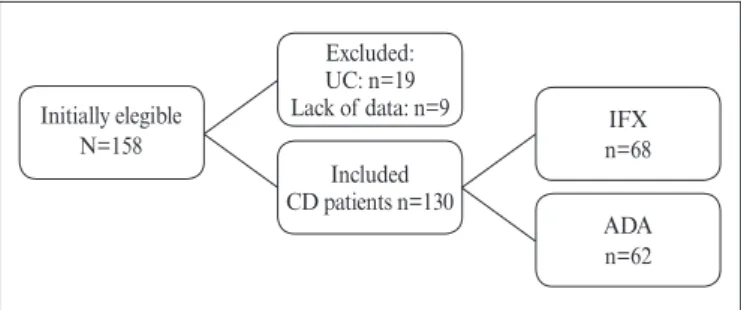
A total of 158 patients from the database were initially eligible. However, 19 patients were excluded due to inal diagnosis of UC and nine patients due to lack of data in charts. Therefore, 130 CD patients fulilled the criteria for the analysis [68 (52.3%) in the IFX and 62 (47.7%) in the ADA groups, respectively]. The lowchart of the study sample is described in detail in Figure 1.
Initially elegible N=158
Excluded: UC: n=19
Lack of data: n=9 IFX
n=68 Included
CD patients n=130
ADA n=62
FIGURE 1. Flowchart of the study sample. In total, 130 patients comprised the population analyzed. IFX: inliximab; ADA: adalimumab.
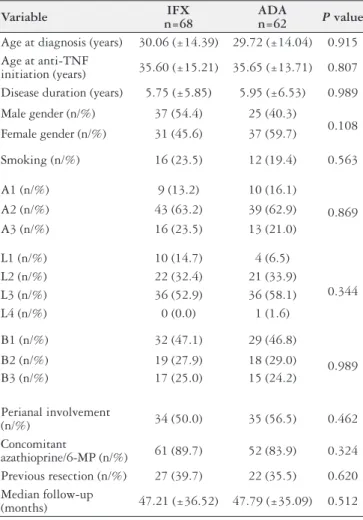
The baseline characteristics of the patients are described in detail in Table 1. As seen, the population of the study was mostly composed by young patients, with a median disease duration of approximately 5 years, presenting with ileocolic location and inlammatory phenotype. Approximately 50% of the patients had perianal CD, more than 80% were in combination therapy and one third had previous intestinal resections. There was no signiicant differences between the two groups in all variables analyzed, what made the groups fully comparable.
Regarding the primary objective of this study, AE were found in 63.2% of patients under IFX therapy and in 64.5% in those treated with ADA (P=0.879). These indings were observed during approximately 47 months of follow-up (average) in both groups.
The most common AE found in cohort were skin lesions, arthralgia, herpes virus and upper respiratory tract infections, as described in Table 2. Other less frequent AE are described in Table 3. Overall infectious adverse events occurred in 29.4% (20/68) in IFX and 43.5% (27/62) in ADA groups, respectively (P=0.094). As seen in these interesting indings, a signiicant statistical difference was observed in the prevalence of infusion reactions (P=0.016 – more prevalent in IFX patients), cephalea (P=0.004) and injection site reactions (P=0.004), more prevalent in ADA patients.
330 • Arq Gastroenterol • 2017. v. 54 nº 4 Out/Nov
Regarding the secondary objectives of the study, treatment dis-continuation was observed in 32.4% in the IFX group (22/68) and in 32.3% (20/62) in the ADA patients (P=0.991). Only one patient died in this cohort, as a result of central permanent catheter infec-tion and sepsis due to short bowel syndrome and total parenteral nutrition, during ADA treatment.
DISCUSSION
Anti-TNF agents constitute an effective therapy in the man-agement of CD in general, but their systemic immunosuppression can be related to a myriad of adverse events. CD is usually being treated in young patients, and once a biological agent therapy is started, is not interrupted, unless severe AE do occur or secondary loss of response does not improve with therapeutic optimization. This means that patients usually are exposed to these agents for a signiicant period during their treatment.
There is a lack of studies regarding the safety proile of IFX and ADA in Latin American patients in the literature. Most of the data come from multicenter pivotal trials, as well as post marketing long-term studies that analyzed patients from different parts of the world(5-7,9,13,14). This study is one of the irst to report a detailed safety proile of CD patients submitted to anti-TNF therapy in Brazil.
The population included in the analysis represents a typical sample of refractory CD patients from daily clinical practice: young individuals, with long disease duration presenting with luminal CD. Moreover, a signiicant proportion of our patients had perianal CD (±50%) and was submitted to previous abdominal operations for intestinal resections (35%-40%), and this can be explained by the proile of our unit (surgeons treating medically IBD patients, a
TABLE 1. Baseline characteristics of the 130 included patients
Variable IFX
n=68
ADA
n=62 P value Age at diagnosis (years) 30.06 (±14.39) 29.72 (±14.04) 0.915 Age at anti-TNF
initiation (years) 35.60 (±15.21) 35.65 (±13.71) 0.807 Disease duration (years) 5.75 (±5.85) 5.95 (±6.53) 0.989
Male gender (n/%) 37 (54.4) 25 (40.3)
0.108 Female gender (n/%) 31 (45.6) 37 (59.7)
Smoking (n/%) 16 (23.5) 12 (19.4) 0.563
A1 (n/%) 9 (13.2) 10 (16.1)
0.869 A2 (n/%) 43 (63.2) 39 (62.9)
A3 (n/%) 16 (23.5) 13 (21.0)
L1 (n/%) 10 (14.7) 4 (6.5)
0.344 L2 (n/%) 22 (32.4) 21 (33.9)
L3 (n/%) 36 (52.9) 36 (58.1)
L4 (n/%) 0 (0.0) 1 (1.6)
B1 (n/%) 32 (47.1) 29 (46.8)
0.989 B2 (n/%) 19 (27.9) 18 (29.0)
B3 (n/%) 17 (25.0) 15 (24.2)
Perianal involvement
(n/%) 34 (50.0) 35 (56.5) 0.462 Concomitant
azathioprine/6-MP (n/%) 61 (89.7) 52 (83.9) 0.324 Previous resection (n/%) 27 (39.7) 22 (35.5) 0.620 Median follow-up
(months) 47.21 (±36.52) 47.79 (±35.09) 0.512
Age at diagnosis, anti-TNF initiation, disease duration and time of follow-up analyzed with U Mann-Whitney test. Other variables analyzed with the chi-square test. Quantitative variables with standard deviation (±). IFX: inliximab; ADA: adalimumab.
TABLE 2. Most common AE found in the cohort of patients
Adverse events (AE) – number of patients
IFX n=68
ADA
n=62 P value
Skin lesions 18 10 0.610
Arthralgia 14 14 0.785
Infusion reactions 6 0 0.016*
Herpes virus infection 6 9 0.314
Upper respiratory tract infections 5 4 0.841
Cephalea 0 7 0.004*
Injection site reaction 0 7 0.004*
Moniliasis 2 0 0.176
Optic neuritis 2 0 0.176
Pneumonia 2 0 0.176
Sinusitis 2 4 0.345
Pseudomembranous colitis 2 3 0.578 Urinary tract infection 1 4 0.142
Tuberculosis 1 3 0.270
* P<0.05. IFX: inliximab; ADA: adalimumab.
TABLE 3. Less common AE found in the cohort of patients Adverse event (AE) – number of
patients
IFX n=68
ADA
n=62 P value
Infectious diarrhea 1 0 0.342
Bacterial endocarditis 1 0 0.342
Epididymitis 1 0 0.342
Folliculitis 1 0 0.342
Perianal HPV 1 0 0.342
Onychomycosis 1 0 0.342
Nausea 1 0 0.342
Peripheral neuropathy 1 0 0.342
Febrile neutropenia 1 0 0.342
Intestinal perforation 1 0 0.342
HBV reactivation 1 0 0.342
Hordeolum 1 2 0.509
Acne 0 2 0.138
Soft tissue infection 0 2 0.138
Tinea cruris 0 2 0.138
Leukocytoclastic vasculitis 0 2 0.138
Bartholinitis 0 1 0.297
Recurrent vaginal candidiasis 0 1 0.297 Facial and lower limb edema 0 1 0.297 Hepatocellular carcinoma 0 1 0.297
Hyperlipidemia 0 1 0.297
Leukopenia 0 1 0.297
* P<0.05. IFX: inliximab; ADA: adalimumab. HPV: human papiloma vírus; HBV: hepatitis
reality in some countries of the world like Brazil, Mexico, Colombia and Japan, for example).
Approximately two thirds of our patients developed at least one AE in both groups during a median follow-up of almost 4 years, 63.2% in IFX and 64.5% in ADA patients (P=0.879). These numbers are in accordance with phase three studies for both agents (54.8% to 65.81% in ADA trials(6), up to 89% of IFX patients in the SONIC trial, for example)(7). Comparative safety studies be-tween agents are scarce in the literature, and we could not detect any difference in terms of prevalence of overall AE between the groups, what conirmed a previous study performed in the same unit, but with a smaller sample of patients(11). Moreover, infec-tious AE in aggregation were also not different between the two groups [29.4% (20/68) in IFX and 43.5% (27/62) in ADA groups, respectively (P=0.094)]. These indings may suggest a class ef-fect of anti-TNF agents in terms of safety in CD management. However, there is a clear need for a prospective study aiming to access this comparison.
Obviously, infusion reactions were more prevalent in the IFX group, (P=0.016) and occurred in 6 (8.8%) of the 68 patients. These indings are also comparable with data from other prospec-tive studies (6% in the ACCENT I trial(9) and 6.1% in the SONIC trial(7)). Similarly, injection site reactions and pain were obviously more prevalent in the ADA group (P=0.004) and occurred in 7 of the 62 patients (approximately 11%). This rate was lower than other ADA studies, that reported injection site reactions in 2.6%-5.5% of the patients(6). Cephalea was also more prevalent in ADA patients, and was observed in 7/62 patients (11.2%), while none of the IFX patients reported this AE (P=0.004). Headache can be described during anti-TNF therapy, and usually is not a cause for discontinuation of therapy(11). In IFX patients, it can be associated frequently with infusion reactions.
Additionally, in this cohort of patients, several different AE were identiied, as seen in Tables 2 and 3. This was probably due to the deeply detailed electronic chart review performed by a single researcher, what reduced the bias of data extraction and possibly increased the accuracy to detect AE.
The discontinuation of therapy lead by AE was also not dif-ferent between the two groups in this cohort, 32.4% in the IFX and 32.3% in the ADA groups, respectively (P=0.991). These numbers were higher than we expected for ADA, as other studies demonstrated lower frequency of treatment interruption. In a study with more than 3000 patients from the ADA programme for CD, discontinuation was observed in 1.1%-6.3% of the patients(6). On the other hand, the present numbers are comparable with data from other IFX studies, as the SONIC trial, where AE leading to discontinuation were observed in 17.8%-20.7% of the patients(7).
There were only four cases of tuberculosis described in this cohort, despite adequate screening with chest x-ray, detailed medi-cal history and cutaneous reaction performed in all patients. These
were probably cases of latent tuberculosis reactivation, and were all treated with proper antibiotics before resuming anti-TNF therapy, usually after 4-8 weeks after interruption.
Only one case of malignancy was detected in this group of patients, a 37 year-old man that was using ADA monotherapy and developed a hepatocellular carcinoma. The patient was submitted to partial liver resection, and as he was in deep remission for 2 years, a joint decision to interrupt CD therapy was made, and no direct relation between ADA and the tumor could be related. Malignan-cies are also rare indings in larger studies with anti-TNF therapy. The TREAT registry did not ind any association between IFX and malignancies(13). In the ADA programme, some cases of lymphoma and other non-melanoma skin cancers were described(6), but they could be also related to the combined therapy with thiopurines. No cases of lymph proliferative disorders were observed in this cohort. Only one ADA patient died due to a severe central line sepsis, as-sociated with malnutrition and combined immunosuppression.
This study has some limitations that must be clariied before interpretation of its results. First, the study was retrospective, and data collection can be always biased at some point, mainly due to the teaching hospital proile of our unit (several residents and students seeing the patients and making chart notes). Secondly, the study period was long (8 years) and the evolution of anti-TNF therapy was fast and remarkable over the years. This can relect that in the beginning of the study period, detection of AE could be impaired, and improved in the last periods of the study dura-tion, as the experience with these agents improved over the years. Additionally, AEs could be related to the immunomodulators and not to the anti-TNF agents. This difference is dificult to be clari-ied in a retrospective cohort study, but the proportion of patients in combination therapy was similar in both groups. Despite these limitations, the strength of this study is based on the fully homo-geneous groups for comparison, what relects the real life practice of our unit, using ADA and IFX in equal proportions and for similar patients.
In summary, this study demonstrated that approximately two thirds of CD patients under anti-TNF therapy develop an AE over time. Additionally, there was no signiicant difference in the prevalence and safety proile between those under IFX or ADA therapy. Infusion reactions were more prevalent in the IFX group, and injection site reactions and cephalea occurred more frequently in the ADA group. There was no difference in treatment discontinu-ation and mortality between the groups.
Authors’ contributions
332 • Arq Gastroenterol • 2017. v. 54 nº 4 Out/Nov REFERENCES
1. Armuzzi A, De Pascalis B, Fedeli P, De Vincentis F, Gasbarrini A. Inliximab in Crohn’s disease: early and long-term treatment. Dig Liver Dis. 2008;40 (Suppl 2):S271-9.
2. Asgharpour A, Cheng J, Bickston SJ. Adalimumab treatment in Crohn’s disease: an overview of long-term eficacy and safety in light of the EXTEND trial. Clin Exp Gastroenterol. 2013;6:153-160.
3. Atzori L, Mantovani L, Pinna AL, Pau M, Usai P. Cutaneous Adverse Reac-tions during Anti-Tnf Alpha Treatment for Inlammatory Bowel Diseases: The Experience of the Dermatology Clinic of Cagliari (Italy). J Pharmacovigilance. 2015, S2:004.
4. Baumgart D, Sandborn WJ. Crohn’s disease. Lancet. 2012;380:1590-605. 5. Burmester GR, Panaccione R, Gordon KB, McIlraith MJ, Lacerda APM.
Adalimumab: long-term safety in 23 458 patients from global clinical trials in rheumatoid arthritis, juvenile idiopathic arthritis, ankylosing spondylitis, psoriatic arthritis, psoriasis and Crohn’s disease. Ann Rheum Dis. 2013;72:517-24. 6. Colombel JF, Sandborn WJ, Panaccione R, Robinson AM, Lau W, Li J, et al.
Adalimumab safety in global clinical trials of patients with Crohn’s disease. Inlamm Bowel Dis. 2009;15:1308–19.
7. Colombel JF, Sandborn WJ, Reinisch W, Mantzaris GJ, Kornbluth A, Rach-milewitz D, et al. Inliximab, azathioprine, or combination therapy for Crohn’s disease. N Engl J Med. 2010;362:1383–95.
8. Hamzaoglu H, Cooper J, Alsahli M. Safety of Inliximab in Crohn’s Disease: A Large Single-center Experience. Inlamm Bowel Dis. 2010;16:2109–16. 9. Hanauer SB, Feagan BG, Lichtenstein GR, Mayer LF, Schreiber S, Colombel JF,
et al. Maintenance inliximab for Crohn’s disease: the ACCENT I randomised trial. Lancet. 2002;359:1541-9.
Bau M, Zacharias P, Ribeiro DA, Boaron L, Steckert Filho A, Kotze PG. Peril de segurança da terapia anti-TNF na doença de Crohn: um estudo ob-servacional brasileiro comparativo entre inliximabe e adalimumabe. Arq Gastroenterol. 2017;54(4):328-32.
RESUMO – Contexto – A utilização de inibidores do fator de necrose tumoral (TNF) alfa no manejo da doença de Crohn é cada vez mais frequente. Tanto o inliximabe quanto o adalimumabe são considerados medicamentos efetivos no controle da doença. Entretanto, por serem potentes imunossupressores,
podem causar efeitos adversos importantes, principalmente infecções. Objetivo – O objetivo primário deste estudo foi analisar a presença de efeitos
adversos dos anti-TNFs em portadores de doença de Crohn, comparando-se inliximabe e adalimumabe e individualizando-se o peril de segurança
de cada droga. Métodos – Estudo observacional, longitudinal e retrospectivo, que incluiu portadores de doença de Crohn com uso de inliximabe
ou adalimumabe de uma coorte de pacientes tratados em um único centro. Analisou-se características demográicas (incluindo-se a classiicação de Montreal), tipo de agente utilizado, presença e tipo dos eventos adversos observados, entre outras variáveis. Os pacientes foram alocados em dois
grupos (inliximabe e adalimumabe) e tiveram os efeitos adversos anotados e posteriormente comparados. Resultados – Um total de 130 pacientes
foram incluídos (68 com inliximabe e 62 com adalimumabe). Os grupos foram homogêneos em todas as variáveis analisadas, com tempo de
segui-mento médio de 47,21±36,52 meses no grupo inliximabe e 47,79±35,09 no grupo adalimumabe (P=0,512). Efeitos adversos foram encontrados em
43/68 (63,2%) e 40/62 (64,5%) nos dois grupos, respectivamente (P=0,879). Não houve diferença entre os grupos em relação a infecções (P=0,094) ou
interrupção do tratamento (P=0,091). Houve maiores índices de reações infusionais no grupo inliximabe (P=0,016). Cefaleia e reações no local das
injeções foram mais frequentes no grupo adalimumabe. Conclusão – Efeitos adversos foram encontrados em cerca de dois terços dos pacientes com
doença de Crohn em uso de anti-TNF, não havendo maiores diferenças em relação ao uso de inliximabe ou adalimumabe.
DESCRITORES – Doença de Crohn. Fator de necrose tumoral alfa. Inliximab, efeitos adversos. Adalimumab, efeitos adversos.
10. Hendy P, Hart A. A review of Crohn’s disease. EMJ Gastroenterol. 2013;1: 116-23.
11. Kotze PG et al. Comparative analysis of adverse events between inliximab and adalimumab in Crohn’s disease management: a Brazilian single-centre experience. J. Coloproctol. 2013;33:33-8.
12. Kotze PG, Vieira A. Guia Prático de Terapia Biológica nas Doenças Inlamatórias Intestinais. São Paulo: Lippincott Williams & Wilkins, 2010. p. 24-70. 13. Lichtenstein GR, Feagan BG, Cohen RD, Salzberg BA, Diamond RH, Langholff
W, et al. Drug Therapies and the Risk of Malignancy in Crohn’s Disease: Results from the TREAT Registry. Am J Gastroenterol. 2014;109:212-23.
14. Lichtenstein GR, Feagan BG, Cohen RD, Salzberg BA, Diamond RH, Price S, et al. Serious Infection and Mortality in Patients With Crohn’s Disease: More Than 5 Years of Follow-Up in the TREAT Registry. Am J Gastroenterol. 2012;107:1409-22.
15. Parameswaran N, Patial S. Tumor Necrosis Factor-α Signaling in Macrophages. Crit Rev Eukaryot Gene Expr. 2010;20:87-103
16. Rubenstein JH, Chong RY, Cohen RD. Inliximab decreases resource use among patients with Crohn’s Disease. J Clin Gastroenterol. 2002;35:151-6.
17. Sanchez-Muñoz F, Dominguez-Lopez A, Yamamoto-Furusho JK. Role of cytokines in inlammatory bowel disease. WJG. 2008;14:4280-8.
18. Strober W, Fuss IJ. Pro-Inlammatory Cytokines in the Pathogenesis of IBD. Gastroenterology. 2011;140:1756-67.