
Sel eçã o d e est í m u l os e a n á l i se a t en t i v a n a t a r ef a d e b u sca v i su a l : Ev i d ên ci a s d e est á gi os
d i scr et os e seq ü en ci a i s
Correspondence concerning this article should be addres-sed to César A. Galera, Departamento de Psicologia e Educacão, Universidade de São Paulo, Av. Bandeirantes, 3900, CEP 14040-901, Ribeirão Preto, SP, Brasil (email: [email protected]).
César A . Gal er a
To find a specific object among many others in the environment is one of the most common actions of our daily life. In accordance with Neisser(1), the selection of the relevant information in the environment involves two moments: a pre-attentive analysis that performs simple operations on great areas of the visual field, and an attentive analysis that performs complex operations on restricted areas of the field. Treisman and her colleagues(2,3) had applied this idea to the study of the visual information processing. In accordance with her feature integration theory, the selection of an object in the visual field depends on the features of the object and on the features of other objects in the field. The information on the visual features of objects is codified in retinotopic maps, specific to each feature, and independent from each other.
The feature maps will codify information through operations carried out simultaneously on great areas of the visual field. Each map codifies only the presence of a specific feature in the visual field, either the color, the size, or the orientation. It informs nothing on the other features, on the position that the feature occupies in the space, or on the identity of the object in which the feature is present. The positions of objects, but not their features or their identities, are codified in a localization map. An object that has only one feature that differentiates it from all other objects present in the field will be selected in a fast and efficient way after an analysis carried out in parallel in the specific feature map. For example, a red vertical line will pop-out, that is, it will be detected very quickly when it is located among black
t a sk : Ev i d en ces o f d i scr et e a n d seq u en t i a l st a ges
A BST R A CT
Keywords: Visual attention; Visual search; Stimuli selection
vertical lines. The analysis of the color map will allow detecting the presence of a red object, but not its position or its identity. On the other hand, the detention of an object that shares its features with other objects will demand the serial focalization of the attention in specific regions of the lo-calization map. The red vertical line will not attract the atten-tion if it is located among black vertical and red diagonal lines. In this case attention must be focused in specific positions of the localization map. The identity and the localization of the object will be established only through this process of attenti-ve analysis. In accordance with the feature integration theory, the focalization of the attention in a position allows to integra-te in a coherent object the features present there(3). If the object identified in the position is the target, the subject can give a “target present” response. If the object is not the target, the alternative is to select, randomly, a new position to be analyzed. The new position is selected at random because the localization map informs just the position of objects, but not what they are. To know what the object in another position is, it is necessary to focus the attention in that position. Only in this way, the features that are present there will be integrated, allowing the identification of the object. In this way, it can be assumed that all objects in the field will be analyzed in the target absent trials. In the target present trials, in average, it would be necessary to examine half of the stimuli before the target could be found. This strategy of serial search that is interrupted in the target presence fits well into the studies in which the slope of the RT function obtained in target absent trials is about two times bigger than the slopes obtained in target present trials(2,4).
Experimental evidences had suggested, on the other hand, that a strict serial process could not explain the search effi-ciency of stimuli defined by the conjunction of features. Treis-man and Sato(5), for example, had shown that the grouping of the stimuli with similar features to the target is an important variable to explain the performance in the search task. The grouping between stimuli does not have an important role in the guided search model(6,7). In accordance with this model, the attention is directed to an individual stimulus position as a function of the bottom-up and top-down activation it recei-ves. A map of the activation works as a weighed sum of the bottom-up and top-down activations, allowing the attention to be directed to the places where the activation is higher. For example, activities of the red and vertical features of the target, among green vertical and red horizontal distractors will sum up in the activation map. The sum of the activation of these features can be used to guide the attention to the most promi-sing locations of the activation map. The attention is allocated in serial way from the greatest to the smallest activation loca-tion in the activaloca-tion map. Although attenloca-tion cannot be di-rected to more than one single item at time, there is an implicit grouping in the guided search model when similar items have similar activations(6). The study by Friedman-Hill and Wolfe(8) suggests, indeed, that the attentional process can be restric-ted to only one subset of items, ignoring the remaining ones. Other evidences had suggested that the search can be restricted to a subgroup of selected stimuli that have a feature
in common with the target, for example, the color, the form, the contrast, the movement or the binocular disparity(8-12). In the study of Egeth et al.(9), for example, the subjects had been instructed to search for a red O letter located among red Ns and black Os. In an experimental condition, the number of stimuli to which the subjects had been instructed to pay attention were kept constant (N = 3), while the number of the “irrelevant” stimuli, the black letters, varied. The results show that the response time (RT) did not vary in function of the total number of distractors when the subjects had been ins-tructed to pay attention only to the three stimuli with the same color as the target. On the other hand, when the number of red and black stimuli varied together, RT increased in function of the total number of stimuli in the field. The conclusion of the authors was that the subjects were capable to attend selecti-vely only to the subgroup of red stimuli, but were incapable to carry out a parallel search in the selected stimuli. The sub-group of red stimuli would be selected in parallel, in a way that was equivalent to the figure-ground segmentation, but analy-zed in a serial way.
The results obtained by Egeth et al.(9) had been corrobora-ted by Kaptein et al.(10). These authors manipulated the size of a to be attended subgroup of stimuli (red lines) and the size of a irrelevant subgroup (green lines). The results show that, in the target present trials, the RT increases only in function of the number of attended stimuli, and not in function of the number of irrelevant stimuli; but the RT also increases with the number of irrelevant stimuli in target absent trials. The authors consider these results as evidence that the selection involves, initially, the segregation of the field in two groups. In this first stage, the available information to the subject is that there are two groups of stimuli with different colors, but the subject does not know which the color of each group is. The color of the group and the decision to reject or to analyze its elements is determined at a second stage when the color of one randomly chosen element is determined. If the stimulus color is different from the target color, all the elements with that color will be rejected simultaneously; if the color of the chosen element is the same as the target color, the elements of that color will be analyzed in a serial way. Theeuwes(13) obtai-ned similar results.
the number of relevant stimuli and by the presence of the background when these stimuli differ in the luminance of its linear components, or when they differ in more general as-pects of the form(18).
The independence between the effects of the number of relevant stimulus and the presence of background stimuli is in accordance with a model in which the relevant stimuli would initially be segmented in parallel and then submitted to an attentive analysis. Our results have also shown that the effect of the background stimuli is larger on target absent trials than on target present trials. This differential effect suggests that more processing is needed to reach a “target absent” respon-se. According to Pashler and Badgio(19), the interaction bet-ween the visual quality and the target presence might be considered evidence that these factors act on later stages related to decision processes. Our results suggest that the stage affected by the presence of the background stimuli can be an early perceptual process, where the selection takes place. The larger effect of the background stimuli on target absent trial could reflect a superposition of the selection pro-cess and target detection. The segmentation of relevant sti-muli and target detection might be occurring at the same time; the target is not necessarily detected after the selection, it might be detected while the relevant stimuli are being selec-ted, producing a smaller effect of the background on target present trial. This hypothesis was investigated in the present study in a situation in which we manipulated the target-dis-tractor similarity while the similarity between the relevant and background stimuli was kept constant. Our assumption was that a target that is very different from the distractors would be detected very early, perhaps while the selection process was still in course. On the other hand, the detection of a target that is very similar to the distractors would take more time, allowing that the effect of the presence of the background stimuli would be completely revealed. In other words, if the selection of the relevant stimuli and the detention of the target overlap, we can suppose that the effect of the background stimuli will be larger when the target is more similar to the distractors than when it is very different.
M ET H O D
Subjects
The subjects were 12 students the University of São Paulo at Ribeirão Preto. All reported normal or corrected-to-normal vision. The subjects participated on two one-hour sessions and were naïve as to the purpose and design of the experiment.
Stimuli
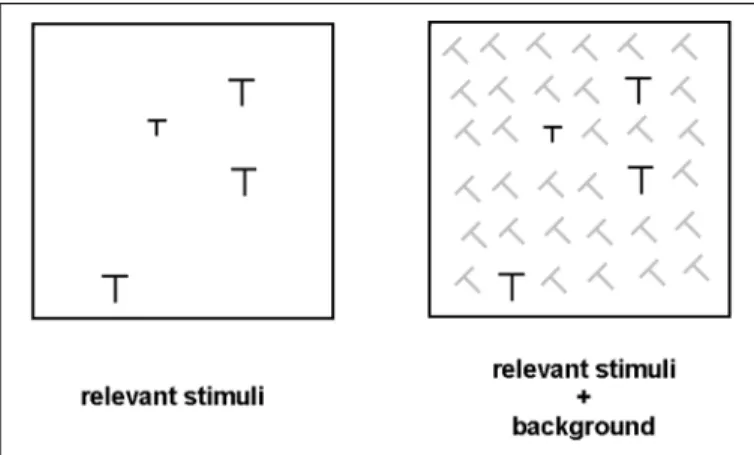
The task was a visual search task with the relevant stimuli (target and distractors) randomly distributed among back-ground elements. Ts, presented in different orientations, sizes and degrees of luminance contrast, were used as stimuli (Figu-and color, or by the stereoscopic disparity (Figu-and movement,
does not vary in function of the total number of stimuli in the field. These authors suggest that the subject is capable to select one specific depth plan, and in this plan, to look for the target in parallel. The same does not happen when the target is defined by the conjunction of color and movement. Nakayama and Silverman(11) attribute this result to the possible priority that the stereoscopic disparity would have in relation to other features of the stimuli. Possibly the disparity would be part of a special group of primary features to which the other features would be subordinated.
McLeod, Driver, Dienes and Crisp(15) had also shown that the target could be detected by a process of analysis carried out in parallel when color and movement define the stimuli. When the grouping or segregation is strong enough, the focused attention is not necessary. In this case, a target defi-ned by the conjunction of features can pop-out as when it is located among distractors with which it shares no features. Theeuwes and Kooi(12) had also shown that the search of a target defined by the conjunction of polarity contrast could be carried out in parallel. With this type of stimulus, the subject can attend selectively to a group of stimuli and ignore those with opposing polarity; for example, attending to the black stimuli and ignoring the white ones.
In summary, some studies have suggested that the second order pop out is possible when the target and distractors are defined by movement, stereoscopic disparity or by polarity contrast. This means that the irrelevant stimuli are not taken in account in the analysis of the selected stimuli. By the other hand, some studies have suggested that the selected stimuli are submitted to a process of serial analysis. This may hap-pens because some irrelevant stimuli are taken in account in the analysis of the selected stimuli. It is possible that in these studies, the pre-attentive grouping could not have been effi-cient enough to eliminate the irrelevant stimuli from the search process, even when this group differs from other stimuli in salient features, as color or orientation. The clear and simplest way to test if the irrelevant stimuli were eliminated or not of the search process would be to compare the performance in two experimental conditions, one with and another without the irrelevant stimuli. However, this cannot be made in these studies once this manipulation would change the nature of the used task, from a search defined by conjunction to a search defined by features(16).
re 1). The relevant and background stimuli differed in orienta-tion and also in the luminance contrast of their component lines. The background elements were Ts rotated 45 degrees to the left, presented in dark gray (7.7 cd/m2) on a black monitor screen. The relevant stimuli were vertical Ts presented in bright white (69 cd/m2).
Target and distractors differed in the length of their com-ponent lines. Distractors and background stimuli were compo-sed of line segments of 0.91 x 0.09 degrees of visual angle. The target could be presented with line segments of 0.77, 0.70, 0.63 and 0.56 degrees of visual angle, defining four levels of target-distractors similarity. The contrast ratio (cr) relating the size of each target to the size of the distractor was used to identify each level of the similarity factor. The relevant stimuli were randomly distributed on a matrix with 6 x 6 cells (9 degrees of visual angle). When present, the background stimuli occupied the remaining free cells of the matrix.
Design and Procedure
The number of relevant stimuli (2, 4, 6), the presence of the target, and of the background stimuli varied from trial to trial. The four levels of size differences between the target and the distractors were manipulated between blocks of trials. Each experimental treatment was presented 84 times to each one of 12 subjects.
The first trial in each trial block was preceded by a signal (*) in the center of the screen. This signal was on for 500 ms and was replaced by the stimuli of the first trial. The stimuli remained on the screen until the subject’s response. The response was immediately followed by a feedback signal, “+” (correct response) or “-” (incorrect response). This signal remained on the screen for 1800 ms, until the beginning of the next trial. In each trial, the subject had to press the “F” of the keyboard if the target was present and the “J” when the target was absent. The first ten trials of each block, the trials with wrong responses, and the trials with RT less than 200 ms or more than 3000 ms, were presented again in the same block of
trials and were not taken into account for the analysis of the results. At the beginning of the session, the subjects were informed that textural stimuli would be presented at random in half of the trials. The subjects were also told that the textural stimuli were not relevant to their task and they should pay attention only to the relevant stimuli. The subjects were asked to respond without errors and as fast as possible. Mean RT was based only on correct trials.
R ESU L T S
The RT decreases with the increasing difference between the target and distractors [F(3, 33) = 42.45, p < .0001], it is larger in target absent trials [F(1, 11) = 34.90, p < .0001] and increases in trials with the background stimuli [F(1, 11) = 4.78, p < .05]. The presence of the background stimuli causes a larger increase of the RT in target present trials [F(1, 11) = 18, 79, p < .001].
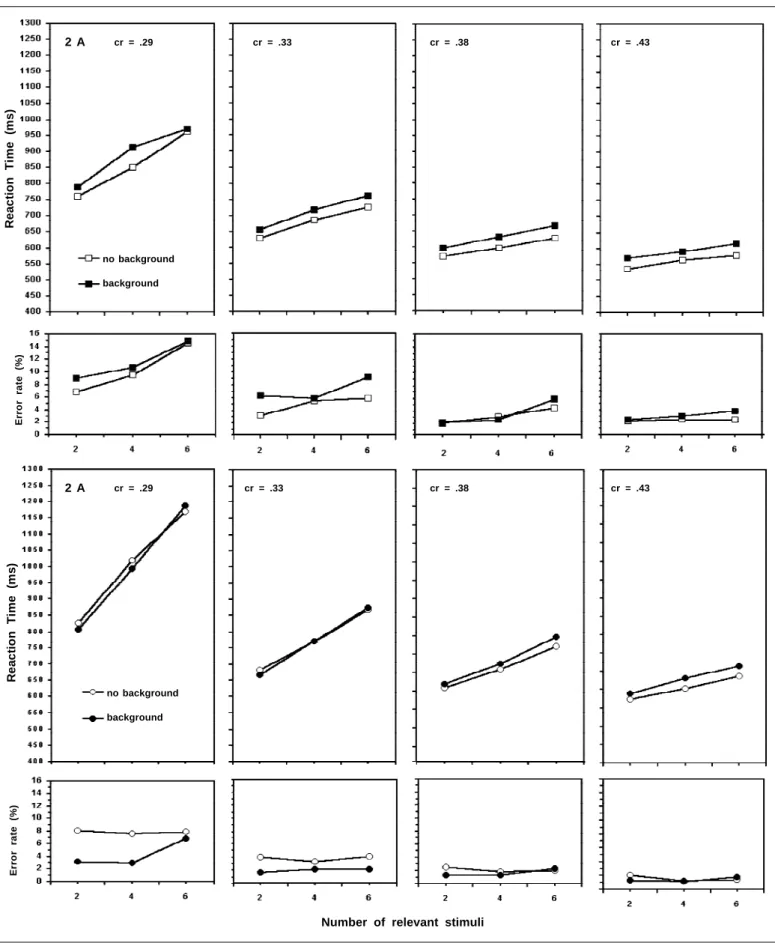
The RT for target present and target absent trials was submitted to separate ANOVAs. Figure 2A presents the mean RT and error rate for target present trials. In these trials, the RT was affected by the presence of the background elements [F(1, 11) = 76.25, p < .0001], by the target-distractor similarity [F(3, 33) = 39.37, p < .0001], and by the number of relevant stimuli [F(2, 22) = 234.17, p < .0001].
The slope of the RT function, which supposedly repre-sents the time spent in the analysis of the relevant stimuli, was largely affected by the target distractor similarity [F(6, 66) = 32.49, p < .0001]. However, contrary to the hypothesis investi-gated in this study, the effect of the background elements was the same for all levels of the target-distractor similarity [F < 1]. The presence of the background added about 30 ms to the mean RT, and this effect was not dependent on the number of relevant stimuli [F(2, 22) = 1.31, p > .05]. The independence between the effects of these factors on RT suggests that the selection of the relevant stimuli was carried out simultaneous-ly for all the relevant stimuli.
In target absent trials (Figure 2B), the RT was affected by the target-distractor similarity [F(3, 33) = 45.39, p < .0001], and by the number of relevant stimuli [F(2, 22) = 89.19, p < .0001]. The presence of the background elements does not have a significant main effect on the RT [F(1, 11) = 2.55, p > .05], but there is a significant interaction between the presence of the background and the target-distractor similarity [F(3, 33) = 5.48, p < 0.05]. A post-hoc analysis reveals that the back-ground affects RT only in the lower target-distractor similarity conditions, those with cr = .38 (p < .05) and .46 (p < .01). In the trials with higher target-distractor similarity (cr = .29 and .33), the presence of the background stimuli does not have a signi-ficant affect on RT. In the two lower levels of target-distrac-tors similarity (.38 and .43), the presence of the background starts to produce a significant increase of the RT. The back-ground also establishes a significant interaction with the num-ber of relevant stimuli in the target absent trial [F(2, 22) = 4.11, Figure 1 - Example of stimuli used in this Experiment; background
elements (slanted Ts), distractors (vertical Ts), and target (smaller vertical T). The actual stimuli were white (target and distractors) or gray
Figure 2. Mean RT and error rate as a function of the contrast (cr) between the size of the target and distractors for trials with background (filled symbols) and without background (open symbols), with target (squares) and without target (circles), where cr = (distractor size - target size)/ ((distractor size + target size). 2a: Target present trials; 2b = Target absent trials. Larger contrast values correspond to lower similarity values
no background
background
no background
background
2 A cr = .29 cr = .33 cr = .38 cr = .43
2 A cr = .29 cr = .33 cr = .38 cr = .43
Number of relevant stimuli
E
rr
o
r
ra
te
(%
)
R
e
a
c
ti
o
n
T
im
e
(m
s
)
E
rr
o
r
ra
te
(%
)
R
e
a
c
ti
o
n
T
im
e
(m
s
p < 0.05]. Figure 3 summarizes the effect of irrelevant stimuli on target present and target absent trials for each level of target-distractor similarity.
The analysis of the incorrect responses shows that the error rate depends on the target-distrator similarity [F(3,33) = 23.02, p < .0001], and on the number of relevant stimuli [F(2, 22) = 17.33, p < .0001]. There is a significant difference between incorrect responses in target present trials (miss) and in target absent trials (false alarm). The false alarm rate (3.3%) is less frequent than the misses (5.7%) [F(1,11) = 16.44, p < .01]. The error rate does not change in the presence of the background stimuli (p > .05), but these stimuli provoke a reduction of 1.6% in the false alarm rate and an increase of 1.2% in the misses [F(3,33) = 5.64, p < .01]. This effect is stronger in the higher similarity levels [F(3,33) = 4.98, p < .01 ]. The increase in the misses in function of the number of relevant stimuli is also larger than for the increase in false alarm [F(2, 22) = 9.35, p < .01).
D I SCU SSI O N
This study aimed to determine if the processes of selection and analysis of stimuli in a visual search task could be carried out simultaneously. According to the logic of our experimen-tal design, the complete overlapping of the two processes would be revealed as a non-significant effect of the back-ground stimuli. A partial overlapping would be evidenced by a variable effect of the background stimuli in function of the target-distrator similarity. The obtained significant effect of the irrelevant stimuli discards the possibility of a complete overlapping. The statistical independence between the
effects of the background and the similarity in the target present trials is an argument against the assumption of partial overlapping and suggests that the selection and analysis are independent and sequential processes. In the target absent trials, the effect of the background stimuli depends on target-distrator similarity. In the direction contrary to that allowed by an overlapping model, the effect of the background stimuli disappears in the highest levels of the target-distrator similarity and is larger in the lower levels. These results do not allow accepting the overlapping hypothesis between selec-tion and analysis. We believe that the results of this study strengthen the assumption that the background affects an initial stage of processing, a stage that precedes and is inde-pendent of the analysis.
The existing literature shows that a decrease in the visual quality of the stimuli, caused either by contrast reduction, or by the introduction of a visual noise, causes a bigger effect in the target absent trials(20,21). Pashler and Badgio(19) suggest that perceptual factors could affect the rate at which the evi-dences for a type of response or another are accumulated. Folk and Egeth(22) suggest that the interaction between the presence of background elements and the target presence could introduce a noise or a change in the decision processes. In our study, the effect of the background stimuli is smaller in the target absent trials, and disappears in the higher target-distrator similarity levels. We agree that this “facilitative” effect of the background stimuli on target absent trials can also be explained by a change in a decision criterion. This change is indirect tough; it is a consequence of the increase in the processing time of the initial stages.
The differences in the RT in target present and target absent trials suggest that different processes are activated by the presence of the target. However, we should consider that at an initial moment the processing is independent of the target presence. The time spent at this early processing should be the same for target present and target absent res-ponses, and we believe that the background stimuli affect the duration of this initial stage. Why then does this effect disap-pear in target absent trials? In target present trials, the subject knows when to stop searching. In target absent trials, a cor-rect response should be given after all the stimuli have been examined, but the exhaustive exam of the stimuli is time expen-sive, forcing the participants to use some criteria to stop searching. One of these criteria is the trial duration: if a certain amount of time has been spent in the analysis of the stimuli and the target has not been found, the subject can guess “target absent”. We propose that one of the factors that could explain the reduction of the background effect in target absent trials would be the tendency the subjects have to lock up the longest trials with a guess(23). The guess in the longest trials could reduce the response time, compensating the increase caused by the background stimuli. In fact, there is a reduction of the effect of the background stimuli in the longest trials, and there has also an increase in the miss error rate, that is consistent to the guessing criterion.
Figure 3 - The effect of background stimuli [(RT with background) - (RT without background)] on target present and target absent trials as a function of the size contrast between the target and the distractors
target present
target absent
Contrast target - distractor (size)
R
T
(b
k
g
)
-
R
T
(n
o
b
k
g
Another possible explanation for the disappearance of the background effect in higher target-distractor similarity consi-ders that the effectiveness of the rejection of the irrelevant stimuli depends on the perceptual load in the relevant informa-tion processing. A model proposed by Lavie and Tsal(24) (see also(25,26)) considers the perception as an involuntary, automa-tic process of limited capacity. The perception is considered automatic not in the sense of a limitless capacity, but in the sense of not being subject of voluntary control. In accordance with this, the processing goes from the most to the least relevant aspects until it depletes the processing capacity of the system. The relevance of an item is determined by the instructions of priority and other top-down factors. If the processing of the relevant information does not occupy all the system capacity, the remaining resources will be destined to the processing of the irrelevant stimuli, and will lead to dis-traction. The processing of the irrelevant stimuli can only be prevented when the processing of the relevant stimuli occu-pies all the processing capacity of the system. In accordance with this hypothesis, the efficient search of a target must result in more processing of irrelevant stimuli than a less efficient search. The larger the resource load demanded in the target localization, the smaller the resources applied to the processing of the irrelevant stimuli. Indeed, the background effect vanishes in high similarity target absent trails, but con-trary to this logic of resource distribution, the target-distrac-tor similarity does not affect the selection in the target present trials. In these trials, the background effect is independent of the task difficulty.
In summary, the data obtained in this study corroborate the idea that the search of a target determined by conjunction of parts can be restricted to a subgroup of pre-attentively selected stimuli. The processes of selection and analysis are affected by different experimental factors, which contribute additively to the RT. The background stimuli increase the duration of an initial stage of processing, which happens before the analysis of the relevant stimuli, whose duration is affected by the target-distractor similarity.
R ESU M O
Uma suposição comum é que apenas uns poucos estímulos serão selecionados e analisados em uma tarefa de busca vi-sual difícil, mas a eficiência do processo de seleção ainda é pouco conhecida. Neste estudo se mostra que os processos de seleção e de análise são afetados por diferentes fatores experimentais, cujos efeitos sobre o TR são aditivos. O TR aumenta em função da similaridade alvo-distrator, e em função da presença dos estímulos de fundo no campo de busca. Nas provas com alvo, a presença dos elementos de fundo aumenta o TR em 30 ms, independente da similaridade alvo-distrator. Nas provas sem alvo, o efeito dos estímulos de fundo é inver-samente relacionado à similaridade alvo-distrator. O aumento na similaridade alvo-distrator pode levar a um aumento na proporção de chutes de “alvo ausente”, compensando ou
eliminando o aumento provocado pela presença dos estímulos irrelevantes. Esses resultados são compatíveis com um mode-lo no qual os estímumode-los relevantes são selecionados pré-aten-tivamente e só então submetidos a um processo de análise.
Descritores: Atenção visual; Busca visual; Seleção de estímulos
A CK N O W L ED GM EN T S
Finantial Support: Fapesp(96/04414-7), CNPq (522624/95).
R EF ER EN CES
1. Neisser U. Cognitive Psychology. New York: Appleton-Century-Crofts; 1967. 2. Treisman A, Gelade G. A feature integration theory of attention. Cognit
Psychol 1980;12:97-136.
3. Treisman A. Features and objects: the fourteenth Bartlett memorial lectures. Q J Exp Psychol 1988;40A:201-37.
4. Sternberg S. The discovery of processing stages: Extensions of Donders’ method. In: Koster WG, editor, Attention and Performance II. Amsterdam: North Holland; 1969, p.276-315.
5. Treisman A, Sato S. Conjunction search revisited. J Exp Psychol Hum Percept Perform 1990;16:459-78.
6. Wolfe JM. Guided search 2.0: A revised model of visual search. Psychon Bull Rev 1989;1:202-38.
7. Wolfe JM, Kave KR, Franzel SL. Guided search: An alternative to the feature integration model for visual search. J Exp Psychol Hum Percept Perform 1989;15:419-33.
8. Friedman-Hill S, Wolfe J. Second-order parallel processing: Visual search for the odd item in a sub-set. J Exp Psychol Hum Percept Perform 1995;21:531-51. 9. Egeth HE, Virzi RA, Garbat H. Searching for conjunctively defined targets. J
Exp Psychol Hum Percept Perform 1984;10:32-9.
10. Kaptein NA, Theeuwes J, van der Hejden AHC. Search for a conjunctively defined target can be selectively limited to a color-defined subset of elements. J Exp Psychol Hum Percept Perform 1995;21:1053-69.
11. Nakayama K, Silverman GH. Serial and parallel processing of visual feature conjunctions. Nature 1986;320:264-5.
12. Theeuwes J, Kooi FL. Parallel search for a conjunction of shape and contrast polarity. Vision Res 1994;34:3013-6.
13. Theeuwes J. Perceptual selectivity is task dependent: Evidence form selective search. Acta Psychol 1996;94:81-99.
14. Treisman A. Perceptual grouping and attention in visual search for features and for objects. J Exp Psychol Hum Percept Perform 1982;8:194-214. 15. McCleod P, Driver J, Dienes Z, Crisp J. Filtering by movement in visual
search. J Exp Psychol Hum Percept Perform 1991;17:55-64.
16. Dosher B. Models of visual search: finding a face in the crowd. In: Scarbo-rough D, Sternberg S, editors, An invitation to cognitive science: methods, models and conceptual issues. Cambridge: MIT Press; 1998.
17. Galera C, Lopes EJ, von Grünau M. Stimulus segmentation in the visual search task. Percept Psychophys 2000;62:505-16.
18. Galera C. Agrupamento por Similaridade e Busca Visual. Psicologia: Teoria e Pesquisa 1997;13:261-8.
19. Pashler H, Badgio PC. Visual attention and stimulus identification. J Exp Psychol Hum Percept Perform 1985;11:105-21.
20. Johnsen AM, Briggs GE. On the locus of display load effect in choice reactions. J Exp Psychol 1973;99:266-71.
21. Logan GD. Attention in character classification task: evidence for the automaticity of component stages. J Exp Psychol Hum Percept Perform 1978;107: 32-63. 22. Folk CL, Egeth H. Does the identification of simple features require serial
processing? J Exp Psychol Hum Percept Perform 1989;15:97-110. 23. Chun MM, Wolfe JM. Just say no: How are visual searches terminated when
there is no target present? Cognit Psychol 1996;30:39-78.
24. Lavie N, Tsal Y. Perceptual load as a major determinant of the locus of selection in visual attention. Percept Psychophys 1994;56:183-97. 25. Lavie N. Perceptual load as a necessary condition for selective attention. J
Exp Psychol Hum Percept Perform 1995;21:1453-68.
![Figure 3 - The effect of background stimuli [(RT with background) - (RT without background)] on target present and target absent trials as a function of the size contrast between the target and the distractors](https://thumb-eu.123doks.com/thumbv2/123dok_br/15438448.597503/6.892.56.436.712.1052/figure-background-stimuli-background-background-function-contrast-distractors.webp)
