ECOLOGY, BEHAVIOR AND BIONOMICS
Population Dynamics and Spatial Distribution of
Spartocera dentiventris
(Berg) (Hemiptera: Coreidae) Adults on
Nicotiana tabacum
L. (Solanaceae)
C
RISTIANER. J
ESUS1, L
UIZAR. R
EDAELLI1,2 ANDH
ELENAP. R
OMANOWSKI11Depto. Zoologia, PPG Biologia Animal, Instituto de Biociências, UFRGS, Av. Bento Gonçalves, 9500, Bloco IV
Prédio 43435, 91501-970, Porto Alegre, RS
2Depto. Fitossanidade, Faculdade de Agronomia, UFRGS, Av. Bento Gonçalves, 7712, 91540-000, Porto Alegre, RS
Neotropical Entomology 31(4):541-549 (2002)
Dinâmica Populacional e Distribuição Espacial dos Adultos de Spartocera dentiventris (Berg) (Hemiptera: Coreidae) em Nicotiana tabacum L. (Solanaceae)
RESUMO - Spartocera dentiventris (Berg), o percevejo-cinzento-do-fumo, devido ao seu hábito
alimentar sugador, provoca o enrolamento ea murcha das folhas de fumo, causando prejuízos à cultura.
O conhecimento da dinâmica populacional é fundamental para o estabelecimento de técnicas mais eficientes de monitoramento e manejo da praga. Com o objetivo de monitorar a colonização, o
estabelecimento, o crescimento e a distribuição espacial da população adulta de S. dentiventris, através
do método de marcação e recaptura, um cultivo experimental de fumo (Nicotiana tabacum) foi
estabelecido em Porto Alegre, RS. Todas as plantas foram inspecionadas três vezes por semana durante o período de agosto de 1999 a abril de 2000, marcando-se 217 indivíduos. Apenas em uma geração os indivíduos sobreviveram até a fase adulta na área. O tamanho populacional, estimado através do método de Fisher-Ford, apresentou um pico de 160 indivíduos. O recrutamento médio estimado foi 5,0 ± 2,67 fêmeas/dia e 6,6 ± 1,73 machos/dia (z = 0,71; gl = 118; P = 0,477). A maioria dos indivíduos concentrou-se na região superior da planta e na face abaxial das folhas. Análiconcentrou-se realizada por grupo de concentrou-seis plantas revelou um padrão agregado de distribuição espacial em 78,4% das ocasiões de amostragem. Os adultos concentraram-se em certos locais da cultura e o tamanho populacional parece ter sido afetado por variações climáticas e predação. Essas observações devem ser consideradas na implementação de medidas de monitoramento e controle da espécie.
PALAVRAS-CHAVE: Insecta, ecologia populacional, método de marcação, liberação e recaptura
ABSTRACT - Spartocera dentiventris (Berg), the gray-tobacco-bug, feeds on the sap of the plant,
inducing leaf wilting and twisting, thus causing economic losses to the tobacco crop. Theknowledge
on its population dynamics is crucial for the development of efficient techniques for monitoring and
managing this species. An experimental tobacco (Nicotiana tabacum) crop was established in Porto
Alegre County, South Brazil, aiming to study the colonization, establishment, growth and spatial
distribution of the adult S. dentiventris populationusing the mark-release-recapture method. All plants
were inspected at least three times a week. From August 1999 to April 2000, 217 individuals were marked. Only one generation completed development up to the adult phase. Population size estimated by the Fisher-Ford method peaked at ca. 160 individuals. Average recruitment was 5.0 ± 2.67 females per day and 6.6 ± 1.73 males per day (z = 0.71; df = 118; P = 0.477). Most individuals concentrated in the upper part of the plant and on the abaxial face of leaves. Analysis performed in groups of six plants revealed an aggregated pattern of distribution in 78.4% of sampling occasions. Individuals concentrated
in certain areas of the crop and the population size seemed to be highlysusceptible to weather variations
and predation. These observations should be taken into account on designingmeasures for monitoring
and control of the species.
KEYWORDS: Insecta, population ecology, mark-release-recapture method
Spartocera (=Corecoris) dentiventris (Berg), the
gray-tobacco-bug, is considered a pest on tobacco (Nicotiana
tabacum) for it feeds on the sap of the plant, causing leaf
1968, Schaefer & Mitchell 1983). The bugs colonize the young tobacco plants from August on, and two further generations of
S. dentiventris generally develop on the crop until March, when the plants die off. Adult daily survival rates are about 96% and longevity is high (ca. 26 days). Most mortality occurs on the nymph phase and seems to be mainly due to predation by
Cosmoclopius nigroannulatus Stål (Hemiptera: Reduviidae).
The hymenopterous egg parasitoids Gryon gallardoi (Brethes)
(Scelionidae) and Neorileya ashemeadi Crawford
(Eurytomidae) also attack S. dentiventris. Nymphs show
aggregated distribution on upper part of the plant (Caldas et
al. 1999, Jesus & Romanowski 2001).
Field observations suggest that S. dentiventris adults do
not distribute in a homogeneous or random way in the crop (Canto-Silva 1999). The distribution pattern shown by a species may be related with resource quality, female oviposition behavior and natural enemies action, among other ecological factors (Crawley 1983, Bernays & Chapman 1994). Only a few studies with this emphasis have been carried out on the Coreidae, despite the fact that the family embraces a considerable number of species which have a high potential for becoming pests of crops of economic importance (Kainoh
et al. 1980, Palumbo et al. 1991). The present workaimed
monitoring adult numbers of S. dentiventris along the cycle of
tobacco, focusing on their spatial distribution patterns andtheir
relation with the insect density and crop phenology.
Furthermore, itwas alsointended to add to the knowledge on
the ecology of Coreidae as a group, which may help to reveal patterns for other species of the family as well.
Material and Methods
Field work was carried out at the Departamento de Fitossanidade da Universidade Federal do Rio Grande do Sul, in Porto Alegre County (30° 10’ S; 50° 13’ W), state of
Rio Grande do Sul, South Brazil. OnAugust 3rd 1999, 270
tobacco seedlings (type Virginia; variety K326) were planted
in an area of approximately 300 m2,in 10 rows with 1 m
inter-rows and 0.8 m spacing between plants, as in
commercial crops. All plants were coded withalphanumeric
coordinates, with letters corresponding to rows and numbers corresponding to plants within the row.
Insects arriving to the crop were daily recorded from August
3rd to November 8th 1999 and three times a week from November
9th to April 5th 2000. All plants were inspected in the morning.
All adults found were hand-captured, marked on the dorsal
surface, and returned to the same sitewhere they were caught.
Marks were made with a permanent ink marker and based on the Brussard’s code points system (Southwood 1978). Notes
were takenon number of specimens, sex and coordinate of plants.
Records were alsotaken on wherethe specimens were found on
the plant in terms of height from the ground (upper, medium or lower third) and structure (stem, upper or lower face of the leaf) or leafstalk.
In addition, notes were taken on the occurrence of eggs and nymphs. All plants on which eggs had been laid by colonizing adults were daily monitored. Fifth instar nymphs
were recognized and monitored in the field based on Caldas et
al. (1998), so that adult recruitment could be registered. On
the following generation, there were more plants with eggs then it could be monitored, so 12 plants were randomly chosen for this purpose.
The periods of colonization, establishment, oviposition, recruitment and dispersal were identified based on the variation on the numbers of eggs, fifth instar nymphs and marked and unmarked adults.
Population size was estimated by the Fisher-Ford model, after testing its assumptions (Fisher & Ford 1947, Begon 1979). Longevity was assessed based on the difference of days between the first and the last capture of each individual. Thus, the figures are in fact the minimum number of days survived by recaptured individuals.
Distribution patterns were tested by goodness of fit to the Poisson and Negative Binomial distributions. The unit considered was groups of six contiguous plants (three plants in each of two adjacent rows), because the number of individuals per plant was most of times too low for analysis. The Iwao and Taylor Power Law dispersion indexes were also computed (Elliott 1983).
Results
From September 6th 1999, S. dentiventris began to appear
in the tobacco field. Colonization period was characterized by the arrival of new unmarked adults on each sampling occasion (also date). When all adults were marked within a sampling date, it was considered that the population was established in the area. The colonizing generation was composed of 17 females and 14 males. A total of 217 adults (131 females and 86 males) were marked over 125 sampling occasions. Sex ratio was 0.6 (1 : 1.2 ).
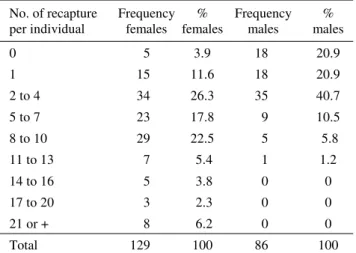
An average of 9.1 ± 1.13 females and 2.6 ± 0.42 males were captured per sampling occasion. The number of recaptures was high: 9.9 ± 1.22 individuals per sampling occasion (8.1 ± 1.02 (n = 129); 1.8 ± 0.28 (n = 86). About 96% of the females and 79% of the males were recaptured and the number of recaptures per individual was also high (Table 1).
No. of recapture per individual
Frequency females
% females
Frequency males
% males
0 5 3.9 18 20.9
1 15 11.6 18 20.9
2 to 4 34 26.3 35 40.7 5 to 7 23 17.8 9 10.5 8 to 10 29 22.5 5 5.8 11 to 13 7 5.4 1 1.2 14 to 16 5 3.8 0 0 17 to 20 3 2.3 0 0 21 or + 8 6.2 0 0
Total 129 100 86 100
Table 1. Distribution frequency of the number of
recaptures per S. dentiventris female and male adult
The estimates of population size and the numbers of captured
and recaptured for females and males along the seasonare
presented in Fig. 1. In the beginning of September there was an
increase in the number of captures, which characterizes the arrival of the colonizing individuals. By early October, the number of recaptures equals the number of captures and almost all adult
1000
100
10
1
Figure 1. Number of captures (n), recaptures (m) and estimates of population size (N) obtained through the Fisher-Ford
method for (a) females, (b) males and (c) males and females of S. dentiventris adults. A) colonization; B) oviposition I; C)
recruitment; D) oviposition II; and E) dispersion. Porto Alegre County, September/1999 to April/2000
6/9/1999
20/09/1999 4/10/1999 18/10/1999 1/1
1/1999
15/1
1/1999
29/1
1/1999
13/12/1999 27/12/1999 10/1/2000 24/1/2000 7/2/2000 21/2/2000 6/3/2000 20/3/2000 3/4/2000
m N n
1000
100
10
1
(a)
1000
100
10
1
6/9/1999
20/09/1999 4/10/1999 18/10/1999 1/1
1/1999
15/1
1/1999
29/1
1/1999
13/12/1999 27/12/1999 10/1/2000 24/1/2000 7/2/2000 21/2/2000 6/3/2000 20/3/2000 3/4/2000
(c)
6/9/1999
20/09/1999 4/10/1999 18/10/1999 1/1
1/1999
15/1
1/1999
29/1
1/1999
13/12/1999 27/12/1999 10/1/2000 24/1/2000 7/2/2000 21/2/2000 6/3/2000 20/3/2000 3/4/2000
9 9 9 9 9 0 0 0 0
N
o. of individuals
(b)
Date
individuals in the area had already been marked. In this period oviposition took place and then most of population was in the immature phase. On the second week of December, there was a sudden increase in the number of new captures, characterizing
the recruitment of the first generation of S. dentiventris adults in
the area. A peak of captures was registered: more than 50 females and almost 30 males. Population level remained above 40 adults for ca. two months. During this period, many eggs and nymphs were also observed. From February on, a decrease in the number of adults was recorded, which continued until April. Adults of the first generation were apparently dying of old age (see
longevity values bellow) and there were few surviving S.
dentiventris left in the area, synchronizing with the end of the tobacco cycle. The high population estimates obtained for this time is an “artifact”, due to the sudden change in the proportion of marked and unmarked individuals.
Thus, based on the variation on the numbers of adults, eggs and fifth instar nymphs, five different periods could be identified in the development of the population: A
-colonization (Sep./6th/1999 to Oct./17th/99); B - oviposition I
(Oct./18th/99 to Dec./8th/99); C - recruitment (Dec./13th/99 to
Jan./12th/2000); D - oviposition II (Jan./14th/00 to Feb./25th/
00); and E - dispersion (Feb./28th/00 to Mar./3rd/00).
Recruitment to the adult phase was estimated as 5.0 ± 2.67 females per sampling occasion and 6.6 ± 1.73 males per
sampling occasion and did not differ significantly between males and females (z = 0.71; df = 118; P = 0.477). Daily survival rates were quite constant and high for females and
males (Æ = 0.978). Average minimum longevity was also
high ( = 31.1 ± 1.88 days and = 15.3 ± 1.83 days) with
no statistically significant differences between sexes (z = 0.26; df = 131; P = 0.793). Maximum longevity registered was 95 and 70 days for females and males, respectively.
During the colonization period, the tobacco plants were
still short, and most adults ( = 47%; = 55%) concentrated
close to the ground. Distribution on the plant during this
period significantly differed from all others (c2 = 1057.28;
df = 28; P < 0.001). Apart from this period, individuals tended to stay on the upper third of the plants in all periods. As the plant grew taller than eight leaves, adults spread to leaves and leafstalks. In the following periods (recruitment, oviposition II and dispersion) as plants grew, females and males moved up. Besides, distribution was not random on
the different plant structures (c2 = 643.03; df = 28; P < 0.001).
During colonization, 52% of females were found on the abaxial face of leaves; males (40%) also concentrated on these sites, but less markedly. This pattern still held from oviposition I on, but less strongly and with more adults spreading to other plant structures.
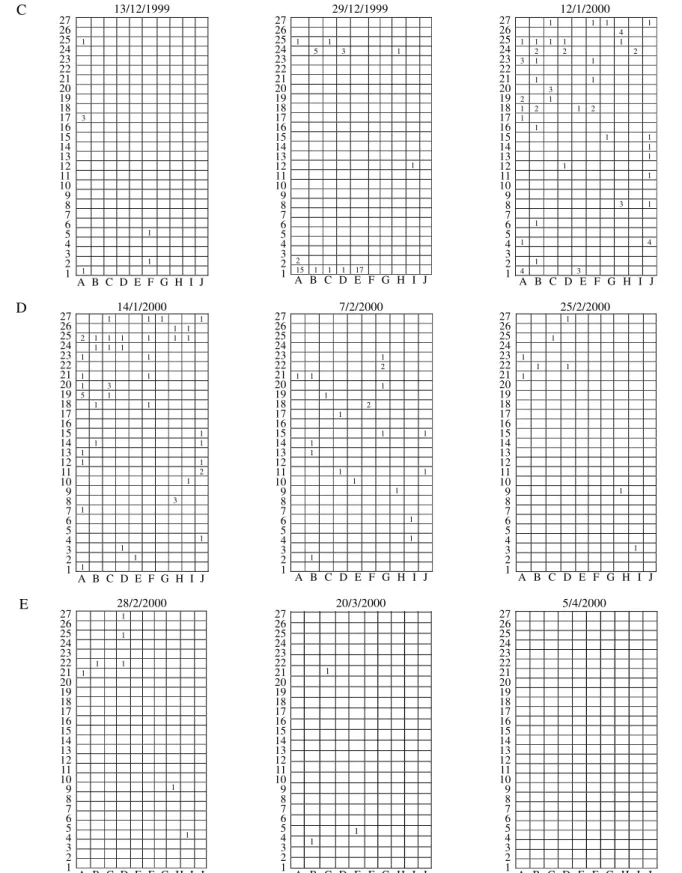
Most plants had zero, one or two individuals (Fig. 2).
A 1 1 1 1 1 1 1 1 1 1 2 1 1 1 1
A B C D E F G H I J 27 26 25 24 23 22 21 20 19 18 17 16 15 14 13 12 11 10 9 8 7 6 5 4 3 2
1 27
26 25 24 23 22 21 20 19 18 17 16 15 14 13 12 11 10 9 8 7 6 5 4 3 2 27 26 25 24 23 22 21 20 19 18 17 16 15 14 13 12 11 10 9 8 7 6 5 4 3 2
6/9/1999 28/9/1999 17/10/1999
A B C D E F G H I J A B C D E F G H I J
B 1
1 1 1
1 1
1
1
1 1 1 1
1
1
1
A B C D E F G H I J A B C D E F G H I J
A B C D E F G H I J
27 26 25 24 23 22 21 20 19 18 17 16 15 14 13 12 11 10 9 8 7 6 5 4 3 2 27 26 25 24 23 22 21 20 19 18 17 16 15 14 13 12 11 10 9 8 7 6 5 4 3 2 27 26 25 24 23 22 21 20 19 18 17 16 15 14 13 12 11 10 9 8 7 6 5 4 3 2
Figure 2. Spatial distribution of S. dentiventris adults on the study site on the beginning, mid-point and end of each succeeding period of population development: A - colonization; B - oviposition I; C - recruitment; D - oviposition II; and E - dispersion. Numbers on the left margin and letters at the bottom of each sketch represent the alphanumeric coordinates of
the plants; squares represent plants; numbers within squares indicate the number of S. dentiventris adults found on that plant
on that date. Porto Alegre County, September/1999 to April/2000
1
3
1
1 1
1 1 5 3 1
1
2
15 1 1 1 17
1 1 1 1 4 1 1 1 1 1 2 2 2 3 1 1
1 1
3
2 1 1 2 1 2 1
1
1 1
1 1 1
1
3 1
1
1 4
1
4 3
A B C D E F G H I J A B C D E F G H I J
A B C D E F G H I J 27 26 25 24 23 22 21 20 19 18 17 16 15 14 13 12 11 10 9 8 7 6 5 4 3 2 1 27 26 25 24 23 22 21 20 19 18 17 16 15 14 13 12 11 10 9 8 7 6 5 4 3 2 1 27 26 25 24 23 22 21 20 19 18 17 16 15 14 13 12 11 10 9 8 7 6 5 4 3 2 1
13/12/1999 29/12/1999 12/1/2000
1 1 1 1 1 1 2 1 1 1 1 1 1 1 1 1 1 1
1 1
1 3 5 1
1 1
1
1 1
1
1 1
2 1 3 1 1 1 1 1 1 2 1 1
1 1
2 1
1 1 1
1
1 1
1 1 1 1 1 1 1 1 1 1
1 1 1 27 26 25 24 23 22 21 20 19 18 17 16 15 14 13 12 11 10 9 8 7 6 5 4 3 2 1 27 26 25 24 23 22 21 20 19 18 17 16 15 14 13 12 11 10 9 8 7 6 5 4 3 2 1 27 26 25 24 23 22 21 20 19 18 17 16 15 14 13 12 11 10 9 8 7 6 5 4 3 2 1
A B C D E F G H I J A B C D E F G H I J A B C D E F G H I J
14/1/2000 7/2/2000 25/2/2000
1
1
1 1 1 1 1 1 1 1 27 26 25 24 23 22 21 20 19 18 17 16 15 14 13 12 11 10 9 8 7 6 5 4 3 2 1 27 26 25 24 23 22 21 20 19 18 17 16 15 14 13 12 11 10 9 8 7 6 5 4 3 2 1 27 26 25 24 23 22 21 20 19 18 17 16 15 14 13 12 11 10 9 8 7 6 5 4 3 2 1
A B C D E F G H I J A B C D E F G H I J A B C D E F G H I J
28/2/2000 20/3/2000 5/4/2000
C
D
Thus, analyzing the number of individuals per single plant
by the I index (s2/x; Krebs 1989), the pattern of spatial
distribution obtained was regular in 86.4%, contagious in 11.9% and at random in 0.8% of the sampling occasions.
When the scale used wasa group of six contiguous plants
(occasions when at least eigth insects were recorded in the field), 78.4% revealed a contagious pattern of distribution, 5.4% regular and 16.2% random.
Analysis through goodness of fit to frequency distribution models corroborates the results: only 21.6% of data fit to the
Poisson distribution; 78.4% fit contagious distribution; and
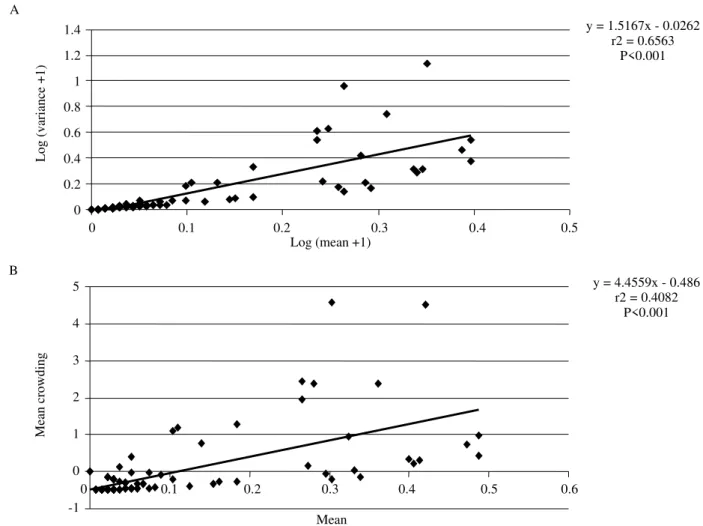
97.3% showed good adjustment to the Negative Binomial (P < 0.05). Aggregation was also evidenced by the Taylor’s Power Law (b = 1.5; t = 5.095; df = 117; P < 0.001; Fig. 3a) and
the Iwao method (b= 4.45; t = 8.94; df = 117; P < 0.001; Fig.
3b). The pattern of distribution varied little over the different periods in spite of variation (or despite the) on adult numbers.
Discussion
Concerning colonization, Jesus & Romanowski (2001) obtained similar results in a work carried out in the same
area from august 26th 1997, where 22 females and 24 males
colonized the tobacco plants. In the previous year, Caldas et
al. (1999) had only recorded the presence of a few S.
dentiventris on the crop, much later on October 8th 1996.
Delays on the onset of colonization seem to be related to differences on weather condition between the years considered. In 1996, spring was late and rainy (5.15 mm average rainfall) as compared to 1997 (4.33 mm) and 1999 (1.71mm). However, since the tobacco crop was first established in the area in 1996, it may be possible that, from
then on, some S. dentiventris individuals have remained in
the area or close by between successive crop cycles. If this
hypothesis follows, S. dentiventris did not need to spend time
searching for the tobacco area and could colonize the plants earlier. Indeed, individuals marked in one year (1997) were found again in the area the following year. Thus, where tobacco is cultivated commercially it sounds sensible to switch crops from year to year.
The variation on adult numbers along the crop cycle here registered followed the same general pattern observed before by Jesus & Romanowski (2001), but for fact that under the conditions of the present study no individual of the second generation managed to complete development up to adult phase.
Figure 3. Mean and variance of the number of S. dentiventris adults per sampling occasion. (a) = Taylor Power Law and
(b) = Iwao method. Porto Alegre County, September/1999 to April/2000
y = 4.4559x - 0.486 r2 = 0.4082
P<0.001 5
4
3
2
1
0
-1
0 0.1 0.2 0.3 0.4 0.5 0.6
Mean crowding
Mean B
Log (variance +1)
1.4 1.2 1 0.8 0.6 0.4 0.2 0
Log (mean +1)
0 0.1 0.2 0.3 0.4 0.5
y = 1.5167x - 0.0262 r2 = 0.6563
Jesus & Romanowski (2001) obtained a proportion of females recruited quite superior to the number obtained in the present work (14.9 ± 3.87 per sampling occasion) in the first generation. For males, however, the values were very similar (6.5 ± 1.76 per sampling occasion).
Adults density in the first generation was also somehow lower than those registered before by Canto-Silva (1999) (46 individuals) and Jesus & Romanowski (2001) (45 and 42 ). In another work, developed simultaneously to the present
one in the same area, large population of Cosmoclopius
nigroannulatus Stål was found (Janhke et al. 2002).
Predation by this Reduvid on nymphs of S. dentiventris
seems to have hindered the second generation of surviving up to adulthood.
It is also noteworthy that the second-generation adult
population numbers registered by Jesus & Romanowski (2001) were quite high (120 and 67 ). By the time adults of the second generation are recruited, most damage caused by S. dentiventris to N. tabacum has already been done. However, as previously mentioned, the possible permanence of these adults in the area from one year to the next, seems to enhance chances of successful colonization of future crops. In fact, observations performed in the area in the year
following this study have shown that S. dentiventris did not
appear in subsequent tobacco crop. It is suggested that the
high population of C. nigroannulatus may have been
responsible for the reduction observed on the
second-generation S. dentiventris adult population.Therefore, it
seems that the predator impacted not only the generation preyed upon but also seemed to have affected the following population cycle.
The high average longevity of adults recorded corroborates the high survival rate estimated. Canto-Silva (1999) and Jesus & Romanowski (2001) found values close
to the ones herein reported. In contrast, Caldas et al. (1999),
registered values almost three times higher (66.1 ± 4.17
days for and 62.6 ± 3.91days for ) in a study in which
all stages of S. dentiventris were kept infield-caged plants
for the exclusion of predators. Since adults were not a target for C. nigroannulatus attack, this difference may be due mostly to constraints on adult dispersion on the cited study rather than differences on predation upon this stage.
Differences in the estimates between females and males may be related to the movement of males to areas out of the crop and/or their permanence in hidden places, thus decreasing the possibility of being found or recaptured.
Although recapture rates herein found (96% and 76% )
are still high. Dreyer & Baumgärtner (1997) obtained recapture proportions between 4% and 6% when studying
the population dynamics of Clavigralla tomentosicollis Stal
(Hemiptera: Coreidae) on Vigna unguiculata L.
(Leguminoseae) in Africa.
The distribution of adults on the plant seemed to relate to plant phenology. Staying close to the ground, when plants are still young and short, could confer same protection since adult color pattern is similar to that of the soil (Costa 1958).
Palumbo et al. (1991) found a similar result studying the
distribution of adults of the coreidean Anasa tristis DeGeer
oncucurbit plants in the USA.
During the oviposition I period, females remained mostly
on the abaxial face of leaves. Caldas et al. (2000) observed
that S. dentiventris oviposits mainly on the mainabaxial leaf
vein. This behavior seems to be common in Coreids. Bonjour
et al. (1990) also registered main leaf vein as the main
oviposition site for A. tristis oncucurbits in the USA.
The gradually moving up of individuals as plants grow, may possibly be due to the search for younger parts of the plant as good sites for oviposition and development of offspring.
The pattern of adults spatial distribution obtained per
individual plant seems to be due more to the regular distribution of plants in the area as well as to the low density of individuals found in each plant rather than to any feature of the insect species. Thus, the analysis by groups of six plants
may be moremeaningful in biological terms. Elliot (1983),
Heads & Lawton (1983) and Tilman & Kareiva (1997) highlighted that the scale used for data analysis is extremely important and determinant of results yielded. The establishment of adequate sample unit size varies according to the characteristics of the species studied.
The contagious pattern occurred throughout the crop
cycle. In fact, during the periods of recruitment and oviposition II, the number of individuals per plant was higher and females mostly seemed to elect some plants and/or certain regions of the crop for oviposition. Steinbauer (1998), in a
study with Amorbus sp. (Hemiptera: Coreidae) in Eucalyptus
sp. verified that females seem to select the most vigorous plants in order to enhance development of their offspring.
Values obtained through indexes of the Taylor’s Power Law and Iwao methods, in addition to determination
coefficient values (r2 = 0.65 e r2 = 0.40), also indicate that
adults presented an aggregated distribution per plants. These results differ from those obtained by Canto-Silva (1999) in which the randomly sampling of individual plants in the area, could not detected aggregation of adults.
Density, period of colonization and permanence in the crop may vary every year. Population fluctuation seems to be very susceptible to climatic variations throughout the year.
More importantly, S. dentiventris population dynamics may
be affected by predators and parasitoids (S. M. Janhke, et al.
2002). Generally, individuals are distributed in certain sites of the tobacco crop, but are able to colonize any plant in the area. Factors such as sunlight incidence in the area, quality of resource and/or spatial heterogeneity in predator-prey and/ or parasitoid-host relations may be determinants of the distribution pattern, deserving further investigations.
Due to its intrinsic characteristics, the S. dentiventris /
N. tabacum system proved to be very useful for ecological studies focusing on spatial distribution and individual movement patterns. Further work is being developed on the
influence of natural enemies dynamics on S. dentiventris
populations. It is suggested that thespatial-temporal aspects
of these interactions may prove crucial to the management of the species on the tobacco crop. Moreover, knowledge on
these aspects of S. dentiventris population ecology, besides
Literature Cited
Begon, M. 1979. Investigating animal abundance: capture-recapture for biologists. London, Edward Arnold, 97p.
Bernays, E.A. & R.F. Chapman. 1994. Host-plant selection phytophagous insects. New York, Chapman & Hall, 312p.
Bertels, A. 1962. Insetos – hóspedes de solanáceas. Iheringia 25: 1-11.
Bonjour, E.L., W.S. Fargo & P.E. Rensner. 1990.
Ovipositional preference of squash bugs (Heteroptera: Coreidae) among Curcubits on Oklahoma. J. Econ. Entomol. 83: 943-947.
Caldas, B–H.C., L.R. Redaelli & L.M.G. Diefenbach. 1998. Descrição dos estágios imaturos de Corecoris dentiventris Berg (Hemiptera: Coreidae). An. Soc. Entomol. Brasil 27: 405-412.
Caldas, B–H.C., L.R. Redaelli & L.M.G. Diefenbach. 1999. Parâmetros reprodutivos de Corecoris dentiventris
Berg, 1884 (Hemiptera: Coreidae) em cultura de fumo (Nicotiana tabacum). An. Soc. Entomol. Brasil 28: 595-600.
Caldas, B–H.C., L.R. Redaelli & L.M.G. Diefenbach. 2000. Biology of Corecoris dentiventris Berg, 1884
(Hemiptera: Coreidae) in tobacco crop (Nicotiana
tabacum). Rev. Bras. Biol. 60: 173-178.
Canto-Silva, C.R. 1999. Aspectos da dinâmica populacional
e distribuição espacial de Corecoris dentiventris Berg,
1884 (Heteroptera: Coreidae) em um cultivo
experimental de Nicotiana tabacum (Solanaceae).
Dissertação de mestrado, Universidade Federal do Rio Grande do Sul, Porto Alegre. 132p.
Costa, R.G. 1958. Alguns insetos e outros pequenos animais que danificam plantas cultivadas no Rio Grande do Sul. Porto Alegre, Secretaria da Agricultura, 256p.
Crawley, M.J. 1983. Herbivory. Oxford, Blackwell Scientific Publication, 473p.
Dempster, J.P. & E. Pollard. 1986. Spatial heterogeneity, stochasticity and the detection of density dependence in animal populations. Oikos 46: 413-416.
Dreyer, H. & J. Baumgärtner. 1997. Adult movement and
dynamics of Clavigralla tomentosicollis (Heteroptera:
Coreidae) populations in cowpea fields of Benin, West Africa. J. Econ. Entomol. 90: 421-426.
Elliott, J.M. 1983. Some methods for the statistical anlysis of samples of benthic invertebrates. Freshwater Biological Association, 156p.
Fisher, R.A. & E.B. Ford. 1947. The spread of a gene in
natural conditions in a colony of the moth Panaxia
dominula L.Heredity I: 143-174.
Hassell, M.P. 1985. Insect natural enemies as regulating factors. J. Anim. Ecol. 54: 223-234.
Heads, P.A . & J.H. Lawton. 1983. Studies on the natural enemy complex of the holly leaf-miner: the effects of scale on the detection of aggregative responses and the implications for biological control. Oikos 40: 267-276.
Jahnke, S.M., L.R. Redaelli & L.M.G. Diefenbach. 2002.
Population dynamics of Cosmoclopius nigroannulatus
Stal (Hemiptera, Reduviidae) in tobacco culture. Rev. Bras. Biol. 62: 1-7.
Jesus, C.R. & H.P. Romanowski. 2001. Population
dynamics of Corecoris dentiventris Berg, 1884
(Hemiptera: Coreidae) at an experimental tobacco crop in Porto Alegre, RS - Brazil. Biotemas 14: 47-60.
Kainoh, Y., K. Shimizu & S. Maru. 1980. Host-finding
behavior of the rice bug, Leptocorisa chinensis Dallas
(Hemiptera: Coreidae), with special reference to diel patterns of aggregation and feeding on rice plant. Appl. Entomol. Zool. 15: 225-233.
Krebs, C.J. 1989. Ecological methodology. New York, Harper & Hall, 654p.
Krebs, C.J. 1994. Ecology: The experimentalanalisys of distribution and abundance. New York, Harper Collins, 801p.
Murdoch, W.W. & J.D. Reeve. 1987. Aggregation of
parasitoids and the detection ofdensity dependence in
field populations. Oikos 50: 137-141.
Palumbo, J.C., W.S. Fargo & E.L. Bonjour. 1991. Spatial dispersion patterns and sequential sampling plans for squash bugs (Heteroptera: Coreidae) in summer squash. Environ. Entomol. 20: 391-395.
Reise, K. & G. Weidemann. 1975. Dispersion of predatory forest floor arthopods. Pedobiologia 15: 106-128.
Santos, R.S.S. 1999. Mortalidade na fase de ovo de
Corecoris dentiventris Berg, 1884 (Hemiptera: Coreidae). Dissertação de mestrado, Universidade Federal do Rio Grande do Sul, Porto Alegre. 93p.
Schaefer, C.W. & P.L. Mitchell. 1983. Food plants of the Coreoidea (Hemiptera: Heteroptera). Ann. Entomol. Soc. Am. 76: 591-615.
Silva, A.G.A., C.R. Gonçalves, D.M. Galvão, A.J.L. Gonçalves, J. Gomes, M.N. Silva & L. Simoni. 1968.
Brasil, seus parasitos e predadores. Rio de Janeiro, Ministério da Agricultura, 622p.
Solomon, M.E. 1980. Dinâmica de populações. São Paulo, EPU, 78p.
Southwood, T.R.E. 1978. Ecological methods, with particular reference to the study of insect populations. London, Chapman & Hall, 524p.
Steinbauer, M.J. 1998. The population ecology of Amorbus
Dallas (Hemiptera: Coreidae) species in Australia. Entomol. Exp. Apl. 91: 175-182.
Tilman, D. & P. Kareiva. 1997. Spatial ecology – The role of space in population dynamics and interspecific interactions. New Jersey, Princeton University Press, 368p.