i
Net Errors and Omissions in Balance of Payments
Statistics
Tómas Örn Kristinsson
Impacts, causes and effects
Dissertation presented as partial requirement for obtaining
the Master’s degree in Statistics and Information
i Net Errors and Omissions in Balance of Payments Statistics
Impacts, causes and effects
Tómas Örn Kristinsson
MEGI
2016
201
6 Net Errors and Omissions in Balance of Payments Statistics Impacts, causes and effects
Tómas Örn Kristinsson
ii
NOVA Information Management School
Instituto Superior de Estatística e Gestão de Informação
Universidade Nova de Lisboa
NET ERRORS AND OMISSIONS IN BALANCE OF PAYMENTS
STATISTICS
by
Tómas Örn Kristinsson
Dissertation presented as partial requirement for obtaining the Master’s degree in Statistics and
Information Management
Supervisor: Ana Cristina Costa
Co Supervisor: João Cadete Matos
iii
ACKNOWLEDGEMENTS
I would like to thank my supervisors: Ana Cristina Costa, professor at Universidade Nova de
Lisboa, Information Management School, and João Cadete Matos, director of the statistics
department of Banco de Portugal for their help and encouragement during this process. I
would like to thank Margarida Paula Brites and Antonio Feliciano Agostinho at Banco de
Portugal for meeting with me and suggesting further research and avenues of stud y and
Paula Menezes and João Falcão, also at Banco de Portugal, for reading the dissertation and
their constructive criticism. I would like to thank Vetle Hvidsten of the Central bank of
Norway, and the staff at International Monetary Fund for the precious data CD’s that were
missing from our collection. Ríkarður Bergstað Ríkarðsson and Lúðvík Elíason at the Central
Bank of Iceland have my thanks for reading this dissertation over and providing constructive
criticism. I would also like to thank the Central Bank of Iceland, Már Guðmundsson, the
governor, Ásta H. Bragadóttir and Birna Kristín Jónsdóttir, and other colleagues at the bank
for the opportunity and support for this project.
iv
ABSTRACT
This dissertation researches a discrepancy that is a part of the production of Balance of Payments statistics, i.e. Net Errors and Omissions. The possible causes, potential methods of detection and remedies are discussed. Statistical analysis is used to analyze time series data of most of the countries that adhere to the Special Data Dissemination Standard of the International Monetary Fund. The Net Errors and Omissions item is analyzed, both for randomness, systematic behavior, correlation with other Balance of Payments items, and other major economic variables. Revision histories of all the underlying items of the Balance of Payments and International Investment Position are researched in search for clues of the most common caused for revisions. A survey among the compilers of Balance of Payments Accounts was conducted, asking for their opinions on the potential causes of, and remedies for Net Errors and Omissions. The main conclusions are; that there are cases where there are evidences of systematic behavior of the Net Errors and Omissions, which can indicate a potential for improvement. Financial Account items seem to be more subjected to revisions than those of the Current Account and Capital Account items. The compilers see counter accounting in the double-entry accounting system as the most likely source of errors, and exchanging information amongst themselves across borders as the best way of improving the accounts.
KEYWORDS
v
INDEX
1. Introduction ... 1
1.1. Objectives and Research Questions ... 2
1.2. Data and Methods ... 2
1.3. Document structure ... 3
2. Balance of Payments System... 4
2.1. A Brief History of the Manuals’ Development
... 4
2.2. Structure ... 6
2.3. Relationship with Other Statistical Systems ... 7
3. Net Errors and Omissions ... 9
3.1. Definition of Net Errors and Omissions ... 9
3.2. Review of Literature ... 10
3.2.1. Causes and Quality Issues ... 10
3.2.1.1. General Literature ... 10
3.2.1.2. Unrecorded Capital Flows ... 12
3.2.1.3. Unrecorded Goods Transactions ... 13
3.2.1.4. Worker’s Remittances... 14
3.2.2. Technical Aspects ... 14
3.2.3. Remedies... 15
3.3. Causes of Errors ... 16
3.3.1. Random Errors ... 16
3.3.2. Systematic Errors ... 16
3.3.3. New Challenges ... 17
3.4. Balance of Payments Specific Items ... 17
3.4.1. Current Account ... 17
3.4.1.1. Goods and Services ... 17
3.4.1.2. Primary Income ... 18
3.4.1.3. Secondary Income ... 20
3.4.2. Capital Account ... 20
3.4.3. Financial Account ... 21
3.5. International Investment Position Specific Items ... 21
3.5.1. Assets ... 22
vi
3.6. Detection of Errors ... 22
3.6.1. First Level Checks ... 23
3.6.2. Second Level Checks ... 23
3.6.3. Comparison ... 23
3.6.3.1. Horizontal Checks ... 24
3.6.3.2. Vertical Checks ... 26
3.6.4. Reconciliation with Other Sources... 26
3.6.5. Asymmetries ... 27
3.6.6. Revision Histories ... 27
3.6.7. Consistency Checks ... 27
3.6.8. Identifying Weaknesses in Processes ... 28
3.7. Remedies ... 28
3.7.1. Validating Systems and Methodology ... 29
3.7.2. Consistent Definitions and Disciplined Adherence ... 29
3.7.3. Source Testing ... 30
3.7.3.1. Coverage... 30
3.7.3.2. Collection ... 30
3.7.3.3. Production ... 31
3.7.3.4. Dissemination ... 31
3.7.4. Comparing and Exchanging Data ... 31
3.7.5. Testing Processes ... 32
3.7.6. Correcting Methods / Processes ... 32
3.7.7. Imputation of Missing Data ... 33
3.7.8. Constructing Systematic Workflows ... 33
3.7.9. Synchronization amongst Different Compilers ... 33
4. Research of Net Errors and Omissions ... 35
4.1. Data... 35
4.1.1. Problems with Data... 36
4.2. Univariate characteristics of Net Errors and Omissions in Different Countries .. 36
4.2.1. Randomness ... 36
4.2.1.1. Bartels Ratio Test... 37
4.2.1.2. Cox Stuart Test ... 38
4.2.1.3. Difference Sign Test ... 38
4.2.1.4. Mann-Kendall Rank Test ... 39
4.2.1.5. Runs Test ... 40
vii
4.2.1.7. Conclusions about Randomness ... 41
4.2.2. Evidence of Systematic Behavior ... 42
4.2.2.1. Tests on Autocorrelations at Seasonal Lags ... 42
4.2.2.2. Non Parametric (Kruskal-Wallis) Test ... 43
4.2.2.3. Periodogram ... 43
4.2.2.4. Tests on Regression with Fixed Seasonal Dummies ... 44
4.2.2.5. Individual Countries ... 45
4.2.2.6. Conclusions on Systematic Behavior ... 45
4.2.3. Trends ... 45
4.3. Multivariate Characteristics of Net Errors and Omissions ... 48
4.3.1. Correlation between Individual Countries... 49
4.3.2. Relation with Economic Variables ... 50
4.3.2.1. Correlations with Balance of Payments Categories ... 50
4.3.2.2. Correlation with Exchange Rates Changes ... 54
4.3.2.3. Correlation with Major Economic Variables ... 55
4.3.3. Can Net Errors and Omissions Predict Crisis? ... 57
4.4. Revision Research ... 57
4.4.1. Theory ... 58
4.4.2. Results ... 58
4.4.2.1. Revision Frequencies ... 59
4.4.2.2. Revision Magnitudes... 63
4.4.2.3. Revision Timings ... 65
4.4.3. Conclusions of the Revision Results... 68
4.5. Survey Amongst Compilers... 68
4.5.1. Methodology ... 68
4.5.2. Results ... 69
4.5.2.1. Items Leading to Larger Net Errors and Omissions ... 69
4.5.2.2. Actions that can Aid in Decreasing Large Net Errors and Omissions ... 70
4.5.2.3. Reactions to Large Net Errors and Omissions... 71
4.5.2.4. Revision Policy... 72
4.5.3. Conclusions of the Survey ... 72
5. Conclusions ... 73
5.1. Results and Discussion... 73
5.2. Final Remarks... 75
5.3. Limitations and Recommendations for Future Works ... 76
viii
7. Appendix I
–
Definitions ... 82
8. Appendix II
–
Results of Tests for Randomness ... 83
9. Appendix III
–
Results of Tests for Seasonality ... 84
10. Appendix IV
–
Net Errors and Omissions in 69 countries... 85
ix
LIST OF FIGURES
Figure 2.1 - Overview of International Accounts (Based on Table 2.1. in BPM6, pp. 14) ... 7
Figure 2.2 - Overview of the Framework for Macroeconomic Statistics (BPM6, pp. 8) ... 8
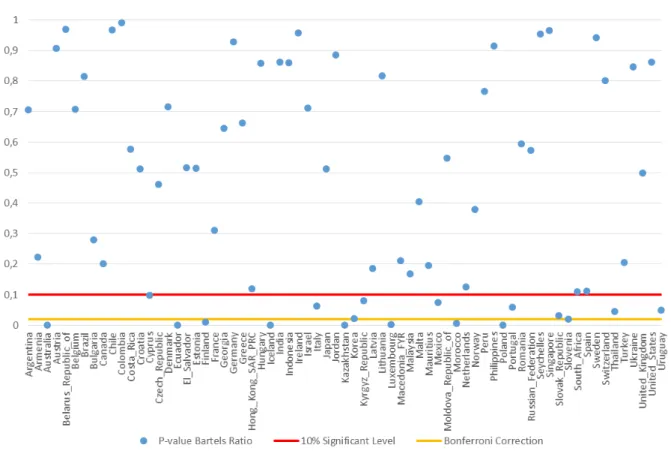
Figure 4.1 - P-Values of Bartels Ratio Tests ... 37
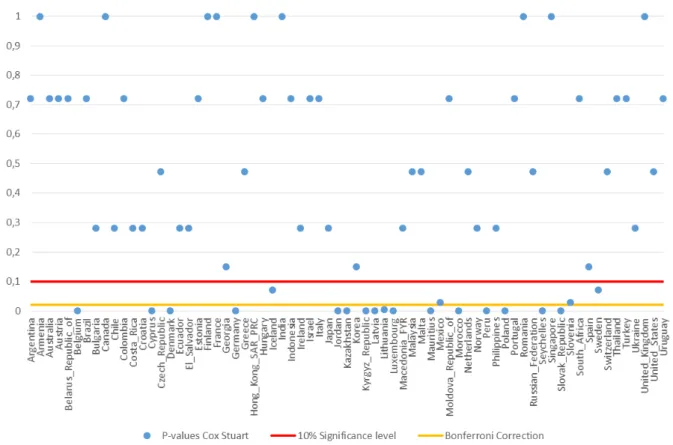
Figure 4.2 - P-Values of Cox Stuart Tests... 38
Figure 4.3 - P-Values of Difference Sign Tests ... 39
Figure 4.4 - P-Values of Mann-Kendall Rank Test ... 40
Figure 4.5 - P-Values of Runs Tests ... 41
Figure 4.6 - P-Values of Tests on Autocorrelations at Seasonal Lags... 42
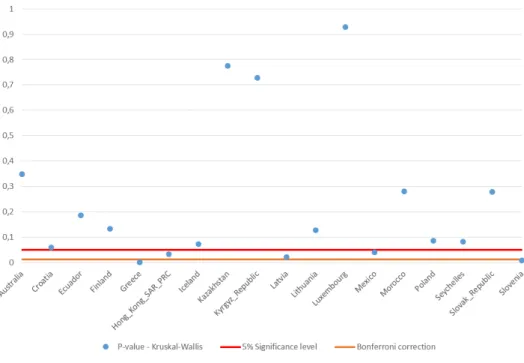
Figure 4.7 - P-Values of Kruskal-Wallis Tests... 43
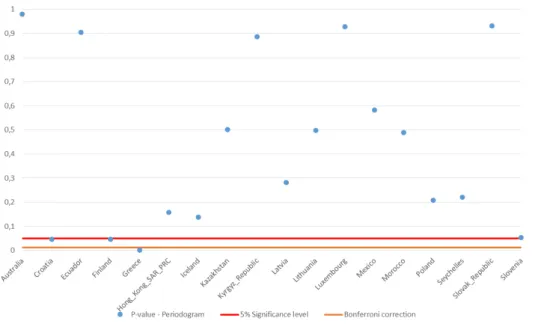
Figure 4.8 - P-Values of Periodogram... 44
Figure 4.9 - P-Values of Tests on Regression with Fixed Seasonal Dummies ... 44
Figure 4.10 - Positive Correlation of Net Errors and Omissions between Individual Countries
... 49
Figure 4.11 - Negative Correlation of Net Errors and Omissions between Individual Countries
... 50
Figure 4.12
–
Significant Correlation of Net Errors and Omissions to BPM6 Items for each
Country ... 53
Figure 4.13
–
Significant Correlation of Net Errors and Omissions to International Investment
Position Items (BPM6) for each Country ... 54
Figure 4.14 - Correlation between Net Errors and Omissions and Exchange Rate Changes
(Significant correlation at 90% confidence level is indicated by red dots) ... 55
Figure 4.15
–
Correlation values of Changes of Economic Variables against Changes in Net
Errors and Omissions of Various Countries (red dots show significant correlation using
90% confidence level)... 56
Figure 4.16 - Net Errors and Omissions Appearing to Predict Crisis ... 57
Figure 4.17 - Net Errors and Omissions Giving False Signals of Crises ... 57
Figure 4.18. - Results of Section 1 of the Survey on Net Errors and Omissions... 70
Figure 4.19 - Results of Section 2 of the Survey on Net Errors and Omissions... 71
x
LIST OF TABLES
Table 4.1
–
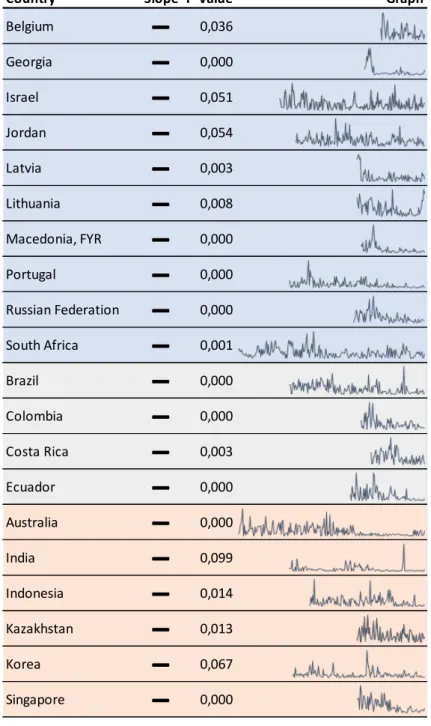
Declining Regression Slope Indicators for Net Errors and Omissions Deflated with
GDP (using 10% significance level) ... 46
Table 4.2
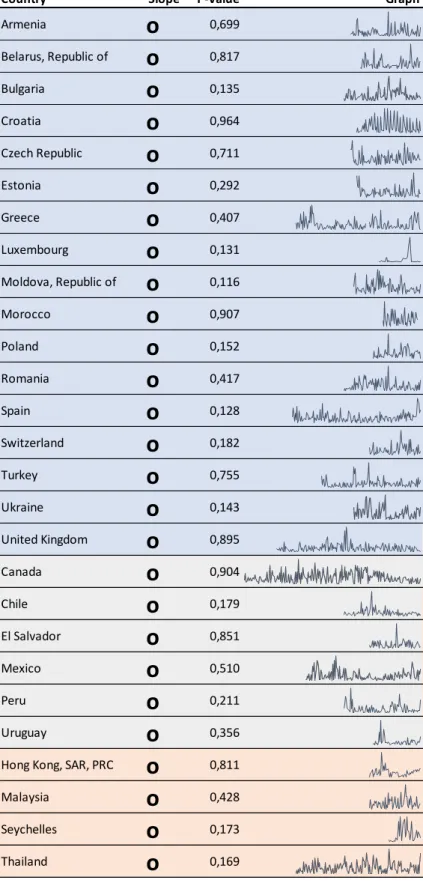
–
Indecisive Regression Slope Indicators for Net Errors and Omissions Deflated with
GDP ... 47
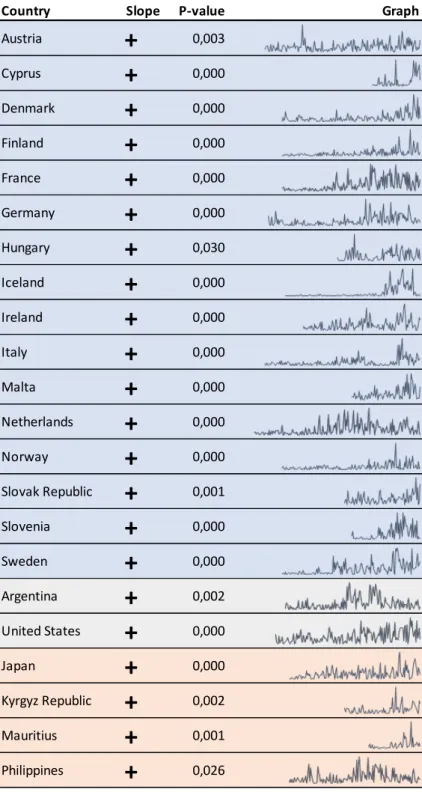
Table 4.3
–
Increasing Regression Slope Indicators for Net Errors and Omissions Deflated
with GDP (using 10% significance level) ... 48
Table 4.4 - Summary of Results for Correlation of Balance of Payments Items (BPM5) against
Net Errors and Omissions of Individual Countries until 2009 ... 51
Table 4.5 - Summary of Results for Correlation of International Investment Position Items
(BPM5) against Net Errors and Omissions of Individual Countries until 2009 ... 52
Table 4.6 - Summary of Results for Correlation of Balance of Payments Items (BPM6) against
Net Errors and Omissions of Individual Countries from 2003 ... 52
Table 4.7 - Summary of Results for Correlation of Balance of Payments Items (BPM6) against
Net Errors and Omissions of Individual Countries from 2003 ... 53
Table 4.8 - Main Results of Correlations of Changes of Economic Variables against Changes in
Net Errors and Omissions of Various Countries ... 56
Table 4.9 - Revision Frequency for Balance of Payments (BPM5) ... 60
Table 4.10 - Revision Frequency for Balance of Payments (BPM6) ... 61
Table 4.11 - Revision Frequency for International Investment Position (BPM5)... 62
Table 4.12 - Revision Frequency for International Investment Position (BPM6)... 62
Table 4.13 - Revision Magnitude for Balance of Payments (BPM5) ... 63
Table 4.14 - Revision Magnitude for Balance of Payments (BPM6) ... 64
Table 4.15 - Revision Magnitude for International Investment Position (BPM5) ... 65
Table 4.16 - Revision Magnitude for International Investment Position (BPM6) ... 65
Table 4.17 - Months between first 5 Revisions for Balance of Payments (BPM5)... 66
Table 4.18 - Months between first 5 Revisions for Balance of Payments (BPM6)... 67
Table 4.19 - Months between first 5 Revisions for International Investment Position (BPM5)
... 67
xi
LIST OF ABBREVIATIONS AND ACRONYMS
BOP Balance of Payments as defined by Balance of Payments and International Investment Position Manual.
BPM5 Balance of Payments Manual, fifth edition (BPM5) issued by the International Monetary Fund 1993.
BPM6 Balance of Payments and International Investment Position Manual, sixth edition (BPM6) issued by the International Monetary Fund 2009.
CDIS Coordinated Direct Investment Survey is a regular survey conducted amongst compilers of Balance of Payments statistics by the International Monetary Fund.
CPIS Coordinated Portfolio Investment Survey is a regular survey conducted amongst compilers of Balance of Payments statistics by the International Monetary Fund.
DI Direct Investment.
ESO Employee Stock Options.
EUROSTAT Statistical office of the European Union.
FATF Financial Action Task Force is an inter-governmental body established in 1989 to combat money laundering, terrorist financing and other related threats to the integrity of the international financial system. FATF encompasses 35 countries worldwide.1
GDP Gross Domestic Production.
IIP International Investment Position as defined by Balance of Payments and International Investment Position Manual
IIP5 International Investment Position as defined by Balance of Manual, fifth edition (BPM5) issued by the International Monetary Fund 1993.
IIP6 International Investment Position as defined by Balance of Payments and International Investment Position Manual, sixth edition (BPM6) issued by the International Monetary Fund 2009.
IMF The International Monetary Fund (IMF) is an organization of 189 countries, working to foster global monetary cooperation, secure financial stability, facilitate international trade, promote high employment and sustainable economic growth, and reduce poverty
xii around the world. Created in 1945, the IMF is governed by and accountable to the 189 countries that make up its near-global membership.2
OECD Organisation for Economic Co-operation and Development is an organization of 35 states that has the aim to promote policies that will improve the economic and social well-being of people around the world.
OI Other Investment.
PI Portfolio Investment.
SDDS Special Data Dissemination Standard is a framework set up by the IMF for providing standardized economic and socio-economic information from the subscribers on a regular basis with summary descriptions of methodology, including descriptions of deviations from international guidelines.3
SDDS+ Special Data Dissemination Standard Plus is based on SDDS, but with additional categories of information and is targeted on countries that have systematically important financial sectors that are integral to the working of the international monetary system.4
2 http://www.imf.org/external/about.htm
3 See: http://dsbb.imf.org/Pages/SDDS/Overview.aspx
1
1.
INTRODUCTION
5Balance of Payments statistics have been an intrinsic part of national accounts for most countries in the world since the end of the Second World War. The purpose of the Balance of Payments is to account for flows of trade, services, transfers, funds and financial transactions from all economic actors in one country against other countries. Balance of Payments is accompanied by International Investment Position which measures the assets and debts of the economic actors of one country against other countries.
Net Errors and Omissions in the Balance of Payments accounts is an item that has not received much attention in public discussions and is often misunderstood. The name of the item may be interpreted as to imply mistakes and improper handling of data, whereas, the item is a discrepancy in the double-entry accounting system that reflects the very complex nature of the statistical reconciliation of the many individual components that make up the Balance of Payments accounts. Net Errors and Omissions represent the discrepancy between the Financial Account minus the sum of Current and Capital Accounts. In theory there should not be a discrepancy but, in practice, Net Errors and Omissions can reach substantial amounts that skew the interpretation of flows between different countries. The causes of the discrepancies are often not known but in some instances explanations emerge later, which prompt the revision of the statistics. The subject of the dissertation is to research this discrepancy, i.e. Net Errors and Omissions.
Each component in the Balance of Payments accounts has to be balanced on both the debit and the credit side. In many cases this is straight forward, such as when importing one simple item from abroad and paying for it with a simple bank transfer, which results in one debit and one credit transaction in the Balance of Payments ledger. However, the complexities can increase dramatically when, for example, a company, which is partly owned by non-residents, imports an airplane which is being built abroad and will be delivered in two years’ time. During the airplanes manufacturing process, a variety of stage payments could be made resulting in Balance of Payments transactions under loans and/or leases, which have implied costs and interest payments. All of this can occur at different periods in time, can change hands between foreign and domestic participants during the process and can stretch on for years to come. Obtaining reliable and timely information about such transactions, about all the relevant participants, timings and details can be a daunting task and then there can be restrictions on information access and deadlines that complicate the process even further. That sort of a problem is what usually causes Net Errors and Omissions, not dumb mistakes and disorderly usage of data.
This subject seems not to have received much attention in academic literature. Several articles have been written that research capital flight or money laundering by evaluating Net Errors and Omissions, e.g. (Adetiloye, K. A., 2012; Altinkaya & Yucel, 2013; Cuddington, 1986; Eggerstedt, Hall, & Wijnbergen, 1993; Hermes, Lensink & Murinde, 2002). There are several studies on the theoretical and practical aspects of Net Errors and Omissions (Cencini, 2005; Damia & Aguilar, 2006; Kilibarda 2013; Tang 2009, 2013). There are also studies that take a limited view on the effects of revisions
5The views expressed in this dissertation are those of the author’s and not necessarily the views of the
2 (Tsz-lim & Kin-cheong, 2010; Kuussaari 2013). There is even a study that provokes discussions on controversial subjects, such as possible falsifying of economic data (Michalski & Stolz, 2012).
1.1.
O
BJECTIVES ANDR
ESEARCHQ
UESTIONSThe main objective of this research is to study the Net Errors and Omissions from a statistical perspective and the viewpoint of the compilers of the Balance of Payments accounts.
The project aims at answering the following research questions:
Is it possible to isolate the main causes of Net Errors and Omissions from the revision history of published data?
Do the results, of the research from published data, resonate with the suggested causes as put forward in the BPM6, and do these causes reflect what the official producers of Balance of Payment statistics believe to be the main causes of Net Errors and Omissions?
To how large a degree do Net Errors and Omissions exhibit classical behavior of errors in the statistical perspective (randomness, seasonality or trends)?
Does the development of magnitude of Net Errors and Omissions relate to major economic indicators (other Balance of Payments items, International Investment Position items, exchange rates, GDP, price levels, wage levels, production and such, and do they correlate
with other countries’ Net Errors and Omissions)?
1.2.
D
ATA ANDM
ETHODSThe main source for Balance of Payments information is the Balance of Payments and International Investment Position Manual, 6th ed. (BPM6). The manual includes a chapter on the Net Errors and Omissions, which explains the issue and the potential sources of the error and how it impacts the Balance of Payments and International Investment Position. There are some general speculations in the BPM6 manual on the causes for Net Errors and Omissions, which this work will try to support or debunk with evidence from research. Furthermore there are areas that are of interest, such as the statistical behavior of this discrepancy and the perceived reasons by the producers of the statistics. The research is done in three separate steps: review of available literature, statistical research on a database of published data from all the countries that adhere to the Special Data Dissemination Standard, and a survey from a sample of the above mentioned countries.
The review of literature involved searching libraries and the internet for articles and books on the subject. The web sites of IMF, OECD, World Bank, European Central Bank, EUROSTAT and EconPapers were important sources of material as well as Google and Bing search engines.
3 items (chapter 4.3.3.1), correlations with exchange rate changes (chapter 4.3.3.2), and correlations of Net Errors and Omissions with major economic variables for each country (chapter 4.3.3.3). Microsoft Excel, JDemetra+, and the R package were used for calculations.
The research of revision histories was conducted by querying a SQL database of IFS data (see chapter 4.1) and calculating frequencies (chapter 4.4.2.1), magnitudes (chapter 4.4.2.2) and timings (chapter 4.4.2.3) of revisions to individual items of Balance of Payments and International Investment Position for each country and correlating these with Net Errors and Omissions. Microsoft Excel and the R package were used for calculations.
A survey was conducted using Google Forms amongst all the SDDS and SDDS+ countries that provided contact information in the IFS database. The results of the survey were aggregated using Microsoft Excel.
Data for the numerical studies was mostly obtained from the International Monetary Fund’s IFS
database6 and World Bank data7.
1.3.
D
OCUMENT STRUCTUREThe dissertation is split into three main sections:
1. An introduction of the Balance of Payments system of accounts.
2. An overview of Net Errors and Omissions as an individual item, explaining the concept, reviews of the available literature on the subject, and an attempt to create an informal handbook on the causes, detection methods and potential remedies for Net Errors and Omissions.
3. Research into the statistical properties of Net Errors and Omissions, which is in two parts, an evaluation of univariate and multivariate characteristics of Net Errors and Omission, and a study of revision histories of the items that make up the Balance of Payments and International Investment Position accounts. Finally, a survey that was conducted amongst the Balance of Payments statistics compilers is presented.
Five appendices with detailed results of tests and other information are in the last section of this dissertation.
6 http://www.imf.org/en/Data
4
2.
BALANCE OF PAYMENTS SYSTEM
Balance of Payments is an accounting system that measures the flow of goods, services and finance between one economy against all others. The two sections below describe the development of the accounting system since 1948 and how it fits into the wider framework of national accounts.
2.1.
A
B
RIEFH
ISTORY OF THEM
ANUALS’
D
EVELOPMENTThe first manual on Balance of Payments statistics was published in 1948 by the International Monetary Fund. The manual was based on earlier work done by the League of Nations, which was an attempt to standardize the production of these statistics (International Monetary Fund 1948). The Bretton Woods agreement of 1944, see Bordo (1993) required the countries that participated to furnish information about: “International balance of payments, including (1) trade in goods and services, (2) gold transactions, (3) known capital transactions, and (4) other items.” (Section 5 vi, United Nations Monetary and Financial Conference, 1944).
The first edition of the manual consisted of one summary table on Balance of Payments a nd eleven supplementary tables with further breakdowns of the 16 main items in the summary table. Errors and Omissions are introduced as a balancing item between Current Transactions and Movement of Capital and Monetary Gold. The manual had no further explanation, nor definition of Errors and Omissions. (International Monetary Fund, 1948).
The second edition was issued in 1950 and contained minor changes to the tables, but added significantly to the instructions and guidance notes, with appendices on geographic classification, abbreviated Balance of Payments schedule, with instructions on methodology, and compensatory official financing (International Monetary Fund, 1950). The manual included a short section on Errors and Omissions explaining that even though the double-entry system should balance there might be
some transactions that might be inaccurately recorded or not recorded at all, “an errors and
omissions item has been included in the standard schedule to bring the statement into balance”
(International Monetary Fund, 1950, pp. 6-7). The manual also has a chapter on: Problems of Classification that indicates potential pitfalls and discrepancies in the accounting and reconciliation of numerus items in the Balance of Payments (International Monetary Fund, 1950, pp. 7-8).
The third edition was issued in 1961 and added explanations of the rationale behind the categories employed and attempted to explain more fully the basic principles and the accounting principles. A simple structural change is introduced by splitting up the current transactions into two categories:
5 pointed out (International Monetary Fund, 1961, pp. 16). The concept: Errors and omissions are changed to Net Errors and Omissions to reflect the likelihood of debit and credit errors that are mutually offsetting, thus reducing the discrepancies (International Monetary Fund, 1961, pp. 25). The chapter on Problems of classification is expanded considerably in this edition of the manual with additional chapters on Problems of valuation and Problems of conversions (International Monetary Fund, 1961, pp. 29-34).
The fourth edition of the manual was issued in 1977 in the wake of the breakdown of the Bretton Woods agreement. Some structural changes were made, such as the reorganization of the Capital Account by splitting it into two categories: Capital and Reserves, and identify Portfolio Investments as a separate item. The explanatory material was rewritten and expanded considerably and a separate chapter on analytic presentation was added. The valuation concept is given a separate chapter in order to explore the difficult problems that it invokes. (International Monetary Fund, 1977). The manual introduces a new rule of thumbs for evaluating the effects of Net Errors and Omissions on
the interpretation of the accuracy of the statements, i.e.: “An empirical rule of thumb that is
sometimes quoted holds that a residual is large enough to create a problem when it exceeds the equivalent of 5 per cent of the gross credit and debit entries for merchandise combined (although the residual can also arise, of course, from nonmerchandise transactions)” (International Monetary Fund, 1977, pp. 62).
The fifth edition of the manual, issued in 1993, introduced a major addition in the form of
International Investment Position. Balance of Payments only relate to transactions during a set time
period, whereas the International Investment Position accounted for external stock position of assets and liabilities that changed due to the aforementioned transactions, with the addition of accounting for valuation changes and other adjustments that were not measured previously. Apart from these changes the manual further aligned the Balance of Payments statistics with the System of National Accounts 1993. Which were revised in a coordinated effort (International Monetary Fund, 1993). Some of the changes made to the manual were the: “result of the liberalization of financial markets, innovations in the creation and packaging of financial instruments, and new approaches to the restructuring of external debt. In addition, there has been unprecedented growth in the volume of international trade in services. All these developments have necessitated changes in the treatment
and classification of such transactions within the structure of the balance of payments accounts”
(International Monetary Fund, 1993, pp. xi). Among other changes, the Current Account of the Balance of Payments was redefined to exclude Capital Transfers, which were moved under an augmented category of: Capital and Financial Account, and clear distinctions were made among goods, services, income, and current transfers (International Monetary Fund, 1993, pp. xi). The manual drops the rule of thumbs on hampering effect of Net Errors and Omissions, which was introduced in the previous manual. (International Monetary Fund, 1993, pp. 38). The fifth edition was accompanied by a very comprehensive compilation guide that was published in 1995 (International Monetary Fund, 1995).
The sixth and current edition of the manual was issued in 2009 and its title included the international investment position. Some of the most significant changes from the previous edition related to:
“Revised treatment of goods for processing and goods under merchanting; changes in the
measurement of financial services […]; elaboration of direct investment […]; the introduction of the
6 concepts for the measurement of international remittances; increased focus on balance sheets and
balance sheet vulnerabilities […]; strengthened concordance with the SNA […]; and extensive
additions to the Manual […].” (International Monetary Fund, 2009, pp. xii-xiii). The manual includes a
short chapter on Net Errors and Omissions where the potential effects of net pluses or minuses are distinguished. The manual also encourages producers to analyze the item to help shed light on data problems, such as coverage or misreporting, as well as patterns that could indicate biases (International Monetary Fund, 2009, pp. 11).
2.2.
S
TRUCTUREBalance of Payments is an accounting system that measures the flow of goods, services and finance between one economy against all others, which can be referred to as residents against non residents. The system is based on double-entry accounting, which means that there is a debit entry and a corresponding credit entry. As in all accounting systems, one transaction may lead to many entries into different accounts. A relatively new and a welcome change in the latest edition of the manual is that netting of categories is more or less abandoned, which gives a more comprehensive account of the values within each category.
7
Overview of International Accounts
Balance of payments Credits Debits Balance
Current account
Goods and services 540 499 41
Goods 462 392 70
Services 78 107 -29
Primary income 50 40 10
Compensation of employees 6 2
Interest 13 21
Distributed income of corporations 17 17
Reinvested earnings 14 0
Rent 0 0
Secondary income 17 55 -38
Current taxes on income, wealth, etc. 1 0
Net nonlife insurance premiums 2 11
Nonlife insurance claims 12 3
Current international cooperation 1 31
Miscellaneous current transfers 1 10
Adjustment for change in pension entitlements
Current account balance 13
Capital account
Acquisitions/disposals of nonproduced nonfinancial assets 0 0
Capital transfers 1 4
Capital account balance -3
Net lending (+)/net borrowing (–) (from current and capital accounts) 10
Financial account (by functional category)
Net acquisition of financial assets Net incurrence of liabilities Balance
Direct investment 8 11
Portfolio investment 18 14
Financial derivatives (other than reserves) and ESOs 3 0
Other investment 20 22
Reserve assets 8 0
Total changes in assets/liabilities 57 47
Net lending (+)/net borrowing (–) (from financial account) 10
Net errors and omissions 0
International investment position
Opening position Transactions (Fin. Acc.) Other changes in volume Revaluation Closing Position
Assets (by functional category)
Direct investment 78 8 0 1 87
Portfolio investment 190 18 0 2 210
Financial derivatives (other than reserves) and ESOs 7 3 0 0 10
Other investment 166 20 0 0 186
Reserve assets 833 8 0 12 853
Total assets 1,274 57 0 15 1,346
Liabilities (by functional category)
Direct investment 210 11 0 2 223
Portfolio investment 300 14 0 5 319
Financial derivatives (other than reserves) and ESOs 0 0 0 0 0
Other investment 295 22 0 0 317
Total liabilities 805 47 0 7 859
Net IIP 469 10 0 8 487
Note: ESO = employee stock option.
(International Monetary Fund 2009, p. 14)
Figure 2.1 - Overview of International Accounts (Based on Table 2.1. in BPM6, pp. 14)
2.3.
R
ELATIONSHIP WITHO
THERS
TATISTICALS
YSTEMS8 Figure 2.2 - Overview of the Framework for Macroeconomic Statistics (BPM6, pp. 8)
The BPM6 also complements work by the Organization for Economic Co-operation and Development (OECD) Benchmark Definition of Foreign Direct Investment. (International Monetary Fund, 2009, pp.
9
3.
NET ERRORS AND OMISSIONS
Net Errors and Omissions refer to a discrepancy in the accounting of Balance of Payments statistics. This discrepancy rises due to several reasons, some of which are quite apparent, whereas some are more hidden. The term Errors indicates incorrectly recorded items and Omissions refers to missing
items. In most discussions, no clear distinction is made between the Errors and the Omissions items, thus, the term is used as a collective term. Below is an attempt to detail the different facets of the concept, ranging from definition of the term, review of the somewhat limited literature that has been published on the subject, attempt at categorizing the possible errors, how they can be detected and what remedies can be used to minimize or eliminate them. A statistical analysis of historical data on Net Errors and Omissions of most of the countries that subscribe to SDDS and SDDS+ is presented. The analysis focuses on statistical attributes of Net Errors and Omissions and relationship with other economic metrics.
3.1.
D
EFINITION OFN
ETE
RRORS ANDO
MISSIONSThe sixth edition of the Balance of Payments manual does not formally define the term of Net Errors and Omissions, only saying: “Although the balance of payments accounts are, in principle, balanced, imbalances result in practice from imperfections in source data and compilation. This imbalance, a usual feature of balance of payments data, is labeled net errors and omissions and should be identified separately in published data. It should not be included indistinguishably in other items. Net errors and omissions are derived residually as net lending/net borrowing and can be derived from the financial account minus the same item derived from the current and capital accounts.”
(International Monetary Fund, 2009, pp. 11). One paper refers to Net Errors and Omissions as “The
Balancing Item” (Duffy, M., & Renton, A., 1971). The World Bank defines Net Errors and Omissions on its web page8 as follows: “Net errors and omissions constitute a residual category needed to ensure
that accounts in the balance of payments statement sum to zero. Net errors and omissio ns are derived as the balance on the financial account minus the balances on the current and capital accounts.” Others, such as OECD define Net Errors and Omissions in the following manner: “Labeled by some compilers as a balancing item or statistical discrepancy, that item is intended as an offset to the overstatement or understatement of the recorded components.” With the added explanation:
“Some of the errors and omissions may be related to recommendations for practical approximation to principles”.9 Kilibarda (2013), argues that: “The essence of the Net errors and omissions position is
finding the cause of its existence and pointing the search for anomalies in the right direction rather than reducing its value to zero.” (Kilibarda, B., 2013 pp. 10). Fausten & Pickett (2004) define Errors as incorrectly recorded transactions and Omissions as transactions that are not recorded at all. “Its particular value is generated by the accounting conventions of double-entry bookkeeping”. (Fausten, & Pickett, 2004, pp. 1303)
The key words or phrases in the definitions in the previous paragraph appear to be: Balancing Item; Discrepancies; Residual; Imperfections; Incorrectly Recorded; Not Recorded; and Double-entry Accounting.
The proposed definition is therefore:
8 data.worldbank.org/indicator/BN.KAC.EOMS.CD. Retrieved 29.5.2016
10
Net Errors and Omissions are a balancing item in Balance of Payments, derived from the total value of the Financial Account minus the combined total value of the Current and Capital Accounts that stem from discrepancies that are due to incorrectly recorded or missing items in the double-entry accounting system.
3.2.
R
EVIEW OFL
ITERATURESince 1948 when Balance of Payments Accounts were first introduced, Errors and Omissions have been a part of the accounts. Little attention was paid to this item at first as it o nly functioned as a balancing item of the accounts. The economies were also simpler and more easily observable shortly after the Second World War and in many countries official controls or interventions were accepted in international trade, often due to shortages of basic goods and limited access to funds or simply due to the governance structure in the individual countries. As sophistication grew and International Accounts received more attention and fuller understanding, more demands were made and focus also shifted to nuances and the more obscure items of the accounts. Therefore, more has been written on Net Errors and Omissions as time has passed, than in the early days. Furthermore, interpretation of the meaning of large deviations in the Net Errors and Omissions have taken into account many facets that are difficult to measure, such as unrecorded capital flows, e.g. capital flight, unrecorded goods flows, e.g. smuggling and workers’ remittances. The technical issues have also received attention, such as availability and usefulness of measurement tools, accuracy of evaluation methods, and the appropriateness of the production methods. Focus has also been on how to increase the accuracy of the production and the usage of intrinsic methods, such as statistical analysis of the data and comparison, such as asymmetries between published numbers by individual countries. In some cases the analysis has been done by international or national institutions involved in the production of Balance of Payments, but users of these statistics and academics have also participated in the discussions.
3.2.1.
Causes and Quality Issues
The Balance of Payments manuals offer numerous valuable insights into the causes for Net Errors and Omissions, from pointing out the obvious relationships, such that if Net Errors and Omissions are positive that may stem from credits in the Current and Capital Accounts being too low or vice versa the debits being too high, etc. (International Monetary Fund, 2009, pp. 11), to the more sophistic reasons as how differences in the time of recording by partner economies can lead to serious distortions (International Monetary Fund, 2009, pp. 39). As many of these will be subject to discussions in the subsequent chapters, it serves no purpose to dwell on these in the current section. Chapter 17 in the Balance of Payments and International Investment Position Compilation Guide
deals with quality issues of Balance of Payments and will be referred in the subsequent chapters, as well as other chapters in the compilation guide where appropriate. (International Monetary Fund, 2014).
3.2.1.1.
General Literature
11 remedy the problems. The study focused on Current Items, such as Investment Income, Shipping and Transportation, Unrequited Transfers, and looked into geographical allocations. The task force found out that a mismatch in accounting for Investment Income Account by debtor countries versa creditor countries explained a substantial share of the discrepancies. As the debtor countries had much better overview of their positions than the creditors, the recommendation was to use available sources by international bodies to estimate, especially Interest Rate Income for Portfolio Investment. Also better treatment of Reinvested Earnings was suggested. Shipping and Transportation was another area of inconsistencies. However, as the situation seemed to be rather stable and involve fleets of a limited number of countries (although important ones) recommendations were made on improvements in reporting and estimation methods where these were lacking. The task force recommended that further work should be undertaken to improve the treatment of Unrequited Transfers. The task force noted several problems in the geographical allocation of certain items, such as investment and services. In most cases this had no effect on the final results, but industrial countries and in some cases international institutions were identified as the most likely sources of incomplete information. (International Monetary Fund, 1987).
In their paper, Blomberg, Forss & Karlsson (2003), discuss the various aspects for minimizing Net Errors and Omissions, the most important being the limitations that it poses on correctly describing and analyzing contents and allocations of net financial savings. They also stress the importance of high quality statistics as these are used in National Accounts, for evaluating foreign trade, direct investments and the exchange rate. (Blomberg, Forss & Karlsson, 2003, pp. 43).
Cencini (2003) looked into the “missing surpluses” that Krugman and Obstfeld discuss in their 2003 textbook: International Economics. Theory and Policy.10 Cencini suggests that the reason lies in two
connected items, unrecorded capital flight and lack of reporting of Net Interests paid on debt by debtor countries. (Cencini, 2005)
In his working paper, Kilibarda (2013), studied the various aspects of Net Errors and Omissions and then examined the Balance of Payments items in his country Montenegro in that light. He observed that significant omissions can cancel out due to the double-entry accounting system and possible failures in reconciling large transactions. He argued that rather than attempting to reduce Net Errors and Omissions to zero the object should be to use it to search for the anomalies that cause the discrepancy. (Kilibarda, 2013, pp. 43).
Committeri (2000) stresses that compilers should pay much attention to reconciliation adjustments
as these “are a part of the data validation process through which national compilers can "explain" how IIP and BOP statistics are related and show that the two sets of data have been cross-checked and their accuracy verified. Second, such adjustments provide the analyst with a means to assess the ex post exposure of a country to valuation changes on both the asset and liability sides.” (Committeri, 2000, pp. 3). He advocates for increase of the amount of financial information when compiling Balance of Payment and International Investment Position as volatility of price and exchange rates affects the accuracy of the accounts, i.e. using fixed price or exchange rates for eac h period introduces errors and complicates reconciliation with other sources. (Committeri, 2000, pp. 24).
12
3.2.1.2.
Unrecorded Capital Flows
Capital flight contributes to unrecorded Capital Flows, but it is a complex issue and there is no generally accepted definition or measurement method (e.g., Calvo, 2016; Cumby & Levich (1987); Dooley, 1986, 1988; Kant, 1996).
Cuddington (1986) examined the negative effects of capital flows on economies in his 1986 article.
He observed that “Some forms of capital flight, such as smuggling or under invoicing of exports and over invoicing of imports, do not even show up in ‘errors and omissions’”. Cuddington’s method is
sometimes referred to as “Hot Money”. (Cuddington, 1986, pp. 3).
Dooley (1988) presents a framework for evaluating capital flight by using interest rate and inflation differential and risk premiums between countries.
Schineller (1997) researches the drivers for capital flight using an econometric model with long time-horizon and panel data. The study identifies the “importance of the government’s budget surplus as
a potential determinant of capital flight” (Schineller, 1997, pp. 20).
By using statistical methods and models it is shown that unrecorded capital flows into the Nigeria are found to partly explain large Net Errors and Omissions Item (Adetiloye, 2012).
In many countries the reverse problem (that of large unrecorded outflows) poses a problem in the Balance of Payments Accounts, such as Mexico (Eggerstedt & Wijnbergen, 1995) who found that using Net Errors and Omissions and short-term asset changes did not relate well with the unreported private accumulation of foreign assets.
Hermes, Lensink & Murinde (2002) researched South Asia, East Asia, Sub-Saharan Africa and Latin America and attempted to use Net Errors and Omissions in their models to estimate capital flight
concluding that it was “conceptually wrong” to use models (Dooley and Hot Money) based on Net
Errors and Omissions (Hermes, Lensink & Murinde, 2002, pp. 6).
In Russia, where it was noted that Net Errors and Omissions were negative for 12 consecutive years apart from one year in a period which was suspect for large illegal capital flows (Loungani, & Mauro, 2001)11.
Shi & Lian (2014) concluded that, based on models using Net Errors and Omissions in China there was a case for encouraging the government entities to strengthen their surveillance of capital flows. (Shi & Lian, 2014).
Geng (2004) examines round tripping of capital in China and estimates that around 40% of Foreign Direct Investment is originated within the country, but via hidden transmissions through other countries, leading to higher Net Errors and Omissions. (Geng, 2004).
Blomberg, Forss & Karlsson (2003) state that Individual households’ investments directly abroad (not via a local intermediary) in the form of, for instance, stocks, shares or bank deposits, are only captured to a very minor extent. They also mention incomplete coverage of securities trading across
13 borders and banking sector transactions abroad, which are often not reported timely. (Blomberg, Forss & Karlsson, 2003, pp. 48).
Brada & Tomšík (2003) discuss controversies about “rules of thumb” regarding certain items in Balance of Payments which are thought to indicate financial crisis, such as the one saying that Current Account should not exceed 5% of GDP. They observe that an anomaly in the imputation of reinvested profits of the subsidiaries of foreign firms, which involves no transactions can overstate the Current Account deficit which might trigger warning signs according to the rules of thumb. They also see this happening in several transition economies. (Brada, Tomšík, 2003 pp. 2-4).
Ndikumana, Boyce & Ndiaye (2006) evaluate capital flight in 39 African countries, mostly Sub-Saharan countries, using the residual method advised by Cuddington (1986), which was developed at the World Bank and which “defines capital flight as a residual, the difference between recorded inflows and recorded uses of foreign exchange”. (Ndikumana, Boyce & Ndiaye, 2006 pp. 5). They identify trade misinvoicing and unrecorded workers’ remittances as important sources for errors, but they distinguish between; Funds acquired illegally; funds transferred abroad illegally; and funds held abroad illegally as illegal Capital Flow. (Ndikumana, Boyce & Ndiaye, 2006 pp. 14-15). They also categorize a number of factors as drivers of Unrecorded Capital Flows, such as: Structural, i.e. governance and lack of management capacity; Macroeconomic environment; Risk and returns to private investment and portfolio choice; Capital account regime and financial regulation; External borrowing; Political factors; and Hysteresis and habit formation, where corruption trickles down the economy from highest rungs in the political ladder. Their most conclusive results point to external borrowing as a common factor, but other results, such as abuse of natural resources endowments is more dependent on the political landscape. (Ndikumana, Boyce & Ndiaye, 2006).
3.2.1.3.
Unrecorded Goods Transactions
Smuggling and money laundering have probably followed human history since the first attempts to regulate and tax goods transactions across borders. These are complex issues, which have social order implications as well as financial. Authorities try to counteract by establishing border controls, financial intelligence units and other measures designed to shed light on the problem and find ways to fight against the illegal activities, (e.g. Pitt, 1984; Unger, Siegel & Ferwerda, 2006).
Altinkaya & Yucel (2013) examine the effects of money laundering on trade in Turkey, where they
infer that “… certain amount of money laundering could be forecasted under the net errors and omission of balance of payments of Turkey” (Altinkaya & Yucel, 2013, pp. 123), citing research of
Aktaş & Altan (2013) on the possible effects of surveillance mechanism on over invoicing trade across
borders. By using mirror statistics they estimate that in 2011 import figures were overstated by 2-3 billion USD. (Aktaş & Altan, 2013). They also refer to research by Blades & Ivanov (1983) who classify three possible sources of discrepancies in trading accounts, a) inevitable differences, for example
“free on board” vs “cost insurance and freight” accounting, which can lead to up to 10% differences
in mirror statistics, b) structural differences, for example different methodology between countries in compiling or accounting for exchange rates, c) errors, such as negligence, fraud or in statistical methods.12 (Blades & Ivanov, 1983).
12 This paper is in French, which this author does not comprehend, therefore, summarizing from (Aktaş
14 Another important source of potential errors due to unlawful activities are reports from Financial Action Task Force (FATF), where some of the most important causes for misrepresentations of trade statistics are listed, such as: over- and under-invoicing of goods and services; multiple invoicing of goods and services; over- and under-shipments of goods and services; and falsely described goods and services. (FATF, 2006). There are also number of recommendation from FATF on how to combat these problems, such as comparisons between countries, manufacturers, importers/exporters, origin, descriptions, tax remittances and more, also using statistical analysis on import/export data to search for discrepancies. (FATF, 2008).
Blomberg, Forss & Karlsson (2003) point to overestimation of Net Export of Goods within the European Union (EU) which are well known and have resulted in a systematic overestimation of Exports. (Blomberg, Forss & Karlsson, 2003, pp. 47).
3.2.1.4.
Worker’s
Remittances
Worker’s Remittances are a cross cutting issue in the current account, touching on primary and
secondary income accounts as well as indirectly on goods and services account. As this item has been growing in importance with more flexibility of workers, more attention has been payed to its effects on Balance of Payments and how it can affect Net Errors and Omissions.
Cali, & DellʼErba (2009) question the methodologies of the World Bank regarding their estimations of the drop of workers remittances after the 2008 financial crisis, believing these estimates understate drop by substantial amounts. They attempt to create a more accurate model for estimating remittances that would rectify the estimates. They point out potential errors in estimating remittances, such as measurement problems due to informal channels of repatriation and changes that can occur in the practices over time. They also mention that different methods are used to evaluate inflows and outflows of remittances. (Cali, & DellʼErba, 2009).
Freund & Spatafora (2005) use historical data from different sources to investigate remittances that are transferred via informal channels. Their conclusion is that these are underestimated in official statistics by as much as 35-75%, although, substantial differences can be across different regions. (Freund & Spatafora, 2005).
Reinke (2006) gives a very comprehensive summary of issues related to remittances, such as definitions, practices for compilation and dissemination as well as suggesting plans for improved compilation guidance. (Reinke, 2006).
3.2.2.
Technical Aspects
Blomberg, Forss & Karlsson (2003) distinguish different types of measurement errors i.e.: Coverage errors, which could be called omissions; Measurement errors (evaluation errors), where there are deficiencies due to definitions or other technical treatment, and; Time errors (periodization errors), where transactions are reported for the wrong period of time. They also caution against interpreting small reported Net Errors and Omissions as a better measure of the statistics, as counter-balances can cancel out significant differences. (Blomberg, Forss & Karlsson, 2003, pp. 43).
15
Balance and Errors and Omissions as a percentage gross flows of Basic Balance (Basic balance being Current Account, Capital Balance, Direct Investment and majority of Securities Trading). (Blomberg, Forss & Karlsson, 2003, pp. 45-46).
Ghosh (1997) sites methodologies of Mankiw et al. (1984) and Mork (1990) to investigate the nature of revisions. Mankiw et al. (1984) classify errors as “classical measurement errors” and “efficient forecast errors”, and Mork (1990) suggests an alternate classification “inefficient forecast errors”. The conclusion of the research is that the revisions in the United States trade balance announcements represent measurement errors. (Ghosh, 1997).
Damia & Aguilar (2006) discuss revisions and what their research indicated as promising use of this category. Using five years data they found that revisions had decreased, but in some areas there was a bias, which suggested areas for further study into how to improve Balance of Payments statistics. They found that differences in timing was often the cause of errors, but some were subsequently eliminated by the revisions to data (Damia, & Aguilar, 2006, pp 5).
Duffy & Renton (1971) use principal components analysis to regress the Errors and Omissions against probable major sources of errors and others. Their analysis shows some success in identifying some of the major sources of errors. (Duffy & Renton, 1971).
Fausten & Brooks (1996) researched the Errors and Omissions in Australia with the intention of finding ways to use the item to improve Balance of Payments statistics. Their results were mostly inconclusive and did not lead them to any improvements in results. They also noted that Errors and Omissions had grown substantially, which might justify using scaling, such as GDP to adjust in research. (Fausten & Brooks, 1996).
Tombazos (2003) refuted these (Fausten & Brooks) results several years later as revisions had decreased the Errors and Omissions substantially in the years between. His conclusion was that caution should be applied to initial publications of Balance of Payments statistics. (Tombazos, 2003). Tang (2013) Found in his study on Australian data that “real GDP, foreign income, foreign interest rate, domestic interest rate, and exchange rate have either directly or indirectly caused EO over the sample period 1960-2010” (Tang, 2013, pp 19-20).
Tang (2009) tested Net Errors and Omissions for linearity and found that some countries exhibited non-linearity, whereas others had linearity, which means that different econometric methods have to be applied when using Net Errors and Omissions in such models.
3.2.3.
Remedies
16 Six years later Lane & Milesi-Ferretti (2007) revisited the subject, with an improved data base and changed methodology. As their dataset now includes data based on BPM5, they have access to International Investment Position data for 145 countries, which allows for estimating backwards series of capital flows for comparison with official data. Their results in many cases compared well with the official data, but in some cases it revealed large potential underreporting in capital flows. Even though the conclusions aim more at identifying global trends in foreign investments, their methodology can be used for cross-checking investment data. (Lane, & Milesi-Ferretti, 2007).
Salo (2014) describes the success by Finnish authorities in reducing Net Errors and Omissions by analyzing residuals and using it to reevaluate overestimates of foreign portfolio investment liabilities. The article also points out the potential underestimation of external assets, which can be due to limited coverage and in some instances intentional hiding due to tax evading. (Salo, 2014).
3.3.
C
AUSES OFE
RRORSBroadly speaking errors can be categorized in two groups: Random Errors and Systematic Errors. Random Errors are errors that happen unexpectedly and can or cannot be repetitive. The causes of Random Errors can range from human mistakes to malfunction in machines, which create an incorrect measure. Systematic Errors stem from underlying weaknesses in processes or observation methods, which repeat erroneous measures or create circumstances where these can compound and skew results. Other categorizations of errors are possible, such as Allchin’s (2001), who categorizes errors into four categories, i.e. material, e.g. improper procedures or improper samples; observational, e.g. insufficient controls to establish domain of data or observations or incomplete theory of observation; conceptual, e.g. flaw in reasoning inappropriate models; and discoursive, e.g. communication failures: incomplete reporting, obscure publication, translation hurdles, patchy citation/search system or mistaken credibility judgments. (Allchin, 2001, pp. 4). For our purposes the
simple categorization of Random and Systematic Errors is used, but Allchin’s categories provide an alternative view on the subject, which can aid in understanding the subject.
3.3.1.
Random Errors
Random Errors are errors that occur unpredictably, sometimes due to known causes and sometimes not. Many kinds of personal mistakes fall under this type of errors, for example, incorrectly registered number, failure to observe some happening, inattention to detail, etc. Other mistakes, such as occasional wrong categorization and glitzes in computer handling fall under this type of errors. These errors can be hard to spot, but statistical testing can often help in locating and minimizing their effects.
3.3.2.
Systematic Errors
Barlow (2002) discusses Systematic Errors in some detail in his 2002 paper: Systematic Errors: Facts and Fictions. He cites two widely used definitions, that of Orear: “Systematic effects is a general category which includes effects such as background, selection bias, scanning efficiency, energy resolution, angle resolution, variation of counter efficiency with beam position and energy, dead time, etc. The uncertainty in the estimation of such a systematic effect is called a systematic error.”,
17 misunderstanding of the concept. Systematic Effects are often mistakenly labeled Systematic Errors, and the two definitions are at odds. For our purposes the Bevington’s definition is better suited. With the emphasis on reproducible or given the same usage of methods, procedures and production technique, systematic errors will reoccur indefinitely; unless discovered and remedied, of course.
3.3.3.
New Challenges
Internet trade has radically affected international trade in goods, services and financial products in recent years. Some of the trade can be measured via indirect methods, as goods are usually accounted for in usual manner via custom reports or sampling, whereas payments can be far harder to track due to a variety of new payment methods, ranging from PayPal, which is usually mirrored through credit cards, to Bitcoin, which is virtually untraceable. Complex tax structures can create barriers from observation of the underlying financial flows and positions, as well as uncertainty about treatment of data. Financial engineering often creates products that can be very difficult to value and sometimes hide the final beneficiary from being observed. Innovation in fraud and scheming seems to be without bounds, and if large scale and undetected, it can create substantial unexplained imbalances.
3.4.
B
ALANCE OFP
AYMENTSS
PECIFICI
TEMSThe BPM6 and compilation guides provide a framework for the production of Balance of Payments statistics. Broadly speaking that should suffice in constructing a system for the production that would fulfill all the requirements for successful production. But, given the complexities involved, due to misalignment of items, for example goods arriving in different proportions and the financing side being interwoven with other items and spread over time, the need for estimations, imputations, and adjustments undermine the implied accuracy and beauty of the system as envisioned by the authors. Complexities of corporate structures, reaching into different regions, often create problems that can require considerable time and effort to untangle.
3.4.1.
Current Account
Imperfect measurement methods are usually to blame for inaccuracy in evaluating the volumes and worth of current account items. Given circumstances, the volume of trading of goods can often be measured quite accurately using records created by customs authorities. But sometimes there are no formal customs controls, which complicates matters. On top of that some activity takes place outside official control and can be hard to measure. Intangible items are much harder to measure, such as services and remittances.