The
TP53
fertility network
Diego d’Avila Paskulin
1,2, Vanessa Rodrigues Paixão-Côrtes
1,3, Pierre Hainaut
4, Maria Cátira Bortolini
1,3and Patricia Ashton-Prolla
1,2,5*1
Programa de Pós-Graduação em Genética e Biologia Molecular,
Universidade Federal do Rio Grande do Sul, Porto Alegre, RS, Brazil.
2Laboratório de Medicina Genômica, Hospital de Clínicas de Porto Alegre, Porto Alegre, RS, Brazil.
3Laboratório de Evolução Humana e Molecular, Universidade Federal do Rio Grande do Sul, Porto Alegre,
RS, Brazil.
4
International Prevention Research Institute, Lyon, France.
5Serviço de Genética Médica, Hospital de Clínicas de Porto Alegre, Porto Alegre, RS, Brazil.
Abstract
TheTP53 gene, first described in 1979, was identified as a tumor suppressor gene in 1989, when it became clear that its product, the p53 nuclear phosphoprotein, was frequently inactivated in many different forms of cancers. Nick-named “guardian of the genome”,TP53 occupies a central node in stress response networks. The p53 protein has a key role as transcription factor in limiting oncogenesis through several growth suppressive functions, such as initiat-ing apoptosis, senescence, or cell cycle arrest. The p53 protein is directly inactivated in about 50% of all tumors as a result of somatic gene mutations or deletions, and over 80% of tumors demonstrate dysfunctional p53 signaling. Be-yond the undeniable importance of p53 as a tumor suppressor, an increasing number of new functions for p53 have been reported, including its ability to regulate energy metabolism, to control autophagy, and to participate in various aspects of differentiation and development. Recently, studies on genetic variations inTP53 among different popula-tions have led to the notion that the p53 protein might play an important role in regulating fertility. This review summa-rizes current knowledge on the basic functions of different genes of theTP53 family and TP53 pathway with respect to fertility. We also provide original analyses based on genomic and genotype databases, providing further insights into the possible roles of theTP53 pathway in human reproduction.
Keywords:TP53, fertility, p53 network.
The
TP53 Gene, its Products and Regulation
The transcription factor p53 is encoded by the Tumor Protein p53 gene (TP53, OMIM 191170), which in humans is located on the short arm of chromosome 17 (17p13.1).
TP53 is composed of 19,198 nucleotides, spanning 11 exons and encoding a 393 amino acid protein that functions primarily as a transcription factor and is biologically active as a homotetramer. The p53 protein has six major domains and its expression is subject to multiple regulation, at trans-criptional, transtrans-criptional, translational and post-translational levels (Hollstein and Hainaut, 2010). A fur-ther level in complexity is generated by the expression of p53 as up to 10 distinct isoforms produced by alternative splicing, alternative promoter usage, and alternative trans-lation initiation (Bourdonet al., 2005).
The p53 protein functions as a multitarget transcrip-tion factor. Upon cellular stress signals (including DNA damage, oncogene activation, hypoxia, nutrient depriva-tion, telomere erosion and ribosomal stress) p53 is acti-vated through protein stabilization and post-translational modifications, allowing full p53 transactivation potential (Kruse and Gu, 2009). Induction of growth arrest or cell death upon activation of p53 prevents the replication of damaged DNA and the division of genetically altered cells, therefore, playing an important role in maintaining the in-tegrity of the genome (Lane, 1992). The importance of p53 as a tumor suppressor is illustrated by the observation that many individuals affected by Li-Fraumeni syndrome (a high penetrance hereditary cancer syndrome that predis-poses to multiple early-onset cancers) are carriers of loss of function germline mutations inTP53(Malkinet al., 1990).
The p53 protein interacts with a large number of part-ner proteins, but special attention has been given to the p53-Mdm2 interaction. Among other biochemical
func-Send correspondence to Patricia Ashton-Prolla. Serviço de Gené-tica Médica, Hospital de Clínicas de Porto Alegre, Rua Ramiro Barcelos 2350, 90035-903 Porto Alegre, RS, Brazil. E-mail: [email protected].
tions, the Mdm2 protein (encoded byMDM2, the human homolog of the Murine Double Minute 2 gene, OMIM 164785) operates as E3 ubiquitin ligase to induce p53 poly-ubiquitination, mediating its nuclear export and targeting it to the proteasome for degradation (Lain and Lane, 2003). Interestingly, Mdm2 forms a negative-feedback loop with p53, asMDM2transcription is positively and directly regu-lated by p53 (Michael and Oren, 2003). This auto-regulatory loop maintains a delicate equilibrium in the pre-cise regulation of protein levels and activities of both p53 and Mdm2. LikeMDM2, its structural homolog,MDM4
(OMIM 602704), can also bind directly to p53, inhibiting its ability to function as a transcriptional activator, as well as regulating its stability, most likely through interactions with Mdm2 (Toledoet al., 2006). However, unlike Mdm2, Mdm4 (also known as MdmX), is devoid of autonomous E3 ligase activity. Another important regulator of p53 func-tion is the Ubiquitin-Specific Protease 7, USP7 (OMIM 602519), which de-ubiquitylates p53 and protects it from proteasome-mediated degradation (Shanet al., 2008). The pivotal role of Mdm2 and Mdm4 in the control of p53 func-tion supports the nofunc-tion that polymorphisms at theseloci
might be potential modifiers of p53 function (Atwalet al., 2009).
The
TP53 Family
The TP53 family of genes includes TP53and two structural and functional p53 homologs: TP63 (OMIM 603273) andTP73(OMIM 601990). These three members share a very high homology in the DNA binding domain, as well as in overall protein architecture, with p63 and p73 be-ing more closely related to each other than to p53 (Belyiet al., 2010). AlthoughTP63andTP73have been discovered well after p53, they seem to have appeared earlier than
TP53during evolution. The current view is that the three genes derive from a single ancestor which was most likely a p63/p73-like gene (Nedelcu and Tan, 2007). The overall protein architecture is highly conserved fromDrosophilato man, and consists of a central sequence specific DNA bind-ing domain (DBD), an N-terminal transactivation domain (TA) and a C-terminal oligomerization domain (OD). p63 and p73 contain a sterilea-motif (SAM) domain at their C-terminus that plays a role in protein-protein interactions and which has no structural equivalent in p53, and a tran-scription inhibition domain (TID) that decreases their transcriptional activity by enforcing a closed conformation through interaction with the amino-terminal TA domain (Straubet al., 2010). The competition for binding to DNA through their structurally similar DBDs suggests that p53, p63 or p73 may cooperate or compete for the regulation of common transcriptional targets.
Given that the main forms of p63 and p73 are the so-called delta-N isoforms lacking the main, N-terminal TA domain, interferences between the three proteins can
result in either synergistic effects or dominant-negative ef-fects, in which p63 or p73 isoforms may down-regulate p53 (Levineet al., 2011). While p53 acts mainly in response to different stresses, p63 is one of the major transcription fac-tors required for the development of stratified epithelia, making it essential for the limb and for the formation of a functional skin (Gonfloniet al., 2009; Millset al., 1999). Accordingly,DNp63 isoforms play distinct roles in regulat-ing epithelium-mesenchyme interactions through the regu-lation of TGFb, resulting in a more invasive phenotype in the presence ofDNp63g (Lindsayet al., 2011; Ohet al., 2011). p73 is involved in the development of the immune and central nervous system (Belyiet al., 2010) and has im-portant functions in the regulation of the spindle assembly checkpoint (SAC) during meiosis and mitosis (Tomasiniet al., 2008), as it prevents aneuploidy through sensing the im-proper attachment of sister chromatids to the mitotic or meiotic spindle and delays anaphase until chromosomes are correctly oriented for segregation (Gardner and Burke, 2000). Considering these observations, a functional diver-gence among p53, p63 and p73 clearly emerges. While p53 behaves as a canonical tumor suppressor gene which is mostly active after induction by various forms of stress, both p63 and p73 play major roles in normal ectodermal differentiation and neurogenesis and only a secondary one in response to the types of stress that activate p53.
TP53 Regulates Reproduction Through LIF
The current knowledge on p53 regulation and func-tions has been the subject of a detailed recent review (Vous-den and Prives, 2009). However, most studies have concentrated on p53 as a stress-induced tumor suppressor gene, and little is known about its function in normal cellu-lar processes. The p53 protein accomplishes its function by transcriptionally regulating target genes. In 2002, several genomic DNA sequences were detected where the p53 pro-tein was most likely able to bind and activate transcription (Hohet al., 2002).
(2007b) demonstrated that p53 plays a significant role in fertility, since p53-null female mice present reduced uter-ine expression of LIF and, as expected, reduced maternal reproduction due to impaired implantation functions. Ad-ministering LIF to p53 deficient female mice at day 4 of pregnancy significantly increased the pregnancy rate and litter size with improved blastocyst implantation. These findings demonstrate that inactivation of p53 decreases the levels and function of uterine LIF, thus indicating a func-tion for p53 in maternal reproducfunc-tion through the regula-tion of LIF.
In addition, estrogen is also involved in the regulation of transient LIF expression at the implantation stage (Chen
et al., 2000), mediated through its nuclear receptor alpha (ERa, encoded by ESR1, OMIM 133430). Feng et al. (2011) demonstrated a significant increase in nuclear ERa
levels in endometrial glands at the implantation stage in mice, and concluded that the increased expression of LIF at this stage requires the activation of p53, increased estrogen levels, and activated ERa.
Single Nucleotide Polymorphisms and Infertility
Considering the strict regulation of LIF by p53, it is reasonable to expect that modulation of p53 function by single nucleotide polymorphisms (SNPs) in TP53 and
TP53-related genes may affect fertility. In humans there are many naturally occurring SNPs in genes at critical nodes in theTP53pathway, including TP53,MDM2,MDM4, and
USP7,all of which have known functional variants that can modify the levels or activity of the p53 protein (Atwalet al., 2009; Bondet al., 2004). One of the most commonly stud-iedTP53variants, the non-silent polymorphism Pro72Arg (rs1042522; C/G), is associated with biochemical and func-tional differences in protein functions, since the protein car-rying the Pro72 allele is more efficient in initiating senescence and cell cycle arrest, while the one with the Arg72 allele is more active in inducing apoptosis and sup-pressing cellular transformation (Dumont et al., 2003; Thomaset al., 1999). The Pro72 isoform is also observed in other primates, including the chimpanzee, while the Arg72 one is only present in humans, thus suggesting that the C (Pro72) allele may correspond to the ancestral allele.
Compared withTP53Pro72, the Arg72 allele pres-ents higher transcriptional activity toward a subset of p53 target genes, includingLIF. The induction of LIF is over 2-fold higher in cells with the Arg72 allele than in cells with the Pro72 allele (Kanget al., 2009), leading to decreased implantation success. Kay et al. (2006) associated the Pro72 allele with recurrent implantation failure and demon-strated that the Pro72 allele is enriched in women with un-explained infertility from an in vitro fertilization clinic, compared with a fertile control population (Kanget al., 2009). In Brazil, Ribeiro Junioret al.(2009) associated the Pro72 allele with intense pain in a cohort of endometriotic
patients and Bianco et al. (2011) considered that the Pro72Arg polymorphism was not a risk factor for infertility or endometriosis in Brazilian infertile patients. Interest-ingly, we found that both TP53 Pro72Arg and MDM4
rs1563828 are associated with twinning in Cândido Godói (Tagliani-Ribeiroet al., 2012), a small town in Brazil re-markable for showing a high frequency of both dizygotic and monozygotic twins (Tagliani-Ribeiroet al., 2011).
An additional remarkable fact regarding Pro72Arg is that the allele frequencies for this SNP vary widely across human populations. For instance, Arg72 frequencies range from ~20% in some Sub-Saharan populations to ~80% in northern Europeans, while in Asians the values are interme-diate (HapMap and Alfred database, respectively). These distinct allele frequencies promote a level of differentiation (FST) of 19% between Caucasians and Yoruba from Nigeria
(Table S1). Recently, the complete nuclear genomes of two extinct hominids belonging the genus Homo, Homo neanderthalensisand Denisova specimen were published (Greenet al., 2010; Reich et al., 2010). Based on these genomic data sets, compiled from UCSC Genome Browser, only Pro72 is present in both archaic human se-quences. Inference from this observation is that the C®G mutation may have a relatively recent origin,i.e.the Arg72 variant may beHomo sapiens-specific. Additional studies on archaic human species will be needed to confirm this hy-pothesis.
The MDM2 SNP309 (rs2279744; T/G) is another commonly described variant that attenuates theTP53 path-way. It is a gain of function variant that increases the affin-ity of a sequence inMDM2for the Sp1 transcription factor leading to increased transcription of the Mdm2 protein, and consequent inhibition or attenuation of the TP53 path-way-mediated tumor suppression functions (Bondet al., 2004). Interestingly, SNP309 is located in a transcriptional enhancer region ofMDM2regulated by estrogen signaling (Phelpset al., 2003). Because SNP309 increases the bind-ing affinity for Sp1, a co-activator of multiple hormone re-ceptors, it could potentially affect the hormone-dependent regulation ofMDM2transcription and result in further ele-vation of the Mdm2 protein levels, as estrogen preferen-tially stimulates transcription of the 309G allele (Huet al., 2007b). In addition toTP53Pro72 andMDM2309G, other variants inTP53-related genes (MDM4, rs1563828: T/C;
USP7,rs1529916: T/C; andLIF,rs929271: G/T) have been proposed as functional variants with a role in reproduction, showing differential allele frequencies in young infertile women submitted toin vitrofertilization when compared to fertile women (Kanget al., 2009).
From an evolutionary perspective,TP53Arg72 and
that p53 has evolutionarily conserved functions other than acting as a tumor suppressor, and the existence of p53-like proteins in short-lived organisms that do not exhibit adult cancer incidence, such as flies and worms, adds to the argu-ment that tumor suppression was not the original function for p53 and its pathway (Luet al., 2009). In addition, the major impact of p53 in cancer prevention or longevity in humans likely occurs in post-reproductive years, which would exclude a major evolutionary role associated to these functions. LikeTP53andMDM2,MDM4andUSP7also appear to have alleles or haplotypes that are under selection pressure and show geographic variations in allele distribu-tion (Atwalet al., 2007; Shiet al., 2009). In a recent study, Feng et al. (2007) reported that SNPs in the TP63
(rs17506395; T/G) and TP73 (rs4648551 G/A and rs6695978 G/A) genes are associated with infertility in women, independently of age forTP63and specifically in women aged over 35 years forTP73. The authors proposed that the possible mechanisms of infertility associated with variations in TP53 might be impaired implantation, whereas variations inTP63andTP73may affect the quality of oocytes and induce chromosomal aneuploidy (Fenget al., 2007).
Based on these findings, it is reasonable to assume that alleles in genes of theTP53family andTP53pathway with reproductive implications may have been important targets for selection pressure during the human evolution-ary history.
The
TP53 Fertility Network
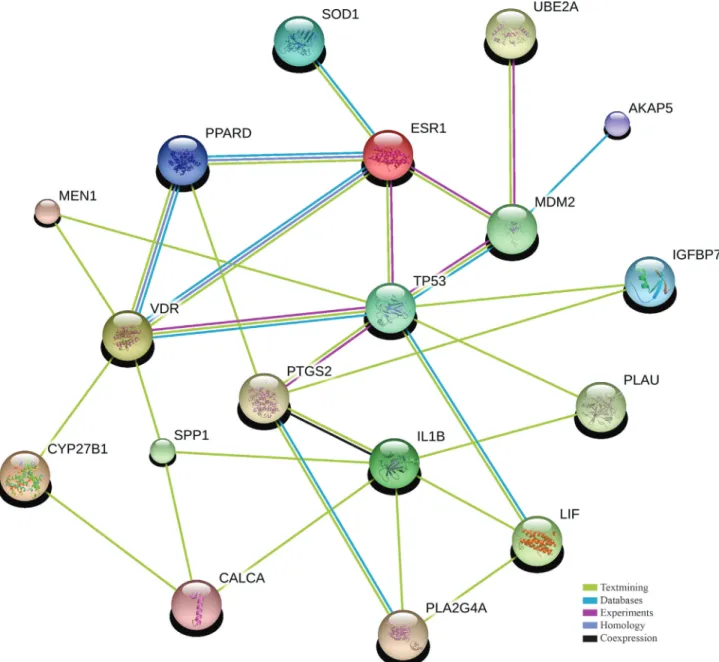
The p53 protein and its signal transduction pathway are composed of a set of genes and their protein products that are designed to respond to a wide variety of intrinsic and extrinsic stress signals. Although the important interac-tion between p53 andLIFis crucial for embryo implanta-tion, current evidence suggests that not onlyLIF, but other genes may be important in the reproductive stages of decidualization and implantation. To further test this hy-pothesis, we constructed a network with 18TP53related genes involved in decidualization and implantation pro-cesses, includingLIF,MDM2and others (Figure 1). Genes related to decidualization and implantation were compiled from the Gene Ontology website database using the AmiGO browser. Association among these genes was tested using the STRING 9 software which tests available known and predicted gene/protein interactions (Szklarczyk
et al., 2011). This “two-step” approach was chosen to mini-mize the possibility of false associations during the STRING analysis due to co-existence of words. Table S2 summarizes the 18 genes of this network, as well as their in-terconnections and wide range of functions. It is important to note that neither p63 nor p73 are on this list, since their main reproduction-related functions refer to the control of ovulation and female germ cell integrity in humans, and
they apparently are not involved in decidualization or em-bryo implantation stages.
This “TP53Fertility Network” illustrates the impor-tance of multiple genes in these specific stages of human fertility and opens a wide range of possibilities for genetic variation studies in genes not yet being investigated with regard to fertility. For example, IGFBP7 (insulin-like growth factor binding protein 7) is predominantly expres-sed in the vasculature of developing embryos and regulates vascular endothelial growth factor-A-dependent neoangio-genesis (Hooperet al., 2009).ESR1(estrogen receptor 1) gene is critical for LIF expression (Fenget al., 2011) and
IL1B(interleukin 1, beta) is involved in a variety of cellular activities that are essential for decidualization, including cell proliferation, differentiation, and apoptosis (Ben-Sas-sonet al., 2009).
An additional analysis to verify if these 18 genes be-long to a specific functional cluster was performed using GeneDecks V3 software. Thirteen of them were function-ally clustered as having an involvement in the reproductive system (CYP27B1, ESR1, LIF, MEN1, PLA2G4A, PLAU, PPARD, PTGS2, SOD1, SPP1, TP53, UBE2AandVDR). More specifically, seven genes (CALCA, IL1B, LIF, PPARD, PTGS2, SOD1andSPP1) were associated with embryo implantation (p = 1x10-16) and seven (CYP27B1, LIF, PLA2G4A, PPARD, PTGS2, SPP1 and VDR) with decidualization (p = 1x10-16). It is noteworthy that some genes are present in all functional clusters cited above (e.g. PPARD;peroxisome proliferator-activated receptor delta). This analysis brought additional evidence of the role of these genes in key stages of fertility.
Evolutionary Pattern of the
TP53 Fertility
Network
In order to explore certain evolutionary aspects of the network we expanded the analysis on its suitability as a model using two different approaches and taking into con-sideration inter- (vertebrate) and intra- (human) species variations of the 18 genes that comprise the network.
signifi-cantly (average of 41%) when the comparison involved only humans and fish species. The results generated from STRING 9.0 show that overall 90% of the network’s con-nections (edges) were retrieved in primates, while for pla-cental mammals the value was reduced to 80%. However, when all vertebrates were considered, only 42% of the net-work is recovered. These results suggest that some of the 18 network genes may have acquired novel functions in differ-ent taxa, throughout vertebrate evolution, in addition to
an-cestral functions, a similar situation to that reported previ-ously for theHOXfamily genes (Chenet al., 2010).
The second approach was to study variation within the 18 genes between human populations. The data were compiled from HapMap and ENSEMBL databases. Using this strategy we identified 10,918 polymorphisms, only 1.4% of which being non-synonymous changes (Table S4). Of these, 82 (e.g.Pro72Arg) are predicted to be deleterious (Table S5). For most other potentially deleterious poly-morphisms no striking difference was found in allele
quencies among continental populations. However, some notable exceptions can be highlighted. Reminiscent of the Pro72Arg polymorphism, the rs5241 SNP located in the
CALCA gene shows a frequency of 17% in Africans, whereas it is absent in European-descendents. On the other hand, for another SNP (rs2227564) located in thePLAU
gene, the rare allele is only present in Euro-Asian popula-tions (23%-33%), whereas it is absent in Africans (Table S1). Overall, these examples suggest that selection pressure for specific alleles in defined populations has af-fected only a small subset of the genes involved in the pro-posed network.
Since reproduction is central to the evolutionary pro-cess, in all vertebrates, as well as in other organisms, the ge-nome is expected to be optimized for reproductive success. However, even among vertebrates there is an immense di-versity in how reproduction occurs, including care and rear-ing of the offsprrear-ing (de Magalhaes and Church, 2005; Plunkettet al., 2011). There are many reasons in the evolu-tionary history of each species, including of our own and of other phylogenetically close species, such as Neanderthal, Denisova and chimpanzee that can explain shared and uni-que reproductive traits. Our results show for instance, that the human fertility network is not identical in all vertebrate species investigated here. An additional complicating fac-tor is that for humans reproductive strategies can have changed drastically due to cultural practices, as well as in response to environmental pressures (e.g.climate change). Thus, it is expected that part of this diversity is the result of variable selection pressures encountered by human popula-tions as they progressively expanded over the world.
Finally, this analysis adds further support to the idea that there is not a unique major effect gene involved in fer-tility and that an approach based on a wider gene network and taken under an evolutionary perspective may lead to the delineation of a more comprehensive view of the impact of p53 on the complex biology of fertility. Additional in-vestigations at population level, as well as functional stud-ies are needed to clarify the exact implications of the inter-(vertebrate) and intra- (human) differences highlighted in the present study.
Acknowledgments
This study was supported by grants from Conselho Nacional de Desenvolvimento Científico e Tecnológico (CNPq grant 475471/2009-1) and Fundo de Incentivo à Pesquisa do Hospital de Clínicas de Porto Alegre FIPE/HCPA (grant 09–430). DDP and VRPC are sup-ported by grants from CNPq.
References
Atwal GS, Bond GL, Metsuyanim S, Papa M, Friedman E, Distel-man-Menachem T, Ben Asher E, Lancet D, Ross DA, Sninsky J,et al.(2007). Haplotype structure and selection of
the MDM2 oncogene in humans. Proc Natl Acad Sci USA 104:4524-4529.
Atwal GS, Kirchhoff T, Bond EE, Montagna M, Menin C, Berto-relle R, Scaini MC, Bartel F, Bohnke A, Pempe C, et al. (2009) Altered tumor formation and evolutionary selection of genetic variants in the human MDM4 oncogene. Proc Natl Acad Sci USA 106:10236-10241.
Belyi VA, Ak P, Markert E, Wang H, Hu W, Puzio-Kuter A and Levine AJ (2010) The origins and evolution of the p53 fam-ily of genes. Cold Spring Harb Perspect Biol 2:a001198. Ben-Sasson SZ, Hu-Li J, Quiel J, Cauchetaux S, Ratner M,
Sha-pira I, Dinarello CA and Paul WE (2009) IL-1 acts directly on CD4 T cells to enhance their antigen-driven expansion and differentiation. Proc Natl Acad Sci USA 106:7119-7124.
Bianco B, Christofolini DM, Brandes A, Lerner TG, Gonçalves-Filho RP, Souza AM and Barbosa CP (2011) Analysis of codon 72 polymorphism of the TP53 gene in infertile women with and without endometriosis. Rev Bras Ginecol Obstet 33:37-42 (in portuguese).
Bond GL, Hu W, Bond EE, Robins H, Lutzker SG, Arva NC, Bargonetti J, Bartel F, Taubert H, Wuerl P,et al.(2004) A single nucleotide polymorphism in the MDM2 promoter at-tenuates the p53 tumor suppressor pathway and accelerates tumor formation in humans. Cell 119:591-602.
Bourdon JC, Fernandes K, Murray-Zmijewski F, Liu G, Diot A, Xirodimas DP, Saville MK and Lane DP (2005) p53 isoforms can regulate p53 transcriptional activity. Genes Dev 19:2122-2137.
Chen JR, Cheng JG, Shatzer T, Sewell L, Hernandez L and Stew-art CL (2000) Leukemia inhibitory factor can substitute for nidatory estrogen and is essential to inducing a receptive uterus for implantation but is not essential for subsequent embryogenesis. Endocrinology 141:4365-4372.
Chen L, Zhao P, Wells L, Amemiya CT, Condie BG and Manley NR (2010) Mouse and zebrafish Hoxa3 orthologues have nonequivalentin vivoprotein function. Proc Natl Acad Sci USA 107:10555-10560.
de Magalhaes JP and Church GM (2005) Genomes optimize re-production: Aging as a consequence of the developmental program. Physiology (Bethesda) 20:252-259.
Dumon P, Leu JI, Della Pietra 3rdAC, George DL and Murphy M (2003) The codon 72 polymorphic variants of p53 have markedly different apoptotic potential. Nat Genet 33:357-365.
Feng Z, Hu W, de Stanchina E, Teresky AK, Jin S, Lowe S and Levine A J (2007) The regulation of AMPK beta1, TSC2, and PTEN expression by p53: Stress, cell and tissue speci-ficity, and the role of these gene products in modulating the IGF-1-AKT-mTOR pathways. Cancer Res 67:3043-3053. Feng Z, Zhang C, Kang HJ, Sun Y, Wang H, Naqvi A, Frank AK,
Rosenwaks Z, Murphy ME, Levine AJ,et al.(2011) Regula-tion of female reproducRegula-tion by p53 and its family members. FASEB J 25:2245-2255.
Gardner RD and Burke DJ (2000) The spindle checkpoint: Two transitions, two pathways. Trends Cell Biol 10:154-158. Gonfloni S, Di Tella L, Caldarola S, Cannata SM, Klinger FG, Di
Green RE, Krause J, Briggs AW, Maricic T, Stenzel U, Kircher M, Patterson N, Li H, Zhai W, Fritz MH,et al.(2010) A draft sequence of the Neandertal genome. Science 328:710-722. Hoh J, Jin S, Parrado T, Edington J, Levine AJ and Ott J (2002)
The p53MH algorithm and its application in detecting p53-responsive genes. Proc Natl Acad Sci USA 99:8467-8472. Hollstein M and Hainaut P (2010) Massively regulated genes: The
example of TP53. J Pathol 220:164-173.
Hooper AT, Shmelkov SV, Gupta S, Milde T, Bambino K, Gillen K, Goetz M, Chavala S, Baljevic M, Murphy AJ, et al. (2009) Angiomodulin is a specific marker of vasculature and regulates vascular endothelial growth factor-A-dependent neoangiogenesis. Circ Res 105:201-208. Hu W, Feng Z, Ma L, Wagner J, Rice JJ, Stolovitzky G and Levine
AJ (2007a) A single nucleotide polymorphism in the MDM2 gene disrupts the oscillation of p53 and MDM2 levels in cells. Cancer Res 67:2757-2765.
Hu W, Feng Z, Teresky AK and Levine AJ (2007b) p53 regulates maternal reproduction through LIF. Nature 450:721-724. Kang HJ, Feng Z, Sun Y, Atwal G, Murphy ME, Rebbeck TR,
Rosenwaks Z, Levine AJ and Hu W (2009) Single-nucleo-tide polymorphisms in the p53 pathway regulate fertility in humans. Proc Natl Acad Sci USA 106:9761-9766. Kay C, Jeyendran RS and Coulam CB (2006) p53 tumour
sup-pressor gene polymorphism is associated with recurrent im-plantation failure. Reprod Biomed Online 13:492-496. Kruse JP and Gu W (2009) Modes of p53 regulation. Cell
137:609-622.
Lain S and Lane D (2003) Improving cancer therapy by non-geno-toxic activation of p53. Eur J Cancer 39:1053-1060. Lane DP (1992) Cancer. p53, guardian of the genome. Nature
358:15-16.
Levine AJ, Tomasini R, McKeon FD, Mak TW and Melino G (2011) The p53 family: Guardians of maternal reproduction. Nat Rev Mol Cell Biol 12:259-265.
Lindsay J, McDade SS, Pickard A, McCloskey KD and McCance DJ (2011) Role of DeltaNp63gamma in epithelial to mesenchymal transition. J Biol Chem 286:3915-3924. Lu WJ, Amatruda JF and Abrams JM (2009) p53 ancestry: Gazing
through an evolutionary lens. Nat Rev Cancer 9:758-762. Malkin D, Li FP, Strong LC, Fraumeni Jr JF, Nelson CE, Kim
DH, Kassel J, Gryka MA, Bischoff FZ, Tainsky MA,et al. (1990) Germ line p53 mutations in a familial syndrome of breast cancer, sarcomas, and other neoplasms. Science 250:1233-1238.
Michael D and Oren M (2003) The p53-Mdm2 module and the ubiquitin system. Semin Cancer Biol 13:49-58.
Mills AA, Zheng B, Wang XJ, Vogel H, Roop DR and Bradley A (1999) p63 is a p53 homologue required for limb and epider-mal morphogenesis. Nature 398:708-713.
Nedelcu AM and Tan C (2007) Early diversification and complex evolutionary history of the p53 tumor suppressor gene fam-ily. Dev Genes Evol 217:801-806.
Oh JE, Kim RH, Shin KH, Park NH and Kang MK (2011) DeltaNp63alpha protein triggers epithelial-mesenchymal transition and confers stem cell properties in normal human keratinocytes. J Biol Chem 286:38757-38767.
Phelps M, Darley M, Primrose JN and Blaydes JP (2003) p53-in-dependent activation of the hdm2-P2 promoter through mul-tiple transcription factor response elements results in
ele-vated hdm2 expression in estrogen receptor alpha-positive breast cancer cells. Cancer Res 63, 2616-2623.
Plunkett J, Doniger S, Orabona G, Morgan T, Haataja R, Hallman M, Puttonen H, Menon R, Kuczynski E, Norwitz E,et al. (2011) An evolutionary genomic approach to identify genes involved in human birth timing. PLoS Genetics 7:e1001365. Reich D, Green RE, Kircher M, Krause J, Patterson N, Durand EY, Viola B, Briggs AW, Stenzel U, Johnson PL, et al. (2010) Genetic history of an archaic hominin group from Denisova Cave in Siberia. Nature 468:1053-1060.
Ribeiro Junior CL, Arruda JT, Silva CT and Moura KK (2009) Analysis of p53 codon 72 gene polymorphism in Brazilian patients with endometriosis. Genet Mol Res 8:494-499. Shan J, Brooks C, Kon N, Li M and Gu W (2008) Dissecting roles
of ubiquitination in the p53 pathway. Ernst Schering Found Symp Proc 2008-1:127-136.
Shi H, Tan SJ, Zhong H, Hu W, Levine A, Xiao CJ, Peng Y, Qi XB, Shou WH, Ma RL,et al.(2009) Winter temperature and UV are tightly linked to genetic changes in the p53 tumor suppressor pathway in eastern Asia. Am J Hum Genet 84:534-541.
Stewart CL, Kaspar P, Brunet LJ, Bhatt H, Gadi I, Kontgen F and Abbondanzo SJ (1992) Blastocyst implantation depends on maternal expression of leukaemia inhibitory factor. Nature 359:76-79.
Straub WE, Weber TA, Schafer B, Candi E, Durst F, Ou HD, Rajalingam K, Melino G and Dotsch V (2010) The C-ter-minus of p63 contains multiple regulatory elements with dif-ferent functions. Cell Death Dis 1:e5.
Szklarczyk D, Franceschini A, Kuhn M, Simonovic M, Roth A, Minguez P, Doerks T, Stark M, Muller J, Bork P, et al. (2011) The STRING database in 2011: Functional interac-tion networks of proteins, globally integrated and scored. Nucleic Acids Res 39:D561-D568.
Tagliani-Ribeiro A, Oliveira M, Sassi AK, Rodrigues MR, Zago-nel-Oliveira M, Steinman G, Matte U, Fagundes NJ and Schuler-Faccini L (2011) Twin Town in South Brazil: A Nazi’s experiment or a genetic founder effect? PLoS One 6:e20328.
Tagliani-Ribeiro A, Paskulin DD, Oliveira M, Zagonel-Oliveira M, Longo D, Ramallo V, Ashton-Prolla P, Saraiva-Pereira ML, Fagundes NJ, Schuler-Faccini L,et al. (2012) High twinning rate in Cândido Godói: A new role for p53 in hu-man fertility. Hum Reprod 27:2866-71.
Thomas M, Kalita A, Labrecque S, Pim D, Banks L and Matlashe-wski G (1999) Two polymorphic variants of wild-type p53 differ biochemically and biologically. Mol Cell Biol 19:1092-1100.
Toledo F, Krummel KA, Lee CJ, Liu CW, Rodewald LW, Tang M and Wahl GM (2006) A mouse p53 mutant lacking the proline-rich domain rescues Mdm4 deficiency and provides insight into the Mdm2-Mdm4-p53 regulatory network. Can-cer Cell 9:273-285.
Tomasini R, Tsuchihara K, Wilhelm M, Fujitani M, Rufini A, Cheung CC, Khan F, Itie-Youten A, Wakeham A, Tsao MS, et al. (2008) TAp73 knockout shows genomic instability with infertility and tumor suppressor functions. Genes Dev 22:2677-2691.
Internet Resources
Online Mendelian Inheritance in Man (OMIM).
http://www.ncbi.nlm.nih.gov/OMIM (May 30, 2011).
International Agency for Research on Cancer (IARC)TP53 Mu-tation Database. http://www-p53.iarc.fr/index.html (May 30, 2011).
The InternationalHapMapProject.
http://hapmap.ncbi.nlm.nih.gov/ (May 30, 2011).
The ALlele FREquencyDatabase(ALFRED). http://al-fred.med.yale.edu/ (May 30, 2011).
Gene Ontology AmiGO browser.
http://amigo.geneontology.org/cgi-bin/amigo/go.cgi (March 28, 2011).
STRING 9.0 software. http://string-db.org/ (March 28, 2011).
LALIGN software. http://www.ch.embnet.org/soft-ware/LALIGN_form.html (March 28, 2011).
GeneDecks V3 software. http://www.genecards.org/ (June 30/2011).
Supplementary Material
The following online material is available for this ar-ticle:
- Table S1 - Frequencies of deleterious polymor-phisms available in the HapMap database.
- Table S2 - Eighteen genes which influence the TP53 Fertility Network.
- Table S3 - Amino acid conservation of the Fertility Network genes.
- Table S4 - The variation and conservation of the Fertility Network genes.
- Table S5 - Non-coding variation and damaging pre-diction of Fertility Network genes.
This material is available as part of the online article from http://www.scielo.br/gmb.