w w w . e l s e v ie r . c o m / l o c a t e / b j i d
The
Brazilian
Journal
of
INFECTIOUS
DISEASES
Original
article
Humoral
and
cellular
immune
response
of
mice
challenged
with
Yersinia
pestis
antigenic
preparations
Elida
A.
Leal
a,∗,
Josimar
D.
Moreira
b,
Fernanda
F.
Nunes
b,
Larissa
R.
Souza
b,
Janaina
M.
Martins
b,
Vicente
P.C.
Toledo
b,
Alzira
M.P.
Almeida
c,
Tania
M.P.
Guimarães
baInstitutoOctavioMagalhães,DivisãodeEpidemologiaeControledeDoenc¸as,Servic¸odeDoenc¸asBacterianaseFúngicas,Belo
Horizonte,MG,Brazil
bUniversidadeFederaldeMinasGerais,FaculdadedeFarmácia,DepartamentodeAnálisesClínicaseToxicológicas,BeloHorizonte,MG,
Brazil
cFundac¸ãoOswaldoCruz,CentrodePesquisaAggeuMagalhães,DepartamentodeMicrobiologia,Recife,PE,Brazil
a
r
t
i
c
l
e
i
n
f
o
Articlehistory:
Received5April2017
Accepted26September2017
Availableonline12October2017
Keywords: Yersiniapestis
Antigens Mice
Immuneresponse
Vaccines
a
b
s
t
r
a
c
t
Objectives:Theplague,whichisaninfectiousdiseasecausedbyYersiniapestis,still threat-ensmanypopulationsinseveralcountries.Theworldwideincreaseinhumanplaguecases andthepotentialuseofthebacteriaasabiologicalweaponreinforcetheneedtostudythe immunitythatisinducedbypotentialvaccinecandidates.Todeterminethe immunogenic-ityofantigenicpreparationsbasedontheF1proteinandthetotalextractfromY.pestis,we assessedtheroleoftheseantigensininducinganimmuneresponse.
Methods:TheimmunogenicityofantigenicpreparationsbasedontheY.pestis(YP)total extractandtheY.pestisfraction1capsularantigenprotein(F1)wasdeterminedin
Swiss-Webstermiceimmunizedwith40gor20gforeachpreparation.Immunophenotyping
wasperformedbyflowcytometry.
Results:AnimalsimmunizedwiththeYPtotalextractdidnotelicitdetectableanti-F1 anti-bodies(Ab)inthehemaglutination/inhibition(HA/HI)test.Animalsimmunizedwith40g or20goftheF1proteinproducedanti-F1Abs,withtitresrangingfrom1/16to1/8132.The averageofCD3+–CD4+andCD3+–CD8+Tcellsdidnotdiffersignificantlybetweenthegroups.
NeitherYPtotalextractnorF1proteininducedasignificantexpressionofIFN-␥andIL-10in CD4+Tlymphocytes.Inaddition,F1failedtoinduceIFN-␥expressioninCD8+Tcells,unlike
theYPtotalextract.
Conclusion:The results showed thatF1 proteinis not animmunogenic T cell antigen, althoughtheYPtotalextract(40gdose)favouredCD8+Tcell-mediatedcellularimmunity. ©2017SociedadeBrasileiradeInfectologia.PublishedbyElsevierEditoraLtda.Thisisan openaccessarticleundertheCCBY-NC-NDlicense(http://creativecommons.org/licenses/ by-nc-nd/4.0/).
∗ Correspondingauthor.
E-mailaddress:[email protected](E.A.Leal). http://dx.doi.org/10.1016/j.bjid.2017.09.001
Introduction
Theplague,whichiscausedbyYersiniapestis,isessentially
arodent-flea-transmitteddiseasethataffectsmanandother
mammalianspecies.1DuetothepossibilityofusingY.pestis
forbioterrorismpurposesandthehighmortalityrateofthe
disease,2thereisacrucialneedtostudytheimmunityinduced
bypotentialvaccinecandidatesforfutureuseas
immunopro-phylaxis.Inrecentyears,efforthasfocusedondevelopinga
subunitvaccinebasedonvirulencefactorsofthisbacterium.3
Y.pestisF1capsularantigenprotein(Fraction1orF1)has
been evaluated in several immunization studies that used
experimentalanimals.4–6Furthermore,vaccinesthatare
for-mulatedwithwholecellsmaycontributetotheinductionof
aneffectiveimmuneresponse.7Themechanismofprotection
conferredbythesepreparationshasnotbeenfullyelucidated, butithasalreadybeenshownthataneffectivevaccineagainst
theplaguemustinducebothhumoralimmunityandTh1type
cellularresponse.8
Aimingtodeterminetheimmunogenicityoftheantigenic
preparationsbasedonthetotalextractfromY.pestisandthe F1protein,weassessedtheroleoftheseantigensininducing
theproductionofantibodies,determiningthephenotypeof
splenicT-lymphocytesandstimulatingtheproductionof
IFN-␥andIL-10bysubpopulationsofCD4+andCD8+Tcells.
Materials
and
methods
Animals
Female, 6–8-week-old, Swiss-Webster mice (20–24g) were
obtained from the Universidade Federal de Minas Gerais
(UFMG)facilities.Fouranimalspercageweremaintainedwith
temperaturesat21–24◦C,a12hlight/darkcycle,andfedwith pelletizedfoodandwateradlibitum.Duetothepolicyof reduc-ingthenumberofanimalsusedinresearchprotocols,onlythe
minimumnumberofanimalspergroupwasutilized.
PreparationofwholecellextractandY.pestisF1antigen
Y.pestisstrainCYP0579fromtheculturecollection
Fiocruz-CYPwasreactivated byinoculation inbrainheart infusion
brothmedia(Difco, USA)and incubated overnightat37◦C.
Thepresenceofthe genescaf1,lcr,pla, andirp2,whichare
prominentpathogenicitymarkers,9wasdeterminedbyM-PCR
accordingtoLealandAlmeida.10Theculturewasinactivated
bythe addition of2% formaldehyde (Sigma–Aldrich, USA),
incubatedovernightatroomtemperature,23–25◦C,andplated onbloodagarbase(Difco,USA)toconfirmbacterialdeath.The
F1antigenwasextracted fromthe Y.pestisstrainA1122 as
previouslydescribed.11
TheY.pestisformaldehyde-killedsuspension(YP)was
frag-mentedbysonicationfor90s(2cyclesof30Hzand2cycles
of60Hzintercalatedwithanicebath).TheYP totalextract
andF1proteinweresubjectedtogammaradiation.The
pro-teinconcentrationofthepreparationswasdeterminedbythe
Lowrymethod12andtheproductsweresuspendedinPBSat
pH7.2–7.4.
Immunization
FourgroupsoffourfemaleSwiss-Webstermicewere
immu-nized with40gor20goftheYP totalextractand theY.
pestisF1proteinsuspensionsinPBSplus25%(v/v)aluminium
hydroxideadjuvant,administeredintwodoseswitha21-day
interval.Eachanimalwasinjectedintramuscularlyinthe
pos-teriorthighwithatotalvolumeof0.1mL.Thecontrolgroup
receivedthesamevolumeofaluminiumhydroxideadjuvant
in PBS. After primary immunization, on day 42, the mice
receivedaboosterintravenousinjectionatthebaseofthetail
with4gor2gdoses ofthe antigenswithout adjuvant.13
Onday45afterprimaryimmunization,micewereeuthanized
byanaesthetic overdose.Bloodsamplesand spleensofthe
immunizedandcontrolmicewerecollected.
Hemaglutination/inhibitiontest(HA/HI)
Serawerecollectedfromimmunizedanimalsthroughoutthe
studyandassayedforthepresenceofanti-F1AbsbytheHA/HI
test.11 Thetest wasconsideredpositive whentheHA
end-pointtitrewasdepressedbythreeormoredilutionsinthe
HItest.Atitreof1/16wasconsideredpositive.
Preparationofspleencellsuspensions
Singlecellsuspensionswerepreparedfromeach2/3spleenin
RPMI1640(Gibco,Germany).Eachspleenwasaseptically
col-lected,andthemononuclearcellswerefilteredthroughsterile
nylon.ThecellswerewashedinRPMI1640andspundownat
440×gfor10minat18◦C.Theerythrocyteswerelysedwithan
ammoniumchloridesolution,andthecellswerewashedthree
timesinRPMI1640andresuspendedintoRPMI1640
supple-mentedwith5%heat-inactivatedfoetalcalfserum(Cultilab,
SP,Brazil),penicillin(100UI/mL)andstreptomycin(50pg/mL;
Sigma–Aldrich,USA).
Spleencellcultureandflowcytometryanalysis
Mononuclearcellswereisolatedfromthespleensof
immu-nized and control mice by Ficoll-Hypaque (Sigma–Aldrich,
USA) density gradient centrifugation. After counting the
viable lymphocytes, suspensionswere preparedcontaining
1×10⁶spleniccells/mLinRPMIsupplementedwith5%foetal
bovineserum,2mMglutamine,50UIpenicillin,and0.05mg
streptomycin (Sigma–Aldrich, USA). Cell suspensions were
usedforthephenotypicanalysisoflymphocytesandfor intra-cellularcytokineanalysis.
Cellsurfacemarkerstainingwasperformedbyaddingthe
previouslypreparedcellsuspension(0.1mL)toflowcytometry
tubescontainingcombinationsofthefollowing
fluorochrome-labelled Abs: CD3-FITC (145-2C11), CD4-PercpCy55 (RM4-5)
andCD8-APC(53–6.7)(BectonDickinson,USA).Sampleswere
vortexedgentlyandincubatedfor30minatroom
tempera-ture.Thefixingsolutioncontaining4%paraformaldehydewas
addedtothesamples,whichwererefrigerateduntilflow
cyto-metric analysis. Lymphocyteswere specificallyanalyzedby
samefluorochromewasused.Dataanalysiswasperformed usingtheFlowJosoftware.
Forintracellularcytokineanalysis,1×106spleencellsfrom
each animalwere platedina 24-wellplateand stimulated
with10g/mLofYPtotalextractor Y.pestisF1antigenfor 72h.CultureswithoutaddedY.pestisproteinsservedas
con-trols.GolgiPlug(1g/mL–BectonDickinson,USA)wasadded
duringthelast4hofincubation.Cellsweresurfacestained
withanti-CD3-FITC (145-2C11),anti-CD4-PercpCy55 (RM4-5)
andanti-CD8-APC(53–6.7) Abs(BectonDickinson,USA)and
thenfixedwith4%paraformaldehydefor10min.After
perme-abilization,cellswerestainedwithanti-IFN-␥-PeCy7(XMG1.2) andanti-IL-10-PE(JES5-16E3)orisotypecontrols(Becton
Dick-inson, USA) and analyzed using flow cytometry (Forteza,
BectonDickinson,USA).
Statisticalanalyses
The difference of the data among groups was compared
by analysis of variance (ANOVA) using the R software14
andprobability valuesof<0.05 wereconsidered significant.
The number of animals per group (N) was determined
using the standard deviation, difference to be detected,
andsignificancelevel15,16andwasconfirmedbythewebsite
http://www.lee.dante.br/esquisa/amostragem/amostra.html.17
Ethics
MicewerehandledfollowingtheGuidefortheCareandUseof
LaboratoryAnimalsguidelines.18Theexperimentalprotocols
wereapprovedbythe EthicsCommitteeonAnimal
Experi-mentation(CETEA)ofUFMG(ProtocolNo.n◦148/2014).
Results
Y.pestisanti-F1antibody(Ab)inanimalsimmunized withdifferentimmunizationprotocols
Tocharacterizethehumoralresponseinducedby
immuniza-tionwithdifferentdosesoftheYPtotalextractandtheY.pestis
F1protein,anti-F1AbtitresweredeterminedbytheHA/HItest
fromserumsamplesofimmunizedmicethatwerecollected
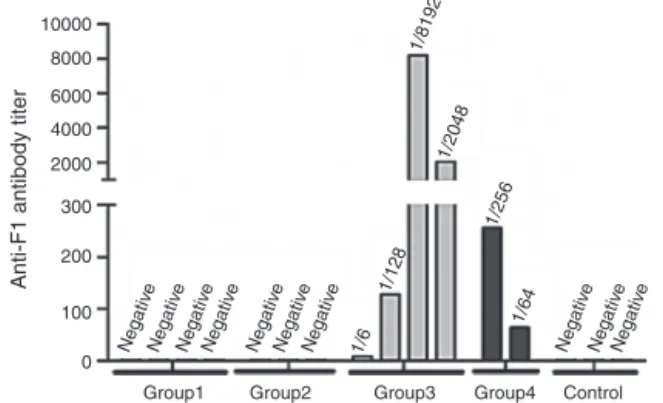
45days post-immunization.Anti-F1 Abswere notdetected
inthetwogroupsimmunizedwith40g(Group1)and20g
(Group2)ofYPtotalextractorinthe controlgroup,which
receivedaluminiumhydroxideadjuvantinPBS.Intheanimals
immunizedwiththeY.pestisF1antigen,theanti-F1Abtitres
inHA/HIrangedfrom1/16to≥1/8132inthegroupreceiving
40gF1(Group3)andfrom1/64to1/256inthegroupreceiving 20gF1(Group4).Itshouldbepointedoutthatthevolumeof serafromsomemiceofgroups2(1),4(2)andcontrol(1)was notenoughfortheHA/HItests(Fig.1).
PhenotypicanalysisofsplenicTcellsafterimmunization
Becausetheresponsetoimmunizationinvolvesactivationat
thecellularlevel,flowcytometricanalysiswasperformedto
investigatewhetherimmunizationresultedinchangesin
cel-lular activation markersor grosschanges ofcell countsof
0
Group3 Group4
Negativ e
Negativ e
Negativ e
Negativ e
Negativ e
Negativ e
Negativ e
1/64 1/256 1/2048 1/8192
1/128
1/6 Negativ e
Negativ e
Negativ e
Control Group2
Group1
Anti-F1 antibody titer
100 200 300 2000 4000 6000 8000 10000
Fig.1–Yersiniapestisanti-F1antibodyinmiceimmunized withdifferentimmunizationprotocols.Group1:40gofYP totalextract;Group2:20gofYPtotalextract;Group3: 40gofY.pestisF1antigen;Group4:20gofY.pestisF1 antigen;Control:aluminiumhydroxideadjuvant.n<4 (groups2,4andcontrol):thevolumeofserawas insufficientfortheHA/HItests.
micegivendifferentpreparationsofY.pestis.Therefore,within
the lymphocyte population, the changes inthe percentage
ofsplenicTcellswereevaluatedamongimmunizedgroups.
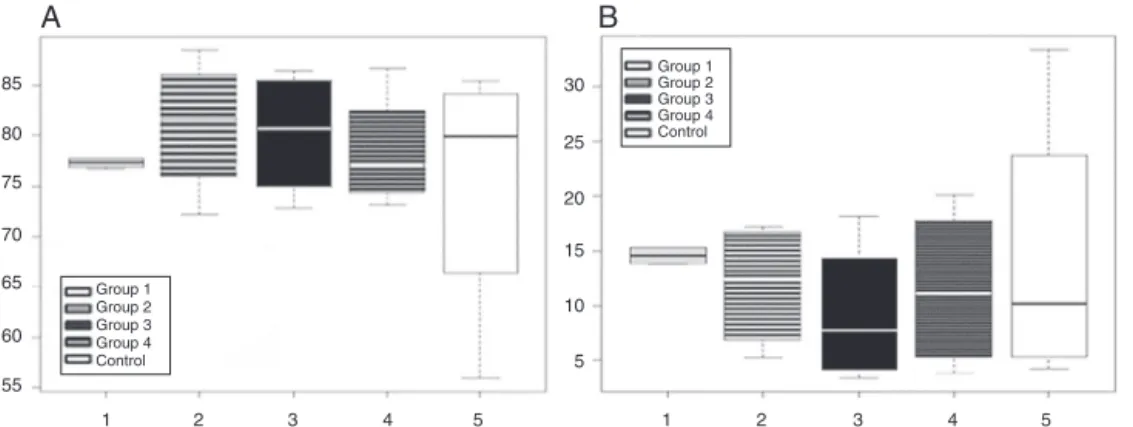
Nosignificantdifferenceswere observedinthepercentages
ofCD3+–CD4+andCD3+–CD8+Tcellsamongthefour
immu-nizedgroups(p>0.05).However,aclearpredominanceofCD4+
Tcellswasobservedinallgroups(Fig.2AandB).
DetectionofintracellularcytokinesIFN- andIL-10inT
cells
Toinvestigate theresponseofCD4+ and CD8+ T cellsafter
invitrostimulationwithYPtotalextractandY.pestisF1
anti-gen, spleen mononuclear cells from immunizedmice that
werecollected45dayspost-immunizationwereculturedand
assessedfortheproductionofIFN-␥andIL-10byflow
cytom-etry. A higher percentage of CD4+ T cells that expressed
IFN-␥wasobservedamongthegroupthatreceived40gYP
total extract compared to the other groups (Fig. 3A). The
levels of CD4+ T cells that expressed IL-10 were higher in
the groupsthatreceived40gand20gofYPtotalextract
(Fig.3B).However,nosignificantdifferenceswereobservedin
thepercentagesofCD4+TcellsthatproducedIFN-␥and
IL-10cytokinesafterstimulationwithYPtotalextract(p>0.05). ThepercentageofCD4+TcellsthatproducedIFN-␥(Fig.3C)
and IL-10 cytokines (Fig. 3D) was lower after stimulation
withtheY.pestisF1 antigenthanafterstimulationwithYP totalextract.Nosignificantdifferenceswereobservedinthe
percentages ofCD4+ T cells thatproduced IFN-␥and IL-10
cytokines among the groups after stimulation with the Y.
pestis F1 antigen(p>0.05). The percentage ofCD8+ T cells
that producedIFN-␥afterstimulationwithYP totalextract
was significantly higher in the group that received 40g
YP total extract (Fig. 3E) compared with the other groups
(p<0.05).Nosignificantdifferenceswereobservedinthe per-centageofCD8+TcellsthatexpressedIFN-␥(Fig.3F)among
the four groups after stimulation withY. pestis F1 antigen
30
25
20
15
10
5 85
80
75
70
65
60
5 Control
Control
Group 4
Group 4
Group 3
Group 3
Group 2
Group 2
Group 1
Group 1
4 3 2 1 5
4 3 2 1 55
A
B
Fig.2–PhenotypicanalysisofsplenicTcellsafterimmunization.A:CD3+–CD4+subpopulations.B:CD3+–CD8+
subpopulations.Group1:40gofYPtotalextract;Group2:20gofYPtotalextract;Group3:40gofY.pestisF1antigen; Group4:20gofY.pestisF1antigen;Control:aluminiumhydroxideadjuvant.
Discussion
Thepresentstudyaimedtoinvestigatetheimmunogenicity
ofthe antigenicpreparationsbased onthe Y.pestisF1
pro-teinand theYP totalextractininducingtheproductionof
anti-F1AbsandindeterminingthephenotypeofsplenicT
lymphocytesandthestimulationoftheproductionofIFN-␥
andIL-10amongthesubpopulationsofCD4+andCD8+Tcells
inmice.Theimmunizationprotocol utilized inouranimal
experimentswasbasedonapreviouslyestablishedmodel16
thatevaluatedtheprotectiveefficacyofY.pestisF1proteinand
Vsubunitvaccinesinmiceagainstsubcutaneouschallenges
ofthevirulentY.pestisstrain.Ourresultsshowedthatanimals
immunizedwiththeF1antigenexhibitedastronghumoral
response with high titres ofanti-F1 Ab in the HA/HI test.
Furthermore,itwasobservedthattheanimalsreceivingthe
lowest(20g)F1doseshowedtitres>1:16,whichwasthe cut-offpointintheHA/HItest.Thesefindingswereinaccordance
withanotherstudy16thatdemonstratedthatadoseof20g
oftheF1antigeninducedsignificantlyhighIgGtitresinmice. TheY.pestisF1andVsubunitvaccineshavebeenthefocusof severalstudies.AlthoughthevalueoftheY.pestisVantigenis
recognizedinitsprotectionagainstnon-encapsulatedstrains
(deficientinF1production),thesignificantcontributionofthe
F1proteinintheinductionofearlyimmuneresponsesisalso
important.Inastudytocharacterizetheimmuneresponse
ofmiceafterimmunizationwiththeF1protein,quantitative
ELISA analysisdemonstrated thatthe levels ofanti-F1 IgM
antibodieswere detectableinserum ofanimalsasearly as
day1post-immunizationandthatanti-F1IgGantibodieswere
detectedafterthreedays.19Theabilityofanti-F1Absto
pro-videeffectiveprotectionagainstthebubonicplaguehasbeen
demonstratedinseveralstudies.19,20 Totalprotection(100%) againstachallengewithavirulentY.pestisstrainwasobserved
inmiceimmunized withthe F1 antigen.19 In another
ani-malmodel,80%survivalratewasdemonstratedwithactive
immunizationwiththerecombinantF1andVantigen.20The
immunogenicityofrecombinantVandF1proteinsmaybeat
maximumbecausetheirconformationsaresimilartothose
ofnative proteins.21Therefore, thisfinding canexplainthe
hightitresofantibodies observedinourstudy becausethe
antigensusedintheimmunizationexperimentwereobtained
fromY.pestisculturesandnotbyusingrecombinantDNA
tech-niques.Theuseofthealuminiumhydroxideadjuvantcould
also explainthe resultsobtainedforthe humoral immune
response.Furthermore,otherstudieshavereportedthat
sub-unit vaccines comprising F1 and V antigensinaluminium
hydroxideinducedapredominantIgG1responseinbothmice
and humans.16,22 Ourresultsshowedthattheanti-F1titres
werevariableamongindividualsfromthesamegroup,which
can be attributedto the mouse lineage used inour study.
WechosetheexperimentalmodelwithSwiss-Webstermice,
whichisageneticallyheterogeneousoutbredlineage23 that
respondedindifferentwaystothesamestimulus.The
pur-poseofusingthatmouselinewastoadoptanexperimental
modelthatcoulddemonstratetherealefficacyofourputative
vaccinebecausetheresponsetovaccinationsmayvaryamong
individualsinapopulation.
Due to the policy of reducing the number of animals
inresearchprotocols,onlyexperimentswiththeminimum
number ofanimals pergroup were approvedbythe ethics
committee.Thiswouldbethebestalternative,althoughthe
possibility of loss throughout the experiments, e.g.,
insuf-ficient volume of sera, loss of mononuclear cells when
preparingthe spleenforcell culture,ormicrobial
contami-nationofcultivatedspleencellculture,wasdiscussed.Infact,
thelosswhenworkingwiththeexactnumberofanimalsper
groupdeterminedan“N”lowerthantheminimumcalculated.
Itmustbenotedthattheabsenceofthehumoralimmune
response to both doses ofthe YP total extract could
indi-catethattheimmunizationschemedidnotinducedetectable
levels ofanti-F1 antibodies. However, it could be that the
YP total extract did not containa sufficient concentration
of F1 protein to induce the humoral immune response in
mice.
Therole ofantibodies inprotectionagainstY.pestishas been verifiedbyseveralstudies.24,25 However,it seemsthat
thehumoralimmuneresponseinducedbysubunitvaccines
alonemaynotbesufficientforcompleteprotectionagainstthe
plague.Itwasobservedthattherewas80%protectionagainst
achallengewithY.pestisinmiceimmunizedwiththeF1andV
antigens;however,20%ofthemdidnotsurvive,eventhough
F
E
D
C
B
A
YP total extract YP total extract
Y. pestis F1 antigen
Y. pestis F1 antigen
Y. pestis F1 antigen
YP total extract
Control
Control
Control Control
Control
Control
Group 2
Group 2
Group 2
Group 2
Group 2
Group 2
Group 4
Group 4
Group 4 Group 4
Group 4
Group 4 Group 3
Group 3
Group 3
Group 3
Group 3 Group 3 Group 1
Group 1
Group 1
Group 1
Group 1
Group 1 0.0
0.0
0.0 0.0
0.0
0.0 0.5
0.5
0.5
0.5
0.5
0.5 1.0
1.0
1.0
1.0
1.0
1.0 1.5
1.5
1.5
% CD4
+
Tcell producing IFN
-γ
% CD4
+
Tcell producing IFN
-γ
% CD8
+
Tcell producing IFN
-γ
% CD8
+
Tcell producing IFN
-γ
% CD4
+
T-cell producing IL-10
% CD4
+
T-cell producing IL-10 1.5
1.5
1.5
Fig.3–DetectionofintracellularcytokinesIFN-␥andIL-10inTcells.(A)CD4+TcellsproducingIFN-␥and(B)IL-10cytokines afterstimulationwithYPtotalextract;(C)CD4+TcellsproducingIFN-␥and(D)IL-10cytokinesafterstimulationwithY.
pestisF1antigen;(E)CD8+TcellsproducingIFN-␥afterstimulationwithYPtotalextractand(F)afterstimulationwithY.
pestisF1antigen.Control:aluminiumhydroxideadjuvant;Group1:40gofYPtotalextract;Group2:20gofYPtotal extract;Group3:40gofY.pestisF1antigen;Group4:20gofY.pestisF1antigen.
protectionagainstY.pestisisnotexclusivelymediatedby
anti-bodiesanddependsontheinvolvementofTcellsandtheir
cytokinesecretion.20
TodeterminethechangesinthepercentageofTcellsthat
respondtoantigenic stimulus,weperformed
immunophe-notypic characterization and quantified the mononuclear
spleniccells.Ourfindingsindicatedaclearpredominanceof
CD4+Tcellsinallimmunizedgroupsstudied.Anotherstudy
alsoreportedahigherpercentageofCD4+TcellsthanCD8+T
cellsinperipheralbloodfromSwissmice.However,our
find-ingsshowednumbersofCD4+ Tcellsthatwerehigherthan
thosepreviouslyreported,24whichcanbejustifiedbythefact
thatourexperimentswere performedinspleenTcells.No
significantdifferenceswereobservedinthepercentageofT
cellsamongmicefromdifferentgroups,whichsuggestedthat
therewasnoTcellproliferationinresponsetoantigenic stim-ulation.
Intracellularcytokineanalysisshowedthatthehigherdose ofYPtotalextract(40g)inducedhigherexpressionofIFN-␥ inCD4+Tcells(group1).Althoughnosignificantdifferences
wereobserved,thisfindingmayindicatethatTcellactivation
ishigherinanimalsimmunizedwithahigherdose of
bac-terialtotalextract.Therefore,increasingthedoseofantigen
candidatesforthevaccineoradministeringadditionaldoses
mayrepresentanalternativetoimprovethecellularimmune
responsetoY.pestis.
Our study demonstrated that YP total extract induced
differencewasnotsignificant.AhigherpercentageofCD4+
Tcells thatexpressedIL-10ingroupsimmunizedwiththe
YPtotalextract(40gand20g)wasobserved.Theseresults
maysuggest aTh2response,which couldbeconfirmed by
determiningthepresenceofothercytokines,suchasIL-4,IL-5
andIL-6.GiventheimportanceofTh1andTh2inprotecting
againstY.pestisandthepossibleuseofappropriateadjuvants todirecttheadaptiveimmuneresponse,itishighlynecessary
tofindnewco-stimulatorymoleculesthatcaninduceamixed
responsebasedoncytokinesandantibodyproduction,which
wouldrepresentanimportantinnovationinvaccineresearch
fieldfortheplague.
Nosignificantdifferenceswereobservedinthepercentage
ofTcellactivationinresponsetotheF1antigen.
Addition-ally,ourfindings revealed thattheTcell responseinduced
bytheF1proteinwaslowerthan thatofthegroups
immu-nizedwiththeYPtotalextract.Thisfindingisconsistentwith apreviousstudy26thatdemonstratedthatF1antigenisunable
toinduceastrongcellularresponseinanimalsimmunized
withthe liveattenuated EV76 vaccine, suggestingthat the
F1proteinmay notrepresentadominantantigeninTcell
activation.Our results alsoshowed that the percentage of
CD8+ Tcells that expressedIFN-␥washigher inthegroup
thatreceived40gYPtotalextractthanintheothergroups, whichmaysuggesttheroleofYPtotalextractinelicitingaTh1 responsemediatedbythiscellularsubpopulation.Thisfinding
ishighlyimportantbecausetheproductionofIFN-␥and
TNF-␣byCD8+Tcellsplaysacrucialroleinactivatingmacrophages
andneutrophils,which,inturn,exhibitanincreased
produc-tionofreactiveoxygenintermediatesthatactinthecontrol
ofintracellularbacteria.27 ItwasdemonstratedthatY.pestis cannotreplicateinmacrophagesofmiceactivatedbyIFN-␥.28
MicewhoseTcells couldnotproduceIFN-␥andTNF-␣ did
notsurvivealethalpulmonaryY.pestisinfection.29 Anti-F1
andanti-VAbsprotectmiceagainstexperimentalpneumonic
plague,butthisprotectionishighlydependentonIFN-␥and
TNF-␣production.Therefore,animalsthatcanproduceand
respondeffectively to cytokinesseem to protectagainst Y.
pestisinfections.30Ourintracellularcytokinesanalysis
exhib-itedadifferentiatedresponseofanimalsfromgroup1,which
received40gYPtotalextract.Thesefindingsmaysuggestthe
activationofCD8+ TcellsbyY.pestisimmunodominant
epi-topes.Toconfirmthishypothesis,furtherstudiesareneeded
toidentifytheproteinsintheYPtotalextractandtheir
con-tributionstoinducingthecellularimmuneresponse.
Inbrief,weshowedthattheimmunizationregimenbased
ontheF1antigeninducedastronghumoralimmuneresponse,
whereas 40gand 20gofYP totalextractdidnot induce
anti-F1Ab productioninmice.Furthermore,immunization
withtheYPtotalextractandtheY.pestisF1antigenneither
promotedCD4+orCD8+Tcellproliferationnorinducedthe
expressionofIFN-␥andIL-10byCD4+Tcells;however,itdid
stimulatetheproductionofIFN-␥byCD8+Tcells.Therefore,
wecansuggestthatY.pestisF1proteinisnotanimmunogenic antigentoTcells.
Conflicts
of
interest
Theauthorsdeclarenoconflictsofinterest.
Acknowledgements
TheauthorsthankFAPEMIG,UFMGandFUNEDfortechnical
andfinancialsupports.
r
e
f
e
r
e
n
c
e
s
1.ButlerT.Plaguehistory:Yersin’sdiscoveryofthecausative bacteriumin1894enabled,inthesubsequentcentury, scientificprogressinunderstandingthediseaseandthe developmentoftreatmentsandvaccines.ClinMicrobiol Infect.2014;20:202–9.
2.InglesbyTV,DennisDT,HendersonDA,etal.Plagueasa biologicalweapon:medicalandpublichealthmanagement. WorkingGrouponCivilianBiodefense.JAMA.
2000;283:2281–90.
3.FeodorovaVA,MotinVL.Plaguevaccines:current developmentsandfutureperspectives.EmergMicrobes Infect.2012;1:1–5.
4.FriedlanderAM,WelkosSL,WorshamPL,etal.Relationship betweenvirulenceandimmunityasrevealedinrecent studiesoftheF1capsuleofYersiniapestis.ClinInfectDis. 1995;21:S178–81.
5.WelkosSL,DavisKM,PittML,etal.Studiesonthe
contributionoftheF1capsule-associatedplasmidpFratothe virulenceofYersiniapestis.ContribMicrobiolImmunol. 1995;13:299–305.
6.DavisKJ,FritzDL,PittML,etal.Pathologyofexperimental pneumonicplagueproducedbyfraction1-positiveand fraction1-negativeYersiniapestisinAfricangreenmonkeys (Cercopithecusaethiops).ArchPatholLabMed.1996;120:156–63. 7.WelkosSL,PittML,MartinezM,etal.Determinationofthe
virulenceofthepigmentation-deficientand
pigmentation-/plasminogenactivator-deficientstrainsof Yersiniapestisinnon-humanprimateandmousemodelsof pneumonicplague.Vaccine.2002;20:2206–14.
8.GuptaG,AlirR,KhanAA,etal.EvaluationofCD4+/CD8+T-cell
expressionandIFN-␥,perforinsecretionforB–Tconstructsof F1andVantigensofYersiniapestis.IntImmunopharmacol. 2012;12:64–73.
9.ZhouD,HanY,YangR,etal.Molecularandphysiological insightsintoplaguetransmission,virulenceandetiology. MicrobesInfect.2006;8:273–84.
10.LealNC,AlmeidaAMP.Diagnosisofplagueandidentification ofvirulencemarkersinYersiniapestisbymultiplex-PCR.Rev InstMedTropSaoPaulo.1999;41:339–42.
11.ChuMC.Laboratorymanualofplaguediagnosistests. Centersfordiseasecontrol.Washington,DC:Government PrintingOffice;2000,125p.
12.LowryOH,RosebroughNJ,FarrAL,etal.Proteinmeasurement withtheFolinphenolreagent.JBiolChem.1951;193:265–75. 13.LadicsGS,SmithC,ElliotGS,etal.Furtherevaluationofthe incorporationofanimmunotoxicologicalfunctionalassayfor assessinghumoralimmunityforhazardidentification purposesinratsinastandardtoxicologystudy.Toxicology. 1998;126:137–52.
14.RCoreTeam.R:alanguageandenvironmentforstatistical computing.Vienna,Austria:RFoundationforStatistical Computing;2014http://www.R-project.org
16.QiZ,ZhoubL,ZhangQ,etal.Comparisonofmouse,guinea pigandrabbitmodelsforevaluationofplaguesubunit vaccineF1+rV270.Vaccine.2010;28:1655–60.
17.PaesAT,OkanoV,PaesAT,OkanoV.Lee–Tamanhode amostra.
http://www.lee.dante.br/esquisa/amostragem/amostra.html [accessed16.12.14].
18.InstituteofLaboratoryAnimalResources.Guideforthecare anduseoflaboratoryanimals.8thed.Washington,DC:The NationalAcademiesPress;2011
http://grants.nih.gov/grants/olaw/guide-for-the-care-and-use-oflaboratory-animalsprepub.pdf[accessed25.01.17].
19.LevyY,FlashnerY,TidharA,etal.Tcellsplayanessential roleinanti-F1mediatedrapidprotectionagainstbubonic plague.Vaccine.2011;29:6866–73.
20.DincG,PenningtonJM,YolcuES,etal.ImprovingtheTh1 cellularefficacyoftheleadYersiniapestisrF1-Vsubunit vaccineusingSA-4-1BBLasanoveladjuvant.Vaccine. 2014;32:5035–40.
21.TitballRW,WilliamsonDE.Vaccinationagainstbubonicand pneumonicplague.Vaccine.2001;19:4175–84.
22.WilliamsonED,EleySM,StaggAJ,etal.Asub-unitvaccine elicitsIgGinserum,spleencellculturesandbronchial washingsandprotectsimmunizedanimalsagainst pneumonicplague.Vaccine.1997;15:1079–84.
23.ChiaR,AchilliF,FestingMF,etal.Theoriginsandusesof mouseoutbredstocks.NatGenet.2005;37:1181–6.
24.AndersonGWJr,WorhamP,BoltCR,etal.Protectionofmice fromfatalbubonicandpneumonicplaguebypassive immunizationwithmonoclonalantibodiesagainsttheF1 proteinofYersiniapestis.AmJTropMedHyg.1997;56:471–3. 25.HillJ,EylesJE,ElvinSJ,etal.Administrationofantibodytothe
lungprotectsmiceagainstpneumonicplague.InfectImmun. 2006;74:3068–70.
26.PhilipovskiyAV,SmileyST.VaccinationwithliveYersiniapestis primesCD4andCD8Tcellsthatsynergisticallyprotect againstlethalpulmonaryY.pestisinfection.InfectImmun. 2007;75:878–85.
27.ShepherdAJ,LemanPA.PlagueinSouthAfricanrodents 1972–81.TransRevSocTropMedHyg.1983;77:208–11. 28.PujolC,BliskaJB.TurningYersiniapathogenesisoutsidein:
subversionofmacrophagefunctionbyintracellularyersiniae. ClinImmunol.2005;114:216–26.
29.SzabaFM,KummerLW,DusoDK,etal.TNF-␣andIFN-␥but notperforinarecriticalforCD8Tcell-mediatedprotection againstpulmonaryYersiniapestisinfection.PLoSPathog. 2014;10:1–12.