Assessment for Learning in EBE/CLIL:
a learning-oriented approach to assessing English language skills
and curriculum content at early primary level
Ana Cristina da Costa Mano Xavier
Outubro 2015
Trabalho de Projeto apresentado para cumprimento dos requisitos necessários à obtenção do grau de Mestre em Didática do Inglês realizado sob a
Dedicated to my mother in whom I find all my strength
and to the Bilingual Schools Project teachers
Acknowledgements
Firstly, I would like to express my sincere gratitude to the Directorate-General for Education of the Portuguese Ministry of Education and Science, the British Council Portugal, the headteachers and the teachers of the bilingual schools, with whom I have learnt so much in the scope of the implementation of the Bilingual Schools Project, and for having authorised me to collect data for this project work.
I would like to deeply thank my supervisors: Mestre Vanessa Boutefeu and Professora Doutora Ana Gonçalves Matos, for having raised my awareness on the value of assessment as an intrinsic part of learning and teaching, and for their precious feedback, guidance and patience. Without them this project work would not have become a final product.
I am also grateful to Mestre Allyson Roberts for her contribution at the time of deciding upon a theme for my project work proposal; and to my remaining professors in this Master’s course: Professora Doutora Ana Frankenberg-Garcia and Mestre Dave Rowlands, who have deepened my knowledge in English Language Teaching.
My heartfelt thanks go to my family, my sister friends, my colleagues at the Directorate-General for Education and my former intern for their all-time encouragement and support.
I am also grateful to the Associação Portuguesa de Professores de Inglês (APPI) and Associação Portuguesa do Ensino Particular e Cooperativo for having helped me send out the questionnaires and having lent me the books I needed.
Abstract
Assessment is usually viewed as an inevitable event in teachers' and learners’ lives resulting from an imposition from education systems. However, if done well, assessment can provide learners, teachers and other stakeholders with sound information about learner performance and progress which will ultimately boost learning and feed into school success. This project work discusses ways of assessing both English language and curriculum content at early primary level and aims to provide learning-oriented guidelines and a principled framework for such assessment. It is meant for learners and teachers involved in Early Bilingual Education/Content and Language Integrated Learning at early primary level.
KEYWORDS – Assessment, formative assessment, assessment for learning, learning-oriented assessment, bilingual education, CLIL.
Resumo
A avaliação é comummente vista como um acontecimento inevitável na vida dos alunos e dos professores, resultante de uma imposição dos sistemas de ensino. No entanto, se bem conduzida, a avaliação pode, de forma eficaz, informar alunos, professores e outros atores, sobre o desempenho e o progresso do aluno, o que acabará por promover a aprendizagem e contribuir para o sucesso escolar. O presente trabalho de projeto discute formas de avaliar a língua inglesa e os conteúdos curriculares no 1.º ciclo do ensino básico e tem como objetivo fornecer recomendações orientadas para a aprendizagem, bem como um referencial para essa avaliação. Este trabalho tem como destinatários alunos e professores envolvidos num contexto de ensino bilingue precoce/aprendizagem integrada de conteúdos curriculares e língua no 1.º ciclo do ensino básico.
PALAVRAS-CHAVE – Avaliação, avaliação formativa, avaliação para a
Acknowledgements ...iv
Abstract ... v
List of Abbreviations ... viii
List of Figures ... ix
List of Tables ... x
Introduction ... 1
CHAPTER 1–Background and context ... 3
CHAPTER 2– Literature Review ... 9
2.1. The need for assessment literacy ... 9
2.1.1. Teacher assessment literacy defined ... 9
2.1.2. A profile of the CLIL teacher and their ability to assess ... 10
2.2. The supportive nature of assessment ... 11
2.2.1. A focus on the pedagogical purpose of assessment ... 11
2.2.2. Key principles of CLIL assessment in early primary ... 11
2.3. An overview on learning-oriented approaches to assessment ... 13
2.3.1. Contributions from other education systems ... 13
2.3.2. From formative assessment to learning-oriented assessment ... 14
2.3.3. Processes, strategies and frequency ... 15
2.3.4. Learner and teacher roles ... 16
2.3.5. Self- and peer assessment ... 17
2.3.6. Feedback to communicate progress ... 18
2.3.7. Observation to collect evidence ... 20
2.3.8. Planning, using and recording assessment ... 21
2.4. EBE/CLIL assessment in early primary ... 23
2.4.1. Contributions from research projects ... 23
2.4.2. Reference points for assessment ... 24
2.4.2.1. The curricula and the Metas Curriculares ... 24
2.4.2.2. The cognitive features of CLIL ... 27
2.4.3. Content and language: integrated or not? ... 30
2.4.4. Assessment criteria ... 30
2.4.4.1. Learning objectives and success criteria ... 30
2.4.4.2. Quality criteria ... 31
2.4.5. Learning tasks and tests as mini-assessments ... 33
2.4.6. Weighting, marking schemes and reporting ... 34
CHAPTER 3–Action research ... 37
3.1. Purpose ... 37
3.2. Procedure ... 37
3.2.1. Design ... 37
3.2.2. Methods and instruments ... 38
3.2.2.1. The questionnaires ... 38
3.2.2.2. The interviews ... 39
3.2.2.3. Classroom assessment observation checklists ... 39
3.2.2.4. Classroom assessment samples ... 39
3.2.3. Permissions, anonymity and piloting ... 40
3.2.4. Timeframe for data collection ... 40
3.3. Data analysis ... 40
3.3.1. Profile of respondents and sample material provided ... 40
3.3.2. Questionnaires ... 41
3.3.2.1. Questionnaire A (QA) – Teachers ... 41
3.3.2.2. Questionnaire B (QB) - Experts... 43
3.3.3. Interviews ... 46
3.3.4. Classroom observation checklists ... 48
3.3.5. Classroom assessment samples ... 50
3.4. Findings ... 52
3.5. Reflection and conclusion ... 53
CHAPTER 4–Assessment framework – an outline for a sample ... 53
4.1. Assessment literacy – Re-visiting assessment essentials ... 54
4.2. Assessment planning – A continuum of methods/techniques/tools ... 55
4.3. Assessment use – Integrated in a lesson learning sequence ... 56
Conclusion ... 58
Bibliography ... i
List of Appendices ... xi
List of Abbreviations
AfL – Assessment for Learning AoL – Assessment of learning BC – British Council
BICS – Basic Interpersonal Communication Skills BSP – Bilingual Schools Project
BSPT – Bilingual Schools Project Teachers
CALP – Cognitive Academic Language Proficiency CELA – Cambridge English Language Assessment
CEFR – Common European Framework of Reference for Languages: Learning, Teaching,
Assessment
CLIL – Content and Language Integrated Learning DGE – Direção-Geral da Educação
EBE – Early Bilingual Education ELT – English Language Teaching FA – Formative Assessment FL – Foreign Language L2 – Second Language
LoA – Learning-oriented Assessment
MEC – Portuguese Ministry of Education and Science NCCA – National Council for Curriculum and Assessment
OECD – Organisation for Economic Cooperation and Development
NBSPT – Non-Bilingual Schools Project Teachers SA – Summative Assessment
SM – Self-monitoring
List of Figures
Figure 1 – Five key strategies of formative assessment ... 15
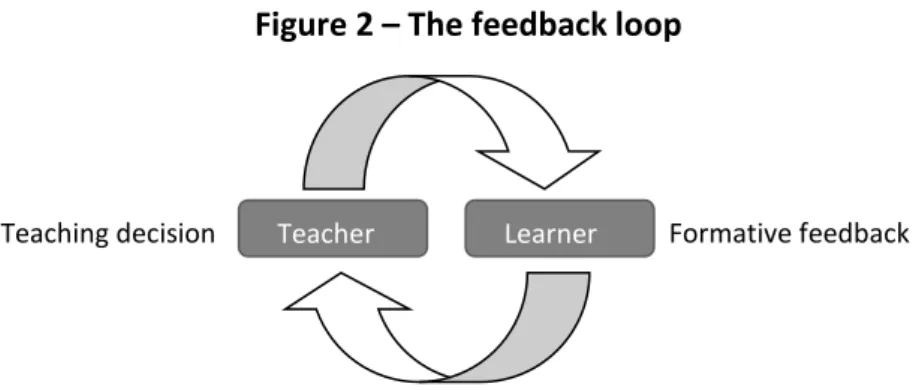
Figure 2 – The feedback loop ... 19
Figure 3 – The LoA Cycle ... 21
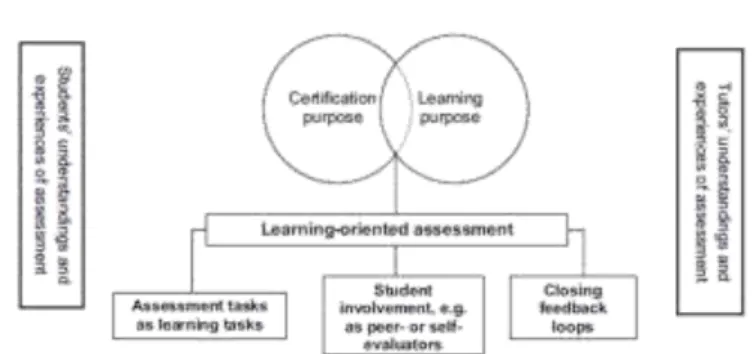
Figure 4 – The LoA Framework ... 22
Figure 5 – The Revised Bloom's Taxonomy ... 28
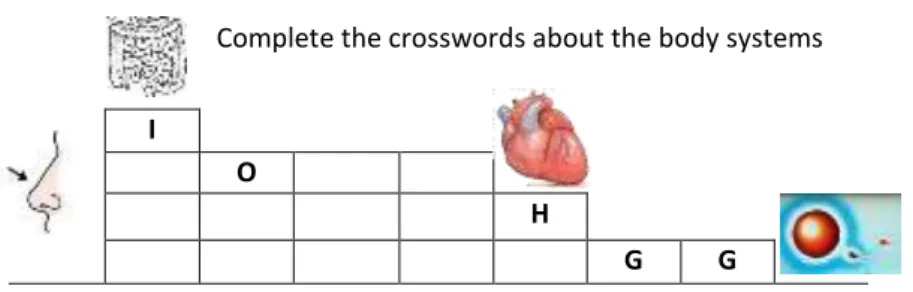
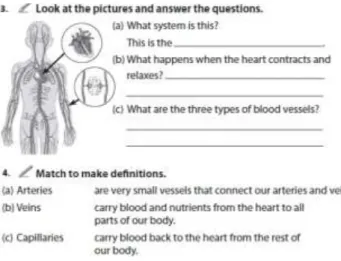
Figure 6 – SC5 test sample (abridged) ... 32
Figure 7 – SC4 revision work sample (abridged) ... 33
Figure 8 - A rationale for supportive and pedagogical assessment ... 55
Figure 9 – A continuum of assessment methods/tools ... 56
List of Tables
Table 1 – Summary of findings from QA ……….…. 42
Table 2 – Importance of assessment constructs –Rating average ……… 43
Table 3 – Importance of types of assessment –Rating average ………..……….. 44
Table 4 – Importance of teacher training in assessment –Rating average ………..………….. 44
Table 5 – Weighting of assessment constructs –Rating average ………....…………. 45
Table 6 – Frequency of planning for assessment – Rating average ………..…… 45
Table 7 – Frequency of use of assessment strategies/tools/records –Rating average ……..… 46
"If we wish to maximise student achievement (...), we must pay far greater attention to the improvement of classroom assessment. Both assessment of learning and assessment for learning are essential. But one is currently in place, and the other is not." (Stiggins, 2002:1)
Introduction
This project work will focus on how primary teachers of young learners (YLs) aged 6-10 in an early bilingual education (EBE) pilot project implemented at early primary education level1 in Portugal can assess language and curriculum content through the medium of English so as to promote more effective learning.
Within this project content teachers (also known as generalist teachers since they teach all curriculum subjects in early primary education) teach part of the curriculum through the medium of English using a Content and Language Integrated Learning (CLIL) approach. These teachers are assisted by their English language colleagues (or specialist teachers) who also teach English as a Foreign Language.
Since this is an innovative project in the Portuguese educational context, where CLIL provisions are a drop in the ocean (cf. Chapter 1), there were practical challenges for the classroom, notably as to how to cope with assessment in a specific setting where content is learnt and taught in a foreign language (FL). Furthermore, as a Masters student in English Language Teaching (ELT), I have grown to understand the importance of the relationship between learning, teaching and assessment and the benefits of knowing more about assessment approaches that support learning and teaching, particularly in a national context where summative assessment is highly valued in practice, and in the light of the recent events concerning ELT in the Portuguese education system, which will be mentioned in Chapter 1.
Accordingly, my research question is: How can language and content be assessed in a CLIL context at early primary level so as to promote effective learning?
Drawing on this, my aims are to first carry out a review of the literature on i) the key concepts in assessment that the teachers in the context under study need to know to effectively assess language and curriculum content, and ii) related existing frameworks for assessment that could support them in this process; second, to diagnose and critically review these teachers’ assessment beliefs, knowledge and practice so as to understand to what extent they are assessment literate; and
simultaneously look at how experts view assessment best practice in this kind of provision; third and last, to develop a framework outline and produce a few examples for principled guidelines, methods and related techniques and tools towards a learning-oriented assessment framework that could be of assistance to any teacher working in an early primary CLIL setting so as to assess language and content more effectively and enhance learning.
As this is a project work, context-specific to early primary CLIL, it combines both empirical and non-empirical research methods and is divided into three stages.
The first stage is theoretical and based on the literature on assessment that is relevant for the context under study. A set of research questions were formulated and organised into four areas:
Assessment literacy
o Why is assessment literacy relevant for the context under study? o What is the profile of the CLIL teacher as regards their ability to assess?
The nature of assessment
o What is the nature of assessment?
o What assessment purposes need to be developed in our context?
o What are the principles underlying CLIL assessment in early primary?
Learning-oriented approaches to assessment
o Which assessment approaches are relevant for our context?
o What are their key concepts?
EBE/CLIL assessment in early primary
o What are the key concepts underlying CLIL assessment of YLs?
o How can these be applied to our context?
The second stage is empirical as it entails data collection and analysis from several sources (teachers, experts and assessment sample material). The following research questions guide this stage:
o What are these teachers' beliefs, knowledge and practices towards assessing YLs’ language ability and content knowledge?
o For what purpose, how and how often do they assess language and content?
o Is assessment an integral part of the lesson? Is it planned? Does it inform
o What uses are being made of feedback? In what forms are these teachers
involving learners in self- and peer assessment so as to support them in taking greater responsibility for their learning?
o Are tests built according to the general assessment criteria (validity, reliability,
impact and practicality)?
o Do they reflect planning of how to assess all language ability and include a
variety of test focus sub-skills and test techniques?
o What contribution can best practice from experts make?
Finally, based on the findings from the previous stages, the third stage answers the following research questions:
o What content areas should the outline of the framework for assessment
contain?
o What samples for guidelines, methods, techniques and tools should be
included in the framework so as to clearly model how teachers can incorporate assessment in their teaching?
C
HAPTER1
–
Background and context
There is a European consensus as to the benefits of educational programmes which use an additional language, in addition to the official language(s) in a given country, such as a second language (L2) or an FL, as a vehicle to acquire curriculum content knowledge and develop skills. Immersion, EBE and CLIL use these vehicular languages or languages of schooling with a dual purpose: to master language ability and content knowledge.
Programme (2007-2013), replaced by Erasmus +, in 2014, or the European Framework for CLIL Teacher Education (Frigols-Martin, M.J. et al., 2011).
So far, CLIL, or other similar forms of provision like the ones stated above, has not yet become widespread in the Portuguese state education system (Eurydice, 2006:13; idem, 2012:40). Exceptions are: higher education where CLIL is becoming more common in some universities which have started providing programmes through English-language medium (Nova School of Business & Economics; ISCTE Business School; Católica Global School of Law); lower secondary education (12-15 age range) where a CLIL national programme in French has been implemented since 2006/2007 (Sections Européennes de Langue Française – SELF); and early primary education2 by means of a small-scale national pilot in EBE through English entitled the Bilingual Schools Project (BSP), which will provide the context for this research.
My working context involves the monitoring of the BSP which was jointly implemented by the Portuguese Ministry of Education and Science (MEC) through the Directorate-General for Education (DGE) and the British Council Portugal (BC) for an experimental period of four years (2011/2015) following the findings and recommendations of a Feasibility Study3 conducted by international and national researchers in 2010 and sponsored by the BC. In the school year under study (2013/2014), the project was being implemented in 9 primary schools of 6 state school clusters4 in the North (Oporto and Matosinhos), Centre (Fundão and Aveiro) and South of Portugal (Lisbon and Évora).
In these schools, learners have been increasingly exposed to English – as a vehicular language and as a target language. They started at the age of 6 in year 1 learning the curricular subjects of Estudo do Meio (a combination of Science, Geography and History) and Expressões (Arts and Crafts) through the medium of English 5 hours a week (20% of their weekly school timetable of 25 hours) until they reached 8 hours a week (30%) in year 3, the school year under study, at the age of 8.
2 In 2008/2009 there was also a CLIL project in this education level entitled Support for Teaching English in Primary Schools (STEPS-UP) in the Oporto region.
3 Internal document of the Ministry of Education and Science in Portugal.
Concurrently, and in order to support the learning of content through the target language, English as a foreign language was taught, both as an extra subject5 of the curriculum (1 hour a week) and as an extracurricular activity6 (1-3 hours a week).
This weekly allocation is below 50% which is not enough to consider the learners involved in the project as bilingual (Genesee, 2004:3), regardless of the diverse understandings of the term. However, in comparison to other year 3 Portuguese learners only attending English lessons at state schools and not learning the curriculum through this language, the BSP learners may be better placed to be considered as “emergent bilinguals” (García, 2008:6) as their levels of exposure to the target language are substantially higher7. The evaluation study report on the BSP carried out in 2014 positioned these year 3 learners in A1+ to A2 (CEFR8 level).
Most of this exposure was assured by having these children learn curriculum content in English on a daily basis. A curriculum in both English and Portuguese (Appendix 1) was devised based on the curriculum of Estudo do Meio9 covering a
principled selection of the specific content to be taught in English each school year. It comprised the same 5-6 blocks (knowledge areas) of the Portuguese document but assured: an alternation of the content learning objectives to be taught in Portuguese and English in the various years of schooling so that children could learn (the content) in both languages; no repetition of a given content in the same year to prevent any potential loss of learner motivation; and the use of intellectually stimulating content so that there could be a balance between the acquisition of concepts and the acquisition of language on the part of the learners. For example, Content 3 –Your Body/Block 1 – All about you was taught in English in year 1, in Portuguese in year 2 and in English again in year 3. Topic webs are then created under each content block for the development of tasks and activities relating Estudo do Meio and Expressões in a cross-curricular approach.
5 Originally named Oferta Complementar (Decree-Law no. 139/2012, of the 5th July, altered by Decree-Law no. 91, of the 10th July and Decree-Law no. 176/2014, of the 12th December).
6 Originally named Atividade de Enriquecimento Curricular (Ministerial Implementing Order no. 644-A/2015, of the 24th August).
7Cf. BSP evaluation study report available at <http://www.dge.mec.pt/ensino-bilingue-precoce-no-1o-ciclo-do-ensino-basico> [Accessed 30/09/2015]
8 Council of Europe (2001) Common European Framework of Reference for Languages: Learning, Teaching and Assessment.
Since the state school organisation in Portugal is comprised of pre-primary to upper secondary teachers and given the fact that the initial training of most content teachers in the BSP did not include English or ELT, they were assisted by English language specialist teachers in their lesson planning and delivery, who also taught the English as a Foreign Language lessons. To this end, these teachers were given time credits at central and local level (by the MEC and the schools, respectively) to collaboratively plan lessons and co-teach with their content colleagues. Both the content and the English teachers working in this project will be called the BSP teachers (BSPT).
The institutional support to the BSPTs was also provided by the MEC and the BC through teacher training and monitoring. The teacher training programme was given by BC specialists once or twice a year and focused on CLIL methodology targeting YLs. The monitoring programme, coordinated by the MEC and the BC, consisted of guidelines for project implementation and visits to schools (three times a year) to observe lessons and carry out subsequent reflection meetings with the BSPTs, EBE project coordinators and head teachers at school level.
Although assessment has been approached in the training as part of the CLIL methodology, especially fostering the regular use of assessment for learning tools (cf. Chapter 2), not all the BSPTs have yet embedded them in their teaching routine (cf. Chapter 3). In fact, they have asked for guidelines on how to combine language and content (i) in their main assessment technique, classroom tests (paper and pen tests generally lasting for one hour, given twice a school term and aiming at grading learners on their knowledge after a block of curriculum content has been taught); (ii) in grading learners at the end of the term; and (iii) in designing end of term reports for parents (cf. Chapter 3). Thus, assessment has been a recurrent issue in this project.
Having said that, and in order to be able to support the BSPTs in coping with assessment, it is important to look at the factors influencing assessment which emerge from this specific context as this is the first step towards any design of a potential framework with guidelines for assessment.
affect learning and teaching in the classroom (micro level). In the Portuguese educational context the four main factors influencing assessment in this project are:
i) The washback of summative assessment in Portuguese and Maths at early primary level. These subjects are viewed as crucial by the system, are subject to national tests and good marks translate into extra resources for schools. Some of the BSP teachers admit restricting classroom activity in the subjects of Estudo do Meio and Expressões to test preparation for Portuguese and Maths. ii) The changing status of English since 2012. It is now the first FL of compulsory provision for 7 years10, having changed from optional in early primary to compulsory in years 3 and 4 (as from September 2015); a new teacher recruitment group was specially created to combine YL methodology and ELT specialist knowledge; new curriculum outcomes (Metas Curriculares11) were devised according to the CEFR levels for primary and lower secondary; and Cambridge exams12 were introduced in year 9 focusing on the assessment of language skills.
iii) The challenging aim of the EBE project. It aims to promote school success by equally fostering the development of (higher) language levels and content knowledge learning.
iv) The lack of assessment guidelines and discussion for assessing YLs in a CLIL context (also mentioned in Fuentes, 2013:54, Hönig, 2010:30, Maggi, 2012:58, and Massler & Stotz, 2013:73). A few guidelines for assessment can be found in the legislation13 targeting all school levels in compulsory education with summative assessment as the main focus; and in the guidelines for teaching English in early primary14 which suggest that the assessment of YLs should be mostly formative.
In sum the assessment message from these macro and micro level factors is that they need to be reflected in the design of EBE/CLIL assessment of YLs.
10 Law no. 139/2012, of the 5th July, altered by Law no. 91, of the 10th July and Decree-Law no. 176/2014, of the 12th December.
11 Ministério da Educação e Ciência (2015) Metas Curriculares de Inglês do Ensino Básico - 1.º, 2.º e 3.º Ciclos (targeting years 3 to 9) available at <http://www.dge.mec.pt/ingles> [Accessed 20/08/2015]. 12 Cambridge English Language Assessment exams Key for Schools (KET) and Preliminary English Test (PET) were introduced, respectively, in 2013/2014 by Legislative Order no. 2929-A/2014, of the 20th February and in 2014/2015, by Legislative Order no. 2179-B/2015, of the 2nf March.
First, if summative assessment is so highly valued, maybe more supportive assessment approaches ought to be re-envisioned so as to build the way from learning progress to achievement as the latter will not just happen by teaching to the test.
Second, and drawing on the new status of English in the Portuguese education system, the language teachers need to carefully combine their approach to suitably teaching YLs to the way they are going to assess their English language progress and achievement. Moreover, if the Metas Curriculares and the Cambridge tests rely on language skills development, according to CEFR levels, this requires understanding of how to assess language skills and their sub-skills in a balanced way that promotes learner progress towards action-oriented communication in English.
This also means that even being at this early primary level, these learners will be potential exam-takers when they reach year 9. As a result, the earlier they learn and are assessed within a language skills approach, the better prepared they will be to face the exam in the future. The assumption here is not by all means teach these learners to the (English) test but seek alignment with the curriculum outcomes and what is expected from them in a way that they can cope with like the YLs they are.
Third, if the project is set to promote higher levels of language and content knowledge, cognitive processes that help children reach these levels need to be in place in the classroom that gradually prepare them to be more reflective thinkers, and undergo positive, yet challenging, learning experiences. Likewise, and because we are dealing with children, emotional and social development needs to be fostered, which may suggest that behaviour/attitude should complement learning, teaching and assessment to develop learner self-confidence and risk-taking in a safe learning ethos.
2013a). If we are dealing with (emergent) bilinguals who are learning content in a language that is new for them, assessment should support learners in a balanced learning of both.
Finally, the factors impacting on the context also suggest a framework with guidelines for early primary, FL and EBE/CLIL assessment are needed to support assessment in this setting. To this end, chapter 2 will also review two frameworks for assessing at this education level, which can offer valuable insights on how formative assessment approaches can help build towards summative assessment achievement, namely “Assessment in the Primary School Curriculum” (2007) by the National Council for Curriculum and Assessment (NCCA15) from the Republic of Ireland and the
“Curriculum for Excellence” (2010), by the Scottish Government. Likewise, two European projects focused on CLIL assessment at early primary level will be reviewed as to their relevance for providing a model for assessing language and content: the Assessment and Evaluation in CLIL Project (AECLIL)16 (Barbero, 2012; Maggi, 2012) and the CLIL Learner Assessment Project (CLILA)17 (Massler, Stotz & Queisser, 2014).
C
HAPTER2
–
Literature Review
2.1. The need for assessment literacy
2.1.1. Teacher assessment literacy defined
To suitably assess in any educational programme, we need to be assessment literate, that is, know about key concepts and methods to effectively assess progress and achievement of the learning happening in the classroom. This needs to be embedded in the context-specific learning and teaching to promote school success.
This is strengthened by the OECD (2013:3) due to a call for school success based on “(…) evidence-based decision making”. Malone (2011:1) also reinforces the
15 The NCCA is an advisory body of the Ministry for Education and Science in charge of curriculum and assessment for primary and post-primary schools in the Republic of Ireland.
16 The AECLIL Project focused on how to assess and evaluate the effectiveness of learning a content subject in an FL, by simultaneously improving language and enhancing cognitive/thinking skills.
need for assessment to be well used in order to inform stakeholders on how learning objectives are being fulfilled. Stiggins (2002:1-10), in an inspirational article about an assessment crisis in the American education system, advocates the need to strongly complement testing and summative assessment with formative assessment. According to this author, this shift of focus will enable us to look at the process and not just the product of assessment, foster learner engagement, reflection and confidence, collect and share information, promote clear communication and facilitate adjustments.
Before incurring a similar crisis, it could be useful for the context under study to look at the classroom as the scenario for a supportive assessment ethos to which teacher knowledge on the topic could contribute.
2.1.2. A profile of the CLIL teacher and their ability to assess
Teacher assessment knowledge or literacy is, additionally, a requirement of the CLIL teachers’ competence grid18 (Bertaux et al., 2010:8), which also makes it relevant for the context under study. The grid established a set of ability descriptors for these teachers. As regards assessment, CLIL teachers are expected to be able to:
o engage learners in an assessment for learning culture including: making
connections between planned and actual outcomes, learning skills and processes, planning and negotiating strategies for future learning; using self and peer assessment tools; maintaining a triple focus on language, content and learning skills;
o distinguish and navigate CLIL-specific characteristics of assessment including:
language for various purposes, work with authentic materials, communication with speakers of the CLIL language, ongoing language growth (being alert to plateauing), level of comfort in experimenting with language and content, progress in achieving planned content, language and learning skills objectives, developing all language skills, distinguishing content and language errors, carrying out assessment in the target language;
o prepare learners for formal examinations including high-stakes examinations.
Adapted from Bertaux et al. (2010:8)
Most of these ability descriptors suggest not only teacher understanding of learning-oriented assessment approaches but also CLIL specific features of assessment
dealing with the use of language to convey content. Assessment for learning is regarded as a key professional skill for teachers (The Assessment Reform Group – ARG19, 2002:2). At this point, it is now appropriate to turn to the nature of assessment and the related approaches that support content and language learning in this context.
2.2. The supportive nature of assessment
2.2.1. A focus on the pedagogical purpose of assessment
The (Latin) original meaning of assessment: assidere or ad sedere, that is, to sit (down) beside (another), defines its supportive nature which is one of “(…) collect(ing) information to help (…) make decisions that will lead to beneficial consequences” (Bachman & Palmer, 2010:26, in Council of Europe, 2010:13) and stimulate learning.
As a result, even though assessment serves a double duty (Boud, 2000:159, in Carless, 2007:1): (i) to support learning to determine what comes next (formative assessment [FA] or assessment for learning [AfL]; and (ii) to grade learners on learning that has gone before (summative assessment [SA] or assessment of learning [AoL], there needs to be a balance between its pedagogical and administrative purposes (Mckay, 2006:21). Given the factors influencing this context (cf. Chapter 1) the supportive nature of assessment and its pedagogical purpose need to be fostered and be in line with principles of assessment concerning YLs in an EBE/CLIL setting.
2.2.2. Key principles of CLIL assessment in early primary
The principles for assessing YLs are broadly discussed in the literature by a number of specialists. Cameron (2001:214-221) refers to the need to consider age, learning aims, methods of teaching and learning theories as regards how children learn. McKay (2006:1-19) elaborates further on the age factor to draw attention to the fact that assessment needs to cater for the specific characteristics, needs, vulnerability and emotional, cognitive and physical growth of YLs.
In this context, we must continuously remind ourselves that these year 3/7-8 year old learners are prominently hands-on learners, who learn mostly by direct experiences involving sound, sight, movement and play. They are starting to correlate concepts but these need to be scaffolded first with clear instructions and feedback. They have short attention spans and get bored easily so need to be challenged by a variety of short assessment tasks, preferably those that relate to authentic situations, such as writing an invitation to another class to visit their work on the body systems. They also need to feel safe and loved when they interact with their peers and with their teachers and get feedback on their work.
Rixon (n.d.) also discusses the importance of compatibility (consistency with the overall curriculum, its holistic approach and its objectives), feasibility (to learners and teachers) and transparency (to learners and parents) of assessment procedures. This suggests that both language and content teachers in this context should work collaboratively so as to fine-tune their assessment procedures.
All this is corroborated by Ioannou-Georgiou & Pavlou (2003:5-6) who provide practical insights into these principles by suggesting that the assessment of YLs integrates learning and teaching child-friendly/non-scary practices so as to positively reflect what children can do given their age-related abilities and consequently keep learners engaged, enhance their motivation and build their confidence. A variety of assessment approaches and tools is recommended to the detriment of only testing. The formative essence of assessment is proposed so as to support learning progress and performance. To this end “criterion-referenced” procedures according to developmental criteria are put forward rather than "norm-referenced" ones that compare the achievement of different learners.
EBE/CLIL assessment chiefly agrees with these principles of good practice but adds more which are important for this context. Some points for reflection are summarised below, drawing on Massler & Stotz (2013:78-80):
o the content taught in the L2 needs to be assessed in the L2 as well;
o content and language need to be integrated with adaptations and variety of the
range of items assessed;
o children need to be given thinking time to process instructions in the target
o the level of difficulty of the tasks and the level of support for the learner to
complete the assessment task need to be balanced without reducing the content complexity levels (e.g. simple language, gestures);
o the type of response the learner has to give should be varied (e.g. by means of
drawings, hands-on demonstration, verbal instead of written responses);
o assessment should take place at systematic and regular intervals to check
understanding of content in a new language, creating both learner and teacher awareness on learning progress and feeding this in teaching practice to boost both learner and teacher confidence.
Adapted from Massler & Stotz (2013:78-80)
These principles are particularly important due to the dual-focused nature of CLIL, which can pose a problem for assessment as to how both language and content can be integrated (Hönig, 2010:22 and Massler & Stotz, 2013:72). However, assessment in EBE/CLIL can also represent a two-way benefit for learners and teachers. It can contribute to raise the levels of confidence of both by finding out what learners know about the content taught and the language developed and by encouraging and giving feedback on both, by identifying appropriate support strategies, and by monitoring to find out if planning and practice have been effective (Bentley, 2010:84).
The nature, purposes and principles of assessment provide the first step towards the building of a rationale for EBE/CLIL assessment of YLs. These determine the reasons why we assess in the first place and thus answer the remaining set of questions we must ask ourselves before assessing, namely what we assess, that is, what the construct or focus of our assessment is (language, content or other), who can assess in it (learners and teachers), how do we do it (child-friendly methods), when should we do it (regularly and systematically) and what assessment approaches should be used in this context (mainly formative to support summative).
2.3. An overview on learning-oriented approaches to assessment
2.3.1. Contributions from other education systems
Government’s (2010) framework for assessment that is included in the “Curriculum for Excellence” which provide guidelines to ensure that assessment meets the needs of all young learners, to help primary teachers’ knowledge and understanding of assessment and to assist schools in implementing a quality assessment policy. A common feature of these documents is that they cover primary curriculum subjects, target similar age-range learners and are designed to support teachers by conveying one key message: that assessment in primary has to entail formative assessment approaches. Such a framework is needed for our context but to devise it we need to understand what FA, AfL and learning-oriented assessment (LoA) are and what they can offer to this context.
2.3.2. From formative assessment to learning-oriented assessment
FA, originally coined by Scriven (1967:41, in Burns, M.K., 2008:2), is broadly perceived as an umbrella term for classroom activities/tasks “which provide information to be used as feedback to modify teaching and learning activities in which they (learners and teachers] are engaged” (Black & William, 1998:1). Sadler (1989:121) describes its key concepts viewing it as inherent to learning and teaching and guided by three principles: being learner focused, informative and based on learning objectives. This suggests that it relies on: (i) objectives and criteria; (ii) self-regulated learning/self-monitoring (SRL/SM), (iii) learner/teacher roles and (iv) feedback.
These key concepts are later extended into AfL (coined by Black & William, 1998) as “the process of seeking and interpreting evidence for use by learners and their teachers to decide where the learners are in their learning, where they need to go and how best to get there” (ARG, 2002:2). These authors were members of the ARG who found evidence that FA practice can increase learning results (learning gains or effect sizes20) and prevent underachievement (Black & William, 2001:2) which seem fairly sound reasons to implement it. AfL takes FA to the practical level of the classroom by relying on research evidence to prove that FA can improve learning and
teaching by (i) assigning specific roles to all stakeholders and (ii) using strategies and tools that show how to put feedback and self-regulated learning in practice.
LoA came later and was defined by Purpura (2004:236) in relation to language assessment as entailing “the collection and interpretation of evidence about
performance so that judgements can be made about further language development.”
Keppell & Carless (2006:3) expanded this definition by adding that LoA is “about putting learning at the centre of assessment and reconfiguring assessment design so that the learning function is emphasised” and “as being applicable to both formative and summative assessments (…)” (Joughin, 2005, cited in Keppell & Carless, 2006:3). By these definitions two innovative features, which aimed at avoiding any potential confusion and/or dispersion caused by the understanding of classroom stakeholders of FA and AfL, can be found in LoA: it offers a structured system for collecting, recording and using evidence from classroom tasks, activities and tests (The LoA Cycle) and combines FA and SA. In both, learning is always put at the centre.
Five major contributions from these assessment approaches can be applied to our context with regard to their relevance for a framework for assessment planning and practice. These will be dealt below.
2.3.3. Processes, strategies and frequency
Leahy et al. (2005) as referenced in William (2014:8) shows three key processes of planning for assessment which include awareness of the point where the learner is going in their learning, where they are now and how to help them get there:
Figure 1 – Five key strategies of formative assessment
Where the learner is going Where the learner is now How to get there Teacher Clarifying, sharing and
understanding learning intentions and success
criteria
Engineering effective discussions, tasks and activities that elicit
evidence of learning
Providing feedback that moves learning forward
Peer Activating learners as learning resources for one
another
Learner Activating learners as owners of their own learning
Adapted from Five key strategies of formative assessment (Leahy et al. 2005; in William 2014:8)
of learning progress, giving feedback that fosters learning and activating learners as learning resources and owners of their learning. The model conveys a crucial message, which is to use evidence to adapt teaching and learning to cater for learner needs.
The other important aspect is the frequency of the processes and the roles in the classroom, whose span, length and impact vary according to the cycle of AfL (Stiggins, 2005). These range from (i) the long-cycle that happens across units or terms, lasting four weeks to one year and may impact on learner monitoring and curriculum alignment; ii) the medium-cycle that takes place within or between units, lasting one to four weeks and whose effect may be on improved, learner-involved assessment and teacher cognition about learning; and (iii) the short-cycle occurring within and between lessons, on a daily basis, in every activity/task, lasting 5 seconds to 2 hours and impacting on classroom practice, notably on learner engagement. Tracking learner progress from unit to unit as defined in the long- and medium-term cycles may not be helpful enough to create an assessment routine among learners and teachers. The short-cycle seems to be the most suitable for the context under study as, for YLs, it can foster their motivation and engagement as they are trying to learn and “watch themselves succeed”; for the teachers, it can keep learning on track (KLT) (William, 2008), that is, modify the course of teaching according to learners’ needs. William (2008) argues that “KLT teachers” plan their assessment in advance, can look at the evidence of learning and are able to make changes as necessary.
2.3.4. Learner and teacher roles
If we take this as a model for planning assessment, we must then assign specific roles to learners and teachers that can actively involve them in assessment. Gallacher (2004:1), Pinter (2009), the Scottish Government (2010:55) and Read (2007) provide hints which apply to this context as a complement to the strategies above.
2007:286), how they learn and can improve their learning (Pinter, 2009:99). This ability is of critical importance to the context under study. It directly links with the cognitive processes of thinking and reasoning which help learners process, understand and convey information on their own which is key to both language and content development.
These authors also describe the teachers’ role as being procedural, behavioural and interactive so as to demonstrate, ask questions and act as mediators. If we start early in raising learner’s awareness about learning, children will be able to think for themselves and be equipped with strategies that will be useful outside school and throughout their lives. The two following sections will discuss the methods that better show how this can be done.
2.3.5. Self- and peer assessment
Learner roles can be best expressed by self- and peer assessment so as to get information from the child’s point of view. This means having learners looking and thinking about their own work or reviewing the work of their peers, in a reflective and constructive way, which helps them gain awareness of what they have achieved and where they might need to improve.
In order to be done purposefully, objectives and criteria need to be shared with the children so that they can compare their performance in a learning task/activity against a reference point. Moreover, self- and peer assessment can also be used for children to plan next steps in their learning by thinking about what they already know and where they can improve or what they can learn further.
be active contributors to assessment (The Scottish Government, 2010:19). However, both require time, effort, consistency of practice and requires learner training until it becomes embedded in the lesson routine. This method can also involve self- and peer correction, particularly of written work produced by the learners and their peers. In addition to what self- and peer assessment can do for the learners, it can be priceless for the teachers, who can use this feedback from the learners as evidence to adjust teaching.
Some examples of tools at early primary level can be smiley faces, traffic signs, thumbs up/down, which learners can easily use to show their degree of difficulty. Two/three stars and a wish convey the same message but add space for children's contribution as regards something they would like to learn or do in the lesson (wish). Ladders, Plus/Minus/Interesting (PMI) diagrams and KWL charts21 (NCCA, 2007:74) are useful for children to organise, order or list their difficulties and achievements against specific questions. When children are asked to think about their learning, their reflections can be shared with a talk partner/buddy (NCCA, 2007:84:85), that is a classmate with whom they are close friends. Other related tools are suggested by Ioannou-Georgiou & Pavlou (2003), which are child-friendly, such as simple self- and peer assessment cards, for assessing their own work or a group performance. Self- and peer correction posters and correction codes can help learners create the routine of self-checking their written work (National Council of Teachers of English, 2015)22 (For examples see Appendix 12).
2.3.6. Feedback to communicate progress
Teacher roles imply planning, devising and using feedback, the “information about how successfully something has been or is being done” (Sadler, 1989:120)or “on the consequence of a performance” (Hattie & Timperly, 2007:81), as this can act as a catalyst of the previous concepts and is particularly relevant for this context. Feedback can be provided by the learners or the teachers, as part of classroom learning activities and tasks which can work as assessment and also as part of tests. The important thing
is that we plan to incorporate feedback in each of these classroom practices as we devise them in order to make sure that assessment backs up learning at all times. This will give us a range of reliable evidence assessed against objectives and enable us to involve learners in assessment by letting them know what is expected from them.
Feedback can be expressed positively/negatively, be immediate/delayed, be evaluative (involving a judgement) or descriptive (describing what the learner did well and how they can improve). It can be conveyed orally or in written form so as to provide specific/general information on the process or product (result) of a task/activity understood or done by the learner.
These features liaise with the concept of feedback loops and learning gaps provided by Sadler (1989:120). Its purpose is to reduce the gap or discrepancy between the learner’s understanding and performance and the aimed learning objective and success criteriaand use this to take future action.
Figure 2 – The feedback loop
Adapted from 8 Ways Technology Is Improving Education (Proto-knowledge, 2010)
In this context this can be more effectively accomplished by using positive feedback in due time (immediately, as suggested by Clarke, 2003), in a supportive classroom environment where affect (gestures, facial expressions, intonations), cognition (specific information on correct/incorrect understandings and pointing directions for further learning), engagement and motivation (indicating alternative strategies during a task/activity process) are used.
As we can see, feedback involves much more than praising, which is often used by the BSPTs in the form of “Well done/Excellent”. This kind of feedback remark may be too general, much focused on the learner as an individual and it only evaluates
Teacher Learner
an action gone by. It does not promote closing gaps in the feedback loop because it does not inform learners on how to improve. Descriptive feedback, on the other hand, can be more useful and beneficial for learning (Black et al., 2004:13-14). If it focuses on the process and product of a task, it can help make clear to the learner what they have done well and what they still need to improve. For example, a short feedback comment on written work can accompany grades so as to give guidance on how to improve: “Most of your spelling is accurate. I found only two errors. Can you find them?”
Oral feedback can also involve explicit correction, recasting (copying the learners’ answer but correcting the mistake),elicitation (copying the learner's answer but excluding the mistake), repetition (using the learner's answer including the mistake but stressing it so as to raise learner awareness of it). It can also involve clarification by means of reminder (“Remember the stages of the water cycle we talked about?”), scaffold or example (“Use the model projected to describe the characteristics of your favourite animal.”) prompts. (For examples see Appendix 12).
2.3.7. Observation to collect evidence
In addition to feedback, observation on the part of the teacher is another of their crucial roles. It allows them to have a snapshot or a series of snapshots of learning progress that feeds forward into teaching and reports on progress to the children and their parents, thus serving more reliably the informal and formal purposes of assessment. Nevertheless, in our context, and surely in many elsewhere, it would be impossible to observe all children at the same time.
tick (), a circle () or a cross () for what was observed/not fully observed/not yet observed, respectively. (For examples see Appendix 12).
Nonetheless, even though observation is valuable to provide and interpret evidence of learning and specifically detect difficulties regarding children as individuals in the course of time such as a unit of work, it is subjective. If observations are not recorded systematically they will not provide valid and reliable assessment information on learners’ progress and achievement.
2.3.8. Planning, using and recording assessment
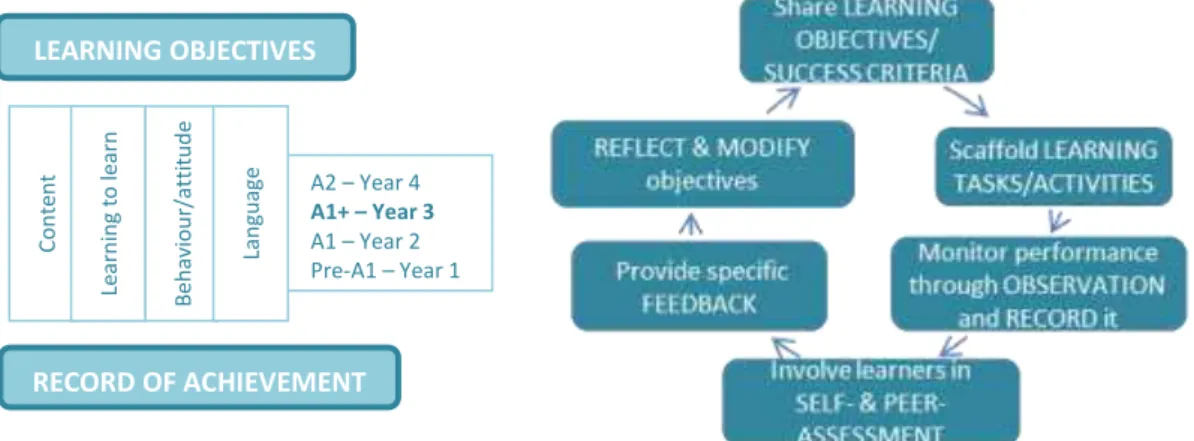
The LoA cycle presented by Cambridge English Language Assessment (CELA) in 2013 provides a system to plan, use and organise the data of what learners know and do not know not only from our observations but also from the previously addressed methods that involve learners in assessment.
Figure 3 – The LoA Cycle
Source: CELA, 201323
The cycle entails a sequence of systematic steps which can be taken in the classroom to help teachers monitor, organise and make use of the assessment information gathered from the observation, feedback and self- and peer assessment methods discussed previously. First by defining and sharing learning objectives with the learners; second by having the learners carry out a given activity or task aligned with those objectives and while this is done teachers observe, monitor and interpret learners’ progress; third the teacher takes quick notes on the children's performance
and progress in the form of informal records; fourth feedback from learning development is shared with the learners which can adapt learning objectives that will start the cycle all over again. The monitoring of learner performance and the informal records can be converted at the end of each lesson in structured records (in the form of the anecdotal records or checklists previously referred to). This way they can later become valid and reliable records of achievement that can be used for the teacher's FA and SA decisions.
Although this cycle was created for more extended language assessment which is why the figure has the CEFR level on the left, it could be adapted for EBE/CLIL classes if other focuses of assessment were integrated. In fact, this was done by Bentley (2014) at the British Council Regional Policy Dialogues 2013-1424, where she adapted the cycle to contain competence-based assessment focuses. The same could be done for our context, so as to integrate the objectives and criteria that can be used in assessment to support leaning and teaching.
Additionally, LoA integrates and simplifies the assessment concepts provided by both FA and AfL into a “unified whole” with three main components –learning tasks, learner involvement, the closing of feedback loops – and a key idea: that these three are aligned with learning objectives. The LoA framework may best illustrate this:
Figure 4 – The LoA Framework
24 Retrieved from
<http://www.britishcouncil.org/sites/default/files/bc_regionalpolicydialogues_baja.pdf> [Accessed 05/06/2014]
Two of these components have already been discussed (learner involvement which can be fostered through self- and peer assessment and feedback which enables bridging learning gaps). The component of “assessment tasks as learning tasks” suggests that assessments take the form of regular learning tasks, such as those that promote direct experiences and authentic situations previously suggested by the principles for assessing young learners in a CLIL setting. However, to devise these in the context under study, we need to look at what the relevant focuses of CLIL assessment actually are. The next section will look at the specific reference points and special features of assessment for EBE/CLIL assessment in early primary that provide a clear idea as regards how to devise objectives, criteria and related learning tasks that can be used as assessment.
2.4. EBE/CLIL assessment in early primary
2.4.1. Contributions from research projects
Two European projects focused on CLIL assessment at early primary level, namely the AECLIL and the CLILA, mentioned in chapter 1, can provide a possible
framework for assessment. The AECLIL first defines a “reference point” for teachers to base on, then the “steps” towards its implementation and finally the focuses of assessment. The reference point includes the setting of complexity levels for content; the identification of the language needed to express that content; the cognitive skills necessary for the integration of content and language; and the need to guarantee alignment between the objectives for learning, teaching and assessment. The steps
describe how this can be done through authentic assessment, which “occurs when we
and adapt to each performance. Finally, based on these reference points and steps, Maggi’s proposed focus of assessment includes content, language and cognition.
The CLILA project seems to go one step further by researching the assessment literature and the practice of both content and language teachers in German and Swiss primary schools to develop and pilot a model for integrating content and language assessment. The model aims to link assessment tasks to frameworks of reference for language, learning objectives of content subjects and the dimensions for scientific literacy. It can be represented in three dimensions: the curriculum content topics of a specific subject; the communicative competence in the foreign language; and the levels of scientific literacy (Massler et al., 2014:142).
These projects suggest that the first step towards EBE/CLIL assessment of YLs needs to start by a reference point that fits what YLs need to know. This is where learning objectives for content and language are extracted from and aligned with these success criteria and assessment focuses are designed.
2.4.2. Reference points for assessment
2.4.2.1. The curricula and the Metas Curriculares
As suggested in the projects presented above, we need a starting point for assessment which provides objectives, criteria and focuses or constructs of assessment, i.e. what children are expected to learn. We need to know these so as to make sure our assessment is valid, i.e., that it assesses what it is supposed to assess.
Dobragem25, from Expressões (years 1-4), in a task where learners have to make a paper model of the heart to describe how systemic and pulmonary circulation happen.
Both the curricula for these two subjects also include objectives related to children’s behaviour/attitude, namely developing self-esteem, building confidence and learning to socially interact with their peers, which are viewed as important to support content learning as children grow. This relates to children’s vulnerability, addressed by McKay (2006:14) and Ioannou-Georgiou & Pavlou (2003:8), that is, if learners do not experience positive attitudes as a child, this may affect their future learning progress. These two last authors define attitude, behaviour and effort as the way children act towards language learning (positively or negatively) and behave in the classroom with their peers/teacher, in pair/group work, if they are polite, sensitive of the efforts of their classmates and good team members.
According to these YL specialists and as inferred by the Portuguese curriculum, behaviour/attitude can be suitable assessment focuses as these help keep learners engaged and motivated. Instead of restricting their assessment to “the child behaved well/badly" or "participated/did not participate in the lesson”, their sub-skills can be related to the social actions we want learners to perform whole class, e.g. “raising hands to speak”, “using my eyes to listen/ears to hear/mouth to speak”, “tidying up my desk”, in pairs/groups whereby they can be assessed as to how well they work collaboratively: “working well in groups”/”taking turns to speak.”; and to their emotions about learning, e.g. “I like working in pairs/helping my partner”.
After looking at how the curriculum can provide content and behaviour/attitude as assessment focuses, we can now turn to reference points for language assessment.
In the BSP, language has always been dictated from the content. No competence levels have been defined nor did they exist for English language learning at early primary level in Portugal at the time the project was implemented. A start for language assessment can now come from the competence descriptors of the Metas Curriculares, ranging from pre-A1 in year 3 to B1 in year 9, or the Lingualevel
instrument (2009), used in the CLILA Project, which has the advantage of breaking down the CEFR levels into intermediate action-oriented descriptors from A1.1 to B2.2. An example for each is provided for the speaking skill:
"4. Expressar-se, com vocabulário limitado, em situações previamente preparadas./3. Falar sobre os temas trabalhados26." (p.10)
From the Metas Curriculares, A1 level, Produção Oral/Spoken Production "I know what the main parts of the body are called (for example if I need to say where it hurts). (MP13)/I can give basic information about my school-class (for example its size, the number of girls and the number of boys and my favourite subjects). (MP07)" (p.26)
From the Lingualevel, A1.2 level
To link these to CLIL, the same language level could now be intersected with the curriculum objectives cited before to convey an integrated content and language objective which could look like this: “To identify the names of the materials to make a paper model of the heart." / "To say what these materials are for.”
Nonetheless, in addition to the proficiency levels provided by these language reference documents, the language skills that form language ability need to be developed and assessed. As such, we need to know the sub-skills or micro-skills that form them. For example, the receptive skills of listening and reading for this age level entail similar sub-skills, e.g. listening/reading for gist, listening/reading for detailed information, inferring meaning, predicting content, recognising letter/sound links (for example, through phonics) and sight words (for example, the, because, what), identifying meaning from lexis and lexical chunks, first at word level and then at sentence-level (Ioannou-Georgiou & Pavlou, 2003:7 and Cameron, 2001:230). Reading aloud or oral reading for the teacher is sometimes used in our context for assessment purposes and treated as the main sub-skill of reading (cf. Chapter 3) but it is not used with the purpose of checking comprehension of a text which is key for understanding content in a foreign language.
As to the productive skills, the age-appropriate sub-skills for speaking can be first pronunciation and intonation of lexis and lexical chunks, turn-taking (It's my/your
turn), agreeing or disagreeing (OK/I don’t think so ...), assessing work (It’s easy/ so-so/difficult) and then gradually moving to more communicative micro-skills, that help children convey content knowledge. For example, giving simple physical descriptions (of an animal, a house), identifying similarities and differences (Luoma, 2004); talking about purpose (birds use their wings to fly); describing a process (First I put the soil in the cup, then …); giving examples (reptiles such as snakes); or presenting work. Writing requires gradual mastery of fine motor skills to form words and this is developmental at the beginning of early primary. As a result, writing skills could first consider ‘writing for learning’ and second ‘writing for writing’ (Harmer, 2004:31-34). The first entails graphic/visual sub-skills (reinforcement writing, such as letter, word and basic sentence formation, copying, making a list and mechanics, such as capitalisation, organisation, punctuation and spelling). The second can be gradually fostered focusing on developing linguistic sub-skills (using simple and appropriate lexis, grammar (has/have got), connectors e.g. first, finally), with a focus on genre which will help learners develop awareness of text type, purpose and audience useful for EBE/CLIL (Bentley, 2010:37) (e.g. a fact sheet on animals and their habitats); creativity and imagination which could be rewriting a different ending for a traditional story (the wolf’s point of view in the three little pigs; or organisational sub-skills, e.g. a simple model/guide questions to write a short paragraph about their favourite animal and its features (adapted from Ioannou-Georgiou & Pavlou, 2003:7).
In addition to the curriculum and the language reference documents referred to, which suggest that the assessment focuses in our context are content knowledge and skills, language skills and behaviour/attitude, the CLIL literature offers specific features dealing with cognition which take the previous focuses to a higher level.
2.4.2.2. The cognitive features of CLIL
The 4Cs framework (Coyle, 2007), the Revised Bloom’s Taxonomy (Krathwohl,
2002) and the Language Triptych (Coyle et al., 2010) provide links to embed cognition into the focuses of assessment.
communicative and cultural components of the framework refer to the language development that serves the content matter (of Estudo do Meio and Expressões, in our case), the language children need to communicate meaning from content and the social language children need to interact with their peers and with the other, that is, with other "speakers of the CLIL language" (Bertaux et al., 2010:8) in or out of their community. This involves the development of both intercultural awareness and communicative skills, which support language ability through the skills of listening, reading, speaking and writing discussed previously.
Cognition is the heart of the 4Cs. It can support higher levels of language development and content knowledge; therefore cognition cannot be separated from any of these. This so happens because cognition, or “the processes our brains use when we think and learn” (Mehisto et al., 2008:20), ranges from concrete thinking, for example, remembering and understanding, to more abstract thinking or reasoning, such as analysing or evaluating. This progression from lower order cognitive skills (LOCS) to higher order cognitive skills (HOCS) is illustrated below in a depiction of the Revised Bloom’s Taxonomy (Krathwohl, 2002):
Figure 5 – The Revised Bloom's Taxonomy
Adapted from Krathwohl, 2002
EBE/CLIL assessment needs to embed this continuum by using assessment approaches that stimulate learners’ cognitive growth that are necessary to deal with the complexity levels of content in an FL and to dismiss rote learning. For these reasons, content and language require an intersection with cognitive skills.
Given the fact that cognition entails reflection, it can be associated to learning to learn skills which, as discussed previously, are key to YLs. In fact learning to learn could be regarded as an early stage of cognition to be developed with YLs. If it becomes a focus for assessment in our context, it will be useful to know their sub-skills. These can be found in Gallacher (2004), Ioannou-Georgiou & Pavlou (2003:7), McKay (2006:50) and Read (2007:286-287) as follows: thinking about learning, using correction and assessment, using a dictionary, reviewing own work or the work of peers, organising learning, identifying and discussing a problem, taking initiative and being persistent in completing tasks, sharing with the teacher and peers the ways in which children have solved problems, actively listening to what peers have to say.
Linked to the idea that content understanding requires language demands so that children understand it (Bentley, 2010:7), the 4Cs framework also involves a different look at language in addition to its communicative purpose. As discussed above, in CLIL, language cannot be viewed on its own as it is a vehicle for content.