ISSN 0100-879X
BIOMEDICAL SCIENCES
AND
CLINICAL INVESTIGATION
www.bjournal.com.br
www.bjournal.com.br
Volume 44 (11) 1070-1193 November 2011
Institutional Sponsors
The Brazilian Journal of Medical and Biological Research is partially financed by
Faculdade de Medicina de Ribeirão Preto Campus
Ribeirão Preto
Ex plor e H igh - Pe r for m a n ce M S Or bit r a p Te ch n ology I n Pr ot e om ics & M e t a bolom ics
an alit icaw eb. com . br S C I E N T I F I C
Braz J Med Biol Res, November 2011, Volume 44(11) 1080-1087
doi: 10.1590/S0100-879X2011007500133
2+
STIM1/Orai1-mediated store-operated Ca entry: the tip of the
iceberg
STIM1/Orai1-mediated store-operated
Ca
2+
entry: the tip of the iceberg
F.R. Giachini
1, V.V. Lima
1,2, J.
L.
Hannan
1, F.S. Carneiro
1,2,
R.C. Webb
1and R.C. Tostes
21Department of Physiology, Georgia Heath Science University, Augusta, GA, USA 2Departamento de Farmacologia, Faculdade de Medicina de Ribeirão Preto,
Universidade de São Paulo, Ribeirão Preto, SP, Brasil
Abstract
Highly efficient mechanisms regulate intracellular calcium (Ca2+) levels. The recent discovery of new components linking
intracel-lular Ca2+ stores to plasma membrane Ca2+ entry channels has brought new insight into the understanding of Ca2+ homeostasis.
Stromal interaction molecule 1 (STIM1) was identified as a Ca2+ sensor essential for Ca2+ store depletion-triggered Ca2+ influx.
Orai1 was recognized as being an essential component for the Ca2+ release-activated Ca2+ (CRAC) channel. Together, these
proteins participate in store-operated Ca2+ channel function. Defective regulation of intracellular Ca2+ is a hallmark of several
diseases. In this review, we focus on Ca2+ regulation by the STIM1/Orai1 pathway and review evidence that implicates STIM1/
Orai1 in several pathological conditions including cardiovascular and pulmonary diseases, among others.
Key words: Ca2+ release-activated Ca2+ channel; Sarcoplasmic reticulum; Intracellular Ca2+ store; Ca2+ influx
Introduction
Correspondence: F.R. Giachini, Departamento de Farmacologia, Faculdade de Medicina de Ribeirão Preto, USP, Av. Bandeirantes, 3900, 14049-900 Ribeirão Preto, SP, Brasil. E-mail: [email protected]
Received January 14, 2011. Accepted September 5, 2011. Available online October 14, 2011. Published November 14, 2011.
Nearly all cell types depend on the generation of cyto-plasmic calcium (Ca2+) signals to regulate cell function or
trigger specific responses. The use of Ca2+ for intracellular
signaling implies a tight local and global control of cyto-plasmic concentration and mechanisms for maintaining the cellular Ca2+ balance. Cytosolic Ca2+ signals are adjusted
by intracellular sources such as the endo-/sarcoplasmic reticulum, Ca2+ binding proteins and plasma membrane
Ca2+ permeable channels. Therefore, Ca2+ pumps, along
with Ca2+ release channels, are key components in Ca2+ homeostasis. The endo-/sarcoplasmic reticulum Ca2+
-ATPase (SERCA) pumps have the highest affinity for
Ca2+ removal from the cytosol. SERCA, along with plasma
membrane Ca2+ ATPases and other transporters, determine
the resting cytosolic Ca2+ concentration (1).
Upon stimulation, most excitable cells display a biphasic
increase in cytosolic Ca2+ concentration. The initial
tran-sient increase is due to inositol triphosphate (IP3)-mediated
release of endoplasmic reticulum (ER) Ca2+. The
subse-quent prolonged increase requires extracellular Ca2+ influx
through various pathways, which include store-operated Ca2+ channels (SOCC), voltage-operated Ca2+ channels,
purinergic receptors, transient receptor membrane potential
channels (TRPC), and the Na+/Ca2+ exchanger (NCX),
among others (1).
In this review, we will focus on new components of store-operated Ca2+ entry (SOCE) and of the stromal
interaction molecule 1 (STIM1)/Orai1 system, and review evidence suggesting that alterations in this system may
contribute to several pathological conditions. We will first briefly describe mechanisms that contribute to Ca2+ entry in
the cell, with special focus on SOCE. Then, a major review addressing the STIM1-Orai1 pathway will be presented. Finally, we will describe how alterations in the STIM1-Orai1 pathway have been correlated directly with some pathologi-cal conditions.
Store-operated Ca
2+entry
One of the pathways that contribute to extracellular Ca2+
influx relies on depletion of Ca2+ from the ER, which causes
activation of plasma membrane Ca2+ channels to refill in
-ternal stores. This mechanism, by which the ER acts as a capacitor, has led to the term SOCE (2). In many cell types, SOCE carries a highly Ca2+-selective, non-voltage-gated,
STIM-Orai signaling 1081
Ca2+ (CRAC) current, or ICRAC. SOCE also plays a crucial
role in most cells by being the main source of Ca2+ to refill
the ER after its depletion (2).
Several factors have been considered to be SOCE acti-vators. It has been proposed that a Ca2+-influx factor (CIF)
is released upon Ca2+ store depletion, resulting in restora-tion of calmodulin activity, generarestora-tion of lysophospholipids and consequently, activation of SOCE. The identity of CIF is unknown, but its presence and biological activity have been detected in several studies. In addition, it seems that CIF is important for the regulation of some types of SOCE, but very little is known about the molecular mechanism of CIF production in the stores (3).
The NCX represents another pathway for extracellular
Ca2+ influx and there is evidence that NCX contributes to
SOCE. It has been reported that NCX participates in store
depletion when this exchanger is operating in the reverse
mode. This seems particularly important for Ca2+
homeo-stasis in the mitochondria. This organelle was found to be essential for the activation and maintenance of SOCE, but the molecular mechanisms by which mitochondria control SOCE are unknown. It has been recently reported that mitochondrial NCX is fundamental for STIM1/Orai1-dependent SOCE (4).
Before the discovery of STIM1, the coupling process between ER and plasma membrane to mediate SOCE was a mechanistic mystery. Recently, two research groups
inde-pendently identified STIM1 as a protein that functions as a
Ca2+ sensor (5,6). It was shown that knockdown of STIM1
in Drosophila S2 cells significantly reduced
thapsigargin-dependent Ca2+ entry and completely suppressed ICRAC.
Similar observations were made in Jurkat T cells, human embryonic kidney (HEK293) (6) and airway smooth muscle cells (7). At the same time, Spassova et al. (8) demonstrated that, in addition to being an ER Ca2+ sensor, STIM1
func-tions within the plasma membrane to control the operation of the Ca2+ entry channel itself. They showed that the
overexpression of STIM1 increased the activity of CRAC channels whereas mutations in the helix-loop-helix struc -tural domain and cytoplasmic C terminus of STIM1 altered operational parameters of CRAC channels, including the
pharmacological profile and inactivation properties (8).
There are two members in the STIM family: STIM1 and
STIM2. They present 61% homology and are expressed widely. Co-expression of both STIM proteins favors trans -location of STIM2 upon store depletion. STIM
transloca-tion occurs in specific areas where the ER comes in close proximity to the plasma membrane, the so-called puncta
formations. However, STIM1 and STIM2 seem to work in different ranges of ER Ca2+ concentration (9). The reason
why cells display two sensors of Ca2+ to set basal and stimulated Ca2+ separately is not known.
The signaling breakthrough represented by the discov-ery of the STIM1 system has led to a better understanding of how STIM1, by interacting with other components in
the plasma membrane, initiates the process to refillthe intracellular Ca2+ stores.
Store-operated activation of STIM1/Orai1
Better comprehension of the molecular mechanisms associated with STIM1 function came after the report of a new plasma membrane protein, Orai1, which was named on the basis of Greek mythology. In Greek mythology, the Orai are the keepers of the gates of heaven: Eunomia (Order or Harmony), Dike (Justice) and Eirene (Peace) (10). Patch-clamp studies have shown that CRAC modulator 1, also known as Orai1, modulates ICRAC in Drosophila cells (11).
This discovery was followed by the identification of a muta -tion in Orai1 in cells of patients with one form of hereditary
severe combined immune deficiency syndrome. The Orai1
mutation resulted in defective SOCE and CRAC channel function (10). Thus, the possibility that Orai1 could be the CRAC channel itself, a subunit of it or a component of the CRAC signaling machinery made this protein a candidate for interaction with STIM1.
Following these seminal findings, it was shown that the combined overexpression of STIM1 and Orai1 markedly
increases ICRAC(12). In addition, the interaction between
STIM1 and Orai1 is greatly enhanced after thapsigargin treatment (12), which acts as a selective inhibitor of the SERCA resulting in depletion of ER Ca2+ stores (13). At
the same time, another research group showed that sub-stitutions in the transmembrane helices of Orai1 resulted in decreased Ca2+ influx and proposed that Orai1 is an
essential pore subunit of the CRAC channel (14). These
data were confirmed by another study showing that, upon
depletion of ER Ca2+ stores, STIM1 and Orai1 move in
a coordinated fashion to form closely opposed clusters in the ER and plasma membranes, thereby creating the
elementary unit of SOCE (15). Combined expression
of STIM1 and Orai1 resulted in a huge gain of SOCE function and indicated that the two proteins are probably
sufficient to mediate the operation of SOCE (16). Peel et
al. (7) showed that Orai1 small interference RNA (siRNA) transfection on whole airway smooth muscle cells blocks inward currents initiated by Ca2+ store depletion. They
found a similar result by using inhibitors of SOCE, including
2-aminoethoxydiphenyl borate (2-APB), gadolinium (Gd3+)
and lanthanum (La3+) (7).
In addition, mutations in Orai1 also result in significant
changes to the electrophysiological properties of ICRAC,
rendering the current less Ca2+ selective with outward
rectification (11). Such studies have provided evidence for
the theory that Orai1 forms the pore forming subunit of the CRAC channel. Orai1 and STIM1 may also contribute to the function of other SOCE channels (17).
These astonishing data brought a new paradigm to the
concept of inter-organelle communication and extensive
character-ize how STIM1 couples store depletion to the functioning of Orai1 in the plasma membrane. Accordingly, it is well known that STIM1 and Orai1 accumulate and colocalize in puncta formations.
Orai1 clusters are formed only in the presence of STIM1,
but not expressed alone (18). Following store depletion,
STIM1 moves from locations throughout the ER to accu-mulate in subregions of the ER positioned within 10-25 nm
of the plasma membrane. STIM1 must first oligomerize to
enable its accumulation at the ER-plasma membrane junc-tions. Simultaneously, Orai1 gathers at discrete sites in the plasma membrane directly opposite to STIM1, resulting in local CRAC channel activation (19).
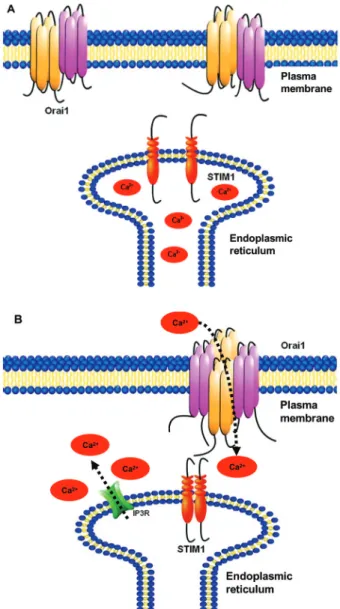
Under basal conditions, Orai1 is predominantly a dimmer in the plasma membrane. Interaction with the C-terminus of STIM1 causes redimerization of Orai dimmers and formation of tetramers that constitute the Ca2+-selective
pore (Figure 1A) (20). Single-molecule imaging techniques made it possible to determine the stoichiometry of each
CRAC channel complex. Four Orai1 molecules and two
STIM1 must associate to form an active CRAC channel (18). This represents a new mechanism by which assembly and activation of the functional ion channel are mediated by the same triggering molecules (Figure 1B).
The relationship between STIM1 and Orai1 expression,
puncta formation and ICRAC activation has been examined.
It was shown that STIM1 accumulates in puncta equally
well in the presence or absence of Orai1 expression. In addition, STIM1 migration is not sufficient for Orai1 ac -cumulation in the same area and normal ICRAC can be
activated in STIM1-deficient cells. These data challenge
the view of direct conformational coupling between STIM1 and Orai1 as a viable mechanism of puncta formation and
SOCE activation and uncover greater complexity in their
relationship, which may require additional intermediate elements (21).
Recent information indicates that STIM1 and Orai pro-teins can interact with and functionally connect to TRPC channels (17,22). As reviewed by Wang et al. (23), TRPC channels may act as “store-operated” channels (SOC) in smooth muscle and it has been an issue with much evi-dence supporting and denying such a role (23). The clusters formed by STIM1 and Orai1 are also required for TRPC1-SOC channel activation, suggesting that TRPC1-SOC and CRAC channels are regulated by similar molecular components (17,22). These data indicate that the STIM1-Orai1 system interacts with multiple proteins and activates channels in a coordinate way. The association between TRPC chan-nels and STIM1/Orai proteins is also an area of intense investigation.
Taken together, these data show that STIM1 is a key regulator and its activity was initially described for SOCE through an Orai-dependent pathway. However, it is impor-tant to remember that there is now considerable evidence supporting a role for TRP proteins in the conduction of Ca2+
Figure 1. Ca2+ entry pathways can be mediated by Orai1, by
ac-tivation of STIM1. A, Orai1 is a protein with four transmembrane regions in the plasma membrane. Under basal condition, when Ca2+ is abundant in the endoplasmic reticulum, Orai1 is
predomi-nantly a dimer in the plasma membrane. B, STIM1 is a single transmembrane-spanning protein located in the endoplasmic re-ticulum and plasma membrane. Under Ca2+ store depletion, e.g.,
when 1,4,5- inositol trisphosphate (IP3) is formed and binds to its
receptor (IP3R) on the endoplasmic membrane, and Ca2+ is
re-leased from stores, the reduced luminal Ca2+ causes dissociation
of Ca2+ bound to the low-affinity helix-loop-helix Ca2+-binding
site domain on the N-terminus of STIM1. This Ca2+ dissociation
causes STIM1 molecules to aggregate and be translocated to
re-gions of the endoplasmic reticulum in close proximity to the plas -ma membrane. Interaction with the C-terminus of STIM induces Orai dimers to dimerize, forming tetramers that constitute the selective Ca2+ pore of the channel, which is a highly Ca2+
selec-tive store-operated channel moiety. Association of STIM1/Orai1 initiates Ca2+ influx and consequently I
CRAC.STIM1 = stromal
STIM-Orai signaling 1083
during SOCE. In this regard, members of the canonical TRP subfamily of cationic channels are especially important.
Orai1, Orai2 and Orai3
Three members of the Orai family have been described: Orai1, Orai2 and Orai3. They are inhibited similarly by
extracellular Ca2+, indicating similar affinities for Ca2+
within the selectivity filter. However, expression of Orai1
and Orai2, but not Orai3, results in a substantial increase in ICRAC. Orai3 channels appear to differ from Orai1 and
Orai2 in being somewhat resistant to the process of Ca2+
potentiation (24).
Co-expression of Orai2 with STIM1 increases the activity
of the CRAC channels (16), although the currents induced by Orai2 are smaller than those induced by Orai1. Orai3, on the other hand, does not synergistically enhance Ca2+
entry when co-expressed with STIM1 (16,25).
In transient transfection experiments, the rank order
of Ca2+ influx efficacy of Orai family members appears to
be Orai1 > Orai2 > Orai3 (26). The differential efficacy of
the members of the Orai family may be determined by the N-terminal tail region. It was shown that Orai1 without its N-terminal tail displayed a small effect on SOCE. In addi-tion, the N-terminus region of Orai1 was important for pore-formation of the channel (27). Furthermore, the C-terminus region appears to be a key element for communication between Orai1, but not Orai2 or Orai3, and STIM1 (28).
Orai1 and Orai3, but not Orai2, seem to participate in STIM1-mediated activation in arachidonic acid-regulated Ca2+ entry, which is a store-independent process that
fol-lows a distinct regulation from the regular CRAC channel activation (29).
Role of STIM1 and Orai1 in pathological
conditions
Ca2+ concentration is tightly regulated in order to control
cell function, and it is well known that an imbalance in Ca2+
homeostasis is associated with several diseases. Since STIM1 and Orai1 proteins play a fundamental role in intra-cellular Ca2+ regulation, their contribution to pathological
conditions represents an area under intense investigation (30). In this last part of the review, we will discuss evidence suggesting that alterations in the STIM1-Orai1 pathway may play a role in some pathological conditions.
Immune response
The first evidence describing abnormalities in the STIM1/ Orai1 pathway was identified in a genetic defect, present
in patients with one form of hereditary severe combined
immune deficiency (SCID) syndrome. Patients with SCID
are homozygous for a single-missense mutation in Orai1 and display a defect in SOCE and CRAC channel function. Feske et al. (10) demonstrated that when T-cells from
af-fected patients were transaf-fected with a functional isoform of Orai1, this restored SOCE and ICRAC.
In T-cells, Ca2+ influx through CRAC channels and the
formation of an immunological synapse with the antigen-presenting cell are required for the development of an im-mune response. During T-cell activation, STIM1 and Orai1 are up-regulated and accumulate in the area of contact between resting or super-antigen-pretreated cells, where they colocalize with T-cell receptors (31). Additionally, it was reported that patients with a homozygous nonsense
mutation in STIM1, which abrogates the expression of
STIM1 and Ca2+ influx, exhibit immunodeficiency and
autoimmunity (32). This may be of clinical importance and has caught the attention of pharmaceutical companies that currently investigate CRAC channel blockers as an option
to reduce the toxicity of immunosuppressant drugs such
as cyclosporine A (12).
Cardiovascular disease
Ca2+ homeostasis plays an important role, particularly
in the vasculature, by regulating the function of the different vascular cell types. Recent studies on STIM1/Orai1 have
contributed to enhancing knowledge in this field, especially
regarding vascular smooth muscle cell (VSMC) proliferation, platelet aggregation and hypertension.
Recent reports have shown that CRAC seems to be the
most important source of SOCE in VSMC, being a significant
contributor to proliferation and migration (33). Disruption of
Orai1 expression resulted in reduced SOCE and attenuated
cell proliferation in human VSMCs, demonstrating that Orai1 is critical to this process (34). Additionally, the STIM1/Orai1 pathway seems to play a role in the SOCE-induced prolif-eratory activity of endothelial cells (35) and STIM1 siRNA abrogated both proliferation and migration of endothelial progenitor cells (36).
The atherosclerotic process leads to alterations in the vascular wall that impair its mechanical properties, resulting in vascular dysfunction. Percutaneous coronary intervention decreases atherosclerosis but the reoccurrence of stenosis after this procedure has been widely reported (37). The restenosis process after vascular injury is characterized by proliferation and migration of medial VSMC, a process that is highly regulated by cytoplasmic Ca2+ levels. STIM1
knockdown by siRNA significantly suppressed neointimal
hyperplasia in a rat carotid artery balloon injury model and in
cultured rat aortic VSMC. Re-expression of STIM1 reversed
the effect of STIM1 knockdown in neointimal formation (38). Similar results were obtained in a study using human coronary artery smooth muscle cells (39).
STIM1 and Orai1 have also been reported to be the primary pathway for agonist-evoked Ca2+ influx in platelets (40), and consequently for pathological thrombus formation
(41). Orai1-deficient mice display severely defective SOCE
associated with impairment of both platelet activation and
-ciency results in resistance to pulmonary thromboembolism, arterial thrombosis and ischemic brain infarction, with only a limited bleeding time prolongation (41,42). Furthermore,
mice expressing a mutated inactive form of Orai1 in blood cells only [Orai(R93W)] exhibit reduced SOCE and impaired
agonist-induced increases in Ca2+, showing that Orai1 is crucial for the pro-coagulant response of platelets (43). The incidence of stroke in diabetic patients is very high. Increased Ca2+ entry in platelets from diabetic patients
as a consequence of augmented STIM1/Orai1 has been reported (44).
These studies initiated the new concept that the STIM1/ Orai1 system is a crucial mediator of ischemic cardio- and cerebrovascular events. Recent evidence suggested that STIM1 may be a new therapeutic target in occlusive vas-cular disease, including the clinical problem of restenosis after angioplasty (45).
Our group has demonstrated that STIM1/Orai1 is im-portant for the vascular dysfunction associated with arterial hypertension. Aortas from stroke-prone spontaneously
hypertensive rats exhibit augmented vascular contrac -tions in response to Ca2+ influx, compared to aortas from
normotensive rats. In addition, ER store depletion induces greater SOCE activation in arteries from hypertensive rats and this is blocked both by inhibiting STIM1 and Orai1.
Furthermore, expression of STIM1 and Orai1 proteins is
increased in aortas from the hypertensive rat (46). The above-mentioned studies show a positive correla-tion between disturbances in CRAC channel and SOCE function, via the STIM1/Orai1 pathway, indicating that CRAC channel and SOCE inhibitors may represent a new therapeutic approach to the treatment of these conditions. Although there is increasing evidence that the STIM1/ Orai1 pathway plays a major role in (patho)physiological processes, many aspects require further investigation. Accordingly, it is not clear whether abnormal activation of STIM1/Orai1 leads to activation of protein kinases that ultimately stimulate VSMC contraction (47). Since defects in Ca2+ handling by VSMC are candidates for the pathogenesis
of hypertension and that STIM1-Orai1 represent important components for intracellular Ca2+ regulation, it seems plau-sible that augmented activation of STIM1-Orai1 contributes to increased vascular reactivity in hypertension. We recently
tested this hypothesis and showed that extracellular Ca2+
influx is increased in VSMC during hypertension, partially
by STIM1-Orai1-dependent mechanisms (46). However, it remains to be shown whether increased Ca2+ influx through
the STIM1-Orai1 machinery results in greater activation of Ca2+-dependent proteins, such as protein kinase C (PKC),
and therefore contributes to increased vascular reactivity in hypertension. Since increased activation of Ca2+-dependent isoforms of PKC results in increased vascular resistance and hypertension, it would be interesting to determine whether this results from increased STIM1/Orai1 activation. It is possible that an intervention at the molecular level,
targeting STIM1-Orai1 system activation, could improve vascular function in hypertensive conditions.
Sexual dysfunction
Recent studies have examined the role of Ca2+ signaling
through STIM1/Orai1 in erectile dysfunction. At the 2010
Sexual Medicine Society of North America meeting, two
abstracts were presented, which characterized the pres-ence and role of STIM1 and Orai1 in human penile corporal smooth muscle cells (CSMC) and internal pudendal arteries from hypertensive rats (48,49). A common mechanism of erectile dysfunction is the inability of the penile cavernous
tissue to relax. In diseased states such as hypertension or
diabetes, the cavernous tissue and vasculature supplying the penis have increased contractile responses to agonists such as endothelin-1, phenylephrine, angiotensin, etc. (50,51). It has been hypothesized that the augmented con-traction is a result of increased sensitivity of SOCE leading to greater cavernous smooth muscle tone. In both human
and cultured CSMC, the endogenous expression of STIM1, Orai1 and TRPC proteins was confirmed via RT-PCR (52).
Additionally, after depletion of Ca2+ stores with thapsigargin
or cyclopiazonic acid, Ca2+ re-entry was reduced in the
presence of SOCE blockers. The internal pudendal artery is the main arterial supply to the penis and contributes to 70% of the total penile vascular resistance during an erectile response (52). In angiotensin-II-infused hypertensive rats, after depletion and reloading of Ca2+ stores, the
caffeine-mediated contractions were greater in pudendal arteries from hypertensive animals (49). Furthermore, these con-tractions were diminished in the presence of thapsigargin. Thus, increased activation of STIM1/Orai1 may lead to impaired intracellular Ca2+ control, excessive constriction
of the pudendal arteries of hypertensive rats and contribute to erectile dysfunction. The ability to modulate the control of the activity of STIM1/Orai1 may provide a novel therapeutic target for the treatment of erectile dysfunction.
Pulmonary disease
The bronchoconstriction response of the asthmatic air-way depends on airair-way smooth muscle contraction and this response is directly associated with increased cytoplasmic Ca2+ through SOCE. Orai1, together with STIM1, has been
shown to be a major mediator of SOCE in human airway smooth muscle cells and modulation of this pathway was proposed to be useful in the treatment of bronchoconstric-tion (7,53,54). Knockdown of STIM1 resulted in reduced
SOCE during acute hypoxia in pulmonary arterial smooth
muscle (55).
Cancer
STIM-Orai signaling 1085
the STIM1 gene, at that time classified as a transmembrane
glycoprotein gene, was a candidate as a metastasis-related gene. The initial observations suggested that STIM1 worked as a tumor suppressor (56), but recent data indicated the
contrary (30), which may be a result of the complexity of
the pathophysiology of cancer.
More recently, it has been shown that Orai1 and STIM1 are essential for breast tumor cell migration and Orai1 and STIM1 siRNA was able to decrease tumor metastasis in animal models, suggesting that SOCE may be a very im-portant target for cancer therapy (57). One study conducted on various breast cell lines showed a differential contribu-tion of STIM1/2 and Orai3 among different cells. SOCE was mediated by STIM1/2 and Orai3 in breast cell lines
expressing estrogen receptors, whereas breast cell lines
lacking estrogen receptors used STIM1/Orai1 to induce SOCE, suggesting a potential role for Orai3 as a target
for breast cancer expressing estrogen receptors (58). The
store-independent activation of Orai1 was described in mammary tumors, and it seems that the secretory pathway of Ca2+-ATPase is involved in this process (59).
Perspectives
Over the past 4 years, a long-standing mystery in the cell biology of Ca2+ channel regulation has begun to be
uncovered. Components of the signaling pathway linking intracellular Ca2+ stores to plasma membrane Ca2+ entry
channels were discovered. STIM1 was identified as a
Ca2+ sensor essential for Ca2+ store depletion-triggered
Ca2+ influx. Orai1 was recognized as being an essential
component of the CRAC channel. Orai1 combined with STIM1 was shown to reconstitute store-operated Ca2+
channel function and STIM1 and Orai1 were biochemically
and functionally identified. The molecular dissection of the CRAC channel complex, moving the field beyond ICRAC
signature to structure, was partially revealed. Numerous studies have shown an abundance of sites where Ca2+
signaling through its sensor, STIM1 and Orai1, might be controlled to modulate (patho)physiological conditions.
The metabolism of Ca2+ is profoundly disturbed in
hy-pertension. Considering that STIM1 and the Orai1 pathway participates in ER Ca2+ regulation, it seems plausible that
alterations in these proteins play a role in arterial hyperten-sion-associated vascular dysfunction. Therefore, STIM and Orai proteins represent highly promising new pharmacologi-cal targets that should be investigated further.
Acknowledgments
Research supported by a grant from the American Heart Association (AHA #09GRNT2250383) and FAPESP.
References
1. Berridge MJ, Bootman MD, Roderick HL. Calcium signalling: dynamics, homeostasis and remodelling. Nat Rev Mol Cell Biol 2003; 4: 517-529.
2. Parekh AB, Putney JW Jr. Store-operated calcium channels. Physiol Rev 2005; 85: 757-810.
3. Bolotina VM. Orai, STIM1 and iPLA2beta: a view from a different perspective. J Physiol 2008; 586: 3035-3042. 4. Naghdi S, Waldeck-Weiermair M, Fertschai I, Poteser M,
Graier WF, Malli R. Mitochondrial Ca2+ uptake and not
mi-tochondrial motility is required for STIM1-Orai1-dependent store-operated Ca2+ entry. J Cell Sci 2010; 123:
2553-2564.
5. Liou J, Kim ML, Heo WD, Jones JT, Myers JW, Ferrell JE Jr, et al. STIM is a Ca2+ sensor essential for Ca2+
-store-deple-tion-triggered Ca2+ influx. Curr Biol 2005; 15: 1235-1241.
6. Roos J, DiGregorio PJ, Yeromin AV, Ohlsen K, Lioudyno M, Zhang S, et al. STIM1, an essential and conserved compo-nent of store-operated Ca2+ channel function. J Cell Biol
2005; 169: 435-445.
7. Peel SE, Liu B, Hall IP. ORAI and store-operated calcium
influx in human airway smooth muscle cells. Am J Respir Cell Mol Biol 2008; 38: 744-749.
8. Spassova MA, Soboloff J, He LP, Xu W, Dziadek MA, Gill DL. STIM1 has a plasma membrane role in the activation of store-operated Ca2+ channels. Proc Natl Acad Sci U S A
2006; 103: 4040-4045.
9. Soboloff J, Spassova MA, Tang XD, Hewavitharana T, Xu W, Gill DL. Orai1 and STIM reconstitute store-operated calcium
channel function. J Biol Chem 2006; 281: 20661-20665. 10. Feske S, Gwack Y, Prakriya M, Srikanth S, Puppel SH,
Ta-nasa B, et al. A mutation in Orai1 causes immune deficiency
by abrogating CRAC channel function. Nature 2006; 441: 179-185.
11. Vig M, Peinelt C, Beck A, Koomoa DL, Rabah D, Koblan-Huberson M, et al. CRACM1 is a plasma membrane protein essential for store-operated Ca2+ entry. Science 2006; 312:
1220-1223.
12. Yeromin AV, Zhang SL, Jiang W, Yu Y, Safrina O, Cahalan
MD. Molecular identification of the CRAC channel by altered
ion selectivity in a mutant of Orai. Nature 2006; 443: 226-229.
13. Leung FP, Yung LM, Yao X, Laher I, Huang Y. Store-operated calcium entry in vascular smooth muscle. Br J Pharmacol 2008; 153: 846-857.
14. Prakriya M, Feske S, Gwack Y, Srikanth S, Rao A, Hogan PG. Orai1 is an essential pore subunit of the CRAC channel. Nature 2006; 443: 230-233.
15. Luik RM, Wu MM, Buchanan J, Lewis RS. The elementary unit of store-operated Ca2+ entry: local activation of CRAC
channels by STIM1 at ER-plasma membrane junctions. J Cell Biol 2006; 174: 815-825.
16. Mercer JC, Dehaven WI, Smyth JT, Wedel B, Boyles RR, Bird GS, et al. Large store-operated calcium selective
currents due to co-expression of Orai1 or Orai2 with the
17. Ambudkar IS, Ong HL, Liu X, Bandyopadhyay BC, Cheng KT. TRPC1: the link between functionally distinct store-op-erated calcium channels. Cell Calcium 2007; 42: 213-223. 18. Ji W, Xu P, Li Z, Lu J, Liu L, Zhan Y, et al. Functional
stoi-chiometry of the unitary calcium-release-activated calcium channel. Proc Natl Acad Sci U S A 2008; 105: 13668-13673.
19. Luik RM, Wang B, Prakriya M, Wu MM, Lewis RS. Oligomer-ization of STIM1 couples ER calcium depletion to CRAC channel activation. Nature 2008; 454: 538-542.
20. Penna A, Demuro A, Yeromin AV, Zhang SL, Safrina O, Parker I, et al. The CRAC channel consists of a tetramer formed by Stim-induced dimerization of Orai dimers. Nature 2008; 456: 116-120.
21. Gwozdz T, Dutko-Gwozdz J, Zarayskiy V, Peter K, Bolotina VM. How strict is the correlation between STIM1 and Orai1
expression, puncta formation, and ICRAC activation? Am J Physiol Cell Physiol 2008; 295: C1133-C1140.
22. Liao Y, Erxleben C, Yildirim E, Abramowitz J, Armstrong DL,
Birnbaumer L. Orai proteins interact with TRPC channels and confer responsiveness to store depletion. Proc Natl Acad Sci U S A 2007; 104: 4682-4687.
23. Deng X, Wang Y, Zhou Y, Soboloff J, Gill DL. STIM and Orai: dynamic intermembrane coupling to control cellular calcium signals. J Biol Chem 2009; 284: 22501-22505.
24. Dehaven WI, Smyth JT, Boyles RR, Putney JW Jr. Calcium inhibition and calcium potentiation of Orai1, Orai2, and Orai3 calcium release-activated calcium channels. J Biol Chem 2007; 282: 17548-17556.
25. Gross SA, Wissenbach U, Philipp SE, Freichel M, Cavalie A, Flockerzi V. Murine ORAI2 splice variants form functional Ca2+ release-activated Ca2+ (CRAC) channels. J Biol Chem
2007; 282: 19375-19384.
26. Guo RW, Huang L. New insights into the activation mecha-nism of store-operated calcium channels: roles of STIM and Orai. J Zhejiang Univ Sci B 2008; 9: 591-601.
27. Takahashi Y, Watanabe H, Murakami M, Ono K, Munehisa Y, Koyama T, et al. Functional role of stromal interaction mol-ecule 1 (STIM1) in vascular smooth muscle cells. Biochem Biophys Res Commun 2007; 361: 934-940.
28. Frischauf I, Muik M, Derler I, Bergsmann J, Fahrner M, Schindl R, et al. Molecular determinants of the coupling between STIM1 and Orai channels: differential activation of Orai1-3 channels by a STIM1 coiled-coil mutant. J Biol Chem 2009; 284: 21696-21706.
29. Mignen O, Thompson JL, Shuttleworth TJ. Orai1 subunit stoichiometry of the mammalian CRAC channel pore. J Physiol 2008; 586: 419-425.
30. Roberts-Thomson SJ, Peters AA, Grice DM, Monteith GR. ORAI-mediated calcium entry: mechanism and roles, diseases and pharmacology. Pharmacol Ther 2010; 127: 121-130.
31. Lioudyno MI, Kozak JA, Penna A, Safrina O, Zhang SL, Sen D, et al. Orai1 and STIM1 move to the immunological synapse and are up-regulated during T cell activation. Proc Natl Acad Sci U S A 2008; 105: 2011-2016.
32. Picard C, McCarl CA, Papolos A, Khalil S, Luthy K, Hivroz C, et al. STIM1 mutation associated with a syndrome of
im-munodeficiency and autoimmunity. N Engl J Med 2009; 360: 1971-1980.
33. Potier M, Gonzalez JC, Motiani RK, Abdullaev IF, Bisail-lon JM, Singer HA, et al. Evidence for STIM1- and
Orai1-dependent store-operated calcium influx through ICRAC
in vascular smooth muscle cells: role in proliferation and migration FASEB J 2009; 23: 2425-2437.
34. Baryshnikov SG, Pulina MV, Zulian A, Linde CI, Golovina VA. Orai1, a critical component of store-operated Ca2+
entry, is functionally associated with Na+/Ca2+ exchanger
and plasma membrane Ca2+ pump in proliferating human
arterial myocytes. Am J Physiol Cell Physiol 2009; 297: C1103-C1112.
35. Abdullaev IF, Bisaillon JM, Potier M, Gonzalez JC, Motiani RK, Trebak M. Stim1 and Orai1 mediate CRAC currents and store-operated calcium entry important for endothelial cell proliferation. Circ Res 2008; 103: 1289-1299.
36. Kuang CY, Yu Y, Guo RW, Qian DH, Wang K, Den MY, et al. Silencing stromal interaction molecule 1 by RNA interfer-ence inhibits the proliferation and migration of endothelial progenitor cells. Biochem Biophys Res Commun 2010; 398: 315-320.
37. Glass CK, Witztum JL. Atherosclerosis. The road ahead. Cell 2001; 104: 503-516.
38. Guo RW, Wang H, Gao P, Li MQ, Zeng CY, Yu Y, et al. An essential role for stromal interaction molecule 1 in neointima formation following arterial injury. Cardiovasc Res 2009; 81: 660-668.
39. Aubart FC, Sassi Y, Coulombe A, Mougenot N, Vrignaud C, Leprince P, et al. RNA interference targeting STIM1 suppresses vascular smooth muscle cell proliferation and neointima formation in the rat. Mol Ther 2009; 17: 455-462.
40. Galan C, Zbidi H, Bartegi A, Salido GM, Rosado JA. STIM1, Orai1 and hTRPC1 are important for thrombin- and ADP-induced aggregation in human platelets. Arch Biochem Biophys 2009; 490: 137-144.
41. Varga-Szabo D, Braun A, Kleinschnitz C, Bender M, Pleines I, Pham M, et al. The calcium sensor STIM1 is an essential mediator of arterial thrombosis and ischemic brain infarction. J Exp Med 2008; 205: 1583-1591.
42. Braun A, Varga-Szabo D, Kleinschnitz C, Pleines I, Bender M, Austinat M, et al. Orai1 (CRACM1) is the platelet SOC channel and essential for pathological thrombus formation. Blood 2009; 113: 2056-2063.
43. Bergmeier W, Chauhan AK, Wagner DD. Glycoprotein Ibal-pha and von Willebrand factor in primary platelet adhesion and thrombus formation: lessons from mutant mice. Thromb Haemost 2008; 99: 264-270.
44. Zbidi H, Lopez JJ, Amor NB, Bartegi A, Salido GM, Rosado
JA. Enhanced expression of STIM1/Orai1 and TRPC3 in
platelets from patients with type 2 diabetes mellitus. Blood Cells Mol Dis 2009; 43: 211-213.
45. Agrotis A, Koulis C. STIM1: a new therapeutic target in
occlu-sive vascular disease? Cardiovasc Res 2009; 81: 627-628. 46. Giachini FR, Chiao CW, Carneiro FS, Lima VV, Carneiro ZN,
Dorrance AM, et al. Increased activation of stromal interac-tion molecule-1/Orai-1 in aorta from hypertensive rats: a novel insight into vascular dysfunction. Hypertension 2009; 53: 409-416.
47. Salamanca DA, Khalil RA. Protein kinase C isoforms as
specific targets for modulation of vascular smooth muscle
function in hypertension. Biochem Pharmacol 2005; 70: 1537-1547.
STIM-Orai signaling 1087
corporal smooth muscle cells. J Sexual Med 2011 (in press). 49. Hannan JL, Hardy DM, Giachini FR, Webb RC. Intracellular
calcium is regulated by stromal interaction molecule-1/Orai-1 in pudendal arteries from hypertensive rats. J Sexual Med 2011 (in press).
50. Okabe H, Hale TM, Kumon H, Heaton JP, Adams MA. The penis is not protected - in hypertension there are vascular changes in the penis which are similar to those in other vascular beds. Int J Impot Res 1999; 11: 133-140.
51. Carneiro FS, Giachini FR, Lima VV, Carneiro ZN, Nunes KP, Ergul A, et al. DOCA-salt treatment enhances responses to endothelin-1 in murine corpus cavernosum. Can J Physiol Pharmacol 2008; 86: 320-328.
52. Hannan JL, Blaser MC, Oldfield L, Pang JJ, Adams SM,
Pang SC, et al. Morphological and functional evidence for the contribution of the pudendal artery in aging-induced erectile dysfunction. J Sex Med 2010; 7: 3373-3384. 53. Lu W, Wang J, Shimoda LA, Sylvester JT. Differences in
STIM1 and TRPC expression in proximal and distal pulmo -nary arterial smooth muscle are associated with differences in Ca2+ responses to hypoxia. Am J Physiol Lung Cell Mol
Physiol 2008; 295: L104-L113.
54. Ng LC, Ramduny D, Airey JA, Singer CA, Keller PS, Shen
XM, et al. Orai1 interacts with STIM1 and mediates capacita-tive Ca2+ entry in mouse pulmonary arterial smooth muscle
cells. Am J Physiol Cell Physiol 2010; 299: C1079-C1090. 55. Lu W, Wang J, Peng G, Shimoda LA, Sylvester JT.
Knock-down of stromal interaction molecule 1 attenuates store-operated Ca2+ entry and Ca2+ responses to acute hypoxia
in pulmonary arterial smooth muscle. Am J Physiol Lung Cell Mol Physiol 2009; 297: L17-L25.
56. Suyama E, Wadhwa R, Kaur K, Miyagishi M, Kaul SC,
Ka-wasaki H, et al. Identification of metastasis-related genes in
a mouse model using a library of randomized ribozymes. J Biol Chem 2004; 279: 38083-38086.
57. Yang S, Zhang JJ, Huang XY. Orai1 and STIM1 are critical for breast tumor cell migration and metastasis. Cancer Cell 2009; 15: 124-134.
58. Motiani RK, Abdullaev IF, Trebak M. A novel native store-operated calcium channel encoded by Orai3: selective requirement of Orai3 versus Orai1 in estrogen receptor-positive versus estrogen receptor-negative breast cancer cells. J Biol Chem 2010; 285: 19173-19183.