ANALYSIS OF THE NUCLEOTIDE SEQUENCE OF THE COAT PROTEIN AND
3’-UNTRANSLATED REGION OF TWO BRAZILIAN
Potato virus
Y ISOLATES
ALICE K. INOUE-NAGATA1*, M. ESTHER N. FONSECA1, TATIANA O.T.A. LOBO1, ANTÔNIO C. DE ÁVILA2 & DAMARES C. MONTE1
1Embrapa Recursos Genéticos e Biotecnologia, Cx. Postal 02372, CEP 70770-900, Brasília, DF, fax: (61) 340-3624, e-mail: [email protected]; 2Embrapa Hortaliças, Cx. Postal 0218, CEP 70359-970, Brasília, DF
(Accepted for publication on 05/12/2000)
Corresponding author: Alice Kazuko Inoue-Nagata
INOUE-NAGATA, A.K., FONSECA, M.E.N., LOBO, T.O.T.A., DE ÁVILA, A.C. & MONTE, D.C. Analysis of the nucleotide sequence of the coat protein and 3’-untranslated region of two Brazilian Potato virus Y isolates. Fitopatologia Brasileira 26:45-52. 2001.
ABSTRACT
* Present address: Embrapa Hortaliças, Caixa Postal 0218, CEP 70359-970, Brasília, DF
Two Brazilian Potato virus Y (PVY) isolates were biologically characterized as necrotic (PVY-NBR) and common (PVY-OBR) based upon symptoms on test plants. Additional characterization was performed by sequencing a cDNA corresponding to the 3’ terminal region of the viral genome. The sequence consisted of 195 nucleotides (nt) coding part of the nuclear inclusion body b (NIb) gene, 804 nt of the coat protein (CP) gene, and 328 nt (PVY-OBR) or 326 nt (PVY-NBR) of the 3’-untranslated region (UTR). Translation of the sequence resulted in one single open reading frame with part of the NIb and a CP of 267 amino
acids. The two isolates shared 95.1% similarity in the CP amino acid sequence. The CP and the 3’-UTR sequence of the Brazilian isolates were compared to those of other PVY isolates previously reported and unrooted phylogenetic trees were constructed. The trees revealed a separation of two distinct clusters, one comprising most of the common strains and the other comprising the necrotic strains. PVY-OBR was clustered in the common group and PVY-NBR in the necrotic one.
Key words: PVY, Potyvirus, phylogenetic analysis, taxonomy, coat protein.
RESUMO
Análise da seqüência de nucleotídeos da capa proteica e da região 3' não codificadora de dois isolados brasileiros de Potato virus Y
Dois isolados do vírus Y da batata (Potato virus Y,
PVY) foram caracterizados biologicamente como pertencentes às estirpes necrótica (PVY-NBR ) e comum (PVY-OBR) com base nos sintomas induzidos em plantas-teste. Caracterização adicional foi realizada com a determinação da seqüência de nucleotídeos do cDNA correspondente à extremidade 3’ do genoma viral. A seqüência obtida continha 195 nucleotídeos (nt) que codificam uma parte do gene da inclusão nuclear b (NIb), 804 nt da capa proteíca (CP) e 328 nt em PVY-OBR e 326 nt em PVY-NBR da região 3’ não traduzida (UTR). A análise da seqüência mostrou ser composta por uma única
fase aberta de leitura contendo parte do NIb e a CP consistindo de 267 aminoácidos. Os dois isolados apresentaram uma similaridade de 95,1% na seqüência de aminoácidos da CP. A CP e a seqüência 3’-UTR dos isolados brasileiros foram comparados com as seqüências de outros isolados de PVY previamente relatados e árvores filogenéticas foram construídas. As árvores mostraram a delimitação de dois grupos distintos, um contendo a maioria das estirpes comuns e o outro com as estirpes necróticas. PVY-OBR foi agrupado no grupo comum e PVY-NBR no necrótico.
INTRODUCTION
Potato virus Y (PVY) is the type species of the genus
Potyvirus from the family Potyviridae. This virus causes serious losses in many important crops worldwide, especially in solanaceous plants such as potato (Solanum tuberosum L.), pepper (Capsicum annuum L.), and tobacco (Nicotiana
tabacum L.). Three PVY strains are recognized by their distinct host responses: the common strain (PVYO), which causes mosaic and mottling symptoms in N. tabacum plants; the tobacco veinal necrosis strain (PVYN), causing necrotic symptoms in N. tabacum; and the stipple streak strain (PVYC), characterized by the hypersensitive reaction caused in many potato cultivars (De Bokx & Huttinga, 1981). Recently, a new PVY isolate causing the potato tuber necrotic ring disease (PTNRD) was reported as caused by a new variant of PVY, PVYNTN (Beczner et al., 1984; Le Romancer et al., 1994).
Under Brazilian conditions, the occurrence of PVYO and PVYN strains (based upon reaction on potato and tobacco plants) are widely reported (Silberschmidt et al., 1954;
Montenegro et al., 1968; Alexandre & Barradas, 1982).
The nucleotide or amino acid sequence of the viral genome has been especially important to classify the species and strains of the Potyvirus genus (Van der Vlugt et al., 1993).
The availability of this information is also a prerequisite for the success of new control measures, e.g. methods based on transgenic resistant plants expressing viral genes (Tennant
et al., 1994). Many of the transgenic approaches are based
upon specific interactions between the transgene and the predominant virus in a given environment, which underlines the need for sequencing local virus strains.
Here, two Brazilian PVY isolates from potato were studied and the nucleotide sequence of part of the inclusion body b (NIb) gene, the coat protein (CP) gene and the 3’-untranslated region (UTR) were determined. The taxonomical position of these Brazilian PVY isolates are discussed in this report.
MATERIALS AND METHODS
PVY isolates
Thy PVY isolates, PVY-OBR and PVY-NBR, used in this study were originally collected from potato in the Federal District region more than 15 years ago. Since their collection, they were maintained in the greenhouse of Embrapa Vegetables in N. tabacum TNN plants by mechanical
inoculation using 0.01M potassium phosphate buffer, pH 7.0, with 0.01M sodium sulfite as inoculation buffer.
Host response
The PVY isolates were mechanically inoculated to 14 test plants (Table 1). Inoculated plants were incubated under greenhouse conditions for symptom development up to 30 days after inoculation.
cDNA Cloning and sequencing of the viral 3' terminal region
Total RNA was extracted from infected N. tabacum
TNN plants using Tri Reagent RNA extraction solution (Sigma). The total RNA was then used for cDNA synthesis primed with oligo d(T) (T-primed first-strand kit, Pharmacia). PCR was performed using Taq polymerase
(GIBCO-BRL) and the primers PY1 and PY2 (Table 2). The amplified DNA fragments amplified of ca. 1.330 bases were cloned in pGEM-T vector (Promega) following recommendation of the manufacturer. The nucleotide sequence was determined by automated sequencing using vector (T7 and SP6) and internal (PY3, PY4, and PY5) primers (Table 2).
Nucleotide sequence analysis
The nucleotide sequences were compiled and analyzed using programs of the University of Wisconsin Genetics Computer group (GCG, Madison, USA) (Devereux et al.,
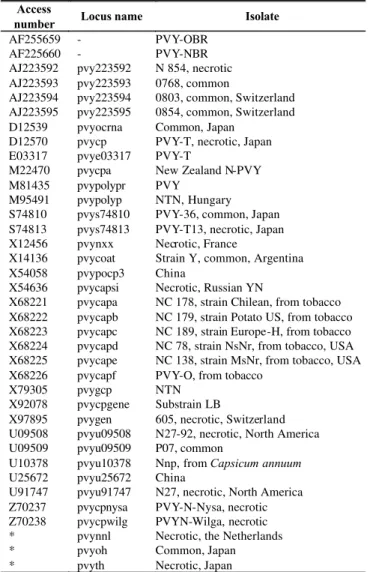
1984). PVY sequences were fetched from the GenBank and referred to as the locus name (Table 3), except for PVYNNL (Van der Vlugt et al., 1989), PVYOH (Ohshima et al., 1991)
and PVYTH (Hataya et al., 1990). The sequences were aligned
and Clustal W (http://www2.ebi.ac.uk/clustalw) was used for phylogenetic tree construction, which was viewed by the program Treeview (http://taxonomy.zoology.gla.ac.uk/rod/ treeview).
RESULTS
Host response to PVY inoculation
PVY-OBR and PVY-NBR were originally isolated from potato fields in Brazil and maintained in N. tabacum
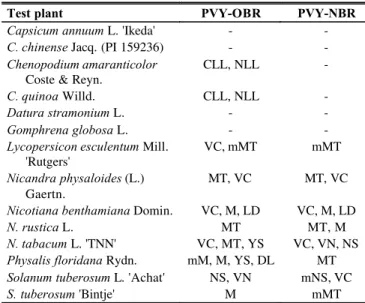
plants. When inoculated into test plants, they showed typical symptoms of the common and necrotic strains, respectively (Table 1). Datura stramonium and pepperplants were not
infected with either isolates and only PVY-OBR caused local lesions in C. amaranticolor and C. quinoa. Nicotiana
TABLE 1 - Reactions of test plants inoculated with the
Potato virus Y isolates OBR and NBR
Test plant PVY-OBR PVY-NBR
Capsicum annuum L. 'Ikeda' - -
C. chinense Jacq. (PI 159236) - -
Chenopodium amaranticolor
Coste & Reyn.
CLL, NLL -
C. quinoa Willd. CLL, NLL -
Datura stramonium L. - -
Gomphrena globosa L. - -
Lycopersicon esculentum Mill.
'Rutgers'
VC, mMT mMT
Nicandra physaloides (L.) Gaertn.
MT, VC MT, VC
Nicotiana benthamiana Domin. VC, M, LD VC, M, LD
N. rustica L. MT MT, M
N. tabacum L. 'TNN' VC, MT, YS VC, VN, NS
Physalis floridana Rydn. mM, M, YS, DL MT
Solanum tuberosum L. 'Achat' NS, VN mNS, VC
S. tuberosum 'Bintje' M mMT
CLL: chlorotic local lesion; NLL: necrotic local lesion; VC: vein clearing; MT: mottling; M: mosaic; LD: leaf distortion; YS: yellow spot; DL: leaf dropping; NS: necrotic spot; VN: veinal necrosis; m: mild; -: no symptom.
Primer a Sequence 5'→→3’b Positionc
PY1 GGGGGATCCAAATCAGGAGATTC 8362-8377
PY2 CCCGGATCCGTCTCCTGATTGAAG 9704-9691
PY3 CTTAGGCAAATCATGGC 9038-9054
PY4 AAACCATATCGTGGCAT 9129-9113
PY5 CACAGTTTGATACGTGG 8835-8851
a The primers were designed according to the sequence of X12456 b Restriction enzyme site (BamH I) is underlined
c Position of the primer according to X12456
Fitopatol. bras. 26(1), março 2001
tabacum TNN showed distinct symptoms. PVY-NBR caused necrotic spots and veinal necrosis, while PVY-OBR caused vein clearing, mottling, and pearl spots. Physalis floridana
infected with PVY-OBR showed more severe symptoms than when inoculated with PVY-NBR. PVY-OBRappeared to be more severe in S. tuberosum, with systemic necrosis in cv. Achat and mosaic in cv. Bintje. The infection of the test plants was confirmed by DAS-ELISA using a polyclonal antibody (Laboratory of Virology, Embrapa Vegetables) against PVY .
Nucleotide sequence analysis of the 3’end of the PVY genome
PCR amplification was directed to the conserved region in the nuclear inclusion body b (NIb) gene approximately 200 bases upstream of the CP gene, and to the last 15 bases of the 3’-UTR, which were completely conserved among all the PVY sequences analyzed. Amplified PCR products were cloned and the sequence of approximately 1.330 nucleotides was determined for both strains using two clones from
different PCR amplifications. The comparison of the nucleotide sequence of both isolates, revealed 87.6% of identity to each other including the NIb, CP and the 3’-UTR (Figure 1). The amplified region of the NIb gene and the CP gene of both isolates were of the same size (nucleotides 1 to 195 for NIb and 196 to 999 for CP). However, the PVY-OBR 3’-UTR (nucleotides 1000 to 1327) was two nucleotides longer than of NBR (nucleotides 1000 to 1325). The PVY-OBR and PVY-NBR nucleotide sequence were deposited in the GenBank under the accession numbers AF255659 and AF255660, respectively.
Translation of the CP gene resulted in 267 amino acids for both isolates sharing 95.1% similarity. The amino acid sequences of 35 different PVY isolates were aligned and compared to the Brazilian isolates (data not shown). Most of the heterogeneity was found in the amino terminal region. The similarity between PVY-OBR and the other isolates varied from 94.4 to 99.2%. The highest similarity was found with PVY223594 (isolate 0803) and PVY223595 (isolate 0854), both common strains from Switzerland. PVY-NBR showed amino acid similarity from 93.3 to 99.7% when compared to other isolates. The highest degree of similarity with PVY-NBR was found with PVYCPNYSA (a necrotic isolate from Poland) and PVYU91747 (a necrotic isolate from North America).
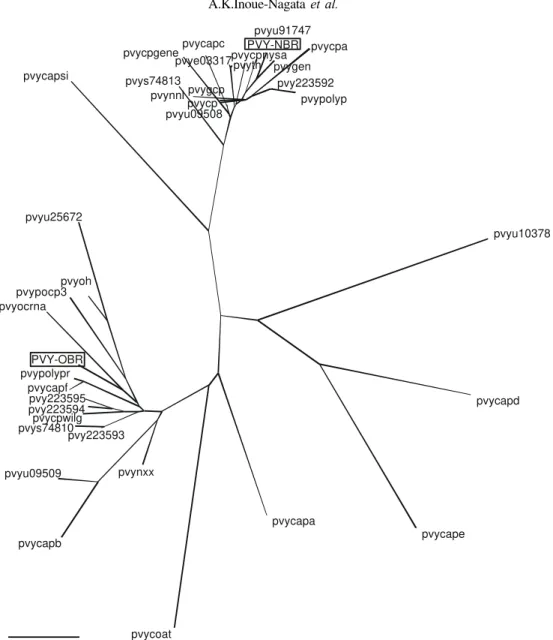
A phylogenetic tree was constructed based on the alignment and displayed as an unrooted tree (Figure 2). PVY-OBR was clearly clustered with other common isolates, with the exception of two necrotic isolates (PVYNXX and PVYCPWILG). PVY-NBR was clustered with typical necrotic isolates and the two PVYNTN isolates (PVYGCP and PVYPOLYP). A potato isolate from Russia (PVYCAPSI) was isolated in a separate branch close to the PVYN cluster, as well as the common isolate from Argentina (PVYCOAT) and a tobacco isolate from Chile (PVYCAPA), both closer to the PVYO cluster. Pepper and tobacco isolates formed a distinct branch including two tobacco isolates from the USA (PVYCAPD and PVYCAPE) and the causal agent of pepper veinal necrosis (PVYU10378).
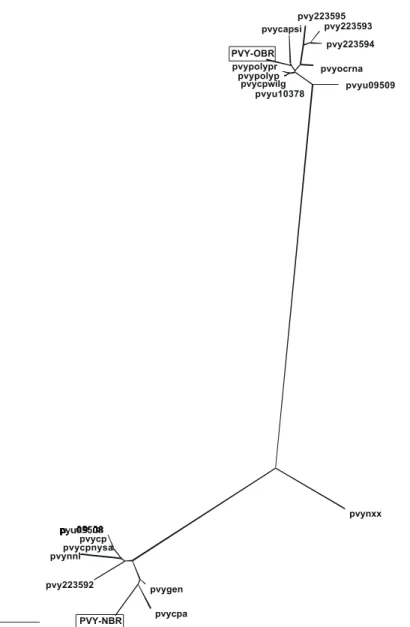
The 3’-UTR nucleotide sequence of the Brazilian isolates was aligned with 18 available PVY sequences and used for construction of an unrooted phylogenetic tree (Figure 3). The consensus sequence found throughout the alignment (data not shown) formed two well defined groups, which were visualized in the phylogenetic tree (Figure 3). The first group comprised all PVYO-like isolates, except for PVYNXX, the necrotic strain from France (Robaglia et al.,
1989), and included PVYNTN (PVYPOLYP), PVY from pepper (PVYU10378), a PVYN from Poland (PVYCPWILG), an unclassified PVY (PVYPOLYPR) and the PVYN from Russia (PVYCAPSI). The second group comprised the PVYN isolates and PVYNXX. The sequence of PVYNXX showed high identity with the PVYO group in the first 90 nucleotides and with PVYN for the remaining sequence (data not shown). PVY-OBR showed 98.2 to 99.4 % identity within the PVYO group. The highest values were found with PVYPOLYP,
Access
number Locus name Isolate
AF255659 - PVY-OBR
AF225660 - PVY-NBR
AJ223592 pvy223592 N 854, necrotic AJ223593 pvy223593 0768, common
AJ223594 pvy223594 0803, common, Switzerland AJ223595 pvy223595 0854, common, Switzerland D12539 pvyocrna Common, Japan
D12570 pvycp PVY-T, necrotic, Japan E03317 pvye03317 PVY-T
M22470 pvycpa New Zealand N-PVY M81435 pvypolypr PVY
M95491 pvypolyp NTN, Hungary S74810 pvys74810 PVY-36, common, Japan S74813 pvys74813 PVY-T13, necrotic, Japan X12456 pvynxx Necrotic, France
X14136 pvycoat Strain Y, common, Argentina X54058 pvypocp3 China
X54636 pvycapsi Necrotic, Russian YN
X68221 pvycapa NC 178, strain Chilean, from tobacco X68222 pvycapb NC 179, strain Potato US, from tobacco X68223 pvycapc NC 189, strain Europe-H, from tobacco X68224 pvycapd NC 78, strain NsNr, from tobacco, USA X68225 pvycape NC 138, strain MsNr, from tobacco, USA X68226 pvycapf PVY-O, from tobacco
X79305 pvygcp NTN
X92078 pvycpgene Substrain LB
X97895 pvygen 605, necrotic, Switzerland U09508 pvyu09508 N27-92, necrotic, North America U09509 pvyu09509 P07, common
U10378 pvyu10378 Nnp, from Capsicum annuum
U25672 pvyu25672 China
U91747 pvyu91747 N27, necrotic, North America Z70237 pvycpnysa PVY-N-Nysa, necrotic Z70238 pvycpwilg PVYN-Wilga, necrotic * pvynnl Necrotic, the Netherlands
* pvyoh Common, Japan
* pvyth Necrotic, Japan
TABLE 3 - PVY sequences used for nucleotide sequence comparison
PVY-OBR 1 TACTCATGGTTATTGCAACAGCAACCTTTTGCAACAATAGCGCAGGAAGG 50
||||||||||| |||||||||||||||||| |||| ||||| ||||||||
PVY-NBR 1 TACTCATGGTTGTTGCAACAGCAACCTTTTTCAACGATAGCACAGGAAGG 50
PVY-OBR 51 GAAGGCTCCTTATATAGCAAGCATGGCATTAAGGAAACTGTATATGGATA 100
|| ||||| || ||||| ||||||||||| | ||| ||||| ||| |||
PVY-NBR 51 AAAAGCTCCATACATAGCGAGCATGGCATTGAAGAAGCTGTACATGAATA 100
PVY-OBR 101 GGACTGTGGATGAGGAAGAGCTAAGAGCCTTCACTGAAATGATGGTCGCA 150
|||| || |||||||| || || | || ||||||||||||||||| ||
PVY-NBR 101 GGACAGTAGATGAGGAGGAACTGAAGGCTTTCACTGAAATGATGGTTGCC 150
PVY-OBR 151 TTAGACGATGAGTTTGAGTTTGACTCTTATGAAGTACACCATCAAGCAAA 200
|| || ||||| ||||||| || |||||||||| |||||||||| |||
PVY-NBR 151 TTGGATGATGAATTTGAGTGCGATACTTATGAAGTGCACCATCAAGGAAA 200
PVY-OBR 201 TGACACAATTGATGCAGGAGGAAGCAACAAGAGAGATGCAAAACCAGAGC 250
||||||||| ||| |||||||||||| |||| |||||||||| |||||
PVY-NBR 201 TGACACAATCGATACAGGAGGAAGCACTAAGAAGGATGCAAAACAAGAGC 250
PVY-OBR 251 AAGGCAGCATCCAGTCAAACCCGAACAAAGGAAAAGATAAGGATGTTAAT 300
|||| ||||| || |||| | ||||| | ||| || ||||| || |||
PVY-NBR 251 AAGGTAGCATTCAACCAAAACTCAACAAGGAAAAGGAAAAGGACGTGAAT 300
PVY-OBR 301 GCTGGCACATCTGGGACACATACTGTGCCGAGAATCAAGGCTATCACGTC 350
| ||| |||||||| || ||||||||||| |||| || |||||||||||
PVY-NBR 301 GTTGGAACATCTGGAACTCATACTGTGCCACGAATTAAAGCTATCACGTC 350
PVY-OBR 351 CAAAATGAGAATGCCCAAAAGCAAGGGAGCAACCGTGCTAAACTTAGAAC 400
|||||||||||||||||| || || || ||||| || ||||| || ||||
PVY-NBR 351 CAAAATGAGAATGCCCAAGAGTAAAGGTGCAACTGTACTAAATTTGGAAC 400
PVY-OBR 401 ATTTGCTTGAGTATGCTCCACAACAAATTGATATTTCAAATACTCGGGCA 450
| || || |||||||||||||| |||||||| || ||||||||||| |||
PVY-NBR 401 ACTTACTCGAGTATGCTCCACAGCAAATTGACATCTCAAATACTCGAGCA 450
PVY-OBR 451 ACTCAATCACAGTTTGATACGTGGTATGAGGCAGTGCGGATGGCATACGA 500
||||||||||||||||||||||||||||| ||||| | | ||||||||
PVY-NBR 451 ACTCAATCACAGTTTGATACGTGGTATGAAGCAGTACAACTTGCATACGA 500
PVY-OBR 501 CATAGGAGAAACTGAGATGCCAACTGTGATGAATGGGCTTATGGTTTGGT 550
||||||||||||||| ||||||||||||||||||||||||||||||||||
PVY-NBR 501 CATAGGAGAAACTGAAATGCCAACTGTGATGAATGGGCTTATGGTTTGGT 550
PVY-OBR 551 GCATTGAAAATGGAACCTCGCCAAATGTCAACGGAGTTTGGGTTATGATG 600
||||||||||||||||||||||||| |||||||||||||||||||||||
PVY-NBR 551 GCATTGAAAATGGAACCTCGCCAAACATCAACGGAGTTTGGGTTATGATG 600
PVY-OBR 601 GATGGGGATGAACAAGTTGAGTACCCGTTGAAACCAATCGTTGAGAATGC 650
||||| ||||||||||| || ||||| ||||||||||||||||||||||
PVY-NBR 601 GATGGAGATGAACAAGTCGAATACCCACTGAAACCAATCGTTGAGAATGC 650
PVY-OBR 651 AAAACCAACCCTTAGGCAAATCATGGCACATTTCTCAGATGTTGCACAAG 700
||||||||| |||||||||||||||||||||||||||||||||||| |||
PVY-NBR 651 AAAACCAACACTTAGGCAAATCATGGCACATTTCTCAGATGTTGCAGAAG 700
PVY-OBR 701 CGTATATAGAAATGCGCAACAAAAAGGAACCATATATGCCACGATATGGT 750
||||||||||||||||||||||||||||||||||||||||||||||||||
PVY-NBR 701 CGTATATAGAAATGCGCAACAAAAAGGAACCATATATGCCACGATATGGT 750
PVY-OBR 751 TTAATTCGGAATCTGCGGGATGTGGGTTTAGCGCGTTATGCCTTTGACTT 800
||| |||| |||||||| |||| |||| || || ||||| ||||||||
PVY-NBR 751 TTAGTTCGTAATCTGCGCGATGGAAGTTTGGCTCGCTATGCTTTTGACTT 800
PVY-OBR 801 TTATGAGGTCACATCACGAACACCAGTGAGGGCTAGGGAAGCGCACATTC 850
|||||| || |||||||| ||||||||||||||||| || || |||||||
Fitopatol. bras. 26(1), março 2001
PVY-OBR 851 AAATGAAGGCCGCAGCATTGAAATCAGCCCAACCTCGACTTTTCGGGTTG 900
|||||||||||||||| || |||||||| ||| ||||||||||||| |||
PVY-NBR 851 AAATGAAGGCCGCAGCTTTAAAATCAGCTCAATCTCGACTTTTCGGATTG 900
PVY-OBR 901 GACGGTGGCATCAGTACACAAGAGGAGAACACAGAGAGGCACACCACCGA 950
|| |||||||| |||||||||||||| |||||||||||||||||||||||
PVY-NBR 901 GATGGTGGCATTAGTACACAAGAGGAAAACACAGAGAGGCACACCACCGA 950
-*-
PVY-OBR 951 GGATGTCTCTCCAAGTATGCATACTCTACTTGGAGTCAAGAACATGTGA. 999
|||||| ||||||||||||||||||||||||||||| ||||||||||||
PVY-NBR 951 GGATGTTTCTCCAAGTATGCATACTCTACTTGGAGTGAAGAACATGTGAT 1000
PVY-OBR 1000 TGTAGTGTCTCTCCGGACGATATATAAGTATTTACATATGCAGTAAGTAT 1049 |||||||||| ||||||||||| ||| |||||| | |||||||||||| PVY-NBR 1001 TGTAGTGTCTTTCCGGACGATACATAGATATTTATGTTTGCAGTAAGTAT 1050
PVY-OBR 1050 TTTGGCTTTTCCTGTACTACTTTTATCATAATTAATAATCAGTTTGAATA 1099 ||||||||||||||||||||||||||| ||||||||||| ||||||||| PVY-NBR 1051 TTTGGCTTTTCCTGTACTACTTTTATCGAAATTAATAATC.GTTTGAATA 1099
PVY-OBR 1100 TTACTAATAGATGGAGGTGGCAGGGTGATTTCGTCATTGTGGTGACTCTA 1149 ||||| |||| | ||||| | | |||| |||| |||| ||||| || PVY-NBR 1100 TTACTGGCAGATAGGGGTGGTATAGCGATTCCGTCGTTGTAGTGACCTTA 1149
PVY-OBR 1150 TCTGTTAATTCCGTATTATTAAGTCTTAGATAAAAGTGCCGGGTTGTCGT 1199 |||| ||| ||||||||| || || ||||||||||||||||| || PVY-NBR 1150 GCTGTCGTTTCTGTATTATTATGT.TTGTGTAAAAGTGCCGGGTTGTTGT 1198
PVY-OBR 1200 TGTTGTGGATGATTCATCGATTAGGTGATGTTGCGATTCTGTCGTAGCAG 1249 |||||||| |||| ||||||||||||||| ||||||| ||||||||||| PVY-NBR 1199 TGTTGTGGCTGATCTATCGATTAGGTGATGCTGCGATT.TGTCGTAGCAG 1247
PVY-OBR 1250 TGACTATGTCTGGATCTATCTGCTTGGGTGGTGTTGTGATTTCGTCATAA 1299 ||||||||||||||| || | |||||||| || ||||||| |||||| PVY-NBR 1248 TGACTATGTCTGGATTTAGTTACTTGGGTGATGCTGTGATTCTGTCATAG 1297
PVY-OBR 1300 CAGTGACTGTAAACTTCAATCAGGAGAC 1327 |||||||||||||||||||||||||||| PVY-NBR 1298 CAGTGACTGTAAACTTCAATCAGGAGAC 1325
FIG. 1 - Nucleotide sequence comparison of the 3’ genome terminal region of PVY-OBR and PVY-NBR cDNAs. Identical nucleotides are linked by vertical bars. Dots were added to the nucleotide sequence to optimize the alignment. The partial sequence of the nuclear inclusion b gene is shown in italics. The coat protein gene is underlined. The stop codon (*) of the polyprotein is shown at position 997-999.
PVYU10378, and PVYCPWILG. The identity ranged from 85.6 to 86.5% with the PVYN group and was 89.0% with PVYNXX. The identity of PVY-NBR within the PVYN group ranged from 97.3 to 98.8% and was 94.4% with PVYNXX. The highest values were found with the necrotic isolates from Switzerland (PVYGEN) and New Zealand (PVYCPA). The identity ranged from 85.2 to 86.5% with the PVYO group. The two groups showed a high degree of homogeneity within the group and the variability between the two groups was found in stretches of one to three nucleotides scattered throughout the sequence (data not shown).
DISCUSSION
The host range and nucleotide sequence of the Brazilian PVY-OBR and PVY-NBR isolates confirmed their inclusion in the PVYO and PVYN group, respectively. A
into the country (Figueira et al., 1998), which may quickly spread throughout potato production areas.
The analysis of the phylogenetic trees from the CP and 3’-UTR sequence revealed two distinct clusters, one comprising most of the PVYO sequences and the other with PVYN ones. In the CP analysis, the two clusters showed a good correlation with the biological properties of the isolates, with the exception of PVYNXX and PVYCPWILG, two necrotic isolates grouped in the PVYO cluster. This tree separated the potato strain from Russia (PVYCAPSI), the pepper strain (PVYU10378), the tobacco isolates (PVYCAPD, PVYCAPE and PVYCAPA) and the PVYO from Argentina (PVYCOAT) from the two clusters. The separation of the isolates from Russia, Argentina and Chile (PVYCAPA) may indicate isolated geographical evolution of these viruses. Pepper and tobacco isolates are still poorly studied, but they formed a separate group suggesting a possible correlation
FIG. 2 - Unrooted phylogenetic tree of 37 coat protein amino acid sequences from different PVY accessions (Table 3). The Brazilian isolates, PVY-OBR and PVY-NBR, are boxed. Bar represents 0.01 amino acid substitutions per site.
among them. This result confirms the grouping of PVY isolates in PVYO, PVYN and non-potato isolates according to RFLP analysis of the CP (Blanco-Urgoiti et al., 1996).
Thirty seven PVY sequences were analyzed for the CP alignment, but only 20 were available for the 3’-UTR analysis. The 3’-UTR tree showed a well defined grouping of PVYO and PVYN and a separate and isolated sequence of PVYNXX, a PVYN isolate from France. Although this isolate was necrotic to N. tabacum (Robaglia et al., 1989), it was consistently clustered with the PVYO isolates when the CP gene was analyzed (Figure 2). This result confirms the previous alignment of 21 CP sequences, which showed the grouping of PVYNXX in the PVYO group (Van der Vlugt et al., 1993). The analysis of the PVYNXX 3’-UTR region showed a mixture of a PVYO–like 5’-region followed by a highly divergent stretch of nucleotides and a PVYN-like sequence at its 3’ termini (data not shown). The PVYCPWILG
pvyu10378
pvycapd
pvycape pvycapa
pvycoat pvynxx
pvycapb pvyu09509
pvy223593 pvys74810pvycpwilg
pvy223594pvy223595 pvycapf pvypolypr
PVY-OBR pvyocrna
pvypocp3pvyoh pvyu25672
pvycapsi pvys74813
pvycpgenepvycapc
pvygcp
pvye03317 pvythpvycpnysa PVY-NBR
pvyu91747
pvygen pvycpa
pvy223592 pvypolyp pvycp
Fitopatol. bras. 26(1), março 2001
was also a necrotic isolate but which was clustered in both trees with PVYO-like isolates. The PVYNTN isolates (PVYPOLYP and PVYGCP) were grouped in PVYN cluster by the CP analysis, but the 3’-UTR of PVYPOLYP was closer to PVYO. Therefore, the nucleotide sequence of CP and 3’-UTR was not useful to distinguish PVYNTN from other PVY isolates. PVYNTN is also indistinguishable from PVYN by serology and host response (Weilguny & Singh, 1998). These results confirm the report that the necrotic reaction determinants in PVY are not localized in the 3’ half portion of the genome (Chachulska et al., 1997).
The nucleotide sequence determination of the CP is postulated as the basis for identification and classification in the Potyvirus genus (Shukla & Ward, 1988). The comparison of two PVY strains with several PVY isolates confirmed the overall clustering into PVYO and PVYN groups. However, the existence of many variants with distinct biological
FIG. 3 - Unrooted phylogenetic tree of 20 3’-UTR nucleotide sequences from different Potato virus Y accessions (Table
3). The Brazilian isolates, PVY-OBR and PVY-NBR, are boxed. Bar represents 0.01 nucleotide substitutions per site.
responses and nucleotide sequences showed that characterization studies of new isolates must include a description of their biological properties.
ACKNOWLEDGEMENTS
We thank Dr. René Van der Vlugt and Dr. Tatsuya Nagata for critically reading the manuscript.
LITERATURE CITED
ALEXANDRE, M.A.V. & BARRADAS, M.M. Solanum mammosum L. nova hospedeira diferencial para o vírus Y da batata (PVY) e sua estirpe necrótica (PVYN). Fitopatologia Brasileira 7:105-109. 1982.
ATREYA, P.L., ATREYA, C.D. & PIRONE, T.P. Amino acid substitutions in the coat protein result in loss of insect
pvyu09509
pvynxx
pvygen
pvycpa PVY-NBR
pvy223592 pvynnlpvycpnysa
pvycp
pvyu10378 pvypolypr PVY-OBR
pvypolyp pvycapsi
pvycpwilg
pvy223595 pvy223593
pvy223594
transmissibility of a plant virus. Proceedings National Academy Sciences. USA. 88:7887-7891. 1991. BECZNER, L., HORVATH, H., ROMHANYI, I. & FORSTER,
H. Studies on the aetiology of tuber necrotic ringspot disease in potato. Potato Research 27:339-351. 1984. BLANCO-URGOITI, B., SÁNCHEZ, F., DOPAZO, J. &
PONZ, F. A strain-type clustering of potato virus Y based on the genetic distance between isolates calculated by RFLP analysis of the amplified coat protein gene. Archives of Virology 141:2425-2442. 1996.
BRAVO-ALMONACID, F. & MENTABERRY, A.N. Nucleotide cDNA sequence coding for the PVYO coat protein. Nucleic Acids Research. 17:4401. 1989. CHACHULSKA, A.M., CHRZANOWSKA, M.,
ROBAGLIA, C. & ZAGÓRSKI, W. Tobacco veinal necrosis determinants are unlikely to be located within the 5’ and 3’ terminal sequences of the potato virus Y genome. Archives of Virology 142:765-779. 1997. DE BOKX, J.A. & HUTTINGA, H. Potato virus Y. CMI/
AAB. Descriptions of Plant Viruses, no. 242. 1981. DEVEREUX, J., HAEBERLI, P. & SMITHIES, O. A
comprehensive set of sequence analysis programs for the VAX. Nucleic Acids Research 12:387-395. 1984. FIGUEIRA, A.R., BARROCAS, E.N., SANTOS, R.C. &
MORAES, F.H.R. Influência da nova estirpe necrótica do vírus Y da batata na escolha de cultivares de batata plantadas em Minas Gerais. Fitopatologia Brasileira 23: (Suplemento):317. 1998. (Resumo)
HATAYA, T., SANO, T., OHSHIMA, K. & SHIKATA, E. Polymerase chain reaction-mediated cloning and expression of the coat protein gene of potato virus Y in
Escherichia coli. Virus Genes 4:339-350. 1990.
LE ROMANCER, M., KERLAN, C. & NEDELLEC, M. Biological characterisation of various geographical isolates of potato virus Y inducing superficial necrosis on potato tubers. Plant Pathology 43:138-144. 1994. MONTENEGRO, M.J., KITAJIMA, E.W., CAMARGO,
L.J.B. & COSTA, A.S. Comparação eletrono-microscópica dos tecidos de plantas infetadas por diferen-tes estirpes do vírus Y da batata que ocorrem no estado de São Paulo. Bragantia 27: 17-23. 1968.
OHSHIMA, K., HATAYA, T., SANO, T., INOUE, A.K. &
SHIKATA, E. Comparison of biological properties, serological characteristics and amino acid sequences of coat protein between potato virus Y ordinary strain and necrotic strain. Annals of the Phytopahological Society of Japan 57:615-622. 1991.
ROBAGLIA, C., DURAND-TARDIF, M., TRONCHET, M., BOUDAZIR, G., ASTIER-MANIFACIER, S. & CASSE-DELBART, F. Nucleotide sequence of potato virus Y (N strain) genomic RNA. Journal of General Virology 70:935-947. 1989.
SECEX/DECEX BRASIL. Ministério da Indústria e Comércio. Secretaria de Comércio Exterior. Importações efetivas-dados preliminares. Brasília, 1999. (Listagens saídas de computador).
SHUKLA, D.D. & WARD, C.W. Amino acid sequence homology of coat proteins as a basis for identification and classification of the potyvirus group. Journal of General Virology 69: 7203-7210. 1988.
SILBERSCHMIDT, K., ROSTOM, E. & ULSON, C.M. A strain of potato virus Y inducing local and systemic necrotic spots on leaves of tobacco White Burley. American Potato Journal 31:213-317. 1954.
TENNANT, P.F., GONSALVES, C., LING, K.-S., FITCH, M., MANSHARDT, R., SLIGHTOM, J.L. & GONSALVES, D. Differential protection against papaya ringspot virus isolates in coat protein gene transgenic papaya and classically cross-protected papaya. Phytopathology 84:1359-1366. 1994.
VAN DER VLUGT, R.A.A., ALLEFS, S., DE HAAN, P.T. & GOLDBACH, R.W. Nucleotide sequence of the 3’-terminal region of the potato virus Y-N RNA. Journal of General Virology 70:229-233. 1989.
VAN DER VLUGT, R.A.A., LEUNISSEN, J. & GOLDBACH, R. Taxonomic relationships between distinct potato virus Y isolates based on detailed comparisons of the viral coat proteins and 3´-nontranslated regions. Archives of Virology 131:361-375. 1993.
WEILGUNY, H. & SINGH, R.P. Separation of Slovenian isolates of PVYNTN from the North American isolates of PVYN by a 3-primer PCR. Journal of Virological Methods 71:57-68. 1998.