THE PRESENT STATUS OF TECHNICAL KNOWLEDGE CONCERNING IMMUNIZATION AGAINST TUBERCULOSIS’ Kurt Toman, M.D.2
Long and involved controversy surrounds the subject of BCG vaccination, This article provides a thorough review of the
issues involved, and describes major factors influencing the
effectiveness of BCG vaccine.
Introduction
For about half a century immunization against tuberculosis has been subjected to com- Prehensive scientific investigation, and during the last three decades about 300 million chil- dren have been vaccinated against the disease. An enormous amount of knowledge and practi- cal experience has thus been accumulated, and yet immunization against tuberculosis is a matter of controversy. Widely differing view- points still leave room for disputes which occasionally evoke strong emotions.
The story of BCG vaccination is full of dramatic conflicts and controversies. This may partly explain why on the one hand there are countries where BCG vaccination has been adopted as legally compulsory national policy, providing coverage for nearly 100 per cent of the eligible population, while on the other there are a few countries where BCG vaccination has been practically unknown to the public and has been unpopular or almost taboo within the medical profession. That, after 50 years of research, is the rather confusing present state of affairs.
This presentation will try to give a balanced account of the facts and attempt their interpre- tation. The goal is not to describe completely, but to focus on those findings which could provide a scientific basis for framing national policies, i.e., on technical information which
‘Paper presented at the II PAHO/WHO Regional Seminar on Tuberculosis held in Bogoti, Colombia, on 6-10 November 1972. Also appearing in Spanish in Boletin de la Oficina Sanitaria Panamericana.
2Member, WHO Expert Advisory Panel on Tu- berculosis.
appears relevant for the public health decision- maker.
Immunological Background Information
The Rationale for Vaccination Against Tu- berculosis
At the beginning of this century, it was often noted that almost everybody got infected with tubercle bacilli, but that only a relatively small proportion of people developed clinically manifest tuberculosis. The large majority of those infected, who did not develop the disease, seemed to have acquired a certain resistance to tuberculosis, although subsequent infections with virulent tubercle bacilli were unavoidable and frequent at the time.
This observation, confirmed by experiments in animals and the application of immunologi- cal principles pertaining to other infectious diseases, led to the following hypotheses:
a) Primoinfection is capable of preventing subsequent infections from developing into clinical disease.
b) Artificial primoinfection could have the same effect. However, since virulent tubercle bacilli are potentially harmful, a strain of mycobacteria should be substituted which is not pathogenic for man.
ENGLISH EDITION-BOLETIN DE LA OSP - Vol. n-I* No.
2, 1973
BCG vaccination of a Costa Rican schoolboy (WHO photo).
be restored. Fortunately, these efforts have
been in vain, and the organism has remained an
attenuated bacillus. Just half a century ago it
was tried out in man for the first time. Today
I all existing BCG vaccines are derived from this
attenuated strain.
At the same time, however, it is important
to note an entirely contrary hypothesis that has
been widely promoted, especially in this Hemi-
sphere.
The main tenet of this hypothesis is that
reinfection of persons who are already sensi-
tized to tuberculoprotein leads to the progres-
sive adult type of tuberculosis. As stated by one
author:
Tubercle bacilli of reinfection are likely to
result in clinical disease because their invasion
occurs on allergic tissues. Before allergy ap
pears, tuberculoprotein
is innocuous to cells
and tissues. With the appearance of allergy,
however, it becomes a violent poison and thus
may kill cells and tissues with which it comes in
contact.
Obviously, therefore, both in animals and
humans the defense mechanism operates more
effectively against initial invasions than those
which later occur in allergic tissue. To produce
allergy artificially,
even with dead tubercle
bacilli, can be a dangerous procedure for many
persons. (Myers, 195 7.)
This unquantified
hypothesis, however,
Toman . TECHNICAL KNOWLEDGE ON TUBERCULOSIS IMMUNIZATION 3
berculosis (Palmer and Long, 1966; Palmer and Edwards, 1968). Palmer and his group thus express clear disagreement with Myers’ hypoth- esis by interpreting nonspecific sensitivity as a sign of acquired resistance rather than a sign of danger.
Some Immunological Findings
The immune response in tuberculosis, partic- ularly as it relates to delayed hypersensitivity, has long been a controversial subject. Numerous attempts have failed to produce a vaccine3 from live, killed, or fractionated mycobacteria which confers protection without inducing de- layed hypersensitivity. However, there is grow- ing evidence to support the hypothesis of Dubos and Pierce (1956) that only live, meta- bolically active mycobacteria multiplying in the host can produce immunity of the required strength and duration. For many years it has been known that delayed hypersensitivity can- not be passively transferred by serum, but only by lymphocytes from sensitized individuals; however, in recent years even acquired resist- ance has been transferred in that way. From this and other evidence it is possible to con- clude (Mackaness, 1968) that both hypersensi- tivity and acquired resistance are not only cell-mediated but also far more closely related than was once commonly believed.
The discovery of non-tuberculous myco- bacteria with immunizing capacity has added another immunologic consideration to the sub- ject. It is now generally accepted that low-grade tuberculin sensitivity is mainly due to sensi- tization by mycobacteria other than M. tu-
berculosis (Palmer and Strange Petersen, 1950; Edwards et al., 1955; WHO TuberculosisRe- search Office, 1955a, 1955~).
Such low-grade or nonspecific tuberculin sensitivity is particularly prevalent in tropical areas, more frequent in lowlands than in high- lands, and more frequent in men than in
31ndividual laboratories have reported producing
such vaccine, but other laboratories have been unable
to confirm or reproduce their results.
women (Nyboe, 1966). The prevalence of this sensitivity also increases with age.
Studies of delayed hypersensitivity to puri- fied protein derivatives (PPDs) prepared from mycobacteria of Runyon Groups I-IV indicate that the causative agent of low-grade sensitivity in man may be antigenically close to mycobac- teria of Runyon Groups II and III, e.g., M.
gause, M. avium, or M. battey (WHO Tuberculo- sis Research Office, 1955b; Edwards et aZ.,
1962; Hart et aZ., 1962; and Edwards et al., 1965).
In a study on mice (Youmans et al,, 1961) and a large experiment on guinea pigs (PaImer and Long, 1966) a BCG-like effect of varying degrees was caused by certain mycobacteria of Runyon Groups I-IV. Interestingly, the degree of protection was shown to be closely related to the average strength of sensitivity to PPD-S4 induced by the respective mycobacteria. How- ever, the protection conferred by BCG was always found to be stronger than that conferred by the atypical mycobacteria. When BCG was administered to guinea pigs already immunized by nonspecific mycobacteria, the protective effect was stronger but not additive. It was simply as strong as if BCG had been given alone-no stronger, no weaker.
Differentiating Mycobacterid Infections
It is obviously of great epidemiologic inter- est to distinguish between members of a popu- lation infected by A4. tuberculosis, those in- fected by nonspecific mycobacteria, and those remaining uninfected. Where only one kind of tuberculin is being employed, individuals who react only to a strong dose such as 100 tuberculin units of PPD-S, and not to a weak dose such as 5 tuberculin units, could be classified as having low-grade sensitivity; this means they are probably infected by nontu- berculous mycobacteria. Nowadays, simultane- ous testing with two or more antigens is preferred; these should be PPDs prepared from
4 ENGLISH EDITION-BOLETIN DE LA OSP . Vol. VII, No. 2, I973
atypical mycobacteria, including one mam- malian PPD. The most extensive experience until now has been with PPD-B (Battey) pre- pared from a non-chromogenic mycobacterium of Runyon Group III, applied in a dose of the same biological strength as that of its compan- ion, PPD-tuberculin. Although testing with mul- tiple antigens provides us with more informa- tion than testing with PPD-tuberculin of various strengths, it lacks the discriminative capacity needed for individual diagnosis.
The Committee on Diagnostic Skin Testing, in its statement on the tuberculin test (Medical Section of the National Tuberculosis and Re- spiratory Disease Association, 197 l), stressed that “simultaneous skin testing with PPD tu- berculin and an antigen prepared from an atypical mycobacterium is of some help [au- thor’s emphasis] in making a differential diag- nosis between reactivity caused by infection with M. tuberculosis or other mycobacteria.” Because of the low specificity of the antigens, however, it is practically impossible to deter- mine which particdar mycobacterium is caus- ing low-grade skin sensitivity in cross-reaction with PPD-tuberculin.
It should also be noted that it has not yet been possible to differentiate BCG-induced sensitivity from postjnfectious sensitivity caus- ed by A4. tuberculosis. BCG, which was original- ly a strain of IV. bow%, appears antigenically related to M. tuberculosis. Multiple testing with PPDs prepared from atypical nontuberculous mycobacteria has not helped to distinguish between these two close mammalian types of mycobacterial infection (Comstock et al.,
1970).
Administration of PPDs prepared from non- tuberculous mycobacteria, and simultaneous administration of PPDs from tubercle bacilli, are helpful primarily in group diagnosis. For individual diagnosis, very great caution must be used in interpreting test results.
The Efficacy of BCG Vaccination in Man
Vaccination Trials
The most valuable contribution to our
knowledge on vaccination efficacy has come from controlled trials. In those reported here, individuals eligible for vaccination were divided at random into two groups; one group received the vaccination while the other received a placebo and served as the control group. Stand- ard follow-up procedures were established, and those making observations had no knowledge of whether an individual belonged to the vac- cinated or the placebo group. The results of seven such controlled trials are presented in Table 1.
The figures shown in the last column indi- cate striking variations in protective efficacy,5 ranging from 0 to 80 per cent. A trial in Puerto Rico indicated that BCG vaccination had a moderate effect, but trials in Georgia (1947) and in Georgia and Alabama (1950) showed it to have very little or no effect. Another trial in Southern India showed 60 per cent efficacy after 7-l /2 years, declining to 31 per cent after 12-l/2 years. On the other hand, a trial in a population of North American Indians showed high protective efficacy on the order of 80 per
cent. Similar high levels were attained by trials in Chicago infants and in British adolescents 14 to 15-l/2 years old. These conflicting results have naturally provoked intense discussion.
Effective measures were taken to prevent methodological shortcomings from affecting the allocation of eligible subjects or the assess- ment of results, and all the trials had built-in safeguards against bias. Furthermore, geno- typical or phenotypical differences between the populations belonging to various ethnic groups and countries were found not to be responsible for the large differences in efficacy (Sutherland,
1967).
The suggestion that gross malnourishment or nutritional differences could have reduced the efficacy of vaccination, as had been the case in mouse experiments (Dubos, 1964), was not in accord with the high vaccination efficacy in
TABLE l-Results of seven controlled trials of BCG vaccination against tuberculosis.
I
Period of Criteria establishing
intake and eligibility for Source
Population group and reference age-range vaccination of vaccine
1) North American Indians (8 tribes) (Stein & Aronson, 1953)
19351938 A negative reaction Henry Phipps
O-20 years to 0.005 mg of PPD- Institute, Seibert (250 TU) Philadelphia
Duration of Cases of Protective
follow-up Vaccination No. of tuberculosis efficacy
(wars) group subjects
No. Ratea (per cent)
Unvaccinated 1,457 238 1,563
9-l 1 BCG 1,551 64 320 80b
2) Chicago infants in high-risk areas 1937-1948 No prior tuberculin Tice Laboratory, Unvaccinated 1,665 65 223d
(Rosenthal er al., 1961) Under testing Chicagoc 12-23 BCG 1,716 17 57d 75
3 months
3) Georgia, general population 1947 A reaction of under Tice Laboratory, Unvaccinated 2,341 3 11
(Comstock & Webster, 1969) 6-17 years 5 mm to 0.002 mg Chicagoc 20 BCG 2,498 5 17 None
of RT 18 (100TU) 4) Puerto Rico, general population
(Palmer et al., 1958)
19491951 A reaction of under N.Y. State Depart- Unvaccinated 27,338
1-18 years 6 mm to 0.0002 mg ment of Health, 5 l/2-7 l/2 BCG 50,634 31
of RT 19-20-21 New York (mean: 6.3) (10 TU)
5) Georgia and Alabama, general 1950 population (Comstock & 5 years
Palmer, 1966) and over
A reaction of under Tice Laboratory, Unvaccinated 17,854 32 13
5 mm to 0.0001 mg Chicagoc 14 BCG 16,913 26 11 14
of RT 19-20-21 6) Great Britain, urban population
(BMC Report, 1972-see Tables 2 and 3)
1950-1952 A reaction of under Statens Serum- Unvaccinated 12,699 240 128
14-15 l/2 5mmtoO.lmlof Institut, 15 BCG 13,598 56 28 78
years 1% Old Tuberculin Copenhagen (100 TU)
7) Southern India, rural population
(Frimodt-Moller et al, 1968) 1950-1955 All ages A reaction of under BCG Laboratory, 5mmto5TUof Madras (mean: 12.3) 9-14 Unvaccinated BCG 5,808 5,069 46 28 31-60e RT 19-20-21
aAnnuaI rate per 100,000 population, usually allowing for observation losses.
bThe protective efficacy against death from tuberculosis was 82 % for a period of 18-20 years (Aronson et al., 1958).
CThis laboratory has issued a number of strains at different times, and it is not known whether the strains used in these three trials were the same or not. dAssuming a mean observation period of 17.5 years.
e60 per cent efficacy after 7.5 years, 31 per cent after 12.5 years.
6 ENGLISH EDITION-BOLETIN DE LA OSP . Vol. VII, No. 2, 19 73
North American Indians (Hart and Sutherland, 1965). Moreover, the thickness of the subcuta- neous fat layer was measured in the Georgia and Alabama trial, and no association with efficacy could be found (Cornstock and Palmer,
1966).
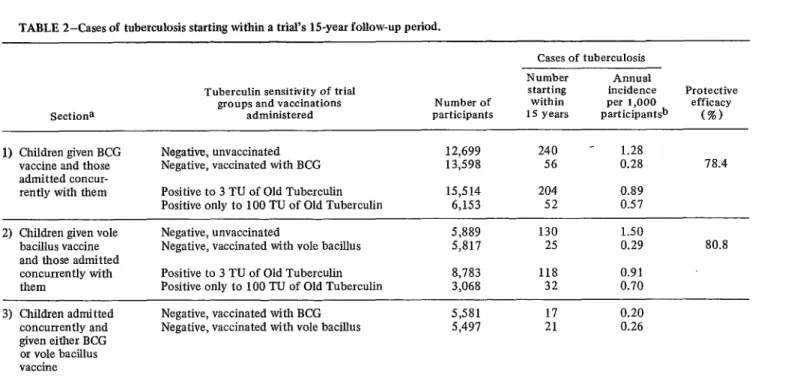
It has also been suggested that the different results of the British trial and the trials in Georgia, Puerto Rico, and Georgia-Alabama can be explained by differences in the prevalence of nonspecific mycobacterial infection in the re- spective areas (Ferebee and Palmer, 1966; Palmer and Long, 1966). It can indeed be assumed that a portion of subjects in the American areas who had been classified as eligible had already been infected by nonspecif- ic mycobacteria. Thus, they were likely to have acquired some immunity that could be in- creased only a little by BCG-a situation analo- gous to that in previously cited animal experi- ments (Youmans, 1961; Palmer and Long, 1966). Also, in the British trial a portion of the subjects were apparently already infected by nonspecific mycobacteria and thus had some naturally acquired immunity (see Tables 2 and 3).
The group of nonspecific reactors6 in the British trial had about twice the disease inci- dence of those vaccinated with BCG. At the same time the control group, i.e., those with negative reactions who did not receive BCG, had about twice the disease incidence of the nonspecific reactors. These findings tend to agree with those of Palmer and Long (1966) showing that the population in the Georgia- Alabama trial was infected with mycobacteria having about half as much antituberculous potency as BCG. A similar degree of protection was observed in a follow-up study of Navy recruits (Edwards and Palmer, 1968).
However, if this estimate of BCG-like protec- tion from nonspecific natural infection is cor- rect, then the differences observed in the American study could not be explained as suggested. If we calculate the natural protection
‘%ubjects having skin reactions to 100 tuberculin units of Old Tuberculin, but not to 3 tuberculin units. (They were not vaccinated but were followed up.)
conferred by the nonspecific mycobacteria it would amount to about 95 per cent of that conferred by BCG (Hart, 1969).7 This obvi- ously conflicts with the initial hypothesis, since such a strong protective effect has never been found, either in experiments or in nature. Moreover, in the Georgia trial the effects of nonspecific mycobacterial infection can be dis- counted, because only nonreactors to 100 TU were eligible, as in the British trial.
If the differences under discussion cannot be explained by the frequency of nonspecific mycobacterial infection, then the only possible conclusion is that the vaccine used in the Georgia-Alabama trial was of lower potency than that used in the British trial. The batches of BCG supplied for the British trial were checked regularly, and their quality was gener- ally found to be good, with a few exceptions. However, the potency of strains used to supply vaccine for the American trials was found to vary. Several studies in animals by two research laboratories revealed that cultures derived from one of the vaccines had very little ability to multiply, sensitize,* and protect (Suter and Dubos, 1951; Dubos, Pierce, and Schaefer, 1953; Dubos and Pierce, 1956; Willis et aL,
1960; Willis and Vandiviere, 1961; Jespersen, 1971). These several studies together indicate that the particular vaccine used in the American trials was prepared from a strain which did not multiply well in laboratory animals and did not protect them satisfactorily. It might be argued that many of the tests were carried out some years after the trials. However, when the strains used in the North American Indian trial and the Danish strain used in the British trial were tested many years later they appeared to have retained their previous virulence and their ability to sensitize and protect test animals. It can thus be concluded that the low BCG
71t should be noted that in almost all tropical areas where nonspecific sensitivity is widespread the tu- berculosis morbidity and mortality is high as well. If nonspecific sensitivity is synonymous with protection then the degree of protection must be low and insufficient.
TABLE 2-Cases of tuberculosis starting within a trial’s H-year follow-up period.
Cases of tuberculosis
* t
sectiona
Tuberculin sensitivity of trial groups and vaccinations
administered participants Number of
Number Annual
starting incidence Protective within per 1,000 efficacy
15 years participantsb (%) 1) Children given BCG
vaccine and those admitted concur- rently with them
Negative, unvaccinated Negative, vaccinated with BCG Positive to 3 TU of Old Tuberculin Positive only to 100 TU of Old Tuberculin
12,699 240 - 1.28
13,598 56 0.28 78.4
15,514 204 0.89
6,153 52 0.57
2) Children given vole Negative, unvaccinated 5,889 130 1.50
bacillus vaccine Negative, vaccinated with vole bacillus 5,817 25 0.29 80.8
and those admitted
concurrently with Positive to 3 TU of Old Tuberculin 8,783 118 0.91
them Positive only to 100 TU of Old Tuberculin 3,068 32 0.70
3) Children admitted Negative, vaccinated with BCG 5,581 17 0.20
concurrently and Negative, vaccinated with vole bacillus 5,497 21 0.26
given either BCG or vole bacillus vaccine
aMany participants and cases of tuberculosis appear in more than one of the three separate sections of this table; therefore the figures from the different sections cannot be totalled.
bAfter allowing for reduction of the population at risk; i.e., through death or contraction of tuberculosis.
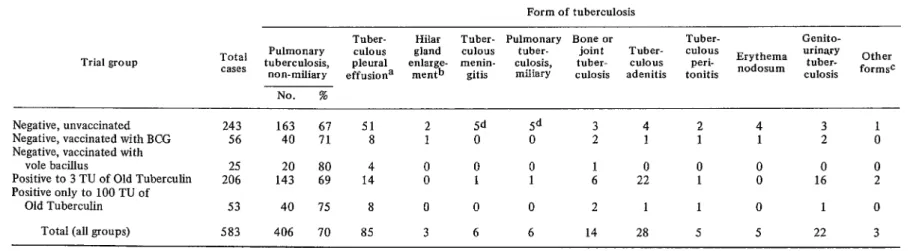
TABLE 3-Cases of tuberculosis starting within 15 years, classified according to the form of the disease.
Form of tuberculosis
Trial group
Tuber- Hilar Tuber- Pulmonary Bone or Tuber- Genito-
Total Pulmonary culous gland CUIOUS tuber- joint Tuber- CUIOUS urinary
cases tuberculosis, non-miliary effusiona pleural enlarge- menin- men+ gitis culosis, miliary culosis tuber- adenitis culous tonitis peri- Erythema nodosum culosis tuber- formsc Other
No. %
Negative, unvaccinated 243 163 61 51 2 9 sd 3 4 2 4 3 1
Negative, vaccinated with BCG 56 40 71 8 1 0 0 2 1 1 1 2 0
Negative, vaccinated with
vole bacillus 25 20 80 4 0 0 0 1 0 0 0 0 0
Positive to 3 TU of Old Tuberculin 206 143 69 14 0 1 1 6 22 1 0 16 2
Positive only to 100 TU of
Old Tuberculin 53 40 15 8 0 0 0 2 1 1 0 1 0
Total (all groups) 583 406 70 85 3 6 6 14 28 5 5 22 3
a Without evidence of pulmonary tuberculosis. b Without other evidence of tuberculosis.
c One case each of tuberculous bronchiectasis, tuberculous endobronchitis, and lupus vulgaris.
din all, there were 10 cases of tuberculous meningitis and pulmonary miliary tuberculosis among the unvaccinated participants and none among vaccinated ones. Source: Fourth Report of the British Medical Research Council on BCG and Vole Bacillus in the Prevention of Tuberculosis in Adolescence and Early Adult Life. 1972.
L
Toman . TECHNICAL KNOWLEDGE ON TUBE
L
7
efficacy in the Georgia and Georgia-Alabama trials dould have been due primarily to the properties of the vaccine used; it is also conceivable that underdosage may have played a significant role in the trials, which employed the multiple puncture vaccination technique. The findings of these long-term trials are of fundamental significance for several reasons: they have provided practical evidence of the protective efficacy of BCG vaccination in man; they have supported the evidence that non- specific sensitivity is associated with a certain degree of protection against tuberculosis; and they have focused attention on the over- whelming impact that variations in vaccine quality can have on efficacy.
4 Retrospective Studies
Numerous retrospective studies on BCG vac- c cination have been published; from among them,it may be useful to mention a few from countries where statistics on tuberculosis mor- bidity have been recorded for many decades. .
Besides BCG vaccine, other vaccines pre- pared from attenuated strains of 8-f tuberculo- sis or other mycobacteria have been recom- mended for use. Some of them may be as potent as BCG (e.g.,vaccine prepared from the vole bacillus, Mycobacterium microti). How- ever, BCG is still preferred because no other vaccine has been proved more effective and equally safe.
Variations in the Potency of KG Strains
One comparative study (Bjartveit and Waaler, 1965) analyzed morbidity rates in three Scandinavian countries where BCG vaccination had been widely used, but where national * vaccination policies had differed. Since the 1940’s, primary vaccination had been given systematically to newborns in Sweden, to those h leaving school in Norway, and to school en- trants in Denmark. Comparing the morbidity rates in those three countries for the decade A 1950-1960, it was found that tuberculosis was decreasing among all age groups, but that age-specific decreases were closely associated Y with vaccination policies in the respective coun-
tries. That is, the age-groups given intensive BCG coverage showed a decrease of 20-25 per *
The potency of BCG vaccines varies widely from laboratory to laboratory, and vaccines with only 1 per cent culturable particles are no rarity (Guld, 1971). From the various BCG vaccination trials discussed in the preceding section, it appears that in some cases a vaccine which gave very little or no protection and induced only very low, short-lived tuberculin sensitivity was prepared from a strain of ques- tionable potency. This strain later multiplied poorly in laboratory animals and protected them unsatisfactorily when challenged with virulent tubercle bacilli.
cent, whereas the nonvaccinated age-groups showed declines of about 10 per cent.
In Hong Kong, where BCG vaccination was
Thus, in producing vaccine it would seem reasonable to choose only strains which are fully active metabolically, multiply fast in the host, and yield a vaccine that induces a strong, long-lasting tuberculin sensitivity in children receiving a small standard dose.
t given almost exclusively to newborn babies, coverage increased gradually to 71.5 per cent in 1960. From 1954 to 1962 the total morbidity from all forms of tuberculosis decreased by about 80 per cent, but there was only a slow
Currently, however, the vaccines produced in different laboratories vary widely. Though all existing BCG substrains trace back to the same strain received from Calmette, as one author recently noted, there are “. . . no two BCG
SRCULOSIS IMMUNIZATION 9
decline in the rate of morbidity in adults (Moodie, 1961-and 1963).
Recent observations in Hungary (Lugosi, 1971), Japan (JATA, 1970), and Birmingham, England (Springett and Sutherland, 1970) indi- cate a close relationship between vaccination policies and the trend of decreasing morbidity in vaccinated populations.
10 ENGLISH EDITION-B~LETIN DE LA 0s~ . Vol. Ku, No. 2, 1973
strains in the world today having identical attributes.“9
Genetic Changes
Twenty years ago marked differences in BCG strains’ immunogenic and sensitizing po- tency had already been demonstrated (Jensen,
1946; Jacox and Meade, 1949; Dubos et aZ.,
1953). In the course of continuous serial subculture, which was the traditional way to maintain strains, the growth of mutants was unavoidable. In particular, mutants which have a faster growth rate in vitro than the mother cells of the strain can quite quickly gain the upper hand. That apparently happened in a number of strains. Sometimes culture media or growth conditions were altered deliberately, with the aim of obtaining a more innocuous strain producing fewer complications or less tuberculin sensitivity; but most of the changes occurred unexpectedly for unknown reasons not subject to control at the time.
Numerous strains have changed their mor- phological appearance, pigmentation, viability, and growth rate; quite often their protective and sensitizing characteristics have been corre- spondingly weakened. However, if a strain spontaneously loses the characteristic proper- ties for which it was originally chosen, it is very likely that the strain’s mother cells have already been replaced by mutant cells. Such a strain has gone out of control, and its potency is ques- tionable .
The Seed-Lot System
In order to prevent genetic changes and minimize this risk, the traditional way of maintaining strains by serial subculture had to be abandoned. Introduction of the more recent seed-lot system was a significant improvement. The seed-lot principle consists of preserving a selected strain in dry form at such low temperatures that multiplication cannot occur. At deep-freeze temperatures metabolic require- ments are reduced to a minimum. A portion of
9Guld, J. In International Symposium on BCG Vaccine, 1971, p. 143.
the bacterial population dies, but a sufficient number of culturable particles can survive for decades. Since no multiplication is taking place, genetic change is eliminated, and so the system accomplishes its goal of preventing such change. In practice the primary seed-lot is a large batch of freeze-dried BCG stored in ampules. One ampule is opened at a time and the content inoculated into culture media. From this cul- ture subcultures are prepared, until the strain has fully recovered; this takes some two or three passages. Subcultures for preparing either vaccine or a secondary seed-lot are established, but no more than 12 passages are permitted in all. After the twelfth passage, i.e., in about IO-12 weeks, a new ampule must be taken from the primary seed-lot.
This limited number of passages prevents deteriorating changes, because the short repro- ductive period minimizes the risk of mutation. Now BCG has indeed become the “virus fixP”
Calmette believed he had obtained. But the limit of twelve passages preceding vaccine pre- paration (including all preliminary passages) must be strictly adhered to. Actually, it appears advisable to further decrease this limit, provid- ing a wider margin of safety, particularly in laboratories which produce vaccine from a secondary seed-lot. (A secondary seed-lot is prepared at the earliest time possible,e.g., after the third preliminary passage, and preparation of the vaccine requires three more preliminary passages. That means that before vaccine pro- duction from a secondary seed-lot can begin, six preliminary passages and sometimes more have already been made.)
The seed-lot system is the most important feature of the “Requirements for Dried BCG Vaccine” adopted by the WHO Expert Com- mittee on Biological Standardization in its Eighteenth Report (1966). Today most produc- tion laboratories routinely use the seed-lot system.
Freeze-Dried Vaccines
Toman . TECHNICAL KNOWLEDGE ON TUBERCULOSIS IMMUNIZATION 11
increasing. Compared to liquid vaccine, the advantages of a heat-stable product in tropical climates are clear. Some of these heat-stable freeze-dried products can be stored at tempera- tures above 30°C for about a month and will keep in the refrigerator at 4-.5OC for a year. Another essential advantage is that any inferior batches can be identified and removed before the vaccine leaves the laboratory, because all tests can be completed before the vaccine is used. Liquid vaccine, because of its short expiration time, must be used before most quality-control test results are available; this sometimes leads to rather embarrassing situa- tions.
Many laboratories producing liquid vaccine hope to embark on production of freeze-dried vaccine. But to prepare a freeze-dried product of satisfactory quality is far more difficult than production of liquid vaccine. Not only does it require a strain which can be freeze-dried without being killed off, but it also demands sophisticated machinery, a complex technolo- gy,l O meticulous and elaborate quality-control procedures, and highly skilled and reliable personnel. These conditions would be very difficult to achieve in all the territories where liquid vaccine has been produced. But even if all the technical obstacles could be overcome, there would still be a long way to go before a semi-industrial production plant could be put into efficient operation. Besides the need to maintain quality standards, such a plant would face manpower difficulties and other manage- rial problems with a potential for causing repeated production breakdowns. These are the reasons why WHO’s warning that “. . . the multiplication of BCG production centers
loAfter the bacterial mass is harvested from the medium on the appropriate dav of growth, and subsequently filtered and pressed, the semi-dry mate- rial is mechanically homogenized according to exact- ing standards. it is then diluted, put into ampules, and freeze-dried. Eventually the ampules are sealed in a near-perfect vacuum. During the whole procedure the product must be strictly protected against exposure to sunlight and kept in rooms with pressurized, filtered, and sterile air. It is thus difficult, though essential, to keep all the production factors which determine the viability and heat stability of the vaccine under safe control.
should be discouraged”11 must be taken seri- ously.
In general, small-country investment in the development of freeze-dried BCG vaccine pro- duction is hard to justify, even if one only compares the high production costs with the low market price, disregarding the scarce re- sources necessary for equipment, maintenance, and the like. If it is not possible to make a profit by producing for export, then it is much better and more economical to buy vaccine from accredited production centers. For the most part, developing countries are supplied through UNICEF.
The WHO Quality-Control Service
WHO has always promoted the idea of having a few reliable large-scale production centers, and with this aim in mind has estab- lished a service to control the quality of BCG vaccines. Not only is care taken to control the vaccines currently supplied through UNICEF, but any Government or production center can have vaccine samples examined upon request
(Document WHO/TB/Technical Guide/G,
1967). The quality control includes a periodic assay in man (Nyboe, 1966), facilitated by the WHO International Reference Center for BCG Seed Lots and Control of BCG products.
During the last few years, since establish- ment of these services, there has been a marked drop in the large quality variations affecting both liquid and freeze-dried BCG vaccine that used to occur in many laboratories.
BCG Vaccination Techniques
12 ENGLISH EDITION-BOLETIN DE LA OSP . Vol. VII, No. 2, I973
leak-proof syringes, the vaccine dose can be kept fairly accurate and thus the risk of complications due to overdosage is low. The intradermal technique also permits the use of a much more dilute vaccine than percutaneous methods, which use vaccines containing concen- trations of culturable particles 20 to 200 times higher; concentrations required for oral vac- cines may be even greater.
Except with the intracutaneous technique, one cannot determine how much vaccine is actually entering the body. Therefore, a wider range of dosages, and more underdoses and overdoses as well, must be expected. Overdoses are likely to cause undesired reactions, and in order to reduce the risk of them the average vaccine concentration must be lowered. As a result the proportion of complications will be lower, but the risk of underimmunization will be higher.
Various multipuncture techniques use either automatic pistol-type (spring-driven) devices or simple discs made of steel or a disposable material. They have been advocated as being simpler and faster, enabling unskilled staff members with no special training to vaccinate large population groups.
The multipuncture technique might oc- casionally give satisfactory though inferior re- sults in comparison with intradermal tech- niques. But experience indicating this is derived mostly from research or special studies. Wheth- er the technique is actually robust enough to give equally good results under practical and ordinarily less favorable conditions is not known; at least, no evidence that it can do so is yet available.
A WHO-assisted study is presently examining a multipuncture technique using the bifurcated needle commonly employed in smallpox vac- cination. When failures are found to be within tolerable limits, field trials under real-life con- ditions will be undertaken. Provided the results are still acceptable, the bifurcated needle tech- nique might be recommended for use in situa- tions where the alternative would be too little vaccination or none at all. An operational advantage of this technique in countries where
c smallpox vaccination is a permanent policy is that BCG vaccinations could be given by smallpox vaccinators without special training. This would permit both vaccinations to be applied at the same time and with the same
technique.
One intradermal technique which seemed rather promising uses a jet-injector based on the air-gun principle. Various types that generate the necessary air pressure can be operated by hand, foot, or an electric current. A supposedly
uniform dose is shot into the superficial layers of the skin, as with the intradermal syringe- needle technique.
A number of studies have compared the ‘r various types of jet-injectors with the intra- dermal syringe technique, and a thorough anal- ysis of these studies was recently published + (Dam et aZ., 1970). Surprisingly, these studies failed to demonstrate the precision one would expect of an automatic apparatus. The size of post-vaccination tuberculin reactions was smaller, on the average, though the variations were similar to those of the syringe technique. . However, the variation in lesion size was much larger, indicating individual differences in the way the jet-injector dispenses vaccine into the superficial layers of the skin. In order to _ achieve post-vaccinal tuberculin reactions of the same size, SO-250 per cent higher doses of vaccine had to be given, depending on the type of jet-injector used. However, the lesions pro- ’ duced by these higher doses were substantially larger than those resulting from syringe injec- L tion.
Disregarding the operational vulnerability and cost of jet-injectors, they offer an advan- tage only in situations where large numbers of eligible persons can be lined up, and where means of repairing the equipment is always at hand. Another difficulty arises when adults and infants have to be vaccinated in alternating sequence-and when infants are to be given a smaller dose-for it is not technically feasible to adjust the jet-injector instantly.
Toman . TECHNICAL KNOWLEDGE ON TUBERCULOSIS IMMUNIZATION 13
used routinely, despite its simplicity. Although sufficient evidence is still lacking, it is believed that it might offer an efficient way of vac- cinating newborns. Critical studies in older age groups, however, revealed that oral vaccination did not fulfill its expectations. Because of the high vaccine dosages required, the risk of serious complications for newborn infants ap- peared to be rather high. Frequent cervical lymphadenitis and BCG infection of the middle ear with subsequent impairment of hearing were among the reasons why oral vaccination has been rejected in the past.
Direct BCG Vaccination
Indiscriminate BCG vaccination, i.e., with- out prior tuberculin testing, has been thorough- ly investigated by several WHO projects in various parts of the world. Also, after the WHO Expert Committee on Tuberculosis (1964) rec- ommended direct BCG vaccination as a coun- try-wide policy, a number of further studies examined the risk of undesired effects. Among other things, the incidence of lymph node enlargement was investigated; no difference was found between reactors and non-reactors (Chavganc et aZ., 1969; Document WHO/TB/ 58, 1967). Other studies dealt with the hypo- thetical risk of reactivating quiescent or healed tuberculosis in children (Egsmose, 1969), and the possible deteriorating effect that vaccina- tion might have on specific lung lesions in persons undergoing radiological and bacterio- logical follow-up (Gothi et al., 1964). No adverse effect of direct BCG has been reported in any of the studies.
Since direct BCG vaccination has been shown highly acceptable in many countries, it could be adopted as a national policy. Its obvious operational advantages, which result in higher outputs while almost halving the work- load, makes direct BCG vaccination recom- mendable, particularly in countries where health personnel shortages are a serious con- straint .
Simultaneous or Combined Administration of BCG and Other Vaccines
Whereas direct BCG vaccination had been accepted by national authorities with certain caution, and only after pilot studies had proven its innocuity, the idea of simultaneous BCG and smallpox vaccination was welcomed with al- most no hesitation. It has been found experi- mentally in animals (Kawazaki, 1959) and by tests in children (Moodie, 1963; Lin, 1965, 1966; Christensen, 1966; Baily, 1967) that there is no interference with respect to develop- ment of local lesions, the take rate, or tu- berculin sensitivity. Convenience for the public, as well as for health authorities and vaccinators, has led several countries to adopt simultaneous smallpox and BCG vaccination of children as a national policy. The recent finding that a potent smallpox vaccine given to infants can protect them for some six years or more, and that revaccination at primary school age may extend the protective effect for two decades or even longer (Henderson, 1971) is very promis- ing and supports the idea of pooling both vaccination programs.
Other investigators have made pilot studies of simultaneous application of BCG with other vaccines, including vaccines for measles (Dutertre, 1971) and yellow fever (Chambon,
et al., 1971).
14 ENGLISH EDITION-BOLETIN DE LA OSP . Vol. VII, No. 2, 1973
useful before it can be recommended as na- Leukemia
tional policy (Dahlstriim, 1972).
Several years ago it was reported that BCG might help protect against leukemia or might have some influence on its clinical development BCG Vaccination Against Diseases Other Than (Math6 et a/., 1967). A recent report from
Tuberculosis Canada has supported this observation
(Davignon, et al., 1970, 1971). In Quebec
Leprosy Province the frequency of leukemia in children
up to five years old was found to be
oniy
half Some striking similarities between leprosy as high in children vaccinated with BCG at birth and tuberculosis, primarily the fact that leprosy as it was in unvaccinated children.is caused by an alcohol and acid-fast myco- The last report on the Medical Research bacterium, have given rise to three controlled Council’s vaccination trial (1972) in Great field trials (WHO Expert Committee on Lepro- Britain, which evaluated the results of 1.5 years sy, 1970). The first was initiated in Uganda in of observation, found the mortality from neo- 1960; it involved 18,000 children O-15 years plasms of lymphatic and hematopoietic tissues old, who were relatives of leprosy patients or for BCG-vaccinated persons between the ages of were living in contact with them. Another trial 15 and 30 to be 2.4/l 00,000 per year, while for was conducted in Burma in 1964, utilizing unvaccinated persons of the same age the rate 27,000 children O-14 years old in a high-preva- was 4.1/100,000. Although the total number of lence area; and a smaller trial was carried out in persons studied was small and the difference New Guinea using 5,000 persons of all ages, was not statistically significant, the findings who were also living in a high-prevalence area were on the same order of magnitude as those (see Table 4). Whereas in Uganda an incidence from Canada and thus supported them. In a reduction of 82 per cent could be observed, this similar analysis (Comstock et al., 1970, as figure was only 55 per cent in New Guinea, and quoted in the BMRC report) no indication was in Burma no clear protective effect was ob- found that BCG might prevent or promote the served. The Committee concluded that the development of leukemia.
differences between these results should first be
studied, and considered it premature to recom- BCG Revaccination mend BCG vaccination for prevention of lepro-
SY. It must be said
TABLE I-Studies of BCG vaccination against leprosy (preliminary results).
that regrettably litvtle is
Study Administration of BCG vaccine persons No. of No. of cases reduction Per cent of cases
Years of observation
Uganda Unvaccinated 9,052 179 4+
Vaccinated 9,036 32 82
Burma Unvaccinated 13,780 264 5.5
Vaccinated 13,797 224 15
New Guinea Unvaccinated 2,296 18 4.5
Vaccinated 2,318 8 55
Toman . TECHNICAL KNOWLEDGE ON TUBERCULOSIS IMMUNIZATION 15
known about the protective efficacy of revac- cination with EKG in man. No controlled trials have been conducted except in animals. One of these animal studies (Tolderlund et al., 1967) investigated the duration of immunity and tuberculin sensitivity in guinea pigs revacci- nated with BCG and observed for five years. It was found that animals vaccinated shortly before challenge, irrespective of whether it was their first vaccination or a revaccination, sur- vived longer than animals vaccinated only once and challenged after a long interval. This finding could conceivably imply that revaccina- tion might be justified in situations or areas where the risk of disease is high due to frequent exposure to infection.
Other findings of this animal study were more conclusive; e.g., it was found that the protective effect of BCG vaccination lasted throughout the animal’s life-span. Although the effect tended to decrease, it could be demon- strated in even the oldest animals (which were kept for an average of five years). Waning protection could also be observed in man after 10 years of the BMRC vaccination trial, though the decrease was less pronounced. It may thus be reasonable to conclude that children living in a high-prevalence environment who are vac- cinated during infancy or early childhood could benefit from revaccination after a lo-year interval, i.e., at about 12-15 years of age.
The same study demonstrated that BCG- induced tuberculin sensitivity can eventually disappear even though protection remains- provided no tuberculin testing is done in the interim. One group that was repeatedly given tuberculin tests showed no lessening of tubercu- lin sensitivity. Nevertheless, the BCG-conferred protection was not influenced by the frequency of the tuberculin test.
The study also confirmed that a single tuberculin test is capable of restoring weakened postvaccination tuberculin sensitivity to the degree that it was originally found in the group tested repeatedly. As has been previously indi- cated, repeated testing can only maintain BCG-induced sensitivity, but cannot maintain protection or increase it.
The restoration of a waned BCG-induced tuberculin sensitivity in man by means of a single injection of tuberculin has been demon- strated by several investigators (Magnus and Edwards, 1955; Ferebee and Mount, 1963; Narain et al., 1966; Guld ef al., 1968). From these studies it can be concluded that increases and decreases in BCG-induced tuberculin sensi- tivity have no correlation with variations in BCG-conferred resistance against tuberculosis. There is no scientific basis for the very common practices of revaccinating persons whose tu- berculin skin sensitivity has waned and denying revaccination to those who still react to tu- berculin, particularly if the latter have regularly been retested.
Thus the decision about what revaccination , intervals have to be chosen cannot be based on the duration of postvaccination tuberculin sen- sitivity, but only on evidence from controlled trials in man. From those trials in which significant BCG protection could be observed, there is little evidence that it would last much beyond 10 years. Thus, in high-prevalence areas a ten-year revaccination interval seems sound. To revaccinate at three-year intervals, as is the policy in some moderate-prevalence countries, is certainly not justified when a potent vaccine is being used. If the potency of the vaccine in use is uncertain, then instead of reducing the intervals it is better to replace the vaccine with one known to have adequate strength. Excep- tions, i. e., candidates for early revaccination, might include persons (such as newborn babies) who were deliberately given a weak dose, or those who received vaccine from a poor-quality batch. Naturally a revaccination policy should not be introduced into a country’s programs until the vast majority of the eligible popula- tion has received a primary vaccination.
BCG-Induced Tuberculin Sensitivity
16 ENGLISH EDITION-BOLETIN DE LA OSP . Vol. VII, No. 2, 1973
absent; nor should it be classified positive or negative (as is often done). It was clearly shown that tuberculin sensitivity is a phenomenon which can only be described adequately in quantitative terms, e.g., the size of a skin reaction measured in millimeters.
This conclusion applies particularly to BCG-induced tuberculin sensitivity. It has been convincingly demonstrated that a group of individuals who were tuberculin nonreactors before they were vaccinated with a uniform vaccine acquired sensitivity which showed a unimodal pattern; i.e., the sizes of skin reac- tions could be grouped around a mean con- forming to a normal frequency distribution. It would be meaningless to divide such an obvi- ously homogeneous group and call those with a small reaction negatives and the rest positives or converters. Even when a weak dose of BCG has been given, this unimodal pattern of size distribution can be demonstrated by adminis- tering a stronger dose of tuberculin.
It is therefore unjustified to separate out the proportion of reactions above a certain limit and to declare that this proportion represents the conversion rate. It is sounder to grade postvaccination sensitivity by a simple measure- ment, such as the average size of skin reactions
(in millimeters) to a specified dose of tu- berculin.
It should be noted that prevaccination sensi- tivity provides information about a certain individual or group, while postvaccination sensi- tivity provides information relating primarily to the vaccination applied.
Assessment Procedures
With the introduction of freeze-dried vac- cine, batch-to-batch variations have practically been eliminated. Increased heat-stability, as well as the practice of dispensing vaccine in ampules of dark glass, is eliminating gross deficiencies due to improper handling. Thus, the use of the tuberculin test for assessment of vaccine efficacy has become less important. Assessment is therefore directed primarily at determining coverage, which is another index of program efficiency. This entails the inspection and counting of local lesions or scars. The work is thus rather simple and requires no special skill (Mokthari, Rouillon, and Dam, 1970); but it can provide the desired information quite fast, so that timely corrective action can be taken.
SUMMARY
Despite a great fund of experience and accumulated knowledge, the subject of BCG vaccination remains controversial. This presen- tation attempts to give a balanced account of the questions involved, and to focus on findings that can provide a scientific basis for framing national policies.
The most valuable data on BCG efficacy has come from controlled trials. Analysis of these trials indicates that low levels of efficacy achieved in some instances resulted from use of poor-quality vaccine. Where it appears certain that good-quality BCG was used, the results show that vaccination was effective in prevent- ing the disease.
A major problem with the bacterial cultures used in BCG production is that mutants can take over a culture, occasionally depriving it of the ability to confer protection against tu- berculosis. Freeze-dried vaccine produced by the seed-lot method greatly reduces the risk of mutation and offers other important advantages as well. However, since the production process is quite sophisticated and requires elaborate quality-control procedures, the number of pro- duction centers should be limited.
Toman . TECHNICAL KNOWLEDGE ON TUBERCULOSIS IMMUNIZATION 17
+
have also been used. A WHO-assisted study is currently examining the effectiveness of a multipuncture technique using the bifurcated needle often employed in smallpox vaccination. Direct BCG vaccination (that is, vaccination without prior tuberculin testing) has been studied thoroughly, and no adverse effects have been reported. Also, there may be definite advantages in simultaneous administration of BCG and other vaccines-notably smallpox vac- cine-though actual mixing of BCG and other vaccines in the same injection is a matter that requires further investigation.
Not enough is yet known about the protec- tive efficacy of BCG revaccination in man, though beneficial effects have been demon- strated in animal studies. Human vaccination trials in which significant BCG protection was observed give little indication that such protec- tion lasts much over 10 years. There thus appears to be a sound basis for revaccination at
1 O-year intervals in high-prevalence areas. Controlled field trials indicate BCG may also confer protection against leprosy, though wide- ly differing results show a need for additional study of this subject.
BIBLIOGRAPHY
(I) Aksenenko, G. R. “BCG and Other Vaccina- d tions.” Probl Tuberk 48: 8, 1970.
(2) American Thoracic Society, Med. Section of NTRDA. Am Rev Resp Dis 104: 169, 1971. r (3) Aronson, J. D., et al. Arch Intern Med IOI: 881,
1958.
(4) Azuma, Y., et al. Document WHO/TB/71.89, 1971.
I (5) Baily, G.V.J. Bull Int Un Tuberc 41: 53, 1967. (6) Bettag, 0. L., et al. Chest 45: 503, 1964. (7) Bjartveit, K., and H. WaaIer. Bull WHO 33: 289,
1965.
(8) Chambon, L., et al. Document WHO/TB/71.88,
c 1971.
(9) Chavganc, .I., et al. Bull WHO 41: 45, 1969. (10) Christensen, H., ef al. Bull WHO 35: 633, 1966. (II) Comstock, G. W. Bull WHO 23: 683, 1960. t (12) Comstock, G. W., cit. Medical Research Council.
Bull WHO 46: 371, 1970.
(13) Comstock, G. W., et al. Am Rev Resp Dis 103:
I 572,197l.
(14) Comstock, G. W., and C. E. Palmer. Am Rev Resp Dis 93: 171, 1966.
(15) Comstock, G. W., and R. G. Webster. Am Rev r’ (16) DahlstrGm, G. In “International Tuberculosis Resp Dis 100: 839, 1969. Conference, Tuberc. Conf. Selected Papers.” Bull Int Un Tuberc 47: 160, 1972.
(17) Dam, H. G. ten, et al. Bull WHO 43: 707, 1970. (18) Davignon, L., et al. Lancet 2: 638, 1970. (19) Davignon, L., et al. Lancer 1: 80, 1971. (20) Dubos, R. Am Rev Resp Dis 90: 505, 1964. (21) Dubos, R. .I., and C. H. Pierce. Am Rev Tuberc
74: 655, 1956.
(22) Dubos, R. J., C. H. Pierce, and W. B. Schaefer.J Exp Med 97: 207, 1953.
(23) Dutertre, J.. OCEAC Edit (Yaounde, Cameroons) 612: .599,1971.
(24) Edwards, L. B., et al. BCG Vaccination. WHO Monograph Series, No. 12, Geneva, 1953. (25) Edwards, L. B., et al. Znd J Tuberc 2: 66, 1955. (26) Edwards, L. B., et al. Bull Int Un Tuberc 32:
384,1962.
(27) Edwards, L. B., et al. Bull WHO 33: 405, 1965. (28) Edwards, L. B., and C. E. Palmer. Ann NYAcad
Sci 154: 40,1968.
(29) Egsmose, T. Epidemiological Studies of Some Tuberculosis Control Measures in a Developing Country. Copenhagen, 1969, p. 67.
(30) Ferebee, S. H., and F. N. Mount. Am Rev Resp Dis 88: 118, 1963.
(31) Ferebee, S. H., and C. E. Palmer. In Tuberkulose in Gunzgebiete, by E. Haefliger (ed.), Vol. 18, p. 105, Berlin, 1966.
(32) Gothi, G. D., K. Bhushan, S. S. Nair, and G.V.J. Baily. In Proceedings of the XIX Conference on Tuberculosis. New Delhi, India, 1964, p.
138.
(33) Guld, J.“BCG as an Immunizing Agent.” In Immunization in Tuberculosis. Fogarty Inter- national Center Proceedings, No. 14, US- DHEW Publication No. (NIH)72-68, 1972, p. 149.
(34) Guld, J. “Vaccination against Tuberculosis.” In International Conference on the Application of Vaccines against Viral, Rickettsial, and Bacterial Diseases of Man. Pan American Health Organization, Scientific Publication No. 226, Washington, D.C., 1971, p. 346. (355) Guld, J. “Use of the Seed-Lot System.” In
International Symposium on BCG Vaccine (S. Karger, ed.). Base1 and New York, 1971, p. 143.
(36) Guld, J., etal.Bull WHO 39: 829, 1968.
(37) Hart, P. D’Arcy. Br MedJ I: 587, 1967.
18 ENGLISH EDITION-BOLETIN DE LA OSP . Vol. VII, No. 2, 19 73
(39) Hart, P. D’Arcy, et al. Bull Int Un Tuberc 32: 403,1962.
(40) Hart, P. D’Arcy, and I. Sutherland. Am Rev Resp Dis 91: 939,1965.
(41) Henderson, D. A. “Design of Immunization Programmes.” In Proc. Internat. Confer. Pedi- atrics, KONICA, Bandung, 1971.
(42) Heyworth, B. J Trop Pediatr 16: 17, 1970. (43) Jacox, R. F., and G. M. Meade. Am Rev Tuberc
60: 541, 1949.
(44) JATA. See Japan Anti-Tuberculosis Association. (45) Japan Anti-Tuberculosis Association. National Tuberculosis Prevalence Surveys, 1953-1968, 1970.
(46) Jensen, K. A. Acta Tuberc Stand 20: 1,1946. (47) Jespersen, A. The Potency of BCG Determined
on Animals. Copenhagen, 1971. (48) Kawazaki, J. Jap J Tuberc 7: 96, 1959.
(49) Labusqui&-e, R. Bull Znr Un Tuberc 47: 164, 1972.
(50) Lin, H. T. Bull WHO 33: 321, 1965.
(51) Lin, H. T. Document WHO/TB/Techn. Informa- tion/46, 1966.
(52) Lugosi, L. “Vaccinations BCG en Hongrie de 1959 a 1969.” In International Symposium on BCG Vaccine (S. Karger, ed.). Base1 and New York, 1971, p. 67.
(53) Mackaness, G. B. Am Rev Resp Dis 97: 337, 1968.
(54) Magnus, K., and L. B. Edwards. Lancet 2: 646, 1955.
(5.5) Math&G., et al. Stand J Haemat 4: 193, 1967. (56) Medical Research Council Bull WHO 46: 371,
1972.
(57) Medical Section, National Tuberculosis and Re- spiratory Disease Association. See American, Thoracic Society.
(58) Mokthari, L., A. Rouillon, and H. ten Dam. BUN Int Un Tuberc 44: 104, 1970.
(59) Moodie, A. S. IndJ Tuberc 8: 59, 1961. (60) Moodie, A. S. Tubercle (Edinborough) 44: 334,
1963.
(61) Myers, J. A. Fortschr Tuberk-Forsch 8: 272, 1957.
(62) Narain, R., S. S. Nair, et al. Bull WHO 34: 623, 1966.
(63) Nyboe, J., and K. Bunch-Christensen. Bull WHO 35:645,1966.
(64) Palmer, C. E., et al. Public Health Reports 65: iiii, 1950.
(65) Palmer, C. E., et al. Am Rev Tuberc 77: 877, 1958.
(66) Palmer, C. E., and L. B. Edwards. JAM4 205: 167, 1968.
(67) Palmer, C. E., and M. W. Long. Am Rev Resp Dis 94: 533, 1966.
(68) Palmer, C. E., and 0. Strange Petersen. Public Health Reports 65: 1, 1950.
(69) Springett, V. H., and I. Sutherland. Br Med J4: 148,197O.
(70) Suter, W. E., and R. J. Dubos. J Exp Med 93: 559,195l.
(71) Sutherland, I. “Intern. Tub. Digest.” Bullint Un Tuberc No. 3, 1967.
(72) Tolderlund, K., et al. Bull WHO 36: 359, 1967. (73) Versamlung der Tuberkulose aizte Bericht 35:
21, 1953.
(74) Willis, H. S., et al. Am JMed Sci 240: 137, 1960. (75) Willis, H. S., and M. R. Vandiviere. Am Rev Resp
DisS4: 288, 1961.
(76) World Health Organization. Document WHO/ TB/58.57, 1967.
(77) World Health Organization. Document WHO/ TB/Technical Guide/6, 1967.
(78) WHO Tuberculosis Research Office. BUN WHO 12: 63, 1955(a).
(79) WHO Tuberculosis Research Office. Bull WHO 12: 85, 1955(b).
(80) WHO Tuberculosis Research Office. BUN WHO 12: 101, 1955(c).
(81) World Health Organization. WHO Expert Com- mittee on Biological Standardization: Eight- eenth Report. Technical Report Series, NO. 329, Geneva, 1965.
(82) World Health Organization. WHO Expert Com- mittee on Leprosy: Fourth Report. Technical Report Series, No.459, Geneva, 1970. (83) World Health Organization. Vaccination against
Tuberculosis: Sixth Report of the Expert Committee on Tuberculosis. Technical Report Series, No. 88, Copenhagen, 1954.
(84) World Health Organization. WHO Expert Com- mittee on Tuberculosis: Eighth Report. Tech- nical Report Series, No. 290, Geneva, 1964. (85) Youmans, G. P., et al. Am Rev Resp Dis 83: 403,
1961.