Abstract
Objectives: Check the reliability and validity of Breastfeeding Self-Efficacy Scale - Short Form (BSES-SF) in Brazilian adolecent puerperal mothers who have recently given birth; and evaluate the association of scores of the BSES-SF with the socioeconomic and obstetric variables of the studied population.
Methods: Methodological and quantitative study developed in a pu-blic maternity in Fortaleza involving 79 adolescent puerperal mothers. The BSES-SF and a form with socioeconomic and obstetric variables were used. Data were analyzed using the SPSS program, considering the Cronbach’s Alpha (α) as a measure of reliability, and Pearson’s correlation, with significance of 5%.
Results: The BSES-SF is a reliable and valid measure (α = 0.807). The teenagers proved to be confident about the practice of breastfeeding (56.15 points). Only education level showed significant association with maternal self-efficacy of adolescents in breastfeeding (p = 0.032).
Conclusion: The BSES-SF is a safe and effective tool in the detection of self-efficacy of adolescent mothers in breastfeeding, favoring their assistance in the process of breastfeeding and, hence, the reduction of early weaning.
Application and Validation of Breastfeeding
Self-Efficacy Scale, Short Form (BSES-SF) in
Adolescent Mothers
ORIGINAL
Livia Maria Damasceno dos Santos1, Rebeca Silveira Rocha2, Anne Fayma Lopes Chaves3, Hilana Dayana Dodou4, Ana Rita Pimentel Castelo1, Sabrine Rodrigues Feitoza1, Andressa Peripolli Rodrigues5, Fabiane do Amaral Gubert6, Mônica Oliveira Batista Oriá7
1 Nurse. MSc in Nursing by the Graduate Program of the Federal University of Ceará, UFC.*.
2 Nurse. PhD student in Nursing at the Graduate Program of the Federal University of Ceará, UFC. Professor at the University Center Estácio of Ceará.*. 3 Nurse. PhD in Nursing by the Graduate
Program of the Federal University of Ceará, UFC. Professor at the University Center Estácio of Ceará.*.
4 Nurse. PhD student in Nursing at the Graduate Program of the Federal University of Ceará, UFC.*.
5 Nurse. PhD in Nursing by the Graduate Program of the Federal University of Ceará, UFC. Professor at the Federal Institute Farroupilha/Campus St. Angelo of Rio Grande do Sul, Brazil.
6 Nurse. PhD in Nursing by the Graduate Program of the Federal University of Ceará - UFC. Associate Professor at the Department of the Federal University of Ceará Nursing.*.
7 Nurse. PhD in Nursing by the Graduate Program of the Federal University of Ceará, UFC. Associate Professor at the Nursing Department of the Federal University of Ceará. Fortaleza, Ceará, Brazil.*.
*: Fortaleza/Ceará, Brazil
Contact information:
Livia Maria Damasceno dos Santos.
[email protected]Keywords
Exclusive breastfeeding is an isolated public health measure that has significant impact on maternal and child health. It is also considered the most eco-nomical, sensitive and effective method to reduce child morbidity and mortality [1]. It is estimated that actions that promote breastfeeding may reduce by 13% the number of deaths in children under five years of age worldwide [2].
However, the maintenance of breastfeeding still constitutes a challenge. Despite the improvement in breastfeeding rates in recent decades, efforts are still needed for Brazil to achieve satisfactory levels [3, 4]. The most recent National Survey on Maternal Lactation held in the Brazilian capitals and the Federal District found that the average duration of breastfeeding was 341.6 days and of exclusive breastfeeding was only 54.1 days [3].
It is known that some variables such as maternal age, education, family income, intention to breast-feeding during prenatal, family support and early breastfeeding, as well as confidence and maternal self-efficacy in the act of breastfeeding influence breastfeeding rates [5 6,7]. Among these variables, maternal self-efficacy in breastfeeding is one of the variables that can be modified.
Theoretically, maternal self-efficacy is defined as the confidence that the mother has on her ability to breast-feed her child and is influenced by four main information: performance accomplishments, previous experience of breastfeeding; indirect ex-periences, like watching other women breastfee-ding a child; verbal persuasion, encouragement by the influence of others, such as friends, family and lactation consultants; and influence of the physio-logical and/or emotional state, pain, fatigue, stress and anxiety [8].
To assist in the evaluation of maternal self-effica-cy in breastfeeding, the Breastfeeding Self Efficaself-effica-cy Scale (BSES) [9] has been created. This has as refe-rence the theory of self-efficacy proposed by Ban-dura [10]. Subsequently, the BSES has been refined and shortened and became known as Breastfeeding
BSES-SF is a structured Likert scale with 14 items that assess the maternal confidence on breastfeeding, distributed in two areas: technical and intrapersonal thoughts, to which scores ranging from 1 (strongly disagree) to 5 (strongly agree) are assigned.
This scale makes posible to learn aspects related to maternal confidence on breastfeeding that need to be improved, contributing to the implementation of more targeted and effective actions in raising self-efficacy, with consequent reduction of early weaning.
There is scientific evidence that maternal self-efficacy has been proved to be important in asso-ciation with initiation, duration and exclusivity of breastfeeding in the most diverse populations of women [12, 13].
However, despite the BSES-SF have been widely used in populations of adult women worldwide, its use when it comes to the adolescent population is still little known. Considering this context, a study conducted in Canada to evaluate the reliability and validity of the BSES-SF among adolescents found that the self-efficacy of this population in breastfe-eding is lower than in the adult public, and that one of the implications is that, due the immaturity of the psychological and physical development inherent to this stage of life, the teenager does not focus on breastfeeding [14].
Given the particularities of the adolescence and the need for greater knowledge about the perfor-mance of breastfeeding among this public, especia-lly in Brazil, this study aimed to verify the reliability and validity of the BSES-SF in Brazilian adolescent recent mothers; and the correlation of the BSES-SF scores with socioeconomic and obstetric variables of the studied population.
Materials and Methods
promote excellence in global and humanized care to the health of women and newborns.
The sample consisted of 79 adolescent recent mothers admitted to the institution under study whose age was within the age group defined by WHO which circumscribes adolescence as the pe-riod of life ranging from 10 to 19 years old. The women were selected by simple random method using medical records.
Inclusion criteria were: adolescents in the im-mediate postpartum period; adolescents that had not presented clinical or obstetric complications in the puerperal period, as well as pathologies that prevented or recommended the non-realization of breastfeeding (AIDS); adolescents hospitalized in the rooming-in along with the healthy newborn, effective suction capacity and thermal control.
Considering the fact that the puerperal mothers remained hospitalized on average 48 hours after delivery, data collection was carried out on Mon-day, Wednesday and Friday mornings. So, during the collection period, all women admitted to the re-search spot and who met the inclusion criteria were interviewed and the consent of the participants had been obtained through the Informed Consent (IC), which was read and signed at the beginning of the interview.
The reliability of the scale was measured to de-termine the homogeneity or internal coherence of the tool, that is, if the scale items correlate with each other or are complementary to each other. Thus, we used the internal consistency measured by Cronbach’s Alpha (α) as indicative of reliability [12].
To measure the degree and direction of the co-rrelation of socioeconomic and obstetric variables with the domains of BSES-SF, and the total scale score, we used the Pearson correlation coefficient. A p <0.05 was adopted as indication of statistical significance of parameters.
The study was submitted to the Ethics Commit-tee of the institution selected for the development of the study, in accordance to the Resolution Nº
466/12 of the National Health Council/Ministry of Health, considering the aspects of autonomy, be-neficence and justice and was approved under the Opinion 208.919.
Results
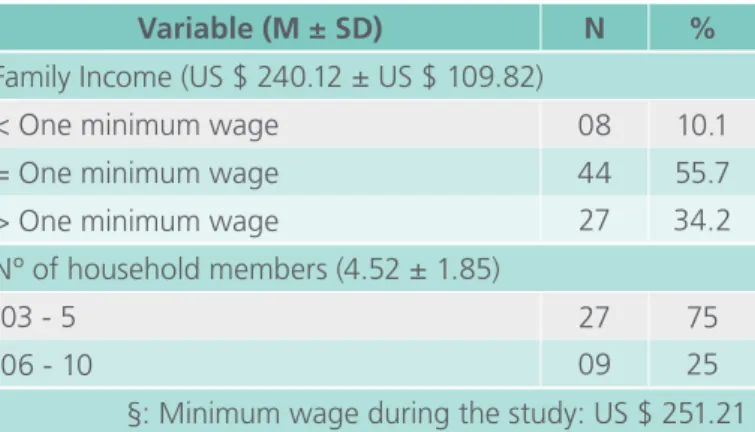
This study involving 79 adolescents allowed the construction of the socioeconomic profile (Table 1) of these puerperal mothers. The age of the mothers ranged from 13 to 19 years, with mean age of 17 years and prevalence of late adolescence (17 to 19 years - 63.3%).
Table 1. Socio-demographic characteristics of ado-lescents (N = 79). Fortaleza - CE.
Variable (M ± SD) N %
Age in years (16.94 ± 1.3)
13 – 16 29 36.7
17-19 50 63.3
Place of birth
Fortaleza 64 81
Others 15 19
Skin
White 18 22.8
Brown 42 53.2
Yellow 07 8.9
Black 11 13.9
Others 01 1.3
Marital status
Single 19 24
Common-law marriage 45 57
Married 15 19
Occupation
Housewife 51 64.6
Sewing 03 3.8
Other 25 31.6
Level of education
Variable (M ± SD) N %
Family Income (US $ 240.12 ± US $ 109.82)
< One minimum wage 08 10.1 = One minimum wage 44 55.7 > One minimum wage 27 34.2 Nº of household members (4.52 ± 1.85)
03 - 5 27 75
06 - 10 09 25
§: Minimum wage during the study: US $ 251.21
As for socioeconomic characteristics, most ado-lescents live in common-law marriage with the partner (n = 45; 57.0%), had as its main occu-pation the housework (n = 51; 64.5%), had in-complete primary education (n = 36; 45.5%) and family income of one minimum wage (n = 44; 55.7%), generally obtained by the partner’s sa-lary or retirement of the mother or father of the puerperal women.
With regard to the obstetrical history and current pregnancy (Table 2), it was observed that most of the adolescents were primiparae (n = 57; 73.4%), with predominance of vaginal delivery (n = 17; 21.5%), and 15 (19.0%) had breast-fed in previous occasions. In the case of the current pregnancy, 52 (65.8%) mothers reported not having planned the pregnancy.
The descriptive analysis of data related to the BSES-SF and its domains (technical and intraperso-nal thought) is presented in Table 3. The range ob-tained for technical and intrapersonal domains was near the upper end of the possible range. Thus, it is observed that the adolescents had high levels of confidence to carry out the practice of breastfee-ding. The average total score was 56.58 (± 6.11) (Table 3).
nancy (N = 79). Fortaleza - CE
Variable N %
Number of Pregnancies
1 57 73.4
2 20 25.3
3 02 2.5
Abortion
No 76 96.2
Yes 03 3.8
Stillbirth
Yes 01 1.3
No 78 98.7
Type of previous births
Not applicable 57 72.2
Cesarean 05 6.3
Vaginal 17 21.5
Previous history of prematurity
Yes 06 7.6
No 73 92.4
Previous breastfeeding practice
Yes 15 19.0
No 64 81.0
Lives with children
Not applicable 61 77.2
Yes 17 21.5
No 01 1.3
Current pregnancy planned
Yes 27 34.2
No 52 65.8
Complications during pregnancy
Yes 26 32.9
No 53 67.1
Reason for intercurrence
Not applicable 53 67.1
ITU 18 22.8
Hypertensive syndromes 02 2.5
Others 06 7.6
Table 3. Descriptive statistics of the resulting scores from the responses of adolescents to the BSES-SF applied to adolescents
Nº of items Possible range Obtained range Average Standard deviation Median
Technical 08 08- 40 22- 40 32.25 3.78 32
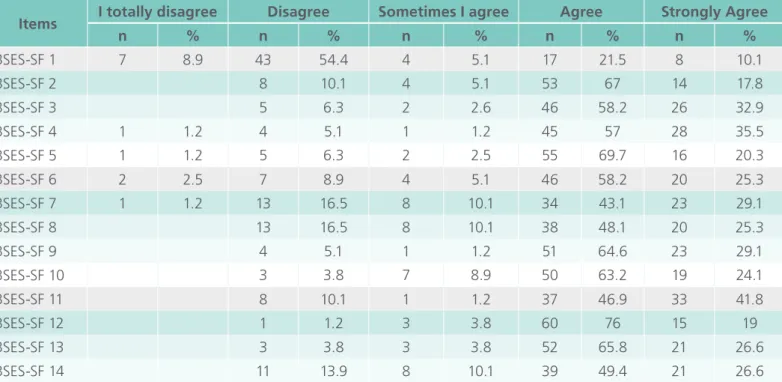
Table 4 shows the pattern of responses of adoles-cents for each item of the BSES-SF and shows that, except for Item 1 (I can always determine that my baby is getting enoughbreast milk), all items had more than 70% agreement.
The reliability of the BSES-SF measured by Cronbach’s alpha was 0.82, indicating good inter-nal consistency among the adolescent population. Table 5 has the details of the statistical analysis of the BSES-SF showing the mean, the variance, the correlation of each item with the total of the scale, and the Cronbach’s alpha in the absence of any of the scale items. It was observed that if any of the items were removed, the scale would not suffer major changes with respect to the alpha which ran-ged from 0.782 to 0.809, a variation of only 0.027. Therefore, the removal of any of the items would not significantly alter the value of the alpha and, therefore, this justifies the permanence of all items according to the original study.
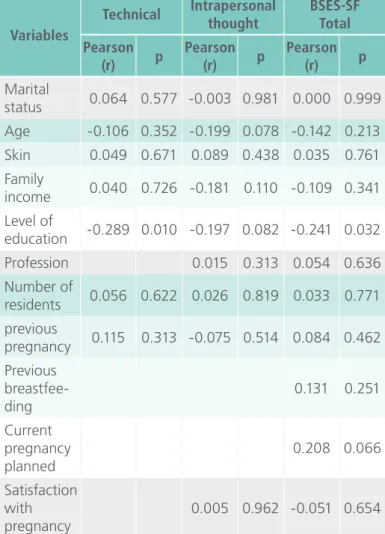
The correlation between socioeconomic/obste-tric variables and the technical and intrapersonal thought domains of the scale and the total
coeffi-Table 4. Distribution of frequency of responses to the BSES-SF applied to adolescents
Items I totally disagree Disagree Sometimes I agree Agree Strongly Agree
n % n % n % n % n %
BSES-SF 1 7 8.9 43 54.4 4 5.1 17 21.5 8 10.1
BSES-SF 2 8 10.1 4 5.1 53 67 14 17.8
BSES-SF 3 5 6.3 2 2.6 46 58.2 26 32.9
BSES-SF 4 1 1.2 4 5.1 1 1.2 45 57 28 35.5
BSES-SF 5 1 1.2 5 6.3 2 2.5 55 69.7 16 20.3 BSES-SF 6 2 2.5 7 8.9 4 5.1 46 58.2 20 25.3 BSES-SF 7 1 1.2 13 16.5 8 10.1 34 43.1 23 29.1
BSES-SF 8 13 16.5 8 10.1 38 48.1 20 25.3
BSES-SF 9 4 5.1 1 1.2 51 64.6 23 29.1
BSES-SF 10 3 3.8 7 8.9 50 63.2 19 24.1
BSES-SF 11 8 10.1 1 1.2 37 46.9 33 41.8
BSES-SF 12 1 1.2 3 3.8 60 76 15 19
BSES-SF 13 3 3.8 3 3.8 52 65.8 21 26.6
BSES-SF 14 11 13.9 8 10.1 39 49.4 21 26.6
Table 5. Mean, variance, and correlation between item-total and Cronbach's alpha for the BSES-SF applied to adolescents
Average of the scale if the item is deleted
Variance range if the item is
deleted
Correlation Item-Total
Cronbach's Alpha if
Item is Deleted
Personal domain
BSES-SF 1 52.5443 34.072 .402 .799 BSES-SF 2 52.2278 34.665 .506 .790 BSES-SF 3 51.9747 35.256 .465 .793 BSES-SF 4 51.9494 34.767 .487 .791 BSES-SF 9 51.9747 34.358 .641 .782 BSES-SF 14 52.2658 33.634 .493 .790 Technical domain
correlation between socioeconomic/obstetricvaria-bles and the technical and intrapersonal thought domains and the total coefficient of the scale was observed. However, despite the weak correlation, schooling showed a statistically significant associa-tion. It is evident that the lower the education level, the higher the maternal self-efficacy in breastfee-ding with regard to the technical aspects of breast-feeding.
Discussion
In this study, there was a predominance of late ado-lescents, a fact that corroborates a study conducted at the same hospital that aimed to characterize the profile of adolescent puerperal mothers, in which
(91%), with mean age of 16.76 (± 1.598) years [15]. The World Health Organization (WHO) considers pregnant women aged between 10 and 19 years, which is the stage of adolescence, to be at high-risk because this is a period of physical and psycho-logical development and of impediment to social and educational development [16 ]. It is notewor-thy that 36.7% of mothers were 16 years old or younger, representing the age group at higher risk for obstetric complications, maternal death, rates of prematurity, stillbirth and low birth weight of the newborn [17].
One of the factors that favored the practice of breastfeeding in this study was the presence of ado-lescents who live a common-law marriage with the partner. Study says that breastfeeding women that live without a partner are six times more likely to prematurely stop breastfeeding, showing that the presence of the companion is considered a protec-tive factor for breastfeeding [18].
A curious fact of this study was the inverse rela-tionship between education and self-efficacy in nur-sing, what contradicts other studies conducted in several countries [19, 20]. Furthermore, it is known that low educational level negatively influences the duration of breastfeeding [21, 22]. Maybe this was due to the homogeneity of the group where all patients are adolescents under academic education.
The predominance of women whose principal oc-cupation is the realization of domestic chores was also evident in this study. A study in Fortaleza with 252 women showed that working within the house can favor the bond between mother and child and provide greater availability of the mother to breast-feed her child [23].
With respect to family income, there was a pre-dominance of one minimum wage (n = 44; 55.7%) among participants. This is a worrisome finding since authors showed that the interruption of ex-clusive breastfeeding through the introduction of cow’s milk is most significant among low-income families [24].
Table 6. Correlations between socioeconomic and obstetric variables and the domains and general coefficient of BSES- SF.
Variables
Technical Intrapersonal thought
BSES-SF Total Pearson
(r) p
Pearson
(r) p
Pearson
(r) p
Marital
status 0.064 0.577 -0.003 0.981 0.000 0.999 Age -0.106 0.352 -0.199 0.078 -0.142 0.213 Skin 0.049 0.671 0.089 0.438 0.035 0.761 Family
income 0.040 0.726 -0.181 0.110 -0.109 0.341 Level of
education -0.289 0.010 -0.197 0.082 -0.241 0.032 Profession 0.015 0.313 0.054 0.636 Number of
residents 0.056 0.622 0.026 0.819 0.033 0.771 previous
pregnancy 0.115 0.313 -0.075 0.514 0.084 0.462 Previous
breastfee-ding
0.131 0.251
Current pregnancy planned
0.208 0.066
Satisfaction with pregnancy
There was predominance of primiparae mothers, which is also reasong for worrying bacause they are inexperient, with more doubts and difficulties in relation to breastfeeding, and may also suffer more easily negative influences on the act of breastfee-ding [25]. On the other hand, if the adolescent is confident about breastfeeding and is well guided and assisted, especially at the beginning of this pro-cess, she will develop the necessary confidence to continue breastfeeding her baby.
Moreover, it was observed that vaginal delivery was more common among adolescents who had already had a previous pregnancy, a fact that can be justified by the hospital’s own profile, which has the initiative of humanization of delivery and birth. It is also worth mentioning that vaginal delivery is safer than caesarean section because it offers less risk of infection, bleeding and prematurity of new-borns [26].
The data show that there were 22 women with more than one child. Among these, five had in-formally donated their children (mothers, aunts). Among the other 17 (77.3%) mothers, 15 (88.2%) had breast-fed their children for at least six months (regardless of the type of breastfeeding). The same occurred in another study, in which 80 adolescents were interviewed in order to trace the profile of breastfeeding among them. Among the 13 (16.3%) with previous experience, six (46.2%) maintained breasfeeding for 90 to 180 days, followed by four (30%) that maintained for 60 days and three (23%) for 10 days. The main reasons cited for early wea-ning were having to return to work, not enjoying breastfeeding and the report that the milk had dried up [26].
Most pregnant adolescents admitted not having planned the current pregnancy, just like what was found in another research in which 65.2 % adoles-cents were not expecting the pregnancy [27]. The lack of pregnancy planning in such a volatile period is adolescence can be a deconstructive factor for the plans of life of adolescents who are still acquiring psychosocial maturity. This is due to factors such as
difficult socioeconomic conditions combined with their being dependant of their partners , the low wages paid to women, that leave them to lose their autonomy and reproductive freedom.
As for the descriptive analysis of data related to the BSES-SF and its domains (Technical and Intraper-sonal thought), it was observed that the obtained range for technical and intrapersonal domains was close to the maximum possible. Thus, it is observed that the adolescents had high levels of confidence to carry out the practice of breastfeeding. Other studies in the state of Ceará that have evaluated the self-efficacy of in women to breast-feed, with no specific age, has also shown that they have high self-efficacy [12, 28]. Therefore, it is evident that wo-men from Ceará that are assisted in public systems have confidence in the practice of breastfeeding.
The adolescents tended to answer the maximum value of the scale, occurring the ceiling effect for almost all items except for item 7. The existence of floor and ceiling effects are observed when more than 15% of participants make the choice of the smallest or the largest possible score of the respon-se scale, respectively. The ceiling effect can affect the responsivity of the instrument, considering that participants with higher or lower scores may or may not be distinguished from each other [29].
Cronbach’s alpha is the most widely used indicator to check the reliability of an instrument. Cronbach’s alpha varies from zero to one and is generally con-sidered to be a reliable tool when it reaches values from 0.7 to 0.8, and values below this are conside-red unreliable [30]. In this study, Cronbach’s alpha was 0.807, reflecting lower degree of variance of each specific item and indicates the consistency bet-ween the items of an instrument, and then this can be considered trustworthy. The Cronbach’s alpha of BSES-SF originally was 0.74 [11] and, when validated in Brazil, the alpha was also 0.7427 [28].
pos-scale items ranged from 0.69 to 0.84, and thus this scale was considered reliable for Canadian adoles-cents [14].
The correlation analysis between socioeconomic and obstetric variables and BSES-SF resulted in low Pearson coefficient values, suggesting that other confounding factors may be responsible for these results.
Conclusion
The results of this study suggest that the BSES-SF is a reliable and valid measure for assessing self-efficacy in nursing of adolescent mothers. This is an effective, reliable, valid and inexpensive instru-ment and, therefore, must be used among health professionals to put in pratice actions that incentive breastfeeding. The adolescents in this study proved to be confident about the practice of breastfeeding. Only education level showed significant association with maternal self-efficacy of adolescents in breast-feeding (p = 0.032).
Thus, it is possible to use a tool to detect the self-efficacy of adolescent mothers in breastfeeding, fa-voring the care of these women in their process of breastfeeding and consequently the reduction of early weaning. From the knowledge of perso-nal perceptions about the competence, capabilities and means of puerperal mothers to adequately deal with inherent requirements in breastfeeding, it will be possible to promote the health of mother and child specifically in health institutions.
This study has some limitations among which we can mention the reduced sampling and selection in one single location that is accredited to the Initia-tive Child Friendly Hospital and, therefore, already develops actions in favor of breastfeeding.
We suggest the importance of this scale be vali-dated with a larger sample of adolescents, and that the recruitment be done in hospitals with different profiles.
References
1. Brasil. Ministério da Saúde. Saúde da Criança: Nutrição Infantil: Aleitamento Materno e Alimentação Complementar. 2009, [Cited 2013 Jun 10]. Available from: http://bvsms.saude.gov. br/bvs/publicacoes/saude_crianca_nutricao_aleitamento_ alimentacao.pdf
2. Brasil. Ministério da Saúde. Estratégia Amamenta e Alimenta Brasil [internet]. Portal da Saúde. [Cited 2013 Jun 10]. Available from: http://dab.saude.gov.br/portaldab/amamenta.php
3. Venancio SI, Escuder MM, Saldiva SR, Giugliani ER. Breastfeeding practice in the Brazilian capital cities and the Federal District: current status and advances. J Pediatr (Rio J). 2010; 86(4): 317-24. [Cited 2013 Jun 10]. Available from: http://www.scielo.br/ pdf/jped/v86n4/en_a12v86n4.pdf
4. Kaufmann CC, Albernaz EP, Silveira RB, Silva MB, Mascarenhas MLW. Alimentação nos primeiros três meses de vida dos bebês de uma coorte na cidade de Pelotas, Rio Grande do Sul. Rev Paul Pediatr. 2012; 30(2): 157-65. [Cited 2013 Jun 10]. Available from: http://www.scielo.br/pdf/rpp/v30n2/en_02.pdf
5. McQueen KA, Dennis CL, Stremler R, Norman CD. A Pilot Randomized Controlled Trial of a Breastfeeding Self-Efficacy Intervention With Primiparous Mothers. JOGNN. 2011; 40(1): 35-46. [Cited 2013 Jun 10]. Avaliable from: http://www.jognn. org/article/S0884-2175(15)30518-9/pdf
6. Uchoa JL, Gomes ALA, Joventino ES, Oriá MOB, Ximenes LB, Almeida PC. Sociodemographic and obstetric history in maternal self-efficacy in nursing: a study in panel. Online Brazilian Journal of Nursing. [ Internet]. 2014, [Cited 2015 Fev 22]; 3(4): 645-55. Available from: http://www.objnursing.uff.br
7. Uchoa JL, Rodrigues AP, Joventino ES, Almeida PC, Oriá MOB, Ximenes LB. Autoeficácia em amamentar de mulheres no pré-natal e no pós-parto: estudo longitudinal. Rev Enferm UFSM. 2016, 6(1): 10-20. [Cited 2016 Abr 05]. Available from: http:// periodicos.ufsm.br/reufsm/article/view/17687
8. Dennis CL. Theoretical underpinnings of breastfeeding confidence: a self-efficacy framework. Journal of Human. Lactation. 1999; 15: 195-201. [Cited 2013 Jun 10]. Available from: http://www.ncbi.nlm.nih.gov/pubmed/10578797
9. Dennis CL, Faux S. Development and psychometric testing of the Breastfeeding Self-Efficacy Scale. Research in Nursing & Health. 1999; 22(5): 399-409. [Cited 2013 Jun 15]. Available from: http://www.ncbi.nlm.nih.gov/pubmed/10520192
10. Bandura A. Self-efficacy: Toward a unifying theory of behavioral change. Psychological Review. 1997; 84(2): 191-215. . [Cited 2013 Jun 15]. Available from: https://www.uky.edu/~eushe2/ Bandura/Bandura1977PR.pdf
11. Dennis, CL. The Breastfeeding Self-Efficacy Scale: Psychometric Assessment of the Short Form. Journal of Obstetric, Gynecologic, & Neonatal Nursing. 2003; 32(6): 734–44. . [Cited 2013 Jun 15]. Available from: http://www.ncbi.nlm.nih.gov/ pubmed/14649593
13. Zubaran C, Foresti K, Schumacher M, Thorell MR, Amoretti A, Muller L, et al. The Portuguese version of the Breastfeeding Self-Efficacy Scale-Short Form. Journal of Human Lactation. 2010; 26(3): 297-303. [Cited 2013 Jun 15]. Available from: http:// www.ncbi.nlm.nih.gov/pubmed/20139376
14. Dennis CL, Heaman MRN, Mossman MRN. Psychometric Testing of the Breastfeeding Self-Efficacy Scale-Short Form among Adolescents. Journal of Adolescent Health. 2011; 49: 265– 71. [Cited 2013 Jun 15]. Available from: file:///C:/Users/user/ Downloads/BSES-2011-Psychometric%20testing%20of%20 BSES%20among%20adolescents.pdf
15. Caminha NO, Costa CC, Brasil RFG, Sousa DMN, Freitas LV, Damasceno AKCO. Perfil das puérperas adolescentes atendidas em uma maternidade de referência de Fortaleza- Ceará. Esc Anna Nery. 2012; 16(3): 486-92. [Cited 2013 Set 08]. Available from: http://www.scielo.br/pdf/ean/v16n3/09.pdf
16. Faria DGS, Zanetta DMT. Perfil de mães adolescentes de São José do Rio Preto/Brasil e cuidados na assistência pré-natal. Arq Ciênc Saúde. 2008; 15(1): 17-23. [Cited 2013 Set 20]. Available from: http://repositorio-racs.famerp.br/racs_ol/vol-15-1/IIIIDDDD259.pdf
17. Moreira TMM, Viana DS, Queiroz MOQ, Jorge MSB. Conflitos vivenciados pelas adolescentes com a descoberta da gravidez. Rev. Esc. Enferm. USP. 2008; 42(2): 312-20. [Cited 2013 Set 20]. Available from: http://www.scielo.br/pdf/reeusp/v42n2/a14.pdf
18. Barbosa MB, Palma D, Domene SMA, Taddei JAAC, Lopez FA. Fatores de risco associados ao desmame precoce e ao período de desmame em lactentes matriculados em creches. Rev Paul Pediatr. 2009; 27(3):272-81. [Cited 2014 Jan 20]. Available from:
http://www.scielo.br/pdf/rpp/v27n3/07.pdf
19. Joshi A, Trout KE, Aguirre T, Wilhem S. Exploration of factors influencing initiation and continuation of breastfeeding among Hispanic women living in rural settings: a multi-methods study. Rural Remote Health. 2014; 14(3): 2955. [Cited 2014 Jun 20]. Available from: http://www.rrh.org.au/articles/subviewnew. asp?ArticleID=2955
20. De´Grangea M, Delebarreb D; Turckc B; Mestdaghd L; Stormeef P; Rakzad DT. Les me`res confiantes en elles allaitent-elles plus longtemps leur nouveau-ne´?. Archives de Pe´diatrie. Paris. 2015; 22, 708-717. [Cited 2016 Abr 05]. Available from: http://www. sciencedirect.com/science/article/pii/S0929693X15001578
21. Roig AO, Martínez MR, García JC, Hoyos SP, Navidad GL, Álvarez JCF, et al. Fatores associados ao abandono do aleitamento materno durante os primeiros seis meses de vida. Revista Latino-Americana de Enfermagem. 2010; 18(3). [Cited 2014 Jun 20]. Avaliable from: http://www.scielo.br/pdf/rlae/v18n3/pt_12.pdf
22. Bizerra R, Carnaúba J, Chaves A, Rocha R, Vasconcelos H, Oriá M. Autoeficácia em amamentar entre mães adolescentes. Revista Eletrônica de Enfermagem [Internet]. 2016 [Cited 2016 Jun 17]; 17(3). Available from: https://revistas.ufg.emnuvens. com.br/fen/article/view/31061
23. Azevedo DS, Reis ACS, Freitas LV, Costa PB, Pinheiro PNC, Damasceno AKC. Conhecimento de primíparas sobre os benefícios do aleitamento materno. Rev RENE. 2010;11(2):53-62. [Cited 2014 Jun 20]. Avaliable from: http://www.repositorio. ufc.br/bitstream/riufc/4382/1/2010_art_lvfreitas1.pdf
24. Oliveira MGOA, Lira PIC, Batista Filho M, Lima MC. Fatores associados ao aleitamento materno em dois municípios com alto índice de desenvolvimento humano no Nordeste do Brasil. Rev. Bras. Epidemiologia. 2013; 16 (1):178-89. [Cited 2014 Jun 20]. Avaliable from: http://www.scielo.br/pdf/rbepid/v16n1/ en_1415-790X-rbepid-16-01-0178.pdf
25.Camarotti CM, Nakano MAS, Pereira CR, Medeiros CP, Monteiro JCS. Perfil da prática da amamentação em grupo de mães adolescentes. Acta Paulista Enferm. 2011; 24(1): 55-60. [Cited 2014 Jun 20]. Avaliable from: http://www.scielo.br/pdf/ ape/v24n1/v24n1a08.pdf
26.Carvalho AYC, Ximenes LB, Fontenele FC, Dodt RCM. Perfil sociodemográfico e reprodutivo de adolescentes grávidas acompanhadas na unidade básica de saúde do município de Canindé. Rev. Rene. 2009; 10(1): 53-61. [Cited 2014 Jun 20]. Avaliable from: http://www.redalyc.org/ pdf/3240/324027965006.pdf
27. Coelho EAC, Andrade MLS, Vitoriano LVT, Souza JJ, Silva DO, Gusmão MEN, Nascimento ER, Almeida MS. Associação entre gravidez não planejada e o contexto socioeconômico de mulheres em área da Estratégia Saúde da Família. Acta Paul. Enferm. 2012; 25(3): 415-22. [Cited 2014 Jun 20]. Avaliable from: http://www.scielo.br/pdf/ape/v25n3/en_v25n3a15.pdf
28. Dodt RCM, Ximenes LB, Almeida PC, Oriá MOB, Dennis CL. Psychometric and maternal sociodemographic assessment of the Breastfeeding Self-Efficacy Scale - Short Form in a brazilian sample. Journal of Nursing Education and Practice. 2012; 2(3): 66-73. [Cited 2014 Jun 20]. Avaliable from: http://www.sciedu. ca/journal/index.php/jnep/article/view/627/553
29. Fayes P, Machin D. Quality of Life: The Assessment, Analysis and Interpretation of Patient-reported Outcomes. 2ª edition. Wiley; 2007.
30. Field A. Discovering Statistics using SPSS. 3ª edition. London: Sage; 2009.
International Archives of Medicine is an open access journal publishing articles encompassing all aspects of medical scien-ce and clinical practiscien-ce. IAM is considered a megajournal with independent sections on all areas of medicine. IAM is a really international journal with authors and board members from all around the world. The journal is widely indexed and classified Q1 in category Medicine.