Copyright © 2015 Revista Latino-Americana de Enfermagem This is an Open Access article distributed under the terms of the Creative Commons Attribution Non-Commercial License (CC BY-NC).
This license lets others distribute, remix, tweak, and build upon your work non-commercially, and although their new works must also acknowledge you and be non-commercial, they don’t have to license their derivative works on the same terms.
Corresponding Author: Lorena Barbosa Ximenes
Universidade Federal do Ceará. Departamento de Enfermagem Rua Alexandre Baraúna, 1115
Bairro: Rodolfo Teóilo
CEP: 60430-160, Fortaleza, CE, Brasil E-mail: [email protected]
1 Paper extracted from doctoral dissertation “Elaboração e validação de tecnologia educativa para autoeficácia da amamentação”, presented to Universidade Federal do Ceará, Fortaleza, CE, Brazil. Supported by Conselho Nacional de Desenvolvimento Científico e Tecnológico (CNPq), Brazil, process nº 475692/2010-1.
2 PhD, Adjunct Professor, Faculdade Metropolitana da Grande Fortaleza, Fortaleza, CE, Brazil.
3 PhD, Adjunct Professor, Universidade da Integração Internacional da Lusofonia Afro-Brasileira, Redenção, CE, Brazil. 4 PhD, Adjunct Professor, Universidade Federal do Ceará, Fortaleza, CE, Brazil.
5 PhD, Adjunct Professor, Universidade Estadual do Ceará, Fortaleza, CE, Brazil. 6 PhD, Associate Professor, Universidade Federal do Ceará, Fortaleza, CE, Brazil.
An experimental study of an educational intervention to promote
maternal self-efficacy in breastfeeding
1Regina Cláudia Melo Dodt
2Emanuella Silva Joventino
3Priscilla Souza Aquino
4Paulo César Almeida
5Lorena Barbosa Ximenes
6Objective: to build, validate and assess an educational intervention using the flip chart titled “I Can Breastfeed My Child.” Method: an experimental study using a pretest, intervention and posttest, as well as a control group. A total of 201 women, who had been hospitalized immediately, for at least 6 hours, postpartum. The mothers were allocated to the intervention (100 women) or control groups (101 women) according to the length of their hospital stay. The effectiveness of the flip chart was assessed by applying the Breastfeeding Self-Efficacy Scale - Short-Form at admission, discharge and by telephone in the second month postpartum. The intervention and control groups were similar in their socio-demographic, obstetric and gynecological variables. Results: the intervention was beneficial because mothers in the intervention group had higher self-efficacy scores, more mothers continued breastfeeding and mothers had a longer duration of exclusive breastfeeding, both at the time of hospital discharge and at the second month postpartum, with statistically significant associations. Conclusions: this experimental study assessed the educational strategy mediated via the flip chart titled “I Can Breastfeed My Child” as being effective both in increasing self-efficacy and increasing the duration of breastfeeding.
Descriptors: Validation Studies; Educational Technology; Breast Feeding; Self Efficacy; Nursing.
Rev. Latino-Am. Enfermagem
2015 July-Aug.;23(4):725-32
DOI: 10.1590/0104-1169.0295.2609 www.eerp.usp.br/rlae
Introduction
Exclusive breastfeeding is recommended during
the irst 6 months of life and should be continued as
supplementary feeding to at least 2 years of age(1). This
recommendation, which is based on several undeniable advantages of breastfeeding(2), aims to prevent
approximately 1.3 million infant deaths annually(1).
Nevertheless, less than 40% of mothers around the
world breastfeed their children exclusively for the irst 6
months of life(1) and several countries, including Brazil,
are still far below the goals advocated by the World Health Organization. In Brazil, according to the latest national research, the median exclusive breastfeeding duration was 60 days, the 25th percentile was 5 days and the 75th percentile was 150 days(3).
Given that breastfeeding is an effective intervention, that it is feasible to implement on a large-scale and that it has the greatest potential to reduce child mortality in Brazil(4),
several strategies have been implemented under the National Policy on Promotion, Protection and Support of Breastfeeding.
We must also consider that in addition to maternal
knowledge of the subject, self-eficacy also has a strong inluence on the initiation and maintenance of breastfeeding
in Brazil(5-6) and worldwide(7-9). Self-eficacy is the belief in
one’s personal skill to successfully perform certain tasks or behaviors to achieve desirable outcomes(10) and it is a
modiiable factor mainly through health education(11).
Given the importance of self-eficacy, we developed
the Breastfeeding Self-Eficacy Scale (BSES)(11), an
instrument to assess the self-eficacy of breastfeeding
mothers. The short form version of the BSES was designed to be used in a hospital environment to optimize nursing support for the promotion of breastfeeding(7),
which has already been validated in Brazil(6).
Instruments such as the BSES are essential for building educational interventions that are appropriate
for the speciic characteristics of each population. Thus,
this study sought to construct, validate and assess an
educational intervention using the lip chart titled “I Can
Breastfeed My Child.” The hypothesis of this study is that
educational intervention using the lip chart titled “I Can Breastfeed My Child” is effective in increasing self-eficacy
and also for increasing the duration of breastfeeding.
Method
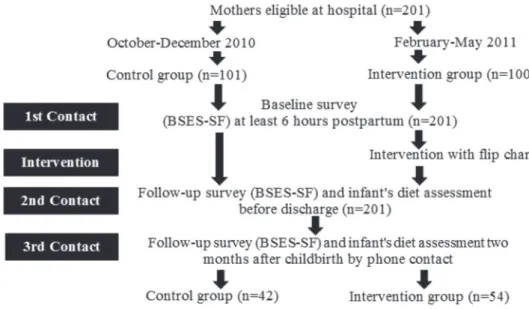
This was an experimental study using a design that included a pretest, intervention and posttest, as well as a control group (Figure 1).
The intervention was a lip chart and the process of construction and validation occurred in ive stages: 1) the construction and validation of the lip chart were
based on literature research and the Breastfeeding
Self-Eficacy Scale-Short Form (BSES-SF)(12); 2) the
BSES-SF was administered to all of the mothers in the study 6 hours postpartum (1st contact); 3) the intervention
group received an explanation from the researcher
using the lip chart, while the control group did not
receive this explanation; 4) the second application of the BSES-SF and an assessment of the infant’s diet were performed before hospital discharge (2nd contact);
and 5) the third application of the BSES-SF and an assessment of the infant’s diet at two months after childbirth were conducted by telephone (3rd contact). The independent variable was the lip chart application. The dependent variable was the maternal self-eficacy
and breastfeeding rates.
The study was conducted in a large public maternity hospital that provided tertiary neonatal and perinatal care. This hospital is located in Fortaleza, Ceará, Brazil; it is associated with the National Health System and also trains students from several universities. As a
maternity hospital that is certiied as baby-friendly and
is associated with the Human Milk Bank in Brazil, it sees an average of 600 births per month. The hospital follows the “10 steps to successful breastfeeding” routine, thus babies are offered infant formula only in cases in which breastfeeding is contraindicated—usually due to illness or medication.
mother or legal guardian (for adolescents) from the research; a change in phone number during the study,
making the continuation of data collection impossible; or the death of the participant or newborn during the study.
Figure 1 - Flowchart of the study design and the timing of follow-ups with study participants
The sample size was calculated using the formula
for intervention studies, setting the signiicance level at
5% and the power at 80%, resulting in a sample size of 150(13). Considering the possible information loss, we added approximately 30% to the inal sample size and
recruited 201 mothers.
To reduce possible bias, we collected data from the intervention and control groups during different periods because if the data was collected during the same period, the mothers could share the information provided in the
lip chart, thus compromising the validity of the eficacy
intervention.
In the 1st and 2nd contacts (before hospital
discharge), the data collection was conducted with the 201 mothers selected according to the inclusion and exclusion criteria: 101 women were in the control group and 100 women were in the intervention group. However, in the 3rd contact, only 96 mothers participated due to dificulties in contacting the participants by phone
42 (43.7%) in the control group and 54 (56.2%) in the intervention group (Figure 1). The researchers compared the phone numbers of the participants with the register at the institution but still failed to maintain communication with some of the participants for the 3rd contact.
The mothers were recruited during the daytime,
from Monday to Friday, after being identiied as eligible
by their medical records. The researchers visited the mothers individually to invite them to participate in the study. After obtaining written consent, they administered
the BSES-SF, socio-demographic and clinical-obstetrics questionnaires.
Between the 1st and 2nd contacts, the intervention
group received health education through the use of a
lip chart that illustrated maternal self-eficacy, while the
control group did not receive this intervention.
The lip chart titled “I Can Breastfeed My Child” (40
cm wide, 32 cm high) had seven illustrations prepared with the help of a professional service and the Corel Draw X5 Graphics Suite, it contained seven scripts (back of each illustration) that addressed the breastfeeding theme based on the BSES-SF items.
Ten experts validated the appearance and content
of the lip chart. These were experts in the area of
breastfeeding who had at least two years of experience and they were selected by convenience. The experts
judged the six igures and six scripts as clear and
understandable, with an agreement level above 50%.
Regarding the degree of relevance of the igures and scripts of the lip chart, two igures presented with 80%
relevance and the others presented with between 90% and 100% in the opinion of the experts. For the degree of relevance, we calculated the global Content Validity
Index (CVI) and obtained 0.92 for the igures and 0.97
for the scripts, indicating excellent agreement between the experts. The suggestions from the experts were
adopted to improve the igures and scripts(12).
Ten lactating mothers participated in a test of the
Can Breastfeed My Child.” They were questioned on the type of intervention used as well as its clarity and the
mothers’ comprehension of the igures shown in the lip
chart was also assessed.
After the validation process, the lip chart was used
with each mother individually at the patient’s bed for an average time of 20 minutes. A single researcher shared
the lip chart with the mothers in the intervention group, covering the content in the lip chart using the scripts as
well as listening to their questions and clarifying issues to encourage them to begin and to continue breastfeeding. Thus, the researcher initially presented each picture in
the lip chart to the mother to hear her opinion on each
aspect of breastfeeding. Based on previous experiences, the researcher tried to establish a bond with the patient,
giving speciic guidance according to the needs of each person. While the mother was looking at each igure in the lip chart, the researcher explained the information
using the corresponding script.
Because the lipchart was developed based on the
domains of the BSES-SF scale (Technique and Intrapersonal Thoughts), the researcher addressed the technical domain by teaching the adequate positioning of the newborn during feeding, ways to improve comfort during the act of feeding, recognition of the signals of quality lactation and proper suction of the nipple-areolar complex, among other technical issues. While the Interpersonal Thoughts domain worked through the desire to breastfeed, the internal motivation for breastfeeding was based on satisfaction with the breastfeeding experience.
We included three measurement instruments in this study. The BSES-SF, which assesses the maternal
self-eficacy in breastfeeding, consists of 14 items organized
into two domains (eight items in the technical domain and six items in intrapersonal thoughts) assessed through a
ive-point Likert scale, from 1 (strongly disagree) to 5
(strongly agree), with scores ranging from 14 to 70. The total score on the scale was used to calculate a person’s
self-eficacy. The version of the scale validated for Brazil
was shown to be reliable (with a Cronbach’s alpha of
0.74 and interclass correlation coeficients ranging from
0.68 to 0.78)(6).
The second questionnaire developed by the
researchers addressed the socio-demographic proiles
of the participants and collected data related to clinical variables, obstetric history, current pregnancy, childbirth, breast conditions and previous experience with breastfeeding.
The third instrument was used to guide the telephone contact with the participants in both the
control and intervention groups and it collected data related to visits to primary care health professionals in
the irst 15 days after delivery and the guidelines on
breastfeeding provided during these visits regarding the infant’s diet according to World Health Organization
classiications(1).
The participants were interviewed three times, twice during hospitalization: one time at least 6 hours postpartum (baseline study) and the other time close to hospital discharge; and the third time at two months after childbirth (follow-up study). The data collection
team included ive nursing students trained for the
research, and another researcher was responsible only
for the presentation of the lip chart. In the training of the
student nurses, they had to interview the main researcher repeatedly until the questions were made without
inluencing the response of the interviewee. The interviews
were recorded so that the students could identify aspects of the interviews that could be improved and also so that the professor could provide some explanations.
The data was double-entered into Access 2007
(Microsoft Ofice) and later exported to SPSS 18.0 for
Windows, by which descriptive and inferential analyses
were performed. To validate the igures and scripts, we
calculated the Content Validity Index (CVI), considering a CVI above 0.90 as being appropriate(14).
The participants were characterized by frequencies (percentages), means, and standard error of the mean (SEM). To compare the intervention and control groups, we applied the Student’s t-test and Snedecor’s F-test.
Along with Snedecor’s F-test (ANOVA) signiicance,
we used Tukey’s test to determine which pairs were
signiicantly different. To compare the groups at baseline
and the groups after two months of intervention, we used the chi-squared test and either Student’s t-test or the Mann-Whitney test, considering a critical alpha of 0.05.
In the analyses of the type of feeding, exclusive
breastfeeding was deined as when the child received
only breast milk and no other liquids or solids except for drops or syrups containing vitamins, oral rehydration salts, mineral supplements or medicines. Breastfeeding is a concept understood as a child receiving breast milk, regardless of whether the child had received other foods(1).
The Research Ethics Committee of the Assis Chateaubriand Maternity School approved the study. All of the study participants in the intervention and control
groups as well as the experts who assessed the lip chart
and the mothers in the intervention test were informed of
their rights, assured of data conidentiality and were given
Results
The total study sample (n=201) was divided into two groups: control (n=101) and intervention (n=100). There was no difference between the intervention and control groups with regard to age (p=0.116), per capita income (0.120), receiving help for household chores (p=0.178), and the existence of a place designated for breastfeeding at home (p=0.273). There was no difference between the groups with regard to the average years of schooling (0.774), with 9.38 years in the intervention group and 9.49 years in the control group. Furthermore, with regard to the obstetric variables, we observed homogeneity between the groups regarding the number of pregnancies (p=0.138), number of abortions (p=0.083) and period of breastfeeding (p=0.546). Thus, the groups were similar, ensuring that the differences found between them were actually due to the intervention and not to selection biases.
The BSES-SF scores ranged from 14 to 70, the minimum and maximum scores, respectively;
higher scores indicated greater maternal self-eficacy. However, to assess the variable maternal self-eficacy
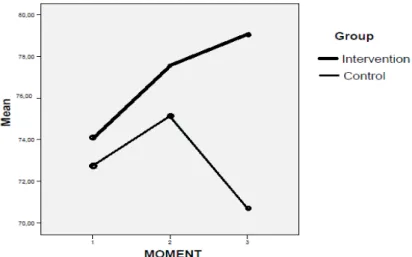
in breastfeeding, we adjusted the total scores obtained from the BSES-SF so that the minimum value was zero and the maximum value was 100 (Table 1, Figure 2).
The mean score of the BSES-SF at baseline in the intervention group was 74.1 (SEM±1.2) and the control group 72.8 (SEM±1.0) (ANOVA, p=0.384). The scores at the 2nd contact, after the lip chart was used with the
intervention group and after the conventional guidelines of the institution were used with the control group, were 77.5 (SEM±1.0) and 75.1 (SEM±1.0) (ANOVA, p=0.113), respectively, verifying that between the 1st
and 2nd contacts, the mean scores were very close, with
an increase of 3.4 points in the intervention group and an increase of 2.3 points in the control group. The BSES-SF scores were higher in the intervention group (79.1, SEM±1.2) than in the control group (70.7, SEM±2.5) two months after childbirth (the 3rd contact), verifying
that the intervention group scores increased by 5 points, while the control group score decreased by 2.1 points (Table 1).
At the 1st contact, 100% of the mothers in both
groups continued breastfeeding, with no differences between the two groups. However, when the 1st
contact was compared withthe 3rd contact, all of
the participants (100%) in the intervention group continued exclusively breastfeeding, while only 41% of the participants in the control group still offered breast milk to their children (Table 1).
Table 1 - Comparison of the Main Outcomes between the 1st and 3rd Contacts According to Group. Fortaleza, CE,
Brazil, 2010-2011
Intervention Group
ρ
Control Group
ρ
1st Contact*
Mean ± SD‡
3rd Contact†
Mean ± SD‡
1st Contact*
Mean ± SD‡
3rd Contact†
Mean ± SD‡
Scale scores 55.5 ± 6.63 58.2 ± 5.02 0.032 54.7 ± 5.68 53.5 ± 9.15 0.332
Change 2.54 ± 8.28 -1.69 ± 11.16
No. (%) No. (%) No. (%) No. (%)
Exclusive breastfeeding§
100 (100%) 54 (100%) 101 (100%) 35 (41.0%)
* IG x CG in 1st contact: p=0.397; † IG x CG in 3rd contact: p=0.002; ‡ SD = Standard deviation; § Z-test applied for proportions of independent data p<0.001
With regard to the inluence of self-eficacy
on continued breastfeeding, we inferred that in the intervention group, the mean scores of the BSES-SF on exclusive breastfeeding were higher than the mean scores on non-exclusive breastfeeding (p=0.003). In the control group, the mean duration of exclusive breastfeeding and non-exclusive breastfeeding were similar (p=0.267). The
duration of exclusive breastfeeding in the intervention group (64.31) was considerably higher than the average duration of exclusive breastfeeding in the control group (56.96) (p<0.05) (Table 2). Thus, the strategy of
health education fostered by the lip chart titled “I Can
Breastfeed My Child” was effective in increasing
self-eficacy and the duration of breastfeeding.
Table 2 - Comparison of Food Types and the Mean of the BSES-SF Scores at the 3rd Contact According to Group. Fortaleza, CE, Brazil, 2010-2011
Group Mean SEM* ρ
Intervention Total in 3rd contact Exclusive breastfeeding
64.31 0.950 0.003
Breastfeeding 58.33 1.563
Control Total in 3rd contact Exclusive breastfeeding
56.96 1.194 0.267
Breastfeeding 54.58 1.807
*SEM = Standard error of the mean.
Discussion
The variation in the BSES-SF scores was more evident in the intervention group than in the control group. Between the 1st and 2nd contacts, the scores increase
by 3.4 points in the intervention group and 2.3 points in the control group. However, between the 2nd and 3rd
contacts, the scores in the intervention group increased by 1.6 points but decreased by 4.4 points in the control group. Other studies have also shown an improvement
in maternal self-eficacy scores among those who
received interventions by specialists(15-16), increasing
by up to 15.1 points on the BSES-SF(8). In Australia, an intervention based on Bandura’s self-eficacy theory increased breast-feeding self-eficacy. Furthermore, at
4 weeks postpartum, women in the intervention group showed a trend toward breast-feeding their infants for longer, and more exclusively than those in the control group(15). In Canada, after a self-eficacy intervention,
the mothers in the intervention group had higher mean BSES-SF scores at 4 and 8 weeks postpartum than the control group.
Educational practices are considered effective when
they inluence the beliefs that people have in their own
abilities. Education also affects how people will behave
when facing adversity and also inluences the duration
of adversity and the amount of effort people will exert to confront adversity(17). Maternal self-eficacy may also have been inluenced by personal experiences, verbal
persuasion at the time of the educational intervention
and vicarious experiences, such as observing other women breastfeeding at the maternity hospital where the study was conducted(18).
For both the control and intervention groups, the scores increased for the items in the interpersonal domain between the 1st and 2nd contacts, while scores for items in
the technical domain decreased between the 2nd and 3rd
contacts. The practice and technique of breastfeeding are factors that cause insecurity in mothers, even in the group that received the intervention and when the impact of the
intervention was not suficient after the mothers of having
returned home. The interventions must occur beyond the maternity context, with an effective daily support network that teaches, supports and demonstrates the ideal practices related to breastfeeding so that mothers may prevent early weaning.
Our literature review identiied that the main factors that inluence breastfeeding among Hispanics are acculturation, interpersonal support, self-eficacy and
immediate competing demands(19). Thus, information
and guidance should be extended to the family support
network because many of the women lose conidence in
themselves after returning home from the hospital due to the pressure from family and friends to provide infant formulas to their children(20).
A study conducted in Chile showed some factors
that negatively inluence the maintenance of exclusive
In addition to raising the scores of maternal
self-eficacy, educational intervention presented through the lip chart titled “I Can Breastfeed My Child” prolonged
the duration of breastfeeding and 100% of the mothers in the intervention group continued breastfeeding in the follow-up study compared to only 41% of the mothers in the control group. A similar result was found in Japan, where, at the one-month follow-up, breastfeeding declined by approximately 24% in the control group but only by 10% in the intervention group(8).
In the intervention group, the mean scores on the BSES-SF with regard to exclusive breastfeeding were higher than the mean scores on non-exclusive breastfeeding and the average BSES-SF scores with regard to exclusive breastfeeding in the intervention
group was signiicantly higher than those scores in
the control group. This result corroborated with an
Australian study in which self-eficacy in breastfeeding
was higher among mothers who maintained exclusive breastfeeding compared with those who breastfed partially and those who had weaned their children. Guidance on breastfeeding, support regarding the
duration of breastfeeding and maternal conidence are
associated with breastfeeding at 1 month postpartum(22).
A study using various strategies (individual consultation, preparation courses for parenting/ childbirth, and domicile visits) without the focus on
self-eficacy showed that the nursing intervention was not a
determinant for the prevalence of breastfeeding(23). We emphasize that self-eficacy should be
considered in interventions related to breastfeeding, and
we should identify the level of these mothers’ self-eficacy
before developing any strategies(7) for implementation
during the prenatal through the postpartum periods(24).
This variable is a strong predictor of breastfeeding duration because the risk ratio for weaning increases by approximately 18% among women who have lower
self-eficacy scores on the BSES(25).
Conclusion
Despite the numerous beneits of breastfeeding,
it is still a practice that requires intervention to ensure continuity. This study found that educational
intervention enhanced by the lip chart titled “I Can
Breastfeed My Child” provided positive results regarding
increased maternal self-eficacy that was related
to a greater adherence to, and a longer duration of breastfeeding at two months postpartum. Therefore, it is important that nurses use health education strategies
such as this lip chart to promote breastfeeding. It
is necessary to engage in further research in other populations and in other contexts, especially during other stages of pregnancy and childbirth, for example, during the prenatal and remote postpartum periods, so
that we can assess the inluences of this intervention
over longer periods of time.
The limitation of this study was the dificulty in
re-establishing phone contact with the study participants
during the inal stage of data collection, which made
it impossible to follow up with some mothers in the study.
References
1. World Health Organization. Indicators for assessing infant and young child feeding practices: conclusions of a consensus meeting held 6–8 November 2007 in Washington D.C. Geneva: World Health Organization; 2008.
2. Rea MF. Benefits of breastfeeding and women’s health. Jornal de Pediatria. 2004;80(Supll 5):142-6.
3. Warkentin S, Taddei JAAC, Viana KJ, Colugnati FAB. Exclusive breastfeeding duration and determinants among Brazilian children under two years of age. Rev Nutr. 2013;26(3):259-69.
4. Darmstadt GL, Bhutta ZA, Cousens S, Adam T, Walker N, Bernis L. Evidence-based, cost-effective interventions: how many newborn babies can we save? Lancet. 2005;365(9463):977-88.
5. Oriá MOB, Ximenes LB, Almeida PC, Glick DF, Dennis CL. Psychometric assessment of the Brazilian version of the Breastfeeding Self-Efficacy Scale. Public Health Nurs. 2009;26(6):574-83.
6. Dodt RCM, Ximenes LB, Almeida PC, Oria MOB, Dennis CL. Psychometric assessment of the short form version of the Breastfeeding Self-Efficacy Scale in a Brazilian sample. J Nurs Educ Practice. 2012;2(3):66-73.
7. Dennis CL. The breastfeeding self-efficacy scale: Psychometric assessment of the short form. J Obstet Gynecol Neonat Nurs. 2003;32(6):734-44.
8. Awano M, Shimada K. Development and evaluation of a self-care program on breastfeeding in Japan: A quasi-experimental study. Int Breastfeed J. 2010;5(9):1-10.
9. Imdad A, Yakoob MY, Bhutta ZA. Effect of breastfeeding promotion interventions on breastfeeding rates, with special focus on developing countries. BMC Public Health. 2011;11(Supll 3):24-32.
11. Dennis CL, Faux S. Development, and psychometric testing of the Breastfeeding Self-Efficacy Scale. Res Nurs Health. 1999;22(5):399-409.
12. Dodt RCM, Ximenes LB, Oria MOB. Validation of a
lip chart for promoting breastfeeding. Acta Paul Enferm.
2012;25(2):225-30.
13. Kirby A, Gebski V, Keech AC. Determining the sample size in a clinical trial. Med J Aust. 2002;177(5):256-7. 14. Alexandre NMC, Marina ZOC. Validade de conteúdo nos processos de construção e adaptação de instrumentos de medidas. Ciênc Saúde Coletiva. 2011;16(7):3061-8. 15. Nichols J, Schutte NS, Brown RF, Dennis CL, Price I. The impact of a self-efficacy intervention on short-term breast-feeding outcomes. Health Educ Behav. 2009;36(2):250-9.
16. McQueen KA, Dennis CL, Stremler R, Norman CD. A pilot randomized controlled trial of a breastfeeding self-efficacy intervention with primiparous mothers. J Obstet Gynecol Neonat Nurs. 2011;40(1):35-46.
17. Smith BJ, Tang KC, Nutbeam D. WHO health promotion glossary: New terms. Health Promotion Int. 2006;21(4):340-5.
18. Narchi NZ, Fernandes RAQ, Dias LA, Novais DH. Variables that influence the maintenance of exclusive breastfeeding. Rev Esc Enferm USP. 2009;43(1):87-94. 19. Schlickau JM, Wilson ME. Breastfeeding as a health-promoting behavior for Hispanic women: literature review. J Adv Nurs. 2005;52(2):200-10.
20. Bueno LGS, Teruya KM. The practice of breastfeeding counseling. J Pediatria. 2004;80(supl 5):126-30. 21. Pino VJL, López EMA, Medel IAP, Ortega SA. Factores que inciden en la duración de la lactancia materna exclusiva en una comunidad rural de Chile. Rev. chil. nutr. 2013;40(1):48-54.
22. Blyth R, Creedy DK, Dennis CL, Moyle W, Pratt J, Vries MD. Effect of maternal confidence on breastfeeding duration: An application of breastfeeding self-efficacy theory. Birth. 2002;29(4):278-84.
23. Graça LCC, Figueiredo MCB, Conceição MTCC. Contributions of the nursing intervention in primary healthcare for the promotion of breastfeeding. Rev. Latino-Am. Enfermagem. 2011;19(2):429-36.
24. Semenic S, Loiselle C, Gottlieb L. Predictors of the duration of exclusive breastfeeding among first-time mothers. Res Nurs Health. 2008;31(5):428-41.
25. Baghurst P, Pincombe J, Peat B, Henderson A, Redding E, Antoniou G. Breastfeeding self-efficacy, and other determinants of the duration of breastfeeding in a cohort of first time mothers in Adelaide, Australia. Midwifery. 2009;23(4):382-91.
Received: July 8th 2014