U
NIVERSIDADE DEÉ
VORAI
NSTITUTO DEI
NVESTIGAÇÃO EF
ORMAÇÃOA
VANÇADADietary manipulation to improve the nutritional value of lipids from
lamb meat
Eliana Alexandra Sousa Jerónimo
Tese de Doutoramento em Ciências Agrárias
ORIENTADOR
Doutor Rui José Branquinho de Bessa
U
NIVERSIDADE DEÉ
VORAI
NSTITUTO DEI
NVESTIGAÇÃO EF
ORMAÇÃOA
VANÇADADietary manipulation to improve the nutritional value of lipids from
lamb meat
Eliana Alexandra Sousa Jerónimo
Tese de Doutoramento em Ciências Agrárias
ORIENTADOR
Doutor Rui José Branquinho de Bessa
Esta tese não seria possível sem o esforço e disponibilidade de muitas pessoas, que de alguma forma contribuíram para a sua realização. Assim, quero agradecer:
Ao agora designado de L-INIA Santarém – Instituto Nacional de Recursos Biológicos (INRB), mas que para mim nunca deixará de ser a Estação Zootécnica Nacional, por me ter acolhido nestes últimos seis anos, e por todos os meios humanos e materiais disponibilizados para a execução do trabalho que originou esta tese.
Ao Doutor Rui Bessa, meu ―mestre‖ científico, pela orientação deste trabalho, pela disponibilidade, pelo apoio em todas as fases da execução deste trabalho, pelos ensinamentos transmitidos que foram muito para além dos científicos, pelos conselhos e ainda pela confiança e por todas as oportunidades que me concedeu. Todas as palavras são poucas para expressar o meu profundo agradecimento e o enorme orgulho e prazer que sinto por fazer parte da sua equipa de trabalho.
Ao Doutor José Santos-Silva, coordenador do projecto que esteve na base do meu plano de doutoramento, pela co-orientação deste trabalho, pelo seu apoio e por todos os ensinamentos transmitidos, principalmente durante a realização dos ensaios. Foi com muito prazer que colaborei na execução deste projecto, bem como em todos os outros em que participei sob a sua coordenação.
Ao Professor José Prates, pela disponibilidade, pelas sugestões e revisão crítica de todos os artigos presentes neste tese, e ainda por me ter acolhido no laboratório de Bioquímica da Faculdade de Medicina Veterinária, Universidade Técnica de Lisboa, e por todos os meios aí disponibilizados.
À Dra. Susana Alves, minha companheira de gabinete, pela sua amizade e companheirismo, pelas sugestões e pela preciosa ajuda na amostragem e principalmente na análise cromatografica e identificação de ácidos gordos. O seu trabalho contribuiu em muito para o enriquecimento deste trabalho, e é para mim um exemplo de excelência e rigor.
Ao Doutor Marcelo Melle, pelo simpático acolhimento no Departamento de Agronomia e Gestão de Agrossistemas da Universidade de Pisa (Itália), por todos os meios disponibilizados e pela orientação dos trabalhos aí desenvolvidos. Agradeço ainda ao Doutor Giuseppe Conte, com quem trabalhei directamente, pela simpatia, pela partilha de conhecimentos e pela sua disponibilidade para a execução de algumas análises.
À Eng.ª Teresa Dentinho, pela colaboração científica no último ensaio, pela partilha de conhecimentos, especialmente sobre taninos condensados e ainda pela sua boa disposição.
À Doutora Valentina Vasta, da Secção de Ciência da Produção Animal da Universidade de Catania (Itália), que embora não conheça pessoalmente agradeço pela frutuosa cooperação científica, pelo interesse e pela revisão crítica dos trabalhos resultantes do último ensaio.
À Cristina Alfaia, pela simpatia com que me recebeu no laboratório de Bioquímica da Faculdade de Medicina Veterinária e pela ajuda na determinação do potencial antioxidante da carne. Agradeço ainda à Cristina, bem como à Paula Lopes e à Susana Martins, também da secção de Bioquímica da Faculdade de Medicina Veterinária pelo interesse e incentivo.
A todo o pessoal do laboratório de Nutrição Animal da Unidade de Investigação em Produção Animal do L-INIA Santarém – INRB pela colaboração que prestaram ao longo
técnicas e pela disponibilização de meios fundamentais à execução deste trabalho, e à D. Edite Silva pela ajuda prestada durante os períodos de amostragem e execução do trabalho laboratorial e ainda pela companhia.
A todo o pessoal do Matadouro Experimental do L-INIA Santarém – INRB, em especial à Paula Santos pela sua incansável ajuda na organização dos abates, recolha das amostras, dissecação dos borregos e preparação das provas sensoriais.
Ao Eng.º Casasnovas, do Centro de Experimentação do Alto Alentejo, pela disponibilização de instalações e de recursos humanos para a realização do primeiro ensaio. Agradeço especialmente ao Sr. José pela ajuda e assistência prestada ao longo deste ensaio.
Ao Eng.º António Sequeira pela ajuda na execução de dois dos ensaios, bem como a todos os tratadores do sector dos ovinos, pelo apoio dado ao longo dos ensaios, em especial ao Sr. Carlos Heitor, pela disponibilidade e preciosa ajuda. E ainda ao Eng.º João Caldeira pela ajuda prestada no último ensaio.
À Dra. Lúcia Rato e à Dra. Ann Paula Barreiro pela revisão do Inglês de alguns dos artigos presentes neste trabalho.
Ao Doutor Nuno Carolino e á Doutora Rosa Lino Neto, pelo interesse e incentivo.
A todos os meus amigos. Aos que conheci no decorrer deste trabalho, em especial à Marta Madeira, Isabel Carvalhais e Elsa Prates, e aos de antes, Filipe Freitas, Ana Isa Estrela, Sérgio Henriques e Vitor Ascenso pelo apoio, pelo incentivo e pelos bons momentos que me proporcionaram.
À minha família, pelo amor, pelo incentivo e por todo o apoio demonstrado ao longo desta caminhada; uma referência especial aos meus sobrinhos, Joana e Afonso pelos sorrisos e mimos que em muito contribuíram para o meu bem-estar.
Por fim, ao Helder, pelo companheirismo, pelo seu constante interesse e atenção, pelo apoio e estímulo, pela sua paciência, descontracção e boa disposição que em muito ajudaram a ultrapassar os momentos menos bons.
This work was funded by Fundação para a Ciência e a Tecnologia (FCT) through the individual fellowship SFRH/BD/23675/2005 and financed by the grant
POCI/CVT/61202/2004
A
BSTRACTDietary manipulation to improve the nutritional value of lipids from lamb meat
Lamb meat is characterized by high contents of saturated fatty acids and low levels of polyunsaturated fatty acids (PUFA), properties that are regarded as being negative to human health. To meet the nutritional recommendations is necessary improving the fatty acid (FA) composition of lamb meat. The main motivation of this thesis was explored some nutritional strategies that allows improve the nutritional value of lipid fraction from lamb meat. Data presented here show that supplementation of diets with vegetable oils rich in PUFA is an effective approach to decrease the saturation of lamb meat and increase its content in PUFA. Moreover, supplementation with blend of sunflower and linseed oils allowed increase simultaneously meat content in conjugated isomers of linoleic acid and n-3 long chain PUFA. Inclusion of sodium bentonite and Cistus
ladanifer in oil supplemented diets also showed to be a good approach to improve the FA
composition of lamb meat.
Keywords: lamb meat; fatty acid composition; lipid metabolism; sunflower oil; linseed
R
ESUMOManipulação da dieta para melhorar o valor nutricional dos lípidos da carne de borrego
A carne de borrego é caracterizada por altos teores em ácidos gordos (AG) saturados e baixos níveis de ácidos gordos polinsaturados (AGPI), propriedades que são consideradas prejudicais para a saúde humana.Para atender às recomendações nutricionais é necessário melhorar a sua composição em AG. A principal motivação desta tese foi explorar algumas estratégias nutricionais que permitam melhorar o valor nutricional da fracção lipídica da carne de borrego. Os resultados obtidos mostram que a suplementação das dietas com óleos vegetais ricos em AGPI é uma abordagem eficaz para reduzir a saturação da carne de borrego e aumentar o seu conteúdo em AGPI. Além disso, a suplementação com mistura de óleos de girassol e de linho permitiu aumentar simultaneamente o conteúdo em isómeros conjugados do ácido linoleico e em AGPI n-3 de cadeia longa. A inclusão de bentonite sódica e de Cistus ladanifer em dietas suplementadas com óleo também mostrou ser uma boa abordagem para melhorar a composição em AG da carne de borrego.
Palavras-chave: carne de borrego; composição em ácidos gordos; metabolismo lipídico;
óleo de girassol; óleo de linho; bentonite sódica, extracto de grainha de uva; Cistus
L
IST OF PUBLICATIONSThis PhD thesis was based on the following publications:
Jerónimo, E., Alves, S. P., Prates, J. A. M., Santos-Silva, J. and Bessa, R. J. B., 2009. Effect of dietary replacement of sunflower oil with linseed oil on intramuscular fatty acids of lamb meat. Meat Science, 83, 499-505.
Jerónimo, E., Alves, S. P., Alfaia, C. M., Prates, J. A. M., Santos-Silva, J., Bessa, R. J. B., 2011. Biohydrogenation intermediates are differentially deposited between polar and neutral intramuscular lipids of lambs. European Journal of Lipid Science and Technology, doi: 10.1002/ejlt.201000398.
Jerónimo, E., Alves, S. P., Martins, S. V., Prates, J. A. M., Bessa, R. J. B., Santos-Silva, J., 2010. Effect of sodium bentonite and vegetable oil blend supplementation on growth, carcass quality and intramuscular fatty acid composition of lambs. Animal Feed Science
and Technology, 158, 136-145.
Jerónimo, E., Alves, S. P., Dentinho, M. T. P., Martins, S. V., Prates, J. A. M., Vasta, V., Santos-Silva, J., Bessa, R. J. B., 2010. The effect of grape seed extract, Cistus ladanifer L. and vegetable oil supplementation on fatty acid composition of abomasal digesta and intramuscular fat of lambs. Journal of Agricultural and Food Chemistry, 58,
10710-10721.
Jerónimo, E., Alfaia, C. M., Alves, S.P., Dentinho, M. T. P., Prates, J. A. M., Vasta, V., Santos-Silva, J., Bessa, R. J. B., 2010. Effect of dietary grape seed extract and Cistus
ladanifer L. in combination with vegetable oil supplementation on oxidative stability of
lamb meat. Provisional acceptance with revisions to Meat Science (MEATSCI-D-10-00396).
Contents
Acknowledgements/Agradecimentos ... vii
Abstract ... xiii
Resumo ... xiv
List of publications... xv
List of tables ... xxi
List of figures ... xxiv
List of abbreviations and symbols ... xxiv
Introduction ... 1
Chapter 1 Scientific background and objectives ... 5
1.1. Fat content and fatty acid composition of ruminant meat ... 7
1.2. Nutritional value of fatty acid, consumptions and dietary recommendations ... 8
1.3. Ruminant lipid metabolism ... 15
1.3.1. Ruminal lipid metabolism ... 15
1.3.1.1. Ruminal lypolisis ... 15
1.3.1.2. Ruminal biohydrogenation ... 16
1.3.1.2.1. Biohydrogenation microorganisms ... 17
1.3.1.2.2. Biohydrogenation pathways and biohydrogenation intermediates .... 19
1.3.1.3. Microbial fatty acid uptake and synthesis ... 24
1.3.2. Intestinal absorption and transport of lipids ... 26
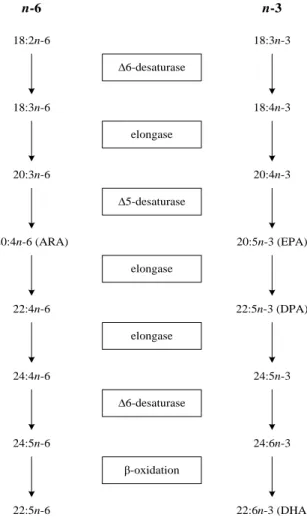
1.3.3. Muscle fatty acids metabolism – Fatty acids syntheses and deposition in muscle ... 27
1.4. Dietary strategies for improving the fatty acid composition of lamb meat ... 34
1.4.1. Basal diet ... 35
1.4.1. Lipid supplementation ... 37
1.4.2. Plant secondary compounds ... 45
1.5. Research objectives ... 49
Chapter 2 Effect of dietary replacement of sunflower oil with linseed oil on intramuscular fatty acids of lamb meat ... 51
2.1. Introduction ... 55
2.2. Materials and methods ... 56
2.2.1. Animals management and sampling procedures ... 56
2.2.2. Lipid analysis ... 58
2.2.3. Statistical analysis ... 60
2.3. Results ... 60
2.3.1. Growth performance, carcass composition and meat colour... 60
2.3.2. Meat fatty acids ... 61
2.3.2.1. Meat polar lipids ... 62
2.3.2.2. Meat neutral lipids ... 62
2.3.2.3. Meat total lipids ... 65
2.3.2.4. Sums and ratios of fatty acids ... 65
2.4. Discussion ... 68
2.4.1. Growth performance and carcass composition ... 68
2.4.2. Meat fatty acid content ... 68
2.4.3. Meat fatty acid composition ... 69
2.4.4. Nutritional quality of meat lipids ... 72
2.5. Conclusions ... 74
Acknowledgements ... 75
Chapter 3 Biohydrogenation intermediates are differentially deposited between polar and neutral intramuscular lipids of lambs ... 77
Abstract ... 79
3.1 Introduction ... 81
3.2 Materials and methods ... 82
3.2.1 Animal management and sampling procedures ... 82
3.2.2 Lipid analysis ... 83
3.2.3 Calculation of selectivity indices ... 87
3.2.4 Statistical analysis ... 87
3.3 Results ... 87
3.3.1 Composition of C18 fatty acids in polar and neutral lipid fractions ... 87
3.3.2 Selective deposition of C18 fatty acids between polar and neutral lipid fractions ... 91
3.4 Discussion ... 93
3.4.1 Effect of graded levels of sunflower and linseed oils on rumen biohydrogenation derived FA (BI) ... 93
3.4.2 Deposition of C18 fatty acids in lipid fractions ... 95
Acknowledgements ... 99
Chapter 4 Effect of sodium bentonite and vegetable oil blend supplementation on growth, carcass quality and intramuscular fatty acid composition of lambs ...101
Abstract ...103
4.1 Introduction ...105
4.2 Materials and methods ...107
4.2.1 Animal management and sampling procedures ...107
4.2.2 Analytical procedures and calculation of variables ...109
4.2.2.1 Feed analysis...109
4.2.2.2 Lipid analysis ...109
4.2.3 Statistical analysis ...111
4.3 Results...111
4.3.1 Growth performance, carcass composition and meat colour ...111
4.3.2 Intramuscular fat and total fatty acids...113
4.3.2.1 General fatty acid composition ...113
4.3.2.2 Biohydrogenation intermediates ...116
4.4 Discussion ...117
4.4.1 Growth performance, carcass composition and meat colour ...117
4.4.2 Intramuscular fat and general fatty acid composition ...118
4.4.2.1 Biohydrogenation intermediates ...120
4.5 Conclusions ...123
Acknowledgements ...123
Chapter 5 The effect of grape seed extract, Cistus ladanifer L. and vegetable oil supplementation on fatty acid composition of abomasal digesta and intramuscular fat of lambs ...125
Abstract ...127
5.2 Materials and methods ... 130
5.2.1 Animals, treatments and sample collection ... 130
5.2.2 Lipid analysis of intramuscular fat and abomasal digesta... 132
5.2.3 Statistical analysis ... 134
5.3 Results ... 135
5.3.1 Feed intake... 135
5.3.2 Growth performance and carcass composition ... 136
5.3.3 Abomasal digesta fatty acids ... 138
5.3.4 Intramuscular fatty acids ... 142
5.3.4.1 Polar lipids ... 143
5.3.4.2 Neutral lipids ... 148
5.4 Discussion ... 154
5.4.1 Growth performance and carcass composition ... 154
5.4.2 Ruminal biohydrogenation ... 155
5.4.3 Intramuscular lipid fractions... 158
Acknowledgment... 162
Chapter 6 Effect of dietary grape seed extract and Cistus ladanifer L. in combination with vegetable oil supplementation on oxidative stability of lamb meat ... 163
Abstract ... 165
6.1 Introduction ... 167
6.2 Materials and methods ... 168
6.2.1. Animal and management ... 168
6.2.2. Sample collection ... 169
6.2.3. Lipid analysis ... 169
6.2.4. Measurement of meat lipid oxidation after induction of oxidation in vitro .. 170
6.2.5. Meat colour measurement ... 171
6.2.6. Sensory analysis ... 171
6.2.7. Statistical analysis ... 172
6.3 Results and discussion ... 173
6.3.1. Meat lipid oxidation ... 175
6.3.2. Meat colour ... 180
6.4 Conclusion ...184 Acknowledgements ...184 Chapter 7
General discussion and future perspectives ...185 References...195
L
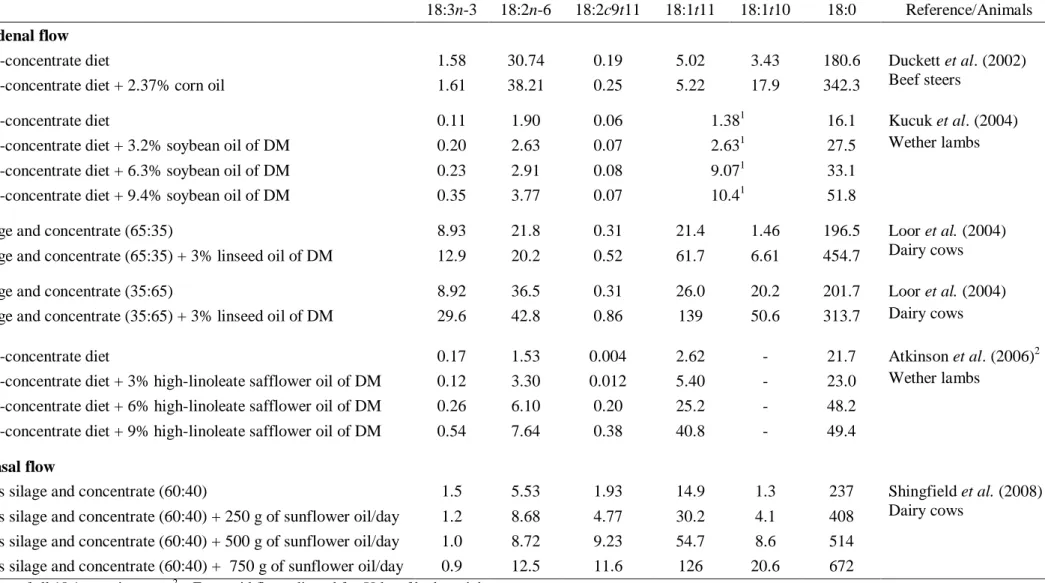
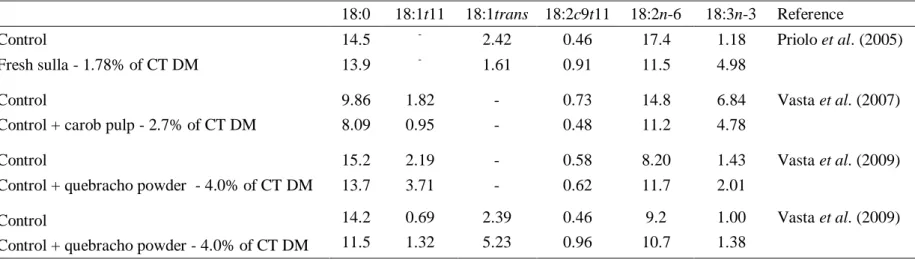
IST OF TABLES CHAPTER 1Table 1. 1 Established and putative biohydrogenation intermediates of oleic, linoleic and linolenic acids ... 22 Table 1. 2 Effect of basal diet on 18:1 trans-10, 18:1 trans-11, 18:2 trans-10, cis-12 and 18:2 cis-9, trans-11 contents (% of total fatty acids) in intramuscular fat of lambs ... 36 Table 1. 3 Effect of dietary supplementation with unprotected lipid sources rich in PUFA on fatty acid rumen outflow (g/day) ... 39 Table 1. 4 Effect of dietary unsaturated lipid supplementation on intramuscular fatty acid composition (% of total fatty acids) of lambs ... 42 Table 1. 5 Effect of dietary condensed tannins sources on intramuscular fatty acid composition (% of total fatty acids) of lambs ... 48 CHAPTER 2
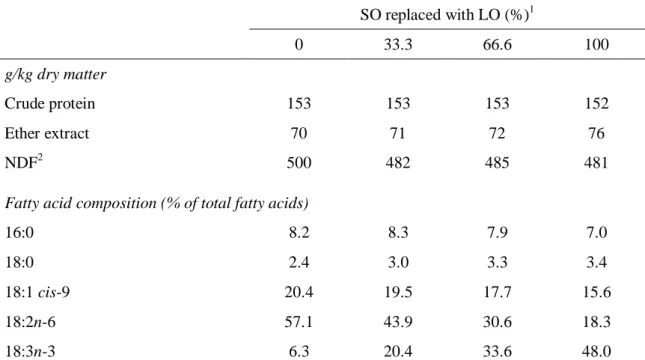
Table 2. 1 Chemical composition of the experimental diets ... 57 Table 2. 2 Effect of dietary replacement of sunflower oil (SO) with linseed oil (LO) on growth and carcass composition of Merino Branco lambs. ... 61 Table 2. 3 Effect of dietary replacement of sunflower oil (SO) with linseed oil (LO) on fatty acid concentration (mg/g fresh muscle) and composition (g/100 g total fatty acid) of polar lipids in longissimus muscle from Merino Branco lambs. ... 63 Table 2. 4 Effect of dietary replacement of sunflower oil (SO) with linseed oil (LO) on fatty acid concentration (mg/g fresh muscle) and composition (g/100 g total fatty acid) of neutral lipids fraction of longissimus muscle from Merino Branco lambs. ... 64 Table 2. 5 Effect of dietaty replacement of sunflower oil (SO) with linseed oil (LO) on fatty acid concentration (mg/g fresh muscle) and composition (g/100 g total fatty acid) of total lipids in longissimus muscle from Merino Branco lambs. ... 66 Table 2. 6 Effect of dietary replacement of sunflower oil (SO) with linseed oil (LO) on sums of fatty acids (g/100 g total fatty acid) and nutritional indices value of total, polar and neutral lipids in longissimus muscle from Merino Branco lambs ... 67 CHAPTER 3
Table 3. 1 Total fatty acid concentration (mg/g muscle dry matter) and composition (mg/100 g of total fatty acids) in polar lipids of longissimus muscle from lambs fed graded levels of sunflower and linseed oils. ... 88
Table 3. 2 Total fatty acid concentration (mg/g muscle dry matter) and composition (mg/100 g of total fatty acids) in neutral lipids of longissimus muscle from lambs fed graded levels of sunflower and linseed oils. ... 89 Table 3. 3 Selectivity indices of C18 fatty acids between polar and neutral lipid fractions in longissimus muscle from lambs fed graded levels of sunflower and linseed oils. ... 92 CHAPTER 4
Table 4. 1 Chemical composition of experimental diets ...108 Table 4. 2 Effect of sodium bentonite (SB) and oil supplementation (O) on Merino Branco lambs growth, carcass composition and meat quality ...112 Table 4. 3 Effect of sodium bentonite (SB) and oil supplementation (O) on total FA concentration (mg/g of fresh muscle) and composition (g/100 g total fatty acids) of
longissimus dorsi from Merino Branco lambs ...114
Table 4. 4 Effect of sodium bentonite (SB) and oil supplementation (O) on biohydrogenation intermediates (mg/100 g total fatty acids) of longissimus dorsi from Merino Branco lambs ...115 CHAPTER 5
Table 5. 1 Chemical composition of the diets. ...131 Table 5. 2 Effect of dietary condensed tannin sources (Control, Grape Seed Extract-GSE and C. ladanifer) and oil supplementation (0% and 6% of added oil in DM) on dry matter and fatty acid intake (g/d) of lambs ...136 Table 5. 3 Effect of dietary condensed tannin sources (Control, Grape Seed Extract-GSE, and C. ladanifer) and oil supplementation (0% and 6% of added oil in DM) on growth and carcass composition of lambs...137 Table 5. 4 Effect of dietary condensed tannin sources (Control, Grape Seed Extract-GSE, and C. ladanifer) and oil supplementation (0% and 6% of added oil in DM) on total fatty acid concentration (mg/g dry matter) of abomasal digesta from lambs ...139 Table 5. 5 Effect of dietary condensed tannin sources (Control, Grape Seed Extract-GSE, and C. ladanifer) and oil supplementation (0% and 6% of added oil in DM) on C18 fatty acid profile (g/100 g of total C18 fatty acids) of abomasal digesta from lambs ...140 Table 5. 6 Effect of dietary condensed tannin sources (Control, Grape Seed Extract-GSE, and C. ladanifer) and oil supplementation (0% and 6% of added oil in DM) on total fatty acid concentration (mg/g fresh muscle) and composition (g/100 g of total fatty acids) of polar lipid in longissimus dorsi muscle from lambs ...144
Table 5. 7 Effect of dietary condensed tannin sources (Control, Grape Seed Extract-GSE, and C. ladanifer) and oil supplementation (0% and 6% of added oil in DM) on C18 fatty acid composition (mg/g total fatty acids) of polar lipids in longissimus dorsi muscle from lambs... 146 Table 5. 8 Effect of dietary condensed tannin sources (Control, Grape Seed Extract-GSE, and C. ladanifer) and oil supplementation (0% and 6% of added oil in DM) on total fatty acid concentration (mg/g fresh muscle) and composition (g/100 g of total fatty acids) of neutral lipid in longissimus dorsi muscle from lambs ... 150 Table 5. 9 Effect of dietary condensed tannin sources (Control, Grape Seed Extract-GSE, and C. ladanifer) and oil supplementation (0% and 6% of added oil in DM) on C18 fatty acid composition (mg/g total fatty aids) of neutral lipids in longissimus dorsi muscle from lambs... 152 CHAPTER 6
Table 6. 1 Effect of dietary condensed tannin sources (control, grape seed extract-GSE and C. ladanifer) and oil supplementation (0% and 6% of added oil in DM) on fatty acid concentration (mg/g fresh muscle) and composition (g/100 g total fatty acids) of
longissimus dorsi muscle from Merino Branco lambs. ... 174
Table 6. 2 Effect of storage time, oil supplementation and inclusion of a condensed tannin sources on lipid oxidation (mg MDA/kg muscle) and surface colour parameters in raw longissimus dorsi muscle from Merino Branco lambs ... 176 Table 6. 3 Results of sensory analysis by a consumer panel ... 183
L
IST OF FIGURES CHAPTER 1Figure 1. 1 Established and putative biohydrogenation pathways. ... 21 Figure 1. 2 Relationship between content of total fatty acids and total fatty acids in neutral and polar lipids in lamb meat and beef. ... 28 Figure 1. 3 Pathways of 18:2 cis-9, trans-11 biosynthesis ... 29 Figure 1. 4 Biosynthesis of n-6 and n-3 long chain polyunsaturated fatty acids ... 31 CHAPTER 2
Figure 2. 1 Effect of dietary replacement of sunflower oil (SO) with linseed oil (LO) on concentration of CLA, n-3 LC-PUFA and sum of both group FA. ... 74 CHAPTER 3
Figure 3. 1 GC-MS mass spectrum of the 4,4-dimethyloxaline (DMOX) derivative of 18:2 trans-11, trans-15. ... 84 Figure 3. 2 Partial GC-FID chromatogram of neutral lipids from lambs fed: S - pellet dehydrated lucerne with 6% of sunflower oil; 2SL - pelleted dehydrated lucerne with 4% of sunflower oil and 2% of linseed oil; S2L - pelleted dehydrated lucerne with 2% of sunflower oil and 4% of linseed oil; L - pelleted dehydrated lucerne with 6% of linseed oil. ... 85 Figure 3. 3 Partial GC-FID chromatogram of neutral lipids from lambs fed diet L. ... 86 CHAPTER 6
Figure 6. 1 Effect of oil supplementation and time of storage on TBARS values determined after oxidation induction in longissimus dorsi muscle. ...177 Figure 6. 2 Effect of inclusion the grape seed extract and Cistus ladanifer in diets and time of storage on TBARS values determined after oxidation induction in longissimus
dorsi muscle. ...177
Figure 6. 3 Effect of inclusion the grape seed extract and Cistus ladanifer in diets on Hue angle (H*) of longissimus dorsi muscle during storage time. ...182
L
IST OF ABBREVIATIONS AND SYMBOLSa* Redness (CIELAB colour dimension) AOAC Association of Official Analytical Chemists
ARA Arachidonic acid; 20:4n-6; 20:4 cis-5, cis-8, cis-11, cis-14
b* Yellowness (CIELAB colour dimension)
BH Biohydrogenation
BI Biohydrogenation intermediates
°C Degree Celsius
C* Chroma – colour saturation
C. ladanifer Cistus ladanifer L.
CACI-MS Covalent adduct chemical ionization mass spectrometry CLA Conjugated linoleic acid
cm centimetre
CoA Coenzyme A
CT Condensed tannins
DHA Docosahexaenoic acid; 22:6n-3; 22:6 cis-4, cis-7, cis-10, cis-13, cis-16, cis-19
DM Dry matter
DMI Dry matter intake
DPA Docosapentaenoic acid; 22:5n-3; 22:5 cis-7, cis-10, cis-13, cis-16, cis-19 EPA Eicosapentaenoic acid; 20:5n-3; 20:5 cis-5, cis-8, cis-11, cis-14, cis-17
FA Fatty acids
FAME Fatty acid methyl esters
g Gram
GC-FID Gas chromatography with a flame ionization detector GC-MS Gas chromatography mass spectrometry
H* Hue angle
HPLC High-performance liquid chromatography IMFA Intramuscular fatty acids
kg Kilogram
KKCF Kidney knob channel fat
L* Lightness (CIELAB colour dimension)
LC-PUFA Long chain polyunsaturated fatty acids - ≥ 20 carbons LDL Low density lipoproteins
LO Linseed oil
m Milimolar
MDA Malondialdehyde
mg Miligram
MJ Megajoule
ml Mililitre
mm Milimetre
mM Milimolar
mRNA Messenger RNA
MUFA Monounsaturated fatty acids
n-3 PUFA Sum of n-3 fatty acids = 18:3n-3 + 20:3n-3 + 20:5n-3 + 22:5n-3 + 22:6n-3
n-3 LC-PUFA Sum of n-3 long chain fatty acids = 20:3n-3 + 20:5n-3 + 22:5n-3 + 22:6n-3
n-6 PUFA Sum of n-6 fatty acids = 18:2n-6 + 20:2n-6 + 20:3n-6 + 20:4n-6 + 22:4n-6
n-6 LC-PUFA Sum of n-6 long fatty acids = 20:2n-6 + 20:3n-6 + 20:4n-6 + 22:4n-6
n-6/n-3 Sum of n-6 PUFA / Sum of n-3 PUFA
NDF Neutral detergent fibre
NL Neutral lipids
nm Nanometre
ns Not significant
O Oil blend supplementation
P Probability
pH Potential of hydrogen
PL Polar lipids
PUFA Polyunsaturated fatty acids
P/S (18:2n-6 + 18:3n-3)/(12:0 + 14:0 + 16:0 + 18:0)
% Percentage
SAS Statistical analysis system (Software package)
SB Sodium bentonite
SCD Stearoyl-CoA desaturase
SD Standard deviation
SEM Standard error of the mean SFA Saturated fatty acids
SO Sunflower oil
TBARS Thiobarbituric acid reactive substances
TFA Trans fatty acids
rpm Revolutions per minute
rRNA Ribosomal RNA
μl Microlitre
μm Micrometre
v volume
UV Ultraviolet
I
NTRODUCTIONIn recent years, fatty acid (FA) composition of ruminant fat has received much interest due to its implications for human health and meat quality. The edible products of ruminant have been associated to an increase of the risk of cardiovascular diseases, due to its high content in saturated fatty acids (SFA) and trans fatty acids (TFA) and low content in polyunsaturated fatty acids (PUFA). In rumen the dietary lipids are extensively hydrolysed and the unsaturated FA liberated (mostly C18 PUFA) are also extensively biohydrogenated (Jenkins et al., 2008), resulting in a high level of SFA in fat, as well as in several unsaturated C18 FA, including trans FA (Bessa et al., 2007). The nutritional recommendations indicate that the SFA content of most Western-type diets should be reduced and the PUFA content should be increased, particularly in n-3 PUFA (WHO, 2003). These recommendations have led to declining the consumption of ruminant edible products. However, ruminant edible products may also be a good dietary source of some health benefit FA, such as n-3 PUFA and conjugated linoleic acid isomers (CLA). The ruminant fats are naturally rich in CLA isomers, particularly of rumenic acid (18:2 cis-9,
trans-11), and are the main sources of these isomers in the human diet(Chin et al., 1992).
The 18:2 cis-9, trans-11 is formed by ruminal biohydrogenation of linoleic acid (18:2n-6) (Harfoot and Hazelwood, 1997) and mainly by endogenous conversion of vaccenic acid (18:1 trans-11) by stearoyl-CoA desaturase (SCD) in tissues (Griinari et al., 2000). The 18:1 trans-11 is an intermediate produced during ruminal biohydrogenation of both 18:2n-6 and α-linoleic acid (18:3n-3) (Harfoot and Hazelwood, 1997).
Manipulation of FA composition of ruminant fat, to reduce the SFA and increase the PUFA, particularly in n-3 long chain polyunsaturated fatty acids (≥ 20 carbons, LC-PUFA) and CLA contents, is a major target in ruminant meat and milk research. Several
studies have been show that there is an opportunity to improve the nutritional value of ruminant fat through the changes in diet. Lipid supplementation is a effective mean of improving the FA composition of ruminant fat (Chilliard and Ferlay, 2004, Scollan et al., 2006, Sinclair, 2007). However, ruminal biohydrogenation (BH) of unsaturated FA constitute the main limitation to enrichment of PUFA in ruminant fat by unprotected lipid supplementation. Thus, the modulation of ruminal BH in order to increase the dietary PUFA and benefit biohydrogenation intermediates (BI) that escape from rumen may be a good approach for to improving the healthiness of ruminant meat and milk. Moreover, the intramuscular FA deposition results from balance between uptake, de novo synthesis and mobilization. Many these metabolic pathways are strongly regulated in order to maintain the homeostasis, but are also influenced by several factors, such as genotype, gender, age and mainly by dietary factors. The strong regulation of FA content and composition in membrane phospholipids (Raes et al., 2004), the main local of PUFA deposition, suggest that there may be limitation to the incorporation of higher amount of PUFA in phospholipids. Moreover, it has been postulated that deleterious effects of some trans PUFA are due to their incorporation in phospholipids. However, information about deposition of most FA, as BI in intramuscular polar (PL) and neutral lipid (NL) fractions is very scarce.
Globally, this work aims to contribute for the study the lipid metabolism in ruminants, particularly contribute for current knowledge over FA metabolism in rumen and muscle. We intend explore several nutritional approach that might modulate the ruminal BH in order to increase the flow of dietary PUFA and benefit BI from rumen, increasing thus availability of these FA for deposition in muscle. We also intend to explore the intramuscular FA deposition between polar and neutral lipid fractions.
This thesis is structured in 7 chapters. In Chapter 1, ―Scientific background and objectives‖, the general FA composition of ruminant meats will be present, and the nutritional value of FA, consumptions and dietary recommendations will be summarily reviewed. Subsequently, will be approached the ruminant lipid metabolism, particularly ruminal metabolism, intestinal absorption and transport, as well as deposition and endogenous synthesis in muscle. Finally, will be reviewed the dietary strategies for improve the nutritional value of lamb meat. After this brief overview, the specific objectives of this work will be described. The chapters 2 to 6 are based on scientific manuscripts, already published (4) or provisionally accepted for publication with revisions (1) in international peer reviewed journals.
Previous data obtained by our group showed that blend of sunflower and linseed oils may a good approach to obtain simultaneously lamb meat enriched in CLA and n-3 LC-PUFA (Bessa et al., 2007). In order to explore this approach, more levels of stepwise substitution of sunflower oil with linseed oil were tested, and results are present in Chapter 2. Detailed C18 FA distribution between intramuscular PL and NL obtained in this trial is reported in Chapter 3.
In Chapter 4 are presents the results obtained from one trial where we tested if incorporation of sodium bentonite in diets supplemented with vegetable oils rich in PUFA might modify the ruminal BH, increasing escape of dietary PUFA from rumen and change the BI profile.
Following the same objective, i.e. improve the nutritional value of lamb meat by modulation the ruminal BH, we explored the utilization of dietary condensed tannins (CT) sources in diets supplemented with vegetable oils rich in PUFA (Chapter 5). However, the susceptibility of PUFA to oxidation, might limit the nutritional strategies
which aim at increasing PUFA concentration in meat. Several CT sources show antioxidant activity. Thus, in this trial we also evaluated if inclusion of CT sources in diets affect the colour stability and antioxidant potential of lamb meat during storage (Chapter 6).
Finally, chapter 7 intends to summarise and discuss in an integrated form the results obtained in each of the five previous chapters, the main conclusions and relevant perspectives for future research are show in this topic.
C
HAPTER1
1.1.FAT CONTENT AND FATTY ACID COMPOSITION OF RUMINANT MEAT
Total fat content of meat is affected by a several factors, including species, age, weight at slaughter, sex, breed, part of the carcass and diet (Valsta et al., 2005, Sinclair, 2007). The intramuscular lipid content of most ruminant meat is less than 50 g/kg (Scollan et al., 2006, Sinclair, 2007), a value generally considered to characterize a low-fat food.
Ruminant meats are known to have higher content of SFA and lower levels of PUFA compared to those from non-ruminant origin. In general, intramuscular fat of ruminant animals is composed of approximately 45-55% of SFA, 45-50% of monounsaturated FA (MUFA) and relatively minor amounts of PUFA (Givens et al., 2006). Thus, the polyunsaturated/saturated ratio (P/S) in ruminant meats is typically low, around 0.1-0.2 (Raes et al., 2004, Sinclair, 2007). Palmitic (16:0) and stearic (18:0) acids are the main SFA, while oleic (18:1 cis-9) is the predominant MUFA (Scollan et al., 2006, Sinclair, 2007). The 18:2n-6, 18:3n-3 and arachidonic acid (20:4n-6; ARA) are the main PUFA (Raes et al., 2004). Meat also contains important levels of n-3 LC-PUFA, but much lower than in fish (Howe et al., 2007). Comparing meats, the highest concentrations of eicosapentaenoic (20:5n-3; EPA) and docosahexaenoic (22:6n-3; DHA) acids (EPA+DHA) were found in poultry meat (~2% of total FA), followed by sheep meat (~1%), pork (~0.6%), and beef and veal (~0.5%) (Givens et al., 2006). Docosapentaenoic acid (22:5n-3; DPA) is the predominant n-3 LC-PUFA in meat, and beef and lamb meat has a higher proportion of DPA than fish (Howe et al., 2006, Howe et al., 2007). Ruminant meats usually have a more favourable n-6/n-3 ratio when compared with non-ruminant animals, due to the relatively higher content of 18:3n-3 in pastures and forages (Prates and Bessa, 2009).
Trans FA occur in higher amounts in ruminant meats than in those from non-ruminant,
representing usually 2–4% of total FA in ruminant meats (Valsta et al., 2005). Trans 18:1 isomers constitute about 80% of total TFA in meat and meat products, being the 18:1
trans-11 the main trans 18:1 isomer (about 60% of total trans 18:1 isomer ) (Prates and
Bessa, 2009). However, high concentrations of 18:1 trans-10 had been found in meat of ruminants fed a concentrate based diet (Bessa et al., 2005).
Meat from ruminants has higher levels of CLA than meat from non-ruminant. The highest CLA concentrations were found in lamb meat (4.3–19.0 mg/g fat), followed by beef (1.2– 10.0 mg/g fat), representing 0.5–2% of total FA (Schimd et al., 2006, Prates and Bessa, 2009). Pork and chicken meat show small levels of CLA and usually lower than 2 mg/g fat (Parodi, 2003, Schimd et al., 2006). Meat CLA content is positively related with intramuscular fat content (Raes et al., 2004). Rumenic acid is the main CLA isomer in meat, constituting about 80% of total CLA (Schimd et al., 2006). Usually the second most prevalent CLA isomer in meat is the 18:2 trans-7, cis-9 (Yurawecz et al., 1998, Martins et al., 2007). The 18:2 trans-10, cis-12 is present in residual levels in foodstuffs.
1.2. NUTRITIONAL VALUE OF FATTY ACID, CONSUMPTIONS AND DIETARY
RECOMMENDATIONS
Consumers are becoming more aware of the relationship between diet and health and this has increased the consumer interest in the nutritional value of food. Particular attention has been given to FA composition of foods; especially in ruminant edible products, as milk or meat due to its implications for human health. Ruminant products have high content of SFA and low levels of PUFA, propriety that is regarded as being disadvantageous within the human diet. A high intake of SFA is positively associated
lipoprotein (LDL)-cholesterol blood levels (Givens, 2005). However, individual SFA show different cholesterolemic responses. Lauric (12:0), myristic (14:0) and palmitic (16:0) acids have a cholesterol-raising effect, whereas stearic acid (18:0) appears to have neutral effect on serum cholesterol (Williams, 2000, Givens, 2005). Within hypercholesterolemic SFA, the 14:0 is considered more potent than 12:0 and 16:0 acids in inducing the increase the total cholesterol and LDL-colesterol (Kris-Etherton and Yu, 1997). However, nutritional recommendations, not consider the specific cholesterolemic effect of the individual SFA and only indicate that intake of SFA should not exceed 10% of total energy intake (Elmadfa and Kornsteiner, 2009). Intake estimations showed that in Western Europe, SFA provides on average between 10 to 19% of total energy intake, with the lowest contribution in most Mediterranean countries (Hulshof et al., 1999).
In contrast to SFA, the PUFA and MUFA are generally regarded as beneficial for human health (Scollan et al., 2006). Substitution of SFA by MUFA or PUFA reduced plasma total cholesterol and LDL-colesterol, being the PUFA more potent to reduction the cholesterol than MUFA (Williams, 2000). Oleic acid (18:1 cis-9), the most predominant MUFA in ruminant fat, is known to have the hypocholesterolemic properties, reducing the plasma cholesterol and LDL-cholesterol levels (Kris-Etherton and Yu, 1997). The recommended intake of MUFA can amount up to 15-20% of total energy intake, and regarding the PUFA 2.5-9% of energy intake should be from n-6 PUFA (18:2n-6) and 0.5-2% from n-3 PUFA (Elmadfa and Kornsteiner, 2009). The minimum dietary requirement of 18:3n-3 for adults is 0.5% of total energy intake (Elmadfa and Kornsteiner, 2009). It is also recommended that P/S ratio of whole human diet should be higher than 0.45 (Department of Health, 1994). However, this nutritional index based only on chemical structure of FA may not be an adequate way to evaluate the nutritional
effects of MUFA (Santos-Silva et al., 2002a). Utilization of indices based on functional effects of individual FA, as hypocholesterolaemic/hypercholesterolaemic FA ratio (Santos-Silva et al., 2002a), or atherogenicity and thrombogenicity indices (Ulbricht and Southgate, 1991) seems a better approach for evaluate the potential effect of dietary fat on human health.
Western diets are generally characterized by excessive amounts of n-6 PUFA and deficient n-3 PUFA, with n-6/n-3 ratios around 15/1-17/1 (Simopoulos, 2004). Despite the higher intake of both n-6 PUFA and n-3 PUFA is associated with reduction of the cardiovascular diseases risk (Stanley et al., 2007), the excessive amount of n-6 PUFA in diet favors the development of many diseases, such as cardiovascular diseases, cancer and inflammatory and autoimmune diseases (Simopoulos, 2004). In contrast, increased the n-3 PUFA levels in diets have protective effect (Simopoulos, 2004). The 18:2n-6 and 18:3n-3, essential FA for humans, are precursors of LC-PUFA via a series of stepwise dasaturations and elongations (conversion pathways of 18:2n-6 and 18:3n-3 in respective LC-PUFA are present in section 1.3.3). Linoleic acid is the precursor of ARA and the 18:3n-3 is converted to EPA, DPA and DHA acids. The LC-PUFA are deposited mainly in membrane phospholipids and constitute substrate for synthesis of the eicosanoids, such as prostaglandins, thromboxanes or leukotrienes (Calder, 2001). Despite the FA composition of the membrane phospholipids to be strictly controlled in order to maintain the cellular homeostasis, its composition in FA is sensitive to changes of diet FA composition (Scollan et al., 2006). The membrane phospholipids FA composition of inflammatory and immune cells determines the type of eicosanoids formed (Calder, 2003), and the eicosanoid derived from n-6 and n-3 PUFA have different biological actions and potencies. The eicosanoids derived from ARA are metabolically more potent in promoting inflammation, platelet aggregation, and immune and vascular reactivity than
those derived from n-3 LC-PUFA (Calder, 2001, Calder, 2003). Moreover, the EPA also induced the suppression in the production of eicosanoids derived from ARA (Calder, 2001).
Nutritional recommendation indicate that the n-6/n-3 ratio in human diets should not exceed 4 (Department of Health, 1994). However, the value of dietary n-6/n-3 ratio in modifying the cardiovascular diseases has been questioned (Stanley et al., 2007, Griffin, 2008). The 18:2n-6 and 18:3n-3 competes for the same elongation and desaturation enzymes, limiting the efficiency of its conversion to n-6 and n-3 LC-PUFA (Brenner, 1989) and it is generally assumed that higher dietary n-6/n-3 reduces the n-3 LC-PUFA synthesis. However, recently was reported that the conversion of 18:3n-3 in humans is influenced by the absolute amounts of 18:26 and 18:33 in diets and not by dietary n-6/n-3 ratio (Goyens et al., 2006). Moreover, the dietary n-n-6/n-3 ratio does not modifies the cardiovascular diseases risk (Stanley et al., 2007, Griffin, 2008).Thus, it is considered that the n-6/n-3 ratio is not a useful concept, and that distract attention from the n-3 LC-PUFA absolute amounts in the diet (Stanley et al., 2007). The health benefits of n-3 PUFA are mostly associated with absolute dietary intake of n-3 LC-PUFA, mainly EPA and DHA, while the principal biological role of 18:3n-3 seems to be as precursor for to
n-3 LC-PUFA (Burdge and Calder, 2005). The EPA and DHA shown to have
anti-atherogenic, anti-trombotic and anti-inflamatory effects (Givens et al., 2006) and may also have important roles in reducing the cancer, obesity and type 2 diabetes (WHO, 2003). Some studies show that intake of EPA and DHA may protect against the neurological disorders, including the Alzheime‘s diseases, as reviewed by Whelan and Rust (2006). The conversion of dietary 18:3n-3 to n-3 LC-PUFA is very limited in adult humans, so the 18:3n-3 is probably a quite limited sources of EPA and DHA (Burdge and
3 reduces the cardiovascular disease risk (Zhao et al., 2004), probably due to increase the synthesis of EPA (Givens et al., 2006). The recent intake estimation of the EPA and DHA in various countries, reviewed by Givens and Gibbs (2008) showed a large variation in mean intake of these FA, ranging from 75 mg/day in Belgian children to 950 mg/day in adults in Japan. However, many of these values are below the recommended daily intake. Simopoulos (2004) reported that adequate intake of EPA + DHA is the 0.3% of diet energy (i.e. 650 mg/day considering diets with 2000 kcal). The minimum recommended by Scientific Advisory Committee of Nutrition and Committee on Toxicity (2004) is the 450 mg of EPA + DHA/day. Recently was reported that the adequate intake of EPA + DHA should range between 250-2000 mg/day (Elmadfa and Kornsteiner, 2009).The concentrations of n-3 LC-PUFA in ruminant meats are lower than those within fish or fish oil. However, the consumption of fish or fish oil in most Western countries is low (Givens and Gibbs, 2008), so may be important the contribution of meat to increase the n-3 LC-PUFA intake. The meat, specially the beef and lamb meat has a high proportion of DPA (Howe et al., 2007), contributing substantially to the DPA intake (Astorg et al., 2004, Howe et al., 2006). The biological effects of DPA has been little researched, but recent evidence suggest that DPA is just as important as EPA and DHA for the health benefits associated with n-3 LC-PUFA (Howe et al., 2007). However, the DPA is not considered in dietary recommendation for n-3 LC-PUFA.
Generally, TFA intake is associated to deleterious effects on human health (Hunter, 2006). However, evidence suggests that individual TFA have differential biological effects. Trans FA are provided in human food by ruminant products, mainly composed by 18:1 trans-11, and by industrial hydrogenated vegetable oils, that shown high levels of several 18:1 trans FA, mainly 18:1 trans-9 and 18:1 trans-10 (Pfeuffer and Schrezenmeir, 2006). Epidemiological studies showed a positive association between cardiovascular
disease risk and consumption of TFA from industrial sources, but not with consumption of TFA from ruminant sources (Chardigny et al., 2008). Moreover, the 18:1 trans-11 has been suggest as beneficial TFA because it‘s the precursor of 18:2 cis-9, trans-11 in animals and man (Scollan et al., 2006). However, the biological effects of TFA from ruminant origin are less known, and the some results are contradictory. Recently epidemiologic study (Motard-Bélanger et al., 2008) showed that a same daily intake of TFA from ruminant and from industrial sources (3.6% of energy intake) has a same negative effect on cardiovascular disease risks factors, but moderate TFA intake from ruminant origin (1.5% of energy intake) has a neutral effect on these risk factors. The contribution of TFA from ruminant sources in ranges from 30 to 80% of total TFA intake, representing to 0.3 – 0.8% of dietary energy (Craig-Schmidt, 2006). Thus, the actual amounts of TFA from ruminant origin consumed in diets do not contribute importantly to risks of cardiovascular disease (Motard-Bélanger et al., 2008). The present nutritional recommendation indicate that TFA should contribute with less than 1% of total energy intake of the human diets (Elmadfa and Kornsteiner, 2009). Intake estimations showed that in Western Europe, TFA provides on average between 0.5 to 2.1% of total energy intake, with the lowest contribution in most Mediterranean countries (Hulshof et al., 1999).
In recent years, CLA have received much attention due their potential beneficial properties to human health. Conjugated linoleic acid is a collective term that refers to a mixture of positional (from carbons 6,8 to 12,14) and geometric (trans, trans; trans, cis;
cis, trans; and cis, cis) isomers of 18:2n-6 with a conjugated double-bond system (Wahle et al., 2004). Numerous beneficial physiological effects have been attributed to CLA,
anti-mainly on the effects of two isomers, 18:2 cis-9, trans-11 and 18:2 trans-10, cis-12 and specific physiology effects have been associated to each these CLA isomers. The anti-adipogenic effect of CLA has been associated to 18:2 trans-10, cis-12 isomer (Park et al., 1999, Chardigny et al., 2003), whereas the both 18:2 cis-9, trans-11 and 18:2 trans-10,
cis-12 isomers appear to be are similarly active in anticarcinogenesis (Pariza et al., 2001).
Recently was reported that a mixture of trans, trans CLA isomers had a greater anticarcinogenic activity in induced rat mammary tumorigenesis as compared to 18:2 cis-9, trans-11 and 18:2 trans-10, cis-12 isomers (Islam et al., 2010). Most evidence of the benefit effects of CLA isomers has been obtained by laboratory animals and by cell culture studies (Pariza et al., 2001, Wahle et al., 2004). In human studies inconsistent effects have been reported, and the beneficial effect of CLA for human health remains to establish (Tricon and Yaqoob, 2006). Moreover, only few studies have explored the health effects in humans of CLA naturally present in food (Prates and Bessa, 2009). The main dietary source of CLA in food is ruminant meat, milk and their products (Parodi, 2003). Martins et al. (2007) reviewing the daily intake estimative of 18:2 cis-9, trans-11 or CLA for several countries showed that its consumption ranges between 15 and 1000 mg. Based in consumption of food rich in CLA was estimated that daily intake of CLA for the Portuguese population is about 74 mg (Martins et al., 2007). Recommendations for the intake of CLA in human yet are not established. Based on animal studies have been extrapolated the CLA intake necessary to promote health benefits in humans. Using this methodology was suggested that consumption of 720-800 mg of CLA/person/day would be necessary for anticarcinogenic protective effects in humans (Parish et al., 2003, Watkins and Li, 2003).
1.3.RUMINANT LIPID METABOLISM
1.3.1. Ruminal lipid metabolism
Fatty acid metabolism in the rumen has a major influence on the FA composition of ruminant products. In rumen, the dietary lipids are extensively metabolized, resulting in marked differences between FA composition of edible products of ruminants (mostly SFA) and FA composition of its diet (mostly unsaturated FA) (Jenkins et al., 2008).The main types of dietary lipids entering the rumen are triacylglycerols, galactolipids and phospholipids (Jenkins et al., 2008). In ruminants fed forage the dietary lipid consists mainly in galactolpids and phospholipids, while cereals and plant oils contribute mainly with triacylglycerols (Harfoot and Hazelwood, 1997). The most abundant FA present in forages is 18:3n-3, whereas cereals and plant oils contain predominantly 18:2n-6 and 18:1
cis-9 (Woods and Fearon, 2009). However, in the linseed and linseed oil the most
abundant FA is 18:3n-3 (Woods and Fearon, 2009). In rumen the dietary lipids are transformed via two major processes – lipolysis and BH.
1.3.1.1. Ruminal lypolisis
In rumen the dietary lipids are rapidly hydrolyzed, which lipases hydrolyze the ester linkages in complex lipids, causing the release the constituent FA (Garton et al., 1961, Dawson et al., 1977). The extent of lipolysis is generally high (>85%) (Bauchart et al., 1990a). However, have been identified several factors that decrease the extent of hydrolysis, such as dietary fat lipid level (Beam et al., 2000, Atkinson et al., 2006) and low pH (Van Nevel and Demeyer, 1996). It is generally accepted that microbial lipases are the main responsible for hydrolysis of plant lipids in rumen (Dawson et al., 1977).
In 1974, Faruque et al. (1974) showed that plant lipases remain actives for up to 5 h in rumen, and suggested that hydrolysis of triacylglycerols and galactolipids from grass was due primarily to plant enzyme activity. More recently, was reported intense lipolysis in leaves of fresh red clover and fresh ryegrass incubated in buffer (Lee et al., 2002, Van Ranst et al., 2009). Dierick and Decuypere (2002) showed that after 56 days of storage approximately 25 to 30% of the lipids in ground raw maize, wheat and barley was hydrolyzed, and for sorghum and oats the degree of lipolysis was 50 and 65%, respectively. Among the various types of ruminal microorganisms the bacteria are considered the most active in lipolysis. Rumen hydrolysis has been most extensively characterized in Anaerovibrio lipolitica which hydrolyzes triacylglycerols and
Butyrivibrio fibrosolvens which hydrolyzes phospholipids and glycolipids (Harfoot and
Hazelwood, 1997).
1.3.1.2. Ruminal biohydrogenation
After lypolisis, the unsaturated FA released are biohydrogenated. Biohydrogenation requires a free carboxyl group to proceed and thus factors that affect hydrolysis also influence the BH. The ruminal BH consist in conversion of the unsaturated FA to SFA via initial isomerization, followed by hydrogenation of double bonds mediated by rumen microorganisms (Harfoot and Hazelwood, 1997). Ruminal BH of C18 unsaturated FA has been extensively studied, because are the main FA present in ruminants food. These FA are extensively biohydrogenated in rumen, and the disappearance of 18:2n-6 and 18:3n-3 in the rumen averages 80 and 92%, respectively (Doreau and Ferlay, 1994). However, the biohydrogenation also occurs on 20- and 22-carbon FA, as EPA and DHA (Chilliard et
and DHA, respectively in whether sheep fed diets that contained fish oil or linseed and fish oil.
The role of BH is as yet unclear, but the most accepted theory is that ruminal biohydrogenation is a detoxification strategy to prevent the toxic effects of unsaturated FA on rumen microbe (Harfoot and Hazelwood, 1997, Jenkins et al., 2008). It is reported that different unsaturated FA have differential antimicrobial effect, which the DHA, EPA and 18:3n-6 are more toxic for biohydrogenating bacteria than 18:3n-3, and this latter than 18:2n-6 (Maia et al., 2007, Maia et al., 2010). The 18:1 trans-11 show to have little toxic effect (Maia et al., 2010), but the 18:2 cis-9, trans-11 is almost as toxic as 18:2n-6 (Kim et al., 2000, Maia et al., 2010). Moreover, the sensitivity of ruminal microorganisms to the toxic effects of PUFA is variable, being Butyrivibrio hungatei and
Butyrivibrio proteoclasticus group much more sensitive than the rest of the Butyrivibrio Pseudobutyrivibrio cluster (Maia et al., 2010). Paillard et al.(2007) found that the
different PUFA sensitivity of ruminal species is related with their enzymatic mechanism of butyrate formation, being most sensitive the species that formed butyrate via butyrate kinase mechanism, as rather than acyl CoA transferase.
1.3.1.2.1. Biohydrogenation microorganisms
Bacteria play the main role in FA biohydrogenation (Jenkins et al., 2008). Diverse bacterial strains with different capacities of hydrogenation were isolated, as reviewed by Harfoot and Hazelwood (1997). Thus, the bacteria involved in BH process were classified as group A and B, which group A bacteria hydrogenated 18:2n-6 and 18:3n-3 to 18:1
of FA, but not form 18:0 from 18:2n-6 and 18:3n-3 (Polan et al., 1964, Kepler et al., 1966, Kepler and Tove, 1967). Recently, B. proteoclasticus was identified as a stearate producer (Wallace et al., 2006). Phylogenetic analysis based on 16S ribosomal RNA (rRNA) sequence analysis, indicated that the stearate producers was clustered on branch with B. proteoclasticus (Jenkins et al., 2008). The high capacity to metabolize 18:2n-6 to 18:2 cis-9, trans-11 has been associated entirely with the Butyrivibrio group (Kemp et al., 1975, Paillard et al., 2007).
Metabolism of 18:2n-6 by B. fibrosolvens or by B. proteoclasticus result in formation of
cis-trans CLA isomers with double bonds in 9, 11 position, mainly 18:2 cis-9, trans-11,
as well in 18:1 trans-11, but no 18:2 trans-10, cis-12 and 18:1 trans-10 is formed (Maia
et al., 2007, Wallace et al., 2007). A significant production of 18:2 trans-10, cis-12 by
some Megasphaera elsdenii strains in cultures enriched with starch was reported by Kim
et al. (2002). Other studies indicate that Propionibacterium acnes may be responsible for
the formation of 18:2 trans-10, cis-12 (Wallace et al., 2007, McKain et al., 2010). In fact, in digesta samples from cows producing high amounts of 18:2 trans-10, cis-12 was found <103/g of M. elsdenii, while much large number of P. acne were detectable (Lourenço et
al., 2010). However, the P. acnes not convert 18:2 trans-10, cis-12 to 18:1 trans-10
(McKain et al., 2010).
Protozoa appear to have a minor role in BH, so BH in ruminal digesta was only slightly decreased following removal of protozoa from the rumen and presence of protozoa was not necessary for biohydrogenation to occur (Dawson and Kemp, 1969). Recently, was demonstrated that ruminal fungi have ability to biohydrogenate 18:2n-6, producing 18:2
cis-9, trans-11 and 18:1 trans-11 as end product (Nam and Garnsworthy, 2007), but their
1.3.1.2.2. Biohydrogenation pathways and biohydrogenation intermediates
It well known that in ruminal content occurs several BI, including 18:3, 18:2 conjugated or non-conjugated and 18:1 isomers. The origin of some BI is already established, and some BH pathway had been proposed. Specific isomers have been associated to BH of dietary 18:2n-6 and 18:3n-3, although no putative pathways for its occurrence have been proposed. Established and putative BH pathways of 18:1 cis-9, 18:2n-6 and 18:3n-3 are show in Figure 1.1. In the Table 1.1 are present the established and putative BI of 18:1
cis-9, 18:2n-6 and 18:3n-3.
Oleic acid, is usually described as being hydrogenated directly to 18:0, without the formation of FA intermediates (Harfoot and Hazelwood, 1997). However, in vitro studies using labelled 18:1 cis-9, demonstrated that biohydrogenation of 18:1 cis-9 result in the formation of the 18:0 as well as in multiples trans and cis 18:1 isomers (Mosley et al., 2002, AbuGhazaleh et al., 2005, Mosley et al., 2006). Harfoot and Hazelwood (1997) described the established BH pathway of 18:2n-6 and 18:3n-3. These FA are initially isomerised to their conjugated FA, followed by hydrogenation of the double bonds. The 18:2n-6 is isomerised to 18:2 cis-9, 11, which is then hydrogenated to 18:1 trans-11, and finally to 18:0. The 18:3n-3 is metabolised in a similar way, being isomerised to 18:3 cis-9, trans-11, cis-15, followed by reductions of double bonds at carbons 9, 15 and 11 to yield 18:2 trans-11, cis-15, 18:1 trans-11 and 18:0, respectively. The established pathways for biohydrogenation of 18:3n-3 also included the 18:1 trans-15 and 18:1 cis-15 as octadecenoic biohydrogenated intermediates.
The BI pattern is strongly dependent from the ruminal environment, and consequently dependent from the dietary regimen offered to animals. High proportion of concentrates
2002, Loor et al., 2004). Griinari and Bauman (1999) proposed that in this ruminal conditions the 18:2n-6 and 18:3n-3 are isomerized by cis-9, trans-10 isomerase to octedecadienoic conjugated 18:2 trans-10, cis-12 and octadecatrienoic conjugated 18:3
trans-10, cis-12, cis-15, respectively. After isomerisation, the double bonds cis-12, and
the double bond cis-15 in case the 18:3n-3 are hydrogenate, resulting in 18:1 trans-10.
In fact, high levels of 18:2 trans-10, cis-12 in duodenal flow (Kucuk et al., 2001, Sackmann et al., 2003), as well as in milk (Piperova et al., 2002) and meat (Bessa et al., 2005) has been found in ruminants fed diets rich in concentrate. However, as far as we know, the 18:3 trans-10, cis-12, cis-15 and 18:2 trans-10, cis-15 only were identified in
vitro studies when incubated 18:3n-3 in rumen microorganisms cultures (Kemp et al.,
1975, Or-Rashid et al., 2009).
Using labeled 18:2n-6, was found that 18:2n-6 may be converted in seven CLA isomers with double bonds in either the 9,11 or 10,12 positions, being all possible cis-trans combinations represented, except the trans-9, cis-11 (Jenkins et al., 2008). Moreover, other CLA isomers have been associated to ruminal biohydrogenation of 18:2n-6, such as 18:2 trans-8, trans-10, 18:2 trans-7, trans-9, 18:2 trans-8, cis-10 and 18:2 trans-7, cis-9 (Collomb et al., 2004, Bessa et al., 2007). Jouany et al. (2007) also showed that incubation of 18:2n-6 increase 18:2 cis-9, trans-12, as well as several octadecenoic FA compared with control incubations.
Ruminal BH of 18:3n-3 result in greater diversity of products. Wasowska et al. (2006) confirm the established 18:3n-3 biohydrogenation pathway when incubated 18:3n-3 in strained rumen fluid, and reported that 18:3 trans-9, trans-11, cis-15 is also a transient intermediate of 18:3n-3 metabolism, which is also hydrogenated to yield 18:2 trans-11,
18:3c9c12c15 18:3c9t11c15 18:2t11c15 18:1t11 18:0 18:3c9t13c15 18:3t10c12c15 18:2c12c15 18:2c12t14 18:1t14 18:1c15 18:2c9t13 18:1t13 18:2t13c15 18:2t10c15 18:1c9 18:2c9c12 18:2c9t11 18:2t11c13 18:1t15 18:2t10c12 18:1t10 18:1t/c
Harfoot and Hazlewood (1997) Griinari and Bauman (1999)
Destaillats et al. (2005) Bessa et al. (2007) Hino and Fukuda (2006) Mosley et al. (2002)
18:3t9t11c15
Wasowska et al. (2006)
Figure 1. 1 Established and putative biohydrogenation pathways.
Table 1. 1 Established and putative biohydrogenation intermediates of oleic, linoleic and linolenic acids
18:1 cis-9 18:2 cis-9, cis-12 18:3 cis-9, cis-12, cis-15
trans-61 cis-9, trans-113 cis-9, trans-11, cis-153
trans-71 trans-10, cis-124 trans-10, cis-12, cis-154, 5
trans-91 trans-9, trans-116, 8 trans-9, trans-11, cis-1510
trans-101 trans-9, cis-116 trans-9, cis-11, cis-155
trans-111 cis-9, cis-116 cis-9, trans-13, cis-1511
trans-121 cis-9, trans-128 cis-9, trans-12, cis-1512
trans-131 trans-10, trans-126 cis-9, trans-12, trans-1512
trans-141 cis-10, trans-126 trans-9, trans-12, trans-1512
trans-151 cis-10, cis-126, 8 trans-11, cis-153
trans-161 trans-8, trans-107 trans-13, cis-1511
cis-112 trans-8, cis-107, 8 cis-9, trans-138,9, 11
cis-122 trans-7, trans-97, 8 cis-12, cis-158
cis-132 trans-7, cis-97, 8 cis-9, cis-158,13, 14
cis-142 trans-49 cis-10, cis-1513
cis-152 trans-59 cis-11, cis-1513
cis-162 trans-6-88,9 trans-10, cis-154,13
trans-98,9 trans-11, trans-1515
trans-104 cis-9, cis-119
trans-113 cis-9, trans-129
trans-128,9 trans-9, cis-129
cis-128,9 trans-9, trans-129
cis-139 cis-11, trans-137, 9
trans-11, trans-137, 8, 9 trans-11, cis-1314 cis-/trans-12, 14 7, 8 trans-12, trans-14 7, 8 trans-59 trans-6-89 trans-99 trans-104 trans-113 trans-129 trans-13-148, 9 trans-153 cis-139 cis-153 1
Mosley et al. (2002); 2 Mosley et al. (2006); 3 Harfoot and Hazlewood (1997); 4 Griinari and Bauman
(1999); 5 Or-Rashid et al. (2009), 6 Jenkins et al. (2008); 7 Collomb et al. (2004); 8 Bessa et al. (2007); 9
Jouany et al (2007); 10 Wasowska (2006); 11 Destaillats et al. (2005); 12 Loor et al. (2004); 13 Kemp et al.
Recently, Or-Rashid et al. (2009) reported that 18:3n-3 also may be isomerized to 18:2
trans-9, cis-11, cis-15. Some FA present in fat (milk and meat) or digesta of ruminats has
been associated to ruminal biohydrogenation of 18:3n-3 and other possible pathways of 18:3n-3 biohydrogenation has been proposed. Destaillats et al. (2005) found in milk fat the 18:3 cis-9, trans-13, cis-15, and proposed that this conjugated octadecatrienoic FA result from the initial isomerization of 18:3n-3, being then reduced to 18:2 cis-9, trans-13 and 18:2 trans-13, cis-15 and subsequently to 18:1 trans-13. The production of 18:2 cis-9,
trans-13 from 18:3n-3 biohydrogenation is consistent with its increase in ruminal fluid,
duodenal flow, blood plasma and milk of cows fed diets supplemented with linseed oil (Loor et al., 2004, Loor et al., 2005). Moreover, Bessa et al. (2007) only detected the presence of 18:2 cis-9, trans-13 in meat from lambs fed linseed oil. However, the 18:2
trans-13, cis-15 has yet to be identified in ruminant fats.
Bessa et al., (2007) reported the presence of 18:2 cis-12, cis-15 only in meat from lambs fed linseed oil, and proposed that the 18:2 cis-12, cis-15 results from the direct reduction of the 18:3n-3 cis-9 double bond. By analogy with the 18:2n-6 biohydrogenation pathway, which is reduced only after formation of a conjugatated intermediate, these authors proposed that 18:2 cis-12, cis-15 might be isomerized to 18:2 cis-12, trans-14 and further reduced to 18:1 trans-14. However, unlike 18:2n-6, the 18:2 cis-12, cis-15 could be reduced directly (Kemp and Lander, 1984), resulting in 18:1 cis-15. Kemp et al. (1975) described several non conjugated dienoic acids as minor intermediates of the 18:3n-3 biohydrogenation, including 18:2 cis-9, cis-15, 18:2 cis-10, cis-15, 18:2 cis-11,
cis-15 and 18:2 trans-10, cis-15. More recently, Jouany et al. (2007) showed that
incubation of 18:3n-3 also increase the 18:2 cis-9, cis-11, 18:2 trans-9, cis-12, 18:2 cis-9,