DEPARTAMENTO DE INFORM ´ATICA
OPEN SOURCE IDS/IPS IN A PRODUCTION
ENVIRONMENT: COMPARING, ASSESSING AND
IMPLEMENTING
MESTRADO EM SEGURANC
¸ A INFORM ´
ATICA
Jo˜ao Paulo da Costa Calado
Trabalho de projeto orientado por:
Prof. Doutor Hugo Alexandre Tavares Miranda
e co-orientado pelo Lic. Pedro Miguel Raminhos Ribeiro Botas
I would like to start by thanking both Pedro and professor Miranda. Thank you for the opportunity of doing something that I like, but most importantly where I find challenge. Thank you for believing in Free/Libre and Open Source Software, I really believe we are making a difference with it. A big ”THANK YOU” to the teachers I found along the way, I don’t think they’ll ever know how they touch our lives and how deeply we keep their teachings with us. I will miss this interaction. Thanks to professor Jo˜ao Ascenso, he is definitely the person responsible for the path that my career and studies have taken, the one who awakened my interest for such topics. Would like to thank my colleagues from school, the ones that, for the last couple of years, shared their time, their knowledge, their experiences, their strength in despair, courage and determination. The ones that did not throw in the towel, and the ones that do not dare to consider it. My colleagues at work, with whom I can always count to take the discussion a step further, to keep me challenged and to obtain both personal and professional guidance. I am grateful to everyone who has believed and supported me for the last couple of years and throughout this path. It has been a long journey and every little action and encouraging word meant the world to me. Acima de tudo, obrigado `a minha fam´ılia: aos meus av´os, aos meus pais e ao meu irm˜ao; `a minha m˜ae, que sempre acreditou que chegaria a bom fim. `A Sara, que um dia tomou a decis˜ao(?) de me acompanhar ”nesta hist´oria”, sem ela nada haveria para contar. `A Maria e `a Inˆes, as minhas pequenas eg´erias; porque nunca conseguirei devolver-vos o tempo que vos tirei.
To one of the most dedicated, committed and passionate teachers that I have ever met, Jos´e Fernando Duarte do Amaral, thank you so much for being a part of my path. May your name never be forgotten.
Este trabalho descreve a concretizac¸˜ao de uma soluc¸˜ao IDS (Intrusion Detection System) num ambiente produtivo e de alta disponibilidade. Pretendeu-se avaliar a sua exequibi-lidade e n´ıvel de confianc¸a nos resultados, comparando algumas opc¸˜oes e abrindo assim a hip´otese de colocar esta soluc¸˜ao em modo inline. Desta forma, em conjunto com uma implementac¸˜ao de iptables, poder-se-´a considerar a substituic¸˜ao de uma atual soluc¸˜ao de seguranc¸a, de hardware e software propriet´ario, por uma antepara de seguranc¸a e IPS (In-trusion Prevention System) de Software Livre ou de C´odigo Aberto (Free/Libre and Open Source Software (FLOSS)).
Tipicamente, o mercado apresenta produtos desenvolvidos para este efeito recorrendo a hardwarededicado, criando caixas negras, altamente eficientes e robustas. Para estes pro-dutos, os fabricantes garantem uma s´erie de compromissos, no entanto, tirando partido de alt´ıssimos valores pelo licenciamento, recursos e caracter´ısticas adicionais ou mesmo at´e pelo suporte ao produto.
Por vezes estes produtos tˆem por base projetos da comunidade, sendo levados ao mercado por fabricantes em variantes propriet´arias. Nesta perspetiva pretendeu-se, neste trabalho, avaliar a possibilidade de criar um ambiente de defesa inteiramente baseado em alter-nativas aos fabricantes, desde o sistema operativo at´e `as camadas de avaliac¸˜ao do n´ıvel aplicacional.
De entre estes produtos, foc´amos o nosso trabalho em NIDSs (Network Intrusion De-tection Systems), concretamente, analisando implementac¸˜oes de Snort e Suricata. Uma implementac¸˜ao deste g´enero requer atenc¸˜ao a v´arias especialidades e `a sua interoperabi-lidade, n˜ao esquecendo ainda os recursos f´ısicos bem como os requisitos e caracter´ısticas da operac¸˜ao dos utilizadores na rede. Procurou-se entender se, usando hardware comum, vulgarmente dispon´ıvel no mercado, seria poss´ıvel construir uma soluc¸˜ao `a semelhanc¸a de conjuntos de equipamento dedicado e constru´ıdos especificamente para o efeito. Como fase inicial, procurou-se enquadrar a problem´atica olhando ao trabalho dos ´ultimos 7 anos, neste campo cient´ıfico. Este tema ´e revisitado continuamente, uma vez que os produtos est˜ao em constante evoluc¸˜ao. Foram revistas diversas comparac¸˜oes entre os dois produtos em an´alise, criando uma base s´olida para o arranque da nossa investigac¸˜ao, de-limitando, assim, melhor o foco.
Ainda que n˜ao sejam a parte elementar deste trabalho, inclu´ıram-se algumas noc¸˜oes e v
enquadrar e agilizar o trabalho futuro.
J´a dentro da envolvente das aplicac¸˜oes, avaliou-se o modo destas serem alimentadas com assinaturas atualizadas, por forma a manter o sistema preparado para reagir de forma atempada a novos eventos de seguranc¸a. Ainda sobre este tema, realc¸ou-se a importˆancia dos recursos humanos envolvidos na gest˜ao e manutenc¸˜ao do sistema, uma vez que requer uma cont´ınua interac¸˜ao, de forma a manter os n´ıveis de seguranc¸a e a reduzir os avisos de falsos positivos. N˜ao menos importante, o trabalho aborda ainda as diversas opc¸˜oes de alarm´ıstica e registo de eventos. Neste sentido, avaliou-se um coletor de registos e correla-cionador de eventos (SIEM) [Security Information and Event Management (SIEM)], para receber os registos do sistema IDS/IPS e acrescentar-lhes mais uma forma de inspec¸˜ao. Estes produtos (SIEMs) permitem correlacionar eventos de v´arias fontes, entre eles, ou com as suas pr´oprias assinaturas, detetando e alertando para eventos na rede, que possam ter despistado a an´alise de uma componente espec´ıfica desta. Assim, conseguiu-se colma-tar um dos requisitos apresentado, que visava a interpretac¸˜ao ´agil e dinˆamica dos alertas gerados pelo sistema IDS/IPS.
O trabalho contemplou uma s´erie de simulac¸˜oes em laborat´orio (recorrendo a virtualizac¸˜ao), a colocac¸˜ao em pr´e-produc¸˜ao da soluc¸˜ao IDS, a comparac¸˜ao de resultados reais com tr´afego real, retirando ainda a avaliac¸˜ao f´ısica de dimensionamento de recursos equi-par´aveis.
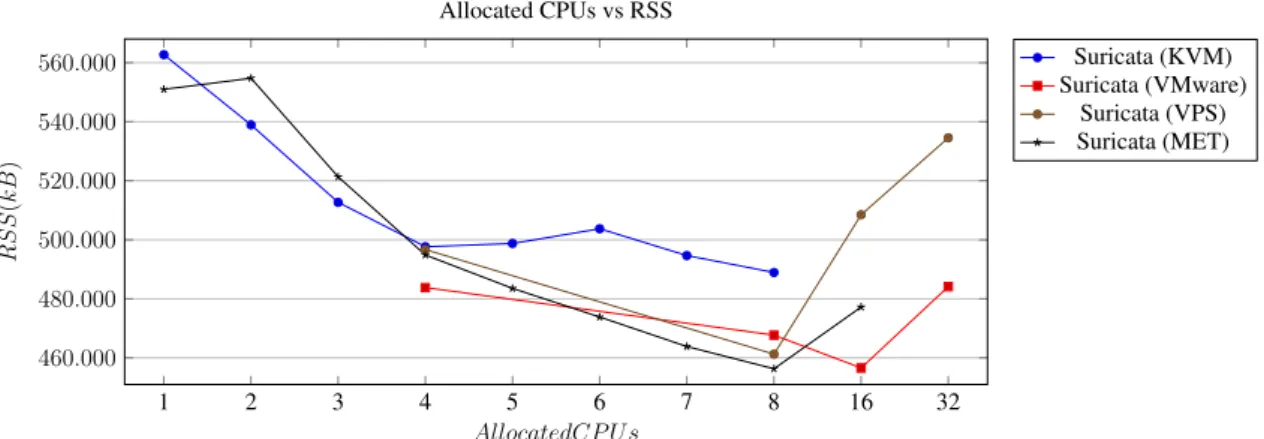
Em laborat´orio, foi poss´ıvel reproduzir os diversos enquadramentos e softwares a ex-plorar, bem como alternar ligeiramente os recursos f´ısicos afetos aos sistemas, proje-tando desta forma as restantes fases do trabalho. Seguiram-se uma s´erie de avaliac¸˜oes em modo offline, baseadas em ficheiros de capturas de pacotes (PCAPs) [Packet Cap-ture]. Estas avaliac¸˜oes inclu´ıram mais de 1500 testes, sendo que apenas 469 foram con-siderados ´uteis devido `a sua dimens˜ao. Concluiu-se que testes com capturas demasiado pequenas geravam sess˜oes de apenas um ou poucos segundos, n˜ao permitindo assim in-tervalos para recolha de dados para an´alise. Estes testes foram efetuados num total de 4 ambientes diferentes, incluindo equipamento dom´estico, equipamento industrial (em an´alise para implementac¸˜ao em produc¸˜ao) e dois ambientes de virtualizac¸˜ao baseados em cloud computing, variando os seus recursos f´ısicos. Entre outras conclus˜oes, esta aborda-gem permitiu ressalvar as problem´aticas inerentes caso uma decis˜ao pendesse sobre uma implementac¸˜ao virtualizada. No entanto importa referir que o hardware dom´estico teve a sua implementac¸˜ao assente em KVM (Kernel-Based Virtual Machine (KVM)) sem que tenham sido detetadas limitac¸˜oes semelhantes `as detetadas em cloud computing. Neste en-quadramento os resultados mostraram ainda que, a mem´oria n˜ao parece ser uma limitac¸˜ao.
Unit]. No entanto, (com o Suricata) a partir de determinado n´umero de n´ucleos o con-sumo de mem´oria volta a aumentar, ainda que ligeiramente.
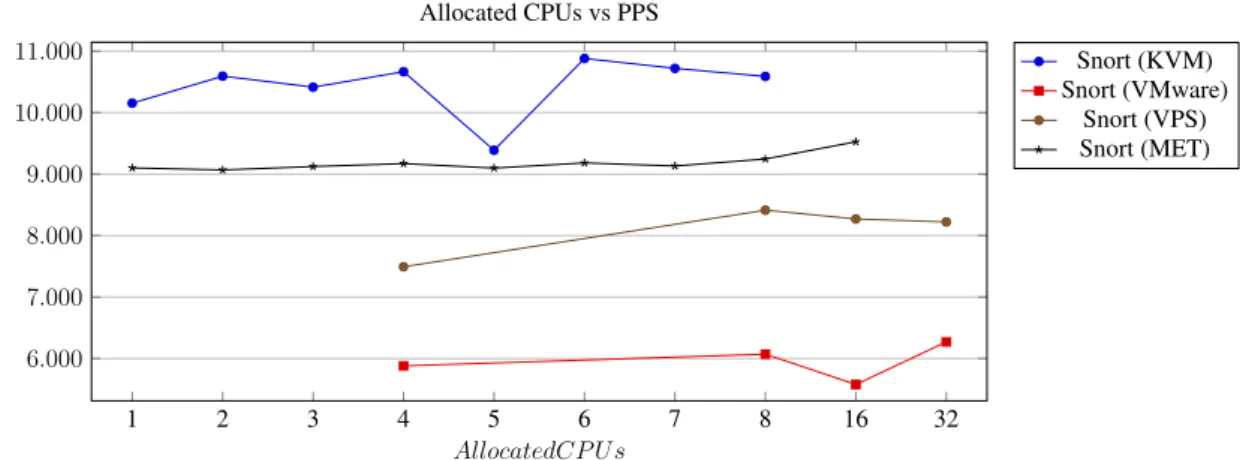
Ainda nesta fase da investigac¸˜ao, adicionou-se a vers˜ao 3 do Snort (ainda em desenvolvi-mento) e efetuaram-se testes em ambos os ambientes fisicamente dispon´ıveis. Detetou-se que, apesar desta vers˜ao, por natureza da sua arquitetura, usar m´ultiplos processos, a variac¸˜ao da disponibilizac¸˜ao de mais e mais n´ucleos n˜ao altera o seu d´ebito. Mas n˜ao havendo seguranc¸a numa vers˜ao ainda em desenvolvimento n˜ao se continuou esta linha de investigac¸˜ao.
J´a em pr´e-produc¸˜ao, variaram-se configurac¸˜oes de alto desempenho em ambos os softwa-res uma vez que o esforc¸o avaliado era elevado. Tanto no Snort como no Suricata, testaram-se t´ecnicas de captura de pacotes usando m´etodos baseados em AF PACKET e PF RING, depois de algumas alterac¸˜oes efetuadas ao n´ıvel das cartas de rede. Testaram-se ainda t´ecnicas de afinac¸˜ao relativamente a pr´e-processadores de an´aliTestaram-se e afetac¸˜ao de mem´oria dedicada a estes. Foi poss´ıvel ainda avaliar o comportamento do software quando executadas mais do que uma instˆancia em simultˆaneo, sendo poss´ıvel dedicar cada uma destas `a inspec¸˜ao do tr´afego escutado em interfaces de rede separados. Assim, provou-se ser poss´ıvel manter monitorizados e registados v´arios segmentos de rede, ins-pecionados de forma independente, sendo certo que o hardware permitia ainda adicionar mais carga, tanto em termos de processamento como de interfaces dispon´ıveis.
Desta forma, apresentou-se, uma avaliac¸˜ao desta soluc¸˜ao, para que seja tomada uma de-cis˜ao informada acerca da sua poss´ıvel implementac¸˜ao em produc¸˜ao, em substituic¸˜ao de uma soluc¸˜ao propriet´aria.
Neste trabalho, provou-se que, de facto, ´e poss´ıvel usar hardware comum para implemen-tar tal soluc¸˜ao no ambiente testado e com o esforc¸o de tr´afego apresentado na prova de conceito. Pelo menos um dos IDSs testados (Suricata) funcionou de forma infal´ıvel, por v´arios dias, num ambiente de rede altamente denso e complexo. Neste caso espec´ıfico, o IDS atuou continuamente, sem perdas registadas, num enquadramento onde por vezes foi poss´ıvel medir mais de 3Gbps, com picos por volta dos 4,5Gbps. Adicionalmente, foi poss´ıvel executar duas instˆancias em simultˆaneo, com cada uma inspecionando um interfacede rede, dedicado, de 10Gbps. Deixaram-se ainda notas importantes a conside-rar na poss´ıvel colocac¸˜ao deste sistema em produc¸˜ao, ressalvando aspetos relativos aos recursos humanos, bem como aos recursos f´ısicos e sua interoperabilidade. Ser´a conve-niente n˜ao descurar um per´ıodo de pr´e-produc¸˜ao, adaptac¸˜ao das regras e customizac¸˜ao das configurac¸˜oes que melhor se adaptem `a concretizac¸˜ao final. Importante ainda, a ter em considerac¸˜ao, a forma de escalamento destes sistemas, que pela natureza das suas limitac¸˜oes poder˜ao apenas expandir partilhando o esforc¸o com outras unidades an´alogas. Palavras-chave: IDS, IPS, Snort, Suricata
This work describes the realization of an IDS solution in a productive environment. It was intended to evaluate its feasibility comparing some options and thus opening the pos-sibility of putting this solution in inline mode. Hence, the host organization may consider replacing a current security solution (proprietary hardware and software), with a Free Software or Open Source firewall and IPS.
Typically the market presents products developed for this purpose using dedicated hard-ware, creating highly efficient and robust black boxes. For these products the manufac-turers guarantee a series of commitments, taking advantage of high values for licensing, additional features or even product support.
Sometimes these products are based on community projects being brought to market by vendors in proprietary variants. In this perspective, it was intended, in this work, to eval-uate the possibility of creating a defense environment entirely based on alternatives to the manufacturers’, from the operating system to the application’s level evaluation layers. This work provides a series of laboratory simulations (using virtualization), the placement in staging of the IDS solution, the comparison of actual results with real traffic, and re-trieving the physical evaluation of comparable resources. In this way an evaluation of this solution will be presented to the host organization so that an informed decision is made about its possible implementation in production, to replace a proprietary solution.
We found that, in fact, it is possible to use commodity hardware to implement such so-lution in the tested environment, and with the presented traffic demand. At least one of the tested IDSs (Suricata) performed flawlessly, for several days, in a highly dense and complex network, where more than 3Gbps with peaks around 4.5Gbps were observed. The work also reports on scenarios where two concurrent instances were run, with each one inspecting a dedicated 10Gbps listening interface.
Keywords: IDS, IPS, Snort, Suricata
List of Figures xvii
List of Tables xix
1 Introduction 1 1.1 Motivation. . . 1 1.2 Overview . . . 1 1.3 Objectives . . . 2 1.4 Contributions . . . 3 1.5 Document structure . . . 4 2 Related work 5 3 Analysis 9 3.1 Firewall . . . 9 3.2 Rules . . . 10 3.3 Snort2 . . . 13 3.4 Suricata . . . 14 3.5 Snort3 . . . 15 4 Design 21 4.1 IDS general approach . . . 21
4.2 Lab approach . . . 21
4.3 IPS in production . . . 22
4.4 PCAP Offline mode . . . 23
4.5 IDS in pre-production . . . 24
5 Implementation 27 5.1 Testbeds for PCAP Offline mode . . . 27
5.2 Testbeds for IDS . . . 27
5.3 IDS . . . 28
5.3.1 Snort . . . 28 xi
5.5.1 Pytbull . . . 33
6 Results 35 6.1 PCAP Offline mode . . . 35
6.2 IDS in pre-production . . . 38 6.2.1 Tuning Suricata . . . 39 6.2.2 Tuning Snort . . . 44 6.3 SIEM - OSSIM . . . 46 7 Conclusion 47 A Snort 51 A.1 Snort basic setup . . . 51
A.1.1 Barnyard2 . . . 58
A.1.2 PulledPork . . . 61
A.2 Snort from PCAP files . . . 63
A.3 Startup scripts . . . 64
B OSSIM 67 B.1 OSSIM basic setup . . . 67
B.2 Integrate Snort with OSSIM . . . 67
B.3 Integrate Suricata with OSSIM . . . 70
C Suricata 71 C.1 Suricata basic setup . . . 71
C.1.1 Oinkmaster . . . 73
C.2 Suricata from PCAP files . . . 75
C.3 Suricata with PF RING . . . 75
D Pytbull 77 D.1 Pytbull Client . . . 77
D.2 Pytbull Server . . . 78
E Snort 3 79 E.1 Snort 3 basic setup . . . 79
E.2 Snort 3 from PCAP files . . . 84 xii
F.1.1 Suricata with long PCAPs . . . 87
F.1.2 Snort2 with long PCAPs . . . 89
F.1.3 Snort3 with long PCAPs . . . 92
F.2 Allocated CPUs vs RSS. . . 94
F.2.1 Suricata with long PCAPs . . . 94
F.2.2 Snort2 with long PCAPs . . . 96
F.2.3 Snort3 with long PCAPs . . . 99
G CLI Outputs 103 G.1 Suricata CLI Outputs . . . 103
G.1.1 Suricata +8days session . . . 103
Acronyms 111
Bibliography 116
Index 119
3.1 Snort’s inline mode [18] . . . 10
3.2 Suricata’s iptables and NFQ Mode: accept [47] . . . 10
3.3 Suricata’s iptables and NFQ Mode: repeat [47] . . . 11
3.4 Suricata’s iptables and NFQ Mode: route [47] . . . 11
3.5 Snort’s pipeline [27] . . . 14
3.6 Snort’s facilities . . . 15
3.7 Snort’s binary and syslog output . . . 16
3.8 Suricata’s pipeline (based on PCAP device runmode) [46]. . . 17
3.9 Suricata’s default runmode . . . 17
3.10 Suricata’s pfring runmode. . . 18
3.11 Suricata’s CPU affinity schema . . . 18
3.12 Snort3’s pipeline [27] . . . 19
4.1 HLD with TAP . . . 22
4.2 HLD with port mirroring . . . 22
4.3 HLD for KVM laboratory. . . 23
4.4 HLD for iptables with HA. . . 24
4.5 Internal network, one month stats. . . 26
6.1 Suricata: Allocated CPU vs PPS - (bigFlows.pcap) . . . 36
6.2 Suricata: Allocated CPU vs PPS - (purplehaze.pcap) . . . 37
6.3 Allocated CPU vs PPS - (maccdc2011 00010 ... .pcap) . . . 37
6.4 Allocated CPU vs PPS - (maccdc2011 00013 ... .pcap) . . . 38
6.5 Snort2 and Snort3: Allocated CPU vs PPS - (maccdc2011 00010 ... .pcap) 38 6.6 Snort2 and Snort3: Allocated CPU vs PPS - (maccdc2011 00013 ... .pcap) 39 6.7 Snort3: Allocated CPU vs RSS - (maccdc2011 00010 ... .pcap) . . . 39
6.8 Suricata: Allocated CPU vs RSS - (maccdc2011 00013 ... .pcap) . . . 40
6.9 Suricata: Allocated CPU vs RSS - (maccdc2011 00010 ... .pcap) . . . 40
6.10 Internal network traffic measured with speedometer 2.8 . . . 41
6.11 External network traffic measured with speedometer 2.8. . . 41
6.12 Snort’s stats showing drops . . . 42
6.13 OSSIM showing a list of alarms . . . 46 xv
F.5 Suricata: Allocated CPU vs PPS - (maccdc2011 00013 ... .pcap) . . . 88
F.6 Suricata: Allocated CPU vs PPS - (maccdc2011 00014 ... .pcap) . . . 89
F.7 Suricata: Allocated CPU vs PPS - (purplehaze.pcap) . . . 89
F.8 Snort2: Allocated CPU vs PPS - (bigFlows.pcap) . . . 89
F.9 Snort2: Allocated CPU vs PPS - (maccdc2011 00010 ... .pcap) . . . 90
F.10 Snort2: Allocated CPU vs PPS - (maccdc2011 00011 ... .pcap) . . . 90
F.11 Snort2: Allocated CPU vs PPS - (maccdc2011 00012 ... .pcap) . . . 90
F.12 Snort2: Allocated CPU vs PPS - (maccdc2011 00013 ... .pcap) . . . 91
F.13 Snort2: Allocated CPU vs PPS - (maccdc2011 00014 ... .pcap) . . . 91
F.14 Snort2: Allocated CPU vs PPS - (purplehaze.pcap) . . . 91
F.15 Snort3: Allocated CPU vs PPS - (bigFlows.pcap) . . . 92
F.16 Snort3: Allocated CPU vs PPS - (maccdc2011 00010 ... .pcap) . . . 92
F.17 Snort3: Allocated CPU vs PPS - (maccdc2011 00011 ... .pcap) . . . 92
F.18 Snort3: Allocated CPU vs PPS - (maccdc2011 00012 ... .pcap) . . . 93
F.19 Snort3: Allocated CPU vs PPS - (maccdc2011 00013 ... .pcap) . . . 93
F.20 Snort3: Allocated CPU vs PPS - (maccdc2011 00014 ... .pcap) . . . 93
F.21 Snort3: Allocated CPU vs PPS - (purplehaze.pcap) . . . 94
F.22 Suricata: Allocated CPU vs RSS - (bigFlows.pcap) . . . 94
F.23 Suricata: Allocated CPU vs RSS - (maccdc2011 00010 ... .pcap) . . . 94
F.24 Suricata: Allocated CPU vs RSS - (maccdc2011 00011 ... .pcap) . . . 95
F.25 Suricata: Allocated CPU vs RSS - (maccdc2011 00012 ... .pcap) . . . 95
F.26 Suricata: Allocated CPU vs RSS - (maccdc2011 00013 ... .pcap) . . . 95
F.27 Suricata: Allocated CPU vs RSS - (maccdc2011 00014 ... .pcap) . . . 96
F.28 Suricata: Allocated CPU vs RSS - (purplehaze.pcap) . . . 96
F.29 Snort2: Allocated CPU vs RSS - (bigFlows.pcap) . . . 96
F.30 Snort2: Allocated CPU vs RSS - (maccdc2011 00010 ... .pcap) . . . 97
F.31 Snort2: Allocated CPU vs RSS - (maccdc2011 00011 ... .pcap) . . . 97
F.32 Snort2: Allocated CPU vs RSS - (maccdc2011 00012 ... .pcap) . . . 97
F.33 Snort2: Allocated CPU vs RSS - (maccdc2011 00013 ... .pcap) . . . 98
F.34 Snort2: Allocated CPU vs RSS - (maccdc2011 00014 ... .pcap) . . . 98
F.35 Snort2: Allocated CPU vs RSS - (purplehaze.pcap) . . . 98
F.36 Snort3: Allocated CPU vs RSS - (bigFlows.pcap) . . . 99
F.37 Snort3: Allocated CPU vs RSS - (maccdc2011 00010 ... .pcap) . . . 99
F.38 Snort3: Allocated CPU vs RSS - (maccdc2011 00011 ... .pcap) . . . 99
F.39 Snort3: Allocated CPU vs RSS - (maccdc2011 00012 ... .pcap) . . . 100 xvi
F.42 Snort3: Allocated CPU vs RSS - (purplehaze.pcap) . . . 101
3.1 Rulesets . . . 12
3.2 Rule Management programs . . . 12
3.3 Rulesets used in this work . . . 13
4.1 PCAP Sources. . . 24
4.2 Short PCAPs (statistics collected with tcpstat) . . . 25
4.3 Long PCAPs (statistics collected with tcpstat) . . . 25
5.1 Testbeds . . . 28
5.2 Testbeds resources’ details . . . 28
5.3 Directories’ summary . . . 29
6.1 PCAP tests . . . 36
Introduction
1.1
Motivation
Typically the market presents products developed for network security in dedicated hard-ware, creating highly efficient and robust black boxes. For such products the manufactur-ers guarantee a series of commitments, additional features and resources or even product support, while charging high amounts for licensing. Some of these security products are based on community-developed software, being brought to market by manufacturers in proprietary variants. In this work, we intended to evaluate the possibility of creating a defense environment based entirely on alternatives to manufacturers’, from the Operating System (OS) to the application’s level evaluation layers. The intention was also to con-sider the replacement of a current firewall solution with a Free/Libre and Open Source Software (FLOSS), complemented with an Intrusion Detection System (IDS); ideally this system should be allied to a firewall to serve as an Intrusion Prevention System (IPS). This work intended to prove the feasibility of this implementation in a reliable, tested and proven way. This work also intended to add new functionalities, similar to those on licensed products, that the market offers and which the Industry currently considers to be good practices, essential to ensure safety levels where risks are reduced and actions are taken to prevent or mitigate cyberattacks. Since some previous tests were done in the past by this department with a particular IDS, we aimed to thoroughly test back that IDS (Snort) in its more recent version, plus adding another well known Open Source Software (OSS) solution (Suricata).
1.2
Overview
An Intrusion Detection/Prevention System monitors events in an environment and ana-lyzes them for possible threats against security policies. As the names state, the Detection system detects such threats in the events, while the Prevention system adds actions to stop such threats. Moreover, such systems can be drilled down in other *IDS such as HIDS,
nections with it. The Network Intrusion Detection System (NIDS) monitors the entire traffic on a network for suspicious activities, within it or incoming/outgoing from it. Oth-ers, such as a Wireless Intrusion Detection System (WIDS), as its name states, works on Wireless related networks and protocols. Typically a NIDS relies on itself or rather in subsets of sensors, distributed across relevant segments of network, listening, capturing and monitoring the traffic. Detection can be either processed at these sensors or at the centralized facility. These sensors can be deployed either inline or in passive mode. A sensor in passive mode works as an IDS, listening to a copy of the traffic which is sent to it to process, by this not having direct interaction with it. Inline mode implies that the traffic passes through the sensor, typically working as an IPS combined with a firewall. A firewall is a security system which acts on the incoming and outgoing traffic passing through it. Such system will allow or deny traffic, based on predefined security rules and policies. A firewall is distinct from an IPS because it is rule based and analyzes packets’ headers for addresses and ports only, an IPS analyzes both the header and the payload based on known events, patterns, behavior and signatures. A log collector is a system that collects and stores events’ logs from several systems across a network. These sys-tems allow to analyze and perform advanced and centralized investigation on available data. Moreover a Security Information and Event Management (SIEM) system com-bines Security Information Management (SIM) and Security Event Management (SEM) with log management, adding Security Event Correlation (SEC), to provide real-time se-curity event’s analysis.
In our work we are focusing on NIDS and we will refer to it simply as IDS or IPS where relevant. We addressed the topic against two specific products in this field, Snort and Suricata. Yet we added some experiments with Snort3 (project also known as Snort Al-pha and sometimes Snort++). For clarity and simplicity, in this text we will refer to Snort2 as Snort; except where relevant or when Snort2 is discussed side-by-side with Snort3.
1.3
Objectives
The main objective of this work was to prove and evaluate the feasibility of this imple-mentation so that the management would make an informed decision on the renewal or change of the actual security system in the upcoming months. The intention was to start this work in a phased way, implementing and testing the various parts of the system and making it more mature and robust in each phase, taking into account the priorities and feasibility of the deliverables. The following is a brief summary of the activities:
2. Simulations and offline evaluations in ”production equivalent” hardware environ-ments (using packets’ captures).
3. Implementation, demonstration and evaluation using mirroring (Intrusion Detection System (IDS)).
4. Demonstration of administration and management capabilities (interface or Secu-rity Information and Event Management (SIEM) integration).
With this work we sought to understand how commodity hardware would perform us-ing either Snort or Suricata in replacement of vendor’s dedicated appliances and special hardware. We wanted to understand if it would be possible to deploy a complete state-of-the-art security solution entirely based on FLOSS and using common hardware; how to measure it and how to assess its scalability. We focused on core performance and tuning and not on rulesets as those would need to be adapted and customized against a specific environment and that takes time to tackle in complex networks such as the one we have worked on. In that sense we relied on pre-existing sets, provided and maintained up-to-date, to kickoff our work.
1.4
Contributions
In our work we have reviewed several years of comparisons using distinct approaches, between these two softwares. We provide an up-to-date comparison for the mid 2018’s versions of the products, where we compared its performance across several types of en-vironments, in search of possible deployment scenarios, its scalability and caveats for implementation. We addressed our intention of relying on Free/Libre and Open Source Software (FLOSS) only, and also added some additional hypervisor possibilities for com-parison. We have built step-by-step documentation, to provide guidance for the imple-mentation, if approved for deployment, or either to publish it within the relevant commu-nities. We tried to include the newest Alpha version of Snort version 3, which would have given us a nouvelle set of information on its performance, since there is a reduced amount of information published in that matter. As an extra mile, we’ve included concerns and details to be addressed ”before” and ”after” the sensor’s deployment in the traffic’s pipe, including concepts on pipping from the firewall, packet acquisition, outputs, log’s and alerts’ facilities piping to external log collectors and event correlation engines. We pro-vide pre-production results, taken from a highly dense and complex network such as a university, with thousands of concurrent users, allowing to identify how common hard-ware performs with such demand.
This document starts by providing a summary of investigation works from the last 7 years in this matter. It follows with the analysis of the presented problem, how such tools work and interact before and beyond its position in a network, or as a security system as a whole. Next, we present the design of the solution, starting from its implementation in laboratory and moving to foreseen details for final implementation and deployment in production, the offline approach to test agnostically across hardware (or virtualized) possibilities and finally, the pre-production setup using real traffic. Next, we present the implementations’ details, testbeds used, techniques and additional software to support the work. Also, we summarize our findings of the gathered results, both, in offline mode and in pre-production. Finally we present our conclusions leaving some topics for future work and/or to be checked while moving this setup to production. We finish the document with appendices describing the softwares’ setups, some troubleshooting steps, common usage and commands; and lastly, the full extent of the relevant plots from the data collected in offline mode.
Related work
The topic addressed in this work has been the focus of much discussion in the industry as well as in academia. It is becoming increasingly clear that security levels in infrastructures must, not only, be restrictive but also dynamic. Networks (especially perimeter’s) must be secured by systems with autonomy and intelligence. This autonomy and intelligence is guaranteed by the typical system training and also by centrally available subscriptions, fed and made available by manufacturers or the community. The proposed work is intended to meet the specific requirements of an implementation as a whole, and it is therefore necessary to evaluate its components as part of the system. In an initial phase, and for a global view of the system, we’ve consulted the work of Jorge Granjal [18] describing comprehensive approaches to security problems and solutions, with practical implemen-tations of those solutions, based on Linux. With a clear path for the intended approach the work focused on the comparison of the IDS component and therefore we dug for previous works.
In 2011, with Suricata released less than 2 years before, Eugene Albin [2] compared both Snort and Suricata looking for speed, memory and accuracy figures. Suricata was adding multi-threading to the state-of-art for IDSs, and as such his work concluded that Suricata could handle larger volumes with similar accuracy. Though his work was per-formed on a busy virtual environment he had access to a network pipe of 20Gbps of bandwidth with an average of 200Mbps per day.
Also in 2011, Jonas Taftø Rødfoss [38], with a similar intention, added Bro to the comparison. He focused on alarms and logs with normal and triggered traffic and also on the installation processes. He concluded that his approach with Bro and using Metasploit was time consuming to configure. Rødfoss also tried to run simultaneous instances and found some issues, therefore he opted for offline Packet Capture (PCAP), providing him a replicable scenario. In one of his experiments, with a 4 days PCAP, he got 40GB that Bro was able to process in almost 28 minutes, Snort in less than 54 minutes and Suricata in
he also found that Suricata was much easier to install and configure, less dependencies issues as those found for Snort. He also found a lot of spam alerts with Snort and Bro.
Already in 2012, Mauno Pihelgas [32], compared all three above-mentioned IDSs, looking for advantages and disadvantages of each one. Evaluating in a 1Gbps network, he found that all could handle 100Mbps, tested with PF RING (a high-speed packet cap-ture network socket) at 1Gbps with no drops. His focus was on drops and its optimization to achieve performance beyond 100Mbps. With Snort he was able to achieve 450Mbps with AF PACKET module (an interface optimized for high performance packet process-ing) and no possible results with PF RING, just unresolved errors; though with Suricata and Bro he was able to achieve 1Gbps with no drops using PF RING.
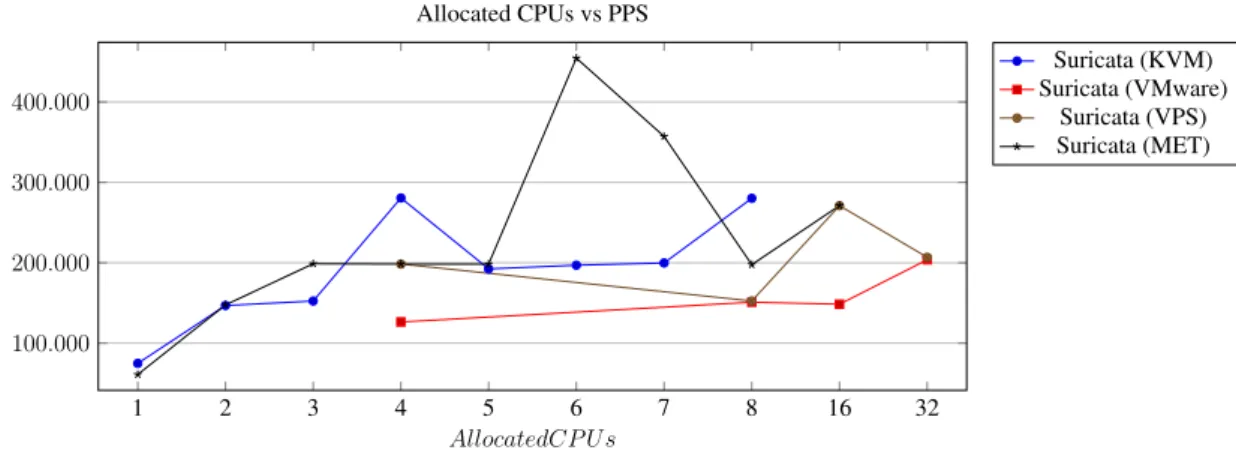
In 2013 Joshua White et al. [12] tested both Snort and Suricata for performance with comprehensive quantitative comparison, based on Snort’s developers arguments that Suri-cata, with multi-threading, would be slowing down the detection as system resources are scaled up. They’ve concluded that Suricata, with single thread, was faster than Snort where they would expect Snort to perform better. They also concluded that Suricata would have problems with high scalability. For this work a methodology was created for testing, and made available to be extended with additional PCAPs, additional rules and additional configurations or hardware platforms and different environments. They focused their metrics on PPS, RAM and CPU values for the process being run. They took Packets per Second (PPS) from built-in stats provided by the IDS at 1 second intervals and remaining metrics from the OS perspective, using PS commands and script parsing to achieve the same readings for both the System Under Test (SUT)s. In this work they’ve shared their scripts and files encouraging others to enlarge findings.
Still in 2013 R. China et al. [15] focused on packet drops which they found to in-crease with the network’s throughput, also if packet size inin-creases (tested with 512 and 1024 bytes) drops decrease. Both Snort and Suricata performed with the same behavior with larger packets and larger throughputs, but they found Snort to be more stable in lower demand.
In 2015 a new work looked into more modern bandwidth values, up to 10 and po-tentially 40Gbps, focusing on the importance of scaling and future problems. This work by George Khalil [24] also found libpcap to be limited so they moved to AF PACKET. He found Suricata and Bro to introduce GeoIP lookups and Suricata introducing the pos-sibility for GPU acceleration and also IP reputation. Regarding Snort he looked into it
introducing multi-instance support. This work highlighted that networks with 100Gbps are expected to be cost effective in a few years and as such sensor’s CPUs won’t be able to keep up with the demand, what leaves the necessity to approach scenarios with multiple CPUs or multiple sensors sharing the load. Khalil also highlighted that with more and more (client) systems in the network, system’s patches, updates and maintenances tend to modify behaviors and can generate false positives or trigger IPSs automatic denials/drops, which lead to the necessity of an appropriately sized and experienced team to maintain and respond to events generated.
Works in 2016 commented on Suricata’s performance over Snort’s, based on the multi-threading characteristics [13] and tests using pytbull on HIDS mode [16], they’ve con-cluded again that Snort performs well at low requisites and that Suricata presents more features and more performance, apparently being more future proof. For example, allow-ing to move computation to GPU as we see more and more in other sort of applications. Later in 2016 the same author [14] presents an approach for Snort, adding a preprocessor for anomaly detection based on profiling.
Finally in 2017 Resmi [37] published a high level survey of different IDSs and Gunadi [19] a descriptive comparison of characteristics of the before-mentioned three IDSs.
Analysis
Considering the goals to deploy the solution in-line, acting as an IPS, we needed to under-stand how the system would perform as an IDS beforehand. The defense system should neither allow packets to pass unchecked, missing possible suspicious activity, nor bottle-neck, dropping packets because it is overwhelmed by the amount of workload. Looking at previous works, and to the products’ documentation, it is clear that rules will need to be customized according to the deployed environment, but that will also be truth for the firewall part of the system. Therefore the focus of this work aimed to find a non-packet-dropping NIDS, deployed to accommodate the host organization’s network loads, based on its performance rather than its reactions and inspections results. Because these inspec-tion’s results will be dependent and dynamic, determined by the network segment that will be inspecting and acting upon. We sought for Packets per Second (PPS), CPU and RAM metrics, to understand how would the available hardware behave and if it would be suitable to perform as it would a dedicated physical appliance.
3.1
Firewall
Though we are not presenting in-depth implementation details of iptables in this work, we are including this short section on how iptables interact with the IPS. As in Figure3.1, for Snort’s inline mode, iptables can be set to target userspace software through NFQUEUE. The listening application will later inspect and react according with its configured behav-ior. As seen in Figures3.2,3.3and3.4 Suricata allows the configuration of this behavior in several modes with different reaction types. The packet would either be processed by the IPS only (no more iptables rules involved), marked and re-injected back to iptables or routed to another tool [47]. In case of complex or highly customized iptables’ rules sets nftables might be considered a better option, allowing a more granular rule deployment while still in the firewall. Also nftables implements techniques for CPU load balancing which can add yet another performance switch to the system.
Moreover, and because this topic is not covered by this work, it is advised that in future 9
Queue
Packet Switching Snort
IPTables
Figure 3.1: Snort’s inline mode [18]
1 ……….. 2 ……….. 3 ……….. 4 …NFQUEUE 5 ……….. 6 ……….. 7 ……….. 8 ……….. 9 ……….. 10 ……… ACCEPT/DROP Suricata
Figure 3.2: Suricata’s iptables and NFQ Mode: accept [47]
work the host organization should consider a proof-of-concept based on NFLOG which allows nftables to send copies of the packets instead of queuing them. This can set a pre-implementation phase for the whole project or either be used as a Development, Testing, Acceptance and Production (DTAP) approach when deploying new rules to the systems. Looking for a more custom approach for the host organization, we foreseen an implemen-tation that could be based on the mixed mode suggested by Giuseppe Longo [50] [49] where an nftables’ rule would log traffic with NFLOG to a listening IDS instance/config-uration and another would queue traffic with NFQUEUE to a listening IPS instance/con-figuration. As an example, such approach allows a scenario where web server accesses can be just logged (never to be inadvertently blocked by the IPS, just checked by the IDS) and remaining traffic would be queued to be fully inspected.
3.2
Rules
An IDSs rule is a method to perform detection. It is an expression processed to look for matches in data or properties, detecting a vulnerability and reacting accordingly by
per-1 ……….. 2 ……….. 3 ……….. 4 …NFQUEUE 5 ……….. 6 ……….. 7 ……….. 8 ……….. 9 ……….. 10 ……… Suricata REPEAT/DROP
Figure 3.3: Suricata’s iptables and NFQ Mode: repeat [47]
1 ……….. 2 ……….. 3 ……….. 4 …NFQUEUE 5 ……….. 6 ……….. 7 ……….. 8 ……….. 9 ……….. 10 ………
Suricata Other tool
Figure 3.4: Suricata’s iptables and NFQ Mode: route [47]
forming some action as described in it. Snort advises to look in to catching vulnerabilities rather than specific exploits, since this makes the rule less vulnerable to evasion if the ex-ploit is slightly changed or mangled [43]. Snort’s rule base allows its language to combine signature inspection methods, protocol inspection methods and anomaly-based inspection methods. Suricata started with the same approach as Snort’s, later developing its own lan-guage. Pre-existing rulesets can be used or one can customize rules as needed for both Snort and Suricata. Both IDSs are widely compatible with the rules developed for such systems. In Table3.1 we can find a list of the main rulesets provided and recommended by Snort and Suricata’s developers and maintainers. Because of the variety of rulesets and their sources, also because of their maintenance (add, remove, amend) and the associated tasks (download, combine, install, update), it is advisable to use a rule management appli-cation. In Table3.2we find a list of suggested rule managers, both compatible with either Snort or Suricata. The developers provide free access to the rulesets, but they also make available a privileged and faster access to the rules, provided through a subscription, with
Ruleset
Shared Object Rules [39]
Snort Rules Snapshot (aka VRT aka Talos Rules) [41] Community Rules [6]
Talos IP Blacklist [51] Emerging Threats Open [10] Emerging Threats Pro [11]
Table 3.2: Rule Management programs Program
PulledPork [36][35] Oinkmaster [28]
other extra features added. For Snort they claim a 30 days faster access for registered users, as for Emerging Threats they claim daily updates for subscriptions.
Listing 3.1: Example of Snort loaded rules’ summary with emerging.rules snortrules community ip-blacklist managed by Pulledpork
29898 Snort rules columnsread 28709 detection rules 150 decoder rules
268 preprocessor rules
29127 Option Chains linked into 3212 Chain Headers 0 Dynamic rules
Listing 3.2: Excerpt of PulledPork unloading snortrules community ip-blacklist Rule Stats... New:---9 Deleted:---33188 Enabled Rules:----18375 Dropped Rules:----0 Disabled Rules:---6366 Total Rules:---24741
Listing 3.3: Example of Snort loaded rules’ summary with emerging.rules managed by Pulledpork 18375 Snort rules columnsread
18375 detection rules 0 decoder rules
0 preprocessor rules
18375 Option Chains linked into 2670 Chain Headers 0 Dynamic rules
Table 3.3: Rulesets used in this work
Community/Open Registered IDS
ip-blacklist Snort2
community-rules.tar.gz snortrules-snapshot.tar.gz Snort2 snort3-community-rules.tar.gz snortrules-snapshot-3000.tar.gz Snort3
emerging.rules.tar.gz Snort2/Suricata
Listing 3.4: Example of Suricata loaded rules’ summary with emerging.rules managed by Oinkmaster
dd/mm/yyyy -- hh:mm:ss - <Info> - 38 rule files processed.
,→ 12529 rules successfully loaded, 0 rules failed dd/mm/yyyy -- hh:mm:ss - <Info> - 12534 signatures
,→ processed. 1158 are IP-only rules, 5309 are
,→ inspecting packet payload, 7656 inspect application
,→ layer, 0 are decoder event only
3.3
Snort2
It is largely pointed that Snort is single-threaded, but this is truth for a single running instance, others tasks can be multi-threaded such as reloads, IP reputation switching [23] or the outputs’ processing and output handling (Barnyard2 and/or SQL) can be assigned to other cores. Several instances can run concurrently on different cores using different rulesets, analyzing the same stream with different rulesets, or balancing the instances to analyze different streams with the same rulesets. Snort with PF RING along with socket clustering allows to distribute packets across multiple processes [42]. Figure3.5 depicts Snort’s pipeline which has been immutable since early versions [27]. This architecture’s layout is extended in Figure3.6to allow a broader interpretation of the application’s flow. The Data Acquisition library (DAQ) acquires the packet which is delivered to the packet decoder. Each pre-processor is engaged according to its features which later passes its results to the detection engine. This is where the available rules are checked against the packets being processed, resulting in a type of output parsed by output plugins. At this stage we should have a reaction from the processing, but, it is when the output facilities are triggered, allowing to either alert or log the output. Depending on the interaction intended from the system its user can have the alerts directed to an interface, allowing a real-time interaction, or either log it along or after the alert. In this case, the log facility can address this task in several ways, by using plain text or binary log files, writing to a Database (DB) or send out through syslog. For an optimized performance it is advised to get the IDSs log facility to always output to binary files (Unified2 File Format), as this reduces the translation efforts and the delays in packets processing. The task of translating
Snort Pipeline Data acquisition Preprocess Detect Output Decode Config Loader Dynamically Created Detection Framework snort.conf
Figure 3.5: Snort’s pipeline [27]
the binary files, either to write them to a DB or to read them, should be separated and left to a different asset of which Barnyard2 [4] is a good example. As depicted in Figure3.7, the output can be sent out through syslog to a remote management or log collector, which permits to add another layer of inspection, for example using an event correlation tool or a Security Information and Event Management (SIEM), something addressed below.
3.4
Suricata
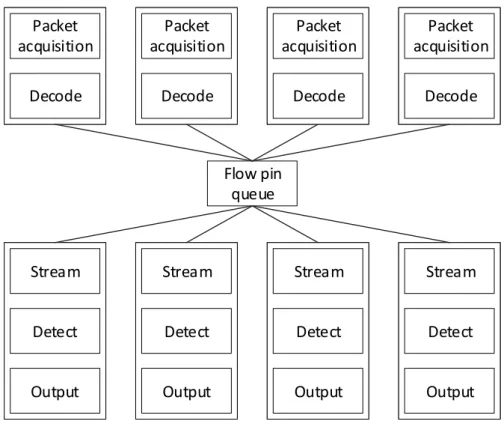
Suricata is developed and sustained as Open Source under a GPLv2 licence. Its motivation was to address some gaps in existent systems, and to explore additional capabilities unex-plored when the project began. Is was built to address high performance with parallelized processing, explore other hardware opportunities (GPU acceleration or hardware sensors) and also to implement new approaches on detection, decompression or matching. There-fore it is expected to perform faster out-of-the-box. Suricata also includes standard input and output formats to allow swift, flexible and effortless integration with other existing tools such as dashboards, log collectors or SIEMs [45]. Figure3.8shows that Suricata’s base pipeline (e.g. PCAP device runmode) is pretty much the same as for Snort. Nonethe-less, in Figure3.9, we can see how the threading is managed through four thread-modules in its default run mode. The packet acquisition module is responsible for reading the
DAQ pre-processors detection engine output plugins alert facility log facility packet decoder rules db syslogsyslog log files interface
Figure 3.6: Snort’s facilities
packets from the network. The second module addresses the packet decoding, but also the stream application layer which includes three tasks: stream-tracking, stream-assembly and application layer inspection. Detection threads are used to compare signatures and can operate simultaneously. Lastly, the outputs module, processes all alerts and events. Figure3.10shows how in pfring runmode each flow follows its own fixed route. However it should be noted that the focus is in the detection task, the more demanding task, that checks packets against thousands of signatures [46]. Additionally Suricata includes other performance customization options, such as CPU affinity, which allows to set fixed cores for every thread, here represented in Figure3.11.
3.5
Snort3
The new version of Snort seems to have been renamed or made known by several names. The Snort++ (codename) project, aiming to develop Snort version 3, is sometimes called just by Snort Alpha. Snort version 3 has been in development at least since 2005 when its
mgmt/log server
IDS log facility
db syslog
syslog binary files
database server
Figure 3.7: Snort’s binary and syslog output
author called the project SnortSP (Snort Security Platform), aiming to rethink its concepts and architecture. But around 2014 is when the Snort development team announces a new Alpha version to be tested in the wild [21]. Its concept was presented by Martin Roesch in a 2008 presentation [27] where he shared its architecture’s conception, shown in Figure 3.12. Besides a completely new code base, its architecture aims to be multi-threaded and accelerated, with engines running continuously with no need for reloads and multi-core parallelization taking advantage of modern hardware. The figure emphasizes the modu-larity of Snort3, showing how each abstraction can be accelerated and tunned not only individually but also while communicating and sending tasks to others. As for rules, Snort3 also uses a new rule’s language. Despite being very similar, it is not the same. Therefore Snort is providing new rulesets on their website, both community and Talos’ (Cf. Table3.3). At the moment of our writing PulledPork is not yet compatible with Snort 3, but a milestone has been shared by the project’s maintainers.
Though we wanted to add this novelty to our work, Snort advertises that this product is only an (yet another) Alpha version and therefore it is not ready for production and should not be used for such purpose.
Suricata Pipeline Capture Module Stream Module Detect Module Output Decode Module suricata.yaml
Figure 3.8: Suricata’s pipeline (based on PCAP device runmode) [46]
Network Network Detect Detect Detect Outputs Decode & Stream app. layer Packet acquisition
Flow pin queue Decode Packet acquisition Decode Packet acquisition Stream Detect Output Stream Detect Output Decode Packet acquisition Decode Packet acquisition Stream Detect Output Stream Detect Output Decode Packet acquisition Decode Packet acquisition Decode Packet acquisition Decode Packet acquisition Stream Detect Output Stream Detect Output Stream Detect Output Stream Detect Output
Figure 3.10: Suricata’s pfring runmode
SF-TAP
Engines
Data Source
Data acquisition Flow/Normalize
Data Source API Output Decode Dispatcher Attribute Manager Snortd & Cmd Shell
Engine Abstraction Layer
Snort
2.x Lua...
Snort 3.x
Design
4.1
IDS general approach
A basic requirement for an IDS implementation is the access of the sensor to all traffic in the network to be protected/surveilled. Figure4.1depicts an alternative for its satisfaction using a Test Access Point (TAP). TAPs pass copy of all the traffic at the network segment to the sensor. While this approach seems to be simple to implement its downside include additional hardware and costs, or to create a disruption to introduce the device. Another alternative is to use a port mirror, as shown in Figure4.2. This approach, normally avail-able in standard switches (with capacity limits per model though) is scalavail-able, flexible, configurable and in general less expensive. On the negative side, both approaches present some limitations. Switched Port Analyzer (SPAN) can result on drastic bottlenecks at the mirror port and hides port errors from the sensor. TAP would include hardware or port errors and packets wouldn’t be dropped.
Though these details should not be forgotten for the host organization’s implementation and real scenario tests, they will not be discussed further in this document since the avail-able and most suitavail-able option is based on port mirroring using Switched Port Analyzer (SPAN) sessions.
4.2
Lab approach
Kernel-Based Virtual Machine (KVM) allows a swift creation of virtual environments and a prompt way to scale solutions. Because of acquaintance and access to such resource we have selected this environment to kick off our laboratory so we could run initial simula-tions and experiments, by this creating drafts for later stages. As depicted in Figure4.3 the project used a KVM host with two Network Interface Controllers (NICs) allowing to simulate an internal and an external network, or, if we want, an internal and a Demilita-rized Zone (DMZ), since ahead we had a router with a built-in firewall. An iptables based firewall was implemented between those NICs, and (external) adapter (br0 in Figure4.3)
IDS mgmt lan
admin client mgmt/log server IDS tap
IDS update
Figure 4.1: HLD with TAP
IDS mgmt lan
admin client mgmt/log server
lo
ca
l la
n
IDS
port mirroring (span session)
IDS update
Figure 4.2: HLD with port mirroring
was set to act as a hub. This was achieved by setting the Linux bridge to forget imme-diately any MAC address seen, and to forward with no delay. Packets received on br0 were now seen from any VM with an active interface using this network adapter (with no address). With this method, instances of IDSs where receiving packets from the listening interface, acting as sensors, and having another network interface in the local (internal) LAN for management but also for product or rules’ updates etc. At a later stage, SIEMs were set on the internal LAN, receiving syslog messages from the IDSs through the local network.
4.3
IPS in production
Despite this work has been focused in comparing the IDSs performance, the objective of the host organization was to assess its capacities to set it as IPS in inline mode. Nonethe-less, its implementation has been brainstormed. It is possible to achieve High Availability
tap local lan KVM hos t br1 IDS beta IDS alpha br0 iptables Internet
home router with built-in firewall
Figure 4.3: HLD for KVM laboratory.
(HA) for iptables using keepalived to provide load balancing and conntrackd to track net-filter monitored connections. But without a clear path to achieve the same robust solution for one of the IDSs in our testbed, suggestion is to pursue the approach used in Cisco Adaptive Security Appliance (ASA) products with Sourcefire (later FirePOWER) mod-ule/service. Here each hardware firewall in a failover pair, implements the inspection module by software (Snort2) in a Linux based image, using a dedicated module. The module on the primary device does not synchronize with the module on the secondary device. The caveats, separate/duplicate configuration management and temporary abnor-mal behavior resulting from the absence of state sharing between the two replicas. To the extent of our knowledge, no solution similar to Cisco’s Management Center that provides centralized configuration exists for both Suricata and Snort. Other Sourcefire/Cisco prod-ucts provide support for HA but not Snort per se. We also couldn’t find it for Suricata. However if the implementation is supported by a virtualization environment, HA capabil-ities can be provided from the hosting perspective, as long as packets’ capture techniques employed are supported over virtualization and do not reduce its performance (as the ones presented by ntop [1]). Taking Figure 4.4 as an example, we can achieve this model with iptables (with keepalived and conntrackd) but with the above-mentioned caveats, the IPS would be implemented per firewall server.
4.4
PCAP Offline mode
IDSs were compared using several testbeds, from regular home desktop hardware, to cloud based virtualization options and later to bare-metal. These testbeds allowed to
virtual IP virtual IP heartbeat
Figure 4.4: HLD for iptables with HA. Table 4.1: PCAP Sources
Sources
http://tcpreplay.appneta.com/wiki/captures.html http://contagiodump.blogspot.pt/
http://maccdc.org/
create a base for comparison using a specific set of Packet Capture (PCAP) files, running all of them on these environments and changing the available resources in each test. The PCAP files selected for the comparisons were obtained from several different sources, to avoid moving private packet captures to outside the host organization. Those sources are listed in Table4.1. Those captures have been bundled in ”Short PCAPs” and ”Long PCAPs”, allowing to have a smaller set for quick tests and a larger set for longer tests. Tables 4.2 and 4.3 show the list of the mentioned PCAPs and their sizes. Their traffic varies from real network traffic on a busy private network’s access to Internet [52], to attack sessions and exploit attempts [7] or cybersecurity competition’s sessions [26] in the case of the larger files.
4.5
IDS in pre-production
To take the implementation to pre-production stage, an approach similar to the one in Figure 4.2, using SPAN sessions to deliver traffic to our bare-metal environment was used. A representative number of LANs have been selected to be used in our Proof of Concept (PoC), allowing us to test both public access traffic and purely internal user’s
Table 4.2: Short PCAPs (statistics collected with tcpstat)
Description Packets Size
99.1.23.71.pcap 5544 2.5M
analysis.pcap 1835 909K
BIN 9002 D4ED654BCDA42576FDDFE03361608CAA 2013-01-30.pcap 6661 4.0M
BIN LoadMoney MailRu dl 4e801b46068b31b82dac65885a58ed9e 2013-04.pcap 43147 30M
BIN Tbot 23AAB9C1C462F3FDFDDD98181E963230 2012-12.pcap 5004 3.3M
BIN Tbot 2E1814CCCF0C3BB2CC32E0A0671C0891 2012-12.pcap 6908 4.1M
BIN Tbot 5375FB5E867680FFB8E72D29DB9ABBD5 2012-12.pcap 8000 5.2M
BIN Tbot A0552D1BC1A4897141CFA56F75C04857 2012-12.pcap 4787 4.0M
BIN Tbot FC7C3E087789824F34A9309DA2388CE5 2012-12.pcap 13050 7.5M
pcap 4B31A4C3A633A0ADB9DBB8A5125DDA85.pcap 138 31K pcap 59A14B490FE4BA650E31B67117302239.pcap 68 9.0K pcap 9B41475A88D12183048A465FFD32EBF9.pcap 982 323K pytbull ALL.pcap 286727 44M pytbull DOS.pcap 3312 2.4M pytbull replay.pcap 1452 2.3M
XTremeRAT DAEBFDED736903D234214ED4821EAF99 2013-04-13.pcap 2729 3.6M
Table 4.3: Long PCAPs (statistics collected with tcpstat)
Description Packets Size µ σ
bigFlows.pcap 791615 352M 434.98B 575.75B maccdc2011 00010 20110312194033.pcap 10000000 3.7G 360.83B 286.60B maccdc2011 00011 20110312201409.pcap 5000000 3.0G 598.96B 501.71B maccdc2011 00012 20110312202052.pcap 5000000 3.2G 654.70B 532.54B maccdc2011 00013 20110312202724.pcap 10000000 4.2G 413.06B 590.26B maccdc2011 00014 20110312233311.pcap 4465786 2.5G 565.77B 646.96B purplehaze.pcap 324711 231M 714.08B 690.10B µ Average σ Standard Deviation
traffic. The bare-metal sensor had 2 listening interfaces, with 10Gbps of port speed, with up to 4 interfaces available, plus 1 dedicated to management and syslog messages (the hardware was a Dell R430 server with 2+1+mgmt interfaces at 1Gbps plus 2xNICs with 2x10Gbps interfaces each). One of the listening interfaces was receiving traffic from the external interface on a front-end firewall. The traffic includes both the published services of the host organization and the Internet traffic generated by the internal network and its users. For this one, the IDS was set to protect two times /16 and one /21 networks ($HOME NET). It is worth saying that the /21 network was public IP addressing, where more than one hundred websites are published. The second interface was receiving traffic from a core switch with mirrored traffic from more than 100 VLANs. These included a /16 and a /23, both set to be protected as $HOME NET in our PoC. For this second one a graph with one month’s network statistics is shown in Figure4.5.
Implementation
5.1
Testbeds for PCAP Offline mode
To achieve a broader view with several implementation scenarios (e.g. physical versus virtual), and to circumvent the hardware availability limitations, which would have given us the opportunity to test both the IDSs side by side, we went for an approach based on packet captures. To achieve credible and comparable values, several environments were tested ranging from KVM in common desktop, to Physical dedicated server. Table 5.1 depicts the 4 distinct testbeds as well as the short designation used throughout the text. All the environments used Debian 9.Table5.2 presents the hardware resources available on each. The first environment was built in a home desktop using KVM and was depicted in Figure4.3. This desktop had an Intel CoreR TMi7-4770K CPU @ 3.50GHz permitting to allocate up to 8 logical CPUs. As for VMware, the product available was based on Intel XeonR CPU E5-2683 v3 @ 2.00GHz, allowing allocation of up to 56 virtualR logical processors. Similarly, the VPS product, was based on Intel XeonR E5-2687WR v4 @ 3.00GHz cores with options in 2, 4, 8, 16 and 32 virtual logical processors. Finally, our physical environment, was seating on a Dell R430 with Intel XeonR CPU E5-2623R v3 @ 3.00GHz with 16 logical CPUs.
5.2
Testbeds for IDS
As a testbed to simulate, troubleshoot and create a base setup for IDSs, the testbed pre-sented above was configured with dynamic resources allocation to allow a swift adaptation along the research. It was possible to, firstly, create a base network with two abstractions, an outer and an inner network zones. These zones were separated by an iptables based firewall and set with the outer interface bridged to allow all traffic hitting this firewall to reach the IDSs listening interfaces. This was achieved using brctl’s options setageing and setfd to 0 so that MAC addresses were not saved and packages are forwarded with no delay [5], allowing for a hub alike behavior at the host level. This context allowed us to
Ref. Description
KVM Home desktop
VMW Virtualization cluster
VPS Cloud service
MET Pre-production bare-metal hardware Table 5.2: Testbeds resources’ details
Ref. CPU CPUs allocated RAM allocated SSD
KVM Intel Core i7-4770K 3.50GHz 1-8 8GB Yes
VMW Intel Xeon E5-2683 v3 2.00GHz 4,8,16,32 8GB Yes VPS Intel Xeon E5-2687W v4 3.00GHz 4,8,16,32 15,30,60,120GB Yes
MET Intel Xeon E5-2623 v3 3.00GHz 1-8,16 32GB No
safely generate traffic at the external network while keeping the internal network’s assets secured. Issuing new VMs, duplicating, snapshotting or changing resources at the KVM environment was easy and instantaneous. IDSs were deployed with two interfaces, with one set in the internal network for management and another in the ”tap network”, as seen in Figure4.3.
As found in the appendices, we’ve brainstormed many options across the System Under Test (SUT). We’ve tested rule’s managers, start up scripting and various log and alert options as described in each IDSs section. It was possible for us to build quick setup guides (for Debian 9), that can be publicly shared and also used by the host organization’s systems administrators to install and maintain.
5.3
IDS
5.3.1
Snort
Our implementation of Snort is documented in appendixA. It’s based on Snort 2.9.9.x on Ubuntu 14 and 16 by Noah Dietrich from Snort’s Documents page [40], a guide to setup Snort on Ubuntu 14 and 16. This appendix includes basic applications to help trou-bleshooting (such as tcpdump), the setup of the listening interface, review of dependencies to build Snort from source and the creation of Snort’s directories. Though we’ve started with Snort’s version 2.9.9.0 soon we’ve changed to 2.9.11.1, released in October 2017. Table5.3shows Snort’s directories and, in code snippet5.1, we can check Snort’s folder structure.
Listing 5.1: Snort’s folder structure /etc/snort/
Table 5.3: Directories’ summary
Purpose Path
Snort binary file: /usr/local/bin/snort Snort configuration file: /etc/snort/snort.conf Snort log data directory: /var/log/snort Snort rules directories: /etc/snort/rules
/etc/snort/so rules /etc/snort/preproc rules
/usr/local/lib/snort dynamicrules Snort IP list directories: /etc/snort/rules/iplists
Snort dynamic preprocessors: /usr/local/lib/snort dynamicpreprocessor/
|-- attribute_table.dtd |-- classification.config |-- file_magic.conf |-- gen-msg.map |-- preproc_rules |-- reference.config |-- rules | |-- iplists | | |-- black_list.rules | | |-- white_list.rules | |-- columnslocal.rules |-- sid-msg.map |-- snort.conf |-- so_rules |-- threshold.conf |-- unicode.map
We opted to use PulledPork to manage the rules, but the fact is that, for the host orga-nization, a controlled approach should be more suitable, allowing to dissect and analyse new rules as they are provided. It is worth mentioning that Snort needs to be restarted once rules are updated or configuration changes are submitted. Recent versions allow for a reload submission depending on the type of changes made and with caveats regarding the ongoing sessions. Moreover this option is available if enabled during compiling. As for logging, we’ve tested Barnyard2, providing binary option for outputs, to allow reduc-tion of resource’s consumpreduc-tion. Nonetheless we found advisable to move this database to an external system, allowing dedicated resource’s allocation and the possibility to main-tain this as a separate and modular environment. This abstraction also allows to migrate this piece of the system to another type of environment, for example to a log collector or event manager, by either creating it for such purpose or aggregate it to an existing one. For both, PulledPork and Barnyard2, startup scripts have been tested and are provided in
During its implementation, in the bare-metal environment, techniques as Large Receive Offload (LRO), Large Send Offload (LSO) or Generic Receive Offload (GRO) have been considered; nonetheless those are documented, for example by Snort, as to be related with possible packet loss during reassembly [33]. There is a possible mismatch of MTU between packets reassembled by the NIC and the truncate value used by Snort. As such, we have opted to remove such options from the NIC to avoid misleading behaviors im-plemented by the network adapter’s vendor. Also, as highlighted in the same document, promiscuous mode (Listing5.2) has been enabled to avoid the NIC to stop traffic from reaching the sensor. Listings5.3and5.4show the configuration of the NIC using ethtool.
Listing 5.2: ifconfig promiscuous mode examples
#ifconfig enable promiscuous mode example with eth0 ifconfig eth0 promisc
#ifconfig disable promiscuous mode example with eth0 ifconfig eth0 -promisc
Listing 5.3: ethtool set features example #ethtool set features example with eth0
ethtool -K eth0 tx off rx off tso off gso off gro off Listing 5.4: ethtool show features example
#ethtool show features example with eth0 ethtool -k eth0
Features columnsfor eth0: rx-checksumming: off
tx-checksumming: off
tx-checksum-ipv4: off
tx-checksum-ip-generic: off [fixed] tx-checksum-ipv6: off
tx-checksum-fcoe-crc: off [fixed] tx-checksum-sctp: off [fixed] scatter-gather: on
tx-scatter-gather: on
tx-scatter-gather-fraglist: off [fixed] tcp-segmentation-offload: off
tx-tcp-segmentation: off tx-tcp-ecn-segmentation: off
tx-tcp-mangleid-segmentation: off tx-tcp6-segmentation: off
udp-fragmentation-offload: off [fixed] generic-segmentation-offload: off
large-receive-offload: off rx-vlan-offload: on [fixed] tx-vlan-offload: on
ntuple-filters: off [fixed] receive-hashing: on
highdma: on [fixed] rx-vlan-filter: on
vlan-challenged: off [fixed] tx-lockless: off [fixed]
netns-columnslocal: off [fixed] tx-gso-robust: off [fixed]
tx-fcoe-segmentation: off [fixed] tx-gre-segmentation: on
tx-gre-csum-segmentation: on tx-ipxip4-segmentation: on
tx-ipxip6-segmentation: off [fixed] tx-udp_tnl-segmentation: on
tx-udp_tnl-csum-segmentation: on tx-gso-partial: on
tx-sctp-segmentation: off [fixed] fcoe-mtu: off [fixed]
tx-nocache-copy: off loopback: off
rx-fcs: off [fixed] rx-all: off [fixed]
tx-vlan-stag-hw-insert: off [fixed] rx-vlan-stag-hw-parse: off [fixed] rx-vlan-stag-filter: off [fixed] l2-fwd-offload: off [fixed]
busy-poll: off [fixed] hw-tc-offload: off [fixed]
Experiences with Snort created the opportunity to interact with the support team, for submission of false positives and report of typos on the web site. Responses were very prompt and satisfactory specially in the IRC channel, which we considered to be very active when compared with Suricata’s, PulledPork’s, Barnyard2’s or Emerging-Threats’.
5.3.2
Suricata
AppendixC presents basic Suricata’s setup steps, based on Suricata’s Wiki for Debian Installation, and Basic Setup, both available at Suricata’s Wiki [47]. As done for Snort, we have included troubleshooting applications and steps related to the OS; dependencies have been reviewed and Suricata was built from source.
With Suricata we have used Oinkmaster to manage rules and we opted to set Emerging-Threats as a base feed for Suricata’s initial setup. We found both with a similar approach
released during the period of our experiments, we’ve started with version 4.0, available since July 2017. We’ve also seen 4.0.1 and 4.0.3 being released and we have finished with 4.0.4 since February 2018 (4.1 beta 1 ready for testing since March 2018). This seems to demonstrate how active and alive this project is. Also, in late 2017 Suricata-Update (rules’ update manager) has been announced; nonetheless we hadn’t the chance to include it in our testing. We found Suricata easy to setup, very customizable with a modular approach and compatible proof, allowing it to be implemented with other external systems. A lot of documentation is available and its manuals and guides are quick and short to read, again, what seems to be a very modular approach.
NIC, drivers and kernel related techniques were set using the same approach of Snort. Suricata also documents such approaches to be disabled or else merged packets won’t be correctly identified and TCP state tracking can be broke. Yet, Suricata documentation states that checksum offloading can be left enabled for both AF PACKET and PF RING. Other considerations can be found in Suricata’s User Guide under the Packet Capture section [46].
5.3.3
Snort3
Though we experimented much less with Snort3 we have included its setup in Appendix E. Snort3 shares similar dependencies, yet some are different and require independent setup. There is a requirement for a legacy C-library which we found odd and worth mentioning. It includes the Hyperscan library for high-performance multiple regex and pattern matching which we also found to be used by Suricata. Nonetheless Hyperscan needed to be setup with other libraries being provided and referenced. Also requires FlatBuffers, a cross platform serialization library, and a particular version of DAQ which is not the same as for Snort2. Remaining setup and usage is quiet similar, but again, not fit for production and therefore we haven’t spent much time with it beyond some lab and PCAP runs.
5.4
SIEM
The selected SIEM for our testing was Open Source Security Information Management (OSSIM), an Open Source version of AlienVault’s SIEM. Its features include Security Information Management, Security Event Management, Asset Discovery and Asset Man-agement, Log ManMan-agement, Network and Asset Monitoring, IDS, HIDS, Vulnerability Assessment, Threat Detection, Behavioral Monitoring, Reporting, Incident Response and others. OSSIM includes tools such as Nagios or OpenVAS or even Suricata, with plug-ins compatible with log collection for dozens of vendors, plus AlienVault’s Open Threat