Mediterranean: Vision from South*
Mohamed Kadry SaidResponsável pela Unidade de Estudos Militares do Centro Al-Ahram de Estudos Políticos e Estratégicos, Cairo, Egipto
Resumo
O projecto de cooperação Euro-Mediterrânico baseado na Declaração de Barcelona em 1995 foi o culminar de um importante conjunto de acon-tecimentos, incluindo o processo de paz no Médio Oriente e a Guerra do Golfo em 1999. Os países do Sul manifestam uma preocupação maior em relação aos conflitos territoriais e aos desequilíbrios estratégicos entre Israel e países vizinhos enquanto factores de perturbação no domínio da segurança cooperativa no Mediter-râneo.
A percepção sobre as novas políticas de defesa da União Europeia, as novas estratégias da NATO e a ameaça comum das Armas de Destruição Massiva e dos Mísseis Balísticos representam desafios adicionais à cooperação regional. Uma perspectiva de cooperação euro-mediter-rânica incluirá sempre uma dimensão de reso-lução de conflitos, a assinatura e implementação de uma Carta de Segurança e cooperação no domínio marítimo.
Uma perspectiva na longa duração terá que contemplar questões como sobrevivência ali-mentar, recursos hídricos, segurança ambiental e energia.
O desenvolvimento da segurança cooperativa para o Mediterrâneo requer a redefinição de prioridades no que respeita à resolução da situa-ção no Médio Oriente, no sentido da construsitua-ção de um ambiente político mais estável na região.
Abstract
The Euro-Mediterranean cooperation project based on the Barcelona Declaration in 1995 was a culmination of a number of important events including the peace process in the Middle East and the Gulf War of 1999. Southern countries give more weight for territorial conflicts and strategic imbalance between Israel and its neighbors and between North and South as important challenges facing security cooperation in the Mediterranean. Perceptions on EU new defense policies, NATO new strategies and the common threat of Weapons of Mass Destruction and Ballistic Missiles represent additional challenges for cooperation. Short-term cooperation perspective in the Euro-Mediterranean includes resolution of regional conflicts, signing and implementation of the security Charter and maritime cooperation. Long term vision focuses on survival issues like food, water, environmental security and energy. Current cooperation activities extend to different security dialogue forums between North and South, peacekeeping and joint military exercise regularly staged in the Mediterranean. Boosting security cooperation in the Mediterranean requires redefining of priorities towards solving current crisis in the Middle East to pave the way for more stable political environment in the region.
* Intervenção proferida no âmbito da Conferência “Portugal e o Mediterrâneo”, Instituto da Defesa Nacional, Lisboa, Março de 2001.
1. Introduction
The Euro-Mediterranean cooperation project based on the Barcelona Declaration in 1995 was a culmination of a number of important events and deep transformations in the Mediterranean region. Taking the end of the Cold War in the background, we can concentrate on two historic events that left impact on the security environment of the Middle East and the Mediterranean.
The first event was the visit of the Egyptian President Anwar El-Sadat to Israel in 19 November 1979. The visit was a real revolution in the region’s traditions and approaches for conflict resolution and a gigantic step of confidence building. It “broke the wall of distrust” and opened the door for the entire package of “peace making” methodologies to be tested in the area.
The second event was the Gulf War of 1991. The War demonstrated the immense possibilities of the South and North to work together to conquer a common threat. The war also revealed the multitude of social and security risks in the area, the proliferation level of Weapons of Mass Destruction (WMD) and ballistic missiles, and the urgent need to deal with the region’s flashing points.
In search for stability, the Middle East has lived a long process of negotiations and political dialogue that led to the implementation of a series of peace agreements between Israel and its neighbours Egypt, Palestine authority and Jordan. The stabilization process was extended to the entire Mediterranean basin by the Barcelona conference in November 1995. The conference affirmed the indivisibility of the basin’s security in a geopolitical sense, and the necessity to integrate the Mediterranean countries economically, and to pacify them through a system of cooperative security. The target is to work out a “Charter” for peace and stability with instruments for Partnership Building Measures (PBMs), Political Dialogue and Conflict Prevention policies and institutions.
Unfortunately, the Charter is waiting to gain approval by the dialogue members. Only a set of broad guidelines has been approved at the Stuttgart Summit in April 1999. The modest security cooperation scope embedded in the Barcelona process reflects in the first place the South suspicions and the challenges facing North-South relations in the field of security. The differences exist basically in the priorities, while
region from Weapons of Mass Destruction. The South also shows major interest in narrowing the large economic gap between the two shores of the Mediterranean. In fact, it was difficult to put the Charter on the agenda of the last Marseille conference while the Israelis and the Palestinians are engaged in wild violence confrontations.
This Paper demonstrates the Vision of the Southern Mediterranean Countries on the issues of security cooperation in the Mediterranean, challenges and future trends. It ends with policy recommendations on what Europe and the US can do to enhance cooperation and surmount the current crisis facing the Middle East peace process.
2. Challenges facing security cooperation in the Mediterranean
The major challenge confronting the Mediterranean has been the economic and military disparity between the North and the South. A significant impediment to any cooperative security in the Mediterranean is the asymmetric level of institutionalisation and cohesion: integration among Northern EU members and disintegration and fragmentation among the 12 countries of the Southern and Eastern Mediterranean. In fact we have two points of view for the reasons behind the lack of security cooperation in the Mediterranean, one of the northern countries and the other of the southern countries.
The North Point of View
The northern countries see the challenges facing security cooperation with the South as mostly internal, such as:
• Lack of regional integration • Domestic instability
• Authoritarian regimes and lack of legitimacy • Presence of ethno-religious tensions
• Lack of democracy • Population explosion
The South Point of View
The southern countries give more weight for the following challenges: • Territorial conflicts mainly the Arab-Israeli one
• The strategic imbalance between Israel and its neighbours • The strategic imbalance between North and South.
• Perceptions on Europe’s new defence policies and the creation of Europe’s ground (Eurofor) and maritime (Euromarfor) rapid deployment forces.
• The NATO strategy after Kosovo: more willing to use force outside the treaty area in internal crisis and without international mandate.
• Europe attitude to align with the US in building a regional Ballistic Missile Defence system.
Territorial issues are viewed in the Southern explanations as the central impediment to security cooperation in the Mediterranean. The main territorial conflict in the South Mediterranean region is the Arab-Israeli conflict. It is the conflict that has generated most of the Middle East wars during the post Second World War era, and it is likely to result in intense use of violence in the future. Most notably in the past two decades alone, the region witnessed two major wars in the Persian Gulf, invasion of Lebanon by Israel, and a number of territorial confrontations between North African countries.
There is also a strong perception, mainly among Arab political elite that the West is pursuing Middle Eastern and Mediterranean policies that favour Israel. These perceptions are derived from a declared American commitment to Israel superiority and the EU economic and human policies in the Euro-Mediterranean partnership. These perceptions have led most Southern Mediterranean intellectuals to conclude that Europe is not concerned with establishing a genuine security system in the Mediterranean, but mainly interested in creating institutions to monitor the South, and that Europe’s security policies carry only little weight compared with its economic concerns. These perceptions were reinforced when Europe created the Eurofor and the Euromarfor without consultation with the southern governments.
3. Threat of WMD and Ballistic Missiles
Threat of WMD and ballistic missiles is generally portrayed in the West (Europe and the United States) as directed from South to North. This threat should in fact be treated as shared risk between South and North. It should be also seen from its future perspective not only in its present status. Defence against ballistic missiles is now a rising issue in the north-south security relations initiating a regional anti-missile defence project in Europe might raise security concerns among the southern Mediterranean countries when they really feel facing, in military terms, a “fortress Europe” and that their modest response capabilities are eroding. It is important that this issue be treated not only on transatlantic level but also on the Euro-Mediterranean one.
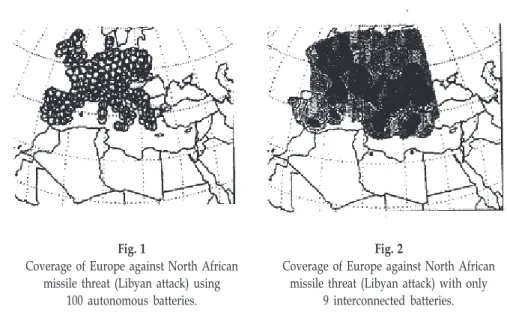
Fig. l and Fig. 2 show the results of a simulation study performed in the United States on how to accomplish population coverage in Europe against ballistic missiles threat. The simulation shows that Europe may need 100 anti-missile batteries to face only two Libyan missile batteries, [Ref. 4]. The NATO allies in south Europe with the exception of Turkey were previously uncomfortable with NATO and US counter-proliferation strategies, preferring political approaches rather than building counter systems. The change of Europe’s attitude regarding this issue would produce a clear split in the Euro-Mediterranean security domain.
Fig. 1
Coverage of Europe against North African missile threat (Libyan attack) using
100 autonomous batteries.
Fig. 2
Coverage of Europe against North African missile threat (Libyan attack) with only
The special case of Israel, as the only country monopolizing nuclear capabilities in the southern and eastern Mediterranean is an important factor fuelling proliferation of other counter weapons in the region. Any suggested Confidence Building Measures in the area of WMD and ballistic missiles in the Mediterranean have to be symmetrical, creating not only obligations on the southern countries but also on the northern ones. In view of the above mentioned remarks the following recommendations are suggested:
• The nuclear countries including the United States should go ahead with the nuclear disarmament process.
• Implementation of a WMDFZ in the Middle East.
• Within the framework of the Euro-Med process, European countries should take effective actions to urge Israel sign the NPT treaty.
• Establishing cooperation agreements in the field of the peaceful use of nuclear energy between the EU and other Mediterranean countries.
To achieve a constrained regime of Ballistic Missiles in the Mediterranean, more global measures should be developed based on:
• Massive reduction of US and Russia arsenal of ballistic missiles.
• A global Ballistic Missile Regime should be studied taking into consideration other related issues like proliferation of missile defences, cruise missiles and sea-born missile systems.
4. The security agenda in the Mediterranean
The security agenda in the Mediterranean comprises “soft” and “hard” security issues. The soft issues are such as: energy security, water, food, environmental degradation, illegal migration and terrorism. On the “hard” security side one can refer to issues such as occupation of territories, the possession and proliferation of Mass Destruction Weapons and ballistic missiles.
4.1 Euro-Med Security Cooperation: Short Term Perspective up to 2010.
• Resolution of existing regional conflicts.
• Signing and implementation of the security Charter. • Maritime cooperation in the Mediterranean such as:
– Prevention of hazardous incidents of military nature at sea. – Cooperation in air and naval search and rescue operations. – Maritime Information Exchange
– Cooperation against terrorism and smuggling at sea – Maritime Environment Protection
– Maritime Peacekeeping Training
– Creation of a Naval Crisis-Prevention Centre.
– Establish the Euro-Mediterranean Maritime Agency (EMMA) to coordinate a cooperative security network in the Sea.
– Institutionalising the nuclear weapon-free status of the Mediterranean Sea. – Limiting proliferation of Sea-borne guided long-range cruise missiles with
conventional or unconventional warheads.
• Establishment of Mediterranean Centre for Strategic Studies. • Joint peacekeeping operations.
• Participation in disaster relief and humanitarian emergency response missions. • Communication “hotline”.
• Euro-Med Early Warming and Centre for Conflict Prevention. • Cooperation in mine action activities.
• Europeans countries should provide more transparency on their military capabilities and intentions regarding circumstances for use of their military forces in the Mediterranean.
• NATO and its three nuclear powers should precise the conditions under which they would threaten or consider the use of nuclear weapons in the Mediterranean.
4.2 Euro-Med Security Cooperation: Long Term Perspective up to 2020.
By the year 2020 the population of the 12 dialogue countries in the South plus Libya will rise from 221 to 328 millions. By the same year, the countries would have exhausted
their oil reserves and have lost their oil income. By the year 2020 the following cooperation initiatives are foreseen, first negotiation of the sub-regional arms control agreements for the Maghreb, and the Middle East, Greece, Turkey and Cyprus and for the Balkans along the CFE model. Second, elimination of all destabilizing weapons systems (e.g. ballistic missiles and military space systems). Third, joint development of Regional seawater Desalination Projects. Fourth, long-term planning to deal with global environmental change, thus dealing with security and survival dilemma.
5. Current Security Cooperation Activities in the Mediterranean
Fortunately, security cooperation between the Euro-Mediterranean countries is not waiting for the Charter. During the 1990s, and even before the Barcelona Declaration, a number of initiatives were developed to establish a new model of North-South relations. Among these initiatives it is possible to recognize the following modes of security cooperation.
5.1 Security Dialogues with European institutions
The WEU Initiative
Since it’s beginning in 1992, WEU’s Mediterranean dialogue has constituted a unique multilateral Euro-Mediterranean exchange in security and military matters. The WEU dialogue partners are the 10 WEU members and associate members plus Algeria, Morocco, Tunisia, Egypt, Israel, Jordan, and Mauritania. The dialogue is based on seven principles: regularity and stability, transparency, confidence-building, conflict prevention, sufficiency of the conventional armed forces, peaceful settlement of conflicts, and the non-proliferation of weapons of mass destruction. Some confidence building measures have been put forward in the frame of the WEU’s dialogue initiative like the organized visit of the Mediterranean Dialogue countries to the Torrejon Satellite Centre and the Planning Cell in Brussel (May 1998).
stability. The dialogue countries are NATO 19 members plus Egypt, Israel, Jordan, Mauritania, Morocco, Tunisia and recently Algeria. Through dialogue and regular exchange of information it is hoped that Mediterranean partners can dispel any misunderstandings and misconceptions that may arise over the activities of NATO. NATO also can get better understanding of some security concerns and perspectives of the dialogue countries. Throughout the dialogue sessions, specific proposals were discussed and it was agreed to hold meeting twice a year with a specific agenda that included issues such as exchange of information and visits of army officers. The NATO-Mediterranean initiative is sometimes criticized in the South by lacking a clear concept of Mediterranean security and being selective by including only seven countries leaving other actors like Syria, Lebanon and Libya. Some also see the NATO initiative as a process to contain the Islamic threat and monitor the possession of WMD and ballistic missiles by the southern Mediterranean states.
Mediterranean Forum for Dialogue and Cooperation
Started in Egypt in 1994 with the participation of France, Greece, Italy, Malta, Portugal, Spain, Algeria, Morocco, Tunisia, and Turkey. This forum continues as a tool for the Barcelona process.
NGOs
A dialogue among security experts from semi-official security institutions is complementing the official dialogue. Examples are: EuroMeSCo and STRADMED networks working in the areas of arms control, confidence building and conflict prevention and funded by the European Commission.
5.2 Peacekeeping operations
Peacekeeping operations are likely to be a major and fruitful area for Euro-Mediterranean cooperation. European countries have played a leading role in promoting peacekeeping activities in various conflicts, and south Mediterranean countries are actively expanding their peacekeeping roles. The contribution of Egyptian, Jordanian and Moroccan soldiers in IFOR and SFOR is clear evidence of the possibilities of North-South cooperation in peacekeeping missions.
5.3 Joint Military Exercises
Two famous examples of “Joint Military Exercises” are now regularly staged in the Mediterranean with the participation of countries from the North and the South:
The “Bright Star” series in which Egypt plays a central role since 1981 is now considered the largest joined exercise outside NATO. Conducted every two years, it presently involves 11 countries: US, Egypt, France, UK, Germany, Italy, Greece, Netherlands, Kuwait, Jordan, and United Arab Emirates. “Bright Star” staged in 1999 included nearly 75 000 troops involved on air, land and sea operations. In addition, certain humanitarian and disaster relief missions are performed, like, for instance, in “Bright Star 97” Egypt and UK had exercised a rescue operation for a large scale earthquake disaster in the city of Alexandria with losses assumed to reach ten thousand inhabitants. The Experience gained was demonstrated during the earthquake tragedy in Turkey, where Egypt and other Mediterranean countries provided help and solidarity.
The other example is the “Cleopatra” naval series started in 1988 with the participation of Egypt and France. Italy has joined the exercises in 1996. It includes joint planning, war games, lectures, debates, and seminars. Missions exercised are terrorism fighting, rescue operations, ship inspection and monitoring. The “Cleopatra” series can be considered as a mini Euro-Mediterranean military cooperation project that can be readily expanded to include other Euro-Med countries or to merge with other defence activities in the area. The last “Cleopatra” exercise was conducted in October 2000.
Bright Star Multilateral Joint Military Exercise Historical Development [Ref. 6]
NO. Date Countries Troops
1 Summer 80 US-Egypt Ground Forces
2 Summer 81 US-Egypt Ground Forces
3 Summer 82 US-Egypt Ground Forces
4 Summer 83 US-Egypt Ground Forces
5 Summer 85 US-Egypt Ground+Air Forces
6 Summer 87 US-Egypt Ground+Air+Naval+Special Forces
7 Autumn 93 US-Egypt Ground+Air+Naval+Special Forces
8 Autumn 95 US-Egypt-Britain-France-UAE Ground+Air+Naval +Special Forces
9 Autumn 97 US-Egypt-Britain-France-UAE- Ground+Air+Naval +Special Forces -Italy-Kuwait
10 Autumn 99 US-Egypt-Britain-France-UAE- Ground+Air+Naval +Special Forces
-Italy-Kuwait-Germany-Greece--Netherlands-Jordan
6. Region in Transition: The Balance Sheet
Despite enormous difficulties and setbacks, the final balance sheet of the security environment in the eastern and southern Mediterranean is encouraging. In the framework of the Arab-Israeli conflict, Israel has signed two peace agreements; one with Egypt and the other with Jordan. Mauritania became in October 1999 the third Arabic country that has full diplomatic relations with Israel. The Israeli-Syrian negotiations have been resumed in December 1999 with hopes to reach an agreement. Although agreement has not been attained, the two sides were likely able to cross the difficulties in most of the sensitive issues including settlements, security arrangements and water. The complete withdrawal of Israel from the Golan Heights to the borders of 4 June 1967 including the northeast shores of Lake Tiberias still represents an obstacle.
On 24 of May 2000, Israel unilaterally ended its occupation of South Lebanon without negative security implications in the area. The United Nations supervised the
implementation of the Security Council Resolution 425 and carried out the demarcation of the borders between Israel and Lebanon.
On the Israeli-Palestinian track, despite the tragic development erupted in September 2000, the situation on the ground presents a number of achievements. 42% of the West Bank and 85% of the Gaza strip are now under the control of the Palestinian Authority. A safe passage between Gaza and the West Bank was in operation. The Gaza International Airport has been inaugurated and opened for the international air traffic, while Gaza Seaport is currently under construction. More than 200 thousands Palestinians are allowed to return back to the territories under the Palestinian Authority meanwhile, the Palestinian National Council cancelled all articles of the Palestinian National Charter calling for the destruction of Israel, in April 22, 1996.
The North African (Maghreb) countries (Mauritania, Morocco, Algeria, Tunisia, and Libya) are not far from the political interactions taking place in the East Mediterranean. Morocco was a member of the international alliance against Iraq during the Gulf War 1991. The five Maghreb countries, with the rest of the other Arab countries (except Oman and Sudan) cut their diplomatic relations with Egypt after the Camp David Treaty. The Arab League General Secretariat had been transferred from Cairo to Tunisia. Tunisia also hosted the Palestinian Liberation Organization headquarters after the invasion of Lebanon by Israel and the eruption of the civil war in Lebanon. Most of the Maghreb countries (like Morocco, Algeria and Libya) had participated – at least symbolically – in most of the Arab-Israeli Wars. One million demonstrators in Rabat have recently protested Sharon’s visit to East Jerusalem and the subsequent Israeli suppressive actions against the Palestinians.
The political and security environment in North Africa has considerably improved during the last three years. The United Nations accepted the proposal made by the Arab League and Libya that the two suspects of the Pan-Am plane bomb attack over Lockerbie should be handed over to a third country and judged by a Scottish court under Scottish law (Security Council resolution 1192 of August 27, 1999). Libya is returning from isolation with different political profile trying to play a diplomatic conflict resolution role in Africa. The recent declarations of the Libyan leader Colonel Kaddafy to the press carry a conciliatory tone towards the West. Yet, accepting Libya as a full member in the Barcelona process and the Euro-Mediterranean Partnership is still facing problems.
towards Europe and the United States. This was clear in the naval joint exercises between Algeria and the United States in 7 May 2000, and with France in 30 May 2000. It was the first visit of a French battle ship to the Algerian shores since 1989. Bouteflika is trying to bring back Algeria to the main stream of events in the Mediterranean. His historic handshaking with the Israeli Prime Minister Ehud Barak during the funeral of the Moroccan king Hassan II in 25 of June 1999 and his recent visit to Paris in June 2000 are two examples.
The same conciliatory trend can be observed in Morocco under the leadership of the new King Mohamed XI. During his visit to Algeria in 29 April 2000, the Moroccan minister of foreign affairs had agreed with his Algerian counterpart to handle their bilateral security problems, and to remove causes of disputes and disagreements between them. An agreement was also reached with the European Union adopting new formula for cooperation in the area of fishing at Sea. The process of the Western Sahara continues in its unsteady course for the implementation of the United Nations Settlement Plan.
Although there is no diplomatic relations between Morocco and Israel, the two countries were working out before the recent developments in the Middle East to normalise their mutual relations. On 16 May 2000 an Israeli businessmen delegation has visited Morocco to foster the commercial, economic and cultural relations and to inaugurate an Internet site for enhancing the relations and contact between the youth of the two countries.
7. Mediterranean Cooperation in crisis: Redefining priorities
Despite the impressive European and American efforts for enhancing cooperation in the Mediterranean and the Middle East, the record remains insufficient in seriously influencing the Arab-Israeli peace process. In fact the deterioration in the peace process affects negatively the Barcelona initiative as previously seen during the ministerial meeting in Malta 1997 and in Marseille November 2000 when the participant fail to reach agreement on a multiplicity of issues. The shocking divergences in the process from common search for peace to mutual violence and even war between the Israelis and the Palestinians means simply the failure of the peace making logic and the loss of the crisis management credibility. The collapse of these pillars will certainly endanger the real core of the Mediterranean project as dreamed by its member states; a region of peace, stability and cooperation not an area of terrorism, war fighting and weapons proliferation.
Redefining priorities seems mandatory to bridge the current crisis and save peace. Europe and the United States must unite to reach a solution. What is needed from Europe is constructive response to Middle East security concerns. The Western interests in the Middle East will continue in the 21st century since the world oil demand is forecasted to continue rising in the future. The southern Mediterranean is undergoing a painful process of transformation that breed’s violence and disintegration and the results will not be confined to the southern region. The events in the Middle East and North Africa have always a spill over impact in the North of the Mediterranean.
Europe should reach a strategic understanding with the United States regarding the Middle East as the case with Eastern Europe and ex-USSR bloc. The purpose of this strategic understanding should be the faithful implementation of the agreements that was mediated and approved by both Europe and the United States.
As concluding remarks I would stress the Europe and the US should then launch an initiative which would include, first the immediate resumption of negotiation for the permanent resolution of the Palestinian question on the reference basis of the Madrid Peace Conference and the UN resolutions. Second, a faithful implementation of the Oslo accords. Third, a moratorium on all settlement activities. Fourth, the immediate resumption of negotiation in the Syrian and Lebanese tracks from the last point that was reached. Fifht, the final goal of negotiations must be based on the total Israeli withdrawal from the occupied Arab territories in exchange for total peace between Israel and Arab countries. Sixth, the resumption of the multilateral negotiations in all their aspects including freeing the Middle East from Weapons of Mass Destruction. Finaly the activation of a regional mechanism to face violence by both sides. Violence should not have a veto power over negotiations.
References
Roberto Aliboni, ed, “Building Blocks for the Euro-Med Charter on Peace and Stability” Report by the EuroMeSCo Working Group on the Euro-Med Charter for Peace and
M. Kadry Said, “Military Confidence Building Measures in the Euro-Mediterranean Region: View from the South”, Fondation Mediterraneenne d’Étude Strategique FMES, DAS Research Paper, Dec. 2000.
Jone L. Dyer, Feature of cover battalion for Wide Area defence of Population”, in Theatre Missile defence: Systems and Issues, (AIAA 1993), p.180.
Camille Grand, “The European Union and the Non-Proliferation Weapons”, Institute for Security Studies, Chaillot Papers No. 37, January 2000.
M. Kadry Said, “How Egypt Thinks Mediterranean? – Joint military exercises and regional security cooperation”, West European Union, Occasional Paper No. 14, March 2000. Hans Gunter Brauch, Antonio Marquina and Abdelwahab Biad, “Euro-Mediterranean Partnership for the 21st Century”, Macmillan Press LTD, 2000.