Building with sugar and corn
Jorge Pinto1, Anabela Paiva2, Ana Costa1, Pedro Tavares1, Lisete Fernandes1, António Murta1, Humberto Varum3
1 University of Trás-os-Montes e Alto Douro, Portugal 2 C-MADE, University of Beira Interior, Portugal
3 University of Aveiro, Portugal
{tiago, apaiva, anacosta, ptavares, ume}@utad.pt, [email protected], [email protected]
Abstract. Two alternative and highly sustainable building techniques are
presented and described. The techniques are sugar reinforcement of earth based material and corncob based thermal isolation material. Some experimental results highlight the advantages and disadvantages of these two proposed techniques whose study is still beginning. The water resistance of earth based materials may be increased by adding a certain amount of sugar. On the other hand, corn cob material may have a similar thermal behavior as the common thermal insulation materials currently used in the building industry.
Keywords: Earth-based materials, performance, sugars, corn, biomimetic.
1 Introduction
The climate changes issue is probably one of the most top priority concerns worldwide. Rigid and drastic measures have to be taken by all nations in order to reduce the noxious gases emission to the atmosphere. This ambitious goal can be achieved by ruling the energy production, having a much more sustainable industry and adopting a much more sustainable way of living by all of us. The building industry has also to adapt to these circumstances to make its contribution to achieve the above goal. Focusing on sustainable urban planning, sustainable building techniques, finding new ways of achieving high levels of comfort combined with the rational use of energy and respecting the drinkable water are part of the solution of this problem.
Sustainable construction can be divided into four main areas such as sustainable urban planning, sustainable building construction, efficient energy use and efficient water management. A sustainable urban planning model should be based on resources, energy and space limitations rules [1], [2]. Natural and local based building materials (i.e. stone, timber, earth, among others) are sustainable because they are abundant and, generally, they are related to building techniques that require an inexpressive amount of energy consumption and also have an inexpressive amount of CO2 emissions [3]. The development of a sustainable building technique may be
inspired on the traditional ones [4]. The search for quality in construction, and the increasing importance of environmental constraints, leads to the need to define sustainable building design alternatives, which must satisfy the need for high levels of comfort combined with the rational use of energy. In order to assure that new buildings will be examples of sustainable design alternatives, it is important to take into account that their thermal quality is strongly related with their energy consumption [5]. Several actions could be taken into account, namely the definition of an efficient orientation of the building, reduction of the glazed areas and a proper definition of their shading elements, increment of the insulation of the envelope (walls, roofs, floors and glazed areas) and an efficient use of the equipments and lightning. These solutions lead to the reduction of the energy consumption for heating and cooling of the building and the emissions of CO2. In the hydraulic field, the attention should be focused on saving the drinkable water, saving rain water processes [6] and wastewater (i.e. grey water) treatment processes for reuse purposes [7].
This paper intends to make a contribution to the areas of sustainable building construction and efficient energy use by introducing and proposing two innovative clean building techniques that can be applied in the earth building context and because an expressive amount of the world’s population approximately, three billion people on six continents, lives or works in buildings constructed of earth. In the third world countries almost half of the existing buildings are made of earth.
The earth construction is a worldwide heritage that reflects the existing cultural diversity of people. Examples of ancient earth constructions are the China Wall (2000 B.C.) and the Arge Bam city in Iran (500 B.C.). This impressive earth heritage also reveals that earth construction can have a considerable sustained durability. In contrast, cutting edge modern earth constructions, such as the Adobe Repository for Buda Statue in Japan (2001 A.D.) and the Desert Cultural Centre in Canada (2006 A.D.), prove that earth based building materials are nowadays in demand. Earth has been used in recent years in the construction of dams in many countries.
Redefining educational curricula to address sustainability issues is something that must occur at all levels of formal education, particularly in what regards the construction mega-sector. Earth based building materials are sustainable, on one hand because earth is natural, recyclable and abundant anywhere in the world, and on the other hand because the techniques used to manufacture these materials are usually simple, requiring an inexpressive amount of energy consumption and also having an inexpressive amount of CO2 emissions associated. The building materials and the building techniques related to earth construction have been developed constantly, the emerging quincha metálica technique which intends to replace a traditional timber structure system by a metallic one keeping the traditional earth covering of the system is just one example [8].
The two innovative clean building techniques that can be applied in the earth building context and that are presented here are sugar reinforcement and corn based thermal isolation material of earth based material techniques.
This paper is structured as follows Firstly, a brief description of the traditional Portuguese earth based material techniques is done. Secondly, the recent and more relevant experimental results obtained in the research project of sugar reinforcement of earth based materials technique are delivered and commented. Thirdly, an explanation of the motivation of the study of the corn cob based thermal isolation
material technique is given and some results are presented. Finally, the main conclusions are drawn.
2 Traditional Portuguese earth based material techniques
In Portugal the most expressive traditional building techniques that use earth based materials are the adobe, the taipa and the tabique. A taipa building component (i.e. a wall) is an earth based monolithic element (Figure 1.a), an adobe building component is an earth based block masonry (Figure 1.b), a tabique building component is made of an internal timber structural system covered on both sides by an earth based mortar (Figure 1.c). a) Taipa (http://4.bp.blogspot.com) b) Adobe (www.arquitecturasdeterra.blogspot.com) c) Tabique (http://arquitecturadouro.blogspot.com) Fig. 1. The most relevant traditional Portuguese building techniques that use earth based
materials.
Recent scientific studies have concluded that an impressive amount of these building heritage are facing ruin and require urgent conservation actions [9], [10], [11]. However, it is recognized that there is still a lack of scientific knowledge that can support the rehabilitation of these constructions.
3 Sugar reinforcement of earth based materials technique
Biomimetics has been applied in several fields of science. In the medicine field, for instance, a bioartificial kidney has been developed. In civil engineering applications, an active prestressing technique has been proposed and developed based on the functioning of the human biceps [12].
Meanwhile, a biomimetic research study has been using the andorinha dos beirais (swallow) bird`s nest as a natural earth structure as a model [13]. A finite element analysis of this structure has indicated that it works basically under normal stresses compression. Scanning electron microscopy/energy dispersive spectroscopy
(SEM/EDS) and X-ray tests have shown that the chemical and mineralogical compositions of the nest materials are similar to the local clay. Colorimetric tests have shown that there is not an expressive amount of organic proteins component in the nest material. On the other hand, this test allowed to conclude that there is a strong possibility that the andorinha-dos-beirais bird adds a certain amount of organic polysaccharides/sugars components into the material used during the building process of the nest. The process followed for the identification of the polysaccharide/sugar type present in the nest material turned out to be very complex. This identification was done through the chromatography ion test. The obtained results indicate that the glucose may be the polysaccharide/sugar naturally added by the
andorinha-dos-beirais bird.
Following the above research work this research intends to propose an alternative sustainable building technique solution based on adding domestic sugar into the earth based materials as an organic cement and in order to increase the material`s properties. At this stage, the option of using domestic sugar relies on the simplicity purpose. In future research we intend to use fruits or plants which are rich in glucose and do not clash with the food stock chain.
An exhaustive experimental work has been developed in order to analyze the effect of the addition of different amounts of sugar percentage in earth based samples. Compression, flexion, fire resistance, SEM/EDS, X-ray and capillarity tests are some of the experimental procedures that have been used to verify the advantages of the influence of this organic additive. In this paper and for the sake of simplicity only some of the experimental results will be presented.
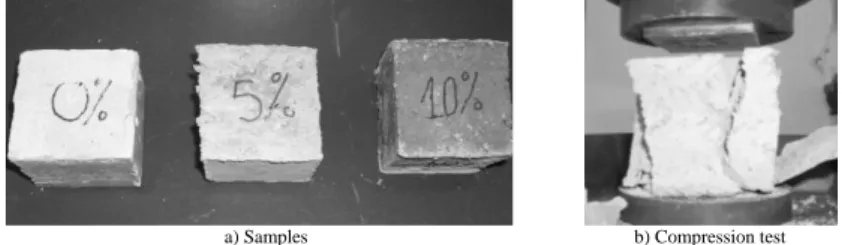
Samples of different mixtures of clay with sugar were made. Three different percentages of sugar (0%, 5% and 10%) were used, Figure 2.a. Four samples of each mixture (after 28 days) were tested in compression (Figure 2.b).
a) Samples b) Compression test
Fig. 2. Samples and compression test.
The results of the compression test are presented in Figure 3 where it is evident that the compression strength capacity decreases when the amount of sugar used in the mixture increases. These results contradict the previously ones obtained in [13]. There are some remarks that should be underlined related to these samples which are: sugar must be an impressive setting retarder which is featured in Figure 2.a by the evident color differences of the sample at the age of 28 days; the surface of the samples were not totally flat (Figure 2.a).
The SEM/EDS and X-ray tests indicate that there is no difference among the samples (0, 5 and 10 sugar percentages) in terms of elementary chemical and
mineralogical compositions. These results are complemented by the images of Figure 4. These results also contrast with the ones delivered in [13].
Fig. 3. Results of the compression tests.
a) 0% of sugar b) 5% of sugar c) 10% of sugar
500 µm 500 µm 500 µm
Fig. 4. Amplified images of the samples.
a) 0% of sugar b) 5% of sugar c) 10% of sugar
Fig. 5. Capillarity test.
The results of the capillarity tests, Figure 5, suggest that the water resistance behavior of the earth based materials may increase with the addition of a certain amount of sugar. After 48 hours, the 0% sugar content samples are completely saturated and already lost their material integrity. The 5% sugar content samples are half saturated and the material degradation occurred at the bottom of the samples. On the other hand, the 10% sugar content samples behaved quite well with the presence of water because they were one third saturated and, after 48 hours, the material deterioration was confined to the very bottom of the samples. These experimental results are very promising because one of the vulnerabilities of the earth based buildings is their weakness to water.
4 Corn based thermal isolation material
As it was stated above, the most popular traditional Portuguese building techniques that use earth as a building material are taipa, adobe and tabique.
A tabique element, such as a wall, is formed by a timber structure covered on both sides by an earth-based mortar plaster layer, Figure 1.c. The incidence of the tabique technique is more expressive in the north of Portugal and, in particular, in the Trás-os-Montes e Alto Douro region which is the northeast part [4].
Taking into account that the traditional technical knowledge has been lost, there is still a lack of scientific studies on this subject for the aforementioned region and that traditional tabique constructions show generally an advanced stage of deterioration an intense research work has been carried out intending to guide and support future conservation and rehabilitation works.
It has been found that the most common use of tabique technique was in interior partition walls, but can also be found in exterior façade walls. The most common solution of the existing tabique constructions are dwellings of two floors. Generally, these constructions show an advanced stage of deterioration, which can dangerously progress till the total collapse. From the research done on the selected representative constructions, it was concluded that the most common materials used are the pinus pinaster for the timber structural elements and earth for the mortars covering the timber structure. These materials are 100% natural and local which classify this type of construction as a sustainable reference model.
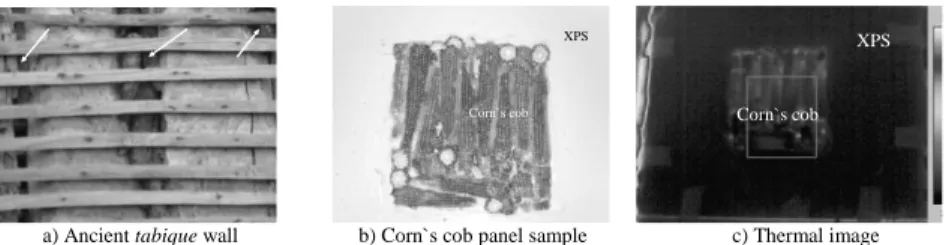
Recent research work has discovered that there are a few examples of ancient building presenting an advanced stage of deterioration that use corn cob in the gap of the vertical timber elements of the exterior tabique walls, Figure 6.a. This is a very unusual Portuguese thermal isolation solution and consequently, this discovery has inspired an additional research work that intends to use the corn cob material as a thermal isolation material in earth based material.
Meanwhile, after inquiring the aged people of the area where these building were discovered it was noticed that, in the past, the corn cob was an agriculture waste which had to be burnt and the resulting ashes were used as an organic composite to fertilize the agriculture fields. Using the corn cob as a possible building material in the building industry means simultaneously reusing a waste material and transforming an industry into a more sustainable one. Other research works have recently approached this context such as [14], [15], [16] and [17].
An exhaustive field survey was done in order to get all the data required to understand the building technique associated with the corn cob wall. This data has to be well documented and registered before those buildings disappear. The physical, chemical and microstructure of the corn cob have been experimentally identified/characterized by using SEM/EDS tests. These properties have been compared with the most common thermal isolation building materials used in the Portuguese building industry.
A corn cob panel sample was fabricated using as molding an extruded polystyrene (XPS) panel, Figure 6.b. XPS is the most common used thermal insulation material in the Portuguese building industry context. This model was tested in terms of thermal behavior and using thermography. Figure 6.c shows a thermal image which indicates that the corn cob may have a similar thermal behavior as the XPS.
a) Ancient tabique wall b) Corn`s cob panel sample c) Thermal image
Corn`s cob
XPS
Corn`s cob XPS
Fig. 6. Ancient tabique wall and some stages of the thermal test of the corn`s cob sample.
5 Main conclusions
Traditional buildings may be real reference models for modern sustainable solutions studies.
Two possible clean building techniques were presented which are: sugar reinforcement of earth based materials and corn cob based thermal isolation material. They use basically organic products and are highly sustainable. They were inspired by nature and by ancient knowledge respectively.
Experimental results have shown that the domestic sugar may decrease the mechanical properties of the earth based material, in particular the compression strength. In contrast, they suggest that the water resistance behavior of the earth based material may increase.
An ancient Portuguese building technique which reuses an agriculture waste was introduced.
A thermal expedite experimental methodology was presented which allowed to verify that the thermal insulation of a simple corn cob panel may be similar to the most common thermal insulation solutions applied in Portugal.
Authors strongly believe that these two building techniques may inspire other researchers and colleagues from the industry to find out new cutting edge modern building techniques and materials more accessible to all in terms of economic aspects and much more environmental friendly which can highly contribute for a better sustainable world.
References
1. Ropero, F., Ramos, L., Álvarez, E.: Desenvolvimento Sustentável do Eixo Atlântico 2013. ISBN: 978-84-691-4197-7, Bilioteca dos Estudos Estratégicos (2008)
2. ISOCARP REVIEW 05: Low Carbon Cities. ISBN: 978-94-90354-04-6 (2009)
3. Murta, A., Teixeira, C., Varum, H., Bentes, I., Pinto, J.: Estudo do ganho energético associado à construção de uma habitação unifamiliar com recurso a materiais naturais no contexto português. In: VIII Seminario Iberoamericano de Construcción com Tierra (VIII SIACOT). Editor: CRIATIAC-FAU-UNT. Tucumán, Argentina (2009)
4. Pinto, J., Varum, H., Cruz, D., Sousa, D., Morais, P., Tavares, P., Lousada, J., Silva, P., Vieira, J.: Tabique Construction Characterization in Douro North Valley, Portugal: A First Step to Preserve this Architectural Heritage. In: 2nd WSEAS International Conference on
Urban Rehabilitation and Sustainability (URES'09), pp. 48--53. Edited by WSEAS Press, Editors: Manoj Jha, Charles Long, Nikos Mastorakis, Cornelia Aida Bulucea, ISBN 978-960-474-136-6, ISSN 1790-5095. Baltimore, USA (2009)
5. Pereira, S., Paiva, A.: Evaluation of the Thermal Behaviour of Dwellings - sustainable construction. In: XXXIV IAHS, Sustainable Housing Design: emphasizing urban housing. Naples, Italy (2006)
6. Pereira, L., Matos, C., Bentes, I.: Viabilidade económica de um aproveitamento de água pluvial. In: 10º Congresso da Água. Alvor, Portugal (2010)
7. Matos, C., Sampaio, A., Bentes, I.: Potencialidades de utilização da água cinzenta em fins urbanos não potáveis in situ. In: 10º Congresso da Água. Alvor, Portugal (2010)
8. Cortés M.: “Innovación tecnológica de construcción en tierra, posibilidades en la arquitectura contemporánea”. In: VIII Seminario Iberoamericano de Construcción con Tierra (VIII SIACOT). Ed: CRIATIC-FAU-UNT, Argentina (2009)
9. Cepeda, A., Murta, A., Lousada, J., Vieira, J., Pinto, J., Fernandes, L., Tavares, P., Silva, P., Varum, H.: Tabique construction in Alto Tâmega. In: 1st International Conference on
Structures and Architecture (ICSA2010), pp. 397--398. Ed. Paulo Cruz, CRC Press, Taylor & Francis Group. London, ISBN 978-0-415-49249-2 (2010)
10. Pinto, J., Varum, H., Cruz, D., Sousa, D., Morais, P., Tavares, P., Lousada, J., Silva, P., Vieira, J.: Characterization of Traditional Tabique Constructions in Douro North Valley Region. Journal WSEAS Transactions on Environment and Development, 6, Issue 2, 105--114 (2010)
11. Silveira, D., Varum, H., Costa, A.: Rehabilitation of an important cultural and architectural heritage: the traditional adobe constructions in Aveiro district. In: A. Kungolas, C.A. Brebbia, E. Beriatos (eds.), Sustainable Development III, ISBN: 978-1-84564-103-0, pp. 705--714, WITPress (2007)
12. André, A., Pacheco, P., Fonseca, A.: Pré-esforço orgânico - Estudos sobre a aplicação de uma nova tecnologia. In: V Simpósio EPUSP sobre estruturas de concreto. São Paulo, Brazil (2003)
13. Silva, B., Correia, J., Nunes, F., Tavares, P., Varum, H., Pinto, J.: Bird Nest Construction: Lessons for Building with Earth. Journal WSEAS Transactions on Environment and Development, 6, Issue 2, 95--104 (2010)
14. Changa, K.F., Choub, P.C.: Measuring the influence of the greening design of the building environment on the urban real estate market in Taiwan. Build. Environ. 45, Issue 10, 2057--2067 (2010)
15. Lertsutthiwong, P., Khunthon, S., Siralertmukul, K., Noomun, K., Chandrkrachang, S.: New insulating particleboards prepared from mixture of solid wastes from tissue paper manufacturing and corn peel. Bioresource Technology 99, 4841--4845 (2008)
16. Khedari, J., Nankongnab, N., Teekasap, S.: New low-cost insulation particleboards from mixture of durian peel and coconut coir. Build. Environ. 39, 59--65 (2004)
17. Panyakaew, S., Fotios, S.: Agricultural waste materials as thermal insulation for dwellings in Thailand: Preliminary results. In: PLEA 2008, 25th Conference on Passive and Low